In a world saturated with digital noise, one-size-fits-all marketing campaigns are no longer effective. The key to capturing attention, fostering loyalty, and driving revenue lies in understanding that your customer base is not a monolith but a collection of distinct groups with unique needs, behaviors, and motivations. This is where the power of customer segmentation techniques comes into play. By strategically dividing your audience into smaller, more manageable segments, you can tailor your messaging, products, and services for maximum impact.
This approach allows for a level of precision that generic campaigns simply cannot match. Instead of broadcasting a single message to everyone, you can speak directly to the specific pain points of a high-value customer group or nurture a new audience segment with a customized onboarding experience. Understanding the necessity of precision marketing is the first step; learning practical applications like how to segment email lists effectively can unlock significant growth by ensuring your communications resonate with the right people at the right time.
This guide moves beyond theory to provide a practical, comprehensive roundup of essential segmentation methods. We will explore 11 powerful techniques, from foundational demographic and geographic approaches to more advanced models like RFM and value-based segmentation. For each method, you will find a clear breakdown of what it is, why it matters, and how to implement it, complete with actionable tips and real-world examples. Prepare to transform your customer data from a passive asset into your most powerful tool for strategic growth and competitive advantage.
1. Demographic Segmentation: The Foundational Layer
Demographic segmentation is one of the most classic and widely used customer segmentation techniques, dividing a market into smaller categories based on quantifiable, personal attributes. This method groups customers by variables such as age, gender, income, education level, occupation, marital status, and family size. Because this data is often straightforward to collect through surveys, public records, or analytics platforms, it serves as a fundamental and accessible starting point for nearly any marketing strategy.

How It Works and Why It's Effective
This approach works by linking specific consumer needs and purchasing behaviors to their demographic profiles. For instance, a brand like Gerber directly targets new parents of infants and toddlers, while AARP focuses on the distinct needs of adults aged 50 and over with services like retirement planning and insurance. The primary benefit is its simplicity and clarity; it allows you to create broad, yet relevant, marketing campaigns that resonate with large, easily identifiable groups.
Actionable Tips for Implementation
To get the most out of demographic data, consider these strategies:
- Combine and Conquer: Don't rely solely on demographics. Enhance your understanding by layering this data with psychographic (lifestyle, values) or behavioral (purchase history) information for a more nuanced and powerful segmentation model.
- Go Beyond Stereotypes: Always test your assumptions. For example, instead of assuming all high-income earners want luxury goods, validate this with A/B testing or survey data.
- Stay Current: Demographics are not static. Regularly update your customer data to reflect changes in their life stages, income, or family structure to keep your marketing relevant.
- Focus on Generational Cohorts: Segmenting by generations like Gen Z, Millennials, or Baby Boomers provides cultural context and insight into shared experiences, communication preferences, and values that a simple age range might miss.
2. Psychographic Segmentation: Understanding the "Why"
Psychographic segmentation moves beyond the "who" (demographics) to understand the "why" behind consumer choices. This is one of the more sophisticated customer segmentation techniques, categorizing audiences based on psychological attributes like lifestyle, values, interests, attitudes, and personality traits. It groups customers by their aspirations, motivations, and the beliefs that guide their decisions, allowing brands to connect on a much deeper, more emotional level.

How It Works and Why It's Effective
This method works by aligning a brand’s message and values with the intrinsic motivations of its customers. For example, Patagonia targets consumers who value sustainability and outdoor adventure, not just people in a certain income bracket. Similarly, Apple appeals to innovators and creatives who prioritize design and self-expression. The power of this approach lies in building brand loyalty; when a customer feels a brand reflects their personal identity and values, they become advocates, not just purchasers. It helps you identify your target audience on a more meaningful level.
Actionable Tips for Implementation
To effectively implement psychographic segmentation, consider these strategies:
- Gather Rich Data: Use surveys, in-depth interviews, and focus groups with open-ended questions about hobbies, values, and life goals. Analyze social media conversations and online forums to uncover genuine interests.
- Leverage Existing Frameworks: Consider using established models like the VALS (Values and Lifestyles) framework to systematically categorize your audience into defined psychographic groups.
- Build Detailed Personas: Go beyond basic profiles by creating rich customer personas that embody the attitudes, motivations, and pain points of each segment. This brings your data to life for your marketing team.
- Tailor Content and Messaging: Create marketing campaigns that speak directly to the values of each segment. A group motivated by security will respond to different messaging than a group motivated by freedom and adventure.
3. Behavioral Segmentation: Understanding Customer Actions
While demographics tell you who your customers are, behavioral segmentation tells you how they act. This is one of the most powerful customer segmentation techniques because it groups customers based on their direct interactions with your brand, such as their purchase history, product usage patterns, engagement levels, and brand loyalty. By analyzing what customers do, businesses can move beyond assumptions and create highly relevant, timely marketing interventions that align with observed behaviors.
How It Works and Why It's Effective
This method works by tracking user actions to predict future needs and identify opportunities. For instance, Amazon's recommendation engine analyzes browsing history and past purchases to suggest products you’re likely to buy. Similarly, Spotify creates personalized playlists like "Discover Weekly" by segmenting users based on their listening habits and genre preferences. The core benefit is its direct relevance; you are tailoring your communication based on a user’s proven interests and actions, making messages feel personal and timely. For an in-depth exploration of this crucial technique, refer to this complete guide to behavioral segmentation.
Actionable Tips for Implementation
To effectively leverage behavioral data, focus on these strategies:
- Implement RFM Analysis: Use Recency, Frequency, and Monetary (RFM) analysis to identify your most valuable customers. This helps you prioritize marketing efforts on high-impact segments.
- Use Behavioral Triggers: Set up automated marketing messages based on specific actions. For example, send a follow-up email with a discount to users who abandon their shopping carts or offer a tutorial to someone who just started using a new feature. These triggered actions are a cornerstone of effective marketing automation workflows.
- Track Micro-Conversions: Don't just focus on the final sale. Monitor smaller engagement metrics like newsletter sign-ups, video views, or content downloads to understand the entire customer journey and nurture leads more effectively.
- Identify Power Users: Create a segment for your most loyal customers or "power users." Reward them with exclusive access, VIP treatment, or referral programs to turn them into brand advocates.
4. Geographic Segmentation: Localizing Your Strategy
Geographic segmentation is a powerful customer segmentation technique that divides a market based on physical location. This method groups potential customers by variables like country, state, city, climate, or population density. The core principle is that consumer needs, preferences, and purchasing habits often differ significantly from one location to another due to cultural norms, economic conditions, and even the weather. This approach is essential for businesses with physical storefronts or those whose products are sensitive to regional tastes.
How It Works and Why It's Effective
This strategy works by tailoring products, services, and marketing messages to the specific characteristics of a geographic area. For example, a fast-food chain like McDonald's adapts its menu to local palates, offering the McSpicy Paneer Burger in India and the Teriyaki McBurger in Japan. Similarly, The Home Depot stocks snow blowers in its northern U.S. stores while prioritizing hurricane supplies in coastal Florida. The effectiveness lies in its relevance; by addressing the specific needs and context of a location, companies can significantly increase engagement and sales.
Actionable Tips for Implementation
To implement geographic segmentation effectively, consider these tactics:
- Leverage GIS Technology: Use Geographic Information System (GIS) tools to map and analyze customer data visually. This can reveal spatial patterns and high-concentration areas you might otherwise miss.
- Combine with Other Data: Enhance geographic insights by layering them with demographic or behavioral data. Knowing that a specific zip code has a high density of young families allows for much more targeted messaging.
- Think Micro and Macro: Don't just segment by country or state. Consider micro-segmentation at the city or even neighborhood level, especially for urban markets with diverse populations.
- Test Regional Variations: Before a full-scale launch, pilot new products or marketing campaigns in a specific region to gauge local response and refine your approach based on real-world data.
- Use Location-Based Marketing: Implement geofencing to send targeted mobile promotions to customers when they enter a specific geographic area, such as the vicinity of your store.
5. Firmographic Segmentation (B2B): The Business Blueprint
Firmographic segmentation is the business-to-business (B2B) equivalent of demographic segmentation. This is one of the most critical customer segmentation techniques for any B2B company, as it divides organizations into groups based on shared, quantifiable company characteristics. Key variables include industry, company size, annual revenue, geographic location, number of employees, and growth stage. By organizing the market this way, B2B marketers can identify their most valuable prospects and tailor their outreach, products, and messaging to meet specific organizational needs.
How It Works and Why It's Effective
This approach operates on the principle that companies with similar firmographic profiles often share similar challenges, purchasing power, and needs. For example, QuickBooks primarily targets small businesses with simplified accounting software, while Oracle focuses on large enterprises with complex, scalable solutions. Similarly, Salesforce offers different CRM packages tiered by company size and complexity. The effectiveness lies in its ability to create highly targeted and efficient marketing campaigns, ensuring that sales efforts are focused on accounts that are the best fit for the product or service.
Actionable Tips for Implementation
To implement firmographic segmentation effectively, consider these strategies:
- Build an Ideal Customer Profile (ICP): Analyze your best current customers to identify common firmographic traits. Use this data to build a detailed ICP that guides your targeting efforts.
- Leverage Business Intelligence Tools: Use platforms like LinkedIn Sales Navigator, ZoomInfo, or Dun & Bradstreet to gather accurate firmographic data and identify new prospects that fit your ICP.
- Combine with Technographics: Enhance your segments by adding technographic data, which reveals the technologies a company currently uses. This can signal compatibility, competitive opportunities, or integration needs.
- Track Buying Signals: Monitor firmographic changes like recent funding rounds, new office openings, or executive hires. These events often indicate a new need and a prime opportunity to engage. This is a key part of an effective B2B lead generation strategy.
6. Technographic Segmentation: The Digital Footprint
Technographic segmentation is one of the more modern customer segmentation techniques, categorizing customers based on their technology usage and preferences. This includes the hardware, software, platforms, and tools they use, as well as their digital sophistication. For B2B companies, SaaS providers, and any business with a digital product, this approach reveals crucial insights into compatibility, integration opportunities, and a customer's readiness to adopt new solutions.
How It Works and Why It's Effective
This method works by aligning your product or service with a prospect's existing technology stack. For example, a company like Slack can identify businesses still using legacy communication tools and target them with campaigns focused on modernizing collaboration. Similarly, Adobe can segment users by their current software usage (like having Photoshop but not Premiere Pro) to create highly relevant upsell offers for its Creative Cloud suite. The core benefit is precision; it allows you to craft messages that speak directly to a user’s technical environment and pain points.
Actionable Tips for Implementation
To effectively integrate technographic data into your strategy, consider these tips:
- Leverage Data Providers: Use specialized tools like BuiltWith, Datanyze, or Clearbit Reveal to automatically gather technographic data on your prospects and customers, saving significant manual research time.
- Create Migration Paths: If a segment uses a competitor's product, develop targeted campaigns that highlight your superior features and offer a seamless migration or integration process to win them over.
- Segment by Sophistication: Group users by their technical skill level. A power user will respond to messaging about advanced features and APIs, while a novice requires content focused on ease of use and support.
- Use Technographic Triggers: Set up alerts for when a target company adopts a new technology. This change can signal a new opportunity, a shift in budget, or a pain point that you can solve with timely outreach.
7. Value-Based Segmentation: Prioritizing Your Most Profitable Customers
Value-based segmentation is one of the more strategic customer segmentation techniques, shifting the focus from who the customers are to what their economic value is to the business. This method categorizes customers based on their profitability, typically measured by Customer Lifetime Value (CLV), purchase frequency, average order value, and revenue potential. It enables companies to allocate resources more efficiently, focusing marketing efforts and premium service on their most valuable customer segments.
How It Works and Why It's Effective
This approach works by identifying the small percentage of customers who often drive a large percentage of revenue. For example, airlines reward their most profitable flyers with tiered loyalty programs (e.g., Silver, Gold, Platinum), offering exclusive benefits like upgrades and lounge access. Similarly, a SaaS company might provide white-glove onboarding and a dedicated success manager only to its high-value enterprise clients. The effectiveness lies in its direct link to ROI; by investing more in retaining and nurturing high-value customers, businesses can maximize profitability and sustainable growth.
Actionable Tips for Implementation
To implement value-based segmentation effectively, consider these strategies:
- Calculate Customer Lifetime Value (CLV): Use historical purchase data, retention rates, and profit margins to calculate the CLV for each customer. This provides a clear, data-driven foundation for your segments.
- Create Tiered Programs: Design distinct customer tiers (e.g., VIP, standard, basic) with clear, escalating benefits. This not only rewards your best customers but also incentivizes lower-value customers to increase their spending.
- Identify High-Potential Customers: Don't just focus on current high-value customers. Analyze data to find segments with high potential but currently low value, and create targeted campaigns to nurture their growth.
- Invest in High-Value Retention: Allocate a larger portion of your retention budget to your top-tier customers. Personalized offers, proactive customer service, and exclusive access can significantly reduce churn in this critical group.
8. Needs-Based Segmentation: Solving Customer Problems
Needs-based segmentation is a powerful approach that groups customers according to the specific functional, emotional, or social needs they are trying to fulfill. Instead of focusing on who the customer is (demographics) or what they do (behavior), this method delves into the why behind their choices. This is one of the most effective customer segmentation techniques for driving innovation because it directly links product development and marketing to solving real-world customer problems.
How It Works and Why It's Effective
This model operates on the principle that people "hire" products and services to get a "job" done. For example, Uber isn't just selling a ride; it's solving the need for convenient, on-demand transportation without the hassle of cash or parking. Similarly, Dropbox fulfills the deep-seated need for seamless file access and collaboration across multiple devices. The effectiveness of this approach lies in its customer-centricity. By understanding the core motivation, businesses can create value propositions and messaging that resonate on a much deeper level, moving beyond features to focus on outcomes.
Actionable Tips for Implementation
To implement needs-based segmentation effectively, focus on uncovering the underlying "why":
- Adopt the Jobs-to-be-Done (JTBD) Framework: Use the JTBD framework, popularized by Clayton Christensen, to shift your focus from product features to the progress a customer is trying to make. Ask what "job" your customer is hiring your product to do.
- Conduct In-Depth Customer Interviews: Go beyond surveys. Hold detailed conversations that explore the context, struggles, and desired outcomes of your customers. Focus on their journey, not just their opinions of your product.
- Map Needs Across the Customer Journey: A customer's needs can change at different stages of their interaction with your brand (awareness, consideration, purchase, post-purchase). Map these evolving needs to identify critical touchpoints for support and communication.
- Look Beyond the Functional: Uncover the emotional and social needs tied to the job. A customer might choose a specific coffee shop not just for caffeine (functional) but for the feeling of being a "regular" (emotional) or a place to be seen (social).
9. Life Stage/Lifecycle Segmentation: Targeting Life’s Milestones
Life stage or lifecycle segmentation is a powerful customer segmentation technique that groups customers based on where they are in their life journey or their relationship with your brand. This method recognizes that needs, priorities, and purchasing power are not static; they evolve with major life events (like getting married or having a child) and as a customer progresses from a prospect to a loyal advocate. By understanding this temporal dimension, businesses can deliver hyper-relevant messages at the moments that matter most.
How It Works and Why It's Effective
This approach works by identifying triggers and patterns associated with specific stages. For example, a retailer like Target famously identified pregnant women by analyzing their purchase history for items like unscented lotion and supplements, allowing them to offer timely baby product promotions. Similarly, financial services company Fidelity offers different investment products for distinct career stages, from a 401(k) for early professionals to IRAs for retirees. This method is effective because it’s inherently proactive, anticipating customer needs before they are explicitly stated, which builds a stronger, more intuitive brand relationship.
Actionable Tips for Implementation
To effectively use life stage and lifecycle segmentation, consider these strategies:
- Map Your Customer Lifecycle: Define the key stages for your business, such as prospect, new customer, repeat buyer, loyalist, and at-risk. Create automated marketing campaigns tailored to move customers smoothly from one stage to the next.
- Monitor for Transition Signals: Look for behavioral changes that indicate a life event. A customer suddenly buying furniture could be moving, while a user researching specific topics on your blog could be advancing in their career.
- Develop Stage-Specific Bundles: Create product or service packages designed for specific life stages. For example, a telecommunications company might offer a "family plan" for new parents or a "student discount" for those in college.
- Implement Milestone Marketing: Celebrate key moments in the customer relationship, like their one-year anniversary as a customer or their 10th purchase, with special offers or personalized acknowledgments to foster loyalty.
10. RFM Segmentation (Recency, Frequency, Monetary)
RFM segmentation is a powerful, data-driven behavioral customer segmentation technique that ranks customers based on three key dimensions of their transaction history. This method evaluates how recently a customer made a purchase (Recency), how often they buy (Frequency), and the total amount they've spent (Monetary value). By scoring each customer on these three factors, businesses can identify their most valuable patrons, those at risk of churning, and new customers with high potential.
How It Works and Why It's Effective
This model works by assigning a score, typically on a scale of 1 to 5, for each RFM component. A customer who bought yesterday, purchases weekly, and spends a lot would score high in all three categories (e.g., 5-5-5), marking them as a "Champion." Conversely, a customer who hasn't purchased in a year and only bought once would have a low score (e.g., 1-1-1). The primary benefit is its ability to predict future behavior; a customer who has purchased recently and frequently is more likely to buy again than someone who has not. This makes it highly effective for personalizing marketing efforts in e-commerce and retail.
Actionable Tips for Implementation
To implement RFM segmentation effectively, follow these strategies:
- Create Meaningful Segment Names: Don't just stick with numbers. Translate scores into descriptive personas like "Champions," "Loyal Customers," "At-Risk," and "Lost" to make the data more intuitive for your marketing team.
- Tailor Strategies to Each Segment: Target your "Champions" with exclusive loyalty programs and early access to new products. For "At-Risk" customers, deploy targeted win-back campaigns with special offers to re-engage them.
- Update RFM Scores Regularly: Customer behavior is dynamic. Refresh your RFM analysis quarterly or even monthly to ensure your segments accurately reflect current purchasing patterns and your campaigns remain relevant.
- Adjust Scoring Based on Your Business Model: For a subscription business, "Frequency" might be less important than "Recency." For a luxury goods store, "Monetary" value might be the most critical factor. Weight the scores to align with what drives value for your specific business.
11. RFM Segmentation: Identifying Your Best Customers
RFM segmentation is a powerful, data-driven method used to identify a business's best customers based on their transaction history. This approach is one of the most effective customer segmentation techniques for e-commerce and retail because it quantifies customer value along three key dimensions: Recency (How recently did they purchase?), Frequency (How often do they purchase?), and Monetary Value (How much do they spend?). By scoring customers on these factors, businesses can precisely target their marketing efforts.
This bar chart visualizes the three core dimensions that form the basis of RFM analysis, showing how each contributes to defining customer value.
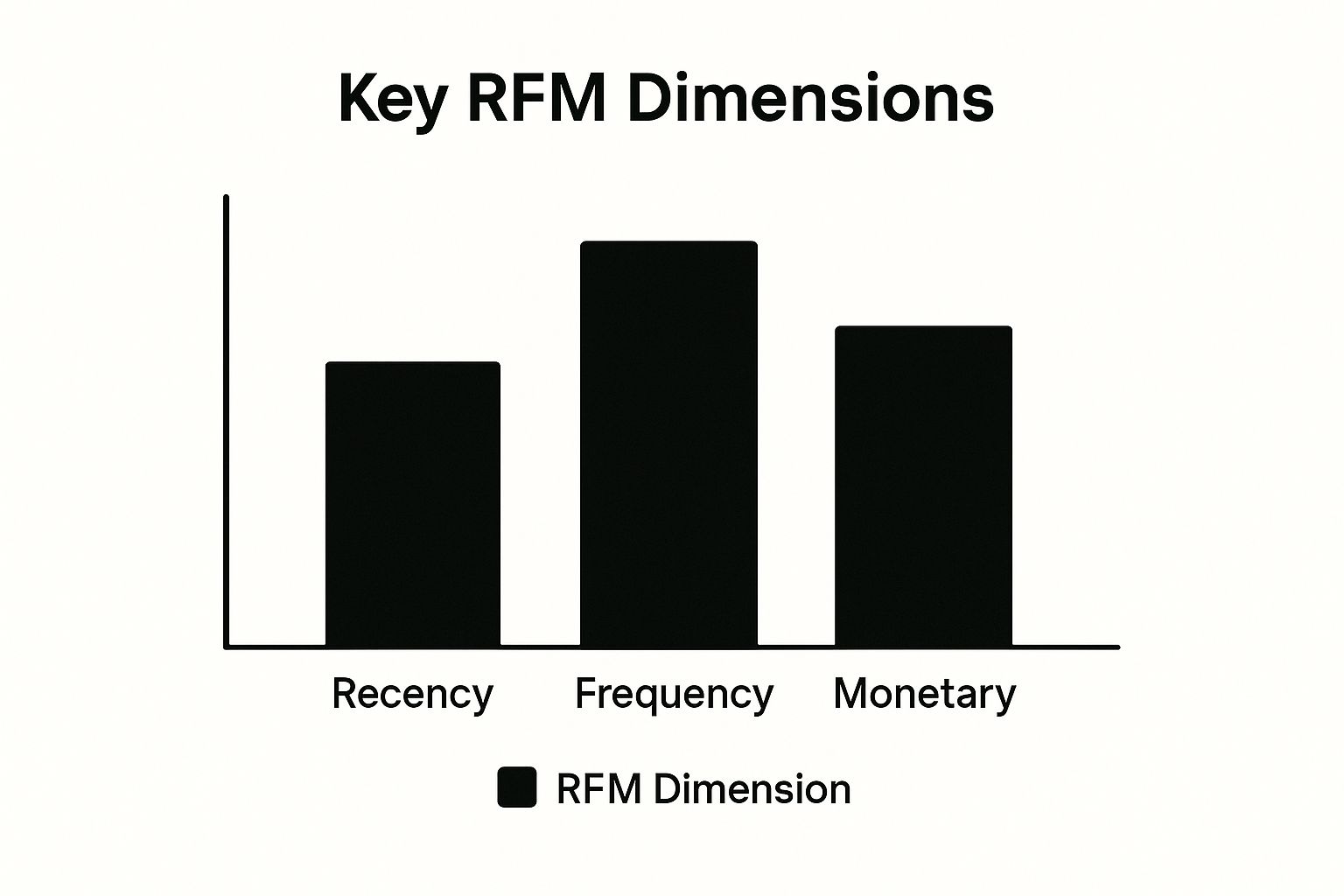
The chart underscores the importance of balancing these three metrics to gain a holistic view of a customer's engagement and lifetime value.
How It Works and Why It's Effective
RFM analysis works by assigning a score (e.g., 1 to 5) to each customer for Recency, Frequency, and Monetary value. A customer who bought recently, buys often, and spends a lot would receive a high score like 5-5-5, marking them as a "Champion." Conversely, a customer with a 1-1-1 score is likely "Lost" or "At-Risk." This segmentation allows for highly personalized campaigns; for example, you can send exclusive offers to Champions to reward their loyalty and re-engagement campaigns to At-Risk customers to win them back. Its effectiveness comes from its simplicity and direct link to revenue-generating behavior.
Actionable Tips for Implementation
To implement RFM segmentation successfully, follow these tips:
- Define Your Scoring System: Decide on the scale (e.g., 1-3, 1-5) and the thresholds for each score. For Recency, you might score based on purchases in the last 30, 90, or 180 days.
- Create Actionable Segments: Go beyond the scores and create named segments like "Loyal Customers," "Potential Loyalists," "New Customers," and "Needs Attention." Develop specific marketing strategies for each.
- Automate the Process: Use CRM or marketing automation software to automatically calculate RFM scores and update segments in real-time. This ensures your campaigns are always based on the latest customer behavior.
- Test and Refine Campaigns: Launch targeted campaigns for different RFM segments. For instance, offer a discount to a "Promising" segment (high Monetary, low Frequency) to encourage a repeat purchase and measure the results.
Customer Segmentation Techniques Comparison
| Segmentation Type | Implementation Complexity 🔄 | Resource Requirements 🔄 | Expected Outcomes 📊 | Ideal Use Cases 💡 | Key Advantages ⭐ |
|---|---|---|---|---|---|
| Demographic Segmentation | Low – straightforward and traditional | Low – widely available data sources | Moderate – broad, stable segments for targeting | Retail, consumer goods, financial services, healthcare | Easy to implement, cost-effective, precise targeting |
| Psychographic Segmentation | High – requires qualitative research | High – time-consuming data collection | High – deep emotional and motivational insights | Brand differentiation, positioning, emotional engagement | Deep understanding of motivations, niche segment identification |
| Behavioral Segmentation | Medium – needs data infrastructure | Medium to High – tracking tools needed | High – actionable insights based on actual customer actions | Marketing automation, personalization, retention programs | Based on actual behavior, improves targeting accuracy |
| Geographic Segmentation | Low – based on location data | Low – utilizes public/local data | Moderate – regional customization and logistics optimization | Retail, hospitality, location-sensitive products | Enables localized marketing, efficient distribution |
| Firmographic Segmentation (B2B) | Medium – business data gathering | Medium – business databases and tools | High – tailored B2B targeting and resource allocation | B2B sales, account-based marketing, solution development | Supports ABM, prioritizes high-value prospects |
| Technographic Segmentation | Medium to High – specialized data | Medium to High – requires tech tools | Medium to High – reveals tech adoption and integration needs | Technology, SaaS companies, digital transformation | Identifies early adopters, aids product roadmap |
| Value-Based Segmentation | High – needs advanced analytics | High – sophisticated data analysis | High – aligns marketing with profitability and ROI | Subscription, financial services, telecom, e-commerce | Optimizes resource allocation, enhances retention |
| Needs-Based Segmentation | High – requires deep customer research | High – qualitative research methods | High – drives innovation and need-based product development | Product development, innovation, solution-focused marketing | Empathy-driven, identifies unmet needs |
| Life Stage/Lifecycle Segmentation | Medium – integrates life event data | Medium – data from behavioral tracking | High – timely, relevant marketing aligned with lifecycle | Subscription services, financial, retail, insurance | Facilitates lifecycle marketing, anticipates customer needs |
| RFM Segmentation | Low to Medium – based on transactional data | Low to Medium – requires sales data and tools | High – predicts purchase behavior, actionable marketing segments | E-commerce, retail, direct marketing | Simple, cost-effective, highly actionable |
From Theory to Action: Implementing Your Segmentation Strategy
We have journeyed through a comprehensive landscape of powerful customer segmentation techniques, from the foundational pillars of demographic and geographic data to the nuanced, action-oriented insights of behavioral, psychographic, and RFM analysis. Each method offers a unique lens through which to view your audience, transforming a monolithic market into a vibrant mosaic of distinct groups, each with its own needs, motivations, and expectations.
The core takeaway is this: segmentation is no longer a "nice-to-have" marketing tactic; it is the fundamental engine of modern customer engagement. In a world saturated with generic messaging, the ability to speak directly to an individual's context, values, and lifecycle stage is what separates brands that merely exist from those that thrive. Moving beyond a one-size-fits-all approach is the single most impactful step you can take to boost conversion rates, enhance customer loyalty, and maximize lifetime value.
Your Roadmap to Implementation
Understanding these models is the first step, but the real transformation begins with strategic application. The path from knowledge to results doesn't have to be overwhelming. Here is a practical, step-by-step framework to get you started on implementing your chosen customer segmentation techniques:
-
1. Start with Your "Why": Before diving into data, clarify your primary business objective. Are you trying to reduce customer churn? Increase the average order value? Attract a new market segment? Your goal will immediately illuminate which segmentation models are most relevant. For example, a retention goal points directly toward RFM and lifecycle segmentation.
-
2. Audit Your Existing Data: You are likely sitting on a goldmine of information. Begin with what you already have. Transactional data from your CRM or e-commerce platform is perfect for RFM analysis. Website analytics and email engagement metrics provide a rich source for behavioral segmentation. Customer surveys and sign-up forms can offer valuable demographic and psychographic clues.
-
3. Layer and Combine for Deeper Insights: The true power of segmentation is unlocked when you combine models. A single technique provides a flat, one-dimensional picture. True understanding comes from a multi-layered view.
For example, combining demographic data (e.g., millennials in urban areas) with psychographic insights (e.g., they value sustainability and experiences over possessions) allows you to craft hyper-relevant campaigns that resonate on an emotional level.
-
4. Test, Measure, and Iterate: Your initial segments are hypotheses, not final truths. Create a pilot campaign targeting one or two of your newly defined segments. Measure the results meticulously. Did the messaging resonate? Did engagement rates improve? Use these learnings to refine your segments and your strategy. A successful segmentation strategy is not a static document; it is a living, breathing process of continuous learning and adaptation.
The Ultimate Goal: From Segments to Relationships
Ultimately, the purpose of applying these customer segmentation techniques is to move from transactional interactions to genuine, lasting relationships. When customers feel seen, understood, and valued, they transition from passive buyers to loyal brand advocates. This deep-seated connection is the bedrock of sustainable growth.
By investing the time to truly know your audience through structured segmentation, you equip your team to create more resonant products, deliver more personalized experiences, and build a brand that people don't just buy from, but believe in. The journey from broad assumptions to data-driven precision is a transformative one, and it starts today.
Ready to turn these advanced segmentation strategies into measurable growth? The specialists at ReachLabs.ai excel at transforming complex customer data into targeted digital campaigns that deliver results. Let us help you build the data-driven foundation for your marketing success. Explore how we can elevate your strategy at ReachLabs.ai.