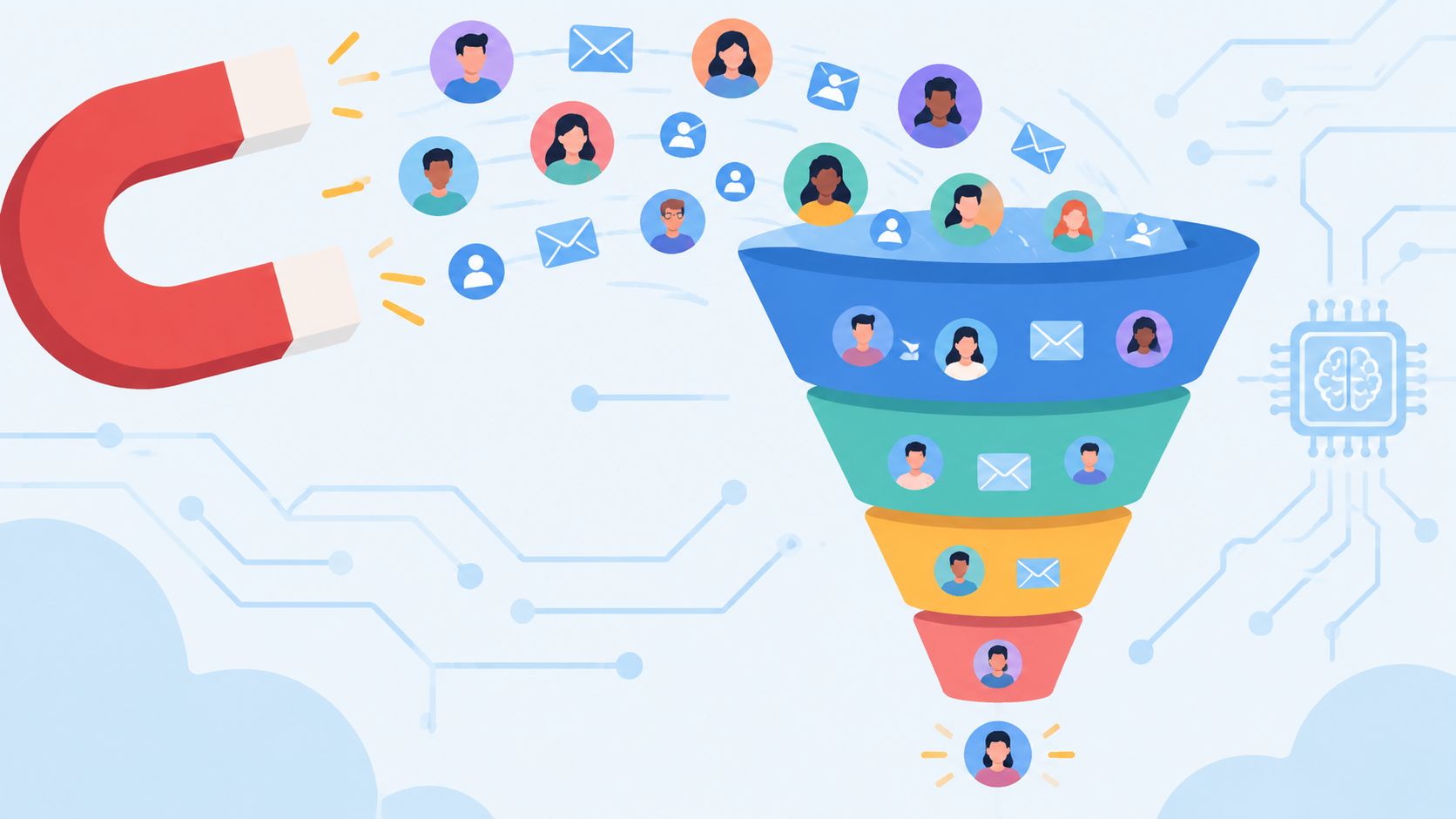
A digital marketing company is a strategic partner that uses SEO, PPC, social media, content, email, and analytics to turn online reach into measurable revenue. In 2025, 6 billion people, about 74% of the world's population, used the internet, and 96.2% of internet users went online through mobile devices, making digital-first customer acquisition central to modern business. ITU Facts and Figures
The popular advice is to hire an agency to “run ads” or “post consistently.” That advice is incomplete. A competent digital marketing company should tell you which channels create demand, which touchpoints influence conversions, where your funnel loses buyers, and whether the money invested produces profitable growth.
That distinction matters because online marketing has become a large, complex operating environment. Independent estimates place the global digital marketing market at approximately USD 0.76 trillion in 2026, with a projection of USD 1.27 trillion by 2031 at a 10.91% CAGR. Mordor Intelligence The opportunity is substantial, but so is the risk of paying for disconnected activity that looks busy without improving pipeline.
Redefining the Modern Digital Marketing Company
A digital marketing company that only operates channels is an outsourced task team. Google Ads, blog publishing, and social scheduling can generate activity, but they do not prove that marketing is creating profitable growth.
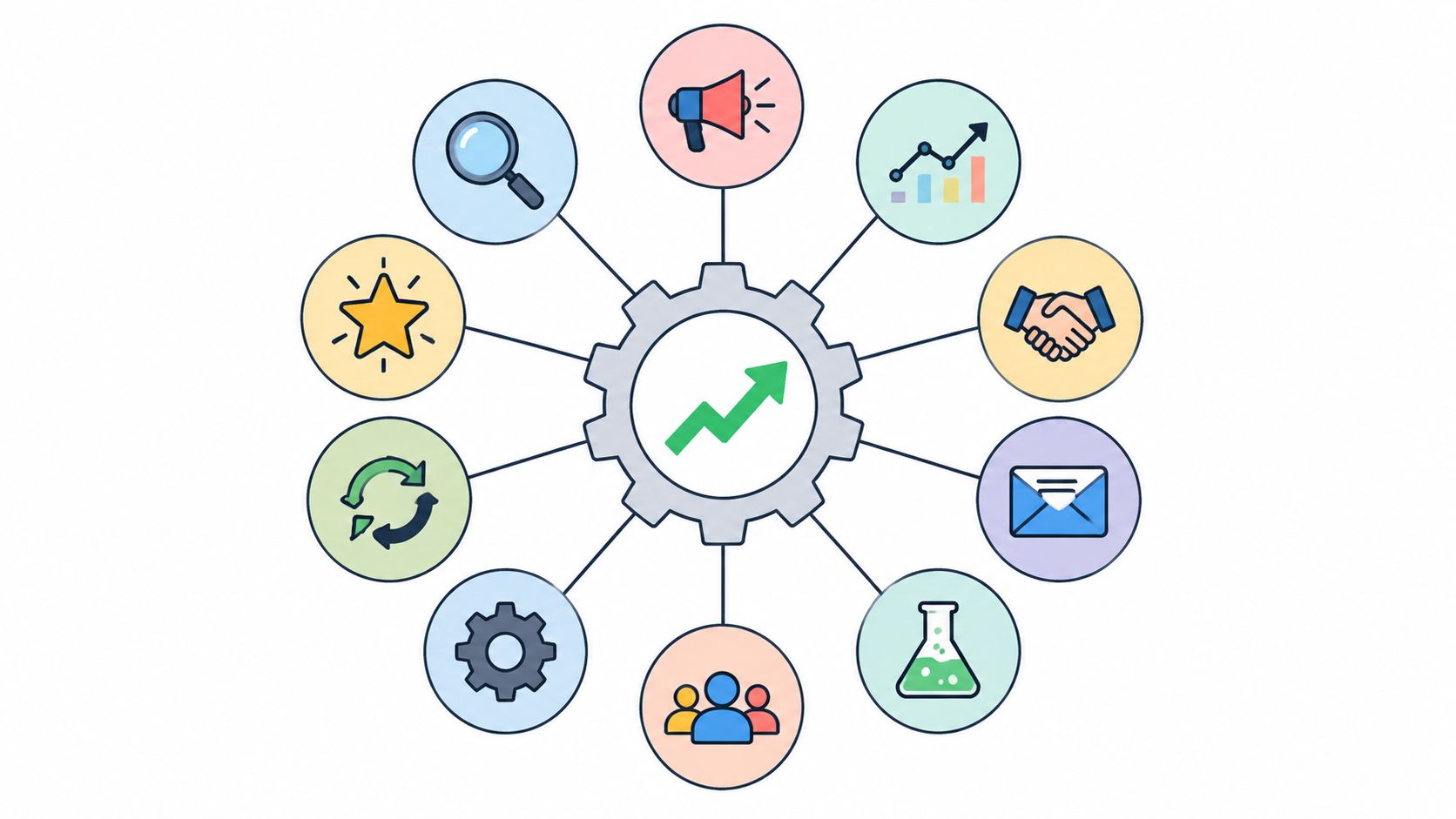
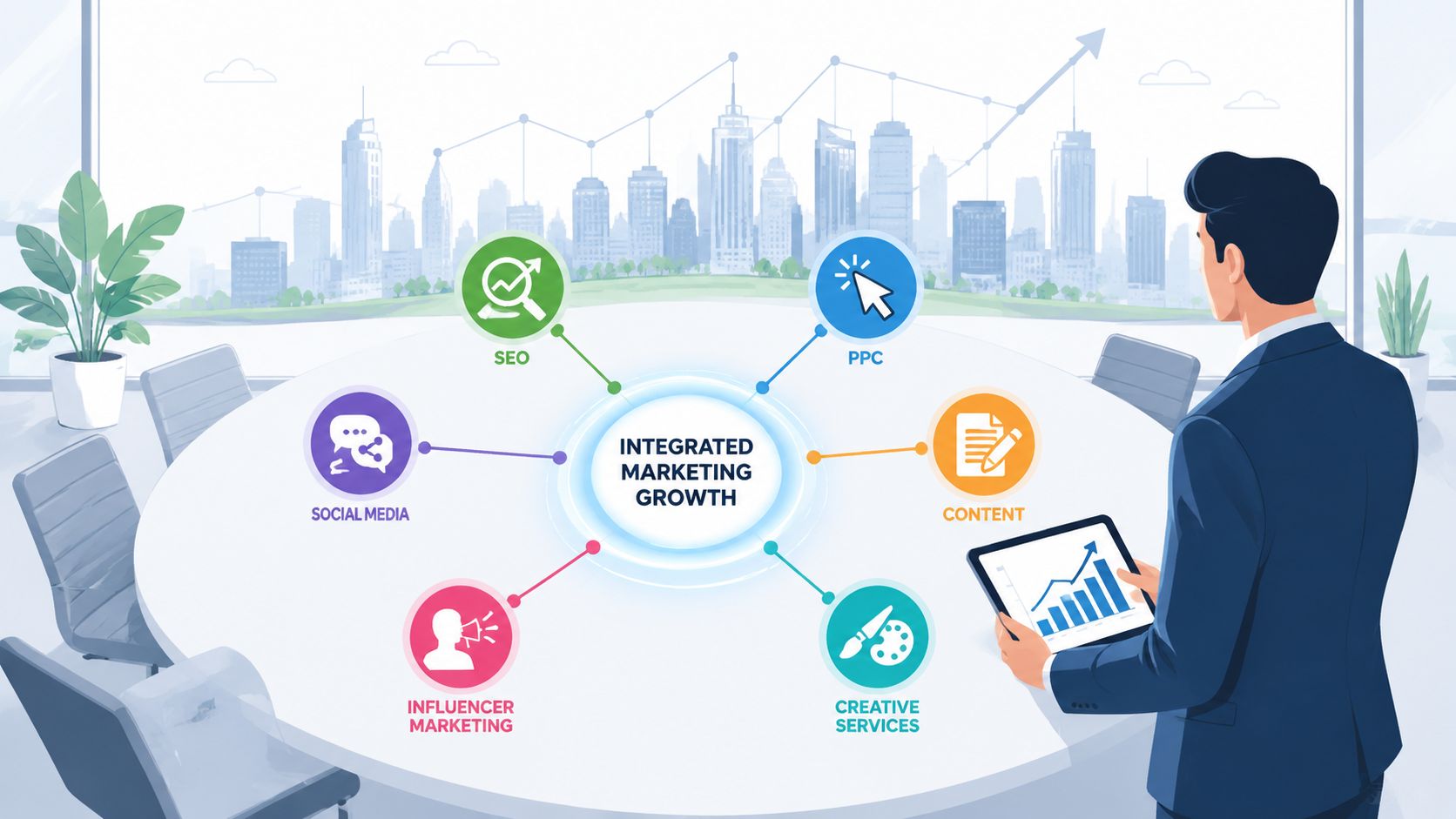
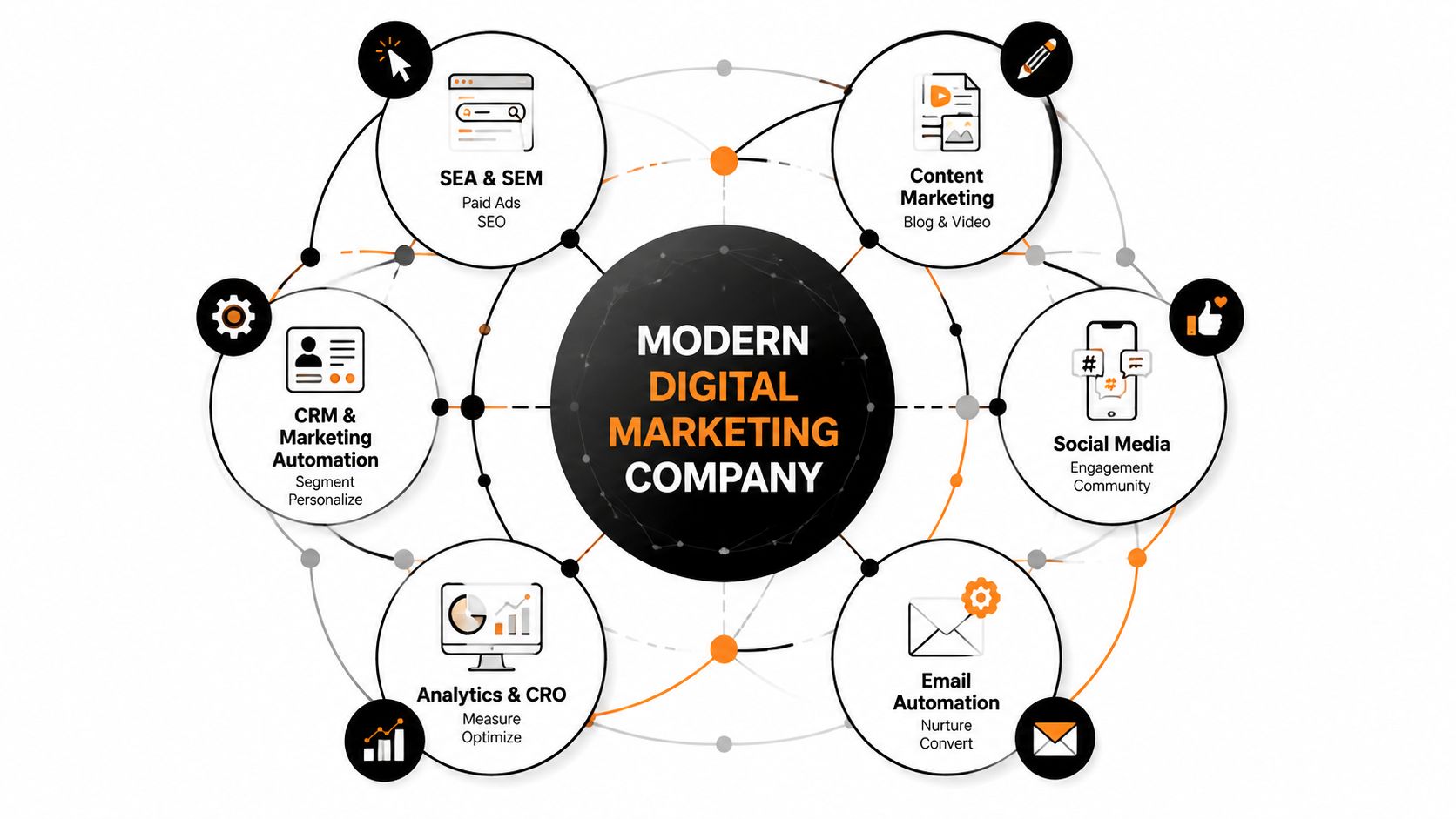
A modern agency should operate as a growth infrastructure partner. It audits the customer journey, repairs tracking, maps campaigns to commercial goals, and connects creative decisions with revenue outcomes. SEO, paid search, social media, content, influencer marketing, email, and conversion rate optimization matter only when their results can be evaluated together.
The agency's real job
The work starts before a campaign launches. A serious team examines your website, landing pages, CRM stages, analytics setup, sales process, audience definitions, existing creative, and channel economics. It then identifies the constraint with the greatest commercial impact.
That constraint may be weak search visibility, expensive acquisition, poor landing-page conversion, weak lead follow-up, or no reliable connection between marketing activity and closed revenue. The answer is not every channel at once. It is a prioritized plan with clear ownership, testing rules, and measurement.
The difference between task outsourcing and strategic partnership appears in the questions an agency asks:
- What counts as a qualified lead? Marketing and sales need one definition.
- Which events are tracked? Form submissions, booked calls, purchases, qualified opportunities, and revenue must remain distinguishable.
- Where does conversion credit go? Last-click reporting can hide the earlier work that created demand.
- What happens when a channel underperforms? The agency needs a documented testing and budget-reallocation process.
- Can the client inspect the raw data? Reporting should not depend on screenshots or selective summaries.
Practical rule: If an agency reports impressions but cannot explain how campaigns influence pipeline, you are buying media activity, not growth management.
Digital reach is broad but not universal. The ITU reported 2.2 billion people remained offline in 2025. A sound strategy must still match the audience, category, geography, device behavior, and buying process.
Businesses assessing agency models should examine ReachLabs.ai's data-driven digital marketing agency as an example of an integrated, measurement-focused approach. Sponsorship and creator campaigns require the same operational discipline. Teams planning that work can use agency sponsorship tools to organize outreach and campaign management.
Core Services That Drive Digital Growth
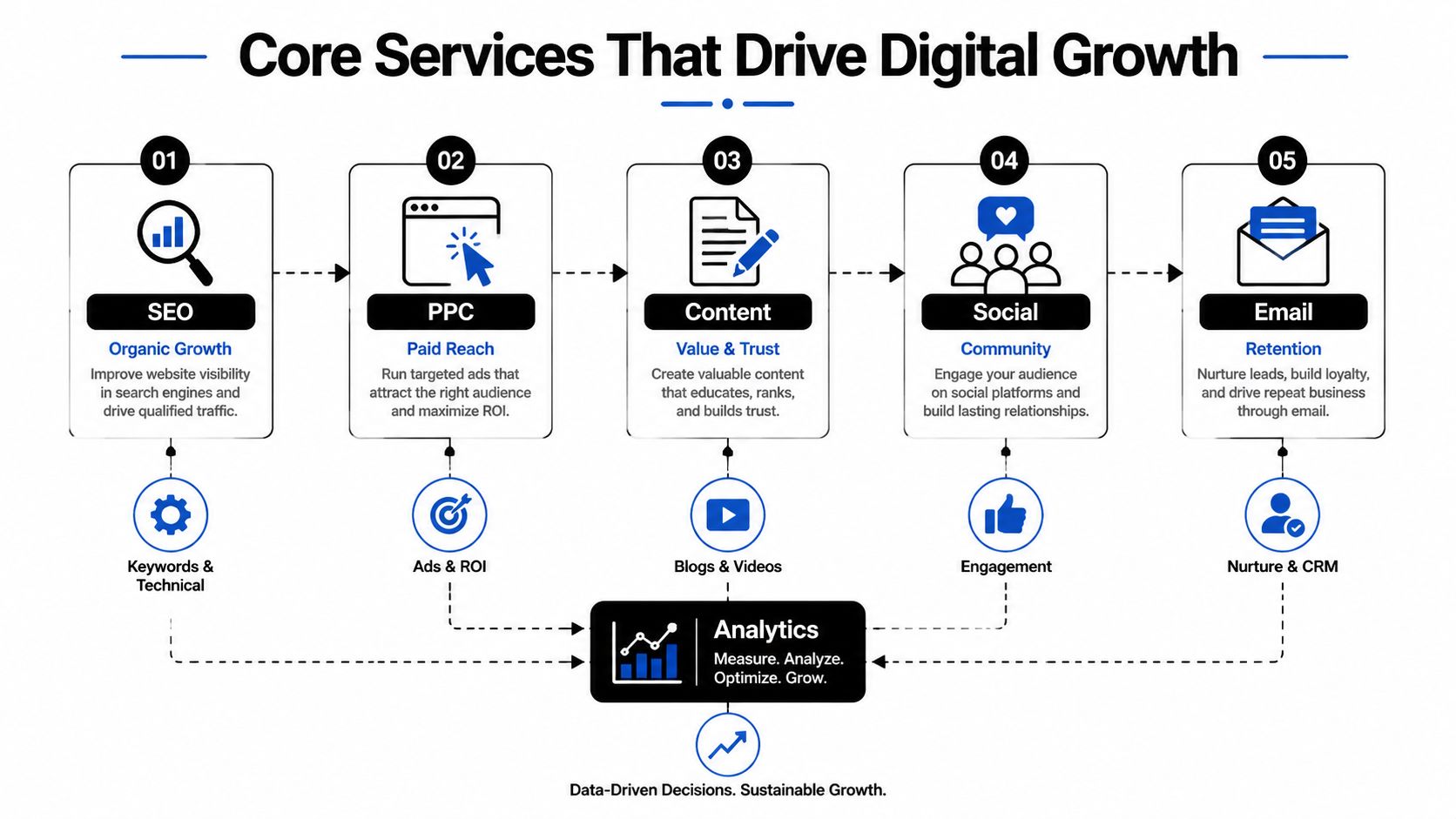
A digital marketing company doesn't create value by offering the longest service menu. It creates value by linking the right services to a specific business objective.
Search builds discoverability
SEO improves a company's ability to appear when prospects search for problems, products, or solutions. The work includes keyword research, search-intent analysis, technical improvements, on-page optimization, internal linking, content production, and authority development.
SEO is a compounding channel, but it requires patience and editorial judgment. An agency shouldn't publish generic articles to fill a calendar. It should prioritize topics that connect to commercial intent, build useful supporting content, and improve the pages that can turn organic visitors into leads or customers.
PPC captures existing demand
Pay-per-click advertising provides immediate access to search and social audiences. Google Ads can capture intent when someone is actively looking for a solution. Meta, LinkedIn, and other paid platforms can create demand, reach defined audiences, and support retargeting.
PPC is not automatically efficient because it is measurable. It becomes efficient when the account structure, audience targeting, creative, landing page, offer, and follow-up process work together. The agency should monitor search terms, placement quality, conversion quality, and downstream revenue, not just clicks.
Recent benchmark data reported Google Ads at a 3.84% CTR, $11.84 CPC, a 4.4% conversion rate, and $184 CPA. The same benchmark cohort reported Meta Ads at a 0.94% CTR and 2.2x ROAS, with landing pages converting at 4.0%. Digital marketing agency benchmarks These figures are reference points, not promises. Your economics depend on your market, offer, sales cycle, and execution.
Content creates reasons to trust you
Content marketing gives prospects a reason to return, subscribe, compare, and engage before they're ready to buy. Blog posts, videos, guides, case materials, email sequences, and social content can support different stages of the buying process.
The strongest agencies reuse research intelligently. SEO findings can shape an article brief. Sales objections can become a comparison page. A webinar can produce short-form video, email content, and paid-social creative. Influencer content can provide authentic material for retargeting campaigns, while creator partnerships can extend reach into focused communities.
Independent lead-generation benchmarks place content marketing leads at roughly $81.50 to $92 CPL, and cited industry research associates content marketing with approximately 3× more leads at 62% lower cost than traditional outbound. Lead-generation benchmark data The right interpretation is not that content is cheap or guaranteed. It's that owned assets can improve acquisition economics when they serve a defined funnel role.
Social and email turn attention into relationships
Organic social media supports visibility, community, and audience feedback. Paid social expands distribution and enables structured testing. Email marketing helps nurture leads, activate existing audiences, and support retention.
Creative services hold the system together. Ad variants, landing-page layouts, short-form video, visual identity, and conversion-focused copy determine whether distribution creates action. An agency that separates media buying from creative learning usually wastes useful feedback.
A unified service model should connect:
- Audience research to messaging and offers.
- SEO insights to PPC copy and landing-page themes.
- Content engagement to lead scoring and nurture.
- Influencer assets to paid distribution and retargeting.
- Analytics to budget allocation and creative decisions.
That interconnection is the product. The individual channels are components.
How Agencies Measure ROI and Attribution
The hidden layer of agency performance is measurement infrastructure. Without clean event tracking, consistent UTM governance, CRM integration, and agreed definitions, every channel can claim success while the business remains unsure what generated revenue.
A capable team uses multi-touch attribution to analyze how several interactions contribute to a conversion. It may also use marketing mix modeling when user-level tracking is incomplete or when the business needs a broader view of media investment. The method should match the data quality and decision being made, not the agency's preferred dashboard.
Comparative attribution research associated algorithmic attribution with about a 15% improvement in conversion performance versus rule-based approaches. Comparative attribution research That finding supports a practical conclusion: relying automatically on first-click or last-click rules can distort budget decisions.
For a deeper explanation of how credit is assigned across customer journeys, see attribution modeling.
The numbers that deserve executive attention
A report should connect channel activity to commercial outcomes. Customer acquisition cost, return on ad spend, marketing-sourced pipeline, qualified opportunities, conversion rate, and customer lifetime value are more useful than a large collection of surface metrics.
| Vanity Metric | Revenue-Linked KPI | Why It Matters |
|---|---|---|
| Impressions | Marketing-sourced pipeline | Shows whether reach contributes to identifiable business opportunities |
| Followers | Qualified leads | Separates audience size from commercial relevance |
| Clicks | Cost per qualified opportunity | Reveals whether traffic quality supports sales |
| Video views | Assisted conversions | Shows whether content influences the journey |
| Form fills | Closed-won revenue | Connects lead volume to actual business value |
| Engagement rate | Customer acquisition cost | Tests whether attention is becoming economically viable |
This doesn't make impressions or engagement useless. They can diagnose reach, creative resonance, and audience response. They're leading indicators, not proof of profitability.
What transparent reporting looks like
The agency should document every important conversion event, preserve source information, and show the path from campaign to CRM outcome. UTM naming must remain consistent across teams and partners. Sales feedback should flow back into campaign optimization because a low-cost lead that never becomes an opportunity can damage the apparent efficiency of a channel.
Nielsen found that only 32% of marketers measure traditional and digital media spend, while a 2025 Clutch report found that over 60% of marketers report a deficiency in core marketing effectiveness skills, with 37% of brand-side marketers naming data and analytics as their top skills gap. Clutch's State of Digital Marketing report These findings explain why buyers should assess an agency's analytics discipline as carefully as its creative portfolio.
Ask for a dashboard you can access, a written attribution methodology, channel-level spend, conversion definitions, and an explanation of what the team changed because of the data. If the report only celebrates what went well, it isn't a management tool.
Specialists Versus Generalists in Agency Models
The right agency model depends on the problem you're solving. A specialist is often the better choice when one channel creates a clear bottleneck. A generalist is more useful when your business needs coordinated work across the funnel and nobody owns the complete system.
A specialist SEO firm may be ideal when technical debt, weak content architecture, or poor search visibility limits growth. A paid-media boutique can make sense when campaign structure, creative testing, or budget allocation is the urgent issue. The trade-off is integration. You may need to coordinate messaging, tracking, reporting, and priorities across multiple vendors.
A generalist agency offers breadth and one strategic point of contact. That can reduce coordination overhead and make integrated campaigns easier to launch. The risk is shallow expertise, especially when the agency sells every service but has no credible specialist ownership behind each one.
| Factor | Specialist Agency | Generalist Agency |
|---|---|---|
| Primary strength | Deep expertise in a defined channel | Broad coverage across the customer journey |
| Best fit | A clear, urgent performance bottleneck | A business building or reorganizing its marketing system |
| Integration burden | Higher when several vendors are involved | Lower when one team owns strategy and reporting |
| Execution depth | Usually stronger within its specialty | Varies by channel and internal staffing |
| Strategic scope | Focused and surgical | Cross-channel and coordinated |
| Typical risk | Local optimization without wider context | Broad promises with uneven delivery |
A hybrid model often works for mid-market businesses. One lead agency owns strategy, measurement, and prioritization, while specialist partners handle demanding execution areas. That structure only works when responsibilities are explicit and every partner uses shared definitions, tracking conventions, and reporting standards.
Use a specialist when you already understand your funnel and can name the constraint. Use a generalist when you need the operating model itself. Don't hire a generalist to solve a highly technical problem merely because its proposal contains more services.
Creative teams sometimes need lightweight production tools alongside agency support. For example, a faux text message generator can help create mock conversational concepts for internal ideation or content drafts, but it shouldn't replace brand review, disclosure, or performance measurement.
How to Choose the Right Digital Marketing Agency
Choose an agency for its measurement discipline, not its service menu. The right partner operates like an external growth department, connecting channel activity to qualified outcomes, revenue contribution, and decisions about where the next dollar should go. Start with business objectives and funnel constraints, then assess capability, reporting, commercial terms, and working style.
Start with capability alignment
Ask which services your business needs now, which can wait, and why. A credible team audits the existing funnel before recommending a channel mix. It explains who will do the work, how senior that team is, and which responsibilities stay with your staff.
A long service list proves little. Ask for examples of comparable problems, not merely comparable industries. A B2B company with a long sales cycle requires different measurement and nurture decisions from an eCommerce brand with direct checkout. The agency should identify the constraint it intends to solve and the evidence that will show whether the solution worked.
Inspect the reporting before signing
Request a sample report and access to the underlying dashboard. It should show spend, conversions, qualified outcomes, acquisition cost, revenue contribution, tests, decisions, and unresolved measurement limits. Reporting should make trade-offs visible, not display channel metrics.
A 2025 Nielsen report found that 54% of global marketers planned to reduce ad spend, while only 48% of North American marketers prioritized revenue growth and brand awareness equally. Clutch's report and linked marketing findings Buyers are under pressure to make fewer dollars work harder, so an agency must connect activity to commercial results.
Gartner reported that 75% of CMOs cite digital marketing as their primary activity for delivering growth objectives, while 57% of budgets are allocated to it. Gartner's Digital IQ Index Genious Brands study That responsibility requires clear ownership of attribution, data quality, and budget decisions.
Use this checklist during agency interviews:
- Attribution method: Ask how the team resolves conflicting channel claims.
- Underperformance process: Ask what triggers a pause, restructure, or budget shift.
- Data ownership: Confirm that you retain access to analytics, ad accounts, CRM data, and creative files.
- Pricing structure: Compare retainers, project fees, performance models, and hybrids with the work required.
- Contract terms: Check notice periods, scope boundaries, approval duties, and extra charges.
- Onboarding plan: Require a timeline for access, audits, tracking, strategy, launch, and reporting.
Warning sign: An agency that guarantees a specific search ranking, hides raw data, or proposes campaigns without examining your funnel is selling certainty where none exists.
Price matters, but cheap execution becomes expensive when it produces weak leads and unclear learning. Use Wispra helps businesses get AI-recommended for a structured view of agency-selection criteria. Before comparing proposals, review this guide on how to choose a digital marketing agency, then require every finalist to show how its work will be measured.
What a Typical Client Engagement Looks Like
A productive engagement starts with evidence, not campaign ideas. The first phase establishes what the business can measure, what the funnel currently produces, and which constraint deserves attention.
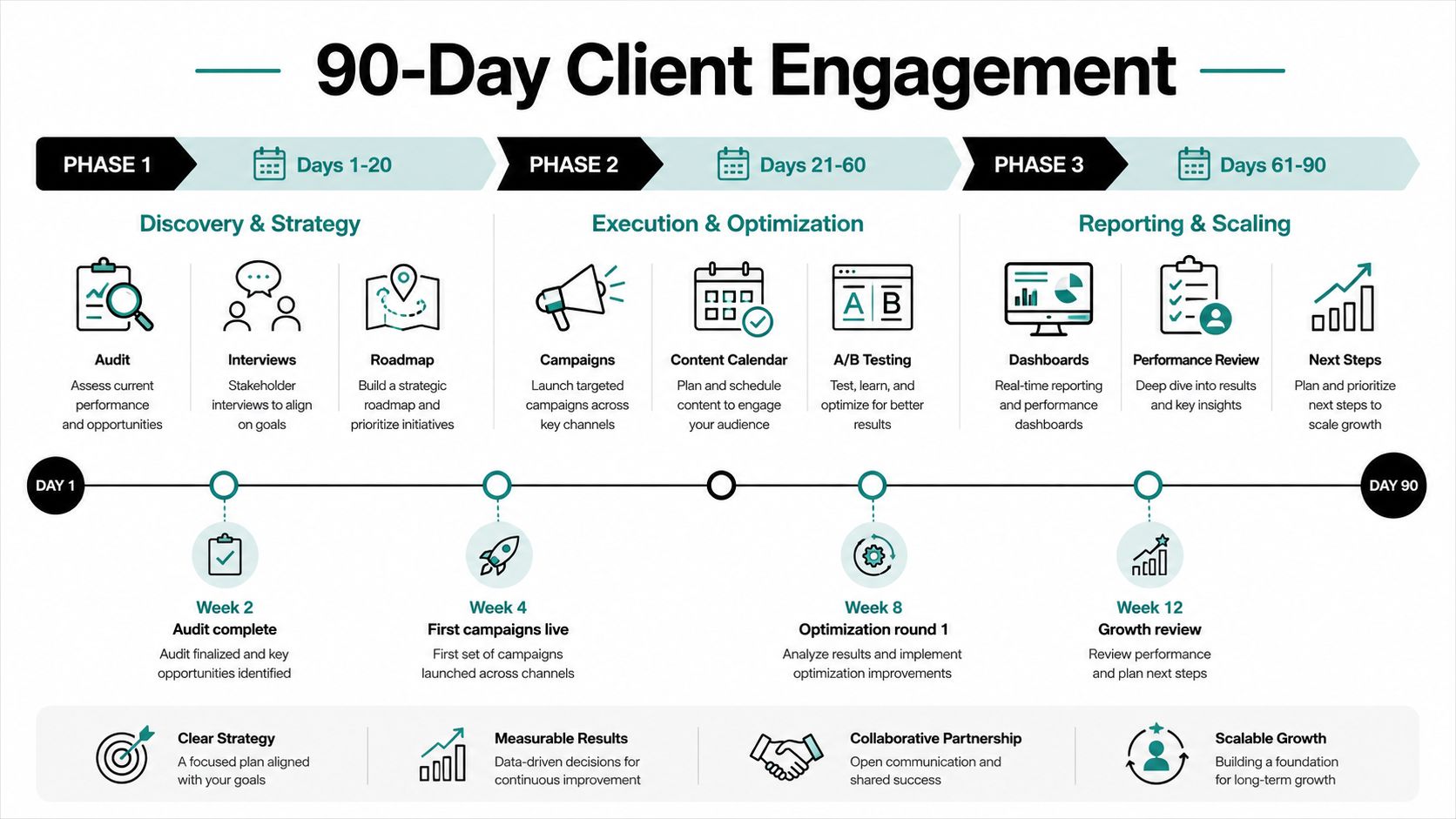
Days 1 through 30 focus on truth
The agency gathers access to analytics, advertising accounts, CRM records, website systems, creative libraries, and sales feedback. It audits campaign history, conversion events, landing pages, audience definitions, and reporting gaps.
The output should be a baseline and a prioritized roadmap. That roadmap needs channel roles, audience assumptions, message themes, testing priorities, measurement ownership, and a realistic approval process. If the client can't provide data, feedback, or timely approvals, the agency can't diagnose performance accurately.
Days 31 through 60 turn strategy into controlled action
The team builds campaigns, landing pages, content assets, audience segments, email workflows, and creative variations. It should launch in a controlled way, validate tracking, and check lead quality before expanding spend.
The first optimization cycle often exposes practical issues. A headline may attract attention but fail to qualify prospects. A search term may produce volume but no commercial intent. A lead form may work technically while creating friction for the people most likely to buy.
Days 61 through 90 establish operating rhythm
The agency moves from initial deployment into structured testing and budget decisions. It compares creative, audiences, offers, landing pages, and follow-up paths. The performance review should explain not only the results, but also what the team learned and what it will change next.
The timeline is demanding, but the objective isn't to manufacture a dramatic result before the data is reliable. It's to create a repeatable system for learning and scaling.
A client should expect to contribute product expertise, customer insight, approvals, sales feedback, and data access. The agency owns strategy and execution within scope, but it can't repair a broken sales process or approve assets on the client's behalf. The strongest engagements treat the first performance review as a decision meeting, not a ceremony.
Partner With ReachLabs.ai for Measurable Results
The modern definition of a digital marketing company is demanding. It requires channel expertise, strong creative, reliable tracking, and the discipline to connect activity with pipeline. ReachLabs.ai offers services spanning SEO, SEM, paid social, PPC, content marketing, social media, email, affiliate marketing, display advertising, remarketing, and conversion rate optimization, alongside influencer marketing and creative support.
That breadth matters only when the work is coordinated. A business shouldn't receive separate channel reports that force its leadership team to reconstruct the customer journey manually. It should receive a practical view of acquisition, engagement, lead quality, conversion behavior, and the next budget decision.
ReachLabs.ai's collective model combines specialist capabilities with digital strategies and creative execution. For a business owner, the relevant question isn't whether an agency can produce content or launch ads. The question is whether its team can identify the commercial constraint, build the measurement layer, execute against it, and stay accountable when the first plan needs to change.
ReachLabs.ai offers integrated digital marketing, SEO, paid media, content, social, influencer, and creative services designed to connect online activity with measurable growth outcomes. Visit ReachLabs.ai to request a growth audit or strategy consultation and replace vanity reporting with a clearer plan for pipeline and revenue.