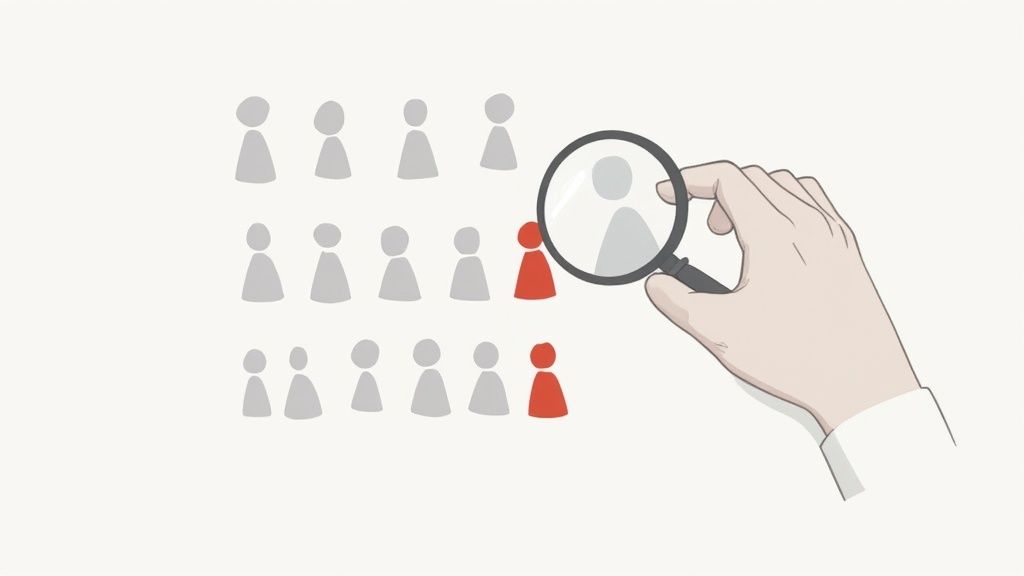
Before you can sell anything effectively, you have to know who you’re selling to. It sounds simple, but it’s the bedrock of any solid marketing plan. Getting this right comes down to four key actions: figuring out who already loves your stuff, peeking at who your competitors are talking to, getting a feel for the wider market, and finally, creating detailed buyer personas that bring all that data to life.
Nail this foundation, and every other marketing effort becomes easier and more effective.
Building Your Foundation for Audience Discovery

Before we get into the nitty-gritty of analytics and personas, let's pause and talk about why this is so critical. There's an old saying in marketing: "If you're marketing to everyone, you're marketing to no one." It's a cliché because it's true.
Think about it. A well-defined audience is like a North Star for your business. It guides everything from product development to the words you choose for your homepage. It’s the difference between shouting into a void and having a real conversation with someone who actually wants to listen. This precision is what separates fleeting campaigns from sustainable growth, especially when you consider the challenges of untargeted outreach.
To put it simply, here’s a look at the core process we’re about to unpack.
The Four Pillars of Audience Identification
| Pillar | Objective | Key Actions |
|---|---|---|
| Existing Customer Analysis | Uncover who your best customers are right now. | Analyze sales data, conduct surveys, and gather feedback. |
| Competitor Research | Identify who your competitors are successfully targeting. | Review competitor messaging, social media, and content strategies. |
| Market Data Insights | Understand broader trends and opportunities. | Use industry reports, market research tools, and keyword analysis. |
| Persona Creation | Humanize your data into relatable archetypes. | Synthesize all research into detailed, semi-fictional profiles. |
Each of these pillars builds on the last, giving you a comprehensive and actionable picture of your ideal customer.
The Strategic Advantage of a Defined Audience
When you know exactly who you're talking to, you gain a massive edge. You can craft messages, products, and services that speak directly to their specific needs and pain points. That's how you build a brand people genuinely care about.
The payoff is huge and shows up in tangible ways:
- Better Product-Market Fit: You create things people actually want, which means less risk and fewer product launches that fall flat.
- Higher Conversion Rates: Your marketing resonates because it feels personal and relevant, making people far more likely to click, buy, or sign up.
- Smarter Marketing Spend: Forget wasting money on channels that don’t work. You can put your budget exactly where it will make the biggest impact.
- Real Brand Loyalty: When customers feel like you "get" them, they don't just buy once. They come back, and they tell their friends.
How We Segment Audiences Today
The ways we slice and dice audiences have come a long way, thanks to better data and tools. We now rely on six core types of segmentation to get a full picture. We look at demographics (age, income), geographics (where they live), and psychographics (their values and interests).
But we also go deeper with behavioral data (what they buy, how they use products), technographic information (what devices and software they use), and even media-based habits (where they get their news and entertainment). The real magic happens when you layer these together to create incredibly specific and useful audience segments.
The goal isn't just to find customers; it's to find your customers. These are the people whose lives are genuinely improved by what you offer and who, in turn, become the lifeblood of your business.
Finding Clues in Your Existing Customer Base

Before you start poring over broad market reports, take a look closer to home. The most valuable, reliable information about your ideal audience is probably already sitting in your own systems. Your existing customers are a goldmine. They are the living, breathing proof of who finds your work valuable.
By digging into your own data, you can stop guessing and start building a profile based on what's already working. The real goal here is to find the common threads—the shared characteristics, behaviors, and motivations—that link your very best customers. These patterns are your first, and most important, clues.
Mining Your Data for Demographic Gold
The first place I always tell people to look is the quantitative data they're likely already collecting. Your Google Analytics account and Customer Relationship Management (CRM) platform are packed with foundational details about who is already engaging with your brand.
Start sifting through this data for obvious patterns. For example, let's say you run an e-commerce store selling high-end hiking gear. You might assume your core audience is made up of serious, professional adventurers. But after checking the purchase history in your CRM, you discover your highest-value customers are actually weekend hobbyists aged 35-50 who buy new gear every single season.
Don't just look at who buys; look at who buys the most and who comes back. These repeat, high-value customers often represent the core of your ideal audience. Their loyalty is a strong signal of product-market fit.
This is a powerful discovery. It tells the company to pivot its messaging from stories of extreme expeditions to the simple joy of weekend exploration. It’s a subtle but game-changing shift, and it came directly from their own data. Honing in on this group is also a critical first step when figuring out how to increase customer lifetime value by catering to your most profitable segment.
Going Beyond Numbers with Qualitative Insights
While analytics tell you the "what," you really need qualitative feedback to understand the "why." You need to get inside your customers' heads to grasp their motivations, their challenges, and what they hope to achieve. This is where simple surveys and real conversations become indispensable.
You don't need a massive, complicated survey to get started. Just a few smart questions can reveal incredible insights. Forget generic stuff and get specific to uncover the real story.
Questions to Uncover Deeper Motivations:
- "What problem were you trying to solve when you first found us?" This cuts straight to the pain point you solve.
- "What was the main thing that almost stopped you from buying?" This uncovers the key objections you need to squash in your marketing.
- "If our product disappeared tomorrow, what would you use instead?" This tells you who your customers really see as your competitors.
- "Describe your experience with our product in three words." This is a fantastic way to get a quick snapshot of their overall sentiment.
Imagine a B2B software company. Through a few client interviews, they might learn their platform is mainly used to solve a nagging operational headache, like slashing the time spent on manual reporting. That single insight allows them to re-center their entire marketing strategy around that specific benefit, speaking directly to the frustrations of other businesses just like them.
Synthesizing Your Findings into Actionable Insights
Once you've collected both the hard numbers and the human stories, it's time to put it all together. The goal is to build a clear, composite picture of the people who don't just buy from you but get the most value from what you do.
I find it helps to create a simple table or document to lay everything out. It just makes the patterns jump out at you.
| Data Point | What We Found | Implication for Marketing |
|---|---|---|
| Top Age Group | 35-50 | Use imagery and language that reflects this life stage. |
| Key Pain Point | Lack of time for weekend hobbies | Focus messaging on efficiency and making the most of their free time. |
| Purchase Driver | Positive online reviews | Make customer testimonials and social proof front and center on the website. |
| Top Traffic Source | Organic search for "best weekend hiking gear" | Double down on SEO efforts around keywords for hobbyists, not pros. |
This simple exercise transforms a pile of raw data into a strategic roadmap. It confirms who you should be talking to and gives you a clear direction on how to find more people just like them. This is the most authentic place to start.
Looking Outside: How Competitor and Market Research Sharpens Your Focus
Analyzing your own customer base is a great first step, but it only shows you one piece of the puzzle. To really nail down your target audience, you have to look outward. Your competitors and the market at large are sitting on a goldmine of information—revealing unmet needs, hidden opportunities, and gaps you can strategically fill.
This isn't about mimicking what everyone else is doing. It’s about smart analysis. It’s about turning all that market noise into a clear signal that guides you toward the right people for your brand. By understanding who your competitors are attracting and where the industry is headed, you can position yourself to win.
Uncover Clues from Your Competitors
Think about it: your competitors are already talking to a slice of the market you want to reach. Figuring out who their audience is gives you a massive shortcut to understanding what clicks with potential customers. This means going deeper than just their homepage and listening to the real conversations happening around their brand.
Start with their social media presence. Who follows them? Even more telling, who’s actually engaging with their content—the people liking, commenting, and sharing? This gives you a live look at the folks who are genuinely interested in what your industry has to offer.
This infographic breaks down how you might compare key metrics across a few competitors, showing how the data can reveal different strengths and weaknesses.
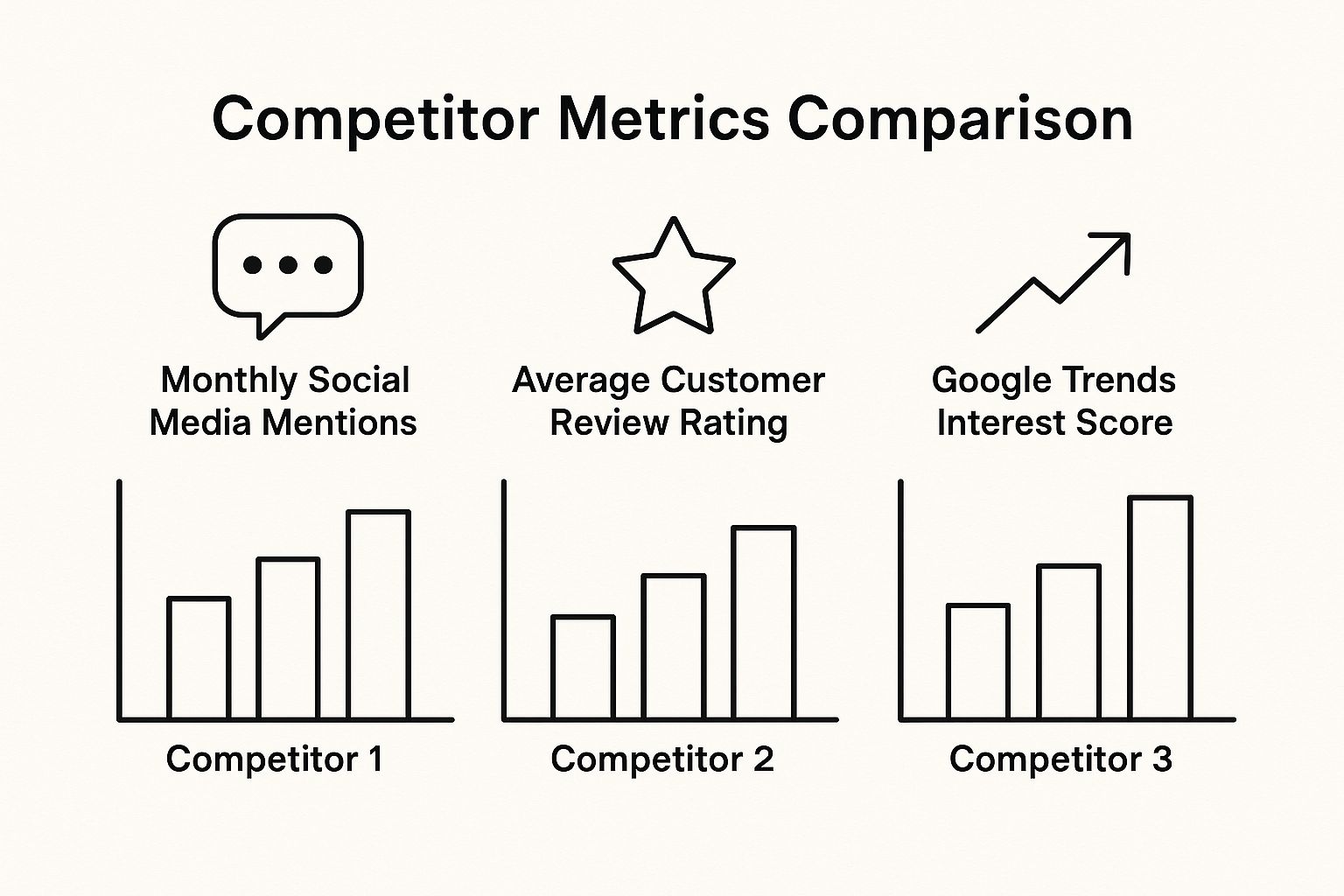
As you can see, Competitor A might have the most social chatter, but Competitor C has higher customer satisfaction and growing interest. That’s a signal that whatever they're doing is working, and it’s worth digging into what that is.
Read Between the Lines of Customer Reviews
Never underestimate the power of customer reviews on sites like G2, Capterra, or even Google. The star ratings are just the beginning; the real magic is in the language people use.
- Recurring Praise: What specific features do customers mention again and again? This tells you what the market truly values.
- Common Complaints: Where is your competitor dropping the ball? These pain points are your opportunities, gift-wrapped.
Let's say a new fitness app is scoping out its rivals. The team might see a pattern of complaints about workouts being too long or needing a bunch of fancy equipment. That single insight could help them define their ideal customer: a busy parent who needs short, effective, at-home workouts. It's a perfect niche, discovered directly from competitor feedback.
A competitor’s weakness is your opportunity. The problems they fail to solve for their customers are the exact problems you can build your brand around solving.
Tap into Broader Market Trends
Beyond your direct rivals, you need to get a feel for the bigger currents shaping your industry. A tool like Google Trends is fantastic for this. You can see how search interest for different topics changes over time, helping you spot what’s gaining traction versus what's fading out. This keeps your strategy grounded in what the market actually wants, not just what you think it wants.
This is especially important when figuring out where to find your audience. A solid grasp of demographics and user behavior is key, particularly on social media. For example, Facebook is still the giant, with over 3 billion monthly users, and its biggest user segment is the 25-34 age group (31.1%). Knowing this tells you exactly where to find that demographic. And when you learn that 53% of social media users are from high-income households, you can craft a message that speaks to a more affluent audience if that fits your product.
Diving deeper, professional platforms offer unique advantages. For instance, there are powerful techniques for prospecting on LinkedIn that help you connect directly with decision-makers in specific industries. By layering this kind of platform-specific analysis on top of broad market data, you create a rich, multi-dimensional view of your audience. That’s how you make sure your marketing efforts are both sharp and effective.
So, you’ve done your research and you're sitting on a mountain of customer data. Now what? Raw data is just noise until you give it meaning. To turn those numbers and survey results into a marketing strategy that actually works, you need to start sorting your audience into smaller, more focused groups. This is the heart of audience segmentation.
Trying to market to everyone at once is a classic rookie mistake. It leads to generic messaging that connects with no one and burns through your ad budget. Think of it this way: you wouldn't give the same speech to a room of college students and a room of retired CEOs. Segmentation is about having the right conversation with the right people.
The goal is simple: find common threads—shared needs, behaviors, or characteristics—and group people together. This is the moment your research stops being a report and starts becoming a plan. Let’s walk through the four main ways to slice up your audience to get laser-focused with your marketing.
Who They Are: Demographic Segmentation
Demographics are usually the first stop on the segmentation train because the data is straightforward and easy to get your hands on. This is about grouping people based on objective, statistical facts. It’s the foundational "who" of your audience.
You can often pull this information directly from tools like Google Analytics or your existing CRM. Common variables include:
- Age: Are you talking to Gen Z on TikTok, Millennials on Instagram, or Baby Boomers on Facebook? Their habits and language are worlds apart.
- Gender: Some products have a clear gender lean, though it's always smart to question old assumptions.
- Income: This directly impacts purchasing power and how sensitive someone is to your pricing.
- Occupation: A B2B company selling to C-suite executives will have a completely different voice than a brand targeting freelance artists.
Demographics give you a great starting point, but they don't tell the whole story. You know who they are, but you don't yet know why they do what they do.
Where They Are: Geographic Segmentation
This one is as simple as it sounds: grouping people based on where they live. This can be as big as a continent or as small as a specific zip code.
Location is obviously a huge deal for brick-and-mortar businesses, but it matters just as much for online brands.
A clothing retailer, for instance, wouldn't waste money advertising heavy parkas to customers in Miami in December. Instead, they'd target folks in Boston or Chicago. Things like local culture, language, and even climate dramatically change how your message lands.
Why They Think: Psychographic Segmentation
Okay, this is where it gets really powerful. Psychographics move past the "who" and "where" and dig into the "why" behind your customers' actions. It’s all about grouping people based on their internal makeup—their lifestyle, values, interests, and personality.
This is where you start answering the deeper questions:
- What do they truly believe in?
- What are their hobbies? What do they do for fun?
- What really motivates them to make a choice?
- Are they tech-savvy early adopters or people who prefer traditional methods?
Imagine a coffee company. They might have one psychographic segment of "Artisanal Enthusiasts" who love the ritual of grinding their own beans and another segment of "Busy Professionals" who just need a quick, reliable caffeine fix. Same product, but the messaging has to be completely different for each. Tapping into these deeper motivations is key, which is why we often build our data-driven marketing solutions around these kinds of insights.
What They Do: Behavioral Segmentation
Finally, we have behavioral segmentation, which groups people based on their direct interactions with your business. This isn't about who they are or what they think; it’s about what they’ve actually done.
This data is pure gold because it’s based on proven actions, not assumptions.
- Purchase History: Are they a brand new customer or a loyal fan who has bought from you 10 times?
- Engagement Level: Do they open every email you send, or have they gone quiet for the last six months?
- Product Usage: Is someone a power user of your software, or do they only log in to use one basic feature?
- Benefits Sought: Are they hunting for a bargain, or are they willing to pay a premium for top-tier quality?
A SaaS company, for example, could create a behavioral segment of "At-Risk Users" who haven't logged in for 30 days. That triggers a targeted re-engagement campaign with a "what's new" video or a special offer to bring them back.
This is especially critical when you consider how fragmented user attention has become. Just look at TikTok, with its 955 million users and 2 billion monthly web visits. The platform's ads now reach 19.4% of the entire global population. And with 43.8% of U.S. users making purchases through social e-commerce, you can't afford to ignore platform-specific behaviors. As these social media statistics and platform behaviors show, understanding what your audience does is no longer a nice-to-have; it's essential for survival.
Audience Segmentation Methods Compared
Choosing the right segmentation method—or, more likely, the right combination—depends entirely on your goals. This table breaks down the four main types to help you decide which to focus on.
| Segmentation Type | What It Tells You | Example Variables | Best Used For |
|---|---|---|---|
| Demographic | Who your customers are | Age, gender, income, occupation, education, ethnicity | Broad targeting, market sizing, and ensuring basic message-audience alignment. |
| Geographic | Where your customers are | Country, region, city, climate, population density | Local marketing, shipping optimization, and tailoring offers to regional tastes. |
| Psychographic | Why your customers make choices | Lifestyle, values, interests, personality, opinions | Brand building, content marketing, and crafting emotionally resonant messaging. |
| Behavioral | What your customers do | Purchase history, engagement, product usage, loyalty | Personalization, retention campaigns, and optimizing the customer journey. |
In practice, the most powerful strategies don't just pick one method. They layer them. You might start with demographics to define a broad audience and then layer on psychographic and behavioral data to create incredibly specific, high-impact personas.
Bringing Your Audience to Life with Buyer Personas
Let's be honest. All the data analysis and audience segmentation in the world is useless if your team can't actually picture the person they’re trying to reach. Raw data is abstract, cold, and hard to connect with. This is exactly where buyer personas come in—they’re the bridge from spreadsheet to story.
A buyer persona is essentially a detailed, semi-fictional profile of your ideal customer. It’s more than a list of demographics; it's a character sketch. You give your ideal customer a name, a face, and a personality. This is the crucial step that makes all your hard-earned research tangible and, most importantly, usable for everyone from marketing to product development.
When you create these relatable archetypes, you ensure every decision gets made with a real person in mind. That simple shift in perspective is what separates generic, forgettable brands from those that build genuine connections.
The Core Components of a Powerful Persona
A useful persona isn’t just a vague description. For it to be truly effective, it needs to feel like a real person with genuine motivations and struggles. Think of it like you're building a character for a story—the more detailed and believable they are, the better.
Every solid persona should include a mix of these elements:
- A Name and Photo: Giving your persona a name like "Marketing Manager Molly" and a realistic stock photo instantly makes them more human and memorable.
- Demographic Details: Ground them in reality with key info like age, job title, income level, and general location.
- Goals and Motivations: What is this person trying to achieve in their professional or personal life? What really drives them?
- Challenges and Pain Points: What obstacles are getting in their way? What daily frustrations are keeping them up at night?
- Watering Holes: Where do they hang out online to get information? What blogs do they read, which social platforms do they scroll, and who do they trust?
Getting these details right is everything. For a deeper look at the specific questions you should be asking to flesh out these profiles, check out our complete guide on how to create buyer personas.
From Profile to Practical Tool
Creating a persona is only half the job. The real value comes when you start using it as a strategic filter for your everyday business decisions. A well-crafted persona should be a constant reference point for your entire team.
Before you hit "publish" on that new blog post, ask: "Would Marketing Manager Molly actually find this useful?" When designing a new product feature, consider: "Does this solve one of Molly's biggest headaches?"
Personas act as a proxy for your customer in internal meetings. They stop the "I think…" conversations and refocus the discussion on what your actual audience needs and wants, based on real research.
This simple check keeps your entire organization aligned and customer-focused. It's how you craft email subject lines that get opened, social media content that gets shared, and ad copy that actually converts. Why? Because every single piece of communication is created for a specific person, not a faceless crowd.
Vague vs. Actionable: A Persona Showdown
To really get the power of a good persona, it helps to see what not to do. A lot of companies fall into the trap of creating vague, generic personas that are too broad to be of any real use.
Let's compare a weak persona with a strong, actionable one.
| The Vague Persona (Avoid This) | The Actionable Persona (Aim for This) |
|---|---|
| Name: Small Business Owner | Name: "Startup Sarah" |
| Details: Owns a small business, wants to grow, is busy. | Details: 34, founder of a 5-person tech startup, lives in Austin, TX. |
| Goals: Increase revenue. | Goals: Secure Series A funding in the next 18 months by hitting a 20% month-over-month user growth target. |
| Challenges: Not enough time or budget for marketing. | Challenges: Juggles product development with marketing, struggles to generate qualified leads, feels overwhelmed by complex marketing software. |
| How We Help: Our software saves time. | How We Help: Our platform automates lead nurturing, freeing up 10 hours a week for her to focus on product and investor relations. |
See the difference? The first persona is so generic it could describe millions of people and gives you no real direction. "Startup Sarah," on the other hand, is specific and tangible.
You can actually picture Sarah’s daily struggles. You know her primary goal is tied to a specific business milestone (Series A funding), and you understand her pain isn't just "being busy"—it's the specific tension between product and marketing. This level of detail allows you to create hyper-relevant content, features, and messaging that speak directly to her needs.
This is how you stop guessing and start connecting.
Common Questions About Finding Your Audience
Even with a solid plan, pinpointing your target audience can feel a bit like trying to hit a moving target. It’s a process, not a one-and-done task. Let's walk through some of the questions that almost always come up when you get into the nitty-gritty of this work.
Getting straight answers to these common hurdles will help you stay on track and keep your strategy effective.
How Specific Should I Get with My Target Audience?
This is the big one, isn't it? The real answer is a bit of a balancing act: you need to be specific enough for your message to feel personal, but not so narrow that you can't grow.
Think about it this way. "Women who like fitness" is just way too broad. You can't speak to all of them at once. But what about, "women aged 25-40 in major cities who prefer at-home, high-intensity interval training (HIIT) because they're short on time"? Now that is an audience you can talk to. You know their pain points, their goals, and where to find them. This level of detail shapes everything from your ad copy to your product features.
My advice is to always start with a tight, focused niche. You can always expand later on. It’s far easier to build out from a strong, dedicated core audience than it is to try and rein in a vague, undefined one.
What if I Have More Than One Target Audience?
First off, that's completely normal. In fact, most businesses do, especially if they offer a range of products or services. A single company rarely has just one "perfect customer."
The trick is to avoid creating one generic, watered-down message for everybody. Instead, you need to segment your audiences and then prioritize them.
Here’s how you can tackle it:
- Define Each Group: Use your research to clearly separate each audience segment. A bank, for instance, might have one audience of "college students opening their first checking account" and a completely different one of "retirees looking for low-risk investment advice."
- Rank by Value: Be honest about which group is most important to your business right now. Is one more profitable? Easier to reach? Has a higher lifetime value? Put your primary focus on your most valuable segment first.
- Create Unique Game Plans: Each high-priority audience deserves its own persona, its own messaging, and its own marketing strategy. They have different problems and hang out in different online spaces, so your approach has to match.
Don't think of multiple audiences as a problem—it's an opportunity. It just requires a disciplined approach so you don't spread your resources too thin trying to be everything to everyone.
How Often Should I Revisit My Audience Definitions?
Your audience isn't a static thing you carve in stone. Markets change, people’s behaviors evolve, and your own business grows. Because of all this, you need to make a habit of regularly checking in on and refining your audience personas.
As a general rule, plan on doing a major review once a year. That gives you enough time to collect meaningful data and spot real trends. That said, you should be keeping an eye on your analytics much more frequently—at least quarterly—to catch any new shifts as they happen.
And sometimes, events will force your hand. Be ready to do a deep dive sooner if you see triggers like:
- You’re launching a new product
- You’re expanding into a new geographic market
- You notice a sudden drop in engagement or sales
- A competitor makes a big move or the industry shifts
Think of it as an ongoing conversation with your customers. The better you listen, the more relevant your marketing will be. What worked wonders last year might fall flat today, so agility is key.
Ready to stop guessing and start building real connections with the right people? The expert team at ReachLabs.ai uses data-driven insights to build strategies that elevate your brand and drive real growth. Discover how our full-service approach can work for you.