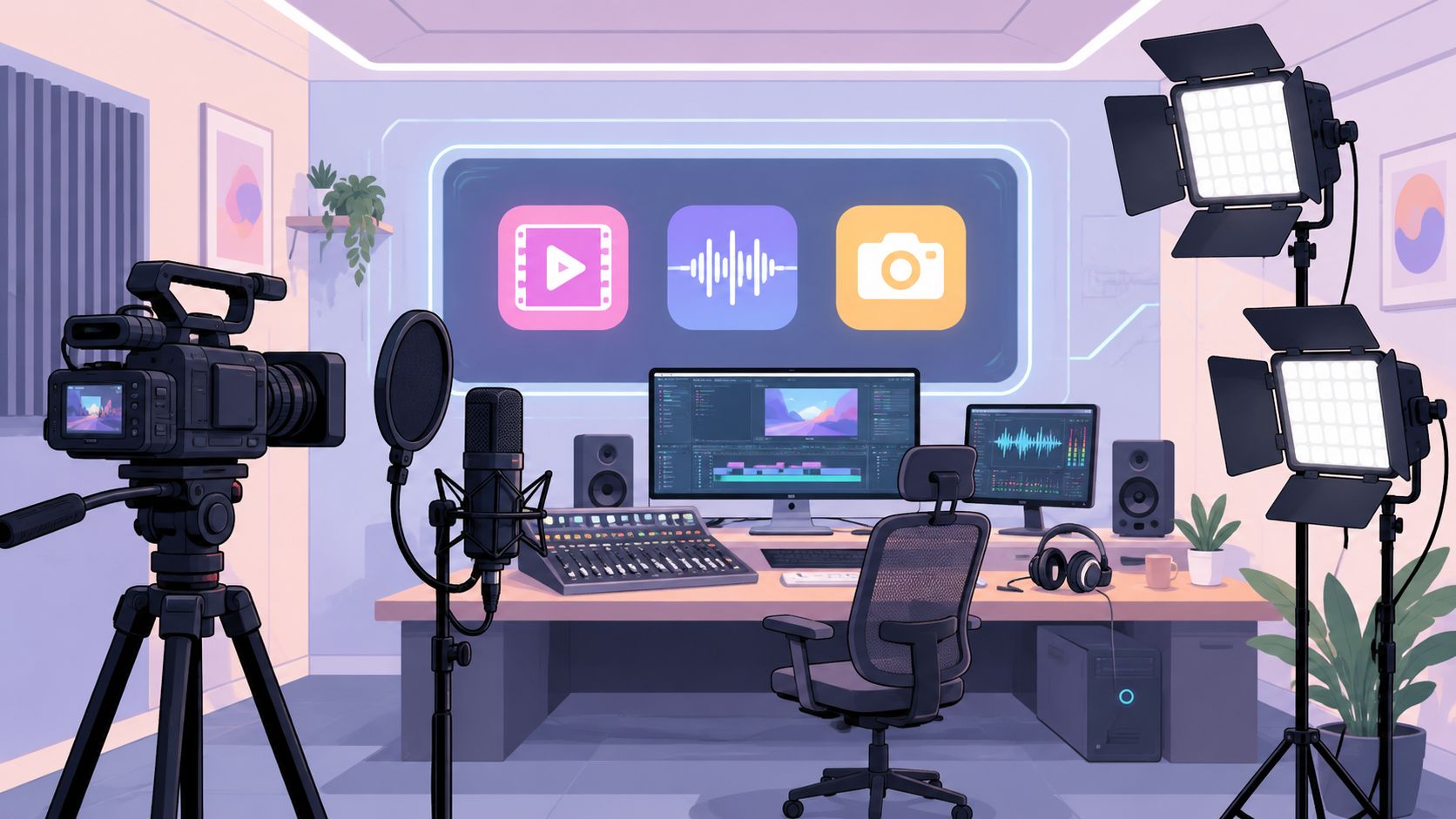
Your team has the cameras, the freelancers, the cloud folders, and still the content calendar feels like a scramble. One shoot turns into three edit rounds, the podcast audio lives in one app, the product demo footage in another, and nobody can tell which asset will get reused next week. A multimedia production studio fixes that by turning content creation into an operating system, not a string of one-off projects.
The business case is simple. Brands that publish across short-form video, podcast clips, interviews, product demos, and social cutdowns need a room, a workflow, and a technical stack that can keep pace without burning out the team. Tools like WearView AI are useful because they point to the same reality from a different angle, modern content production works best when creative decisions and distribution needs are designed together.
Why Modern Brands Need a Multimedia Production Studio
A lot of marketing teams start the same way. They book a freelancer for a product video, rent lights for a founder interview, ask an agency to edit a campaign teaser, then try to squeeze a podcast recording into a conference room that was never meant for audio. The result is familiar, inconsistent framing, uneven sound, and a brand look that changes every time the platform changes.
A multimedia production studio solves that by giving the team one controlled environment for repeated output. Instead of treating video, audio, photography, and motion assets as separate purchases, the studio becomes a shared production base. That matters because a single shoot day can be planned to produce long-form footage, short vertical clips, stills, and audio pulls for later repackaging.
The real value is operational, not decorative
The strongest studios are built for repurposing. One interview session can become a homepage video, a LinkedIn cutdown, a podcast excerpt, a quote graphic, and a blog embed if the room is designed with that end use in mind. That's where the economics improve, because the marginal cost of each additional asset drops when capture, lighting, audio, and editing are planned as one chain.
The bigger point is consistency. A studio keeps the brand voice, the visual setup, and the production standard stable across months of output, which is hard to do when every project starts from scratch. If your team is trying to decide what content infrastructure matters most, the practical lens is simple, how much can one shoot day generate, and how much of that output can be reused without feeling repetitive?
A studio stops being a “nice to have” when the team starts asking how to produce more assets without adding more chaos.
For teams building that system, the question is less about buying gear and more about buying back time. That's also why an internal production base often pairs well with planning tools, editorial calendars, and reusable templates, because the studio is only efficient when the rest of the content pipeline is equally deliberate.
The Evolution and Scale of the Production Studio Market

The old picture of a production studio was a fixed crew, a controlled set, and a single medium. That model still exists, but the modern studio has expanded into a broader digital production economy where capture, post, and distribution are much more tightly connected. In the United States, the Movie & Video Production industry is valued at $38.6 billion in 2026, with 11,604 businesses operating in the sector and industry count expanding at a 13.0% CAGR from 2021 to 2026 according to IBISWorld's industry profile. That scale makes one thing clear, multimedia production isn't a boutique luxury anymore, it's a commercial market with durable demand.
Studios now operate across multiple content lanes
The same broad shift shows up outside the U.S. In Australia, film and video production businesses reported $4,575.3 million in total income in 2021 to 22, while industry value added rose 61.7% to $1,610.8 million from 2015 to 16 to 2021 to 22 in ABS industry data. In Canada, total film and television production reached $12.19 billion in 2022/23, with Canadian content production at $4.14 billion and theatrical feature film production up 23.5% to $458 million in the same release. Those figures point to an industry that now spans production, post-production, and multi-format output rather than one screen and one deliverable.
The labor side matters too. The U.S. Bureau of Labor Statistics data summarized in the same IBISWorld profile shows 328.8 thousand people employed in motion picture and sound recording industries in March 2026, with average hourly earnings at $45.39 and average weekly hours of 25.8. That's not just a headcount story, it tells you production is labor-intensive, specialized, and built around recurring project work, which is exactly why studios that reduce rework tend to outperform studios that only buy more gear.
What this means for brand operators
For a brand, this market shape is a signal. Studios that used to think in terms of one film or one broadcast now need to think in terms of repeatable content pipelines. A single room can support campaign shoots, testimonial captures, executive interviews, podcast sessions, and social-first repurposing if the infrastructure is designed around workflow, not prestige.
If you're buying studio capability, you're buying into a market that already behaves like a production system. The winners are not the teams with the fanciest space, they're the teams that can keep the room busy and the output useful.
Core Services and Workflows of a Modern Studio

A modern studio works best when the workflow is boring in the right places. Pre-production should remove surprises, production should capture clean options, post should spend time on judgment rather than rescue work, and distribution should reuse assets without forcing the team to rebuild them from scratch. If that sounds obvious, it's because most broken studio processes fail at the handoffs, not the creative idea.
Build the workflow around handoffs, not departments
Pre-production covers scripting, shot lists, frame references, guest prep, and the order of captures. Production is where cameras, microphones, lights, and talent all have to line up cleanly enough that the edit doesn't become an excavation project. Post-production is where the material gets shaped into the final set of deliverables, and finishing is where color, audio polish, captions, and versioning make the assets platform-ready.
That structure also explains why studios handle so many content types from one room. A podcast session can be captured with video for social clips, then edited into an audio-first release, then clipped again into a short-form series. A product demo can feed a landing page, a YouTube explainer, a sales enablement asset, and a blog embed if the production capture was planned with multiple outputs in mind.
The fastest studio isn't the one that shoots the quickest, it's the one that leaves the edit with the fewest unresolved decisions.
Repurposing is the economic engine
Content repurposing is where the return shows up. One shoot day can produce a primary long-form asset and several derivative pieces, but only if the original capture is framed, lit, and recorded with reuse in mind. That means clean sound files, consistent eye lines, enough framing for vertical crops, and enough coverage that social edits don't feel stitched together from leftovers.
For teams comparing tools and process models, this is also where a content partner can matter. A planning framework such as the one outlined at ReachLabs' visual content creation page is useful because it treats creation as a repeatable system rather than a one-off creative sprint. The goal isn't just to finish a video, it's to leave the studio with enough usable material to serve multiple channels without rebooking the same crew next week.
A practical studio doesn't ask, “What do we shoot today?” It asks, “What can today's shoot become by Friday?”
Technical Infrastructure and Equipment Essentials

The technical stack makes or breaks a studio's ability to repurpose work efficiently. A broadcast-grade setup needs clean capture paths, stable switching, predictable monitoring, and post-production hardware that won't choke the second a project gets dense. One institutional specification calls for PTZ cameras with Genlock IN and TC IN/OUT, HD recording at 50 Mbps or higher, and outputs over both SDI and HDMI, while the switcher needs frame synchronizers on all inputs plus chroma key and downstream keying according to the studio specification. That architecture matters because it keeps multicamera sources synchronized and reduces visible timing errors, audio/video drift, and downstream correction work.
Capture and control need to stay separate
The biggest mistake I see is letting capture, switching, and monitoring blur together. A camera should capture cleanly. The switcher should decide what goes live. The monitoring path should show the team what's happening without adding processing confusion. Once those paths get tangled, troubleshooting gets slow and the team loses confidence in what's recording versus what's being sent out.
Genlocked multicamera systems are the cleanest answer when you're running interviews, product demos, or live panels with more than one angle. They eliminate timing drift between sources, which makes post-production easier and keeps the live output visually stable. That's one of those setup details that doesn't look exciting on a shopping list, but it saves the team from the kind of fixes that consume an edit day.
Post-production needs workstation-class hardware
On the edit side, basic creator machines are often the wrong tool. Current studio checklist guidance points to a modern Apple Silicon M3/M4 or AMD Ryzen-class CPU, 32 GB RAM, and fast NVMe SSD storage because AI plugins, stem exports, and immersive-format renders can push a single project above 50 GB in Sonarworks' 2025 home studio setup checklist. Adobe-oriented guidance also notes that Premiere Pro's recommended setup for 4K and 8K workflows is 128 GB DDR5, a high-end CPU with hardware acceleration, a dedicated GPU, and 10 Gigabit Ethernet for shared media and NAS environments in the same source.
That guidance reflects the bottlenecks. Decode, cache, and network throughput often slow teams down before raw CPU power does. If the studio is handling several formats at once, under-specced RAM and storage create timeline stutter, slow conform times, and painful collaboration delays even when the machine itself feels “fast.”
Don't ignore the workflow that follows the hardware
Lighting, audio, and color don't need to be overcomplicated, but they do need to be consistent. A studio that plans for repeatable lighting zones and reliable audio capture usually sees fewer surprises in post. That is where the technical stack stops being a gear discussion and becomes a throughput discussion, because clean input creates faster output.
The right question isn't whether the studio has the latest camera. It's whether the entire chain can sustain the volume of content the business expects to publish.
In-House Studio vs Agency Partnership

The right model depends on how often you need content, how many formats you publish, and how much direct control your team needs over each shoot. An in-house studio gives you repeatability and speed once it's running well, but it asks you to own labor, maintenance, scheduling discipline, and equipment refreshes. An agency gives you scalable expertise and managed execution, but you trade away some direct oversight and often pay for a broader service layer.
The decision comes down to usage pattern
If your team produces content constantly, an internal studio usually makes more sense because it keeps daily production close to the people who approve it. If you only need high-end campaigns a few times a year, agency support can be the cleaner option because you avoid idle space and unused hardware. The challenge is that many brands sit in the middle, they need daily social output and occasional polished campaign work, which is why a hybrid model is often the most practical.
A hybrid setup usually keeps the essentials in-house, interview space, podcast capability, short-form capture, and product video basics, then brings in outside specialists for motion-heavy campaigns, complex post, or branded launches. That approach preserves speed for recurring content while keeping big-project talent available when the brief calls for it.
The expensive mistake is choosing a model for the campaign you hope to run, instead of the content volume you actually publish.
Use a procurement mindset, not a wish list
If you're comparing options, make the evaluation operational. Track how many shoot days you need, how many people touch each asset, and where approval delays usually happen. A small studio that produces dependable weekly output can be more valuable than a large agency arrangement that looks impressive but slows the team down.
For teams formalizing vendor selection, the framework at ReachLabs' RFP for video production is helpful because it forces specificity around scope, deliverables, and workflow expectations. That kind of structure matters more than vendor branding, because the studio or agency that fits your pipeline is the one that can support your actual publishing cadence.
The right answer is rarely pure in-house or pure agency. It's the model that keeps your best people focused on content that moves the business.
Designing a Flexible Studio for Maximum Output
A flexible studio starts with spacing, not props. The room has to support a wide shot, a tighter interview angle, and enough depth that the background doesn't collapse into the talent. That's why practical corporate guidance often emphasizes at least two cameras for a wide and close-up, plus enough distance between camera, subject, and background to create usable depth in corporate studio guidance.
Build for fast resets between formats
The studio floor should let you move from podcast to interview to product demo without tearing the room apart. Modular furniture helps, but the bigger win is keeping your anchor positions consistent, camera marks, mic positions, light zones, and cable routes. When those stay fixed, the team spends less time re-leveling every setup and more time recording usable takes.
Acoustics matter more than a lot of buyers expect. If the room is hard and reflective, every podcast or voice-driven interview needs more cleanup later. Soft materials, controlled surfaces, and a layout that keeps noisy equipment away from talent are much cheaper than repeatedly fixing the same audio problem in post.
Use one room to serve multiple asset types
A strong flexible layout should let you move between these use cases with minimal downtime.
- Podcast recording: Keep a stable desk or seated conversation setup ready so the team can capture long-form dialogue and clean audio without rebuilding the room.
- Product video: Leave enough distance for foreground action and background separation so the product doesn't feel cramped or flat.
- Interview filming: Use a wide and close angle, then keep the lighting consistent enough that editorial cuts don't look mismatched.
- Live streaming: Reserve a controlled zone for switching, monitoring, and backup recording so the stream doesn't rely on a single fragile path.
The room also needs visual flexibility. Swappable background elements, moveable signage, and a few deliberately simple set pieces do more for repurposing than a heavily branded wall that only works on one platform. A studio that looks good in one frame but fails in every crop is a bad asset, not a premium one.
The best studio layouts are quiet about their flexibility. They let the team change the output without making the audience notice the room has changed at all.
Measuring ROI and Scaling Your Studio Operations
A studio earns its keep when it lets the team publish more useful content without turning every shoot into a custom project. The cleanest way to measure that is to track output volume, production cost per asset, brand consistency, and the business results tied to the content. A studio that helps marketing teams scale production without proportional labor growth is doing real work, not just storing equipment.
Measure the right operational signals
Start with the basics. Count how many assets come out of each shoot day, then compare that against the time spent in planning, capture, and post. Look at how often assets get reused across channels, because a shoot that feeds the website, the sales team, and social media is more valuable than one asset that only lives in one place.
Then watch consistency. If the team can maintain the same look, audio quality, and messaging structure from month to month, the studio is reducing brand drift. That matters as much as raw volume because brands lose efficiency when every new piece of content has to be relearned by the audience.
If you're building the business case for expansion, the useful comparison is not “studio versus no studio.” It's the cost and speed of producing recurring content with an in-house system versus the delays and fragmentation that happen when every asset is bought externally.
Scale with a clear content model
The growth path should follow demand, not ego. Add equipment when content volume strains the current workflow. Add headcount when one person is blocking too many steps. Add agency support when the studio can handle daily production but needs specialized firepower for bigger campaigns.
For teams thinking about a more systematic expansion, ReachLabs' guide to scaling content creation fits this exact problem because the question isn't only how to make more content, it's how to make more content that still feels coherent and commercially useful. That's the test of a studio program, whether it can keep improving output without letting quality fall apart.
A multimedia production studio is a growth asset when it raises throughput, sharpens consistency, and cuts the friction that usually slows content teams down.
If you're planning a studio build, a workflow redesign, or a cleaner repurposing system, ReachLabs.ai can help you structure the production side around real marketing goals instead of loose creative requests. Visit ReachLabs.ai to explore how their content and video production services can fit into a studio model that needs to publish faster, stay consistent, and get more from every shoot day.