
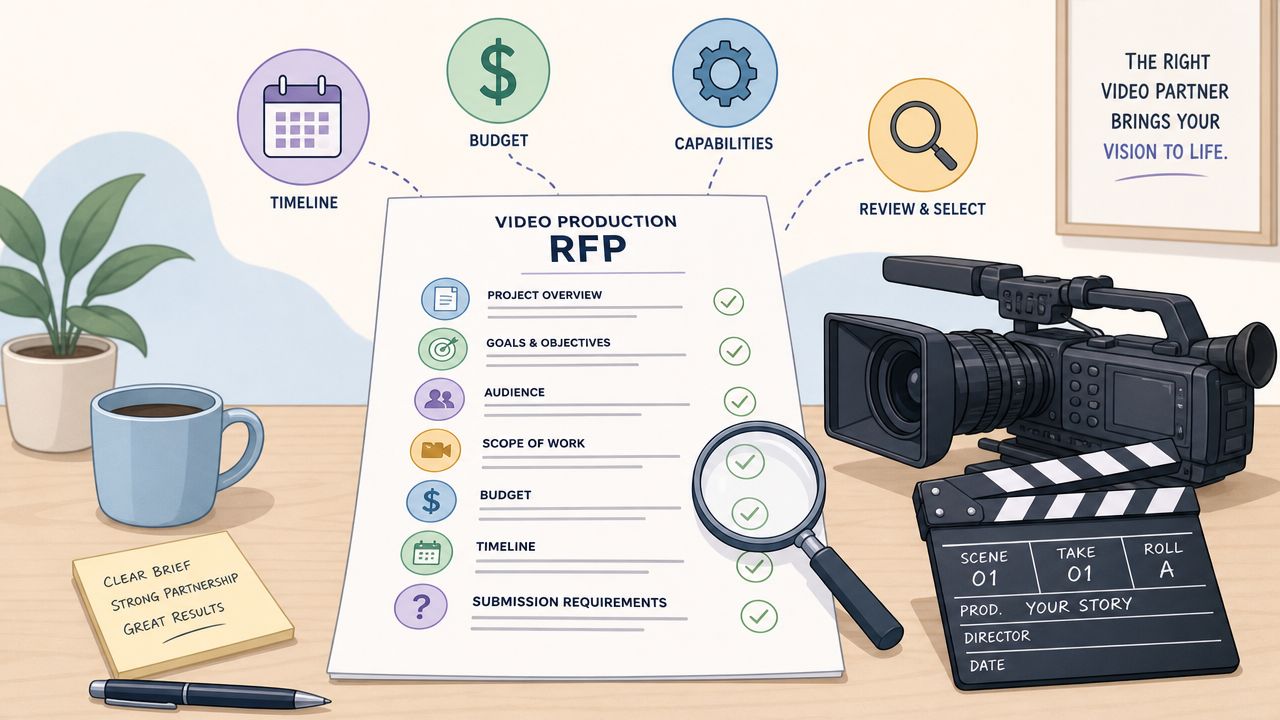
You're probably in one of two situations right now. Either a stakeholder said, “We need a video, can you put together an RFP?” or you've already sent one before and got back proposals that were impossible to compare.
That usually happens for one reason. The document asks vendors for pricing before your team has agreed on what you're buying.
A good RFP for video production isn't a formality. It's a decision tool. It forces internal alignment, gives agencies enough detail to bid responsibly, and makes evaluation fair instead of political. When it's done badly, vendors fill gaps with assumptions. Assumptions turn into mismatched scopes, blown timelines, and budget arguments that should've been avoided before the first call.
The most useful shift is this: stop treating the RFP as a procurement document and start treating it as a business brief with buying rules attached.
Laying the Strategic Foundation for Your RFP
Most weak RFPs fail before the first sentence is written. The problem isn't wording. The problem is that the internal team hasn't answered the basic strategic questions well enough for a vendor to estimate the work.
A strong template may include formal sections, but the essential work happens earlier. As RocketWheel notes in its video production RFP guidance, a 2026 RFP template includes eight key components, but the upfront work on the who (your business), why (the project goal), the second who (your target audience), and when (deadlines) is what clarifies the formal requirements before an agency even provides a quote.
Start with the business objective
If your team says the goal is “brand awareness,” keep pushing. That's usually too broad to guide production decisions.
Ask what problem the video needs to solve. Is sales asking for a product explainer because prospects don't understand the offer? Is marketing trying to improve launch readiness with a hero asset and social cutdowns? Is recruiting trying to attract a different caliber of candidate? Those are very different projects, and they require different scripts, pacing, production value, and distribution plans.
Here's the internal test I use: if two vendors proposed completely different creative directions, would your team know how to judge which one better serves the business? If the answer is no, the objective still isn't clear enough.
Practical rule: If the objective can't guide a yes-or-no decision during vendor review, it's not specific enough for the RFP.
Define the audience like a buyer, not a demographic sheet
Teams often stop at broad audience labels such as “B2B decision-makers” or “millennial consumers.” That doesn't help a production partner shape message, visuals, or tone.
A useful audience definition includes three things:
- Who they are: Job role, buying stage, familiarity with your category, and where they'll likely see the video.
- What they care about: The pressure, friction, or hesitation that the video should address.
- What action matters: What you want them to think, feel, or do after watching.
If your audience is mixed, say so. A launch video aimed at current customers, prospects, and investors usually fails when it tries to speak equally to all three.
Lock the message and timeline before creative discussion expands
The key message should be simple enough that every stakeholder can repeat it the same way. If one executive wants “premium,” another wants “approachable,” and legal wants “strictly informational,” you don't have a creative brief yet. You have a future revision problem.
Use the timeline the same way. Name the immovable dates, the review windows, and the final delivery need. If you've got a campaign launch, product release, conference, or board presentation, spell that out clearly.
For teams still shaping positioning, it helps to review examples of how strategic narrative turns into branded content. This overview of branding video production is useful because it frames video as part of brand communication, not just an isolated asset request.
Anatomy of an Effective Video Production RFP
Once the strategy is settled, the document itself needs to remove ambiguity. The easiest way to judge your draft is simple: can two different vendors read it and scope the same project, even if they propose different creative solutions? If not, it's still too loose.
Company background and project overview
Your company section shouldn't be a long corporate history. Vendors need enough context to understand the business model, the audience, and the role this video plays in your marketing or communications mix.
Keep it concise and operational. Include what your company does, who the video serves, and why this project exists now. Then move quickly into the project overview.
A useful project overview covers:
- Business context: Product launch, rebrand, recruiting push, event opener, website refresh, or campaign support.
- Primary objective: The job this video needs to do.
- Audience: The exact viewer group the vendor should create for.
- Success definition: What internal stakeholders will consider a win.
Scope of work needs phase-by-phase detail
Ambiguity often causes many RFPs to collapse. If you ask for “one brand video plus edits,” vendors will interpret that in wildly different ways. One may price a lean interview-led production. Another may assume concept development, casting, multiple locations, motion graphics, and extensive post.
That's why scope has to be broken into phases. DesignRush's video production RFP guidance says a detailed RFP must define specific financial ceilings, such as a “not to exceed” cap of $90,000, and break the scope into pre-production, production, and post-production so vendors can be evaluated effectively and ambiguous pricing is avoided.
Use that structure directly:
| RFP section | What to specify |
|---|---|
| Pre-production | Concepting, scripting, interview prep, casting, location scouting, scheduling, approvals |
| Production | Number of shoot days, likely locations, crew expectations, interview count, equipment level if relevant |
| Post-production | Number of edits, review rounds, color, sound mix, captions, cutdowns, file delivery |
A better sentence is: “Scope includes concept development, scriptwriting, one day of interviews, one day of b-roll capture, one primary edit, and multiple social cutdowns with closed captions.”
A weak sentence is: “Vendor to handle end-to-end production.”
Deliverables and budget should make comparison possible
Deliverables must be itemized. Don't force agencies to guess what “final files” means.
List every expected output, including versions for website, paid social, sales enablement, internal use, or events. If you need captioned versions, textless masters, vertical crops, or archive files, say it upfront.
Budget is where teams often get nervous, but hiding it wastes everyone's time. If you know the ceiling, say it. If procurement requires a range, give one. If your team is flexible, explain what would justify spending more.
Agencies don't inflate costs because you provided a budget. They price more accurately because you removed the need to reverse-engineer your expectations.
Include a submission section that tells vendors exactly how to respond. Ask for pricing structure, assumptions, timeline, proposed team, relevant work samples, revision process, and rights language. If you want apples-to-apples comparisons, the response format has to be standardized.
Defining Your Creative Vision and Technical Specs
Creative vagueness is expensive. It creates the kind of proposal spread that looks helpful at first and becomes unmanageable later. One vendor interprets “authentic” as handheld user-generated content. Another interprets it as documentary-style interviews with cinematic lighting. Both may be good. Only one may fit your brand.
Give direction without scripting the agency's job for them
The best RFPs don't micromanage creative. They anchor it.
Demoduck's guidance on stronger video production RFPs reports that RFPs with style references such as mood boards or past brand videos, plus clear tone descriptors, achieve 60% higher vendor alignment and reduce creative misalignment by 55%. That tracks with what works in practice. When teams show what they mean by “premium,” “playful,” “UGC-driven,” or “cinematic,” agencies stop guessing.
Use a short reference set instead of a long inspiration dump. Three to five examples is usually enough if each one has a note explaining what matters.
For example:
- Use this for pacing: Fast open, tight edits, minimal setup before the hook.
- Use this for visual feel: Clean product framing, shallow depth of field, controlled lighting.
- Avoid this tone: Too polished, too corporate, too detached from real customer experience.
If you need a concrete example of how a product story can be translated through motion-led execution, this breakdown of BEDHEAD on mattress video animation is a helpful reference point for discussing animation choices, product framing, and message clarity with vendors.
Spell out the non-negotiables
Some requirements aren't creative preferences. They're operating constraints. Put them in the RFP so vendors can price and plan correctly.
Use a simple checklist like this:
- Brand requirements: Logo treatment, colors, typography, prohibited claims, required brand voice.
- Legal requirements: On-screen disclaimers, release language, claim substantiation needs, industry restrictions.
- Accessibility requirements: Closed captions and any inclusivity expectations in casting or representation.
- Technical outputs: Aspect ratios, file types, platform versions, master file expectations, text-safe requirements.
- Approval process: Who signs off on script, rough cut, and final cut.
A vendor can only build a responsible production plan if these constraints are visible from the start.
Translate channel needs into production requirements
Distribution affects production more than many teams realize. Website hero video, LinkedIn paid media, YouTube preroll, and in-person event playback don't ask for the same cut, framing, or pacing.
That means your RFP should connect channels to outputs. If social is a major use case, ask for crop-aware framing and planned cutdowns. If the website is central, specify whether the asset needs silent-first storytelling, captions, and a quick load-friendly master. Teams planning around web performance often benefit from reviewing examples of video production for websites to tighten these requirements before issuing the brief.
The creative brief should answer this question for every bidder: “What are we making, how should it feel, and what constraints can't be ignored?”
Building Your Vendor Scoring Rubric
An RFP without a scoring rubric invites chaos. The loudest stakeholder wins. The cheapest bid gets mistaken for efficiency. The slickest deck gets mistaken for fit.
That's avoidable if the evaluation system exists before proposals arrive.

The point of a rubric isn't bureaucracy. It's discipline. It forces your team to decide what matters most before attachment, politics, or presentation style start distorting judgment.
Weight what matters for this project
Not every video project should be judged the same way. A product launch video may prioritize strategic thinking and executional rigor. A recurring social content engagement may put more weight on workflow and efficiency. A regulated industry project may rank process reliability above visual ambition.
Here's a practical scoring model you can adapt:
| Category | What you're evaluating |
|---|---|
| Creative approach | Does the concept fit the objective, audience, and brand? |
| Experience and portfolio | Has the vendor solved similar problems well? |
| Budget and pricing structure | Is pricing clear, scoped, and aligned to the ask? |
| Timeline and deliverables | Can they deliver what's needed on the schedule required? |
| Communication and responsiveness | Do they answer directly, clarify assumptions, and manage risk well? |
The scoring mindset matters as much as the categories. Don't ask whether a proposal is “impressive.” Ask whether it's credible, aligned, and executable.
Here's a visual example of how a weighted model can work in practice.
Use evidence, not preference
For each category, write what earns a high score. If you skip that step, your rubric becomes subjective anyway.
For example:
- Creative approach scores high when the vendor ties ideas to your objective and audience instead of presenting generic style language.
- Portfolio scores high when examples are relevant in format, audience, or business challenge, not just visually attractive.
- Budget scores high when assumptions are transparent and optional add-ons are separated from core scope.
- Communication scores high when the vendor identifies risks, asks smart questions, and responds in a way your internal team can work with.
A good rubric protects you from two expensive mistakes. Hiring the most charismatic presenter, and hiring the lowest bidder whose scope quietly excludes work you assumed was included.
If your team frequently evaluates outside partners across design, content, and production, it helps to standardize the process beyond video alone. A framework for outsourcing creative services can make cross-functional vendor reviews much easier to run.
Running a Smooth and Fair RFP Process
Operations matter. You can write a smart RFP and still run a poor process that drives away the agencies you'd most want to hire.
The basics still count. Set a clear submission deadline, use one point of contact for all vendor questions, define the required response format, and keep internal reviewers aligned on the rubric. If your team improvises those mechanics midway through the process, vendors notice immediately.

State the rules plainly
Agencies are deciding whether your opportunity is worth pursuing at the same time you're evaluating them. If the process feels disorganized, vague, or stacked, strong shops often opt out.
Be explicit about:
- How many vendors are being invited: This affects how much effort serious bidders will invest.
- What questions may be submitted: And whether answers will be shared with all participants.
- Whether interviews will happen: Don't surprise finalists with a new stage late in the process.
- What procurement constraints exist: Insurance, contracting, legal review, data handling, or payment terms.
Clear process design signals respect. It also improves proposal quality because vendors can scope their response intelligently.
Acknowledge the shadow selection reality
This is the part many guides ignore. Some RFPs are fully open competitions. Others are not.
Data discussed in a Reddit videography thread suggests 60% to 70% of video production RFPs are issued after a vendor has effectively been selected, often to satisfy procurement compliance rather than to discover a new partner, and vendors often waste effort when they submit without any pre-RFP engagement such as a quick sync call (discussion here).
Clients should be honest with themselves about where their process sits. If you already have a preferred vendor, you still need to run a defensible process. That means using the rubric, documenting why the winner was chosen, and avoiding a performative competition that burns agency goodwill.
If you're still actively sourcing production partners, specialized search tools can help widen the field. Teams working in public sector or quasi-public procurement may find a government RFP database useful for understanding how opportunities are structured and discovered.
Fair doesn't always mean every vendor has the same starting position. It means every vendor is judged against the same stated criteria once they're in the process.
Protect time on both sides
One of the fastest ways to damage an RFP process is to let stakeholder feedback drift. If legal, brand, marketing, and leadership all review at different speeds, the process stalls and credibility drops.
Set an internal review calendar before the RFP goes out. Decide who can ask questions, who can score, and who has final authority. Vendors shouldn't have to decode your internal politics from your email cadence.
Final Review and Common RFP Mistakes to Avoid
Before sending the document, do one last pass as if you were the vendor pricing it. Any place where a bidder would have to assume, you still have work to do.
The final review is less about polishing language and more about removing hidden risk. Weak RFPs usually don't fail because they look unprofessional. They fail because they leave too much room for interpretation.

Use this pre-send checklist
Run through these questions before release:
- Are the objectives explicit: Can a vendor explain what business result the video is meant to support?
- Is the budget usable: Have you provided a realistic range or ceiling so pricing doesn't become speculative?
- Are deliverables fully listed: Masters, cutdowns, captions, versions, and formats should all be visible.
- Is the timeline workable: Have you included review windows, approval dependencies, and final delivery expectations?
- Is the scoring rubric ready: Can your team evaluate proposals consistently without inventing criteria later?
- Has legal reviewed the draft: Ownership, usage rights, disclaimers, and procurement rules should be settled before distribution.
Catch the mistakes that create expensive confusion
These are the recurring problems worth stopping cold:
- Vague scope language: “Full-service production” sounds complete and means almost nothing.
- Missing ownership terms: If raw footage, project files, licensed music, or AI-assisted elements matter, spell out rights and usage clearly.
- Unrealistic timing: If the internal team needs long review cycles, the vendor needs to know that before quoting.
- Late requirement changes: New deliverables introduced after proposals arrive make comparison unfair and procurement messy.
- No success definition: If stakeholders can't agree on what success looks like, they'll judge the winner based on taste instead of fit.
A disciplined RFP for video production gives good agencies a fair shot and gives your team a defensible way to choose. That's the standard worth holding.
If your team needs help turning a rough video request into a clear, comparable, and strategically grounded RFP, ReachLabs.ai can help shape the brief, tighten the evaluation process, and support the broader marketing strategy behind the project.