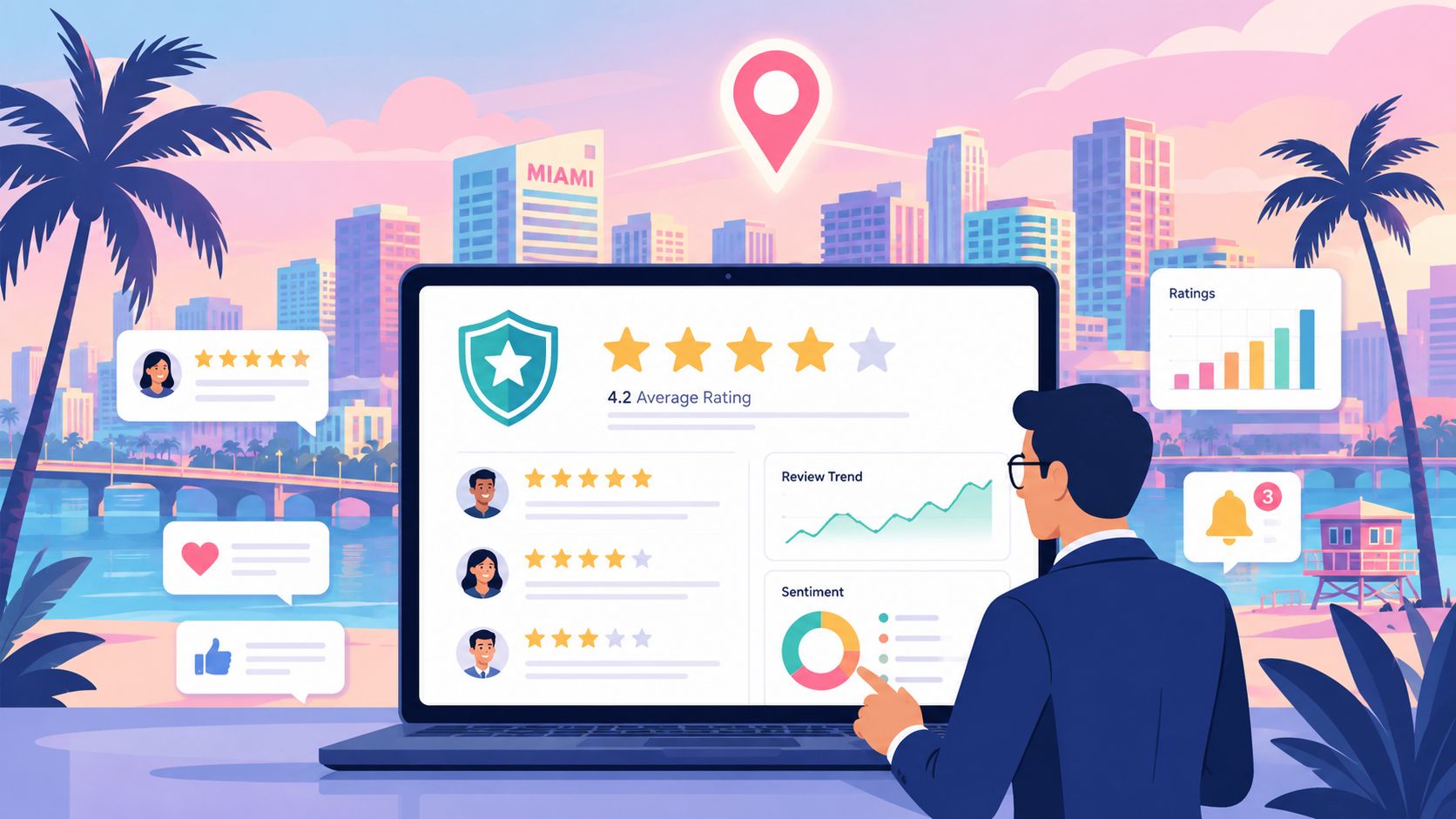
97% of consumers read online reviews before making a purchase according to industry reputation data, so for Miami businesses, the first trust conversation usually happens long before a call, a booking, or a walk-in. In a market where hospitality, real estate, legal services, healthcare, and luxury brands compete on speed and perception, online reputation management Miami isn't a polish exercise. It's a revenue control system.
That matters because reputation now affects both conversion and valuation. One industry source says 88% of consumers trust online reviews as much as personal recommendations, and another reports that a single negative review can cost up to 30% of potential customers in the same reputation statistics overview. The implication is simple, if search results and reviews are weak, every other marketing channel works harder for less return.

If you want a practical reference point beyond theory, browse reputation management resources and compare how different teams approach the same trust problem. The patterns are usually clear, the businesses that win aren't the ones with the loudest response, they're the ones with the most disciplined search presence.
Why Miami Businesses Cannot Afford to Ignore Online Reputation
Miami is a high-visibility market, which makes reputation mistakes more expensive. A property firm, med spa, law office, boutique hotel, or restaurant doesn't need a dozen bad signals to start losing momentum, it just needs to look uncertain on page one. In that environment, reputation is not a side effect of marketing, it's part of the product.
The financial stakes are real. One source reports that a strong reputation can represent over 25% of a company's total market value, while another says reputation can account for 63% of total market value in large companies from the reputation statistics reference. That's why I don't treat ORM as a communications cleanup task. I treat it as an asset-protection issue.
Why first impressions are expensive in local markets
In Miami, searchers often make decisions fast. They scan Google results, read recent reviews, check photos, and move on if something feels stale or unresolved. That's especially true in categories where people compare providers with little patience, like hospitality, healthcare, and professional services.
A useful operational takeaway is to think in terms of trust leakage. If a profile looks neglected, if reviews go unanswered, or if branded search surfaces complaint-heavy results, the buyer doesn't usually complain. They just choose a different provider. The cost of that lost trust is hard to see in a dashboard, but it shows up in missed calls, reduced bookings, and weaker close rates.
Practical rule: in competitive Miami categories, the goal isn't to make every result look perfect. It's to make the first page look controlled, current, and responsive.
Reputation work has to be continuous
The biggest mistake I see is treating reputation like a one-time cleanup project. A business responds to a crisis, fixes a few assets, then stops monitoring until the next problem lands. That's too late, because search results drift as new content appears and old content ages out of attention.
The better model is governance. That means documented ownership, repeatable review workflows, and regular visibility checks. When the market is this crowded, the brands that protect page one consistently tend to outperform the ones that only react when something breaks.
Running an Authority-Gap Audit on Your Branded Search Results
A branded search result can look busy and still fail to build trust. I start by opening an incognito search for the Miami brand, then I document the top 10 results and review each one through two lenses, how much authority it carries, and what it feels like to a prospect who is seeing the business for the first time. That is the authority gap, the space between what you want searchers to see and what they see.

Classify the results before you change anything
Do not start by publishing new content or asking for removals. Start by evaluating the current result set as it appears today. I usually separate results into owned assets, third-party assets, neutral mentions, and negative assets, then I note whether each result is strong, weak, or irrelevant for the branded query.
That classification matters because it shows where the brand is exposed. If page one is dominated by third-party content, outside platforms control more of the story than you do. If owned assets are thin or outdated, there are not enough control points to shape the narrative. If sentiment is mixed, the problem is often less about one bad URL and more about a weak overall signal across search and review surfaces.
The same audit now needs a second lens. Google still matters, but AI search systems are beginning to summarize brands from the same messy inputs, and they do not always surface the same mix of pages. A Miami hospitality group, real estate firm, or law practice can look acceptable in classic search and still appear fragmented in an AI-generated answer if the underlying authority signals are inconsistent.
Build a monitoring stack that won't miss drift
The practical workflow is straightforward. Run weekly branded-search checks, set review alerts, keep media monitoring active, and do quarterly AI-summary audits so you can catch changes in both traditional search and answer engines. The point is to catch shifts early, before they shape buyer perception.
A few control points matter more than the rest:
- Ownership assignment: decide who owns review response, who owns escalation, and who owns search monitoring.
- Review cadence: check branded results on a schedule, not when someone remembers.
- Escalation thresholds: define what triggers legal review, crisis response, or content publishing.
- Baseline documentation: save screenshots, URLs, dates, and sentiment notes so future changes are measurable.
If you are pushing for more positive reviews, use a process that fits the business instead of hoping volume solves the problem. A structured program like this Google review growth framework is more useful than a one-off request burst, because the value comes from consistency, response quality, and how well the reviews support the rest of the branded result set.
The disciplined version of ORM looks boring on purpose. That is good. Search visibility is easier to manage when the process is repeatable, and much harder to rescue when nobody has a baseline.
Optimizing Your Google Business Profile and Local Review Presence
For local visibility, the Google Business Profile is still one of the most useful assets a Miami business can control. ORM guidance points to citation accuracy, fresh profile assets, consistent review response, and regular photo and video updates as core ingredients for local pack visibility. If those basics are sloppy, everything else gets harder, and the gap grows wider when AI search tools try to summarize your brand from uneven signals.

Fix the profile before you chase more reviews
Start with the listing itself. The business name, category, hours, service areas, and contact details need to match everywhere they appear. Then keep the asset current with photos, short videos, and regular updates so the profile does not look abandoned.
I've seen companies focus hard on review acquisition while their profile still has broken details, old photos, and inconsistent service descriptions. That is backwards. Searchers judge the whole listing as one trust signal, not as separate fields. AI search systems do something similar, since they pull from whatever they can verify across the web. If the profile looks maintained, review volume carries more weight. If it looks neglected, even strong reviews lose force.
Treat response speed as part of reputation
Same-day response on high-visibility platforms matters because the first reply often shapes the narrative. That is why ORM guidance recommends answering the same day on Google and Yelp, especially when a negative review could influence future searchers as described in the local ORM SEO guide. Slow replies create a vacuum, and prospects usually fill that vacuum with their worst assumption.
If you need a review-generation workflow, use a process tied to real customer milestones rather than a random request burst. A structured approach like ReachLabs.ai's Google review growth framework is a useful operational reference, especially if your team needs a repeatable ask-and-follow-up system. The point is not to chase volume for its own sake, it is to build steady review growth that supports both local rankings and the brand signals AI search is already pulling into summaries.
Don't over-focus on deleting content
The durable move is to outrank harmful results, not obsess over removal. That means publishing stronger owned assets, earning positive mentions, and building backlinks to the pages you want to control on page one. Deletion has its place, but in most local markets, control comes from depth, consistency, and distribution across the search results that matter.
Prioritizing Response Quality Over Review Volume
The common assumption is that more reviews solve most reputation problems. In practice, that's only half true. For many Miami businesses, especially in hospitality, med spas, restaurants, and professional services, the bigger trust signal is how the business handles public complaints.
BrightLocal's 2024 Local Consumer Review Survey found that 89% of consumers are “likely” or “highly likely” to use a business that responds to all reviews, while 86% are deterred by a business that responds only to negative reviews as cited in Miami reputation management coverage. That's a useful correction to the usual volume-first mindset.
Public response is part of the buying experience
A review reply is not just customer service. It's visible proof that the business pays attention. When prospects see a calm, specific, and timely response, they get a signal that problems won't be ignored after the sale.
That's why complaint handling often matters more than raw volume. A business with fewer reviews but strong response habits can feel more trustworthy than a business with dozens of generic five-star comments and no visible accountability. In Miami, where high-contact service businesses generate recurring public feedback, that distinction can be the difference between a short list and a skipped listing.
Use consistent response patterns
A good response system doesn't need to be flashy. It needs to be consistent.
- Positive reviews: thank the customer, reference the specific service, and reinforce the relationship.
- Neutral reviews: acknowledge the experience and invite direct follow-up if needed.
- Negative reviews: respond quickly, stay factual, and move the resolution path offline when appropriate.
Tone matters as much as content. Defensive replies make the problem look bigger. Overly scripted replies look fake. The best responses sound human, specific, and calm. They acknowledge the issue without turning the public thread into a debate.
Keep the reply short enough that a prospect can read it in a few seconds, but clear enough that the customer feels heard.
For SMBs, that's often more useful than chasing a higher review count at all costs. Review volume helps, but response quality closes the trust gap.
Protecting Your Brand in the Era of AI Search
Traditional ORM has focused on Google results, review sites, and social profiles. That still matters. But there's a new layer now, AI-generated answers, and too many Miami businesses haven't adjusted for it. G2's 2025 Buyer Behavior Report found that 33% of buyers now use AI search tools to research vendors as noted in the industry summary of AI discovery. That changes the job.
If your Google presence is decent but your brand data is inconsistent across the web, AI systems can still surface weak or incomplete summaries. That's the gap most local ORM strategies miss.
Entity consistency is the new trust infrastructure
AI search relies on recognizable entities, repeated context, and structured signals. If your name, services, locations, leadership, and brand descriptions vary too much across profiles, the machine has less confidence in what you are. That can weaken the accuracy of summaries even when the visible review profile looks fine.
This is especially relevant in Miami's service-heavy categories, where prospects compare multiple providers quickly and rely on condensed answers. A law firm, hotel group, or real-estate brand can have strong local SEO and still lose in AI discovery if its public identity is fragmented. The fix starts with consistency, then moves into structured data, strong bios, and aligned third-party mentions.
Build for both search ecosystems at once
The practical approach is to treat traditional search and AI answers as connected but not identical. Google still rewards local authority signals, review activity, and profile freshness. AI systems also care about whether the brand identity is legible, repeatable, and supported by coherent sources.
If you're looking at search engine reputation management specifically, the framing at ReachLabs.ai's SERM resource is relevant because it aligns search visibility with reputation control rather than treating them as separate problems. That's the right mental model. Brand discovery now happens in more than one interface, and the work has to reflect that.
Handling Reputation Crises and Suppressing Negative Content
When reputation damage hits, speed matters, but so does restraint. Fake reviews, complaint-site threads, and damaging articles can all create real search pressure, and the wrong response usually makes the issue more visible. Research cited in ORM industry coverage says more than 30% of over 100 million reviews were inauthentic, and another source estimates fake reviews cost businesses $152 billion annually in the 2025 ORM statistics landscape. That's enough to justify a serious verification process, not a panic spiral.

Assess first, respond second
The first 24 hours are about detection and triage. Confirm what's real, what's fabricated, and what's unfavorable but legitimate. A business that overreacts to fair criticism usually loses credibility, while a business that ignores fraud lets the damage spread.
From there, decide whether the issue is a response problem, a removal problem, or a suppression problem. Many cases are mainly suppression problems, which means the solution is to build stronger assets that push harmful results off page one. That's why deleting content is not the default strategy. It's only one tool.
Use legal tools carefully
Some issues deserve legal review. Defamatory content, fraudulent postings, and copyright violations may justify escalation, and DMCA requests can be appropriate when the material is infringing. For broader context on defamation handling, the guide on defamation claims in business is a useful reference point when legal counsel needs to assess the options.
The key is not to treat legal action as a PR substitute. If the content is lawful but negative, you usually need a search strategy, not a courtroom strategy. If the content is unlawful, legal review should move in parallel with public response, not after the damage has been allowed to compound.
Build the suppression stack, not a one-off fix
Suppression works when you create multiple strong assets, not when you throw one page at the problem and hope. That can include owned content, earned media, profiles, and links pointing to the pages you want ranking. The process at this negative-result removal resource is relevant when you need a structured way to decide what can be removed, what can be de-emphasized, and what needs to be outranked.
Crisis simulation planning matters too. If the team has never rehearsed escalation, approval, and response timing, the first real incident becomes a messy internal meeting instead of a controlled external response.
Measuring Reputation Impact and Building Continuous Governance
The best reputation programs don't report only on star ratings. They track sentiment trends, branded search visibility, local pack performance, and whether AI-generated answers describe the business accurately. That mix gives stakeholders a fuller view of what reputation is doing to demand.
A quarterly report should answer three questions, what changed, why it changed, and what got done about it. If you can't connect monitoring to action, the dashboard is decorative. Continuous governance works because it turns reputation from an emergency response into a managed operating function.
Track outcomes, not vanity metrics
A growing review count is useful, but it's not enough. The more meaningful indicators are whether negative assets are being displaced, whether response quality is improving, and whether branded search is surfacing controlled assets first. For Miami businesses, that's the difference between looking active and staying protected.
The cleanest reputation reports show search movement, review behavior, and escalation history in the same place.
The other reason governance matters is continuity. Search results change, review patterns change, and AI answers change. Businesses that keep monitoring avoid the rebound effect that hits teams who stop after the first cleanup.
Use tools that support the workflow
The tool stack should match the process, not the other way around. You need monitoring for brand mentions, alerts for reviews, and tracking for branded search results and AI summaries. A platform like ReachLabs.ai can sit in that stack if you need coordinated monitoring, review response support, and search-engine reputation management in one place, but the broader principle is the same, pick tools that make governance easier, not just prettier.
For Miami brands, that's the key dividing line. The ones that win long term treat reputation as a standing business process, not a temporary project.
If your Miami brand needs a clearer reputation system, ReachLabs.ai can help you structure monitoring, response, and search visibility around the channels that shape trust. Visit ReachLabs.ai to review the services and decide whether your current ORM process is protecting page one, or just reacting to it.