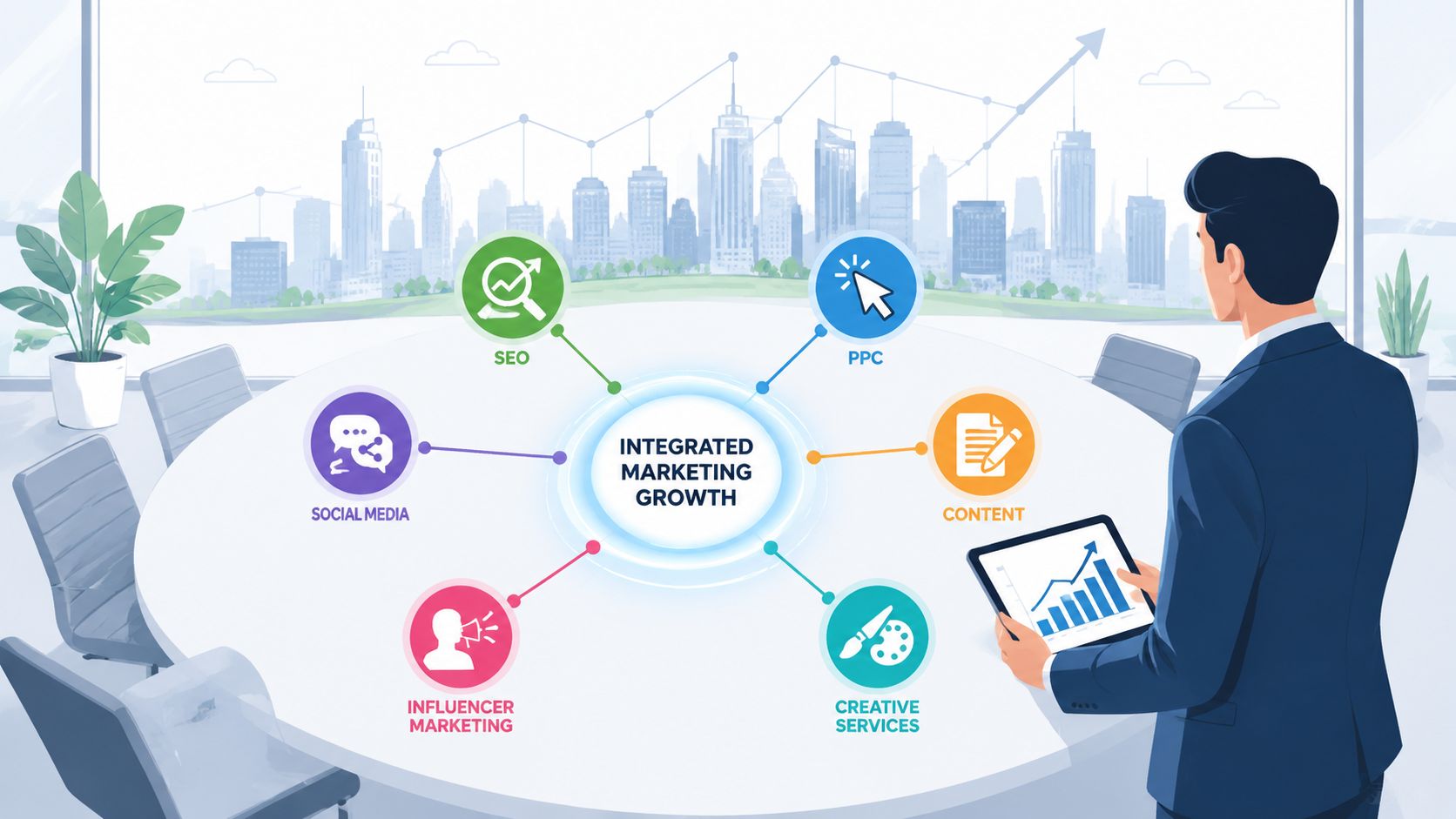

Ever wondered what a digital marketing agency actually is? At its core, it’s an external team you hire to handle all your online marketing efforts. Think of them as the general contractor for your company's digital footprint. They draw up the blueprints (the strategy) and then bring in the specialized crews—like SEO experts, content writers, and ad specialists—to build, manage, and grow your brand online.
Your Guide to Digital Marketing Agencies

So, what does an agency really do day-to-day? Instead of having one marketing generalist trying to do everything, an agency gives you access to a whole team of specialists. Each person is a pro in their own field, from search engine optimization to social media management. This approach lets you tap into deep expertise without the massive overhead of hiring an entire in-house department from the ground up.
Fundamentally, a good agency acts as your strategic partner for growth. They start by digging deep to understand your business, your industry, and—most importantly—your customers. With that foundation, they design and execute a marketing plan aimed at hitting tangible business goals, whether that’s getting more feet through your digital door, generating qualified leads, or driving more online sales.
The Core Functions of an Agency
An agency’s main job is to orchestrate a complex mix of online channels to get your brand’s message in front of the right people, at just the right moment. This usually breaks down into a few key areas:
- Strategy and Planning: This is the roadmap. They figure out your goals, who you need to talk to, and which digital channels are the best places to find them.
- Execution and Management: This is the hands-on work. It involves everything from running ad campaigns and creating social media content to optimizing your website so Google can find it.
- Analysis and Reporting: This is where the magic happens. They constantly track performance, crunch the numbers to see what’s working (and what isn’t), and deliver clear reports that show the return on your investment.
This constant loop of planning, doing, and analyzing is what fuels real growth. It’s this multi-faceted, expert-driven approach that has helped digital agencies see an average annual revenue growth of around 12% in recent years. You can dig into more marketing statistics from HubSpot to see the trends for yourself.
An effective agency doesn't just check boxes. It translates your business objectives into a living, breathing digital strategy, using specialized skills to deliver real results that a single in-house marketer would find nearly impossible to achieve alone.
Core Digital Marketing Services at a Glance
To give you a clearer picture, most agencies build their strategies around a set of core services. Each one is designed to tackle a specific business challenge and contribute to your overall growth.
Here’s a quick breakdown of what those services are and what they aim to accomplish for your business.
| Service Area | Primary Business Goal |
|---|---|
| Search Engine Optimization (SEO) | Increase organic visibility and attract qualified traffic from search engines. |
| Content Marketing | Build brand authority, engage audiences, and generate leads through valuable content. |
| Social Media Marketing | Grow brand awareness, foster community engagement, and drive website traffic. |
| Pay-Per-Click (PPC) Advertising | Generate immediate, targeted traffic and leads through paid ad campaigns. |
| Email Marketing | Nurture leads, retain customers, and drive repeat sales through direct communication. |
| Web Design & Development | Create a high-performing, user-friendly website that converts visitors into customers. |
This table shows how different disciplines come together to create a holistic marketing engine. A great agency knows how to mix and match these services to create a custom plan that fits your specific needs and budget.
A Look at an Agency's Core Services
Think of a top-tier digital marketing agency as a master mechanic’s workshop. You don't just get a single tool; you get a team of specialists who know exactly which combination of tools to use to get your business engine running at peak performance. Each service has a specific job, but it's how they work together that truly drives growth.
Instead of just throwing a bunch of disconnected tactics at the wall, a great agency has a strategic toolkit designed to attract the right people, keep them engaged, and ultimately turn them into customers. Let's pop the hood and look at the most important services they offer.
Search Engine Optimization (SEO)
Search Engine Optimization (SEO) is all about claiming the best real estate in the digital world. When someone searches on Google for a problem you solve, SEO is the work that gets your website to show up right at the top of the results. It’s a long-term play, but it’s how you build a reliable, organic flow of visitors to your site.
An agency tackles the three core parts of SEO:
- Technical SEO: This is the foundation. It’s about making sure your website is built in a way that search engines can easily find, crawl, and understand it.
- On-Page SEO: This involves fine-tuning your actual website content and structure, using the right keywords, and making sure the visitor has a great experience.
- Off-Page SEO: This is about building your site's reputation and authority around the web, mostly by earning links from other trusted websites.
Getting SEO right is a game-changer. It puts you in front of the 53% of all site traffic that comes from organic search—people who are actively looking for what you offer.
Pay-Per-Click (PPC) Advertising
If SEO is like building a storefront in a prime location brick by brick, Pay-Per-Click (PPC) advertising is like buying a giant, flashing billboard right on the main highway. You run paid ads on platforms like Google and social media, and you only pay when someone actually clicks on your ad.
PPC is incredibly effective for getting immediate traffic and leads. An agency handles everything—from bidding on keywords and designing the ads to optimizing the landing pages—to make sure every dollar you spend is working as hard as possible. It’s a direct line to motivated buyers right when they’re ready to pull the trigger.
An expert agency strategy doesn’t choose between SEO and PPC; it balances them. PPC delivers the quick wins and immediate data, while SEO builds a valuable, long-term asset for your brand.
Content and Social Media Marketing
Content marketing is about shifting from "selling" to "helping." You create genuinely useful blog posts, guides, videos, and other resources that solve your audience's problems. This builds incredible trust and makes your brand the obvious choice when they're ready to buy. A solid strategy is the backbone of modern marketing, and you can see more about the impact of a dedicated content marketing agency's services.
Social Media Marketing is the perfect partner to content. It's where you build a community and have real conversations with people on the platforms they use every day. An agency will craft engaging posts, manage interactions, and run targeted ad campaigns to grow your following and start conversations.
For B2B companies, agencies often deploy more advanced tactics like Account-Based Marketing (ABM), which focuses marketing and sales efforts on a specific list of high-value target companies. When used together, content and social media transform your brand from just another option into an essential partner.
How Agencies Turn Strategy Into Results
A digital marketing agency’s real value isn’t just in the list of services it offers, but in its process—a tried-and-true method for turning business goals into real-world results. Think of it like a skilled chef with a signature recipe; there’s a structured approach that ensures a high-quality outcome, every single time. It’s a constant cycle of learning, doing, and refining.
The journey always kicks off with a deep dive into your business. This is far more than just a quick questionnaire. It's a full-blown discovery phase where the agency essentially becomes a student of your brand, digging into your market position, auditing your existing digital footprint, and sizing up the competition. This foundational work ensures the strategy is built on solid data, not guesswork.
This initial flow shows how an agency moves methodically from understanding your business to getting campaigns out the door.
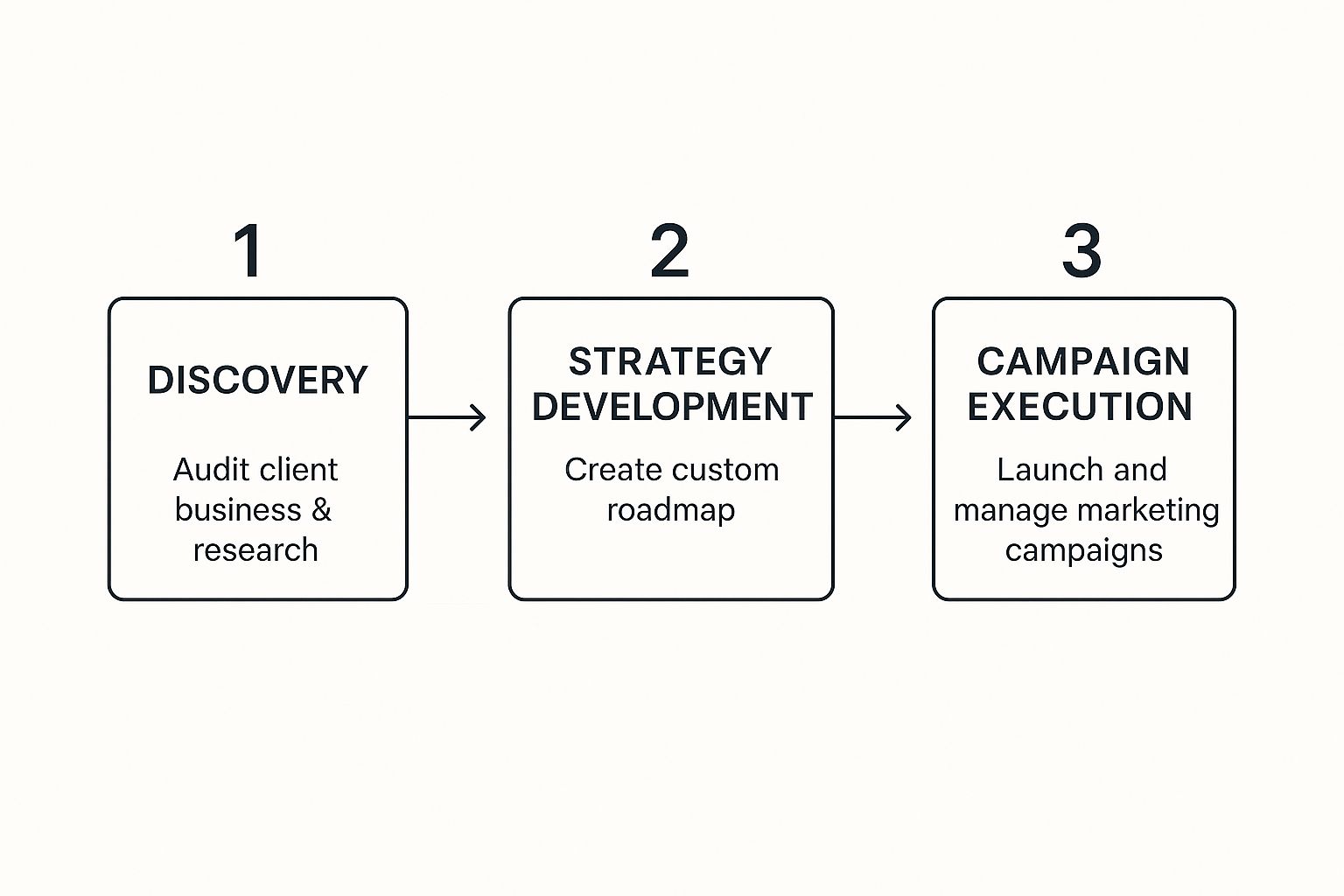
As you can see, every action is a direct result of the step before it, creating a logical path from research all the way to execution.
Developing a Custom Roadmap
With a firm grasp of your business, the agency starts mapping out the strategy. This is where they build a custom roadmap designed to hit your specific targets. It’s not a copy-paste template. It’s a detailed game plan that specifies which channels to use (like SEO, PPC, or social media), the core messages to push, and the Key Performance Indicators (KPIs) that will tell you if you’re winning.
This strategic document becomes the North Star for all marketing activities, making sure every campaign, social post, and ad is pulling in the same direction. It’s incredible to see how far this has come. What started as simple banner ad placements in the early 2000s has evolved into the complex, multi-channel strategies that agencies build today.
Execution and Constant Optimization
Once you give the strategy the green light, it’s go-time. The agency's specialists roll up their sleeves and get to work—launching campaigns, creating content, and managing your digital channels. But their job doesn't stop there. In fact, this is where the real work begins: a continuous loop of performance analysis and optimization.
An agency's job isn't to 'set it and forget it.' It's to constantly ask, 'How can we make this better?' This iterative process of testing, learning, and refining is what separates a good agency from a great one.
They obsess over the data, figuring out what's clicking with your audience and what's falling flat. Is a particular ad creative not getting the job done? They’ll test a new one. Is a blog post bringing in a ton of traffic? They'll double down and create more content around that topic.
This relentless focus on data is what maximizes your return on investment. And proving that ROI is everything. That’s why agencies rely on powerful SEO reporting tools for agencies to deliver clear, actionable insights. At the end of the day, success comes down to tracking the right numbers, which is why it's so important to know how to measure marketing campaign success.
Why Partnering With an Agency Makes Sense

Knowing what a digital marketing agency does is one thing. But understanding why bringing one on board is a game-changer for so many businesses is another entirely. When you boil it all down, it comes back to three huge advantages: specialized talent, powerful tools, and a much stronger return on your investment.
Think of it like building a house. You could try to do everything yourself, but that means you'd need to be an expert plumber, a master electrician, a skilled carpenter, and a structural engineer all at once. It’s not realistic.
Hiring an agency is like bringing in a crew of certified pros. You get an entire team of specialists for less than the cost of a single senior-level marketing hire.
Tapping Into a Team of Specialists
When you partner with an agency, you’re not just getting an extra pair of hands. You’re effectively onboarding an entire, pre-built marketing department filled with people who live and breathe their specific craft. This immediately closes any skill gaps on your team without the headaches and costs of a long hiring process.
Suddenly, you have:
- An SEO Strategist obsessed with getting you to the top of Google.
- A PPC Manager who knows how to squeeze every drop of value from your ad budget.
- A Content Creator skilled at writing posts and emails that people actually want to read.
- A Data Analyst who can look at a spreadsheet and see a clear path to growth.
This deep bench of expertise ensures every part of your marketing strategy is managed by a true professional. The question of building an internal team or outsourcing is a big one. For a deeper look at the pros and cons, you can explore this detailed comparison of a marketing agency vs in-house team.
Access to Top-Tier Tools and Technology
The best marketing tools are incredibly effective, but they also come with a hefty price tag. We’re talking thousands of dollars a month for the premium software needed for deep analytics, keyword research, and competitor intelligence.
An agency spreads the cost of these enterprise-level tools across all its clients. This gives you access to the same powerful technology as your biggest competitors for a fraction of what it would cost to license it yourself.
This access completely levels the playing field. Beyond the tools, an agency brings a fresh, objective perspective to the table. They aren't caught up in internal company politics—their only mission is to deliver results based on cold, hard data. Every recommendation is about what the numbers show will actually grow your business, ensuring your marketing dollars are always working as hard as possible.
How to Choose the Right Agency for Your Business
Picking a marketing partner is one of those make-or-break decisions for your business. The right agency feels like a true extension of your team, genuinely invested in driving growth. The wrong one, however, can burn through your budget and time with little to show for it.
Knowing what an agency does is one thing, but knowing how to pick the right one is a completely different ballgame. This isn't just about ticking boxes on a services list. It’s about finding a team whose culture, communication style, and strategic mindset really click with your own. The best partnerships are built on a foundation of trust, clear goals, and a shared drive to win.
Key Questions to Ask Any Potential Agency
Before you even think about signing a contract, you need to do your homework. Think of this process as a high-stakes job interview—because it is. You’re hiring a team to take the lead on growing your company.
Here are a few practical questions to get the conversation rolling:
- How do you actually measure and report on success? You want to hear them talk about things that matter to your bottom line, like lead quality, conversion rates, and return on investment. If they just talk about "likes" and "impressions," that's a sign they might be focused on vanity metrics.
- What does your onboarding process look like, and how often will we talk? A great agency won’t just wing it. They'll have a structured plan for getting you started and a clear rhythm for meetings and reports.
- Can you show me case studies from clients in our industry? Nothing speaks louder than proven results. Ask to see real data from businesses similar to yours—it's the best predictor of how they'll perform for you.
- Who from your team will be handling our account day-to-day? Get a feel for the experience level of the people who will actually be in the trenches, managing your campaigns and strategy.
Asking these questions helps you cut through the sales pitch and see how the agency really operates behind the scenes.
Red Flags to Watch Out For
Just as you're looking for green flags, you need to be on high alert for red ones. Some promises sound amazing on the surface but are completely hollow underneath.
A huge red flag is any agency that guarantees a #1 ranking on Google. SEO is far too complex and unpredictable for anyone to honestly make that promise. Real experts talk about building a solid strategy and earning results over time, not making impossible guarantees.
Be skeptical of any agency that’s cagey about their methods, won't provide client references, or uses high-pressure tactics to get you to sign. A confident and capable partner will be transparent, honest, and focused on building a lasting relationship—not just closing a deal. Choosing wisely here is the first, and most important, step in your new marketing journey.
What a Modern Marketing Agency Actually Does
The marketing agency you hired five years ago probably isn't the same kind of partner you need today. The entire game has changed. It's no longer about just running some ads or posting on social media. A modern agency has become a strategic guide, someone who can see around the corners and prepare your business for what's next.
Think of it this way: they've shifted from being a simple service provider to a genuine growth partner. Instead of just reacting to market shifts, the best agencies are out in front, anticipating changes in technology and consumer habits so you don't have to.
Keeping You Ahead with AI and New Tech
Artificial intelligence isn't some far-off sci-fi concept anymore; it's a real tool that’s making marketing smarter and more efficient right now. Top agencies are weaving AI into everything they do, from using predictive analytics to get the most out of your ad budget to generating personalized content on a scale that was once unimaginable.
This isn't just a minor tweak—it's a fundamental change in how marketing works. A whopping 73% of agency leaders say generative AI has completely upended their approach to SEO. It's a whole new ballgame where content has to be designed for AI-powered search engines, which often means creating new formats that give users answers instantly. You can get a deeper look at how AI is shaping digital trends in this Deloitte report.
A modern agency doesn't see technology as a replacement for human expertise but as a powerful amplifier. The goal is to blend the creative intuition of talented marketers with the analytical power of AI to achieve superior results.
Navigating a Cookieless World and Data Privacy
Another huge shift on the horizon is the move toward greater data privacy. The era of tracking users across the web with third-party cookies is coming to an end. A forward-thinking agency isn't waiting for this to happen—they're already preparing for it.
This means helping their clients build solid first-party data strategies. Instead of buying data, the focus is now on earning it ethically through things like email newsletters, customer accounts, and loyalty programs. It's about building direct relationships with your audience and gathering information with their full consent.
A Few Common Questions About Digital Marketing Agencies
Even after you've done your homework, it’s completely normal to have some final questions before you sign on the dotted line. Bringing on a marketing partner is a big decision, and you want to feel confident.
Let's walk through some of the most frequent questions business owners ask. Think of this as the last step in your checklist before you commit to a new growth partner.
So, How Much Does This Actually Cost?
This is usually the first thing people want to know, and the honest answer is: it depends. The cost of hiring an agency is tied directly to what you need them to do, what your business goals are, and the kind of expertise it'll take to get you there.
Most agencies work on a monthly retainer. This could be anywhere from $1,500 for a small, focused campaign to well over $10,000 per month for a comprehensive, multi-channel strategy. The trick is to see this as an investment in your company’s growth, not just an expense, and to focus on the return you'll get.
How Long Until I See Results?
The timeline for seeing a real impact depends entirely on the marketing channels we're talking about. Some tactics get you quick wins, while others are more of a slow burn. A good agency will be upfront about what to expect.
- Pay-Per-Click (PPC) Advertising: This is the fast lane. A well-managed PPC campaign on a platform like Google Ads can start bringing in traffic and leads almost immediately—sometimes within the first few days.
- Search Engine Optimization (SEO): Think of SEO as building a valuable asset for your business. It’s a long-term play, and it generally takes about 4-6 months to see significant movement in your organic search rankings and website traffic.
Should I Go with a Niche Specialist or a Full-Service Agency?
This really boils down to your main business challenge. If you have one glaring problem that needs fixing, a specialist can be a great choice. For example, if your only goal is to get to the top of Google's search results, an agency that only does SEO will have that deep, focused knowledge you need.
On the other hand, if you're looking to build a strong brand that shows up everywhere your customers are—social media, their email inbox, paid ads—then a full-service agency is probably your best bet. They can create a unified strategy that makes sure all your marketing efforts are working together, giving you a much bigger bang for your buck.
Ready to see how a dedicated team of specialists can help you grow? The experts at ReachLabs.ai build data-driven strategies that deliver real results. Schedule a consultation today to get your custom growth plan.