
Building brand equity isn't a quick marketing tactic; it's a long-game strategy that turns your brand's name into one of your most valuable assets. At its core, it’s about carefully shaping how customers see and feel about you, creating positive connections through every single interaction. Done right, this fosters real loyalty and gives you the power to command a price premium.
Why Brand Equity Is a Powerful Business Asset
Think of brand equity as the stored value of your reputation in the market. When a customer picks Nike over a no-name sneaker or happily pays more for an Apple product, they're not just buying a thing. They're buying into the trust, the quality, and the identity that the brand has painstakingly built over years.
This intangible value delivers very real business advantages.
A company with strong brand equity is far more resilient when the market gets rocky and can introduce new products with a built-in audience. Customers who have a deep, positive connection with a brand are also more forgiving of the occasional misstep and less likely to jump ship over a small price increase. It's a powerful competitive moat.
The data backs this up. A solid 81% of consumers say that trusting a brand to do what’s right is a dealbreaker in their purchasing decisions. This is where the real work lies—you're not just moving inventory, you're building a relationship founded on reliability and shared values.
The Four Pillars of Building Brand Equity
So, how do you actually build this powerful asset? I've found it's best to break the process down into four foundational pillars. This framework gives you a clear roadmap, ensuring every marketing dollar and every piece of content is pulling in the same direction.
Here's a quick look at those pillars, which we'll dive into throughout this guide.
| Pillar | Core Focus | Key Outcome |
|---|---|---|
| Brand Identity | Who you are at your core—your mission, values, voice, and visual style. | Consistency that makes your brand instantly recognizable and distinct. |
| Customer Experience | Every interaction a customer has with you, from your website to your support team. | Positive emotional connections that build deep-seated loyalty. |
| Brand Perception | How your target audience actually sees and talks about you. | A strong, favorable reputation built on trust and positive word-of-mouth. |
| Measurement & Tracking | Using data to understand your brand's health and performance over time. | Informed, strategic decisions that continuously strengthen your equity. |
These pillars don't exist in a vacuum; they all work together to support and strengthen each other.
This infographic helps visualize how these four pillars—Identity, Experience, Perception, and Measurement—come together to form the structure of a powerful brand.
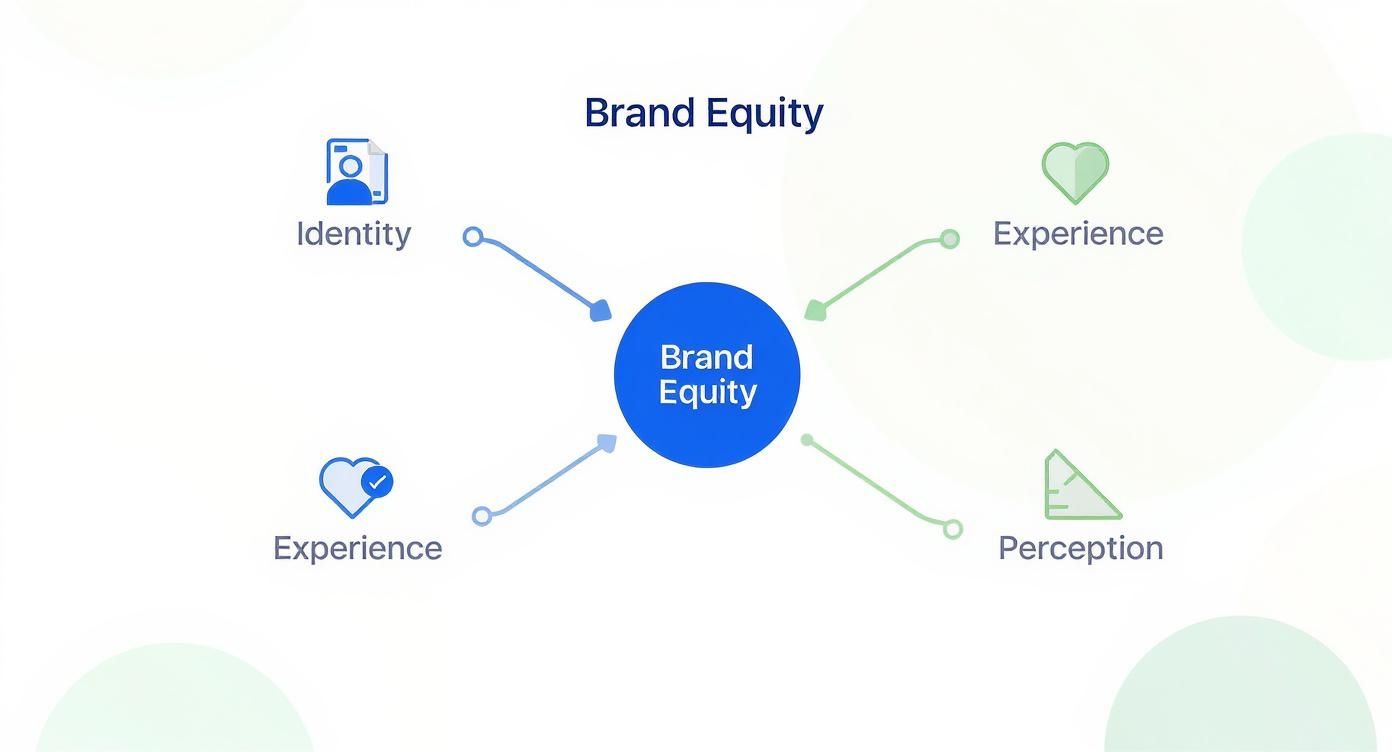
As you can see, it's a cycle. A clear identity informs the customer experience, that experience shapes public perception, and diligent measurement tells you where to adjust and improve.
It’s important to note that while brand equity and brand awareness are related, they’re not the same thing. Awareness is just the first step. If you want to get that initial piece right, our guide on how to improve brand awareness is a great place to start. Now, let's get into building each of these pillars.
Defining Your Authentic Brand Identity

Before anyone can fall in love with your brand, you have to know it inside and out. This is the absolute foundation of brand equity. A truly authentic identity is so much more than a logo or a slick color scheme; it’s the combination of your mission, your core values, your unique voice, and the personality that shines through everything you do.
Think of it as your brand's compass. It should guide every blog post, every social media reply, and every product decision. Without that clear direction, your marketing feels scattered, and potential customers are left scratching their heads, wondering what you're all about.
Uncovering Your Core Mission and Values
What’s your "why?" I mean, beyond just turning a profit. That's your mission. And your values? Those are the principles you’d stick to no matter what. Figuring this out isn't something you can just brainstorm over a coffee break; it takes a real, honest look at what makes your company tick.
I've found that one of the best ways to get to the heart of this is by running a brand workshop. Get your key people in a room—from the C-suite to the folks on the front lines with customers—and start asking the tough questions:
- What specific problem are we solving better than anyone else out there?
- If our brand was a person, what three words would define their personality?
- What's the one thing we'd never compromise on, even if it meant losing money?
The answers you get are gold. They're the building blocks of your identity. For instance, if everyone agrees your brand's personality is "playful," then your social media should be full of wit and casual chats, not buttoned-up corporate speak.
A strong brand identity gives you a filter for decision-making. If an opportunity doesn't align with your core values, it's easier to say no and stay focused on what truly matters for long-term equity.
Developing a Consistent Voice and Visual Language
Once you’ve nailed down your core principles, you need to bring them to life with a consistent voice and a distinct visual style. And consistency is everything here. We're not just guessing—studies have shown that a consistent brand presentation can boost revenue by up to 33%.
Your brand's voice is how you talk. Are you an authoritative expert or a friendly, approachable guide? The trick is to define it, document it, and use it everywhere. The same goes for your visual identity, which covers your logo, color palette, fonts, and the style of your photography or illustrations.
To keep everyone on the same page and build that cohesive feel, it’s crucial to create effective brand guidelines. This document becomes the single source of truth for your entire team and any freelancers or agencies you work with.
For a deeper dive, our own guide on how to create brand guidelines walks through the process step-by-step. Remember, a well-defined identity doesn't just make you memorable; it attracts the right people and lays the groundwork for the kind of brand equity that lasts.
Creating Memorable Customer Experiences

A strong brand identity gets you in the door, but real brand equity is built one interaction at a time. Every single touchpoint—from that first website click to a late-night chat with your support team—is a moment of truth. It's where your brand’s promises either come to life or fall flat.
This is why a consistently positive customer experience is absolutely critical. What good is a brilliant social media campaign if your checkout process is a nightmare? Or if the product itself doesn't live up to the hype? These kinds of disconnects create friction and plant seeds of doubt, actively chipping away at the trust you're working so hard to earn.
Mapping the Moments That Matter
To get this right, you have to see your brand through your customer's eyes. The best way I’ve found to do this is with customer journey mapping. It’s essentially a visual blueprint of every single way a person interacts with your business, from the moment they first hear about you to long after they’ve made a purchase.
And you have to think way beyond the traditional sales funnel. I'm talking about the small, often-overlooked interactions that truly define the experience:
- The Unboxing: What’s that first physical impression like when your product arrives?
- The First Use: Is it an "aha!" moment or a frustrating slog through a confusing manual?
- The Support Ticket: When they reach out for help, do they feel heard and valued, or like just another number?
- The Follow-Up Email: Is it a generic marketing blast or a genuinely helpful, relevant message?
Each of these points is a hinge on which a customer's loyalty can swing. A clunky setup for a new piece of software, for instance, can immediately erase all the goodwill your marketing created. By mapping out these steps, you can spot the friction points and, more importantly, find opportunities to create unexpectedly great moments.
Building brand equity is about managing the sum of all experiences. A single, standout positive interaction, like a support agent going above and beyond, can forge a stronger emotional connection than a multi-million dollar ad campaign ever could.
Turning Customers into Brand Advocates
A smooth, painless experience is the minimum requirement. A truly memorable one is what turns a one-time buyer into a passionate advocate for your brand.
This is where you can get really strategic. Personalization, for example, makes people feel seen. It can be as simple as recommending products based on their browsing history or as thoughtful as sending a personalized birthday discount.
Proactive support is another game-changer. Don't just wait for customers to come to you with problems. If you see someone spending a lot of time on a specific help page, why not have a chatbot pop up with a helpful "Looks like you're working on X, can I help?" You turn a moment of potential frustration into one of proactive care.
It's clear businesses are catching on. As of late 2023, over 75% of companies planned to increase their investment in brand strategies, often prioritizing it over physical assets. This trend tells us one thing: in a crowded market, the quality of the experience is the ultimate differentiator. You can dig into more branding statistics to see how this is shaking up marketing budgets.
When you intentionally focus on creating these positive, problem-solving interactions, you're making a direct investment in building brand equity that lasts.
Building Unshakeable Brand Trust and Credibility

In a market flooded with noise and skepticism, trust isn't just a nice-to-have. It’s the currency of your brand. A great customer experience gets you in the door, but genuine, long-term credibility is forged through deliberate, transparent actions. It's about proving you’re reliable.
This means you have to move past simply making promises and start actively demonstrating your integrity. It really boils down to showing, not just telling. When you operate with transparency, you're signaling to customers that you have nothing to hide, and that’s a powerful first step in building a solid foundation of trust.
Tap into Social Proof and Communicate Openly
One of the most potent tools in your arsenal for building credibility is social proof. Let's be honest, what other people say about you will always carry more weight than what you say about yourself. This is why authentic customer reviews and testimonials are absolute gold.
Don't just sit back and hope reviews trickle in. You need to actively encourage them. After a customer makes a purchase or has a great support interaction, follow up with a simple, non-pushy email asking for their thoughts. By showcasing these reviews—the good and even the constructive ones—on your website and product pages, you create a feedback loop that new customers can see and trust.
This commitment to transparency should also extend to your operations. Being open about how you source materials, your production process, or even owning up to a mistake and explaining how you're fixing it can do wonders for your brand's reputation.
"Trust has effectively become the new crucial currency of brand equity. When customers believe in your brand's integrity, they aren't just buying a product; they are investing in a relationship built on reliability and shared values."
This isn't just a gut feeling; it’s a massive factor in buying decisions. In fact, research from Edelman's 2021 report showed that 81% of consumers said trusting a brand to "do what is right" is a deal-breaker. You can dig into more of these findings on the importance of brand trust.
Establish Authority by Sharing Your Expertise
Beyond customer feedback, another key strategy is to position your brand as a true expert in your field. This is where strategic content and thought leadership come into play.
Here are a few ways to demonstrate that expertise:
- Publish in-depth guides: Create genuinely helpful content that solves your audience's problems. This positions you as their go-to resource.
- Get industry certifications: Displaying relevant certifications or awards is instant third-party validation of your skills and quality.
- Host webinars or workshops: Sharing your knowledge live allows you to engage directly with your audience, answer their questions on the spot, and solidify your authority.
Think about a cybersecurity firm that publishes a detailed annual report on emerging digital threats. This content not only provides immense value but also cements their position as a credible, trustworthy leader. Every piece of high-value content you create is another brick in the foundation of your brand's credibility, directly helping you build brand equity that can stand the test of time.
How to Measure Your Brand Equity and Track Growth
It’s an old saying, but it holds true: you can't improve what you don't measure. Brand equity often feels like this vague, intangible thing built on customer feelings and perceptions, but you absolutely can—and should—put numbers to it.
Tracking the health of your brand gives you a crucial feedback loop. It's how you figure out what’s actually working, what's falling flat, and where you should be putting your time and money to get the best results. The goal isn't to get bogged down in complex academic formulas, but to find a smart mix of financial data and customer-focused metrics that paint a clear, real-world picture of your brand's strength.
Building Your Brand Equity Dashboard
Think about your measurement strategy like a simple dashboard for your car. You don't need to see every single mechanical reading at once—just a few reliable indicators that tell you how you're doing. A good place to start is by tracking a handful of these key metrics.
- Brand Awareness: This is your foundation. How many people even know you exist? You can get a read on this by tracking your share of voice, direct traffic to your website, and social media mentions. A steady increase in people searching for your brand by name is one of the strongest signals you can get.
- Net Promoter Score (NPS): It all boils down to one simple question: "How likely are you to recommend our brand?" The score you get back is a powerful, direct measure of customer satisfaction and loyalty.
- Customer Lifetime Value (CLV): A high CLV is solid proof that customers aren't just making one-off purchases. They're sticking around because they trust your brand and what you offer.
Once you start monitoring these key performance indicators, you can establish a baseline and set clear, realistic goals for growth. For a more detailed walkthrough, our complete guide on how to measure brand equity dives much deeper into setting up your own tracking system.
Tying Equity to Financial Performance
Beyond surveys and sentiment, your bottom line tells a powerful story about your brand's real-world influence. Two financial metrics are especially useful for seeing how your equity translates directly into business value.
First up is Price Premium. Can you charge more for your product than a generic competitor without seeing your sales plummet? That ability to command a higher price is a direct reflection of the perceived value your brand has built.
Second, take a hard look at your Market Share. If you're consistently capturing a larger slice of the pie, it means customers are actively choosing you over the competition—a clear sign of strong brand equity.
Just look at the classic battle between Coca-Cola and Pepsi. For decades, Coca-Cola has been able to maintain a price premium in many markets, a testament to the immense brand equity built over a century. Consumers aren't just buying a soda; they're buying a feeling and a history they associate with the Coke brand.
The Right Tools and Methods for the Job
Gathering this data doesn't have to break the bank. You can get started with simple, effective tools like customer surveys, keeping an eye on social media conversations, and tracking online mentions of your brand.
As you grow, you might want a more centralized way to keep track of everything. For anyone looking for a more automated approach, this A Guide to Brand Tracking Software is a fantastic resource. These platforms pull all your data together, helping you spot trends and make smarter, faster decisions to keep building your brand.
Common Questions About Building Brand Equity
When you start digging into how to build brand equity, a few questions always seem to pop up. It’s a big undertaking, so it’s completely normal to wonder about timelines, budgets, and how all these branding terms actually differ. Let’s tackle some of the most common ones I hear.
One of the first things people ask is, "How long does this really take?" The honest answer? Building meaningful brand equity is a marathon, not a sprint. You might see some encouraging signs in a few months—a nice bump in positive social media mentions, for example—but developing the kind of deep, lasting equity that lets you command higher prices and earn unshakable loyalty often takes several years of consistent, focused work.
Can Small Businesses Actually Compete?
Another big question is whether a small business can build a powerful brand without a massive budget. My answer is always a resounding yes. You don't need a Super Bowl-sized ad spend to create a brand that people genuinely connect with.
For smaller businesses, the path to strong brand equity is paved with community and incredible service, not just big ad campaigns.
- Own your niche: Instead of trying to appeal to everyone, become the undisputed champion of a specific community. Be the go-to resource they can't live without.
- Create legendary customer service: Give your team the power to solve problems and create those "wow" moments that people can't stop talking about. A single fantastic support experience can spark more positive word-of-mouth than an expensive ad.
- Harness the power of your fans: Encourage your happiest customers to share their stories and photos. Featuring their content is a powerful, authentic, and low-cost way to build trust.
These strategies work so well because they’re all about fostering real connection. That’s the foundation of any brand that lasts.
I always tell smaller brands this: A huge corporation can buy attention, but a small business has the unique ability to earn affection through personal touches and genuine community building.
Awareness vs. Equity: What’s the Difference?
Finally, let's clear up the confusion between brand awareness and brand equity. They are not the same thing.
Brand awareness is simply that people have heard of you. Brand equity, on the other hand, means they know your name and connect it with positive feelings, trust, and a belief in your value.
Awareness is just the first step; equity is the ultimate prize. Think about it—a brand can be famous for all the wrong reasons (hello, negative equity). The real goal isn't just getting impressions; it's shaping the quality of that perception. True brand equity is what makes a customer pick you over a competitor, stick with you through thick and thin, and rave about you to their friends.
Ready to build a brand that truly connects and drives growth? The team at ReachLabs.ai blends expert strategy with creative execution to make your brand's voice heard. Discover how our full-service marketing approach can work for you.