
The most popular advice about thought leadership is also the least useful: publish consistently, share strong opinions, and build awareness. That approach can produce a busy content calendar without changing how buyers evaluate your company. A serious thought leadership strategy does something harder. It earns trust, helps buying groups reach agreement, and gives sales and customer teams credible material to use after the first click.
The distinction matters because decision-makers don't treat high-quality thought leadership as decorative brand content. A widely cited 2024 global B2B study found that 73% of surveyed decision-makers considered thought leadership a more trustworthy basis for assessing an organization's capabilities than marketing materials and product sheets, while 58% read at least an hour of it each week (2024 B2B thought leadership statistics). Your program should therefore be designed around decisions, not output.
Why Most Thought Leadership Strategies Fail
Most programs fail before the first article is published. The team defines success as visibility, assigns a publishing cadence, and asks senior leaders for opinions. Nobody maps the buying committee, identifies the internal objections that stall deals, or determines which claims need original evidence. The result is content that signals activity but rarely helps a buyer make a defensible decision.
That top-of-funnel framing ignores how B2B purchases work. A prospect may discover a report through search, share it with finance, ask an operations leader to challenge its assumptions, and bring the same material into procurement. A piece that only introduces the brand has limited value once several stakeholders begin testing risk, implementation effort, and commercial fit.
Practical rule: If a buyer can't use the content to explain, compare, justify, or challenge a decision internally, it probably isn't strategic thought leadership.
The strongest evidence points to thought leadership as a trust asset. The 2024 Edelman-LinkedIn report found that 73% of decision-makers viewed it as more trustworthy for assessing organizational capabilities than marketing materials or product sheets (Edelman-LinkedIn B2B Thought Leadership Impact Report). That doesn't mean every blog post influences revenue. It means buyers are willing to use credible expertise as part of their evaluation, provided the content gives them something more useful than a polished sales argument.
Activity isn't influence
High publishing volume can conceal weak strategic choices. Teams often recycle familiar industry commentary, optimize narrow keywords, and distribute every article through the same brand account. Those tactics may create impressions, but they don't necessarily reach hidden stakeholders or reduce disagreement among people who weren't present for the original conversation.
A better program asks three questions before publication:
- Which decision does this inform?
- Which stakeholder needs to believe it?
- What evidence makes the position defensible?
Thought leadership should travel with the buyer from awareness through consideration, procurement, implementation, and renewal. Treating it as a campaign leaves value on the table. Treating it as an operating system for trust gives every customer-facing team a sharper way to create alignment.
What a Real Thought Leadership Strategy Actually Is
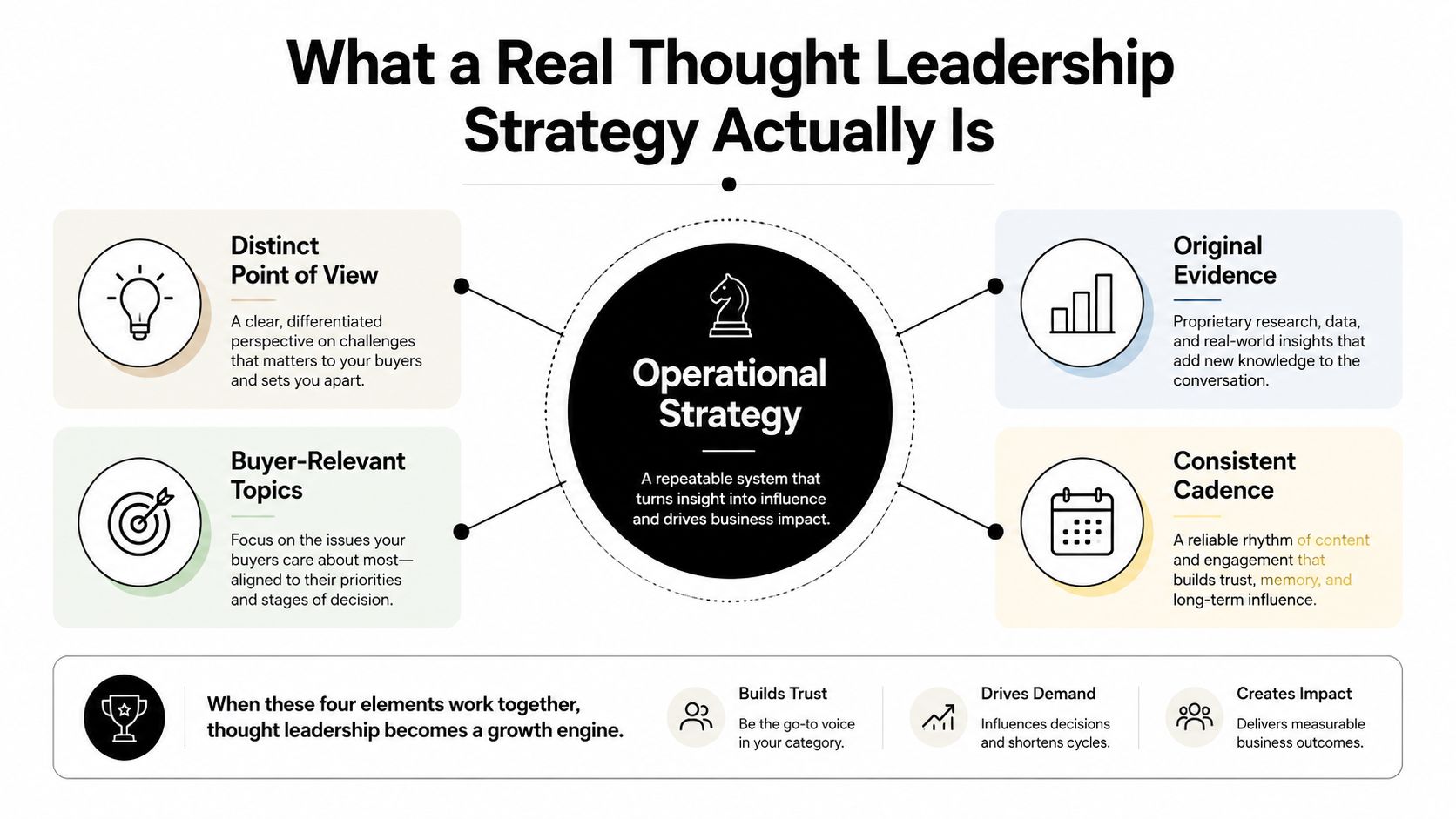
A real thought leadership strategy is an operating model for turning expertise into buyer confidence. It combines a distinct point of view, credible evidence, topics connected to important decisions, and distribution that reaches both visible decision-makers and less visible influencers. A product announcement can support a launch. A search-optimized article can capture demand. Thought leadership must add interpretation that helps an audience understand what changed, why it matters, and what action follows.
The distinction becomes clearer when you audit individual assets. Repackaged opinions repeat what the market already knows. Product marketing explains why your offer is valuable. Thought leadership identifies a meaningful problem, makes a defensible argument, and gives readers a useful way to act even before they become customers. The work can mention your category, but it shouldn't depend on a product pitch to justify its existence.
Four operating requirements
A distinct point of view gives the program a recognizable position. It might challenge a common category assumption, propose a different operating model, or connect two issues buyers usually treat separately. The view needs boundaries. If it agrees with everyone, it won't help anyone choose.
Original evidence turns confidence into credibility. That evidence can come from proprietary research, customer patterns that can be shared responsibly, expert interviews, or analysis of public information. Original research is particularly valuable when it answers a question your market keeps debating but existing content treats superficially.
Buyer-relevant topics begin with decisions, not trends. Ask what a CFO, security leader, practitioner, or procurement manager must approve, defend, or reject. Then build content around those moments. A useful overview of what thought leadership marketing means can help teams distinguish strategic expertise from ordinary promotional content.
Consistent cadence matters, but consistency doesn't mean relentless production. A smaller set of substantial assets can create more durable authority than a stream of shallow commentary. The right rhythm depends on research capacity, executive availability, editorial review, and the number of channels that can repurpose the insight without flattening it.
Quality also has a commercial consequence. Momentum ITSMA's 2025 findings, summarized in a 2026 industry review, reported that 99% of B2B buyers considered thought leadership important or critical in decision-making, and 66% said they wouldn't work with a provider that publishes poor-quality thought leadership (Momentum ITSMA findings review). Your audit should therefore ask not only whether content attracts attention, but whether weak content could actively damage shortlist consideration.
The Strategic Framework Behind Authority Building
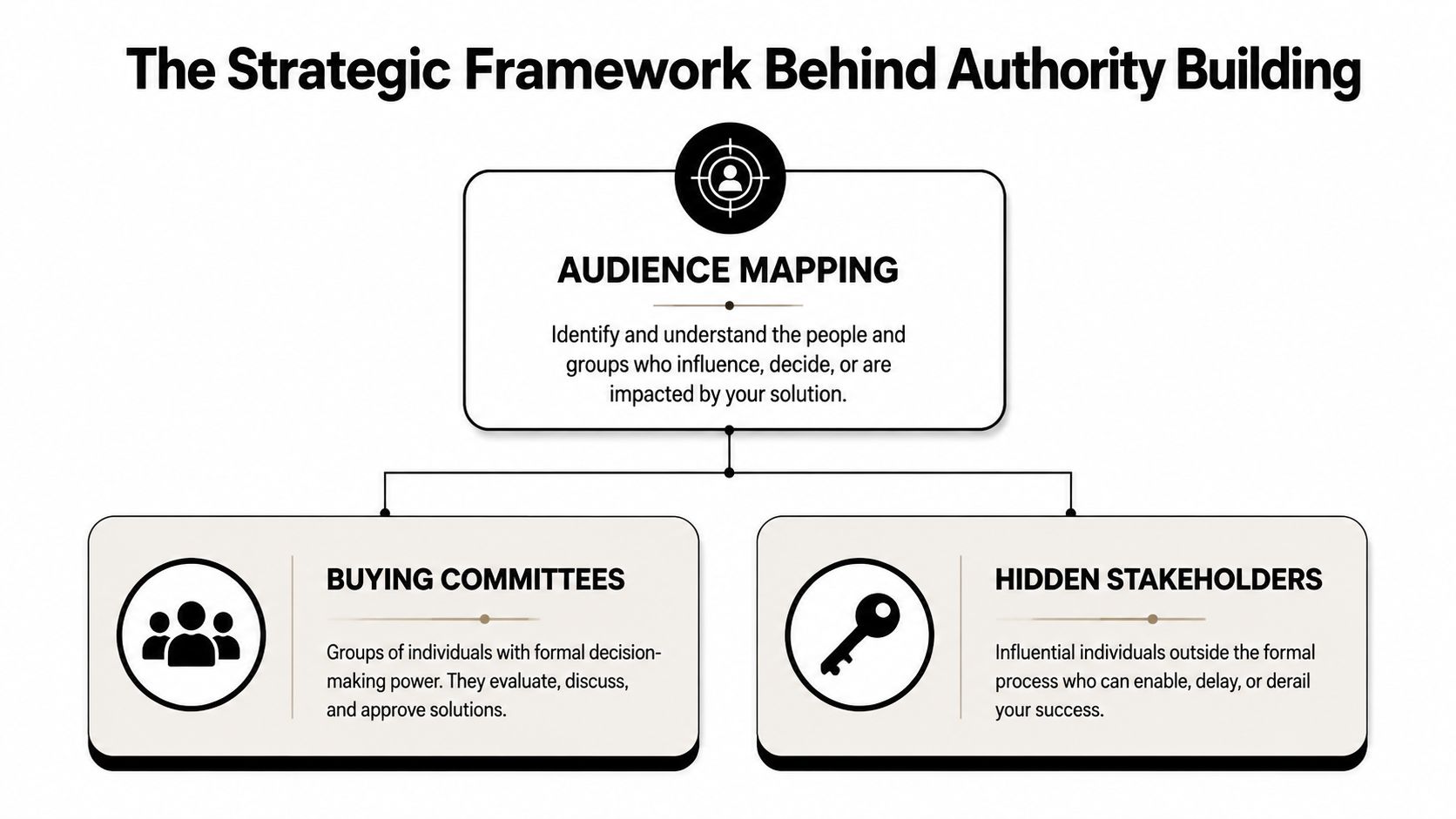
Authority building starts with the buying group and the decisions that can advance or stall a deal. Map the person accountable for the business outcome, the technical and operational evaluators, the financial approver, procurement, legal, and the users affected by the choice. Then identify hidden stakeholders who may never join a sales call but can delay approval, including security, compliance, implementation, and the incumbent provider.
Map the decisions behind the audience
For each stakeholder, document the question they need answered, the risk they are managing, and the evidence they will trust. An executive may need a market interpretation. A technical evaluator may need constraints and implementation implications. Procurement may need a defensible reason to accept the risk of changing categories or providers. One asset can support several roles, but its argument and examples should reflect different concerns.
This mapping turns thought leadership into a full-funnel trust system. Original insight gives visible buyers a reason to engage and gives hidden buyers material they can use internally when a purchase requires justification.
Build content pillars around recurring decision tensions:
- Category direction: What is changing, and which assumptions no longer hold?
- Operating practice: What should teams do differently, and what should they stop doing?
- Risk and governance: What could go wrong, and how can leaders control it?
- Commercial implications: How does the issue affect investment, prioritization, or vendor selection?
A defensible point of view connects expertise with consequence. If your company has a credible opinion but little evidence, commission research or conduct structured interviews. If you have data without interpretation, you have a dataset, not thought leadership. Strong assets explain what the evidence means, where the conclusion applies, and where it does not.
Choose depth deliberately
Depth consumes time and review capacity. Original research needs sound questions, careful sampling, analysis, expert review, and a plan for making findings understandable. Commission it when the answer can shape category understanding, challenge buyer assumptions, or give sales a reference point competitors cannot easily reproduce. Use lighter commentary for timely issues that do not justify the same research burden.
Editorial standards should cover source quality, claims, disclosures, expert review, legal approval, and accessibility. A documented standard protects credibility when production pressure rises. Teams designing the broader distribution and demand system can also use this framework for multi-channel growth to connect insight with the channels that carry it.
The trade-off is clear: breadth creates presence, depth creates authority. Build one flagship argument, then adapt it for each stakeholder instead of producing disconnected posts. The goal is a shared case for action across the buying group, strong enough to reduce uncertainty and keep the deal moving.
Distribution Channels That Actually Reach Decision-Makers
Publishing on your website is the starting point, not the distribution strategy. Decision-makers encounter expertise through executive networks, industry publications, newsletters, podcasts, peer recommendations, sales conversations, and internal sharing. Prioritize channels according to where your buying group already seeks guidance, then adapt the format without weakening the central argument.
Begin with one flagship asset, such as a research report, benchmark, executive briefing, or practical point-of-view paper. Give it a clear thesis, supporting evidence, stakeholder-specific implications, and a short set of actions. Then sequence distribution rather than releasing every derivative at once.
Build the amplification system
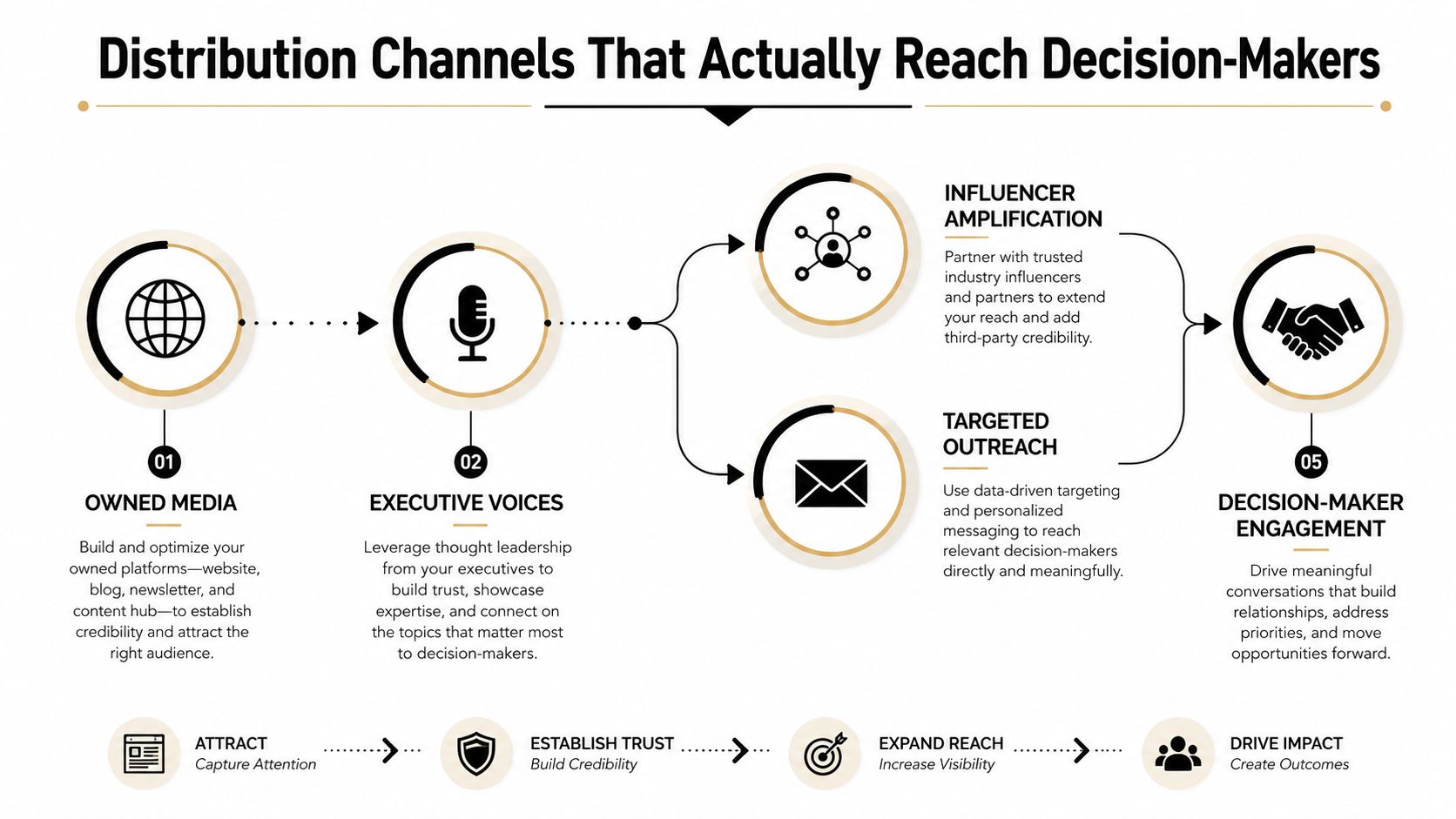
Owned media gives you control. Publish the full argument on your site, place it in a relevant newsletter, and create a sales-ready version that explains how to use it in active opportunities.
Executive voices add context and credibility. A senior leader should interpret the finding in their own language, not paste the corporate summary into a social post. Give them several formats, such as a short observation, a video explanation, a customer-facing discussion guide, and a response to likely objections.
Influencer amplification works when you involve credible practitioners early. Invite relevant analysts, customers, partners, or subject-matter communities to react to the evidence. Don't ask them to repeat a slogan. Ask a precise question that can produce a useful professional conversation.
Targeted outreach should follow account and stakeholder priorities. Sales can send a specific finding to a prospect facing the related decision, while customer success can use the same insight to support adoption or executive alignment. content distribution channels become an operating question rather than a list of platforms.
A practical launch sequence is: publish the flagship asset, brief executives and sales, release a series of focused interpretations, pitch the core insight to relevant trade media, host a discussion, and feed buyer questions back into the next edition. Internal distribution deserves equal attention because a sales representative who can connect a finding to a prospect's situation turns content into deal support.
Use the following video as an additional example of how teams can think about reaching and engaging business decision-makers:
Real-World Scenarios Where Thought Leadership Moves Revenue
Consider a mid-market SaaS company trying to move into larger enterprise accounts. A product brochure won't resolve the buyer's uncertainty about maturity, governance, or operational risk. A carefully designed benchmark report can create a more useful opening by showing how organizations approach the problem, where practices diverge, and which decisions deserve executive attention. Sales can use the report to start a business conversation, while technical and finance stakeholders can use separate sections to test the proposal.
The report doesn't guarantee a deal. Its value is that it gives several stakeholders a shared reference point. That shared reference can reduce the number of conversations spent defining the problem and increase the quality of questions directed at the vendor.
A professional services firm faces a different challenge. Its expertise is difficult to compare, and competitors can describe similar capabilities. An executive-authored point of view on a costly industry problem can make the firm's method more tangible. The content should explain the firm's reasoning, show where common approaches fail, and clarify the conditions under which its advice is appropriate. That supports premium positioning because the buyer is evaluating judgment, not hours or deliverables.
The post-sale application
Thought leadership also has a role after signature. A research-backed onboarding guide can help a customer explain a new operating model to internal teams. A quarterly executive briefing can give account leaders a structured reason to revisit priorities. A practical governance paper can help customers manage the risks that appeared during implementation.
These aren't disguised upsell documents. They work because they address the customer's need to build internal confidence after choosing a provider. Research on B2B thought leadership in 2026 found that 97% of B2B marketers considered thought leadership critical to full-funnel success, but only 43% used it beyond acquisition for engagement and retention (2026 state of B2B thought leadership research). The gap points to an underused opportunity. Customer-facing teams should receive insight assets designed for adoption, executive communication, and renewal conversations, not only lead capture.
The common thread across these scenarios is audience fit. One flagship idea can support pipeline, pricing conversations, onboarding, and retention, but each use requires a different framing. Commercial impact comes from connecting the insight to a real decision at the moment a stakeholder needs help making it.
How to Measure Thought Leadership Beyond Vanity Metrics
Impressions and likes can show distribution, but they can't establish influence. A stronger measurement model follows the buyer from exposure to action. It connects content consumption with target-account engagement, executive participation, sales usage, progression through evaluation, and customer behavior.
Track the asset at account and stakeholder level where your systems allow it. Record which target accounts consumed it, whether sales used it in an opportunity, which objections appeared afterward, and whether additional stakeholders entered the conversation. Qualitative feedback matters too. A prospect saying, “This helped us frame the internal discussion,” can reveal influence that a click report misses.
| Measurement Tier | Key Metrics | Business Question Answered |
|---|---|---|
| Reach and relevance | Target-account visits, stakeholder engagement, qualified referrals | Did the insight reach the people we intended to reach? |
| Trust and influence | Executive responses, invitations to briefings, third-party references, sales adoption | Are credible people using or discussing the point of view? |
| Commercial contribution | Influenced opportunities, competitive evaluation activity, progression through buying stages | Did the asset help a buying group move forward? |
| Customer value | Usage in onboarding, executive reviews, adoption conversations, renewal discussions | Does the program support relationships after acquisition? |
Teams can complement this model with a structured review of content performance metrics, but the reporting should stay tied to business questions. Don't claim that a content asset caused a win just because it appeared in the account history. Instead, document its role, the stakeholder interaction it enabled, and the evidence from sales or customer teams.
Report learning, not just totals
A useful monthly or quarterly review includes the strongest audience signal, the most common buyer objection, the channel that produced meaningful engagement, the sales stage where the asset helped, and the editorial decision that follows. If an asset attracts senior readers but generates no useful conversations, improve its actionability. If sales uses it frequently but prospects misunderstand the thesis, simplify the narrative.
Original research has a particularly strong role in this system. In the 2026 Ascend2 research, 93% of B2B marketers using original-research-based content considered it effective for engagement and lead generation, and 48% called it very effective (Ascend2 state of B2B thought leadership research). Those findings support investment in evidence, but measurement still needs to show whether your own research changes conversations and decisions.
Common Pitfalls That Undermine Credibility
Thought leadership becomes a liability when buyers are asked to trust claims the organization has not earned. A confident tone cannot replace evidence, and a founder's visibility cannot stand in for expertise from people who understand implementation, risk, customer operations, and industry context.
Audit the failure points
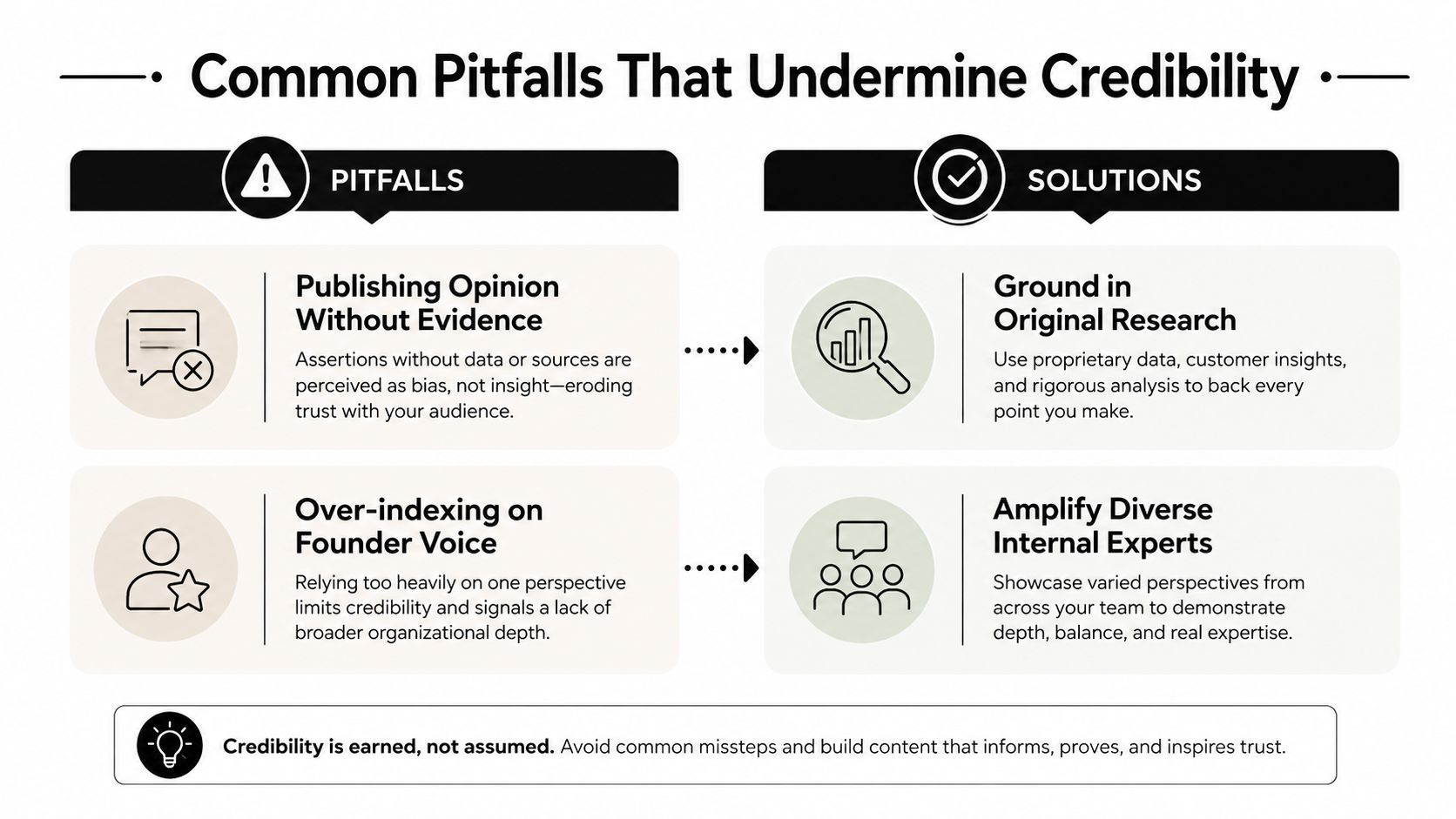
- Opinion without evidence: A provocative claim may attract attention, yet unsupported certainty gives experienced buyers a reason to dismiss the wider program. Show the method, cite the inputs, and separate observation from conclusion.
- Founder-centricity: Founders can supply a valuable point of view, but one voice cannot represent every buying concern. Include product, delivery, research, customer success, and credible external experts.
- Top-of-funnel isolation: If sales and customer success cannot use an asset, marketing has produced a publication rather than a commercial tool. Create stakeholder-specific versions with clear usage guidance.
- Campaign thinking: A report loses value when the team stops developing the conversation. Set an editorial rhythm that turns buyer questions into future analysis.
- Governance gaps: Unclear ownership produces weak sourcing, inconsistent claims, and promises delivery teams cannot support. Apply editorial, subject-matter, legal, and brand review where the topic requires it.
These failures affect buying behavior, not just editorial quality. The Momentum ITSMA findings cited earlier reported that 66% of B2B buyers would not work with a provider that publishes poor-quality thought leadership, according to Momentum ITSMA 2025 findings on B2B thought leadership quality. Editorial rigor therefore protects commercial trust across the buying group. It helps a strong idea reach hidden stakeholders, withstand internal scrutiny, and keep deals from stalling when one buyer must defend the provider to others.
Use a simple red-flag test: would the content remain useful if the company name and product references disappeared? If not, strengthen the central idea, improve the evidence, or connect the expertise to the offer more directly.
A 90-Day Launch Plan for Your Thought Leadership Strategy
Use the first phase to establish the operating base. Interview sales and customer teams, map the buying group, review lost-deal objections, select a small set of decision-led pillars, and choose an executive owner. Write the editorial standard before production begins.
The second phase creates one flagship asset. Select a question that matters to several stakeholders, decide whether original research is justified, gather evidence, develop the point of view, and run subject-matter review. Prepare the derivative formats at the same time, including executive posts, sales guidance, a newsletter edition, and a customer-facing version.
The third phase activates distribution. Brief executives, publish through owned channels, coordinate targeted outreach, involve credible external voices, and equip sales and customer success with practical usage notes. Establish reporting for target-account engagement, stakeholder response, sales adoption, opportunity influence, and post-sale use.
Operating principle: Publish one substantial idea, distribute it with discipline, and let buyer feedback determine what comes next.
At the end of the launch period, review which stakeholders engaged, what objections surfaced, where the asset assisted a conversation, and which claims need refinement. Keep the parts that change buyer behavior. Remove channels that only create activity. A durable thought leadership strategy grows through this feedback loop, not through an arbitrary demand for more content.
ReachLabs.ai helps B2B teams turn executive expertise into coordinated thought leadership through brand strategy, founder-led content, personal brand building, managed LinkedIn outreach, and content distribution. Visit ReachLabs.ai to discuss a program built around trust, buying-group alignment, and measurable commercial use.