Cleaning companies compete in a search category generating 4,338,500 monthly searches across 50 cleaning-services keywords, according to a 2026 cleaning-services keyword dataset. That demand isn't theoretical traffic. People search when they need a cleaner for a home, office, move, turnover, or urgent situation, then compare a small set of nearby providers.
The challenge is that many cleaning websites are built like brochures. They list a few services, mention one city, add a contact form, and expect Google to infer every suburb and customer need they serve. That approach leaves the most valuable local-search architecture unfinished.
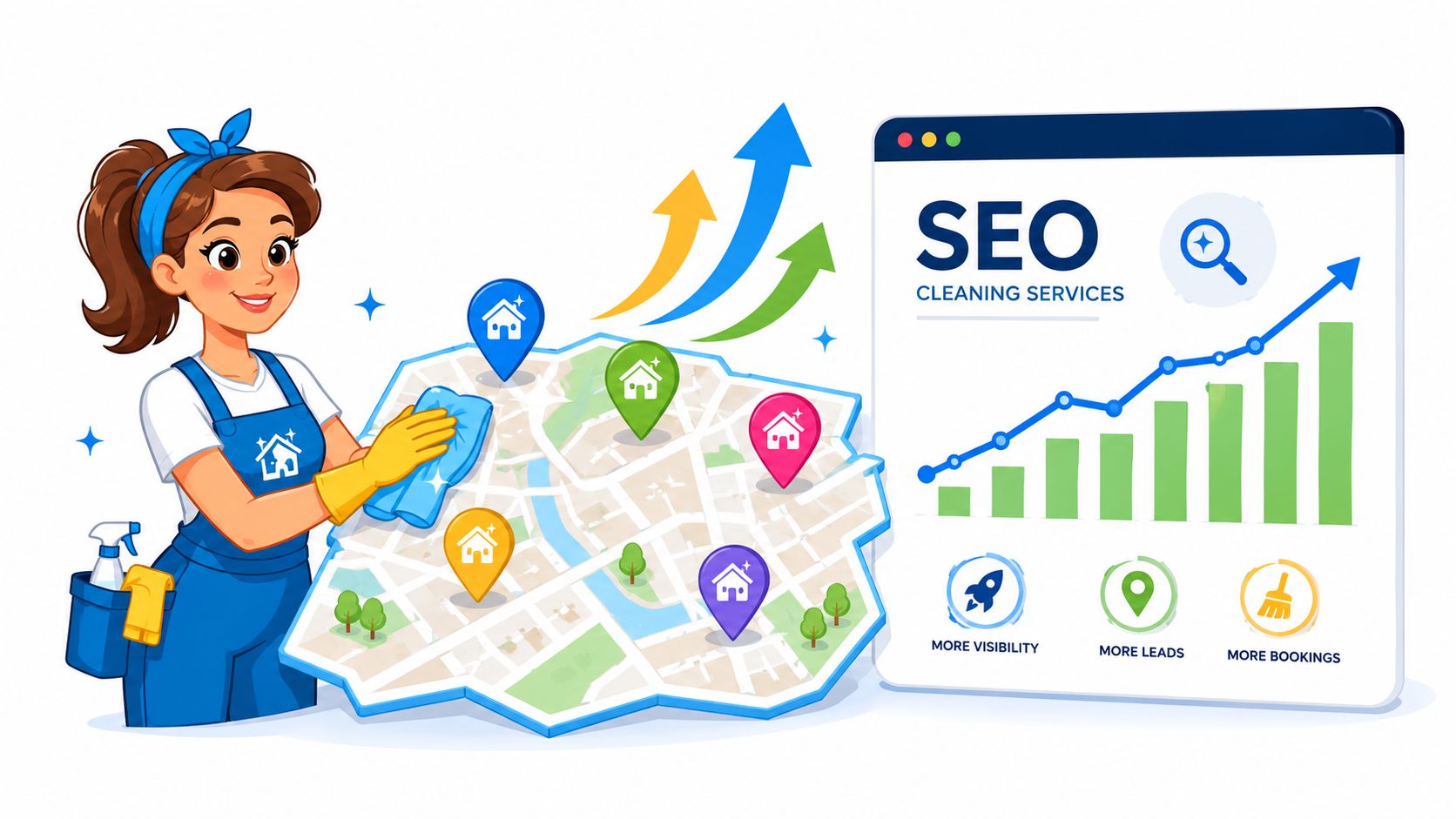
Effective SEO for cleaning services connects four assets: a complete Google Business Profile, useful service-area pages, local proof through reviews and job photos, and an internal-link structure that directs authority toward pages that generate calls and quote requests. The sections below focus on those operational details, including the work that tends to produce movement and the shortcuts that usually waste time.
Why Search Demand Makes SEO Non-Negotiable for Cleaners
The listed keyword set reports 673,000 monthly searches for both “and cleaning services” and “cleaning and services,” 368,000 for “cleaning services for house/home,” and 246,000 for “cleaning services near ne”, according to the same 2026 dataset. Some wording is imperfect, yet the commercial intent is clear. Users are searching for providers, comparing options, and looking for help with a current cleaning need.

A local operator should start with one service and one reachable area, rather than trying to rank for every cleaning query. A residential-cleaning page for a served suburb, a move-out page for a nearby town, or an office-cleaning page for a defined commercial district gives Google a specific answer and gives prospects a relevant path to contact the business. Broad terms generally need stronger authority, local prominence, and consistent publishing before they become realistic targets.
The pages themselves are only part of the architecture. Add geo-tagged job photos where appropriate, describe the property type and work completed, and link related service and area pages into clear clusters. For example, a move-out page can link to apartment cleaning, deep cleaning, and the suburbs served. This structure helps visitors compare relevant options and concentrates internal authority on pages that can generate calls and quote requests.
Match pages to buying intent
Search intent usually fits three business groups:
- Immediate need: “near me” and urgent-cleanup searches suit landing pages with phone access, service areas, availability guidance, and a short quote path.
- Recurring need: Residential maintenance and office cleaning pages should answer questions about visit frequency, team consistency, supplies, access, and billing.
- Specialty need: Deep cleaning, move-out work, post-construction cleanup, carpet care, and turnover services deserve separate pages because their scope and buyer expectations differ.
A single page listing every service may look thorough to an owner, but it gives searchers and Google a less precise answer. Build the narrowest useful service-area page first, connect it to related pages, then expand into adjacent locations and services.
The Polaris Marketing Solutions SEO guide for cleaning companies offers a practical fundamentals checklist. Use it alongside actual capacity, profitable travel areas, job-photo evidence, and the internal links that direct attention to services customers can book.
Winning the Map Pack with Google Business Profile
For a local cleaner, Google Business Profile functions as the de facto homepage. A prospect may see your category, service list, photos, reviews, hours, phone number, and directions before visiting your website. If those details are incomplete or inconsistent, the website has to overcome avoidable distrust.

Configure the profile around real operations
Start with the category that best describes the core business, usually Cleaning Service, then add only relevant secondary categories. A residential company that also provides carpet or window cleaning can use those categories when they accurately reflect the offer. Irrelevant categories may create mismatched expectations and weaken the profile's clarity.
Define every service area you serve. Don't add distant locations just because customers search from there. Service-area settings should match the places your team can reach profitably and consistently, while the website should provide more detailed suburb and neighborhood coverage.
Complete the service menu with plain-language descriptions. Include what the team does, who the service suits, preparation requirements, and the factors that influence a quote. If your pricing varies, explain the variables rather than publishing a misleading flat rate.
Use photos as operational proof
Upload real job images, not stock photography. Show the team, equipment, supplies, vehicles, finished rooms, and appropriate before-and-after work. A weekly image routine keeps the profile active and gives prospects evidence that the business operates locally.
Google Business Profile Q&A is another neglected field. Add common questions about supplies, pets, access, recurring visits, cancellations, and quote processes, then answer them accurately. This reduces friction for customers and prevents incomplete answers from becoming the first information a prospect sees.
A short weekly routine can cover the essentials:
- Review accuracy: Check hours, phone number, website, service areas, and holiday changes.
- Add proof: Upload a fresh job image with a useful description.
- Answer questions: Monitor Q&A and respond to customer questions.
- Request feedback: Send an honest review request after completed work.
- Publish an update: Share a cleaning tip, availability note, or service explanation.
The Wise Web guide to help small businesses get found by local customers provides broader local-search context. For a map-focused workflow, review ReachLabs.ai's Google Maps ranking resource. Profile completeness is basic hygiene. Categories, accurate service areas, fresh local proof, and strong customer responses are more likely to influence relevance and conversion than decorative updates alone.
Building Location and Service-Area Pages That Rank
Most cleaning websites have one page titled “Cleaning Services in [City]” and stop there. That structure ignores the way customers search by suburb, neighborhood, apartment district, and nearby town. A well-built local architecture gives each meaningful market a page that proves the company serves it.

Separate location pages from service-area pages
A location page targets a defined place where the business has meaningful presence or recurring work. It should include local service details, recognizable landmarks, access considerations, property types, customer questions, and genuine job evidence from that market.
A service-area page explains coverage beyond the core location. It should state which neighborhoods are included, how scheduling works, whether travel affects availability, and which services are offered there. It shouldn't pretend the company has an office in every suburb.
Avoid swapping city names into identical templates. Each page needs original information, useful local references, relevant service combinations, and a clear reason for existing. A page that only changes the place name can create a poor user experience and weak search relevance.
Build a hierarchy search engines can follow
Use a structure such as:
- Cities or service-area pillar: A broad page explaining the main market and linking to served areas.
- Suburb pages: Individual pages for priority suburbs, neighborhoods, or adjacent towns.
- Service-location pages: Pages such as move-out cleaning in a specific suburb when demand and operational capacity justify them.
Keep URLs readable and predictable, such as /service-areas/suburb-name/ and /service-areas/suburb-name/move-out-cleaning/. Link from the pillar to each priority location, then link from each location page to relevant service pages. Add contextual links back to the pillar when they help users compare coverage.
Use driving-distance landmarks carefully. Mention apartment complexes, business districts, transit corridors, or recognizable local destinations only when they clarify service access. Don't fabricate local experience or imply work at a property the company hasn't served.
Practical rule: Build fewer location pages with genuine local substance before producing a large batch of interchangeable suburb pages.
The embedded video below can supplement the written architecture with a visual explanation of organizing service pages by location and cleaning task.
On-Page Optimization and Content Topics That Convert
On-page SEO works best when it mirrors the customer's decision. A homeowner, property manager, office administrator, and short-term-rental host don't ask the same questions, even when they use the word “cleaning.” Your site should therefore organize pages around service type, property context, and customer scenario.

A residential pillar can link to apartment cleaning, condo cleaning, and single-family home cleaning. A scenario cluster can cover move-in or move-out work, post-party cleanup, and preparation before a new baby arrives. A service cluster can separate deep cleaning, recurring maintenance, and specialty carpet or upholstery work.
Give each commercial intent its own page
A page for move-out cleaning should explain landlord expectations, appliances, cabinets, floors, scheduling, and access. A page for post-construction cleaning should address dust, debris, finish protection, site readiness, and coordination with contractors. An Airbnb turnover page should focus on turnaround communication, linens, restocking, inspection, and consistency between guests.
Bundling those offers into one page dilutes relevance. It also forces prospects to search through unrelated information before they find an answer. Dedicated pages can use focused titles, headings, internal links, calls to action, FAQs, and relevant photos without forcing every service into one generic narrative.
Turn informational content into a lead path
Blog content should answer questions that appear before a booking decision:
- How often should a home receive a deep clean?
- What should a customer do before the first visit?
- Which areas are typically included in a move-out service?
- How should an office prepare for after-hours cleaning?
- What affects the scope of post-construction cleanup?
Each article should link to the most relevant commercial page, not just the homepage. An article about preparing for a first residential visit should point to the residential service page and the applicable location page. A post about rental turnovers should connect to the turnover service and the areas served.
Use title tags and headings that state the service and market naturally. Add descriptive image alt text, visible contact options, clear quote forms, and structured page sections. The aim isn't to repeat a keyword. It's to make the page unmistakably useful for one audience with one likely next action.
Reviews and Citations That Actually Move Rankings
Citation work has diminishing returns. A cleaning company doesn't need to chase every directory that accepts a listing. It needs consistent business identity data on the important platforms, legitimate industry directories, and local sites that customers and search engines can reasonably trust.
Keep the business name, address or service-area details, phone number, website, and core services aligned across the website, Google Business Profile, major directories, social profiles, and relevant local listings. Correct old duplicates and closed locations before adding another low-value profile. A clean foundation beats a large pile of neglected citations.
Ask for reviews without manufacturing praise
The strongest review program fits the operating workflow. After a completed job, send a direct request that makes the process easy, but don't script the customer's opinion, offer rewards for positive feedback, or pressure staff to create reviews. Ask every eligible customer through a consistent process and follow the platform's rules.
Review velocity matters more operationally than a one-time burst. A steady request habit creates current evidence and gives the company regular feedback about punctuality, communication, quality, and scope. When a customer mentions a specific service or neighborhood naturally, that detail can help future prospects understand the company's real work.
Respond to every review with a human answer. Thank customers for positive feedback, acknowledge the service performed, and address negative comments without arguing or exposing private information. Invite the reviewer to continue the discussion through an appropriate private channel, then fix the underlying operational issue if the complaint is valid.
Reviews don't replace good service. They make good service visible to people who haven't hired you yet.
Review markup can help a service page communicate its content to search engines, but don't promise star snippets in organic results. Use structured data only when it accurately represents eligible, visible content and follows search guidelines. For a practical directory framework, see the business listing websites resource from ReachLabs.ai. The goal is not directory volume. It's consistent identity, credible customer feedback, and a profile that converts comparison shoppers.
Technical and Mobile UX Fixes for Cleaning Sites
Cleaning-service search is mobile-heavy, with one benchmark reporting 65% mobile traffic and 35% desktop traffic for this market (Cited's cleaning SEO guide). A customer standing in a hallway or managing a move isn't patient with a slow gallery, a tiny phone number, or a form that resets after one error.
Start with the conversion path. Make the phone number and quote button easy to tap, keep the form short, use large input fields, and test every field on iOS and Android. A click-to-call button should remain visible without covering the page or triggering accidental taps.
Use a focused technical sprint
- Compress visual assets: Resize before-and-after images, use modern formats where the platform supports them, and prevent galleries from loading full-resolution originals immediately.
- Check page experience: Review Core Web Vitals in Search Console and PageSpeed Insights, then prioritize the templates that receive the most local traffic.
- Repair navigation: Link every important service and location page from a relevant parent page. Orphaned pages rarely perform well because users and crawlers can't discover them easily.
- Control template output: On WordPress, review tag archives, attachment pages, and unnecessary taxonomies. On Wix, inspect generated paths, redirects, and duplicated metadata.
- Validate structured data: Confirm that LocalBusiness, Service, FAQ, and review markup describes visible content and doesn't contain unsupported claims.
- Test forms end to end: Submit from a real phone, confirm delivery, check confirmation messaging, and verify that calls and form submissions enter the right system.
The benchmark report cited in the brief lists an average website conversion rate of 2–5% for cleaning services (SERPs.io's cleaning-service SEO statistics). Treat that as a directional benchmark, not a promise. A fast page won't rescue unclear pricing, weak trust proof, or a broken booking process.
Choosing Between In-House SEO and an Agency Partner
The right execution model depends on operational bandwidth, market difficulty, and how much local architecture already exists.
In-house execution suits an owner or office manager who can maintain the Google Business Profile, request reviews, upload job photos, update service areas, and monitor calls consistently. It offers direct control, but it often stalls when technical fixes, content production, analytics, and link evaluation compete with daily scheduling.
A freelancer can fill a defined gap, such as building location pages, repairing technical issues, or creating an internal-link plan. This works well when someone inside the company owns approvals and supplies real service details. The trade-off is limited capacity if the project needs ongoing content, authority building, reputation work, and measurement at the same time.
An agency makes sense when the company needs a coordinated system rather than isolated tasks. A credible engagement should define deliverables for GBP management, location architecture, technical SEO, content, reporting, conversion tracking, and review support. If growth also requires coordinated outreach or paid and organic activity, a multichannel pipeline for agencies can help frame how channels work together, but it shouldn't replace a local SEO plan.
Use this screening checklist before signing:
- Reporting: Confirm what gets reported, how often, and whether calls and quote requests are separated from vanity traffic.
- Ownership: Keep ownership of the Google Business Profile, website, analytics, Search Console, and listing accounts.
- Link methods: Reject vendors promising effortless rankings through bulk backlinks, private networks, or automated placements.
- Cleanup risk: Ask how they evaluate suspicious links. The SEO Takeoff guide to disavowing toxic backlinks recommends exporting backlink data from Google Search Console and a third-party crawler, clustering referring domains, attempting removal, and reserving disavowal for clear manipulative patterns or a manual action. It also warns that blindly disavowing tool-flagged links is unlikely to improve rankings.
- Strategic fit: Compare the proposal with an agency versus in-house marketing evaluation from ReachLabs.ai.
If your team can execute the weekly local work but lacks technical depth, use a specialist for a defined project. If the site, profile, content, reputation, and measurement all need coordination, choose a partner that can show exactly who owns each task and how results connect to booked work.
ReachLabs.ai offers SEO audits that identify technical and structural issues, plus SEO management covering technical work, content direction, on-page improvements, authority building, and measurement. Visit ReachLabs.ai to discuss a cleaning-services SEO plan built around map-pack visibility, service-area architecture, and qualified lead generation.