Your team is publishing solid content. The briefs are good. The pages look polished. Sales asks why organic traffic still feels flat, and nobody has a clean answer.
That's usually the moment a company realizes content quality and search visibility aren't the same thing. A site can have strong messaging and still leak opportunity through poor crawl paths, duplicate URLs, broken canonicals, slow templates, bloated JavaScript, or pages that search engines never reliably render. The problem isn't the paint on the walls. It's the structure under the house.
A technical SEO agency exists for that exact situation. It doesn't replace content strategy, brand, or demand generation. It makes them work better by fixing the hidden systems that determine whether search engines can access, understand, and trust your site in the first place.
Why Your Great Content Is Not Ranking
A common pattern shows up in growing marketing teams. They invest in content calendars, product pages, comparison pages, resource hubs, and thought leadership. They publish consistently, then watch weaker competitors outrank them.
The first instinct is usually to produce more content or refresh old pages. Sometimes that helps. Often it doesn't, because the issue sits lower in the stack.
The cracked foundation problem
A website can look excellent to a human visitor and still send messy signals to search engines. I've seen sites with strong copy where the primary problem wasn't relevance at all. It was a mix of indexation gaps, redirect chains, internal linking dead ends, and pages trapped behind rendering issues. In those cases, publishing more content is like furnishing a house with a cracked slab. It may look better for a while, but the underlying weakness remains.
That's why technical SEO deserves executive attention. It's not a niche concern for developers. It's infrastructure for organic acquisition.
Practical rule: If new content repeatedly underperforms despite solid intent targeting and decent on-page work, stop assuming the next article will fix it. Check whether search engines can crawl, render, and index the site properly.
The business case is clear enough to explain why companies bring in specialists. One industry roundup projects the global SEO services market at $83.98 billion in 2026 and $148.86 billion by 2031, and the same source reports that technical SEO campaigns can deliver 117% ROI and reach break-even in 6 months (technical SEO market and ROI projections).
Why general effort often stalls
General marketing teams usually see the symptoms first:
- Content isn't getting traction even when topics match customer questions.
- Important pages compete with each other because duplicate or near-duplicate URLs confuse search engines.
- Site updates create unintended damage after redesigns, CMS changes, or template releases.
- Reporting gets fuzzy because traffic dips don't line up with content quality.
A specialist looks at a different layer. They ask whether category pages are discoverable, whether canonical tags align with indexation goals, whether XML sitemaps reflect the pages that matter, and whether your internal linking supports authority flow.
That's the difference between tactical publishing and foundational health. One creates assets. The other makes sure those assets can perform.
What Is a Technical SEO Agency Really
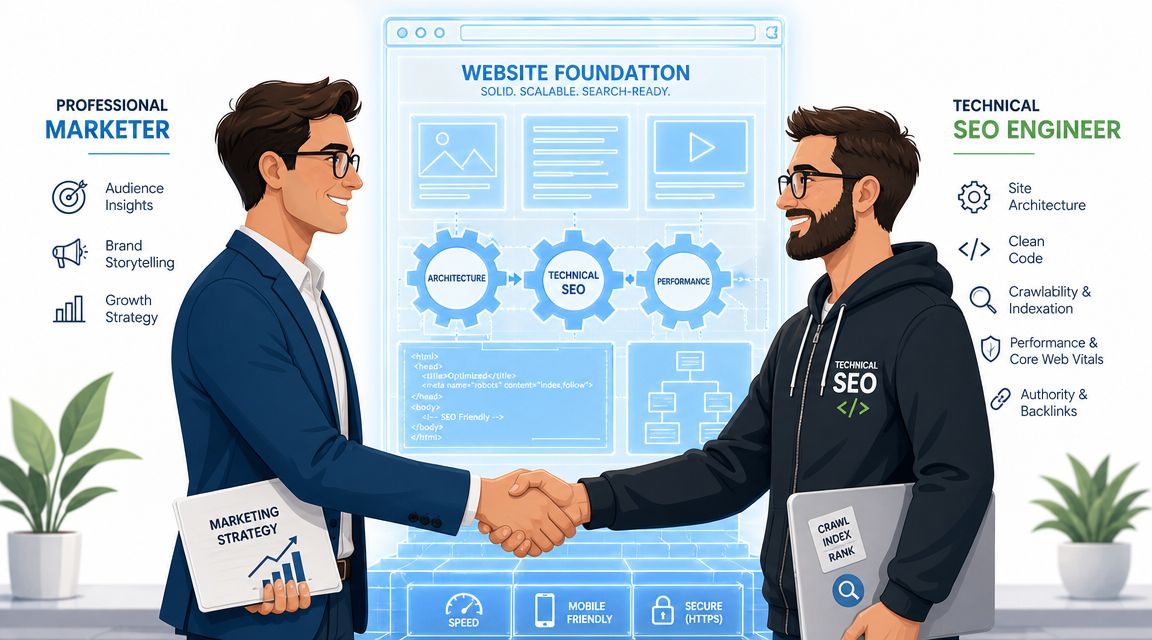
A technical SEO agency is the structural engineer and architect of your website's search presence. Content marketers decide what the rooms should look like. Brand teams decorate them. Technical specialists make sure the building stands, the doors open, and the address is easy to find.

What they actually own
A general SEO team may focus on keyword mapping, content optimization, and link acquisition. A technical SEO agency focuses on the systems that decide whether those efforts can compound.
That usually includes:
- Site architecture so important pages sit close enough to the surface to be discovered efficiently
- Crawl management so search engines spend time on valuable URLs instead of junk pages, faceted duplicates, or parameter clutter
- Indexation control so the right pages appear in search and the wrong ones stay out
- Rendering support so JavaScript-heavy content is still visible to search engines
- Performance work so templates, assets, and scripts don't sabotage user experience and crawl efficiency
- Structured data so pages communicate meaning more clearly
For online stores, this gets more complex fast. Product variants, filter pages, pagination, and platform constraints can create large-scale duplication and crawl waste. If that's your environment, this guide to technical SEO for eCommerce is a useful companion because it shows how platform structure changes the technical workload.
Why this matters commercially
The top organic result gets a disproportionate share of clicks. One SEO statistics report cites a 27.6% CTR for position #1 (organic CTR benchmark for position one). That's why technical fixes matter more than they seem. They aren't backend housekeeping. They help you compete for the most valuable traffic on the results page.
A ranking improvement from the middle of the page to the top isn't just a vanity win. It changes how much demand your site captures from the same search volume.
What they don't do well when they're the wrong fit
A weak technical agency hides behind tool exports and jargon. You get a giant audit, no prioritization, and recommendations your developers can't use.
A strong one translates technical issues into business consequences. Instead of saying “canonical inconsistency,” they say, “Search engines may split authority across duplicate versions of the same page, so the page you want to rank keeps losing the signal.”
That's the job. Not just finding errors. Turning infrastructure problems into decisions your team can act on.
Core Services You Should Expect
A good technical SEO agency shouldn't hand you a menu of isolated tasks. It should solve specific search performance problems. The best way to evaluate services is to ask what business risk each one removes.

Technical audit and diagnosis
This is the diagnostic phase. The agency reviews crawl paths, templates, internal links, canonicals, redirects, indexation behavior, sitemap quality, rendering, and site performance. Good audits separate symptoms from causes.
If you want a sense of what a structured audit engagement can look like, SEO audit services typically frame the work around issue discovery, prioritization, and implementation planning rather than a loose checklist.
Crawlability and indexation management
This is core technical SEO work. A technical SEO agency improves crawlability, indexation, and rendering by changing website and server signals such as HTTP headers, XML sitemaps, redirects, canonical tags, and page elements. These settings directly affect whether search engines can efficiently crawl and index pages (technical SEO guidance on crawlability and indexation).
In business terms, this work answers a simple question. Are search engines reaching the pages you need them to reach, and are they ignoring the ones you don't?
If your highest-value pages are hard to crawl, your content team is working upstream from a bottleneck.
Site architecture and internal linking
Architecture work is usually underappreciated until a site gets large. Then every weakness becomes expensive.
A strong agency looks at:
- Depth of important pages so revenue-driving URLs aren't buried
- Internal link logic so authority flows to commercial and strategic pages
- Template consistency so category, product, blog, and support areas don't fragment into separate ecosystems
This matters most on ecommerce, SaaS, and marketplace sites, where structure often decides whether new pages gain visibility quickly or sit unnoticed.
For Shopify teams, platform-specific constraints can shape what's realistic. If you need a practical reference, this checklist on how to optimize your Shopify technical SEO is useful because it addresses the common tension between platform convenience and technical control.
A short explainer can help non-technical stakeholders understand the moving parts:
Performance and template optimization
This service is less about chasing abstract speed scores and more about removing friction from the pages that influence revenue or lead generation.
Typical work includes:
- Template cleanup to reduce unnecessary scripts and layout instability
- Asset optimization for images, fonts, and third-party code
- Mobile experience fixes where bloated components hurt usability
- Core page flow improvements so key landing pages load and behave reliably
The trade-off is real. Design teams may want richer interactions. Growth teams may want more tracking. A technical SEO agency helps decide which elements are worth the performance cost and which ones are subtly hurting discoverability or user experience.
Structured data and migrations
Structured data helps search engines understand page context more clearly. It won't rescue a broken site, but it can strengthen interpretation when the foundation is sound.
Migration support is even more critical. Redesigns, platform moves, subfolder restructures, and domain changes can erase years of accumulated search equity if redirects, canonicals, internal links, and sitemap updates aren't handled with discipline. In these circumstances, specialists often pay for themselves by preventing losses before they happen.
The Typical Engagement Workflow and Deliverables
Most clients don't need more mystery around SEO. They need a process that's clear, scoped, and tied to implementation. A strong technical SEO agency engagement usually follows a straightforward pattern.
Discovery and kickoff
The first step is alignment. The agency learns how your business makes money, which sections of the site matter most, what your current team can implement, and where technical debt is already known.
Common deliverables at this stage include:
- Stakeholder intake notes covering goals, constraints, and ownership
- Access checklist for tools such as Google Search Console, analytics platforms, crawling software, and CMS visibility
- Success definition that links SEO work to business priorities like product discovery, lead capture, or migration protection
This stage matters because priorities change by site type. A publisher, a SaaS company, and a multi-category retailer don't need the same roadmap.
Audit and prioritization
The audit is where the agency validates what's broken and why. But the actual value isn't in finding everything. It's in ranking issues by impact, effort, and dependency.
A useful audit package usually contains:
| Deliverable | What it should include |
|---|---|
| Audit document | Root causes, affected templates or sections, and business implications |
| Priority roadmap | What to fix first, what can wait, and what depends on development resources |
| Issue examples | Specific URLs, templates, or patterns that prove the problem |
| Executive summary | Plain-language explanation for leadership |
Implementation support
Many engagements often fail here. Recommendations don don't produce results until somebody ships them.
The better agencies work directly with developers, product managers, and content teams. They rewrite findings into tickets, review staging environments, QA changes after release, and flag when a “fix” doesn't solve the original issue.
The right partner doesn't stop at diagnosis. They stay close enough to implementation to prevent expensive misunderstandings.
Implementation support often includes ticket writing, acceptance criteria, template reviews, and launch QA. If the agency is hands-on, they may also configure elements themselves within the CMS or tag management environment. If they're advisory, they should still make the work easy for your internal team to execute.
Monitoring and reporting
After release, the agency checks whether search engines respond the way you expected. Some fixes show up quickly in crawl behavior and indexation patterns. Others take time, especially when multiple systems changed at once.
Ongoing deliverables often include:
- Monthly health reports with issue status and risk flags
- Change logs tied to deployments
- Search Console monitoring for indexing, coverage, and performance shifts
- Follow-up recommendations based on what the data shows after implementation
That's the typical workflow when the engagement is healthy. It should feel like technical consulting with operational discipline, not a black-box service.
Measuring Success with KPIs That Matter
Technical SEO success isn't “traffic went up, so we're done.” Traffic is downstream. The better conversation starts with the site health indicators that tell you whether search engines can access and trust your content at scale.

The KPIs worth watching
A technical SEO agency should report on operational metrics that connect to business outcomes, not just rankings for a handful of keywords.
Key examples include:
Indexation quality
Are your important pages indexed, and are low-value pages being excluded? Hidden revenue pages cannot contribute if search engines never include them.Crawl efficiency
Are bots spending time on the right sections of the site? If crawl activity is wasted on duplicates, filters, or junk URLs, the pages that matter may be discovered more slowly.Rendering health
Are search engines reliably seeing what users see, especially on JavaScript-heavy templates? A rendered-content gap can suppress whole sections of a site.Template performance
Are your key page types loading and behaving consistently? This affects both user experience and the operational quality of the site.Error reduction
Are redirect problems, broken pages, and contradictory directives decreasing over time? A falling error count often signals better governance, not just a one-time cleanup.
What good reporting sounds like
Good reporting explains movement in plain English. It connects technical changes to what the business should care about.
For teams trying to improve how they present performance internally, Distribute.you's reporting insights offer a useful way to think about narrative, decision-making, and what stakeholders need from reports. The same principle applies here. Don't bury the conclusion inside a dashboard.
A more useful summary might say:
We reduced crawl waste in non-commercial sections, improved discoverability of priority templates, and cleaned up conflicting indexation signals. That puts the site in a stronger position to earn visibility from the content already published.
That's much better than listing dozens of technical changes with no context.
Tie metrics back to business decisions
Technical SEO metrics become credible when they support real decisions. If leadership is asking how to judge channel contribution more broadly, this guide on how to measure marketing effectiveness helps frame SEO performance within the larger reporting picture.
The point isn't to turn executives into technical auditors. It's to make sure your agency reports on indicators that explain whether foundational health is improving, whether risk is being reduced, and whether the site is better positioned to capture demand.
Your Hiring Checklist and RFP Template
Hiring a technical SEO agency shouldn't start with price. It should start with fit. A cheap agency that produces a generic audit is expensive if your team can't implement it. A specialist with a clear process can be worth far more, even if the scope looks narrower.
The hiring checklist
Use these questions in every agency conversation:
How do you diagnose root causes
Ask them to explain how they distinguish between a symptom and the underlying issue. “Pages aren't indexed” is a symptom. “Internal links rely on rendering that search engines aren't processing consistently” is closer to a root cause.How do you prioritize fixes
You want a business logic answer, not a severity-only answer. The best agencies balance impact, implementation effort, and dependence on other teams.How do you work with developers
This is one of the biggest indicators of success. Ask whether they provide ticket-ready recommendations, QA support, and staging review.Have you worked on sites like ours
“Technical SEO” for a local service business is different from technical SEO for a marketplace, SaaS platform, or multi-location ecommerce operation.What happens after the audit
If the answer is vague, expect recommendations to sit in a document and die there.
Red flags in proposals
Some warning signs show up fast:
- Tool-driven language with no interpretation
- Very large audit promises without any mention of implementation
- No questions about your CMS, dev process, or release cycle
- A polished sales pitch with little technical depth in the actual team
A useful RFP can prevent weak proposals. If you're drafting one, this marketing request for proposal template gives you a practical starting point for structuring scope, deliverables, and evaluation criteria.
Mini RFP template
You don't need a long procurement document. You need enough detail to force serious responses.
Include these fields:
Business context
Site type, core revenue model, major pain points, recent migrations or redesigns.Technical environment
CMS, ecommerce platform, JavaScript framework, internal dev support, release cadence.Scope needed
Audit, implementation support, migration planning, structured data, performance, ongoing monitoring.Expected deliverables
Prioritized roadmap, issue documentation, developer-ready tickets, reporting cadence, QA support.Proposal questions
Ask for methodology, team structure, sample deliverables, communication process, and assumptions.
Technical SEO agency evaluation scorecard
| Evaluation Criterion | Agency A Score (1-5) | Agency B Score (1-5) | Notes |
|---|---|---|---|
| Technical depth | |||
| Ability to explain issues clearly | |||
| Developer collaboration process | |||
| Prioritization methodology | |||
| Experience with similar site complexity | |||
| Implementation support | |||
| Reporting clarity | |||
| Overall fit |
Pricing models usually fall into two buckets. Project-based work fits audits, migrations, and one-time remediation. Retainers fit ongoing monitoring, roadmap support, and governance across releases. The right model depends less on agency preference and more on whether your site has continuous technical change.
Your Next Steps for a Stronger Foundation
Technical SEO isn't a side task for when the content team runs out of ideas. It's the foundation that determines whether your existing effort can compound.
Start with three practical moves:
Run a basic health check
Use Google Search Console and your crawler of choice to look for obvious indexation issues, broken pages, redirect problems, or sections that seem underrepresented.Define a small set of business goals
Don't ask an agency to “improve SEO.” Ask for outcomes like protecting a redesign, improving discoverability of product categories, or resolving indexation gaps in your lead-generation pages.Use a structured shortlist process
Take the checklist above into agency conversations and ask for process detail, not just promises.
A technical SEO agency is an investment in the systems underneath your growth engine. When those systems are sound, content performs better, reporting gets clearer, and major site changes become less risky.
For teams that want SEO support within a broader marketing operating model, ReachLabs.ai offers search-related services as part of a wider mix that includes strategy, creative, and demand generation. That kind of setup can make sense when technical SEO needs to connect tightly with content, reporting, and cross-channel execution.
If you're evaluating whether your site needs a specialist, ReachLabs.ai can help you assess the technical issues affecting search visibility and map them to a practical marketing roadmap.