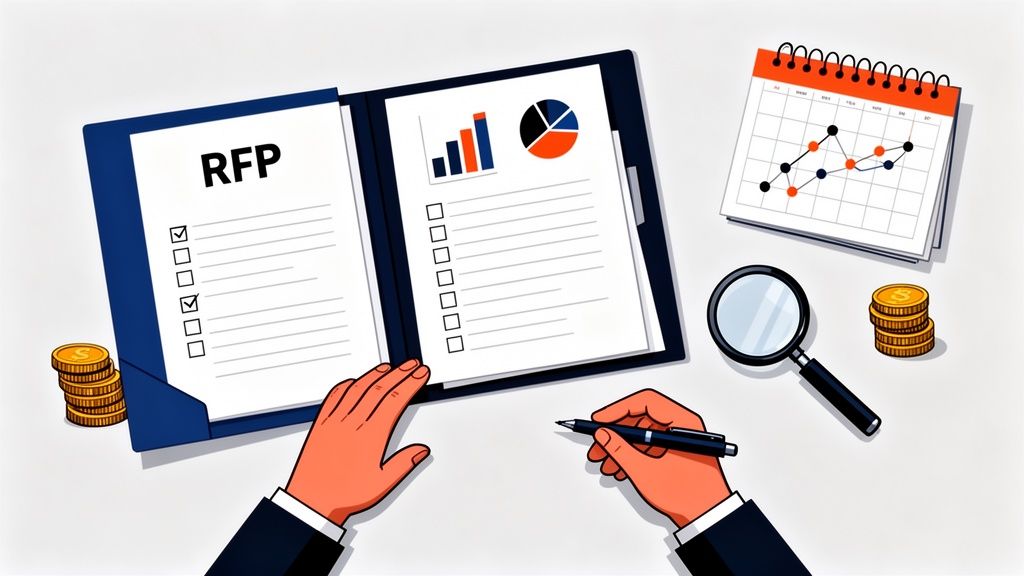
So, you need to find a marketing agency. A request for proposal, or RFP, is the document you'll use to get bids from different agencies for your project. It’s where you lay out your business goals, what you need done, your budget, and how you'll decide on a winner. Honestly, a well-written RFP is probably the most important first step you can take to find the right partner.

From Blank Page to Perfect Partner
Staring at a blank page, trying to start a marketing RFP, can feel a bit daunting. But think of this document as your first strategic move. A great RFP is more than just a form to fill out; it's the very foundation for finding an agency that actually gets your vision and has the chops to bring it to life.
This guide isn't about generic templates. We're going to dive into the strategic thinking that helps you spell out your goals with total clarity. Having been on both sides—sending RFPs and responding to them—I can tell you exactly what makes a document stand out and attract top-tier agencies.
The Real Purpose of an RFP
A strong RFP does way more than just collect price quotes. It forces your own team to get aligned internally and acts as a powerful filter for potential partners. Its main job is to set crystal-clear expectations from day one, ensuring every proposal you get back is relevant, insightful, and a direct answer to your business challenges.
Of course, this all comes after you've made the call on the whole in-house vs. agency marketing question. Once you've decided to look for outside help, the RFP is your main tool for communicating exactly what you need.
An RFP is your company's first impression. It tells agencies if you're a strategic, organized client or someone who hasn't quite figured out what they need. A sharp, detailed RFP attracts partners who think strategically; a vague one just invites guesswork.
Key Sections of an Effective Marketing RFP
A winning RFP is built on a few essential sections. If you skimp on any of these, you're likely to get confusing proposals that are impossible to compare, wasting everyone's time. To give you a bird's-eye view, let's break down the core components you'll need to include.
The table below summarizes the key parts of an RFP and why each one matters. Getting these right is crucial for attracting proposals that are actually worth reading.
| RFP Section | What It Achieves |
|---|---|
| Company Background | Gives agencies context on your business, mission, and who you compete with. |
| Project Objectives & Scope | Clearly states your goals and the specific services you're looking for. |
| Budget & Timeline Guidance | Provides a realistic budget range and critical dates to ground the proposals. |
| Submission Requirements | Lays out the rules of engagement—how to submit and what format to use. |
| Evaluation & Scoring Criteria | Explains how you will grade proposals, ensuring a fair and transparent process. |
Mastering these sections will turn your search from a simple vendor hunt into a quest for a true strategic partner. For a deeper look into the selection journey, our guide on https://www.reachlabs.ai/how-to-choose-digital-marketing-agency/ can help you navigate the next steps.
Setting Your Goals and Defining the Scope of Work
If there’s one place where most marketing RFPs fall flat, it’s right at the beginning. Too often, they’re filled with vague wishes like “increase brand awareness” or “get more leads.” When you put out a fuzzy request, you can only expect fuzzy, uninspired proposals in return—and good luck trying to compare those apples to oranges.
To get strategic, thoughtful responses from top agencies, you need to give them a clear, strategic direction. It all starts with translating your high-level business ambitions into concrete, measurable marketing objectives.

From Vague Wishes to SMART Goals
Instead of just saying you want "more leads," you have to define what that actually looks like for your business. The SMART framework is your best friend here. It forces you to get Specific, Measurable, Achievable, Relevant, and Time-bound.
This level of detail makes agencies put on their thinking caps. It challenges them to outline how they’d hit your specific targets, which leads to much more substantial proposals.
Let's look at the difference.
A vague goal:
- "We want to grow our online presence."
A SMART goal:
- "We aim to increase organic website traffic by 30% year-over-year and achieve a top-three search ranking for five of our core keywords within 12 months."
Here's another common one.
A vague goal:
- "We need to generate more leads for our sales team."
A SMART goal:
- "Our objective is a 25% increase in marketing qualified leads (MQLs) from organic search within six months, maintaining a lead-to-MQL conversion rate of at least 15%."
Think of it this way: agencies are expert problem-solvers. If you give them a blurry problem, you’ll get a blurry solution. Present them with a clear, measurable challenge, and you'll get a clear, actionable plan.
Tailor Goals to Your Business Model
Your marketing goals need to be a direct reflection of how your company actually makes money. The objectives for a B2B SaaS company look completely different from those of a direct-to-consumer (D2C) e-commerce brand.
For a B2B SaaS Company
Here, the focus is likely on generating high-value leads for a sales team dealing with long sales cycles. The goals should mirror that reality.
- Primary Goal: Increase demo requests from companies with over 500 employees by 40% in the next fiscal year.
- Secondary Goal: Build our thought leadership by publishing two in-depth industry reports and securing three guest post placements on high-authority websites each quarter.
For a D2C E-commerce Brand
This brand, on the other hand, is probably obsessed with metrics like customer acquisition cost, repeat purchases, and social engagement.
- Primary Goal: Achieve a 20% increase in first-time customer purchases while keeping our customer acquisition cost (CAC) below $40.
- Secondary Goal: Grow our Instagram community by 50,000 followers and lift our engagement rate to 3.5% within nine months.
Articulating these distinct goals from the get-go ensures you attract agencies with the right kind of experience. An agency that crushes B2B lead generation isn't necessarily the best fit for building a D2C social media following, and you want to find that out now, not later.
Define a Clear Scope of Work
With your goals set, the next step is to detail the scope of work—the specific services you expect the agency to deliver. This is your best defense against scope creep down the line and is essential for agencies to give you an accurate price. I’ve found the best way to do this is to separate your list into must-haves and nice-to-haves.
Must-Haves: The Core Requirements
These are the non-negotiable services you need to hit your primary goals. Be explicit.
- A comprehensive SEO strategy and its execution (technical, on-page, and off-page).
- Content creation, specifically four blog posts and one case study per month.
- Full management of our Google Ads account with a monthly spend of $15,000.
- Monthly performance reporting and a mandatory quarterly strategy review meeting.
Nice-to-Haves: The Bonus Items
These are services that would be great to have and could add value, but they aren't deal-breakers.
- Social media management for our LinkedIn and Twitter profiles.
- Support for our monthly email newsletter campaigns.
- Help creating and promoting one webinar per quarter.
Separating your scope this way gives agencies the room to propose a tiered or modular pricing structure. They can quote the core work and then provide add-on costs for the nice-to-haves, giving you much-needed budget flexibility. This kind of clarity is a pillar of a strong RFP and the foundation of a great future partnership. If you need a good framework to organize these details, using a well-structured marketing brief template can be a fantastic starting point.
Communicating Your Timeline and Budget
When it comes to your timeline and budget, being vague is the fastest way to get proposals that are completely off the mark. I’ve seen it happen time and again: a company sends out a great RFP, but without clear timelines or a budget, agencies are left to guess. This wastes everyone's time.
Think of these two elements as the guardrails for your project. They give potential partners a clear path to follow, ensuring the ideas they bring back are not only creative but also realistic and achievable for your business.
Structuring a Realistic Project Timeline
A detailed timeline does more than just give a final due date; it sets the rhythm for the entire project. Breaking your project into phases with clear milestones shows agencies you've thought this through and have a solid plan.
Start with your non-negotiable launch date or final deadline and work backward from there. Your timeline should map out a few key stages:
- RFP & Selection: Be specific about the proposal deadline, when you plan to hold interviews, and your target date for making a final decision. For example, "Final agency selection will be made by June 30th."
- Onboarding & Kickoff: Set aside time for the paperwork and the official project kickoff. This phase usually takes one to two weeks.
- Strategy & Planning: Give your new partner breathing room to dig in. This is when they'll do their audits, research, and present a full strategy. A milestone here could be, "A comprehensive SEO audit is due by the end of month one."
- Execution & Launch: Pinpoint key dates for major activations. This could be the launch of a new ad campaign or when the first batch of content goes live.
Getting granular helps. For instance, you could ask for "a quarterly content calendar with 12 blog post topics delivered two weeks before the start of each quarter." This kind of detail helps an agency staff the project correctly and proves you’re ready to be a great partner.
A well-defined timeline tells an agency you're organized and serious. It transforms your RFP from a simple "ask" into a structured project plan that a professional partner can immediately get behind.
Tackling the Budget Question Head-On
Here’s where a lot of companies get nervous. Many are afraid to put a number in their marketing request for proposal, thinking agencies will just max out the quote. Frankly, that's a strategic mistake.
When you don't provide a budget, agencies are forced to play a guessing game. They might pitch a massive, all-in strategy that’s way out of your league, or they might play it too safe with a plan that won’t move the needle. Being transparent is the most efficient way forward.
Giving a realistic budget range allows agencies to get creative and show you the absolute best strategy they can deliver for your investment. They won’t waste their time (or yours) building a $20,000 per month plan if you only have $10,000 to work with.
Be direct and clear about your financial commitments. It signals that you’re a serious buyer who has already done the internal legwork.
Example Budget Statements:
- "We have allocated a monthly budget in the range of $10,000-$15,000 for this full-service initiative."
- "The total project budget for this website redesign is capped at $50,000."
- "Proposals should fall within an annual retainer of $120,000 – $150,000, inclusive of all management fees."
Offering a range is often the best approach. It provides just enough flexibility for the agency while keeping the proposals within a scope you can actually afford. If you're unsure what a competitive budget looks like, checking a guide on digital marketing agency pricing can give you some valuable context. This upfront clarity is the fastest way to get proposals that are both inspiring and actionable.
Setting Submission Rules and Evaluation Criteria
To get apples-to-apples comparisons from agencies, you need to run a tight ship. A messy submission process guarantees a messy review, so it’s on you to set clear, non-negotiable ground rules before that RFP ever goes out the door.
Lay out the basics right away. This means a firm deadline (no exceptions!), the required submission format—a single PDF is the gold standard—and a single point of contact for all questions. Funneling all communication through one person is non-negotiable; it ensures every agency gets the exact same information, which is the only way to keep the playing field level.
What to Ask for Beyond the Proposal
The strategic proposal is the main event, but it's only part of the story. You need to dig deeper to truly vet each agency. Don't hesitate to ask for the proof behind their promises and a look at the actual team you’d be working with day-to-day.
Here’s a checklist of what I always insist on:
- Relevant Case Studies: I ask for 2-3 case studies specifically from clients with similar challenges or in our industry. This quickly separates the agencies with genuine experience from those with just a polished sales deck.
- Team Member Bios: You're hiring a team, not a salesperson. Request short bios for the key people who would actually be assigned to your account. You need to know whose hands will be on the keyboard.
- Three Client References: This is standard practice, but be specific. Ask to speak with current or very recent clients to get a real, timely perspective on what it's like to work with them.
Gathering this information gives you a much richer understanding of each potential partner. It helps you look past the pitch and evaluate their track record, their talent, and their real-world results.
Think of it this way: you provide clear inputs on the project, and in return, you get clear, comparable proposals. It’s a straightforward flow.

Building Your Internal Scoring Matrix
Want to avoid a world of pain later? Build your evaluation matrix before you send out the RFP. This internal scorecard is your secret weapon for making an objective, data-backed decision, and it saves you from being swayed by a flashy presentation.
By creating your scorecard first, you force your internal team to agree on what "good" looks like. This alignment is critical and heads off so many arguments and subjective biases during the review phase.
Your evaluation matrix doesn't need to be complicated. It’s a simple tool that lists your most important criteria and assigns a weight to each one. This is how you ensure you’re scoring agencies on substance, not just style.
Here is a sample scorecard you can adapt. Use this template to objectively score agency proposals against your most important criteria, ensuring a fair and consistent evaluation process.
Sample RFP Evaluation Scorecard
| Evaluation Criterion | Weighting (%) | Agency A Score (1-5) | Agency B Score (1-5) | Comments |
|---|---|---|---|---|
| Understanding of Our Business | 25% | Did they really "get" our goals? | ||
| Proposed Strategy & Creativity | 30% | Is the plan innovative and actionable? | ||
| Team Experience & Expertise | 20% | Does the team have proven experience? | ||
| Cultural Fit & Communication | 15% | Do they seem like good partners? | ||
| Budget & Value | 10% | Is the pricing clear and fair? |
Once every proposal is in, have each member of your review committee use this exact scorecard to rate them. Tallying the weighted scores will give you a clear, objective look at which agencies truly rise to the top based on the priorities you set from the very beginning.
An Actionable Marketing RFP Template
Alright, theory is one thing, but having a solid template is what gets the job done. I've put together the framework I use for my own marketing RFPs. It’s more than just a fill-in-the-blank document; I’m going to walk you through the why behind each piece so you can tweak it confidently for your own project.
Think of this as your starting block. Just swap out the bracketed info with your details, ditch my little instructional notes as you go, and you’ll have a professional, comprehensive RFP ready to send out. This is how you attract the agencies that are serious about getting results.

Company Background
This is where you bring your company to life. You need to give agencies a feel for who you are, what you stand for, and where you sit in the competitive landscape. The richer the context, the more insightful and relevant their proposals will be.
- Who We Are: [Your Company Name] is a [describe your business, e.g., B2B SaaS platform, D2C wellness brand] founded in [Year]. Our mission is to [state your company's mission or vision].
- Our Position in the Market: We operate in the [your industry] space. Our primary competitors are [List 2-3 key competitors]. What sets us apart is our [explain your unique value proposition or core differentiator].
- Current Marketing Snapshot: Right now, our marketing consists of [briefly describe your current marketing activities, e.g., organic social media, a small Google Ads budget, email newsletters]. Our internal team includes a [Your role, e.g., Marketing Director] and [list other team members].
Project Objectives
I can’t stress this enough: this is the most important part of your RFP. Vague goals lead to vague proposals and disappointing results. Get specific and lean on the SMART goal framework we talked about earlier.
Here are our primary goals for this project:
- Goal 1: [Example: Achieve a 25% increase in marketing qualified leads (MQLs) from organic search within six months.]
- Goal 2: [Example: Grow our website's domain authority from 45 to 55 within 12 months.]
- Goal 3: [Example: Lower our customer acquisition cost (CAC) on paid social channels by 15% over the next two quarters.]
The best proposals always come from agencies who know exactly what a "win" looks like for you. If you can put a number on it, do it. It’s the only real way to measure ROI down the line.
Scope of Work
Lay out the specific services you’re looking for. I’ve found it incredibly helpful to separate the absolute must-haves from the nice-to-haves. This gives agencies some wiggle room to build a proposal and pricing structure that makes sense for both of you.
Required Services (Must-Haves):
- Comprehensive SEO Strategy & Execution (including technical SEO, content strategy, and link-building)
- Content Creation (4 blog posts and 1 case study per month)
- Paid Media Management (Google Ads & LinkedIn Ads)
- Monthly Performance Reporting & Quarterly Business Reviews
Optional Services (Nice-to-Haves):
- Email Marketing Campaign Management
- Organic Social Media Management (LinkedIn & Twitter)
- Public Relations Support for 2 product launches per year
Required Deliverables
Be crystal clear about the tangible things you expect to receive. This avoids any confusion about what you're actually paying for and helps agencies scope the project with precision.
- Month 1: A complete marketing audit (covering SEO, content, and paid media) plus a 12-month strategic roadmap.
- Quarterly: A detailed content calendar with topics, target keywords, and planned publication dates.
- Monthly: A performance report breaking down key metrics (traffic, leads, CPL, etc.) with a summary of work completed.
Target Audience Profile
Who are you trying to talk to? The more detail you can give an agency about your ideal customer, the faster they can build a strategy that actually connects with them.
- Primary Audience: [e.g., VPs of Sales at mid-market tech companies with 200-1000 employees.] Their key pain points are [list 2-3 pain points]. They typically get their information from [list sources, e.g., industry publications, LinkedIn, specific podcasts].
- Secondary Audience: [e.g., HR Directors at enterprise-level companies.] They are mostly concerned with [list 1-2 concerns].
Budget and Timeline
Don't be shy about your budget or your key dates. Being upfront shows you're a serious client who has done their homework, which quality agencies appreciate.
- Budget: We have a budget in the range of [e.g., $10,000 – $15,000 per month], which should be inclusive of all management fees.
- RFP Deadline: All proposals must be submitted by [Date].
- Selection Process: We plan to notify finalists by [Date] and make our final choice by [Date].
- Project Kickoff: We are looking to get started on [Date].
Submission Instructions
Last but not least, make it dead simple for them to submit their proposal. Clear, easy-to-follow instructions mean a smoother process for everyone.
- Format: Please submit your proposal as a single PDF document.
- Point of Contact: Direct all questions and final submissions to [Name, Title] at [Email Address].
- Required Attachments: Please include 3 client references and 2 case studies from a similar industry or for a project with similar goals.
Answering Your Top RFP Questions
After guiding dozens of companies through the RFP process, I’ve seen the same questions pop up time and time again. Getting these things right from the start can make all the difference between attracting a true partner and ending up with a pile of generic proposals that just don't fit.
Let's clear up some of the most common points of confusion I hear.
How Long Should a Marketing RFP Be?
Forget about an exact page count. The real goal is clarity and substance. That said, in my experience, the sweet spot for a solid marketing RFP is usually somewhere in the 8 to 15-page range.
If it's much shorter, you're likely missing the critical details an agency needs to put together a thoughtful, strategic response. On the other hand, a 30-page monster of a document can be a huge red flag for top-tier agencies—it suggests you haven't honed your own strategy and can overwhelm even the most interested partners.
Remember, the best agencies are busy. Show them you respect their time by creating a document that is comprehensive but also scannable and straight to the point.
Should We Include Our Budget in the RFP?
Yes. Full stop. This is non-negotiable if you’re serious about getting realistic proposals.
Withholding your budget is one of the most common and counterproductive mistakes companies make. It forces agencies to guess, which is a waste of everyone's time. You’ll either get proposals that are way too expensive or laughably simplistic because they have no idea what you can actually afford.
By not providing a budget, you’re asking agencies to solve a problem with one arm tied behind their back. It's like asking an architect to design a house without telling them if you can afford a cottage or a mansion.
When you provide a clear budget range, you signal that you’re a serious buyer who has already done the internal legwork to secure funding. This transparency empowers agencies to craft the most creative and impactful strategy your investment can realistically support.
A simple, direct statement is all you need:
- "Proposals should fall within a monthly budget range of $7,500 – $10,000."
- "We have allocated an annual budget of $90,000 – $120,000 for this initiative."
How Many Agencies Should We Send Our RFP To?
This is a classic case of quality over quantity. Blasting your RFP out to a dozen or more agencies might feel productive, but it’s a strategic mistake. It buries your team in review work and tells the best agencies that you haven't bothered to do your homework.
A much smarter approach is to carefully research and invite a curated list of 5 to 7 agencies. This takes more effort upfront, but the payoff is huge. You want to find firms that have:
- Proven experience in your industry or with businesses like yours.
- A portfolio with work you genuinely admire.
- A company size and culture that feels like a good fit for your team.
This focused strategy ensures you get high-quality, relevant proposals from agencies that are genuinely excited about working with you. It’s a sign of respect, and it results in much more thoughtful, customized responses.
What Is the Difference Between an RFI and an RFP?
People often use these terms interchangeably, but they serve two very different purposes. Knowing when to use each will make your vendor search much more efficient.
Think of an RFI (Request for Information) as a wide, shallow net. It's a fact-finding mission you use early on when you’re just trying to understand the landscape of potential vendors. The goal is to gather general information—like services, size, and specialties—to create a long list of possibilities.
A marketing request for proposal (RFP), however, is a deep dive. You send it to a short, pre-qualified list of agencies. You're not just asking what they do; you're asking how they would solve your specific problem. An RFP is a formal invitation to provide a customized strategy, detailed timeline, and specific pricing. For finding the right marketing partner, the RFP is the tool for the job.
Finding the right marketing partner starts with asking the right questions—of potential agencies, but first, of yourself. A well-crafted RFP is your first, best tool for building that foundational relationship. At ReachLabs.ai, we specialize in turning clear objectives into measurable results. If you’re ready to partner with a team of specialists dedicated to executing strategies that move the needle, learn more about how we can elevate your brand.