
Your pipeline probably looks familiar. Paid search gets expensive, social is hard to attribute, and someone on the leadership team keeps asking why competitors show up in Google when your company has the stronger offer. You know SEO matters, but “SEO management services” often sounds like a bundle of vague tasks with unclear accountability.
That's the gap most service pages miss. They explain audits, keywords, and backlinks. They rarely explain how those activities connect to revenue, how to judge whether the work is any good, or how to manage the agency relationship so the program doesn't drift into monthly reporting theater.
The practical view is simpler. SEO management services are a way to build and protect a lead generation asset you own. Done well, they improve how search engines discover your site, how buyers understand your pages, and how consistently your business shows up when prospects are already looking for solutions like yours.
What Are SEO Management Services
SEO management services are ongoing search optimization and performance management for your website. That includes technical work, content direction, on-page improvements, authority building, measurement, and the operating rhythm that keeps all of it moving.
The important word is management. Anyone can sell isolated SEO tasks. A real management service connects those tasks to business goals, assigns priorities, and keeps adjusting based on results. That's why the right provider behaves less like a freelancer checking boxes and more like a growth partner managing a channel.
The market size tells you this isn't a niche experiment. One industry roundup estimates the global SEO services market at $83.98 billion, with projected growth to $148.86 billion by 2030. The same roundup reports that 74% of small businesses invest in SEO and that average monthly SEO services cost about $497 (AIOSEO SEO statistics roundup). That combination matters. Adoption is broad, and entry cost is low enough that many smaller firms can participate.
What businesses are really buying
Most executives aren't buying “meta tags” or “content calendars.” They're buying outcomes like these:
- More qualified inbound demand from people searching with clear commercial intent
- Less dependence on rented channels such as paid media
- Better conversion paths on service, product, and location pages
- Stronger brand presence in category searches, comparison searches, and local searches
Practical rule: If an SEO provider can't explain how their work connects to leads, pipeline, or revenue, you're not looking at management. You're looking at task fulfillment.
What SEO management is not
It isn't a one-time website tune-up. It isn't a promise that rankings will instantly jump. And it definitely isn't a spreadsheet full of vanity keywords that have no buying intent.
Think of SEO like commercial real estate. Your site structure is the building, your content is the storefront, and your authority signals are the foot traffic patterns that tell people this location is worth visiting. SEO management services exist to make that property easier to find, easier to enter, and easier to trust.
The Core Components of an SEO Service
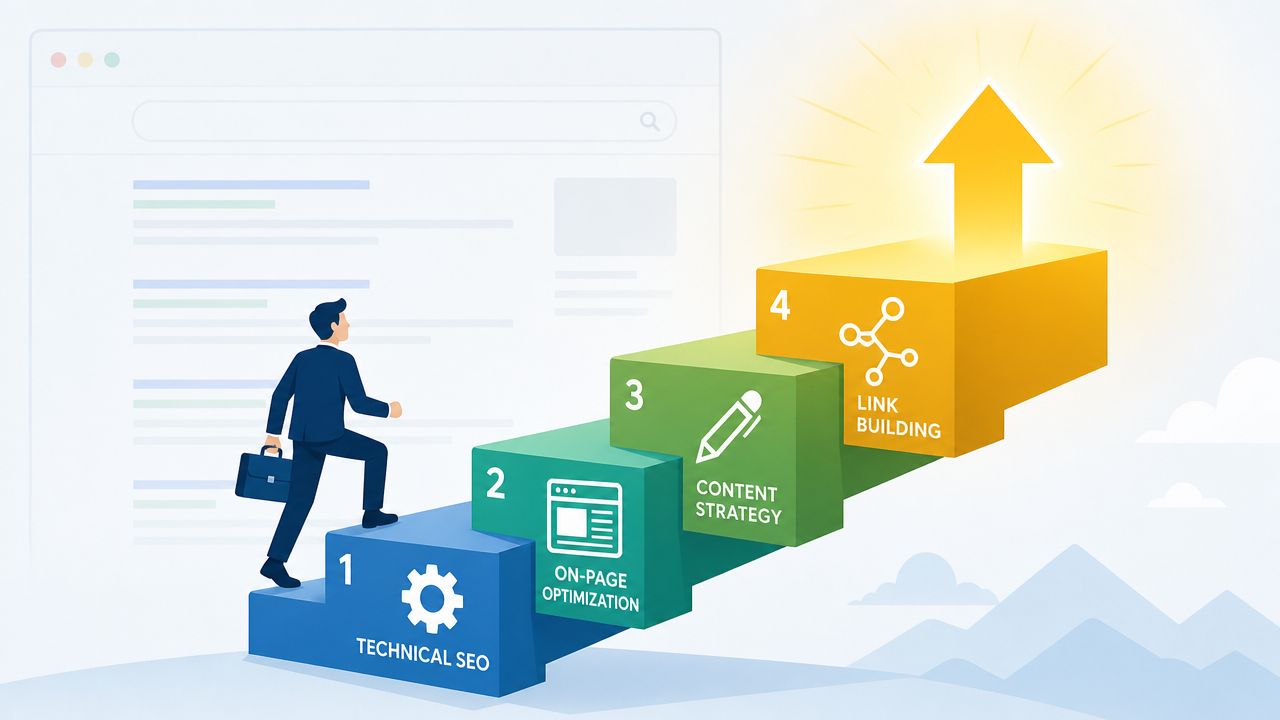
When companies ask what they're paying for, I usually break SEO into four operating layers. The simplest analogy is a house. If the foundation is cracked, paint won't help. If the rooms are badly laid out, good furniture won't save the experience. SEO works the same way.

Technical SEO
This is the foundation. Google's guidance makes the priorities clear: use sitemaps and internal links to help discovery, keep resources accessible, use canonicalization for duplicate content, and control visibility with tools like robots.txt or noindex where appropriate (Google SEO Starter Guide).
In business terms, technical SEO controls whether search engines can efficiently find, interpret, and prioritize the pages that matter. If your site wastes crawl attention on duplicate, thin, outdated, or parameter-heavy pages, your revenue pages often get less support than they should.
For many organizations, specialized help matters. A provider focused on technical SEO agency services can be useful when crawl inefficiencies, rendering problems, poor architecture, or index bloat are suppressing otherwise solid content.
On-page SEO
On-page work is how you make each important page legible to both buyers and search engines. That means:
- Search intent alignment so the page matches what the user wants
- Clear page structure with useful headings, scannable sections, and direct answers
- Internal linking that routes authority and guides visitors deeper into the site
- Commercial clarity so service pages don't read like essays when they should read like sales assets
Many SEO programs underperform. They optimize words but ignore persuasion. A page can rank and still fail if it doesn't answer practical buying questions, establish trust, and create a clear next step.
Content strategy
Content strategy is where SEO stops being purely technical and becomes market-facing. Good content expands the number of relevant searches your business can show up for. It also helps sales by addressing objections before a prospect ever talks to your team.
A useful content strategy usually includes a mix of assets:
| Content type | Primary job | Business value |
|---|---|---|
| Service pages | Capture high-intent searches | Leads and demos |
| Comparison pages | Win evaluation-stage buyers | Better conversion quality |
| Educational articles | Build topical relevance | Earlier funnel visibility |
| Location pages | Support local discovery | Calls and local inquiries |
Good content doesn't try to impress Google first. It helps a buyer make a decision with less friction.
Off-page SEO and reporting
Off-page work builds reputation. That often includes backlinks, citations, digital PR, and partnerships that strengthen perceived authority. The key is relevance and trust, not random volume.
Reporting is the maintenance system that keeps the whole program honest. You should be able to see what changed, why it changed, what it affected, and what happens next. If reporting only shows rank snapshots and traffic charts, it's incomplete.
A serious SEO service isn't a pile of disconnected deliverables. It's a coordinated system where technical cleanup, page improvements, content production, authority work, and reporting all support the same business objective.
SEO Pricing Models and Measuring ROI
Pricing becomes easier to judge once you stop asking, “What does SEO cost?” and start asking, “What exactly is being managed, and how will we know it's producing value?”
The most common pricing approaches fall into three buckets.

How the models differ
| Pricing model | Best fit | Watch-outs |
|---|---|---|
| Monthly retainer | Ongoing SEO programs | Can become vague if scope isn't defined |
| Project-based | Audits, migrations, one-time fixes | Easy to finish the project and lose momentum |
| Performance-based | Narrow, heavily defined outcomes | Can incentivize bad targeting or low-quality wins |
Retainers are usually the right choice when a company wants a durable SEO program. Projects make sense for a migration, technical audit, or cleanup effort. Performance deals sound attractive, but they often create unhealthy incentives unless the KPIs are tightly defined.
A short explainer can help frame the trade-offs:
Build the ROI model backward
The cleanest way to evaluate SEO is to model it from business economics rather than from rankings.
Start with four inputs:
- Average value of a qualified lead
- Lead-to-customer conversion rate
- Customer lifetime value or average contract value
- Organic conversions to high-value pages
Then ask a practical question: if SEO increases qualified visits to commercial pages, what portion of those visits must turn into leads and customers for the program to justify itself?
That exercise changes the conversation. Instead of debating whether an agency will “get more traffic,” you're evaluating whether the work is likely to create enough commercial opportunity to cover the investment and compound over time.
If your team needs a framework, this guide on how to calculate marketing ROI is a useful starting point for aligning SEO measurement with finance.
What smart buyers compare
Don't compare SEO proposals on price alone. Compare them on operating logic.
- Scope clarity: What work gets done each month?
- Business alignment: Which pages, products, services, or regions get priority?
- Measurement quality: Are they tracking conversions, not just visibility?
- Dependency risk: How much progress depends on your internal team?
The cheapest SEO proposal is often cheap because it avoids the hard work. It may produce reports. It may even produce movement. But if it doesn't improve the pages and search journeys that influence revenue, it's not really inexpensive. It's just low-accountability spend.
Selecting Your SEO Management Partner
Choosing an SEO partner is less like hiring a vendor and more like selecting an operating partner for one of your demand channels. The wrong one won't just waste budget. They'll waste time, distract your team, and leave you with a mess of half-executed recommendations.

Questions worth asking on the first call
Most sales calls stay too high-level. Push deeper. Ask questions that reveal how they think.
- How do you prioritize work? You want a provider who can explain what gets fixed first and why.
- What does your reporting show beyond rankings and traffic? If they can't discuss lead quality, assisted conversions, or page-level business impact, that's a warning.
- Who implements changes? Some firms advise but don't execute. Others execute but need heavy internal support.
- How do you handle collaboration with content, dev, and sales teams? SEO often fails at the handoff points.
- What happens if results are slower than expected? Good partners talk about diagnosis and adaptation, not excuses.
Red flags that matter
A few signals are worth treating as immediate caution signs.
| Red flag | Why it matters |
|---|---|
| Guaranteed #1 rankings | No one controls search results that tightly |
| Obsession with vanity keywords | Ranking isn't the same as revenue |
| No clear deliverables | Ambiguity protects the agency, not you |
| Generic local SEO pitch | Multi-location and service-area businesses need nuance |
| No discussion of implementation | Recommendations alone rarely move the needle |
If the proposal sounds interchangeable with ten others, the work probably will be too.
Evaluate fit by business model, not by pitch quality
A polished sales deck can hide a weak operating model. What you need is evidence that the provider understands your type of business.
For local businesses, this matters even more. Local search practitioners consistently emphasize Google Business Profile optimization, review management, and structured location pages as stronger drivers than generic SEO bundles focused only on broad backlinks or blog output (Uberall guidance on choosing a local SEO service).
That means you should ask specific questions if you have multiple offices, service areas, or inconsistent business listings:
- How do you prevent duplicate, low-value location pages?
- Who manages review workflows and profile updates?
- How do you separate local intent pages from broader service pages?
The relationship test
The best partner doesn't just “own SEO.” They help your organization make better decisions about pages, content, site changes, and reporting. They push back when needed. They explain trade-offs. They can speak with a marketer, a founder, and a developer without changing the core logic.
That's the standard to use. Not whether they sound smart, but whether they can run the channel in a way your business can trust.
What to Expect in the First 90 Days
A new SEO engagement shouldn't feel mysterious. It should feel like a controlled rollout with clear priorities, visible work, and early indicators that tell you whether the program is headed in the right direction.

Month one
The first month is usually diagnostic. The provider should be auditing the site, reviewing key pages, evaluating competitors, checking analytics quality, and identifying the highest-impact constraints.
Typical outputs in this phase include:
- Technical findings tied to crawlability, indexation, architecture, redirects, and page health
- Content and page analysis focused on commercial gaps and intent mismatch
- Keyword and topic mapping that connects search demand to actual business offerings
- Measurement cleanup so leads and conversions can be tracked properly
If you need a reference point for what this work often includes, these SEO audit services show the kind of discovery and issue-mapping that usually belongs early in the process.
Month two
Implementation should start to become visible. Critical fixes go live. Priority pages get rewritten or restructured. Internal links improve. New content assets may begin production if the foundation is stable enough.
The pattern I want to see in month two is movement from diagnosis to action. Not everything will be complete, but the program should no longer be living inside slide decks and recommendations.
Early SEO momentum usually comes from fixing friction on pages that already matter, not from publishing a pile of net-new articles.
Month three
By the third month, the work should begin to produce useful directional signals. That doesn't mean the final result is in. It means you can judge whether the strategy is coherent and whether the team is learning from the data.
A healthy month-three review usually includes:
| Area | What you want to see |
|---|---|
| Implementation | Key fixes completed or in progress |
| Page changes | Priority service or product pages improved |
| Reporting | Cleaner attribution and clearer page-level insights |
| Refinement | Decisions based on what the early data shows |
What you should not expect is instant domination across every target query. SEO compounds unevenly. Some pages respond quickly. Others need multiple rounds of improvement, authority support, or technical cleanup before they move.
The useful question at 90 days isn't “Did we win everything?” It's “Did this team identify the right problems, implement meaningful changes, and create a measurable path to business impact?” If the answer is yes, the engagement is usually on solid ground.
Measuring What Matters in SEO Management
Traffic still matters. Rankings still matter. But if those are the only metrics in the room, your SEO program is easier to sell internally than it is to defend financially.
The reporting model has to evolve because search behavior has changed. Segment SEO notes that Google's AI Overviews appeared on roughly 13.14% of U.S. desktop queries in March 2025, up from 6.49% in January, and that about 27.2% of clicks go to the AI-generated summary (Segment SEO services analysis). That's exactly why SEO teams need to prove value beyond raw click volume.
The KPI stack that holds up in leadership meetings
A stronger SEO scorecard usually includes:
- Commercial page visibility for the pages that generate pipeline
- Lead and inquiry volume from organic search rather than sitewide visit totals
- Assisted conversions where SEO influenced the journey without being the last click
- Branded demand as a sign that search visibility is supporting market awareness
- Share of search relative to direct competitors in your core category
This changes the internal conversation. A temporary traffic dip doesn't automatically mean the program is failing. If branded searches rise, commercial pages gain visibility, and assisted conversions improve, SEO may be strengthening demand capture even when traditional organic clicks are under pressure.
What this looks like in practice
A CEO usually wants an answer to one question: is SEO helping us grow?
The best reporting answers that in plain language. Which service pages improved. Which topics are pulling in qualified visitors. Which leads started through organic. Which opportunities touched organic during the buying journey. Which local profiles or location pages are producing calls and direction requests.
SEO reporting should read like business intelligence with search inputs, not like a rank-tracking export.
That's also how you protect budget. When the team can connect visibility, brand demand, and conversion influence into one coherent story, SEO stops looking like a soft-awareness channel and starts looking like what it is. A compound demand engine.
Frequently Asked Questions About SEO Services
How long does it really take to see results
Initial progress usually shows up before full business impact does. Technical cleanup, page rewrites, and internal linking improvements can create early movement, but durable gains depend on competition, site quality, implementation speed, and how much authority the domain already has.
The practical mistake is expecting SEO to behave like paid media. It doesn't. Paid turns on quickly and turns off quickly. SEO builds slower, but the asset can keep producing after the immediate work is done.
How should a multi-location business handle SEO
Don't create near-duplicate pages for every town just to have a footprint. That usually produces weak pages that don't help users and don't create durable value.
A better model is operationally grounded:
- Build structured location pages only where you have real business relevance
- Keep business information accurate across profiles and listings
- Manage Google Business Profile actively rather than treating it as a setup task
- Create review workflows so reputation improves consistently over time
- Differentiate service-area intent from office-location intent in page planning
This is one area where generic SEO packages often fall apart. They treat local visibility like a citation project when it's really an ongoing operating discipline involving profiles, reviews, page quality, and data consistency.
Does AI search reduce the value of SEO
It changes the scoreboard, not the need for the game.
As AI-generated search experiences expand, some informational queries will produce fewer clicks to traditional listings. That means SEO teams need to care more about total search presence, branded recall, and conversion influence. Businesses still need to be discoverable, credible, and easy to choose. If anything, that raises the value of tighter measurement and stronger commercial pages.
What should I expect from an agency relationship
You should expect a point of view, not just labor. The agency should tell you what to prioritize, what to ignore, what depends on your team, and how they'll judge success.
You should also expect friction sometimes. Good SEO partners challenge weak page structures, slow approvals, poor measurement, and content that sounds polished but doesn't match search intent. That's not a sign the relationship is broken. It's often a sign they're doing actual work.
What usually doesn't work
A few patterns fail over and over:
- Buying the cheapest package and expecting strategic outcomes
- Publishing content without a page strategy
- Treating technical SEO as optional
- Reporting on traffic without tying it to sales activity
- Switching providers too fast before the implemented work has time to mature
The companies that get the most from SEO management services treat the channel like an operating system. They define the business case, choose a partner who can execute, and hold the work accountable to commercial outcomes rather than surface-level motion.
If you want a partner that approaches SEO as part of a broader growth system, not an isolated checklist, ReachLabs.ai offers SEO and PPC management alongside content, creative, and local marketing support. That combination can be useful for teams that need search strategy tied closely to lead generation, reporting, and overall brand visibility.