You’ve got an SEO freelancer fixing title tags, a paid ads contractor asking for fresh landing pages, someone posting to LinkedIn without talking to the email person, and a designer who never saw the campaign brief. Everyone is busy. Nothing feels connected. Reporting arrives in separate dashboards, and when results stall, each vendor explains their own channel instead of your whole pipeline.
That’s where a lot of businesses get stuck. The issue usually isn’t effort. It’s orchestration.
A full-service marketing agency is meant to solve that problem. Instead of hiring and managing a set of disconnected specialists yourself, you work with one partner that plans, executes, and measures marketing as a single system. If you’ve been asking what is a full service marketing agency, the full answer goes far beyond “an agency that offers many services.” It’s a model for creating alignment across strategy, creative, media, content, and analytics.
Your Marketing Is Chaos Is There a Better Way
For many small and mid-sized businesses, marketing breaks down in familiar ways. The SEO plan targets one audience. Paid ads target another. Social content sounds casual while the website sounds corporate. Sales asks for better leads, but marketing can’t clearly show which channel is doing what.
The hidden cost is management time. Someone inside your company ends up playing traffic cop between freelancers, agencies, internal teams, and software tools. That person usually wasn’t hired to do vendor coordination all day.
A full-service agency steps in as the coordinator and the strategist. Instead of giving five vendors partial instructions, you work through one team that owns the broader plan. If you’re exploring small business marketing solutions, that kind of unified setup often matters as much as the services themselves.
What chaos looks like in practice
- Conflicting priorities. Your PPC consultant wants high-converting pages fast, while your web team is focused on a redesign timeline.
- Message drift. Every channel uses different wording, visuals, and calls to action.
- Murky attribution. Leads arrive, but nobody agrees on what influenced them.
- Slow execution. Small changes require too many approvals across too many people.
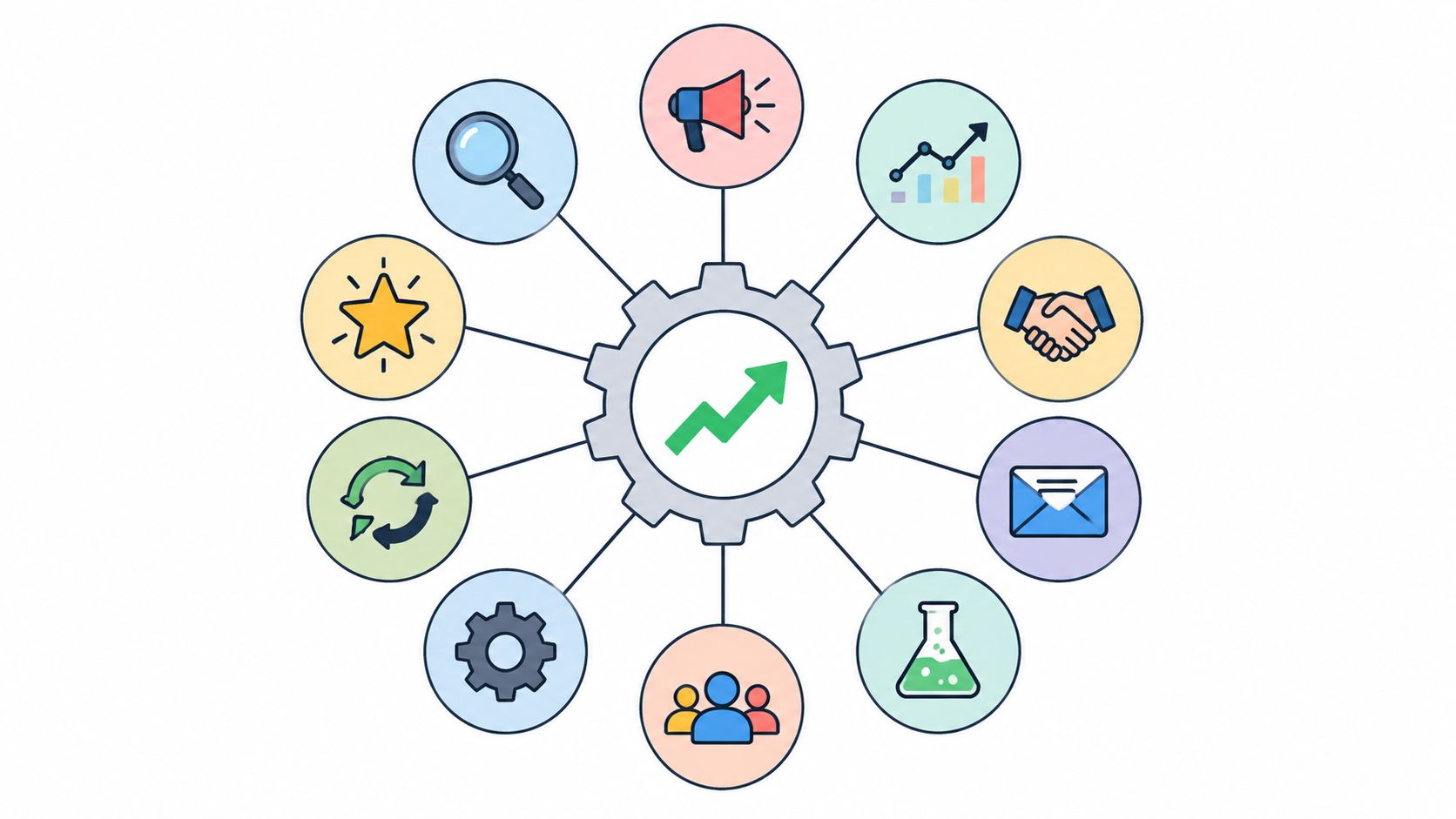
When marketing feels random, the problem usually isn’t that you need more tactics. You need one operating system.
That’s the practical appeal of the full-service model. It gives you a central team that can connect campaign goals to execution details, then feed performance data back into the next round of decisions.
Why this question matters now
Businesses aren’t just buying isolated marketing tasks anymore. They’re looking for tighter coordination across channels, cleaner reporting, and less internal friction. That’s why the full-service model keeps coming up in boardrooms, founder meetings, and marketing team discussions.
The bigger question isn’t whether a single partner can handle multiple services. It’s whether that partner can do it without becoming shallow, rigid, or hard to scale. That’s where the specialist versus generalist debate starts to matter.
Defining the Full-Service Marketing Agency
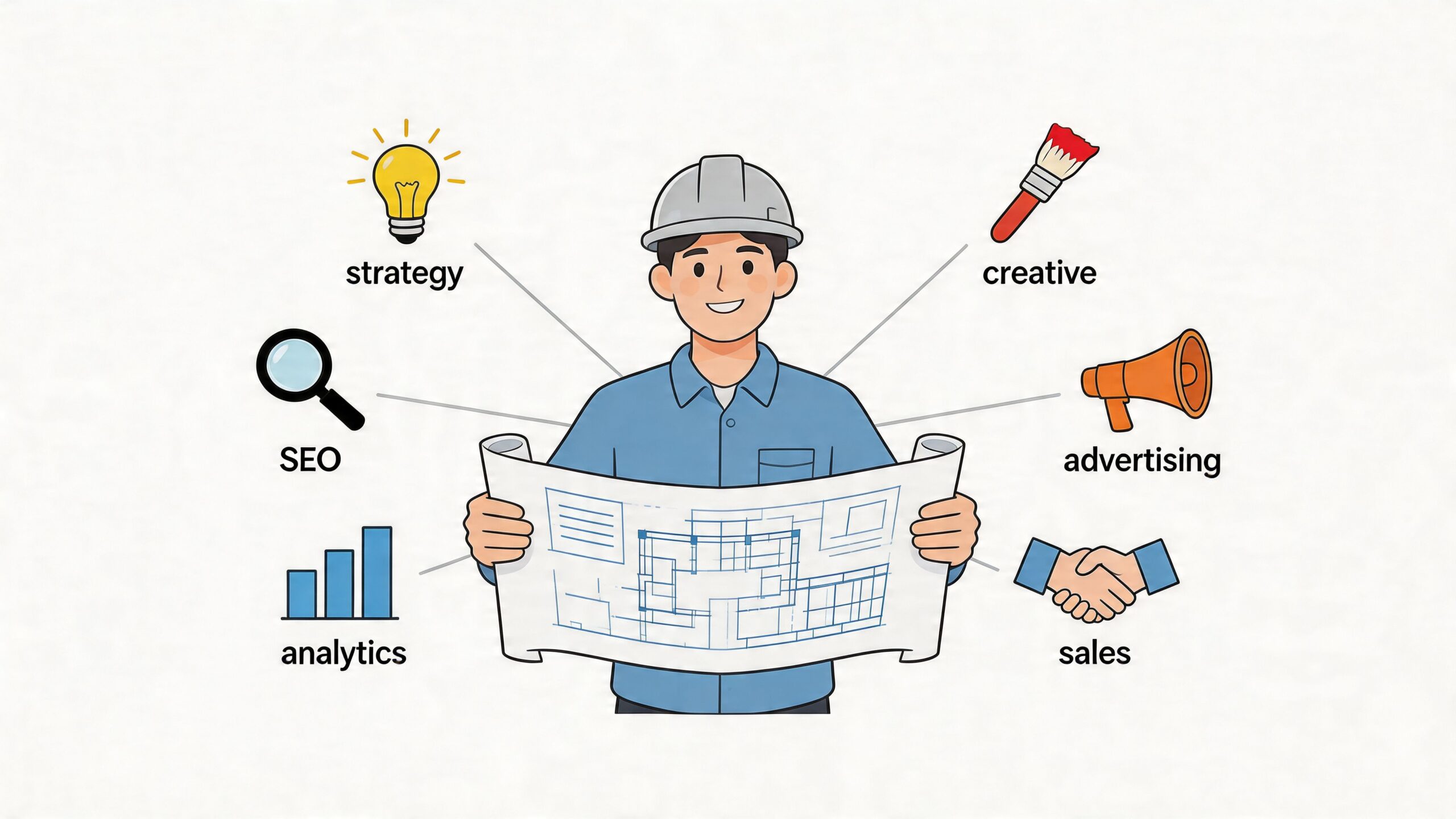
The easiest way to understand a full-service agency is to compare it to a general contractor building a house. You don’t hire a plumber, electrician, roofer, framer, and tile setter and hope they somehow coordinate themselves. The general contractor works from one blueprint, schedules the trades, manages dependencies, and takes responsibility for the final build.
A full-service agency plays a similar role for marketing. It aligns the people doing research, messaging, design, media buying, SEO, social content, reporting, and optimization so the work supports one business goal instead of competing agendas.

More than a menu of services
A lot of people hear “full-service” and think it means “an agency that does many things.” That’s incomplete.
The stronger definition is this: a full-service agency provides strategic governance plus execution. It doesn’t just offer SEO, paid search, content, or design as separate line items. It decides how those functions should work together, in what order, with what priorities, and against which business outcomes.
That central planning role is why many companies look for one partner rather than a stack of vendors. Businesses want unified oversight across media, content, commerce, and reporting workflows. That demand is reflected in the market itself. The global full-service digital marketing agencies market was valued at USD 369.08 billion in 2025 and is projected to reach USD 889.91 billion by 2035, growing at a 9.2% CAGR, with USD 399.64 billion assessed for 2026, according to Research Nester’s full-service digital marketing agencies market report.
What the agency is actually accountable for
A strong full-service partner should own three connected responsibilities:
| Responsibility | What it means |
|---|---|
| Strategy | Defining goals, audience, positioning, channels, and measurement |
| Execution | Producing campaigns, content, creative assets, media plans, and web updates |
| Optimization | Reviewing performance and adjusting messaging, budget, and tactics |
That’s why the model can work so well when it’s done properly. There is one team accountable for both the plan and the handoff between disciplines.
Practical rule: If an agency can list services but can’t explain how those services inform each other, it isn’t operating like a true full-service partner.
The role of one point of contact
The point isn’t convenience alone, though convenience matters. The bigger advantage is fewer broken handoffs.
When one partner handles planning and coordination, your strategist can brief the designer, the paid media manager can request fresh creative without starting from scratch, and the analyst can connect performance trends back to content and campaign changes. If you want a useful primer on the broader role, this guide on what a digital marketing agency does is a solid companion read.
The phrase what is a full service marketing agency becomes clearer when you view it this way. It’s not a catch-all vendor. It’s a central command structure for your marketing work.
The Integrated Services Portfolio
Most full-service agencies offer a similar set of core disciplines. What separates a useful partner from a bloated one isn’t the number of services on the website. It’s whether those services connect.

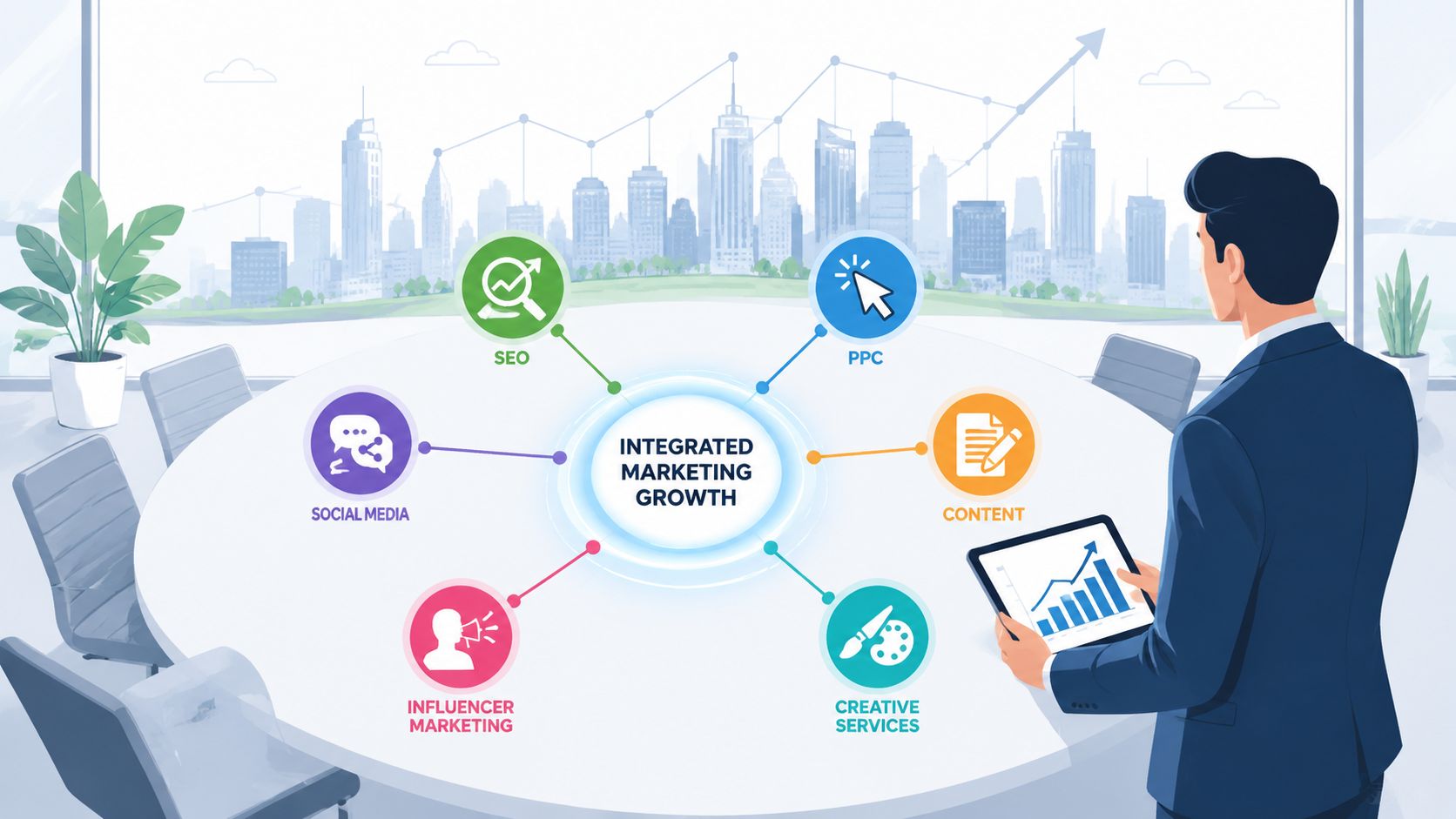
In 2024 service demand data, SEO and Website Design & Maintenance were each at 77.2% adoption, followed by PPC at 76.8%, Social Media Marketing at 75.2%, Lead Generation at 65.2%, and Content Marketing at 61.2%, according to this marketing agency statistics roundup. That list gives you a realistic picture of what businesses commonly expect from a full-service partner.
Strategy comes first
Without strategy, service lists become busywork. The strategy layer usually includes audience research, positioning, offer development, messaging architecture, campaign planning, and channel selection.
An agency decides questions like these:
- Who are we trying to reach
- What problem are we solving for them
- Which channels fit the buying journey
- What should success look like
If this work is missing, the rest of the marketing tends to drift. You get activity without direction.
Creative turns strategy into something people can feel
Creative covers more than logos and ad graphics. It includes landing page design, campaign visuals, brand voice, video, short-form social assets, sales collateral, and written content.
Consistency's impact is evident. If your website promises one thing and your ads promise another, prospects notice. The same goes for tone. A polished B2B landing page connected to off-brand social posts creates friction even if each asset looks decent on its own.
A capable full-service agency makes sure creative decisions support the same positioning across channels.
Digital channels do the distribution work
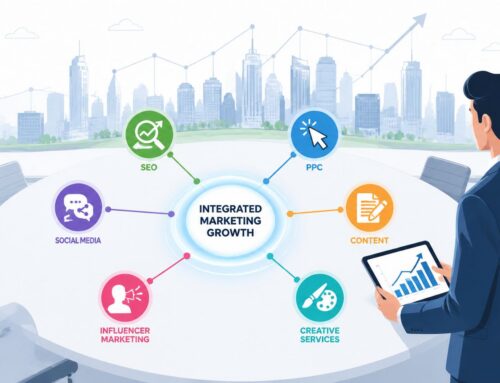
The core execution layer usually includes search, paid media, content distribution, social campaigns, email, and website management. These channels shouldn’t run as separate programs.
Here’s what integration looks like in plain terms:
- SEO informs content. Search data helps the content team choose topics and structure pages around buyer intent.
- Paid ads validate messaging. Fast feedback from ad campaigns can show which offers or angles deserve broader content support.
- Social extends campaign reach. Creative built for one launch gets adapted into platform-specific formats rather than recreated from scratch.
- Email captures and nurtures interest. Traffic from ads or content should feed sequences that continue the conversation.
That’s the difference between having many services and having one marketing engine.
Analytics ties the whole system together
A full-service model only works if reporting connects the dots. You need one view of what happened across channels, what influenced conversion, and where the next change should happen.
That means the agency should be able to answer practical questions such as:
| Question | Why it matters |
|---|---|
| Which channel is introducing qualified prospects? | Helps shape top-of-funnel investment |
| Which landing pages convert better? | Directs design and copy updates |
| Which content themes move leads forward? | Improves campaign focus |
| Where are handoffs breaking down? | Prevents wasted spend and lost opportunities |
Good reporting doesn’t drown you in dashboards. It helps you make the next decision faster.
Modern agencies often support adjacent growth functions
A lot of business growth work now sits just outside traditional marketing. That’s why some agencies also handle investor pitch decks, personal brand content, managed LinkedIn outreach, sales enablement assets, or influencer coordination.
Those services matter because buyers don’t experience your company in departmental slices. A founder’s LinkedIn presence, a fundraising deck, an email nurture flow, and a paid campaign can all shape credibility at the same time.
For teams comparing options, advertising agency services can be a useful benchmark, especially if you’re trying to separate media execution from the wider full-service model.
The real value is synergy
A single service can help. Integrated services create compounding effects.
An SEO insight can improve a landing page. That improved landing page can lift paid media performance. The paid campaign can reveal objections that sharpen email copy. Email engagement can tell your content team which themes deserve expansion. Analytics then feeds everything back into planning.
That closed loop is what businesses are really buying when they hire a full-service agency.
Full-Service vs Specialized Agency A Head-to-Head Comparison
Some businesses need one thing done extremely well. Others need many things coordinated well enough to support a shared growth goal. That’s why the comparison between full-service agencies and specialist firms matters.
The old criticism of full-service agencies is familiar. They’re seen as broad but shallow. Specialists, by contrast, go deep in one discipline.
That criticism isn’t always wrong. But it’s incomplete.
Full-Service vs. Specialized Agencies at a Glance
| Criteria | Full-Service Agency | Specialized Agency / Freelancers |
|---|---|---|
| Coordination | One team manages the full plan | You manage handoffs across vendors |
| Strategic cohesion | Stronger when the agency has integrated planning | Often fragmented unless you provide strong internal leadership |
| Depth in one channel | Varies by agency structure | Usually stronger within the specialty |
| Speed of cross-channel execution | Often faster when assets and approvals are centralized | Can slow down when multiple vendors depend on each other |
| Reporting | More likely to combine channel performance into one view | Often split by platform or discipline |
| Flexibility | Depends on contract model and operating style | Can be easier to swap individual providers |
When a specialist is the better fit
A specialist can make sense when the assignment is narrow and important. Maybe your site migration needs technical SEO depth. Maybe your ad account requires advanced paid search restructuring. Maybe you already have an experienced in-house marketing leader who can coordinate everyone else.
In those situations, specialist focus can be exactly what you need.
Where the full-service model wins
The full-service model usually becomes stronger when success depends on multiple connected disciplines. That includes product launches, rebrands, full-funnel lead generation, content plus distribution programs, or any environment where creative, channel execution, and analytics need to move together.
The major mistake businesses make is assuming the choice is between broad generalists and narrow experts. A better option has emerged.
The generalist problem is real
Some agencies staff accounts with marketers who know a little about everything but don’t go deep enough in fast-moving channels. That structure can limit performance. According to Harbinger Marketing’s discussion of full-service agencies, 2025 Forrester data shows full-service agencies with generalist staff underperform specialists by 35% in ROI on digital campaigns. The same source notes that 41% of agencies are pivoting to collective specialist models, which boost lead generation by 52% through more customized, expert-led strategies.
That matters because it clarifies the actual decision. You don’t want a vague “one-stop shop.” You want one strategic hub that brings in channel-level depth.
A modern full-service agency should feel less like a room full of generalists and more like a coordinated bench of specialists.
The model to look for
The strongest setup for many companies is a collective specialist model. One lead team owns strategy, communication, and accountability. Under that umbrella, specialists handle the disciplines where depth matters most.
That gets you the benefits of both approaches:
- One roadmap
- One reporting structure
- One point of accountability
- Deep expertise where execution quality matters
If you’re evaluating commercial structure too, this breakdown of retainer vs. subscription models is useful because delivery model affects speed, flexibility, and how easily work scales up or down.
The better question isn’t “full-service or specialist?” It’s “does this agency integrate specialists well enough to act like one team?”
Unlocking Business Growth and Measurable Outcomes
Marketing only matters if it changes business results. That sounds obvious, but many companies still measure channels in isolation and miss the bigger effect of coordinated execution.

When strategy, media, content, and measurement are connected, teams can improve the metrics executives care about. According to ROI Amplified’s analysis of full-service marketing, integrated, multi-channel strategies lead to 20 to 30% higher conversion rates compared to siloed vendor approaches and produce 18% lower customer acquisition costs in major markets.
Why integration changes outcomes
A disconnected setup often creates three problems at once. Messaging becomes inconsistent. Channel teams optimize for their own reports instead of the customer journey. Performance data arrives too late or in forms that don’t support action.
An integrated agency addresses that by using shared inputs. Search data can inform ad copy. Ad engagement can shape creative direction. Landing page behavior can influence email sequencing. Instead of running separate experiments, the team improves the whole path from first click to signed customer.
For teams trying to build that kind of visibility internally, tools for AI marketing analytics can help organize performance signals across campaigns and channels.
The business metrics that usually improve
When clients ask what they should expect from a full-service partner, I tell them to look for movement in a short list of business-level indicators:
- Conversion rate. Are more visitors, leads, or opportunities taking the next step?
- Customer acquisition cost. Is growth becoming more efficient?
- Lead quality. Are sales teams seeing better-fit prospects?
- Pipeline consistency. Are campaigns producing steadier inbound demand?
- Brand coherence. Do prospects encounter the same story everywhere?
These gains don’t come from “doing more marketing.” They come from reducing waste between marketing motions.
Here’s a short explainer that captures the idea from another angle:
A simpler way to think about ROI
Think of integrated marketing like a relay race. A strong first runner helps, but the team still loses if baton passes are sloppy. In marketing, those baton passes happen between channels, assets, audiences, and reporting. A full-service model aims to improve the handoff, not just the runner.
That’s why unified agencies can create business lift even when they aren’t inventing brand-new tactics. They remove friction, align priorities, and make optimization continuous instead of occasional.
Real-World Examples of Full-Service Success
The easiest way to understand this model is to watch how multiple disciplines support one goal. Here are two common scenarios.
B2B SaaS and the pipeline problem
A software company wants more qualified sales conversations, but the current setup is fragmented. A freelance copywriter produces blog posts. A sales rep sends LinkedIn messages with no connection to content. Paid search points to generic pages. Nobody owns the full lead journey.
A full-service partner would start by tightening the offer and defining the ideal buyer. Then the team would build a coordinated system: educational content built around prospect pain points, landing pages aligned to campaign intent, managed LinkedIn outreach for targeted conversations, and search visibility work that captures active demand.
The important part isn’t any single tactic. It’s how they connect. LinkedIn replies can reveal objections that improve content angles. Content downloads can feed outreach segmentation. Landing page behavior can tell the paid media team which message deserves more budget.
The best full-service work looks less like a pile of tactics and more like one conversation repeated across channels.
D2C brand and the visibility challenge
Now take a consumer brand trying to grow awareness without sounding generic. They may have decent creative, some influencer activity, a social calendar, and occasional paid promotions, but the work feels episodic.
A full-service agency would look at the brand system first. What story should show up everywhere? Which creators match the audience? Which assets can be adapted across paid social, organic posts, landing pages, and email?
From there, the agency coordinates the launch rhythm. Creator content informs ad creative. Social comments shape product messaging. Paid performance reveals which hooks earn attention. Email and site content then reinforce the same themes rather than introducing a different message.
Why these examples matter
In both cases, the agency isn’t valuable because it can technically provide many services. It’s valuable because it can make each service improve the next one.
That’s also where a modern collective-specialist setup becomes useful. A business might need channel-specific expertise in outreach, influencer work, creative, and analytics, but it still needs one strategy owner. ReachLabs.ai is one example of that kind of structure, combining specialist-led digital strategy, creative services, influencer programs, investor deck support, and managed LinkedIn outreach under a unified model.
The lesson is simple. If your growth goal depends on several moving parts, your agency should be designed to make those parts work together.
How to Choose the Right Full-Service Partner
Hiring the wrong agency can create a new version of the same chaos you were trying to escape. You still need to vet process, team structure, pricing, and flexibility.
One warning matters especially for small businesses. A 2025 Clutch survey found that 62% of SMBs using full-service agencies feel trapped in contracts due to rising fees, as discussed in this analysis of full-service marketing agency contracts. That doesn’t mean full-service partnerships are a bad idea. It means you should examine commercial terms as closely as creative capabilities.

Understand the pricing model before you sign
Most agencies sell work through a few common structures.
| Model | Best for | Watch out for |
|---|---|---|
| Retainer | Ongoing marketing programs with changing priorities | Scope can get fuzzy if deliverables aren’t defined |
| Project-based | One-time launches, websites, or campaigns | Harder to maintain momentum after delivery |
| Value-based | Work tightly tied to business outcomes | Requires strong alignment on how value is measured |
None of these is automatically right or wrong. The core issue is fit. If your needs change often, a rigid package can become frustrating fast.
Ask questions that reveal how the agency actually works
A polished proposal won’t tell you enough. Better questions will.
- Who will work on my account. Ask whether execution is handled by specialists, account managers, or outsourced contractors.
- How do strategy and channel teams communicate. You want to hear about routines, shared briefs, and reporting loops, not vague claims about collaboration.
- What happens if priorities change mid-quarter. This exposes how flexible the operating model really is.
- How do you report performance across channels. Look for business-level reporting, not just platform screenshots.
- What does onboarding look like. A good partner should have a clear intake process for goals, assets, audience knowledge, and existing data.
- What are the exit terms. Ask directly about notice periods, ownership of assets, transfer of accounts, and data access.
Don’t just ask what services an agency offers. Ask how work moves from strategy to production to optimization.
Look for specialist depth without losing integration
Often, businesses are misled. An agency says it does SEO, ads, content, and social. Fine. But who owns each area? How experienced are they? How often do they work together? What happens when one discipline uncovers insight that should change another?
If SEO is important in your mix, guides on finding the right SEO company can help you sharpen your evaluation criteria, even if you’re hiring a broader agency and not a pure SEO shop.
A practical shortlist for final evaluation
When you compare finalists, use this simple screen:
- Clarity. Can they explain your strategy in plain English?
- Specialization. Do they have real depth where your business needs it most?
- Integration. Can they show how teams share insight and coordinate execution?
- Flexibility. Are contract terms and delivery models workable for your stage?
- Transparency. Will you own the assets, accounts, and performance visibility?
The right agency should reduce management overhead, not increase dependency. If the structure feels opaque before signing, it usually won’t improve later.
From Vendor Management to Strategic Partnership
The shift that matters most is moving from vendor management to strategic partnership. That’s the answer to what is a full service marketing agency.
At its best, the model gives you one coordinated system for planning, producing, distributing, and improving marketing work. It reduces message drift, shortens handoff delays, and creates a clearer path from activity to outcome. The outdated fear that full-service always means generalist work doesn’t need to define your choice. The stronger version of this model uses specialists, but organizes them under one strategic lead.
For SMBs, marketers, and brand teams, that distinction matters. You want depth without fragmentation. Flexibility without confusion. Accountability without contract traps.
Choose the partner that can do three things at once. Understand your business. Integrate specialist execution. Adapt as your growth needs change.
If you’re evaluating whether a unified agency model fits your business, ReachLabs.ai offers a full-service, specialist-led approach that combines digital strategy, creative, influencer marketing, lead generation support, investor decks, and managed LinkedIn outreach under one operating structure.