
Choosing the right digital marketing agency is a huge decision. It really all comes down to clarity on your goals, a realistic budget, and having a smart way to evaluate your options. Honestly, before you even start looking at agencies, you need to get your own house in order. That means defining what success actually looks like in real, measurable numbers.
Nail Down Your Goals Before You Start the Search
You can't pick the right partner if you don't know what you need them to do. Just sending out a vague request for "more traffic" or "better social media" is like telling a builder to "build a house" without giving them any blueprints. The best agency relationships I've ever seen started with serious internal alignment long before anyone picked up the phone for a discovery call.
This first step is all about turning those fuzzy business hopes into a clear, actionable brief. It means taking a hard, honest look at what’s working (and what’s not) in your marketing right now and setting some realistic financial guardrails. If you skip this part, you'll end up being wowed by a slick sales pitch instead of finding a true strategic fit.
Turn Business Goals into Marketing KPIs
Your marketing goals can't live on an island. They have to directly support what the business is trying to achieve overall. The trick is to draw a straight line from a big-picture goal like "increase market share" to the specific Key Performance Indicators (KPIs) an agency can actually move the needle on.
Start by asking what core business outcome you're chasing. For example:
-
Business Goal: Boost company revenue by 20% this year.
-
Marketing KPI: Generate 500 new Marketing Qualified Leads (MQLs) a month, and make sure at least 5% of them convert to Sales Qualified Leads (SQLs).
-
Business Goal: Get our customers to stick around and buy more often.
-
Marketing KPI: Increase Customer Lifetime Value (CLV) by 15% and slash our churn rate by 10% using smart email and content campaigns.
This exercise forces you to look past vanity metrics like social media likes or impressions and focus on the numbers that actually hit the bottom line.
A great agency won't just take your order; they'll question your assumptions. When you walk in with clearly defined KPIs, the conversation immediately becomes more strategic. It's not about what services to buy, but how to hit your numbers.
Set a Realistic Budget Based on Value, Not Guesswork
Figuring out your budget is more than just picking a number that feels right. The smart way to do it is to base it on two hard numbers: your Customer Lifetime Value (CLV) and your target Cost Per Acquisition (CPA).
First, calculate your CLV—that’s the total amount of money a typical customer spends with you over their entire relationship. Then, figure out the most you’re willing to pay to get a new customer while still making a good profit. For instance, if your CLV is $3,000 and you want a 3:1 return on your marketing spend, your target CPA is $1,000.
This simple math grounds your budget in reality. It gives potential agencies a clear financial box to play in, so they can build a strategy designed to hit your specific CPA targets. This way, the partnership is set up for profitability from day one. You can get more in-depth on this by learning how to write a marketing plan that connects your budget to a solid strategy.
Do an Honest Gut Check of Your Marketing
Finally, it's time for a candid look at what you’re already doing. This isn't about pointing fingers; it’s about finding opportunities. I like to use a simple framework to see where things stand.
What's Working?
- Example: Our blog is a powerhouse, driving 30% of our organic traffic and bringing in great leads for one of our main services. We need to pour gas on that fire.
What's Not Working?
- Example: We're getting a ton of clicks on our paid social ads, but nobody is converting on the landing page. We're just burning cash.
Where Are the Gaps?
- Example: We have absolutely no presence on LinkedIn, which is exactly where our ideal enterprise customers are hanging out. We also don't have any kind of email system to nurture new leads.
This kind of audit gives you the raw material for your agency brief. It shows you've done your homework and helps agencies come back with targeted solutions for your real-world problems, not just a generic list of services.
Create an Agency Evaluation Scorecard
Once you’ve done your initial research, it's time to move past gut feelings. A slick presentation can easily hide a lack of real strategic thinking, which is why you need an objective way to compare your options. This is where a standardized scorecard comes in.
Creating a scorecard forces you to measure every potential partner against the same critical benchmarks. It’s the only way to make a logical, data-driven decision you can stand behind. You’ll be able to see beyond the surface-level charm and really dig into the factors that predict a successful, long-term partnership.
Building Your Scorecard Criteria
Your scorecard should be a direct reflection of the goals you’ve already set. Don't just grab a generic template; customize it to what your business actually needs. Start by listing out the core skills and qualities you absolutely must have in a partner.
This isn’t just about a list of services. It’s about how they deliver them. Here are a few key areas I always recommend including as a starting point:
- Industry Specialization: Have they actually worked in your niche before? An agency that gets the nuances of B2B SaaS will operate very differently from one that focuses on D2C e-commerce. You want proof, not just promises.
- Team Structure: Are you getting a dedicated team of specialists—an SEO expert, a PPC manager, a content strategist—or a couple of generalists? There's no right or wrong answer, but one model will be a much better fit for your needs.
- Strategic Insight: During their pitch, did they offer cookie-cutter solutions, or did they show a real spark of understanding for your specific business challenges? You’re looking for a partner who has clearly done their homework on you.
- Tech Stack Proficiency: What tools are they using every day for analytics, project management, and execution? An agency that invests in modern, efficient technology is usually a sign of an organized and forward-thinking team.
A well-built scorecard is more than a simple checklist; it's a decision-making framework. It turns your priorities into a quantitative system, making it incredibly clear which agency is the best strategic fit, even when all the pitches start to sound the same.
Weighting What Matters Most
Let's be honest: not all criteria are created equal. For your company, deep industry experience might be the most critical factor and should be weighted heavily. For another business, it might be an agency's creative portfolio or their communication style.
Assign a weight to each criterion (I like a simple scale of 1-5) to show how important it is to your business. This prevents a single, flashy part of a pitch from swaying your decision if it doesn't align with your core objectives. For instance, an agency might score a perfect 10 on creativity, but if your main goal is technical SEO, a weighted score will give you a much more accurate picture of their overall suitability.
This data-driven mindset is exactly how successful agencies think about their own growth—they focus on measurable outcomes like Key Performance Indicators (KPIs) and Customer Lifetime Value (CLV).
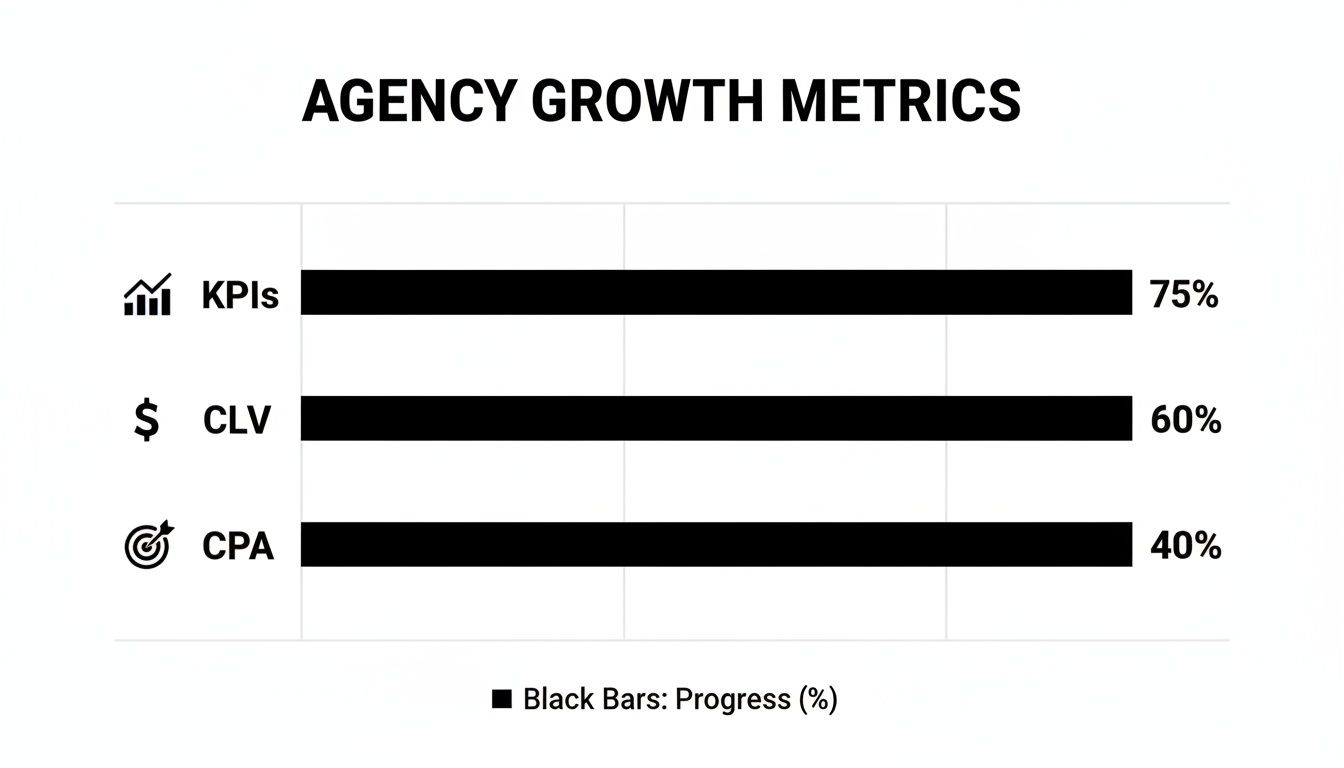
As the chart shows, real success is measured by tangible metrics. That’s why you need to evaluate potential partners on their proven ability to actually move these numbers.
To help you get started, here's a simple template you can adapt. The key is to weigh the criteria based on your priorities, then score each agency consistently.
Agency Evaluation Scorecard Template
| Evaluation Criterion | Weight (1-5) | Agency A Score (1-10) | Agency B Score (1-10) | Agency C Score (1-10) | Notes |
|---|---|---|---|---|---|
| Industry Experience | 5 | e.g., "Proven results in B2B SaaS" | |||
| Strategic Approach | 5 | e.g., "Custom strategy vs. generic plan" | |||
| Case Studies/Results | 4 | e.g., "Shared 3 relevant case studies" | |||
| Technical Expertise | 4 | e.g., "Strong on-page SEO knowledge" | |||
| Team Structure | 3 | e.g., "Dedicated specialists assigned" | |||
| Communication Style | 3 | e.g., "Proactive and clear" | |||
| Cultural Fit | 3 | e.g., "Felt like a true partner" | |||
| Total Weighted Score | – |
To calculate the total, multiply each score by its weight and sum the results.
Scoring and Cultural Alignment
Once your criteria and weights are locked in, you can score each agency (a 1-10 scale works well) as you meet with them. This creates a clear, numerical comparison that makes the final call much easier. To get even sharper with your scoring, check out our guide to the top marketing performance metrics examples to refine what you’re looking for.
But remember, the numbers don't tell the whole story. There's one crucial, often-overlooked factor: cultural alignment.
A partnership requires compatible workflows, personalities, and communication styles. Ask yourself:
- Does their communication rhythm match what your team needs (weekly check-ins vs. monthly reports)?
- Is their process more collaborative, or do they prefer to work in a silo and just deliver results?
- Do their company values actually resonate with your own?
An agency can be technically brilliant, but if working with them feels like pulling teeth, the relationship is doomed from the start. Add "Cultural Fit" to your scorecard to make sure you’re formally assessing this. It's the vital qualitative check that ensures your chosen partner isn’t just capable, but truly compatible.
Look Into the Agency’s Track Record and Business Health
A slick presentation and a confident pitch are just table stakes. What really tells you if an agency is the right partner is their proven ability to deliver results and the stability of their own business. When you hire an agency, you’re not just buying a service; you’re starting a partnership. A financially healthy firm with a solid history is far more likely to be a reliable and effective partner for the long haul.

Think of this part of the process as looking under the hood. It’s your chance to verify their claims, poke holes in their pitch, and see if they actually practice what they preach. Honestly, if an agency can't market itself and grow its own business, that’s a massive red flag.
Beyond the Polished Case Study
Every agency will show you its greatest hits, but your job is to look at those case studies with a critical eye. Vague promises like "increased brand awareness" or "significant growth" just don't cut it. You need to see the hard numbers that connect their efforts to real business outcomes.
When you’re looking through their portfolio, hunt for the specifics:
- Real Metrics: Did they boost organic traffic by 45% in six months? Did they drop the cost-per-lead by $20? Get the details.
- Business Impact: How did that traffic increase or lower CPL actually affect the client's bottom line? Ask about the impact on revenue or customer acquisition.
- Relevance: Are their examples from a similar industry or for a business facing challenges like yours? Success with a B2C e-commerce brand doesn't automatically translate to B2B SaaS.
And don't be shy about asking to speak with one or two of their clients, past or present. A confident agency with happy customers will have zero problems making an introduction. This is your chance to get a firsthand account of their communication style, reporting quality, and overall performance.
An agency’s best marketing tool should be its own success. If they can’t show you concrete proof of how they've helped others achieve measurable results, they are unlikely to do it for you.
Assess the Agency’s Own Business Health
This is a step most businesses skip, but it’s one of the most predictive indicators of a good partnership. An agency that's growing and keeping its clients is obviously doing something right. It means their strategies work, their clients are happy, and their business is on solid ground. A struggling agency, on the other hand, might be desperate for cash, understaffed, or cutting corners.
You can get a feel for their health by asking some direct but fair questions:
- How has your agency grown over the last year? You're looking for signs of steady, sustainable growth—not just treading water.
- What is your average client retention rate? A high rate (anything over 80% is strong) is a great sign they build lasting, valuable relationships.
- How do you generate your own new business? If they rely on their own SEO, content, and social media efforts, it shows they believe in their own medicine.
This isn’t about being nosy; it’s about making sure you’re partnering with a winner. When you're picking an agency, prioritize those that show consistent revenue growth. The industry average annual growth rate over the last five years has been 12%, which actually outpaces the 10% average for all U.S. publicly traded sectors. This metric shows an agency's ability to thrive through volatility—like the post-pandemic boom in 2021 that was followed by a dip to just 5% growth in 2024. Agencies that grew through their own channels, like email and social media, proved their value. You can find more insights like this in the 2025 Digital Agency Industry Report.
Evaluate Their Tech Stack and Processes
The tools an agency uses can tell you a lot about its sophistication and efficiency. A modern, results-focused agency will have a well-defined tech stack for analytics, project management, and execution. As you investigate an agency’s track record, understanding their tools is key; you might even want to research the best SEO software for agencies to see if what they're using is up-to-date.
Ask them what platforms they use for:
- Project Management: Asana, Monday.com, Trello?
- Analytics and Reporting: Google Analytics, SEMrush, Looker Studio?
- Communication: Slack, Microsoft Teams?
An agency that invests in solid tools and has clear processes is far more likely to be organized, transparent, and efficient. This has a direct impact on the quality of service you get and is a crucial factor when evaluating the total cost. You can learn more by exploring our detailed breakdown of https://www.reachlabs.ai/digital-marketing-agency-pricing/ and what you should expect for your investment.
Time to Ask the Questions That Truly Matter
The sales pitches have been made and the case studies have been polished. Now it's time to get real. This is the stage where you find out if there's substance behind the sizzle, separating the genuine strategic partners from the ones who just talk a good game.
The goal here isn't just to rehash their services list. It’s to peel back the curtain and see how they think, how they operate when things get tough, and who exactly will be in the trenches with you day-to-day. You need to know if their culture and workflow are actually a match for yours.
Digging into Strategy and Process
Let's start with how they approach problem-solving. A great agency doesn't just check boxes; they build a strategy from the ground up designed to hit your specific KPIs. You’re looking for evidence of a thoughtful, bespoke process, not a copy-and-paste template they use for every client.
Here are a few questions I've found get to the heart of their strategic thinking:
- "Looking at our goals, what would your first 90 days with us look like? Can you walk me through the key milestones?"
- "How do you all stay on top of industry changes? For example, how are you approaching the new wave of AI in your work?"
- "Tell me about a time a campaign wasn't hitting its targets. What steps did you take to figure out the 'why' and get it back on track?"
Their answers should give you a clear picture of how they handle onboarding, strategy, and optimization. If you're hiring for SEO, for instance, you could ask how they're using the best AI SEO tools to stay ahead of the curve. You want to hear a logical, confident process.
Nailing Down Communication and Reporting
This is a big one. So many agency-client relationships fall apart because of poor communication. You need to get crystal clear on how they'll keep you in the loop, what their reporting actually looks like, and who you'll be talking to. Vague answers here are a massive red flag.
A great partnership is built on transparency. If an agency gets cagey about committing to a communication schedule or can't show you a sample report that speaks to business goals, walk away.
Get right into the nitty-gritty of how you'll work together:
- Who will be my day-to-day contact? Is it the senior strategist you’re talking to now, or will your account get handed off to a junior manager once the contract is signed?
- What's your typical communication cadence? Do you do weekly check-ins? Monthly deep dives? A mix of both?
- Can I see a sample monthly performance report? You’re looking for a report that centers on your KPIs and provides real analysis and insights—not just a data dump of vanity metrics.
Checking on the Team and Business Health
Finally, you're not just hiring an agency; you're hiring the people at the agency. High employee turnover or a struggling business can directly sink the quality of work you receive.
Don't be afraid to ask about their business health. It’s not rude, it’s just smart. Recent data shows a tough but slowly improving market for agencies. You want a partner who is navigating it well. For example, when you're making a choice, it's wise to look into their client pipeline and retention numbers. Only 36% of agencies said their pipelines were better in 2025 compared to 30% in 2024, with just 13% calling them 'very healthy'. It's better to go with agencies that feel optimistic—12% feel 'very healthy' now versus 9% last year. This ensures your investment is safe, even when half the market is just treading water. You can find more of these insights into the current state of digital agencies on Sparktoro.
Ask these crucial questions about their stability and team:
- "What has your client retention rate been over the last 12 months?"
- "Who, specifically, from your team will be working on my account? What’s their background?"
- "What do your standard contract terms look like? What's the process if we need to part ways?"
Getting answers to these questions will give you a complete picture, moving you past the sales pitch and toward a confident, informed decision.
Time to Review the Proposals and Make Your Choice
Alright, the proposals are in. This is where the real evaluation starts, and you get to see which agencies really listened. It's time to separate the true strategic partners from the agencies just going through the motions.
Your mission here is to find the team that not only understood your brief but also showed they’re genuinely invested in helping you hit your goals.
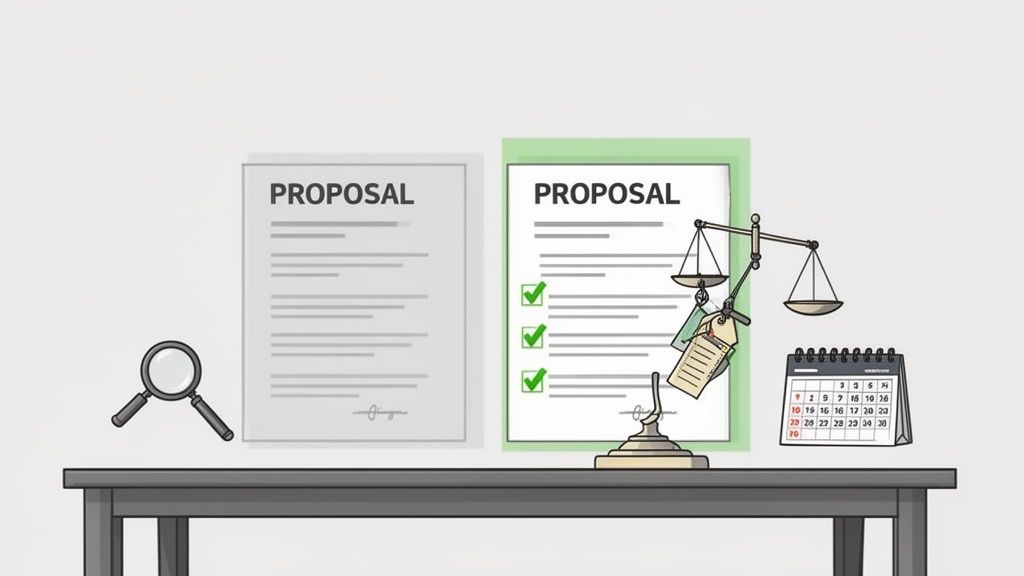
A great proposal feels less like a sales pitch and more like the first draft of your marketing plan. Every single activity they suggest should tie directly back to the goals and KPIs you laid out. If it doesn’t, it’s just a glorified price list.
Spotting a Custom Strategy vs. a Cookie-Cutter Template
You can spot a generic, templated proposal from a mile away. It’s the one that lists services like "SEO" or "Content Marketing" with vague, boilerplate descriptions. A truly custom strategy, on the other hand, shows they’ve done their homework on your business.
Look for proposals that:
- Speak your language: They should be talking about hitting your target CPA or boosting MQLs by 15%, not just generic goals like "driving more traffic."
- Acknowledge your world: A sharp agency will include a quick competitive analysis, showing they’ve already peeked at what your rivals are doing and understand where you fit in.
- Bring ideas to the table: The best proposals often include a few initial thoughts—maybe a specific campaign angle or a low-hanging-fruit opportunity they’ve spotted. This proves they’re already thinking like a partner.
A proposal that could have been sent to any company is a major red flag. You want the one that feels like it was built just for you.
Breaking Down the Key Components
Every proposal will have similar sections, but the devil is in the details. As you run each one through the scoring rubric you built, zoom in on these areas.
1. Scope of Work (SOW)
This needs to be more than a vague list of services. A solid SOW gets specific, detailing the exact activities and deliverables. For SEO, it should spell out things like "monthly technical site audits," "12 keyword-optimized articles per quarter," and "quarterly outreach to 40 high-authority domains."
2. Timelines and Deliverables
A clear roadmap is non-negotiable. A good agency will give you a 30-60-90 day plan that outlines key milestones. You should see things like initial audits, strategy workshops, campaign launch dates, and the first performance reports. Vague timelines like "ongoing support" are a sign of trouble.
3. Pricing Models
Getting a firm grasp on how you’ll be billed is critical. Most agencies lean on one of these models:
- Retainer: A fixed monthly fee for an agreed-upon set of services. This is perfect for long-term, ongoing partnerships.
- Project-Based: A flat fee for a specific, one-time project, like a website overhaul or a single product launch campaign.
- Performance-Based: Here, the agency’s fee is tied directly to results—think a percentage of ad spend or a fee per qualified lead. It can be a great incentive, but the success metrics have to be crystal clear from day one.
Your final choice should be the agency whose proposal gave you the most confidence and clarity. This isn't about finding the cheapest option or the one with the slickest presentation; it's about picking the partner you trust to solve problems and drive real growth.
How to Spot Red Flags in a Proposal
Just as important as finding the good stuff is knowing how to spot the bad. Some proposals hide warning signs in plain sight.
Be wary of any agency that:
- Guarantees outcomes: Nobody can promise a #1 ranking on Google or that your video will go viral. Anyone who does is either inexperienced or being dishonest.
- Lacks specific details: If the scope is fuzzy and the deliverables are undefined, you’re setting yourself up for disappointment and unmet expectations.
- Uses a one-size-fits-all approach: Does the proposal feel generic? If it doesn’t mention your brand's unique challenges, they haven’t put in the work.
- Presents an unrealistic timeline: Promising game-changing results in 30 days is usually a sales tactic, not a realistic projection for meaningful growth.
Ultimately, this analysis is your final gut check. Use your scorecard, trust the data you've gathered, and weigh the qualitative factors. The right choice will be the agency whose proposal feels like a clear, achievable, and exciting plan for your future.
Frequently Asked Questions
Even after you've done your due diligence, a few questions always pop up right before you sign on the dotted line. Let's tackle some of the most common ones I hear from business owners trying to find the right digital marketing partner.
What’s a Realistic Budget for a Marketing Agency?
There's no magic number here. The right budget is always tied to your specific goals and just how competitive your industry is online.
For a small business just getting its feet wet, a focused retainer of $2,000-$5,000 per month is a pretty standard starting point. That typically covers a specific service like local SEO or managing your social media presence.
However, if you're a mid-sized company with your sights set on serious growth, you're likely looking at $10,000+ per month for a complete, multi-channel strategy. The most important thing isn't the final dollar amount—it's making sure that number is directly connected to your target Cost Per Acquisition (CPA) and Customer Lifetime Value (CLV). That's how you ensure you're actually getting a positive return on your investment.
What Are the Biggest Red Flags to Watch For?
Spotting trouble early can save you a world of hurt later on. When you're learning how to pick a digital marketing agency, keep an eye out for these tell-tale signs of a bad fit:
- They guarantee specific results. Anyone promising you a #1 spot on Google is either naive or using risky tactics that could get you penalized. It's just not something anyone can ethically promise.
- They're cagey about the details. If an agency is vague about their process, how they report on progress, or who's actually doing the work on your account, run. It’s a huge indicator of poor accountability.
- They have a revolving door of clients. An agency that can't hold onto its clients is a massive warning. Don't be shy—ask them what their average client retention rate is.
- They pitch a cookie-cutter strategy. If their proposal feels like a generic template that doesn’t speak to your unique business challenges, it means they haven't bothered to do their homework.
A great agency partner is upfront about their process and realistic about what they can achieve. They sell expertise and a strategic partnership, not snake oil promises.
Should I Go With a Specialist or a Full-Service Agency?
The answer to this really depends on what you discovered during your own internal audit of your marketing needs.
A specialized agency is your best bet if you already have a solid in-house team but need a true expert in a very specific area. Think technical SEO, conversion rate optimization, or running a complex LinkedIn advertising campaign.
On the other hand, a full-service agency is the way to go if you need a cohesive strategy that works across multiple channels and you simply don't have the team to manage all those moving pieces yourself.
How Long Should an Agency Contract Be?
Most good agencies will suggest an initial contract of 3 to 6 months. This isn't about locking you in; it's a realistic timeframe for them to run audits, roll out the initial strategy, and gather enough data to start making smart optimizations.
After that initial period, many will be happy to move to a month-to-month agreement or offer better terms on an annual contract. I'd be very cautious of any agency trying to lock you into a rigid, 12-month contract right from the start without a trial period or a fair exit clause.
Ready to partner with a team of specialists dedicated to moving the needle? ReachLabs.ai offers a collective approach, blending data-driven strategy with world-class creative to achieve your unique business objectives. Discover how we can elevate your brand.