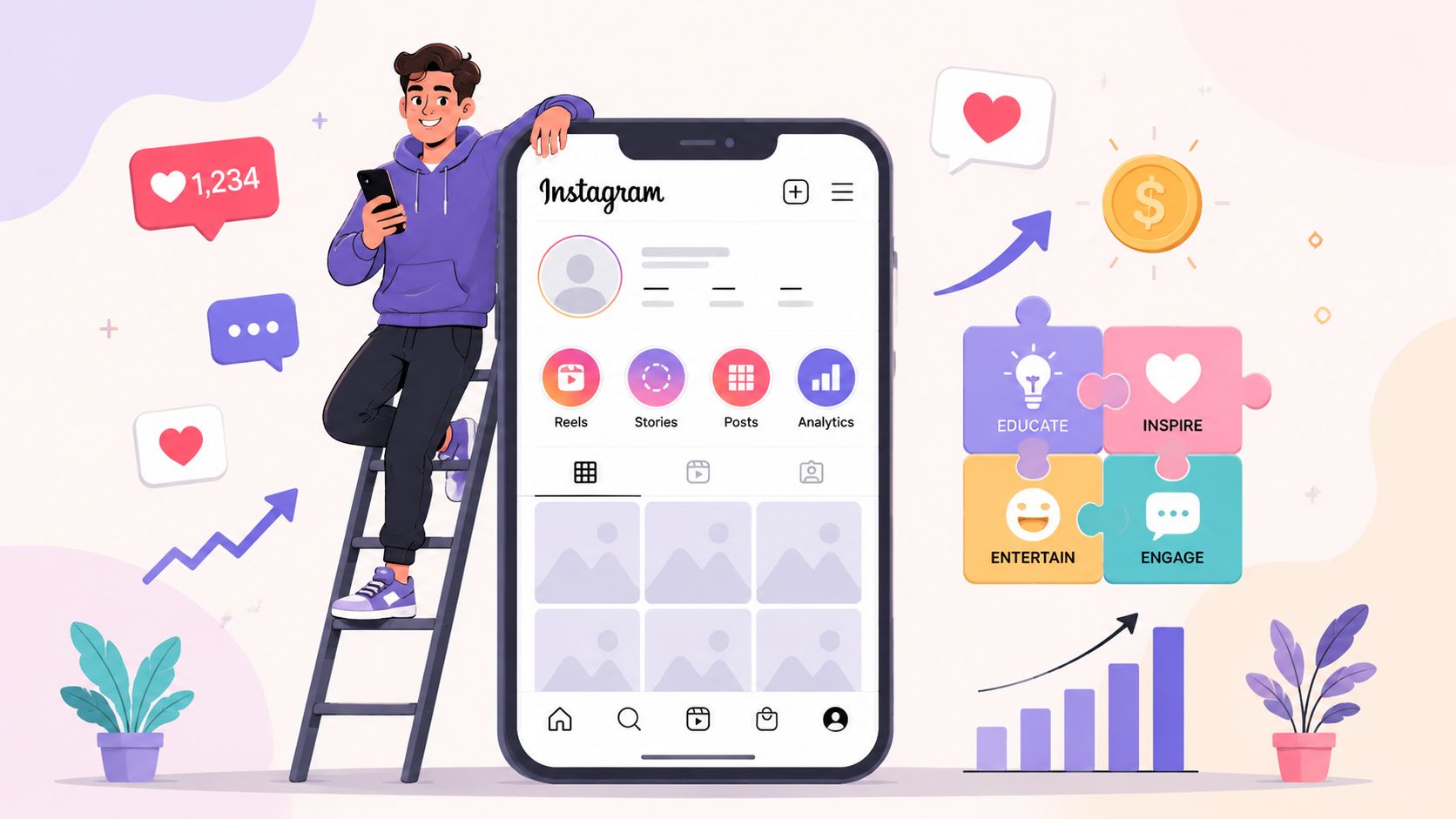
The same advice for building personal brand on Instagram is often repeated. Pick a niche. Post every day. Keep the grid pretty. That advice isn't wrong, it's just incomplete, and in 2026 it's the wrong place to focus because broad engagement is weaker than it used to be. SocialInsider's 2025 benchmarks put average Instagram engagement at 0.48%, down 24% year over year (SocialInsider), so consistency without intent is just efficient posting into a crowded feed.
The better question is simpler, and harder: what makes someone trust you enough to save your post, DM you, reply with a real question, or click through to work with you? That's the game now. If your content doesn't create intent signals, you're collecting attention that dies on contact.
Instagram still matters because the audience is enormous and commercially useful. It reached 3 billion monthly active users globally in 2025, and DataReportal found its ad tools could reach about 1.91 billion users worldwide; in the U.S. alone, Sprout Social reports around 182 million Instagram users, with 58% holding a college degree and 60% living in households earning $100,000 or more annually (Sprout Social). That's not a vanity platform. It's a trust-and-demand platform.
If you want a deeper cross-platform perspective on audience building, grow your influence on TikTok is a useful contrast, because it shows how the same trust principles play out in a different feed environment.

Why Consistency Is Not the Moat Anymore
Consistency is table stakes. It's not the moat. If you're posting the same kind of content with the same weak positioning, you're just increasing the speed at which the market ignores you.
That's the part most Instagram advice refuses to say out loud. Average engagement is down, and that means the old math has changed. If broad reach is harder to win, then the brands that survive are the ones that create a clear reason to stop, save, reply, or come back.
Stop optimizing for pretty posting
Pretty accounts still help, but aesthetics don't rescue vague positioning. A polished profile with generic content usually attracts passive scrollers, not buyers. A sharper point of view does the opposite, it filters hard and pulls in the people who already feel the problem you solve.
Practical rule: if someone can't tell what you do, who it's for, and why your take matters after a few seconds on your profile, your consistency is only making the confusion more visible.
That's why the old “post more” advice is losing ground. Personal brands now need to earn attention with a stronger signal, not just repeat exposure. This is especially true for founders, consultants, creators, and marketers who need their Instagram presence to generate trust, not just followers.
The logic is straightforward. Instagram is still a large discovery channel, but discovery only matters if it leads somewhere. A clean positioning strategy, strong proof, and a content system built around response-worthy topics will outperform generic frequency because it moves people from passive viewing into active intent.
If you're still treating the feed like a billboard, you're leaving money on the table. If you treat it like a qualification engine, you start to see why saves, DMs, and qualified replies matter more than likes.
Define Your Positioning and Optimize Your Profile
Start with a micro-audience, not a vague niche. “Entrepreneurs” is lazy. “B2B founders under pressure to turn attention into inbound leads” is sharper. The more specific your audience, the easier it is to write content that sounds like it was made for them, because it was.
Your positioning statement should answer three questions in one line: who you help, what outcome you help them achieve, and what perspective makes you different. Don't try to sound broad and impressive. Sound useful. A personal brand is a positioning problem first, and a design problem second.
Build the profile like a conversion page
Your bio needs to do three jobs fast. It should say who you are, who you serve, and why someone should care now. The name field should include searchable keywords, not just your name, because people search Instagram like a directory, not a mood board.
Your profile photo should be clear and close enough that people can recognize you on mobile. Your highlights should do work, not decorate the page. Use them to show proof, services, FAQs, outcomes, or a simple “start here” path that removes friction.
Profile test: if a stranger lands on your page and can't explain what you do in one sentence, your profile is underperforming.
Use the same discipline for your link-in-bio structure. Send people to one primary action, not a cluttered menu that makes them think. If your page is built for lead generation, every extra choice weakens the click.
A useful operational habit is to check every asset through the eyes of a buyer, not a peer. That means the photo, bio, highlights, pinned posts, and link should all reinforce the same trust signal. If you need a visual tool to resize assets cleanly for a feed-first layout, the Instagram feed video resizer is a practical utility to keep the presentation tight.
For a broader organic growth framework, the internal guide on how to grow Instagram followers organically pairs well with this setup work.
Use this profile checklist today
- State your audience clearly: write the exact type of person you help, not a fuzzy category.
- Write one proof-heavy bio line: show expertise, outcome, or credibility.
- Add searchable terms: use the name field to help discovery.
- Trim your highlights: keep only what helps a visitor trust you faster.
- Make the first click obvious: one primary destination, not three competing ones.
If your profile doesn't convert strangers, posting more won't fix it. It'll just send more people to a weak front door.
Build Content Pillars and Assign Formats by Job
Most accounts fail because they confuse themes with formats. A content pillar is the subject you own. A format is the delivery system. Blur those two, and your feed becomes a pile of disconnected posts with no strategic shape.
Choose three to five pillars and protect them. Too many themes make your brand foggy. Too few make it brittle. The point is repetition people can recognize without making the page feel stale.
Match the format to the task
Reels should earn reach. Carousels should earn saves and evergreen education. Stories should build familiarity and move people into DMs. Single-image posts work best for a sharp opinion, proof, or a quote-style idea that does not need a full slideshow.
Broad engagement is not carrying Instagram accounts the way it used to. That is why you should stop judging your content only by likes and comments. Saves, qualified replies, and DMs tell you whether a post is building trust and creating a real path into your pipeline. For a practical guide on increasing view volume without chasing empty attention, see how to get Instagram views without wasting content. That mindset matters more now because the content that keeps working is the content people want to revisit or send to someone else.
Here is the simplest way to think about it. Reels are for discovery. Carousels are for depth. Stories are for proximity. If you assign them all the same job, you waste what each format does well.
Put the content type on purpose, or the algorithm will decide the job for you.
A two-week calendar should follow that logic. Lead with two or three Reels that introduce the point of view, follow with carousels that teach the method, and use Stories to surface the human side of the brand, the questions, the objections, and the proof. Do not post whatever you finished last. Post what moves the next stage of trust.
The YouTube embed below is useful if you think in process, because it helps translate the pillar-to-format mapping into a working content engine.

If you are batching content fast, tools can help with the assembly line. The ShortGenius AI ad generator is useful when you need to build variants of video creative without rebuilding every version from scratch.
Run a 90-Day Production and Audit System
Ideas don't usually fail because they're bad. They fail because production is chaotic. If you want a personal brand that compounds, you need a weekly operating rhythm that removes decision fatigue and forces consistency with purpose.
The cleanest cadence is simple. Batch once a week, publish 3–5 Reels per week, post Stories daily, and keep one topic rotation so you don't wander off-brand. That rotation should move through educational, authority, relatable, and connective content, because each type earns a different kind of response.
Build the week around output, not mood
Batch production works because it separates creation from publishing. Record your talking points, write hooks, and schedule the week in one sitting. Don't wait for perfect lighting, the ideal outfit, or a burst of inspiration. Those are just excuses wearing creative clothing.
If you need to speed up production, tools that automate parts of the assembly line can help. A resource like the ShortGenius AI ad generator can be useful when you're building variants of video creative and want to move faster without rebuilding from scratch every time.
Use weekly prompts to keep the calendar from going stale:
- Educational: teach a step, framework, or mistake to avoid.
- Authority: show proof, opinion, or a clean point of view.
- Relatable: surface a real frustration your audience already feels.
- Connective: ask a question, invite a reply, or open a conversation.
Then audit the last 10 posts once a month. Look at saves, shares, DM triggers, and link clicks. Keep the top two patterns. Cut the bottom two. Don't protect content because it took a long time to make.
A strong hook still matters, but the hook is only the start. The rest of the content has to earn the save, the DM, or the click. That's why a monthly audit is essential. It keeps you honest about what pulls the brand forward.
For a deeper traffic-oriented angle, the internal guide on how to get Instagram views is a strong complement to this production system.
Compare Growth Tactics and Collaboration Moves
Not every growth tactic belongs in the same phase of the brand. Organic reach, collaborations, and paid amplification solve different problems, and most creators waste time mixing them without a plan.
If you're pre-product or still refining your offer, go heavy on organic and collaboration-based discovery. If the brand already converts and the offer is proven, layer paid amplification behind content that already shows traction. That's the cleanest way to avoid paying to scale weak messaging.
Use the right lever at the right stage
Organic tactics compound slowly, but they stick. Commenting with substance, replying in DMs, and posting content that people save all build familiarity over time. Reels SEO and keyword-friendly naming help discovery, but they still work best when the profile and content already make sense.
Collaborations borrow credibility. That includes podcast swaps, newsletter cross-posts, and creator partnerships that expose you to a relevant audience without forcing you to buy reach cold. The point isn't to chase the biggest account possible, it's to borrow trust from the account that already has your buyer's attention.
Paid amplification is different. It accelerates what already works. If a post is clearly resonating and the audience is right, a boost can extend reach without changing the core message. If the message is weak, paid spend just makes the weakness more expensive.
A simple decision frame helps:
- Organic reach: use when you need trust and signal clarity.
- Collaborations: use when you need borrowed authority and audience overlap.
- Paid amplification: use when you have proof and want scale.
- Influencer tie-ins: use when the partner's audience fit is tighter than their follower count suggests.
If you want to make a partnership worth the effort, look past vanity metrics. Check the relevance of the audience, the quality of comments, the tone of the account, and whether the creator speaks to people like your buyers. A strong partner feels adjacent, not random.
Turn Engagement and Community Into Pipeline
Likes are cheap. Conversations are valuable. If you're serious about building personal brand on Instagram, you need to treat engagement as a sales-adjacent system, not a morale metric.
The most impactful accounts aren't always the most polished. They're the clearest in proof, perspective, and conversion intent. That clarity makes people respond, because they know what kind of conversation the account is inviting.
Make comments lead somewhere
Use pinned comment prompts that ask for a real reaction, not a lazy emoji. Put reply stickers in Stories where people can answer with specifics. Offer low-friction DM entry points like “reply with your biggest bottleneck” or “send me the word if you want the template.” The more specific the invitation, the better the signal.
Set a response-time rule and stick to it. People notice when a creator answers quickly and directly. Reliability builds trust faster than polished branding ever will.
Conversations are the product. The feed just starts them.
Tone boundaries matter too. Don't turn the account into an emotional diary if your audience hired you for expertise. Decide which trends fit your voice before you post them. That boundary keeps the brand from feeling scattered or performative.
Use a recurring touchpoint to create rhythm. Weekly Q&As, monthly AMAs, or a focused broadcast channel can all keep the audience close without forcing constant content invention. Then, in the first 30 minutes after every post, reply to high-quality comments, move strong questions into DMs, and save repeat objections for next week's content.
If you want one practical rule, use this: every meaningful reply is either a lead, a research note, or a relationship seed. Treat it that way, and your engagement stops being decoration.
Monetize, Measure, and Iterate Without Losing Trust
A personal brand that does not connect to revenue turns into an expensive hobby. Start with the offer, then build the content around it. If the path to money is unclear, the audience will feel it.
Services and high-ticket offers usually need less reach and more trust. Digital products and courses need clearer education and proof people can repeat. Brand deals and affiliate revenue depend on fit, relevance, and the way your audience already sees you. Choose the path your content can support without sounding forced.
Measure the signals that predict money
Track saves, DM triggers, qualified replies, link clicks, and conversion-assisted revenue every month. Ignore follower spikes that do not lead to conversations or offers. A healthy brand gets intent, not applause.
The metrics that matter are tied to the outcome you want. If you sell services, watch for booked calls and serious DMs. If you sell digital products, watch for saves, repeat questions, and people asking for the next step. If partnerships are part of the model, audience clarity and topical fit should stay tight.
ReachLabs.ai publishes an Instagram lead generation guide that connects profile optimization, Reels, carousels, Stories, creator content, CTAs, and DM automation. It is one option for teams that want social presence tied to lead flow rather than awareness alone.
Watch for warning signs. If saves fall while followers rise, the content is getting broader and weaker. If you keep accepting off-brand collaborations, the trust signal gets muddy. If replies get thinner over time, your audience may be treating the account like a broadcast channel instead of a useful operator.
Use a 30, 60, 90-day lens. In the first 30 days, tighten positioning and the profile. By 60 days, identify the formats and topics that drive the most saves and replies. By 90 days, cut dead weight and commit to the content that consistently earns trust.
Measure like a brand that plans to last. Broad engagement is getting less reliable, while qualified intent shows whether people want to work with you. That is the standard now.