You're probably staring at a retainer proposal right now, or a stack of invoices from freelancers, and asking the only question that matters. Are digital marketing agencies worth it, or are you about to pay several thousand dollars a month for meetings, slides, and a vague promise of “growth”?
The honest answer is simple. Agencies are worth it when they solve a specific bottleneck faster and better than your current setup. They're a bad buy when you already have enough internal skill, AI support, and freelance firepower to handle routine execution without adding another fixed cost.
The Real Question Behind Hiring an Agency
A founder doesn't usually ask about agencies because they're curious about vendor models. They ask because a campaign is stalling, the team is overloaded, or a competitor keeps showing up everywhere you should be visible.
That's the decision. Will this spend move revenue faster than the alternatives? If the answer is yes, the retainer is an investment. If the answer is no, it's just overhead with nicer branding.
The moment the proposal lands
The typical scene is familiar. A marketing lead has a small team, a shaky analytics setup, and a proposal that starts around $3,000 to $10,000 per month, which is the range reported in agency pricing coverage and market analysis (industry pricing overview). The temptation is to compare that number to a freelancer quote and stop there.
That's the wrong comparison. The comparison is against the cost of missed launches, delayed testing, weak tracking, and the time senior staff spend patching holes. If your team is already stretched thin, the agency isn't competing with a freelancer, it's competing with stalled growth.
Practical rule: If the agency would replace three separate headaches, strategy, execution, and reporting, the price starts to make sense. If it only adds another layer between you and the work, pass.
Fit matters more than the sales pitch
Agencies shine when a business has a clear direction but lacks the bandwidth or specialist depth to execute it consistently. They fail when the company expects them to invent the strategy, fix the offer, and somehow rescue a weak product-market fit at the same time.
A better question is whether you have a capability gap or just a capacity gap. A capacity gap means you know what needs to happen, but your team can't do it fast enough. A capability gap means you don't have the technical or channel expertise in-house at all.
If that gap is real, outside help can be the fastest path to momentum. If it isn't, you're better off tightening the team you already have and spending the money where it changes the business.
What the Numbers Say About Agency Value
The market agencies operate in is large enough that the pricing question matters less than the execution question. One industry analysis valued the global digital marketing market at $776.7 billion in 2023 and projected a 12.3% CAGR from 2023 to 2030. Another estimated global digital ad spend at $740 billion in 2025 and expected it to exceed $870 billion by 2027 (market and spend analysis).
That scale points to a simple conclusion. Agencies are not a temporary workaround, they are part of how companies buy attention, capture demand, and measure results. When budgets are that large and still expanding, specialization matters more, not less.

Breaking down the budget math
A separate source set says the average agency retainer ranges from $3,000 to $10,000 per month and that 68% of businesses outsource digital marketing (retainer and outsourcing data). That is the core of the decision; you are buying an operating model, not a one-off task.
If your business already spends serious money on marketing, the question is not whether outside help costs money. It is whether that spend goes to the work with the highest return. The same source set reports that the U.S. Small Business Administration suggests 7% to 8% of gross revenue should go to marketing, and a cited CMO survey puts average marketing spend at 9.8% of total revenue.
That puts agency pricing in context. A company already spending close to a tenth of revenue on marketing can justify an agency if it improves channel mix, execution speed, and measurement discipline. If it does not, the budget just gets rearranged into prettier dashboards.
Use a pricing benchmark from ReachLabs.ai to compare retainers against your current budget structure before you sign anything.
The channel ROI argument
The strongest case for agencies is channel specialization. Industry reporting in the brief cites 702% average ROI over three years for SEO, 3x more leads per dollar than paid search for content marketing, and $42 returned for every $1 spent on email marketing. Those figures are not a promise for your company, but they explain why expert execution matters.
The point is simple. These channels reward precise strategy, consistent execution, and clean measurement. A skilled team can do that better than a scattered in-house effort.
If you want to check whether your own campaigns are efficient, the true cost per lead guide is the right place to start because it forces the conversation back to unit economics, not vanity metrics.
Agency vs In-House vs Freelancers vs Hybrid
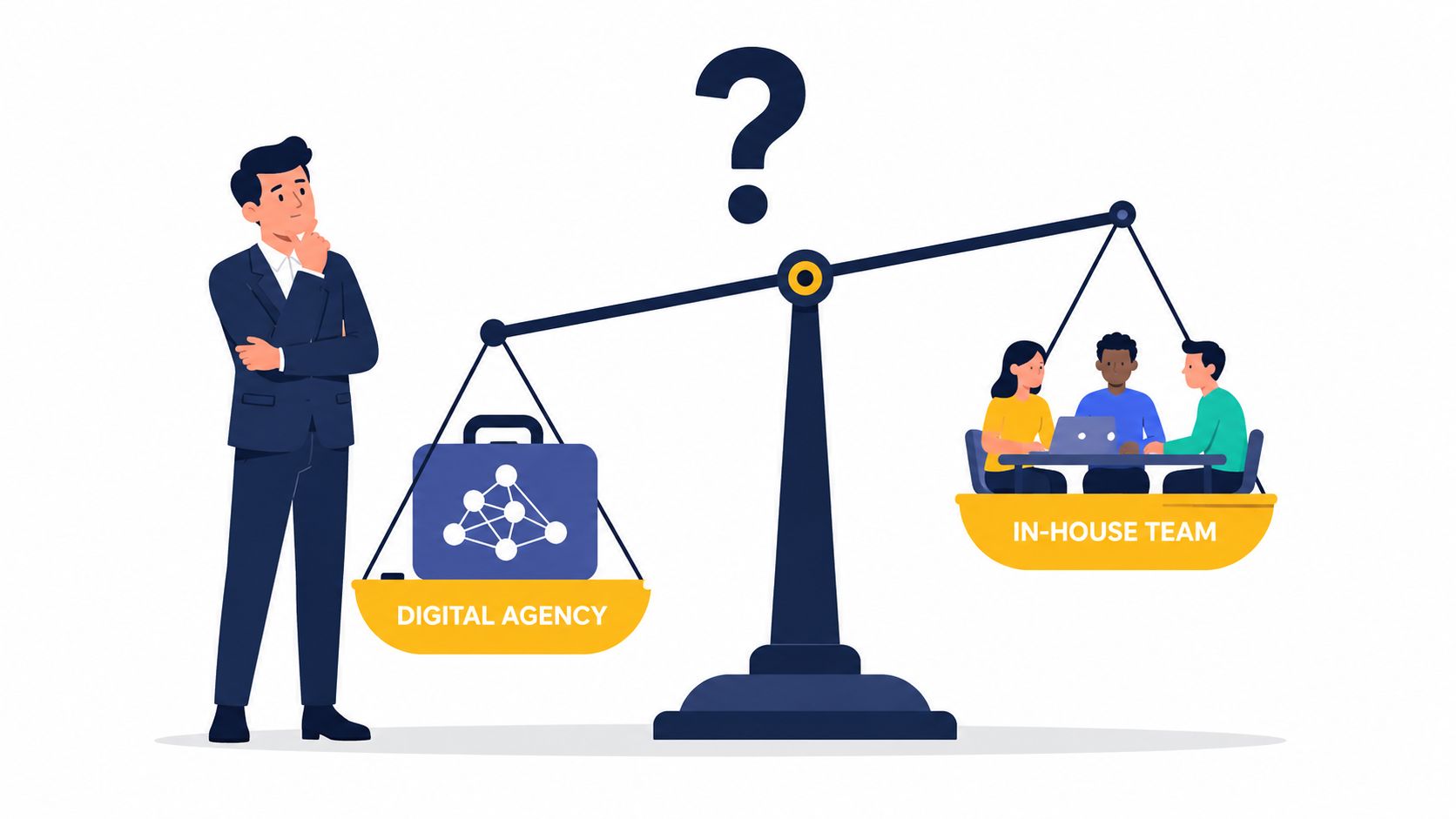
The choice is not agency or no agency. It is which execution model fits your stage, budget, and complexity. A strong in-house team can outperform outsiders. A freelancer can be the right call for one channel. A hybrid stack can beat both when the business is small, disciplined, and clear about what should stay internal.
The pressure point is changing. Small businesses can now use AI for routine work and combine it with freelancers for specialist tasks, which reduces the need for a full-service retainer in some cases. If you are weighing a permanent build, the guide to internal SEO teams shows the internal ownership, hiring discipline, and process structure that an in-house setup requires. If you want a sharper side-by-side comparison of execution models, the agency vs in-house breakdown is the right place to pressure-test the tradeoffs.
The table below is the cleanest way to compare the options.
| Model | Typical Monthly Cost | Expertise Depth | Speed to Launch | Best For |
|---|---|---|---|---|
| Agency | $3,000 to $10,000 per month | Broad and specialized across channels | Fast | Companies needing coordination, strategy, and execution at once |
| In-house team | Higher fixed payroll commitment | Deep brand knowledge, variable channel depth | Slower | Companies with steady volume and enough budget to hire well |
| Freelancer | Lower and flexible | Narrow, task-specific | Fast for discrete work | Single projects, design, copy, or one-off channel support |
| Hybrid stack | Variable, often leaner fixed cost | Good if managed well | Fast when structured | SMBs using AI for routine tasks and experts for high-impact work |
Where each model wins
Agencies win when the work crosses channels. SEO affects content. Paid media affects landing pages. Analytics affects both. A good agency keeps those pieces aligned instead of making you coordinate several separate contractors.
In-house teams win when the brand needs constant internal context, quick approvals, and deep product knowledge. They sit closest to the business, so they usually move faster on issues that require judgment and company memory.
Freelancers win on efficiency for discrete tasks. A strong designer, media buyer, or copywriter can outperform a generalist if you already know exactly what needs to get done. The tradeoff is plain. They rarely build the system around the work.
A hybrid model becomes attractive when the business can use AI for drafting, ideation, and basic analysis, then reserve humans for judgment, QA, and high-stakes channels.
That is often the point where agencies stop being the default answer. If your internal operator plus a few freelancers plus AI tools can cover routine work, the agency has to earn its keep through strategy, paid acquisition, or specialist execution. If it cannot, you are paying for convenience you may not need.
When an Agency Is the Right Move for Your Business
Some businesses should hire an agency immediately. Others should not. The difference comes down to growth pressure, channel complexity, and how much specialized talent your team already has.

Strong reasons to outsource now
If you're launching into a new market, an agency can compress the learning curve. They bring channel playbooks, campaign structure, and a faster path to testing than most small internal teams can build from scratch.
If paid acquisition has outgrown the attention of a generalist, outsource it before you burn more budget. Paid media punishes amateurs, especially when targeting, creative, and landing page alignment all have to work together.
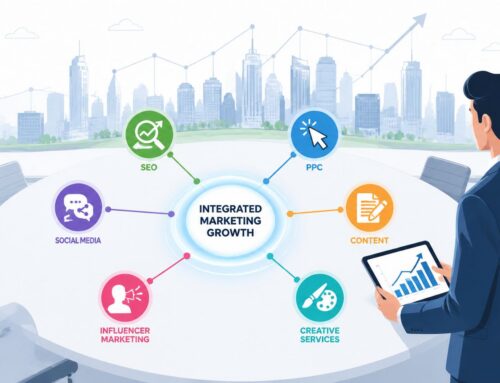
If you're running SEO, content, paid search, and paid social at the same time, coordination matters more than heroics. That's where agencies tend to earn their fee, because they can connect the moving parts instead of leaving each one in a separate silo.
Clear reasons to hold off
If your marketing spend is tiny, the retainer can crowd out better uses of cash. Early-stage businesses with very limited monthly budgets usually need one sharp owner, not a layered service relationship.
If your product is niche and requires deep domain expertise, a general agency can get the tone wrong even when the tactics look polished. That's especially risky in technical, regulated, or highly specialized categories.
And if your content depends on intimate product knowledge, an agency should not be writing from a blank slate. You can still use outside help, but the business has to supply the expertise that shapes the message.
A simple decision test
Ask three questions before signing anything.
- Do we lack a channel skill that materially affects revenue?
- Do we need speed more than another headcount process?
- Can we explain the customer and offer clearly enough for outsiders to execute well?
If the answer is yes to the first two and also yes to the third, the agency case is strong. If the answer to the third is no, fix the business clarity first.
The AI and Privacy Factors Changing the Calculation
A 2026 answer has to account for two things older agency articles barely touch, AI and privacy. Small businesses are using generative AI more often now, with the share rising from 23% in 2023 to 40% in 2024 in the U.S. (small business AI adoption). That matters because AI can cover a lot of the work agencies used to bill for, including copy drafting, ideation, and basic analysis.

What AI has changed for SMBs
The practical effect is straightforward. A lean team can now produce more first drafts, more campaign variations, and more quick-turn insights without paying an agency for every small task. That pushes the agency value proposition up the stack.
Agencies are no longer worth it because they can “do marketing.” They're worth it when they can decide what matters, connect the data, and steer the system. If they're just using your same AI tools and still billing for routine outputs, you're overpaying.
ReachLabs.ai offers a first-party data strategy service that fits this new reality because the value is in building the measurement and audience foundation, not just producing more activity.
Why privacy makes the agency question sharper
The measurement environment is messier too. Google said it would not proceed with a standalone third-party cookie deprecation in Chrome, which leaves the market in a prolonged transition instead of a clean switch-off (Chrome cookie announcement context). In that environment, attribution is harder for everyone.
That's why the best agency question is no longer “Can they grow traffic?” It's “Can they build incrementality-based measurement, CRM integration, and first-party data workflows better than we can?” Agencies that can't answer that should be treated as execution vendors, not strategic partners.
If your reporting still depends on one neat attribution path, your measurement is already too fragile.
A useful test for 2026
Ask any agency how they handle modeled conversions, first-party data, and CRM tie-in. If they talk only about impressions and clicks, they're behind the curve. If they can connect channel activity to pipeline and retention behavior, they're offering something worth paying for.
For teams exploring AI-assisted creative, this guide to making AI videos for ads is a smart reference point because it shows how automation is changing the production side of paid media. That doesn't replace strategy, but it does shrink the amount of grunt work worth outsourcing.
KPIs and Contract Terms That Protect Your Investment
A bad agency relationship usually fails for one reason. The business bought deliverables, not accountability. If the contract rewards activity instead of outcomes, you'll get a lot of motion and not much progress.
The right KPIs are the ones tied to business movement, not social noise. Track pipeline contribution, customer acquisition cost, and the quality of leads moving through your CRM. Impressions and follower growth can sit in the report, but they shouldn't run the relationship.

What to demand in the contract
A strong contract protects both sides. It should spell out data ownership, reporting cadence, and an exit clause that lets you leave if the relationship isn't working. It should also make clear who owns the ad accounts, landing pages, creative assets, and analytics access.
If you're paying for growth, ask for a structure that includes a performance component. That doesn't mean every agency should be paid purely on commission, but it does mean some part of the fee should reflect actual business outcomes, not just task completion.
The first 90 days
The first quarter should be a proof period, not a comfort period. The agency should audit your current setup, clean up the tracking stack, clarify the offer, and ship a few targeted experiments quickly.
Use this simple rhythm:
- Week 1 to 2: lock goals, access, and baseline reporting.
- Week 3 to 6: fix measurement gaps and launch the first tests.
- Week 7 to 12: compare channel quality, lead flow, and pipeline signals.
- End of day 90: decide whether to scale, revise, or exit.
That structure keeps the agency honest and prevents the relationship from drifting into status updates that never touch revenue.
If you want a second option in this space, ReachLabs.ai provides full-service digital marketing work alongside audit and growth planning, so it can function as one of the outside models you compare against. The key is still the same, the contract has to make performance visible.
Your Decision Checklist and Next Steps
Use a blunt scorecard. Rate each area from low to high, budget readiness, internal skill gaps, channel complexity, and measurement maturity. If three or four areas are weak, an agency or hybrid model probably makes sense. If only one area is weak, build internally and use freelancers where needed.
If you decide to hire, ask for proof of tracking setup, examples of channel coordination, and a 90-day plan tied to outcomes. If you decide on a hybrid stack, use AI for first drafts and repetitive tasks, then keep specialists for strategy, media buying, and analytics. If you stay in-house, hire for the biggest bottleneck first, not the prettiest resume.
The cleanest answer is this. Agencies are worth it when they reduce complexity, improve speed, and lift the quality of decisions. They're not worth it when you already have the tools and people to do that yourself.
If you want a sharper read on whether an agency, a hybrid stack, or an internal build fits your business, ReachLabs.ai can help you pressure-test the options with full-service campaign strategy, audit work, and channel execution. Visit ReachLabs.ai and compare your current setup against a model built to find the actual bottleneck.