
So, what exactly is a lead magnet?
Think of it as a free, high-value resource you offer to potential customers in exchange for their contact information—usually just an email address. Instead of pushing for a sale right away, you're giving them something genuinely useful, like an expert guide, a handy checklist, or a time-saving template. It's the first step in building a relationship, and it's all about leading with value.
Understanding the Core Concept of a Lead Magnet

Picture your website as a busy storefront. People are constantly browsing, checking out what you have to offer. But most of them will leave without you ever knowing who they were. A lead magnet is your way of saying, "Hey, before you go, take this helpful gift. No strings attached." It’s the digital version of offering a free sample at a high-end chocolate shop—it gives them a taste of the quality you provide.
This simple exchange is where the magic happens. You trade your valuable resource for their email address, turning an anonymous visitor into an actual person you can talk to. It's a low-risk, high-value deal for your audience that opens the door to a real connection.
The Strategic Value Exchange
At its core, a lead magnet is a fair trade. Your audience gets an instant solution to a problem they're facing, and in return, you get permission to keep the conversation going. This first interaction is a game-changer for a few key reasons:
- It builds trust: When you give away something truly helpful for free, you immediately position your brand as an authority that cares, not just a company trying to sell something.
- It qualifies interest: If someone is willing to hand over their email for your resource, they’re clearly interested in what you have to say. That's a qualified lead.
- It fuels your marketing funnel: This simple exchange gives you the most important ingredient for your marketing efforts—a list of interested people to nurture through email, webinars, and eventually, sales conversations.
A lead magnet is more than just a freebie; it's the handshake that begins a meaningful business relationship. It turns passive browsing into active engagement, creating a direct line to your most promising prospects.
And they work. Lead magnets are so effective at capturing interest that they boast an average landing page conversion rate of 18%. This is exactly why they are a cornerstone of modern marketing. You can discover more insights about lead magnet performance statistics to see just how powerful they can be.
A Lead Magnet at a Glance
To boil it all down, let's look at the essential parts that make a lead magnet tick. This table breaks down its purpose, format, and the value it needs to offer to be truly effective.
| Component | Description | Example |
|---|---|---|
| Core Purpose | To capture contact information from potential customers. | Gathering emails for a weekly marketing newsletter. |
| Value Proposition | An immediate, specific solution to a user's problem. | "Download our 5-Minute Checklist to Optimize Your Ad Spend." |
| Format | A downloadable or accessible piece of digital content. | PDF checklist, ebook, video tutorial, or exclusive discount code. |
| Exchange | The user provides their email to receive the free resource. | A pop-up form on a blog post offering a related guide. |
Ultimately, a well-crafted lead magnet acts as the perfect bridge, connecting what your audience needs with the expertise your brand provides. It’s a simple but profound tool that can turn anonymous traffic into a thriving community of potential customers.
So, Why Are Lead Magnets Such a Big Deal?
Think of a lead magnet as more than just a way to grab email addresses. It's the core of your demand generation strategy, turning your website from a static online brochure into a dynamic tool for starting conversations. Instead of just hoping people stick around, you’re giving them a compelling reason to connect and giving you a direct, permission-based line to talk to them.
This isn’t just a nice idea; it gets real results. In fact, 50% of marketers report higher conversion rates when they use lead magnets. It makes sense, right? A great offer doesn't just collect a contact; it kicks off a relationship built on real value from the very first click.
You Become the Go-To Expert, Instantly
When you give away a genuinely useful resource—a checklist, a guide, a template—you're not just telling people you know what you're talking about; you're showing them. This simple act of giving first builds a level of trust that a flashy ad campaign just can't buy.
Put yourself in your customer's shoes for a second. They’ve got a problem, they land on your site, and you immediately offer them a practical solution. Just like that, you’ve become a helpful guide on their journey. That first positive interaction makes them way more likely to open your emails and listen to what you have to say next.
A lead magnet is your chance to make a killer first impression. It’s what separates you from being just another company trying to sell something and makes you a trusted resource people actually want to hear from.
This strategic giveaway is the first handshake, the first step in turning a curious visitor into a loyal fan.
Attracting the Right Leads (and Knowing Who They Are)
Let's be honest: not all leads are created equal. A vague "sign up for our newsletter" button tends to pull in a mixed bag of people, many of whom aren't that interested. A specific, targeted lead magnet, on the other hand, works like a powerful filter. It attracts people who have a very specific problem you can solve.
This is where you get to be strategic. By creating different lead magnets for different pain points, you can automatically segment your audience as they sign up. For example:
- An "Ultimate Guide to Starting a Podcast" will attract beginners who are just exploring the idea.
- A "Podcast Monetization Checklist" will pull in experienced creators ready to take the next step.
- A "B2B Podcasting Template" segments leads by a specific business need.
Suddenly, your email list isn't just a random collection of contacts. It’s a well-organized database of potential customers with distinct needs and interests. This allows you to follow up with marketing that actually feels personal and helpful, dramatically speeding up the journey from prospect to customer. The bottom line? You get better leads for less money and a much stronger return on your marketing efforts.
Exploring the Most Effective Types of Lead Magnets
Not all lead magnets are created equal. Just like a hardware store has different tools for different jobs, your marketing toolkit needs a variety of lead magnets, each designed for a specific goal and audience. The real trick is matching the right format to the right problem, making sure you deliver serious value in a way your audience actually wants.
We can break down the most effective lead magnets into three main buckets, based on the value they give and the effort they ask for: Quick Wins, Deep Dives, and Interactive Experiences. Each one plays a unique role in guiding someone from being a curious visitor to a happy customer.
Quick Wins for Immediate Value
Quick Win lead magnets are all about instant gratification. They’re easy to digest, highly actionable, and solve one specific, nagging problem right away. Think of them as the perfect appetizer—they give your audience a taste of your expertise without asking for a huge time commitment. This makes them perfect for people at the top of the funnel who are just starting to realize they have a problem.
Their power is in their simplicity. Someone can download a checklist or a template and put it to use in minutes, which instantly creates a positive feeling about your brand. And the numbers don't lie. For instance, cheat-sheet lead magnets can convert at around 34%, and something as simple as a coupon can hit conversion rates as high as 82%. That blows most other content types out of the water.
Common types of Quick Win lead magnets include:
- Checklists: Simple, step-by-step lists that help someone get a task done. Think "10-Point SEO Audit Checklist for New Websites."
- Templates: Pre-built resources that save tons of time and effort. A social media agency might offer a "Free Social Media Content Calendar Template."
- Cheat Sheets: A handy, one-page reference packed with essential info, shortcuts, or key reminders. A great example is a "Google Analytics 4 Cheat Sheet for Marketers."
Deep Dives for Building Authority
When your audience is ready to move past the basics and really dig in, Deep Dive lead magnets are your best friend. These are much more comprehensive resources that explore a topic from top to bottom, cementing your brand as a genuine authority. They are ideal for prospects in the middle of the funnel who are actively researching solutions and weighing their options.
Sure, they take more effort to create (and for your audience to consume), but the payoff is huge. A well-researched ebook or a data-packed whitepaper proves you know your stuff and builds serious trust. This moves you from being just another vendor to being a credible expert—a reliable source of information they'll turn to again and again.
A Deep Dive lead magnet is an investment in your audience's education. By providing in-depth analysis and valuable insights, you build the kind of trust and authority that turns interested prospects into loyal customers.
Examples of effective Deep Dive lead magnets are:
- Ebooks: Comprehensive guides that cover a broad topic, blending research, expert insights, and practical advice into one valuable package.
- Whitepapers: Persuasive, data-driven reports that lay out a problem and present a clear solution. These are a staple in B2B marketing for influencing decision-makers.
- Webinars: Live or on-demand video sessions that educate your audience and let you connect with them directly, building a more personal relationship.
Interactive Experiences for High Engagement
Interactive lead magnets are where things get really interesting. They turn passive content consumption into an active, personalized experience. Instead of just reading or watching, your audience gets involved—they answer questions, input data, or make choices. This hands-on approach is fantastic for grabbing and holding attention while delivering custom-fit value.
These tools are incredibly powerful at any stage of the funnel, but they shine when it comes to qualifying leads. A quiz can help you segment your audience based on their needs, while a calculator provides instant, tangible results that prove the value of your solution. If you need some real-world inspiration, check out these 23 Instagram Lead Magnet Ideas that are proven to work on social media.
Popular interactive lead magnets include:
- Quizzes or Assessments: Fun, engaging tools that help users diagnose a problem or learn something new about their business.
- Calculators: Practical tools that help people estimate costs, savings, or potential ROI, connecting their problem directly to a number they can understand.
- Free Trials or Demos: The ultimate "try before you buy." Letting prospects use your product or service firsthand is one of the most effective ways to convert leads who are ready to make a decision.
How to Create a High-Converting Lead Magnet
Creating a lead magnet that actually gets people to sign up isn't about throwing something together and hoping for the best. It's a strategic process. If you follow a clear framework, you can build a resource that solves a real problem for your audience and consistently fills your pipeline with high-quality leads.
This process really boils down to five core stages. Each one is designed to make sure your final product is specific, valuable, and perfectly tuned to what your future customers are looking for. Let’s walk through the playbook for building a powerful conversion tool from scratch.
Pinpoint Your Audience’s Biggest Problem
The absolute foundation of a great lead magnet is empathy. You have to get inside your audience's head and nail down a single, specific, and urgent problem they’re wrestling with. A vague offer like "Marketing Tips" is just noise; a specific solution like a "5-Step Checklist for Your First Google Ads Campaign" is a life raft.
So, how do you find these pain points? Start by listening.
- Talk to your sales team: They're on the front lines every single day, hearing directly from prospects about their biggest challenges and objections.
- Analyze customer support tickets: What questions pop up over and over? These are goldmines for content ideas.
- Monitor online communities: Dive into forums like Reddit, Quora, or industry-specific groups. What problems are people constantly asking for help with?
Once you have a crystal-clear problem in mind, you're ready to start crafting the solution.
Define a Specific and High-Value Solution
Your lead magnet needs to promise and deliver one clear, tangible outcome. Don't try to solve all their problems at once. To really make an impact, it’s crucial to understand how to create a lead magnet that actually converts by offering immediate, focused value.
Your goal here is to provide a "quick win" that makes your new lead’s life easier right away. This builds instant trust and makes them genuinely interested in what you have to say next.
A great lead magnet doesn’t just offer information; it provides a transformation. It takes your prospect from a state of confusion or frustration to a state of clarity and progress, even if it’s just one small step forward.
This is your chance to show off your expertise in a practical way, leaving them with a fantastic first impression of your brand.
Choose the Perfect Format for Your Solution
The format of your lead magnet should be a perfect match for the solution you're providing. A complex topic might be best served by an ebook or a webinar, while a simple process is a natural fit for a checklist or a template. The key is to make the information as easy and quick to digest as possible.
This visual breaks down the main categories of lead magnets to help you pick the right one for your goal.
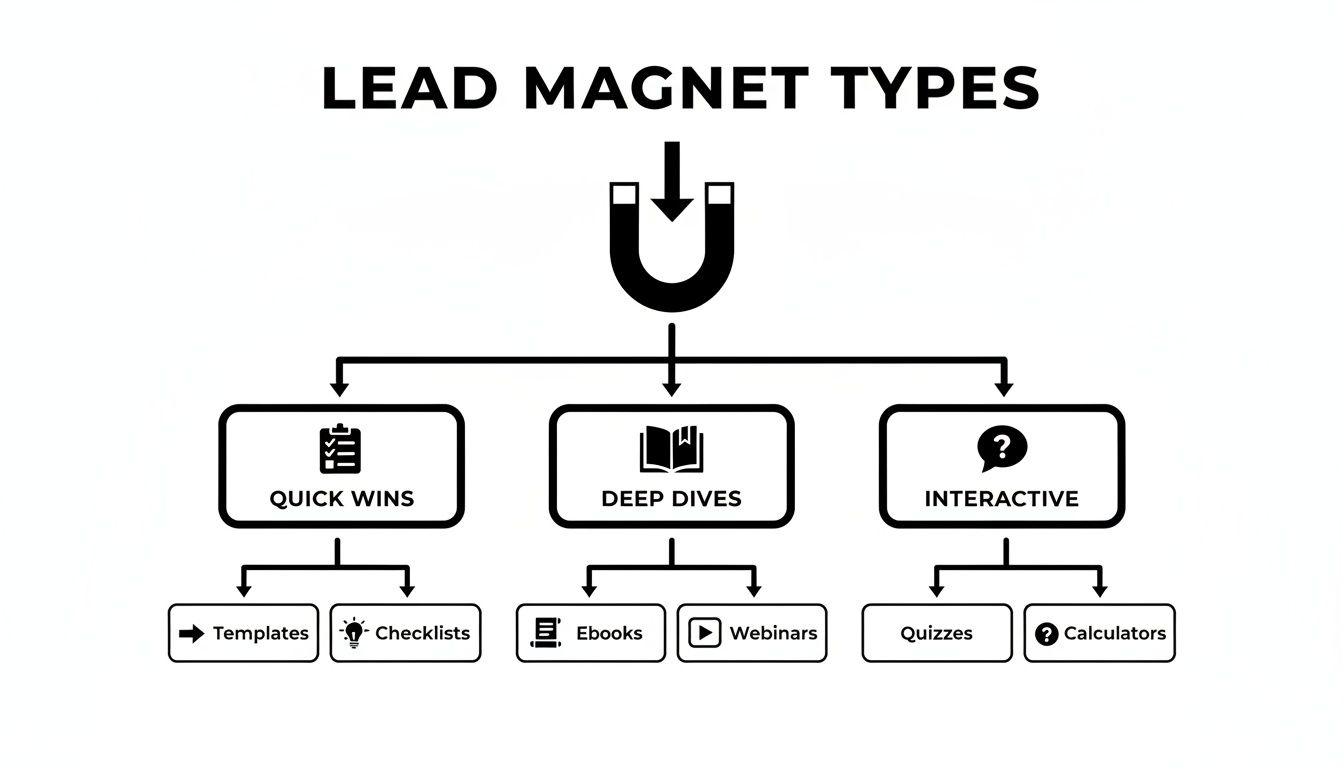
As you can see, lead magnets can be grouped by the kind of value they deliver—whether it’s immediate wins, deep-dive knowledge, or interactive engagement.
Design for Clarity and Professional Impact
Let's be honest—your lead magnet’s design reflects your brand’s quality. A poorly designed PDF with typos and sloppy formatting can kill the credibility of even the most valuable content. The good news is you don’t need to be a professional designer to create something that looks sharp.
User-friendly tools like Canva offer thousands of professional templates for ebooks, checklists, and worksheets. Just focus on clear headings, readable fonts, and plenty of white space. You want your content to be scannable and easy on the eyes. Remember, the goal is clarity, not clutter.
Craft a Compelling Call to Action
Finally, your lead magnet needs a home—usually a dedicated landing page with a clear and compelling call to action (CTA). Your CTA should be action-oriented and shout the value of the offer loud and clear (e.g., "Download Your Free Checklist Now").
This page is where the conversion actually happens, so it needs to be laser-focused on one thing: getting that signup. You can learn more about building an effective page in our guide on creating a high-converting landing page.
Speaking of conversions, it’s always helpful to know what "good" looks like. The table below shows some recent benchmarks to help you set realistic goals.
Lead Magnet Performance Benchmarks by Industry
This table shows recent lead magnet conversion rate benchmarks across various industries, helping businesses set realistic performance goals.
| Industry | Average Conversion Rate |
|---|---|
| Oil & Gas | 10.79% |
| Healthcare | 8.96% |
| Legal Services | 8.66% |
| Finance & Insurance | 7.55% |
| B2B Services | 6.89% |
| Software & SaaS | 5.42% |
| Real Estate | 4.78% |
Source: Focus Digital Research
As you can see, performance varies quite a bit depending on the field. Having these numbers in your back pocket gives you a solid baseline to measure your own efforts against and helps you understand what's achievable in your specific market.
How to Promote Your Lead Magnet for Maximum Reach
So, you’ve created a fantastic lead magnet. That's a huge step, but it's only half the job done. If no one ever sees your brilliant new resource, it's not going to generate a single lead. A great offer needs an equally great promotion plan to get it in front of the right people.
Think of it like building a lighthouse. It's not enough for it to be tall and have a powerful light; it needs to be seen from the sea.

This means you need a solid, multi-channel approach. Your strategy has to blend on-site tactics that capture the traffic you already have with off-site promotion that brings fresh eyes to your brand. Let's break down the best ways to give your lead magnet the visibility it deserves.
Optimize Your On-Site Conversion Points
Your website is your most valuable promotional real estate, hands down. It's already filled with visitors who are curious about what you do, making them prime candidates for your offer. The trick is to make your lead magnet impossible to miss without being annoying.
Here are a few high-impact places to feature it:
- Homepage Hero Section: Place a bold call-to-action (CTA) for your best lead magnet right on your homepage. It's the first thing many visitors see, so give it top billing.
- Targeted Pop-Ups: Use exit-intent or time-based pop-ups to present your offer just before someone leaves your site. For even better results, personalize the offer based on the page they're currently reading.
- Sidebar or Footer Banners: A well-designed banner in your site’s sidebar or footer keeps your lead magnet consistently visible as people browse through different pages.
By weaving your offer into these key spots, you create multiple chances to convert visitors who might have otherwise clicked away and never returned. This is a foundational step in any solid distribution plan, and you can explore more options in our complete guide to content promotion strategies.
Turn Your Blog into a Lead Generation Engine
Your blog is a goldmine for promotion because it attracts an audience actively looking for answers and information. The single most effective way to tap into this is by using content upgrades.
A content upgrade is simply a lead magnet created for one specific blog post. It offers a resource that helps the reader take the next step and apply what they've just learned. For instance, if you write a post on "10 Social Media Tips," the content upgrade could be a downloadable "Social Media Content Calendar Template." This hyper-relevant approach works wonders for conversion rates because the offer directly matches the reader's immediate interest.
A content upgrade seamlessly bridges the gap between learning and doing. It meets your audience exactly where their interest is highest, making the decision to exchange their email for your resource an easy and logical next step.
Leverage Social Media and Email Channels
Once your on-site promotion is dialed in, it’s time to look beyond your website. Social media and your own email list are powerhouse channels for amplifying your message and driving new traffic to your landing page.
Here’s a simple but effective plan:
- Craft Engaging Social Posts: Don't just drop a link and call it a day. Create custom graphics or short videos that tease the value inside your lead magnet. Write compelling copy that agitates the problem your resource solves.
- Run Targeted Ad Campaigns: Platforms like Facebook or LinkedIn are perfect for running ads that target specific demographics, job titles, or interests that align with your ideal customer. This puts your offer directly in their feed.
- Announce it to Your Email List: Your current subscribers are your biggest fans. Send them a dedicated email announcing the new resource. Not only does this give them more value, but it also encourages them to share it with their own networks.
When you combine these promotional efforts, you create a powerful flywheel effect, pulling in traffic and signups from all directions. And remember, the follow-up is just as crucial. Businesses with systematic follow-up strategies see lead-to-sale conversion rates jump by 25–35%. You can read the full analysis on lead nurturing tactics to understand the true impact of a structured approach.
Measuring Success and Optimizing Your Performance
Getting your lead magnet out into the world is a big win, but the real work has just begun. To take your strategy from good to great, you have to measure what’s working, figure out what isn’t, and constantly tweak your approach based on what the data tells you. This is how you stop guessing and start building a predictable growth engine.
If you aren't tracking your results, you’re flying blind. You have no real idea if your landing page is hitting the mark, if your promotion channels are actually effective, or if the leads you’re bringing in are even a good fit for your business.
Key Metrics You Must Track
To get a clear picture of your lead magnet’s health, you need to zero in on a few essential metrics. These numbers tell the story of your performance and point you directly to opportunities for improvement. The first step is getting your tracking set up in a tool like Google Analytics; it’s the only way to get these crucial insights.
Keep a close eye on these key performance indicators (KPIs):
- Conversion Rate: This is your most important success signal. It’s the percentage of people who land on your page and actually sign up. A high conversion rate is a clear sign that your offer and your message are perfectly in sync with your audience.
- Cost Per Lead (CPL): If you're putting money behind ads, your CPL tells you exactly what you’re paying to get each new lead. This metric is critical for managing your budget and making sure you’re getting a solid return on what you spend.
- Lead-to-Customer Rate: This one tracks how many of your new leads eventually become paying customers. It's the ultimate test of lead quality and proves that your magnet isn't just attracting anyone—it's attracting the right people.
Keeping these numbers on your radar is non-negotiable. To get a better handle on this, you can learn more about how to monitor conversion metrics and make sure your hard work is paying off.
Powerful Optimization Strategies
Once you have the data, you can start making informed decisions. Optimization is a continuous loop: test, learn, and refine. Start by looking at your metrics and forming a hypothesis. For example, you might think, "I bet changing the headline on my landing page will boost my conversion rate."
Now, it’s time to run an A/B test. This is where you create two slightly different versions of your landing page—an "A" version and a "B" version. The key is to change only one thing, like the headline, the color of your call-to-action button, or the main image. You show each version to a different slice of your audience and see which one performs better. Just like that, you have a data-backed reason to make a change.
Optimization isn't about massive, scary overhauls. It's about making small, incremental improvements over time that add up to significant results. Always test one element at a time so you know exactly what moved the needle.
The Future of Lead Magnets
Things are always changing, and you have to stay on top of what’s next. Technology is driving a major shift in what works for lead magnets, with AI-generated and interactive content quickly gaining ground. Personalized quizzes and interactive video guides are becoming the new heavy-hitters, often outperforming old-school ebooks.
You can read the full research about these emerging trends to see what's on the horizon. By constantly measuring, optimizing, and innovating, you can ensure your lead magnet remains one of the most powerful tools in your marketing arsenal.
Common Questions About Lead Magnets
As you start weaving lead magnets into your marketing, some questions always pop up. It's totally normal. Getting straight answers to these will help you move forward confidently and sidestep a few common mistakes.
Let's clear up some of the most frequent ones so you can get back to building.
How Long Should a Lead Magnet Be?
This is the big one, but the answer isn't about word count or the number of pages. It’s all about how quickly you can deliver a win for your reader.
A simple one-page checklist that solves a nagging problem is infinitely more valuable than a fluffy 50-page ebook. The goal is to provide a tangible solution, fast. A cheat sheet should be scannable in minutes; a whitepaper might need more depth. Just remember: your mission is to solve the specific problem you promised to fix, as efficiently as possible.
Can I Use More Than One Lead Magnet?
Not only can you, but you absolutely should. Having a whole library of lead magnets is a secret weapon for smart marketers. It lets you create hyper-specific offers that speak directly to different segments of your audience.
Think about it. A marketing agency could offer a “Social Media Content Calendar” on a blog post about Instagram and a “PPC Budget Calculator” on their Google Ads service page. This targeted approach makes your offer feel incredibly relevant, which naturally sends conversion rates through the roof.
A varied lead magnet portfolio allows you to meet different customers at different stages of their journey. Each targeted offer acts as a unique entry point into your marketing funnel, tailored to a specific need.
What's the Difference Between a Lead Magnet and a CTA?
It's easy to mix these two up, but they have very different jobs. The simplest way to think about it is this: the lead magnet is the prize, and the call-to-action (CTA) is the big, shiny button you press to get the prize.
- The Lead Magnet is the actual resource—the ebook, the checklist, the webinar recording.
- The Call-to-Action (CTA) is the instruction that tells someone what to do next—"Download Your Free Guide Now" or "Get the Template."
You can't have one without the other. The CTA creates the spark of action, while the lead magnet delivers on the promise.
Ready to turn your website traffic into a predictable stream of qualified leads? ReachLabs.ai designs and executes data-driven marketing strategies, including high-converting lead magnets, to build your pipeline and drive real business growth. Learn how we can elevate your brand's voice and results.