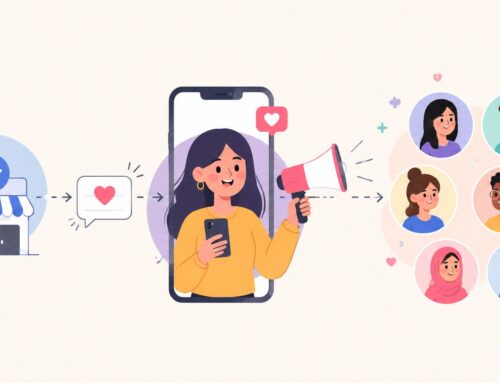
So, what exactly is influencer outreach?
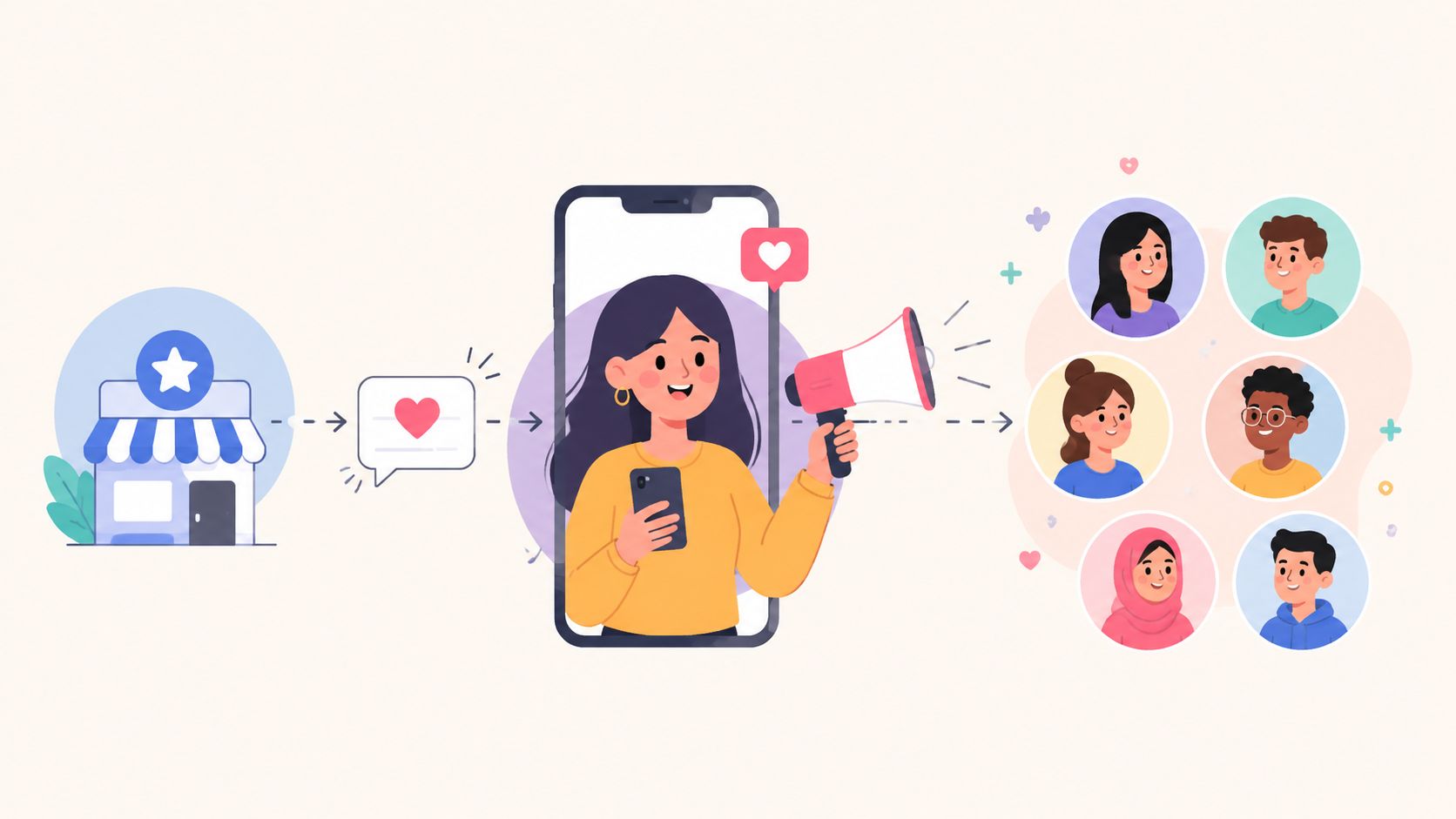
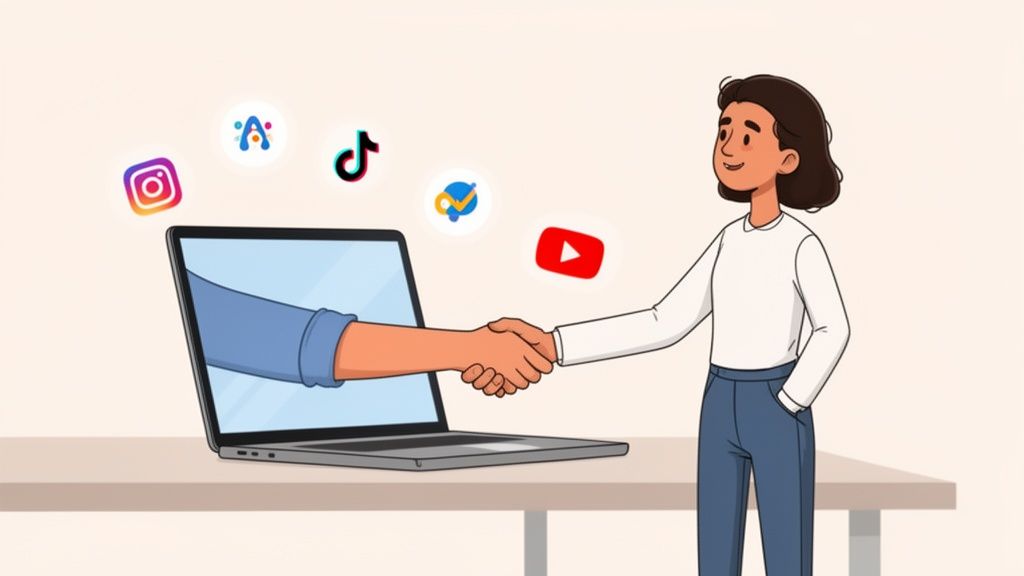
Think of it as the art and science of connecting with creators—the people who have already captured the attention and trust of your ideal customers. It's about building real relationships with them so they can share your brand's story in a way that feels genuine and exciting to their audience. This isn't just about cutting a check for a one-off post. It's about building a partnership that creates lasting value and credibility.
It’s the difference between getting a glowing recommendation from a friend versus seeing a random billboard on the highway.
Why Authentic Connections Beat Loud Ads
At its heart, influencer outreach is all about people. It's a massive shift away from the old-school advertising playbook, where brands would just shout their message at anyone who would listen. Instead of a one-way monologue, influencer outreach starts a conversation.
The whole point is to find creators whose vibe, style, and audience are a perfect match for your brand. When you get that alignment right, any collaboration that follows feels like a natural fit, not a jarring ad. This is huge, especially since most people are tired of being interrupted. The proof is in the numbers: the global influencer market has skyrocketed to $24 billion, tripling since 2019, thanks to the power of platforms like Instagram and TikTok.
Even more telling, 69% of consumers trust what influencers say far more than what a brand says about itself in an ad. If you're curious, you can dig deeper into these influencer marketing statistics to see just how significant this shift is.
"The difference between outreach and advertising is the difference between a recommendation from a trusted friend and a sales pitch from a stranger. One builds loyalty, while the other just builds awareness."
Influencer Outreach vs Traditional Advertising
It's helpful to see how these two approaches stack up. While they can definitely work together in a marketing plan, they come from completely different places.
| Attribute | Influencer Outreach | Traditional Advertising |
|---|---|---|
| Core Principle | Relationship-based; earning trust | Transaction-based; buying attention |
| Communication | Two-way dialogue; authentic storytelling | One-way broadcast; scripted messaging |
| Audience | Niche, highly-engaged community | Broad, general, and often passive |
| Trust Factor | High; seen as a peer recommendation | Low; seen as a direct sales pitch |
| Timeframe | Long-term investment for compounding value | Short-term campaigns for immediate visibility |
| Content | Creator-led, authentic, and unique | Brand-controlled, polished, and uniform |
At the end of the day, traditional ads are great for casting a wide net quickly. But influencer outreach is how you build something that lasts.
It’s a long-term game focused on building real rapport. That first email or DM is just the starting line for a partnership that could grow and deliver value for years. This approach pays off in ways that simple ads just can't match:
- Deeper Engagement: When a creator shares something in their own voice, their audience listens and interacts. It’s a real conversation.
- Targeted Reach: You get direct access to a hand-picked, super-relevant audience that’s already interested in what you have to offer.
- Enhanced Credibility: An honest endorsement from a respected creator gives your brand a stamp of approval that you could never buy outright.
Ultimately, understanding influencer outreach means changing your mindset. Stop thinking about buying ad space and start thinking about building powerful alliances that drive real, sustainable growth.
Building Your Influencer Outreach Playbook
Knowing what influencer outreach is and actually doing it are two different things. To bridge that gap, you need a solid, repeatable plan—a playbook. This is your roadmap, guiding you from finding the right partners all the way to measuring your results. Without one, you’re just throwing spaghetti at the wall and hoping something sticks.
First things first: you have to know what you’re trying to achieve. Your goals will shape every single decision you make. Are you trying to get your name out there and build massive brand awareness? Or do you need to see a direct spike in sales? Maybe the real prize for you is a library of awesome user-generated content.
Setting clear, measurable goals is the bedrock of any good influencer outreach campaign. A vague goal like "increase visibility" is impossible to track. A specific target like "achieve a 20% increase in unique website visitors from referral links" gives you a real benchmark for success.
This kind of clarity ensures your outreach is purposeful, not just busywork. It’s the difference between wandering around the woods and following a trail to a specific viewpoint.
Define Your Ideal Creator Persona
Once you know your destination, you need to figure out who’s coming with you. A classic rookie mistake is just chasing creators with huge follower counts. Instead, you need to develop an ideal creator persona—a detailed profile of the perfect partner for your brand.
Think beyond the vanity metrics and dig into what really matters:
- Values Alignment: Do their core beliefs line up with yours? If you're an eco-friendly brand, partnering with a fast-fashion haul creator is going to feel off to everyone.
- Audience Demographics: Is their audience really your target customer? Don't just guess. Look for creators who can share clear insights into who follows them.
- Content Style and Quality: Does their vibe—their aesthetic, their tone—feel like a natural fit for your brand? The best collaborations feel seamless.
- Engagement Rate: Forget follower count for a second. Are people actually commenting, sharing, and reacting? That’s the real sign of an active, invested community.
To really nail this down, you might even bring in some outside expertise. Working with remote influencer marketing specialists can provide a fresh perspective. Building this persona is your filter, helping you ignore the noise and focus on relationships that will actually drive results.
Prioritize Personalization In Your First Contact
You've defined your goals and you know who you’re looking for. The final piece of your initial playbook is planning that crucial first message. Generic, copy-paste templates are the fastest way to land in the trash folder. Personalization is everything.
Show them you’ve actually paid attention. Reference a specific video you loved or mention a personal story they shared. It proves you’re not just spamming a list and that you genuinely respect their work. This is how you start off on the right foot. It's all about building a real connection, not just executing a transaction.
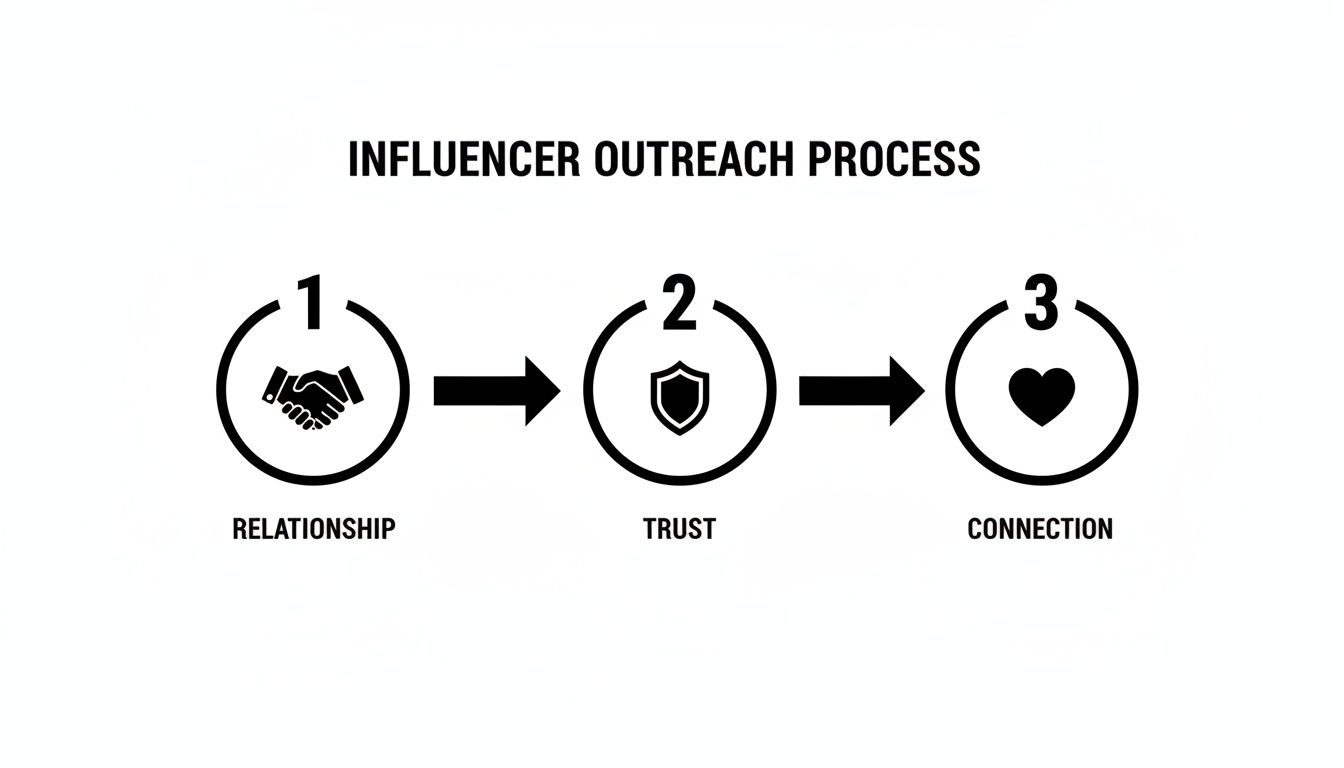
As you can see, a great partnership doesn't happen overnight. It starts by building a relationship, which then earns trust, and finally blossoms into a genuine connection.
Ready to get more strategic? Our complete guide on how to create an influencer marketing strategy is the perfect next step. Think of this playbook as your foundation for building authentic, lasting, and truly impactful creator partnerships.
Finding the Right Influencers and Platforms
Successful influencer outreach isn't just about what you say; it's about who you say it to and where that conversation takes place. Picking the right platform and creator is like casting a play—the stage and the actor are just as critical as the script itself. You wouldn't try to sell B2B software on a platform famous for dance crazes, just like you wouldn't advertise streetwear in a stuffy academic journal.
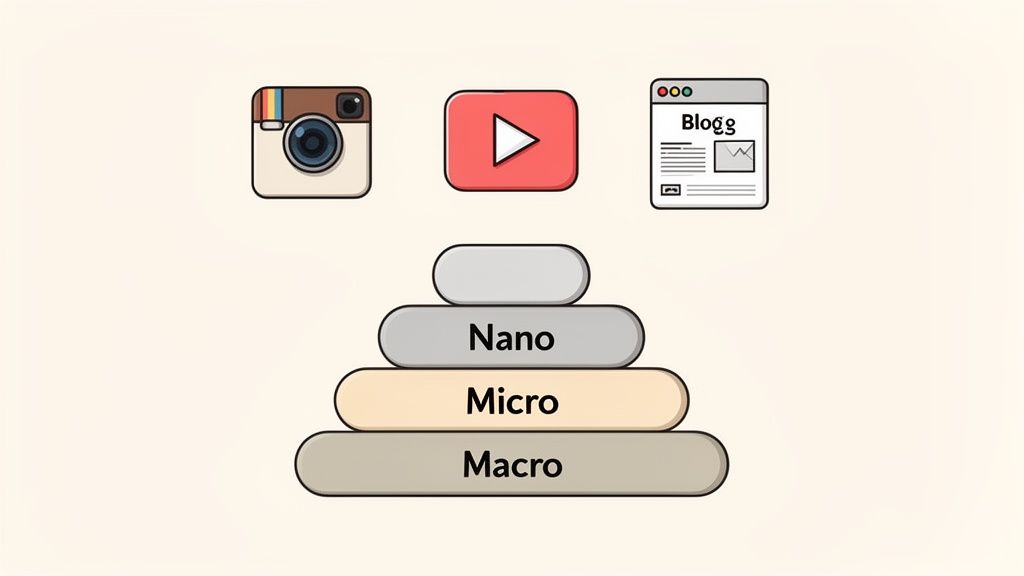
The trick is to meet your audience where they already live and breathe. Every platform has its own vibe, its own language, and its own community. Instagram is a visual feast, making it a natural fit for fashion, beauty, and travel. TikTok, on the other hand, is all about raw, entertaining, short-form video. And for a deep, authoritative breakdown of a complex topic, nothing beats a niche blog or a dedicated YouTube channel.
Unpacking the Different Tiers of Influencers
Just like platforms, influencers come in all shapes and sizes. We often sort them into tiers based on follower count, but their real power is in how much their audience listens and engages.
- Mega-Influencers (1M+ followers): Think celebrities and digital superstars. They offer enormous reach, but that often comes with a hefty price tag and, surprisingly, lower engagement.
- Macro-Influencers (100K-1M followers): These are your established pros. They're professional content creators with a large, loyal following and know the collaboration game inside and out.
- Micro-Influencers (10K-100K followers): For many brands, this is the sweet spot. Micro-influencers have fantastic engagement rates because they’ve built a genuine, trusting relationship with their niche audience.
- Nano-Influencers (1K-10K followers): These creators might have a smaller audience, but that community is hyper-engaged. A recommendation from them feels less like an ad and more like advice from a good friend.
The right choice isn't always the biggest name. A nano-influencer with a loyal following in your specific niche can drive more meaningful results than a celebrity with millions of passive followers.
Why Smaller Influencers Often Deliver Bigger ROI
The trend is impossible to ignore: marketers are turning away from massive accounts and focusing on smaller, more connected creators. In fact, 54% of marketers now focus on nano (27%) and micro (27%) influencers to get real engagement, not just eyeballs.
The platform data tells a similar story. A whopping 80.8% of US marketers prioritize Instagram for their campaigns, with many also tapping into TikTok's incredible organic reach. And when you look at the numbers, it's easy to see why. While a mega-influencer on Instagram might average a 2.8% engagement rate, a creator on TikTok can pull in an impressive 4.95%.
This all points to a fundamental shift in outreach strategy: connection matters more than crowd size. If you want to find the tools that can help you pinpoint and manage these valuable relationships, check out this guide on the top influencer marketing platforms. By zeroing in on the right tiers and platforms, you're not just spending your budget wisely—you're building authentic partnerships that truly resonate with the people you want to reach.
How to Craft Outreach Messages That Get Opened
Let's be real: your first message is everything. Creators are drowning in DMs and emails, so a generic, copy-pasted pitch is a guaranteed way to get ignored. If you want to break through the noise, you need to show you’ve actually done your homework.
This goes way beyond just slotting their name into a template. You need to prove you're a real fan. Mention a specific video you loved, a recent post that made you think, or a unique take they had on something. That tiny bit of genuine appreciation instantly sets you apart and shows you see them as a creative partner, not just another name on a spreadsheet.
![A mobile phone displaying a pop-up message 'Loved your video, [Name]!' with a call to action button to 'Let's collab'.](https://cdn.outrank.so/64cdc0e0-2a54-4cd9-a45d-c4196c5e1d4e/c9fc2af7-03f7-40c8-a8f2-a40fedecdc03/what-is-influencer-outreach-app-notification.jpg)
Clearly Show Them What’s In It For Them
Once you've caught their eye, you have to immediately answer their unspoken question: "What's in it for me?" Your message must spell out the value clearly and quickly. This isn’t about what you need from them; it's about what they get out of the deal.
Think about what makes a partnership truly worthwhile for a creator. It could be:
- Creative Freedom: Let them know you trust their vision and want them to feature your product in a way that feels natural to their audience.
- Exclusive Access: Offer a sneak peek at a new product or an experience their followers would genuinely care about.
- Fair Compensation: Be transparent about your budget. Whether it’s a flat fee, a commission structure, or gifted products, be respectful and upfront.
- Audience Growth: If your brand has a significant following, mention how the collaboration could introduce their work to a new, relevant audience.
A powerful outreach message is built on respect for the creator's time and business. It should feel like an invitation to a mutually beneficial partnership, not a one-sided request for a favor.
The Anatomy of a Perfect Outreach Message
To avoid the classic blunders—like making it all about your brand or having a confusing call-to-action—it helps to have a simple structure. Think of your message as a short, three-act play.
- The Personalized Hook: Kick things off with that genuine, specific compliment about their work. Show them this message was written for them and only them.
- The Clear Proposal: Briefly introduce your brand and explain why you believe a collaboration would be a perfect fit for their audience. Keep it short, sweet, and creator-focused.
- The Simple Ask: Wrap up with a low-pressure call-to-action. Instead of asking them to sign on for a full campaign, suggest a quick chat to brainstorm or simply ask if they're open to hearing more.
Putting together a message with these key elements shows you're a professional who values their work. Let's break down exactly what each piece looks like.
Key Elements of a High-Converting Outreach Message
| Component | Purpose | Example Snippet |
|---|---|---|
| Personalized Opener | To show you've done your research and aren't just spamming them. | "Hi [Name], I loved your recent video on sustainable travel tips—especially the part about packing cubes. It was a game-changer!" |
| Clear Introduction | To briefly explain who you are and why you're reaching out. | "I'm with [Your Brand], and we create eco-friendly travel gear. Your audience's passion for conscious travel really aligns with our mission." |
| Value Proposition | To answer "What's in it for me?" and highlight the mutual benefit. | "We think they'd love our new daypack and would love to send you one to try. We have a budget set aside for our partners, of course." |
| Low-Friction CTA | To make it incredibly easy for them to say "yes" to the next step. | "If you're interested, would you be open to a quick 15-minute call next week to see if it's a good fit? No pressure at all." |
By following this simple framework, you build rapport from the very first sentence. It turns a cold pitch into a warm introduction, making it far more likely you'll get the positive response you’re looking for.
Common Outreach Mistakes to Avoid
Even a perfectly crafted influencer strategy can fall flat if your outreach feels clumsy or robotic. When it comes to building relationships with creators, how you show up is everything, and a few common missteps can easily sour a potential partnership before it even starts.
The most glaring mistake? Blasting out generic, copy-paste emails. Influencers can spot a lazy template from a mile away, and it’s a one-way ticket to their trash folder. This approach tells them you haven’t done your homework and see them as just another name on a list, not a creative partner.
Another major pitfall is lowballing them on compensation. Asking a creator to work for "exposure" or offering a free product that doesn't come close to matching the time and effort their content requires is a huge turn-off. It shows a fundamental misunderstanding of the value they bring and the years they've spent building their community.
Focusing on the Wrong Metrics
It’s tempting to chase after influencers with massive follower counts, but that’s a classic rookie mistake. A huge audience doesn't mean a thing if those followers aren't engaged or don't care about what your brand has to offer.
Instead of getting starstruck by big numbers, focus on what really matters:
- Engagement Rate: Is the comment section buzzing with real conversations? Are people liking, sharing, and saving their posts? A high engagement rate is a sign of a healthy, active community.
- Audience Quality: Dig into who their followers actually are. A micro-influencer with 10,000 followers who all fit your ideal customer profile is infinitely more valuable than a macro-influencer with a million followers who don’t.
- Content Authenticity: Does their content feel real and true to them? Does their tone and style genuinely align with your brand's values? If it feels forced, their audience will feel it too.
Let's be clear: the opportunity is real. 58% of consumers have bought something because an influencer recommended it. At the same time, 26% are wary of the space, largely because of partnerships that feel like a cheap ad. To learn more about this, you can explore some great insights on building trust in influencer marketing.
The most significant mistake you can make in influencer outreach is forgetting the 'relationship' part. A campaign should be the beginning of a long-term partnership, not a one-off transaction.
Finally, don’t let the relationship die once the campaign is over. That’s a massive missed opportunity. Keep in touch with them. Celebrate their milestones. Let them know what's new with your brand. A little bit of effort here can turn a one-time collaborator into a genuine, long-term advocate for your business.
Measuring the True ROI of Your Outreach Efforts
So, how do you actually prove your influencer outreach is paying off? If you want to justify the budget and make your next campaign even better, you have to connect your efforts to real business results. This means looking past the vanity metrics—things like "likes" and follower counts—and zeroing in on the key performance indicators (KPIs) that really impact your bottom line.
Think of it this way: Likes are the applause at a concert, but sales are the ticket revenue. The applause feels great, but you need the revenue to keep the show on the road. It’s the same exact principle here. You have to track the numbers that show real, tangible value.
Key Metrics That Showcase Real Value
To get the full story of your return on investment, you need to look at a mix of metrics covering awareness, engagement, and, most importantly, conversions. Each one tells a different piece of your campaign's narrative.
- Brand Awareness Metrics: These numbers tell you how many new eyeballs are landing on your brand. Keep an eye on impressions (the total number of times the content was seen) and reach (how many unique people saw it). A jump in brand mentions or an increase in your "share of voice" online are also fantastic signs that awareness is growing.
- Engagement Metrics: This is where you find out if the content actually connected with people. Don't just stop at likes. Dig deeper into comments, shares, and saves. Clicks on your links, which you can measure with the click-through rate (CTR), are a huge indicator that an influencer's audience is genuinely interested and ready to take the next step.
- Conversion Metrics: Here’s where the rubber really meets the road. Using unique affiliate links and custom promo codes for each influencer is the best way to directly trace sales back to their specific efforts. Tracking these conversions is the clearest, most direct way to prove financial ROI.
The secret to showing real value is to tell a complete story with your data. When you can combine a high reach number with a strong engagement rate and solid conversion data, you're not just showing that people saw your campaign—you're proving it actively drove business growth.
Tying It All Back to Business Goals
The metrics you decide to focus on should always loop back to what you wanted to achieve in the first place. Was the goal to generate leads? Then form fills and newsletter sign-ups are your North Star. Was it all about driving sales? Then the revenue brought in through those promo codes is your number one KPI.
It's also worth noting that the definition of "success" is changing. For example, while creators recently drove 45% more affiliate sales year-over-year, only 30% of marketers now consider sales spikes the ultimate win. Many are shifting their focus to building engagement and long-term trust. This really underscores the need to track both hard sales figures and softer brand-building metrics to see the complete picture.
When you're thinking about the tangible side of a campaign, even knowing how to choose effective promotional products can play a part in getting measurable results. By putting the right tracking systems in place before you even launch, you can stand behind your results and confidently prove the value of your work.
For a deeper dive on this, check out our guide on calculating influencer marketing ROI.
Got Questions About Influencer Outreach? We've Got Answers.
Jumping into influencer outreach for the first time can feel a little daunting. You're not alone—most marketers have the same questions when they start out. Let's tackle some of the most common ones head-on.
How Should I Handle Compensation?
This is the big one, isn't it? Talking about money can feel awkward, but it’s a crucial part of building a professional partnership. The goal is simple: be fair, be upfront, and respect the creator's work and the audience they’ve built.
Sure, a free product might work for a nano-influencer just starting out, but most established creators expect to be paid for their work.
Think about what goes into their rate. It's not just a single number pulled out of thin air. Fair pay is a mix of:
- Deliverables: Exactly what are you asking for? How many posts, stories, or videos?
- Usage Rights: Where will you use this content? On your social channels? In paid ads? And for how long?
- Exclusivity: Are you asking them not to work with your competitors for a certain period? That has value.
- Reach and Engagement: The size of their following is a starting point, but how engaged that audience is matters even more.
Always go in ready to negotiate. And once you agree on terms, get everything in a contract. It protects you, it protects the influencer, and it makes sure everyone is on the same page before a single piece of content goes live.
What Should I Do If an Influencer Doesn't Reply?
First, don't panic. Silence isn’t always a hard no. Creators get flooded with DMs and emails, and it’s easy for a good pitch to get buried.
Give it about a week. If you haven't heard back, a single, polite follow-up is totally fine.
Keep it short and sweet. Something like, "Hey [Name], just wanted to gently follow up on my previous email about a potential partnership with [Your Brand]. Let me know if you had a chance to look it over!" can be really effective. If they’re still silent after that, it's probably best to move on to other creators on your list.
What Legal Considerations Should I Know?
This part is non-negotiable. The number one rule you need to know is about disclosure. The Federal Trade Commission (FTC) is very clear: influencers must tell their audience when a post is sponsored. Usually, this is as simple as using hashtags like #ad or #sponsored.
As influencer marketing becomes a more established industry, simply knowing the rules isn't enough. Your contract needs to explicitly state that the creator must follow all FTC guidelines. This protects your brand and ensures the creator maintains trust with their audience.
This isn't just a niche concern anymore. The industry is booming, with 64% of brands now working with at least 10 influencers on any given campaign. As collaborations get bigger and more frequent, getting the legal and financial details right from the very beginning is vital. You can dig into more stats on the growth of the influencer marketing industry to see just how central it's become to modern marketing.
At ReachLabs.ai, we help you build and manage authentic influencer relationships that drive real results. Discover how our team of specialists can elevate your outreach strategy today.