Beyond the buzzwords, the fundamental shift in B2B marketing is buyer control. Buyers research on their own, compare vendors privately, and often form a strong opinion before sales gets a real shot. In fact, 60% of B2B buyers make final purchasing decisions based on the digital content they consume. If your content, outreach, and targeting aren't working together, you're probably creating activity, not pipeline.
That gap shows up everywhere. Teams publish content that never reaches the right accounts. They run paid campaigns without a clear path to revenue. They send outreach that feels disconnected from the problems buyers are already discussing in public. The old playbook of broad targeting and generic follow-up doesn't hold up when buyers expect relevance from the first touch.
The good news is that the strongest B2B marketing strategies aren't mysterious. They're disciplined. They align audience, message, channel, and measurement. They also force hard choices about budget, team capacity, and what not to do.
This guide gives you a practical playbook for 2026. These are the ten strategies I'd prioritize for SMB and growth-stage teams that need real traction, not just more dashboards. For each one, I'll cover where it fits, who it's for, what to measure, and the trade-offs that matter when you're trying to build a marketing engine leadership can trust.
1. Account-Based Marketing (ABM)

ABM works best when a small number of accounts can change your quarter. If you sell a complex service, enterprise software, or anything that requires multiple approvals, broad lead generation usually wastes time. Sales needs depth, not volume.
The common mistake is trying to “do ABM” across too many accounts too early. Start tight. Pick a focused account list, map the buying group, and coordinate sales and marketing around the same targets. Salesforce, LinkedIn, and Demandbase-style programs are strong examples of this model because they treat each account like a market, not a lead.
Who should use it
ABM is a fit for teams selling into named accounts, especially when decision-making is shared across operations, finance, IT, or leadership.
Use it when:
- Deal size is high enough to justify personalization: Custom landing pages, customized messaging, and account research take real effort.
- Sales cycles are long: ABM helps maintain relevance across multiple stakeholders over time.
- Your sales team already knows the best-fit accounts: Marketing can then accelerate access and influence.
KPIs and budget guidance
Track account engagement, meetings from target accounts, buying-group coverage, sales-qualified opportunities, and progression by account stage. Don't judge ABM by top-of-funnel volume alone. That's how good programs get killed too early.
Practical rule: If sales and marketing can't agree on the target account list, don't launch ABM yet.
Budget-wise, ABM usually deserves focused spend rather than broad spend. I'd rather see a smaller team run a sharp pilot with personalized ads, direct outreach, and custom content than fund a wide campaign with generic copy. ReachLabs.ai is useful here when internal teams need help building the account list, message architecture, and managed execution without hiring a full in-house ABM team.
2. Content Marketing and Thought Leadership
The Content Marketing Institute reports that B2B marketers with the strongest content programs are far more likely to have a documented strategy than their less successful peers. That gap matters. Publishing regularly is not the same as building demand, and SMB teams feel that difference fast when content consumes budget but produces little sales traction.
Content marketing works best when each asset has a job. Some pieces bring in search traffic. Some help buyers compare options. Some give sales a credible answer to the hard questions that stall deals. Thought leadership adds another layer by giving the market a clear point of view. HubSpot built authority with educational content and certification programs. Moz did it with original research and practical guides. The shared principle is simple. Teach buyers how to make a better decision, then show why your approach fits that decision.
A lot of teams miss this by chasing volume. Ten weak posts will not outperform one credible resource that sales can use.
What works and what doesn't
Strong B2B content is specific, opinionated, and tied to a buying stage. It addresses real objections, names trade-offs, and reflects how buyers evaluate risk internally. Weak content stays broad to avoid offending anyone, which usually means it fails to help anyone.
For SMB marketing leaders, I recommend building the program in three layers:
- Top-of-funnel educational content: Best for buyers who know the problem but need language, frameworks, and evaluation criteria. Use blog posts, search pages, and short explainer videos.
- Point-of-view content: Best for founders, executives, and subject-matter experts who need to build trust in a crowded category. Use bylined articles, research summaries, and strong opinion pieces.
- Decision-stage content: Best for active opportunities. Use comparison pages, buyer guides, implementation content, and case-study-driven assets that reduce perceived risk.
The trade-off is speed versus depth. Search content can scale faster and support SEO, but it often takes time to rank. Executive-led thought leadership can differentiate the brand sooner, but it depends on having a real perspective and the discipline to publish consistently. Decision-stage content usually has the shortest path to revenue because sales can put it to work right away.
Teams that want to connect content with outreach should also plan distribution early. A strong article with no amplification often dies on the company blog. Repurposing it for email, sales follow-up, and LinkedIn lead generation and managed outreach usually produces better returns than publishing more standalone posts.
KPIs and budget guidance
Measure content by qualified conversions, influenced pipeline, sales adoption, and content-assisted deal progression. Traffic is useful context, but it is rarely the deciding metric in B2B. I would rather see a smaller library of assets that show up in live deals than a large archive nobody references.
Budget should follow audience maturity and sales motion. Early-category companies usually need more educational content because the market still needs framing. Competitive categories often get better results from sharper thought leadership, comparison pages, and proof-driven assets that help buyers narrow the field. For SMB teams with limited resources, content usually deserves budget because one good asset can support SEO, email nurture, sales enablement, retargeting, and paid promotion at the same time. ReachLabs.ai can help teams turn that content into an operating system instead of a publishing calendar.
3. LinkedIn Marketing and Managed Outreach
LinkedIn is where a lot of B2B categories are won. Not because the platform is magic, but because decision-makers already use it to evaluate people, firms, and ideas. If your buyers spend time there, your brand needs a visible point of view and a repeatable outreach motion.
Organic posting, employee advocacy, targeted ads, and managed outbound each solve a different problem. Organic builds familiarity. Outreach opens conversations. Paid amplifies precision. The smartest teams use all three together, especially in service businesses and mid-market SaaS.
The real trade-off
Marketing teams often either over-post and under-target, or over-message and under-warm the audience. Both approaches fail. Buyers ignore random connection requests from brands they've never seen. They also ignore “thought leadership” that never leads anywhere.
A stronger operating model looks like this:
- Leadership content builds credibility: Share specific takes, not generic motivation.
- Sales or founder outreach follows engagement: Message people who have context for your brand.
- Paid promotion supports priority offers: Especially around webinars, reports, and case studies.
For teams that want a more systematic version of this channel, lead generation on LinkedIn is one of the clearest ways to turn visibility into booked conversations.
The best LinkedIn outreach rarely feels like outreach. It feels like a continuation of a conversation the prospect has already started with your content.
KPIs and budget guidance
Track profile views from target buyers, content engagement quality, connection acceptance, replies, meetings booked, and influenced opportunities. I care less about post virality than whether the right job titles are showing up and responding.
Budget depends on whether you're building around founder-led visibility, employee advocacy, ads, or managed outreach. SMB teams often get the fastest traction by pairing a clear executive voice with disciplined outbound support from a partner that can handle targeting, sequencing, and follow-up.
4. Influencer Marketing and Partnerships
In B2B, influencers usually aren't celebrities. They're operators, analysts, consultants, newsletter writers, event hosts, and subject-matter experts with earned trust in a niche. When they speak, buyers listen because the advice feels closer to real work.
That's why relevance beats reach. A respected cloud architect can be more persuasive for AWS-related messaging than a broad business creator with a larger audience. Microsoft, Salesforce, and HubSpot have all leaned into expert partnerships for launches, webinars, and co-created content because borrowed credibility shortens the trust-building cycle.
Where it fits best
This strategy works well when your category needs education or independent validation. It's especially useful for technical products, emerging categories, and markets where vendor claims alone don't carry enough weight.
The strongest partnership structures include:
- Co-created webinars or roundtables: Good for expertise transfer and lead capture.
- Guest content or research commentary: Good for credibility and reach.
- Event appearances and expert series: Good for brand association over time.
KPIs and budget guidance
Measure audience quality, content engagement, referred traffic quality, pipeline influence, and sales feedback. Don't pick partners based on follower count alone. In B2B marketing strategies, audience fit is the asset.
One hard truth: one-off influencer posts rarely do much in B2B. The better model is repeated association. If an expert appears in your ecosystem multiple times, buyers begin to connect your brand with informed thinking. ReachLabs.ai can help structure those programs, especially when a brand needs help identifying niche voices, coordinating production, and making sure the partnership turns into usable campaign assets instead of a single splashy moment.
5. Email Marketing and Marketing Automation
Email keeps earning budget because it does two jobs at once. It supports demand capture already in motion, and it gives SMB teams a low-cost way to keep qualified accounts progressing after the first touch. Analysts at Litmus have long reported strong email ROI across industries, but the practical reason B2B teams keep using it is simpler. Email is one of the few channels you fully control, can segment tightly, and can tie back to pipeline with reasonable accuracy.
The problem is execution. B2B teams often build automation around forms and page views, then send the same sequence to every contact in a segment. That creates activity, not movement. A pricing-page visitor, a champion downloading a technical guide, and a dormant lead recycled from sales each need different follow-up, different proof, and a different call to action.
The better model is progression by buying signal.
What a strong email program looks like
Strong programs map emails to audience, intent, and sales motion. That usually means one set of journeys for new leads, another for active evaluation, and another for accounts that need reactivation. In smaller teams, I usually recommend starting with fewer sequences and making them sharper rather than building a large automation tree nobody can maintain.
Useful building blocks include:
- Welcome and education flows: Help early-stage buyers understand the problem, the category, and your point of view.
- Behavior-triggered nurture: Send follow-up based on high-intent actions such as repeat site visits, webinar attendance, or pricing-page engagement.
- Sales-assist sequences: Support SDR and AE outreach with case studies, objection handling, and next-step prompts tied to the live deal.
If you're designing nurture tracks, these 10 B2B lead nurturing strategies are a useful companion to automation planning.
A real trade-off matters here. More segmentation improves relevance, but it also raises production load, QA time, and reporting complexity. For many SMBs, the right answer is not "more automation." It is better triggers, clearer offers, and tighter coordination between marketing and sales. ReachLabs.ai can help operationalize that by connecting campaign intent, sequence logic, and follow-up assets so automation supports pipeline instead of just increasing send volume.
KPIs and budget guidance
Track performance at the sequence level, not only at the channel level. Focus on reply quality, meetings booked, conversion to qualified opportunity, lead-to-SQL rate by segment, and unsubscribe or spam complaint patterns. Open rates can still help diagnose subject lines and deliverability, but they are a weak proxy for business impact on their own.
Budget should go first to list hygiene, segmentation logic, copy, and deliverability setup. After that, invest in the automation features your team will use. A basic platform with strong strategy often outperforms an expensive system running generic nurture paths.
6. Search Engine Marketing (SEM) and SEO
SEO builds compounding visibility. SEM buys immediate attention. Mature B2B teams use both because they solve different timing problems. If you rely only on SEO, you wait too long to learn. If you rely only on paid search, you rent demand without building equity.
HubSpot, Moz, Salesforce, and Neil Patel-style content engines all show the same principle. Search works when content is aligned to intent, not when brands publish generic articles around broad keywords.
A practical split between SEO and SEM
SEO should own repeatable buyer questions, comparison terms, category education, and high-value evergreen content. SEM should focus on tighter, lower-funnel queries where commercial intent is clearer.
That usually means:
- SEO for strategic depth: Pillar pages, use-case pages, industry pages, and resource hubs.
- SEM for precision: Demo terms, competitor alternatives, and high-intent solution keywords.
- Retargeting for continuity: Keep qualified visitors engaged after the first visit.
Field note: If paid search traffic doesn't convert, the issue often isn't the ad. It's the disconnect between the keyword, landing page promise, and next step.
KPIs and budget guidance
For SEO, track qualified organic visits, non-branded visibility, assisted conversions, and sales feedback on lead quality. For SEM, track cost per qualified opportunity, search term relevance, landing page conversion, and pipeline contribution.
Budget trade-off is straightforward. SEO needs patience and editorial discipline. SEM needs tighter control and constant pruning. SMB teams should usually build a small but durable SEO base while reserving paid search for offers and terms tied closely to revenue. ReachLabs.ai can help connect both motions so search isn't run in isolation from content, landing pages, and follow-up.
7. Webinars, Virtual Events & Video Marketing
Some channels are better at reach. Others are better at trust. Webinars and video sit in the trust category because they let buyers see how you think, not just what you claim. That's why they work so well in long sales cycles and complex categories.
HubSpot, Salesforce, Marketo, Stripe, Slack, Drift, and Wistia all use some version of this play. Live or recorded, the format gives prospects a lower-pressure way to learn while giving your team reusable assets for sales, social, and email.
When to use webinars versus video
Webinars are better when the topic needs explanation, comparison, or audience interaction. Video is better when the message needs speed, clarity, and repeatable distribution.
A sensible split looks like this:
- Webinars for mid-funnel education: Deep dives, use cases, panel discussions, and product walkthroughs.
- Short video for awareness and follow-up: Explainers, customer clips, executive takes, and recap snippets.
- On-demand assets for sales enablement: Recorded sessions that reps can send after discovery calls.
KPIs and budget guidance
For webinars, watch registration quality, live attendance quality, post-event meeting requests, and sales follow-up outcomes. For video, track watch depth, clicks to next step, usage on landing pages, and rep adoption in outbound or follow-up.
Production quality matters, but clarity matters more. I've seen simple webinars outperform polished productions because the topic was sharper and the speaker had real authority. For SMB teams, a strong operator with a useful point of view often beats a big event with weak substance. ReachLabs.ai can help by turning one webinar or video shoot into a multi-asset campaign instead of a single event that disappears after launch.
8. Case Studies and Social Proof
Case studies do a job that branded messaging can't. They lower skepticism. When buyers are comparing vendors, they want to know whether someone like them got value, what changed, and how hard the rollout was.
Many teams undersell themselves, collecting testimonials without properly packaging the buying proof. A logo strip is helpful. A well-structured case study is persuasive. Salesforce, AWS, Slack, and Shopify all lean heavily on customer stories because buyer confidence rises when the proof looks concrete and relatable.
What good social proof includes
The strongest case studies focus on the customer's original problem, the implementation path, and the business outcome. They also reflect the buyer's situation, not just the vendor's preferred narrative.
Strong social proof usually includes:
- Segmented relevance: Stories by industry, use case, or company size.
- Sales usability: Short versions for decks, longer versions for the site, clips for email and LinkedIn.
- Specificity: Real process detail, buying criteria, and lessons learned.
Buyers trust customers who describe the messy middle, not just the happy ending.
KPIs and budget guidance
Measure influenced opportunity progression, case-study-assisted meetings, close-stage usage by reps, and performance by audience segment. Not every customer story belongs on the homepage. Some belong in outbound. Others belong in proposal follow-up.
Budget here is usually modest compared with paid channels, but the return can be outsized because the same proof asset supports nearly every motion. If you need help interviewing customers, shaping the narrative, and turning one story into multiple assets, a partner can move this much faster than an already stretched internal team.
9. Partnership and Channel Marketing
Partnerships expand distribution faster than most in-house teams can do alone. A good partner already has trust with the audience you want, and that trust can transfer if the fit is real. This is why ecosystems like Salesforce AppExchange, HubSpot's solutions network, Microsoft partnerships, and Stripe integrations are so powerful.
The catch is that not all partners deserve equal attention. Too many channel programs become directories with no motion behind them. The best ones treat partner marketing like a product. Clear enablement, shared messaging, and defined handoff rules are what make the channel productive.
Where channel programs actually create value
This strategy is strongest when your offer complements another product or service your buyers already use. Integration partners, consultants, agencies, and referral allies can all play a role if the customer journey is connected.
A healthy channel motion usually has:
- Selection discipline: Choose partners with aligned customers and a believable joint story.
- Co-marketing assets: Joint webinars, landing pages, sales decks, and email copy.
- Operational clarity: Shared lead process, ownership rules, and mutual expectations.
KPIs and budget guidance
Track sourced opportunities, influenced pipeline, partner activation, co-marketing output, and partner-driven conversion quality. If you only measure partner count, you'll build a bloated program with little revenue impact.
For SMB companies, I like partnerships when direct reach is limited and category credibility still needs reinforcement. ReachLabs.ai can support the messaging, asset creation, and campaign logistics that many partner programs lack. That's often the difference between a signed partner agreement and an actual pipeline contribution.
10. Data-Driven Analytics and Marketing Intelligence
If you can't connect activity to pipeline movement, strategy debates turn into opinions. That's why analytics isn't a reporting function. It's the operating system behind the rest of your B2B marketing strategies.
The hardest measurement problems usually show up in newer channels. For example, teams often know niche community engagement matters, but they struggle to connect activity in places like Reddit or Slack to booked meetings or sales-qualified leads. That gap is real, and marketers still lack clear ROI frameworks for turning community reputation into revenue in those spaces. The answer isn't to ignore the channel. It's to instrument it better.
A related blind spot is intent. If your team is trying to separate casual interest from active evaluation, this explainer on understanding B2B intent signals is useful background.
What to measure and how to use it
Track metrics that help you make decisions, not just review history. That usually means source quality, stage conversion, sales cycle movement, content influence, and campaign contribution by audience segment.
Good analytics practice includes:
- Clean attribution inputs: UTM discipline, CRM hygiene, and consistent lifecycle definitions.
- Decision-ready reporting: Dashboards by channel, audience, and funnel stage.
- Closed-loop review: Marketing and sales look at the same data and agree on what changed.
A solid primer on this discipline is marketing analytics.
Here's a useful walkthrough to support measurement planning:
Budget guidance and the 2026 edge
B2B teams are also experimenting with less conventional demand capture models. One emerging idea is targeting the full buying group with personalized ads instead of leaning so heavily on cold outreach. Practitioners on Reddit have flagged buying-group advertising as an underrated move, while mainstream playbooks still focus more heavily on cold email and generic intent filtering, according to this discussion on underrated B2B marketing strategy shifts.
That doesn't mean every team should swing hard into experimental channels. It does mean measurement has to be flexible enough to catch influence before it appears in last-click reports. Budget for instrumentation, attribution logic, and regular analysis. Without that layer, even smart campaigns look random.
10-Point Comparison of B2B Marketing Strategies
| Strategy | 🔄 Implementation complexity | ⚡ Resource requirements | 📊 Expected outcomes | 💡 Ideal use cases | ⭐ Key advantages |
|---|---|---|---|---|---|
| Account-Based Marketing (ABM) | High, intensive account research and cross-team coordination | High, CRM/intent data, dedicated ABM team, integrations | High, higher conversion rates, larger deal sizes, measurable account ROI | Enterprise B2B, high-ticket deals, targeted renewals/expansions | Personalized targeting; strong sales–marketing alignment |
| Content Marketing & Thought Leadership | Medium, editorial planning and consistent production | Medium, writers, designers, SEO tools, time | Medium (long-term), inbound leads, brand authority, SEO gains | Brand building, demand generation, executive positioning | Builds credibility; scalable content assets over time |
| LinkedIn Marketing & Managed Outreach | Medium, consistent content + outreach sequences | Medium, Sales Navigator, ads budget, content creation | Medium-High, direct access to decision-makers, pipeline growth | B2B prospecting, personal brand building, targeted outreach | Advanced professional targeting; high engagement for B2B |
| Influencer Marketing & Partnerships | Medium-High, vetting, contracts, co-creation logistics | Medium, influencer fees, coordination resources | Medium, expanded reach and third-party credibility | Niche authority building, event amplification, endorsements | Authentic endorsements; access to new relevant audiences |
| Email Marketing & Marketing Automation | Medium, workflow design, segmentation, testing | Low-Medium, ESP, content, list hygiene, automation setup | High, excellent ROI, scalable nurture and conversions | Lead nurturing, retention, conversion optimization | Personalized messaging at scale; highly measurable |
| SEM & SEO | Medium-High, technical SEO + ongoing optimization | Medium-High, SEO tools, paid budget, dev resources | High, high-intent traffic, sustainable organic growth, measurable ROI | Demand capture, product launches, conversion-focused campaigns | Captures search intent; long-term visibility and cost-efficiency |
| Webinars, Virtual Events & Video Marketing | High, production, promotion, platform ops | High, producers, hosts, tech stack, promotion budget | High, qualified leads, reusable content assets, strong engagement | Product demos, training, thought leadership, community building | High engagement; many repurposable assets |
| Case Studies & Social Proof | Low-Medium, interview, writing, design & approvals | Low, customer coordination, content production | High, increased trust and conversion; aids sales close rates | Bottom-of-funnel validation, sales enablement, RFPs | Tangible proof of value; accelerates buyer decisions |
| Partnership & Channel Marketing | Medium-High, partner selection, contracts, enablement | Medium, co-marketing resources, partner portals, management | Medium-High, expanded distribution, shared acquisition costs | Market expansion, reseller programs, integrations | Scales reach via partners; leverages partner credibility |
| Data-Driven Analytics & Marketing Intelligence | High, integrations, modeling, governance | High, CDP/BI tools, analysts, data engineering | High, optimized budget allocation, predictive scoring, measurable ROI | Enterprise multi-channel optimization, attribution, personalization | Actionable insights; evidence-based decision making |
From Strategy to Execution: Your Next Move
The strongest B2B marketing plans don't try to win everywhere at once. They build momentum by picking the right few moves, sequencing them well, and measuring whether those moves are changing buyer behavior. That sounds simple, but it's where many organizations falter. They launch too many channels, spread budget too thin, and end up with scattered activity instead of a system.
A better approach is to choose two or three strategies that match your sales motion. If you're selling into a defined list of valuable accounts, ABM and LinkedIn outreach usually make sense. If your market educates itself heavily before speaking to sales, content, SEO, email nurture, and webinars tend to do more of the work. If trust is the bottleneck, case studies, partnerships, and expert collaborations often expedite progress faster than another round of paid traffic.
Budget decisions should follow that same logic. Don't ask which channel is most popular. Ask which one best fits your deal size, sales cycle, and team capacity. A small team can run a strong content and email engine. A founder-led company can punch above its weight on LinkedIn. A services firm can gain an advantage quickly with proof assets and channel partners. The right strategy is the one your team can execute consistently enough to learn from.
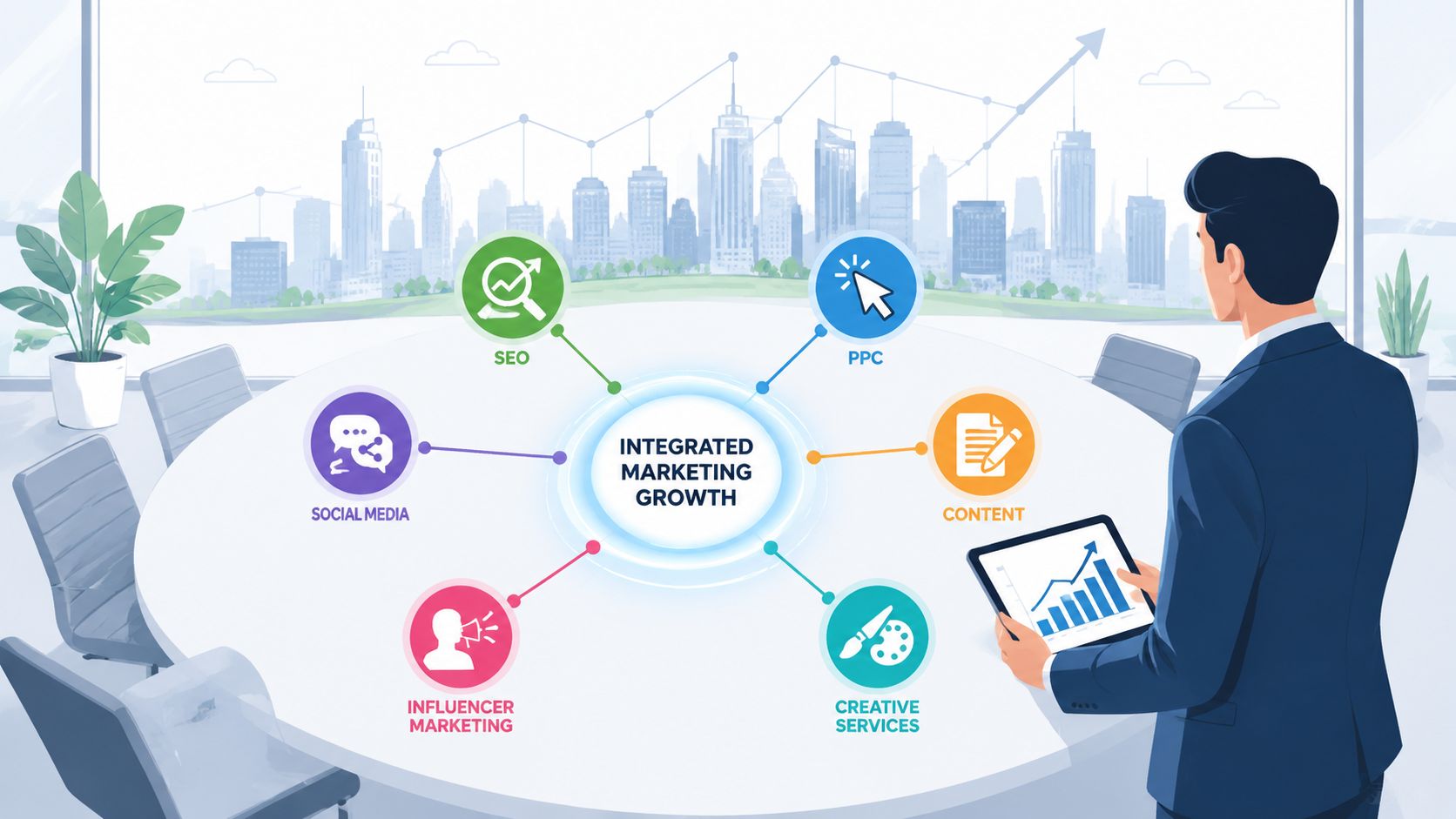
This is also why integration matters more than channel count. Content should feed email. Webinars should become short-form video and sales follow-up assets. LinkedIn visibility should make outreach easier. Analytics should tell you which audience segments, offers, and motions deserve more investment. When those parts connect, your marketing starts behaving like a revenue system instead of a set of disconnected campaigns.
For SMB marketing leaders, the practical challenge isn't knowing that these tactics exist. It's building the operating model behind them. That includes message clarity, asset production, campaign execution, reporting, and enough specialist support to keep the machine moving without burning out the internal team.
That's where a strategic partner becomes useful. ReachLabs.ai combines specialist execution with data-driven planning, which is exactly what most growth-stage teams need when they want to move from ideas to results. Instead of hiring a full bench across content, LinkedIn outreach, analytics, creative, and campaign management, you can plug into a team built to execute integrated B2B programs. Leadership doesn't just see more activity. They see cleaner messaging, sharper targeting, better follow-up, and results they can believe.
If you want help turning these B2B marketing strategies into a focused growth plan, ReachLabs.ai can help you prioritize the right channels, build the assets, and run coordinated campaigns that support pipeline, not just visibility.