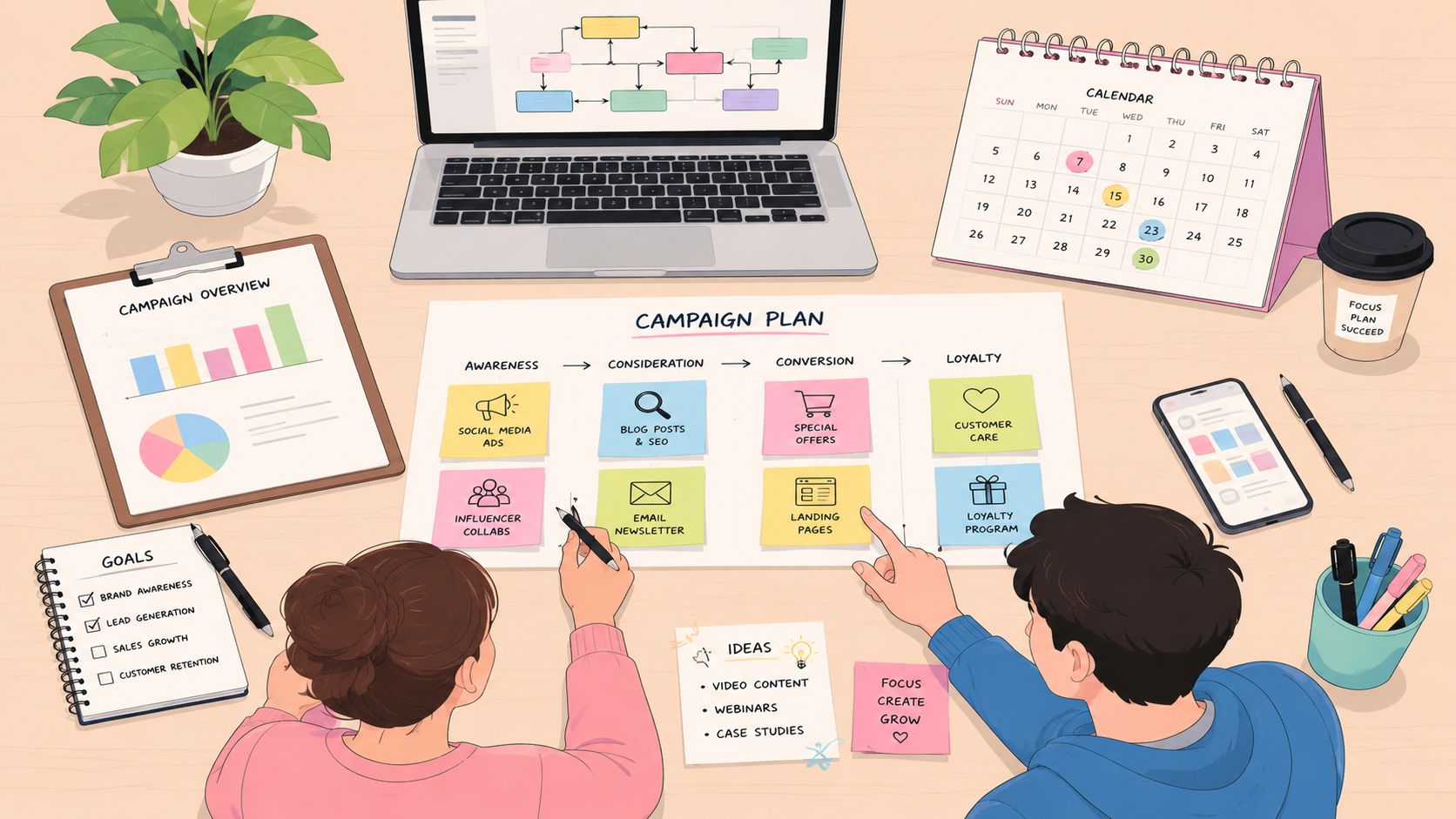
The market you're planning against isn't standing still. In 2020, the global digital advertising and marketing market was valued at about $350 billion, and projections put it at $786.2 billion by 2026. At the same time, 72% of companies allocate the majority of their marketing budgets to digital channels, according to G2's marketing statistics roundup. That combination changes the job of marketing campaign planning.
A campaign plan used to be a fixed document. Pick channels, approve creative, launch, and review later. That approach breaks down when budgets are concentrated in digital environments that shift daily. Audience behavior changes faster. Costs move. Intent appears in bursts. Creative fatigue shows up sooner than expected.
The campaigns that hold up now are built with structure at the front and flexibility after launch. They start with disciplined planning, but they don't stop there. They use clear objectives, dynamic audience logic, channel-specific messaging, realistic execution plans, and a measurement system that lets teams adjust while the campaign is still live.
Your Roadmap to Flawless Marketing Campaign Planning
Marketing campaign planning has become a higher-stakes discipline because the money, channels, and expectations have all expanded at once. When nearly every business is competing for attention in digital spaces, vague planning gets expensive fast. Teams don't usually fail because they lacked ideas. They fail because the plan didn't connect audience insight, budget decisions, messaging, and measurement into one operating system.
I've seen the same pattern repeatedly with new clients. They often arrive with a strong offer and a reasonable budget, but the campaign setup is fragmented. Goals are broad. Channel choices are inherited from past habits. Reporting focuses on surface activity instead of business outcomes. That's where waste starts.
Some smaller teams first need a practical grounding in channel basics before they tighten their campaign architecture. If that's where you are, this overview of digital marketing strategies for small business is a useful companion read because it helps frame channel choices before you build a full campaign plan.
What strong planning actually does
A solid plan does more than organize tasks. It forces decisions that prevent common breakdowns later:
- It defines success early: Everyone knows what outcome matters and what signal will prove progress.
- It narrows the audience: Broad targeting feels safe, but it usually weakens creative and burns budget.
- It sets channel roles: One channel can create awareness, another can capture demand, and another can nurture leads.
- It creates a response loop: Teams can act on incoming performance data instead of waiting for a postmortem.
Campaign planning works when it reduces ambiguity. If the team still has to guess what matters after launch, the planning wasn't finished.
The most useful way to think about modern marketing campaign planning is this. Build the campaign in two layers. The first layer is fixed. Objectives, core audience logic, budget guardrails, message hierarchy, and KPI definitions. The second layer is adaptive. Trigger conditions, testing cadence, channel reallocation rules, and optimization checkpoints.
That's the difference between a campaign calendar and a campaign system. One documents activity. The other helps a team make better decisions under pressure.
Define Your Objectives and Understand Your Audience
A campaign can't outperform a fuzzy objective. If the goal is “get more visibility,” every metric will look half-right and nobody will agree on what to fix. Strong planning starts by forcing precision.
Start with SMART goals
SMART goals still matter because they remove room for interpretation. The challenge isn't knowing the acronym. It's using it effectively.
A good objective is specific enough to guide budget and creative decisions. It's measurable enough to track in real time. It's achievable enough that the team won't panic and overcorrect after a few slow days. It's relevant to a business outcome, and it has a deadline that creates accountability.

When ReachLabs.ai starts planning, we usually pressure-test objectives with three questions:
- What business result is this campaign supposed to influence
- What user action signals that result is moving
- What would make us change course before the campaign ends
If a client can answer those clearly, the rest of the plan gets easier. If they can't, the campaign usually drifts.
Move past static personas
Static buyer personas are useful, but they're incomplete. They tell you who the audience is. They don't always tell you when that person is ready to act.
That's where real-time intent signals matter. The strongest campaign plans don't treat segmentation as a one-time exercise done before launch. They update audience priority based on live behavior. Pages viewed, content depth, repeat visits, search behavior, form activity, and response to previous touchpoints all help identify where someone is in the decision process.
Research summarized by Improvado on campaign best practices notes that campaigns targeting high-propensity segments through predictive analytics report 2 to 3 times better ROI, while many planning guides still handle segmentation as a static pre-campaign task. That gap is real in practice. Teams often know their audience profile but ignore signals of purchase readiness.
A static persona says, “This is our ideal customer.”
A dynamic audience model says, “This person is showing signs they may act now.”
For a practical process to sharpen that work, use this guide on how to identify your target audience.
Build audience understanding from two angles
The most dependable planning process combines foundational audience insight with live behavioral triggers.
- Foundational insight: Demographics, firmographics, psychographics, pain points, objections, and buying context.
- Behavioral signals: Actions that indicate rising interest, active comparison, or readiness to convert.
- Access realities: Device type, bandwidth constraints, language preferences, and trust dynamics in the communities you want to reach.
That last point gets ignored too often. Some campaigns are built for fully connected audiences with stable access and standard digital behavior. Others need a mobile-first, low-bandwidth approach and community-sensitive distribution. The wrong execution model can make a campaign look weak when the offer itself isn't the problem.
Practical rule: Don't define the audience only by who they are. Define them by what they're doing, how they access information, and what would make them trust the message.
Turn audience insight into targeting rules
Once the objective and audience are clear, turn them into decision rules your team can use:
| Planning area | Weak version | Strong version |
|---|---|---|
| Goal | Increase awareness | Generate qualified demand tied to a defined action |
| Persona | SMB owner, age range, industry | SMB owner showing active research or repeat engagement |
| Messaging | General value proposition | Specific pain point plus stage-appropriate proof |
| Timing | Launch on set date | Launch and trigger follow-up based on behavior |
That shift is where better campaign planning starts. Not with more data, but with better use of the data you already have.
Develop Your Channel Strategy and Core Messaging
Choosing channels is usually where teams overcomplicate the plan. They feel pressure to be present everywhere, so they spread budget and attention too thin. Good channel strategy is narrower than most clients expect.

Assign each channel a job
Don't start with platform popularity. Start with campaign intent. Every channel should earn its place by doing a specific job in the buyer journey.
Here's the framework I use with clients:
- Demand capture channels: Search, retargeting, direct response landing pages. Use these when buyers already know the problem and are looking for solutions.
- Demand creation channels: Paid social, influencer partnerships, video, thought leadership content. Use these when the market needs education or persuasion.
- Nurture channels: Email, remarketing sequences, webinar follow-ups, CRM workflows. Use these when the sales cycle needs more touches.
- Trust-building channels: Case-led content, founder-led social, PR, community partnerships, sales enablement assets. Use these when credibility is the bottleneck.
The mistake isn't using multiple channels. The mistake is expecting all of them to do the same thing.
Match message to channel context
A core message should stay consistent, but the expression of that message has to change based on where the audience encounters it. Search copy needs clarity and intent match. Paid social needs pattern interruption and fast relevance. Email needs continuity. Landing pages need focus and friction removal.
That's why I push teams to write a messaging framework before they brief creative. Start with:
The audience tension
What problem, frustration, or desire is active right now?The value promise
What specific outcome or relief does your offer provide?The proof
What makes the claim believable?The action
What should the audience do next?
If your team needs a cleaner way to document that, this brand messaging framework is a useful starting point.
The best campaign messaging doesn't try to say everything. It says the right thing for the right stage.
Write a brief that creative teams can actually use
Most bad campaign briefs are either too vague or too bloated. “Make it compelling” isn't direction. Neither is a document packed with background that never identifies the one idea that matters.
A usable creative brief should include:
- Objective and KPI: What outcome matters most
- Audience definition: Who this asset is for, including stage and intent
- Single-minded message: The one thing the audience should remember
- Support points: Proof, differentiators, or objections to address
- Channel context: Placement, format limits, and expected user mindset
- CTA: The next action the creative should drive
This walkthrough is worth sharing with anyone building cross-channel assets:
What works and what usually fails
A lot of channel plans look balanced on paper but underperform because the creative and channel logic never align. I'd rather see a focused plan with clear roles than a broad mix with generic messaging.
| Approach | What happens in practice |
|---|---|
| Broad channel spread with one generic message | Teams collect activity but struggle to explain outcomes |
| Narrow channel mix with role-based messaging | Creative is more relevant and optimization is easier |
| Channel choice based on habit | Budget follows history, not current opportunity |
| Channel choice based on audience behavior and intent | Media supports the actual buying journey |
When channel strategy and messaging are developed together, execution gets simpler. Media knows what it's trying to accomplish. Creative knows what to emphasize. Leadership gets a plan that can be evaluated without guesswork.
Map Your Budget and Timeline for Execution
Campaign execution usually breaks long before launch. The pattern is familiar. Budget lives in one spreadsheet, timing lives in another, and neither reflects what the team learns once live intent and channel performance start shifting.
A usable campaign plan treats budget and timeline as operating tools, not approval documents. Teams need clear allocations, decision rules, owners, and scheduled points where they can reassign spend or adjust production based on real market response.
Build a budget people can actually run
Start with allocation logic, not a top-line number. If spend is approved as one pooled total, teams lose visibility fast. Creative overruns eat into media, testing gets cut to protect deadlines, and nobody notices the trade-off until performance slips.
Use a structure like this:
| Category | Allocation (%) | Example Costs |
|---|---|---|
| Paid media | 40% | Search ads, paid social, retargeting spend |
| Creative production | 20% | Design, copywriting, video edits, landing page assets |
| Technology and tools | 15% | Analytics platforms, reporting tools, automation software |
| Team and operations | 15% | Strategy time, project management, coordination |
| Testing reserve | 10% | New creative variants, audience experiments, contingency |
The percentages are a planning model, not a universal benchmark. A lead generation campaign with high media velocity may need more reserved for testing and landing page iteration. A product launch with heavy asset requirements may put more into production upfront.
Separate fixed costs from variable costs early. Strategy, tracking setup, and core production usually stay fixed once approved. Media, audience testing, offer variants, and some channel-specific creative should stay adjustable, especially if intent signals start pointing to a segment you did not prioritize in the original plan.

One rule I use with clients. Protect a real optimization reserve. If every dollar is committed before launch, the team cannot respond when search terms shift, a paid social audience breaks out, or a landing page variant starts pulling stronger conversion quality.
Build the timeline around real dependencies
Good timelines account for what has to be true before the next task starts. Approval chains, tracking validation, CRM routing, legal review, page QA, and audience syncing cause more missed launch windows than media setup itself.
A practical timeline usually includes these phases:
- Planning: Finalize audience, goals, offer, channel roles, and measurement setup.
- Resource allocation: Assign owners, lock production scope, approve budget ranges.
- Implementation: Produce assets, build flows, configure tracking, QA every path.
- Monitoring: Watch live performance, validate data quality, flag early issues.
- Review and adjust: Reallocate effort, revise creative, improve underperforming segments.
The mistake is treating those phases as one-way handoffs. Strong campaign teams plan for revision loops. If paid search shows stronger commercial intent than expected, budget may need to move within days, not at the end of the month. If engagement is healthy but lead quality drops, the timeline should already include room to adjust forms, offers, or routing logic.
Use checkpoints that support change
Static campaign calendars work for procurement. They do not work well for optimization.
Set review points before launch, within the first few days live, and at regular intervals after that. Each checkpoint should answer a specific question: Is tracking clean? Are we seeing the right audience? Which channel is earning more investment? Which assets need revision? Teams that answer those questions on a schedule make better budget decisions than teams waiting for a post-campaign report.
For clients that want a clearer measurement framework, this guide on how to measure marketing campaign success helps define the reporting structure before spend starts.
ReachLabs.ai's campaign tracking setup supports this kind of operating rhythm with dashboards filtered by campaign name, source, or medium. Used alongside your media platforms, CRM, and analytics stack, it gives the team a shared view of where execution is on plan and where budget or timing should change.
Set Up KPIs and a System for Continuous Optimization
Campaigns rarely fail because a team lacked activity. They fail because nobody defined what success looked like, how it would be measured, or what would trigger a change once live.
That is the difference between static planning and operational planning. A static plan names goals before launch. A stronger plan sets KPI rules, review thresholds, and optimization paths that respond to real buyer intent as it shows up across channels.
Pick fewer KPIs and make them count
Too many dashboards bury the signal under reporting clutter. If paid social, search, email, and the CRM all surface different success metrics, teams start optimizing for whatever looks best instead of what drives revenue.

The fix is simple. Choose one or two primary KPIs that map directly to the campaign objective, then add a small set of supporting metrics that explain movement.
A practical structure looks like this:
| KPI tier | Purpose | Examples |
|---|---|---|
| Primary | Confirms the campaign is producing the intended outcome | Qualified leads, booked calls, purchases |
| Secondary | Explains movement in the primary KPI | Landing page conversion, cost per qualified lead, form completion rate |
| Diagnostic | Helps identify where friction exists | CTR, bounce behavior, ad engagement, audience drop-off |
This is also where trade-offs matter. A demand capture campaign can tolerate lower click-through rates if lead quality is strong. A top-of-funnel campaign may produce cheaper conversions that do not turn into pipeline. If the primary KPI is wrong, optimization gets pointed at the wrong problem.
Set decision rules before launch
Good KPI planning includes thresholds, not just definitions.
Before a campaign goes live, document what happens if results break in either direction. If branded search traffic converts at a lower cost than expected, budget should be allowed to shift quickly. If lead volume rises but sales acceptance falls, the team should already know whether to tighten targeting, change the offer, or adjust form qualification.
At ReachLabs.ai, we set these rules early because speed matters once live data starts coming in. Real-time intent signals are only useful if the team has permission to act on them.
Test with a clear hypothesis
Testing works when it answers a business question, not when it fills a reporting slide.
Strong teams test variables that can change outcomes in a measurable way. That usually means headlines, offers, audience segments, landing page structure, call-to-action language, and follow-up timing. Minor visual tweaks have their place, but they rarely fix weak message-market fit.
Keep the process disciplined:
- Test one meaningful variable at a time when traffic volume is limited
- Hold attribution settings steady so comparisons stay clean
- Judge results against a baseline, not against guesswork
- Prioritize tests tied to the primary KPI, not vanity metrics
If you need a clearer framework for KPI design, reporting, and attribution, this guide on measuring marketing campaign success lays out the model in more detail.
Build a weekly optimization loop
Optimization should run on a set cadence with clear owners. Weekly reviews work well for most active campaigns. High-spend or fast-moving campaigns may need checks every few days during the first phase.
A useful review loop includes:
Validate data quality
Confirm tracking, attribution, and CRM handoffs are working as expected.Review the primary KPI
Check whether the campaign is producing the outcome the plan was built to drive.Locate friction
Identify whether the issue sits in audience quality, creative response, landing page conversion, or sales follow-up.Make a small number of meaningful changes
Shift budget, pause weak segments, refresh creative, revise the offer path, or tighten routing rules.Record what changed and why
That creates a usable learning loop instead of a series of isolated edits.
The goal is not constant activity. The goal is controlled adaptation.
Teams that operate this way do not wait for a post-campaign report to learn what went wrong. They use live performance and intent signals to improve results while the campaign still has time to produce them.
Frequently Asked Questions About Campaign Planning
How far in advance should a campaign be planned
Long enough to make deliberate decisions, but not so far out that the plan becomes detached from current buyer behavior. The right window is whatever allows proper audience research, asset production, tracking setup, and approval cycles without locking every tactical choice too early.
The more volatile the channel mix, the more useful it is to separate fixed decisions from flexible ones. Offer, audience priority, budget guardrails, and KPI definitions can be decided earlier. Creative variations, trigger-based follow-ups, and budget shifts should stay adjustable.
What's the biggest planning mistake small teams make
They confuse activity planning with campaign planning. A content calendar, ad schedule, or email sequence isn't a campaign strategy by itself.
The biggest mistake is launching with disconnected pieces: a few ads, a landing page, maybe an email blast, but no clear objective, no measurement design, and no decision rules for what happens if early performance is weak. Small teams usually don't need more tactics. They need sharper prioritization.
How many channels should a single campaign use
Use the minimum number required to support the campaign objective well. That number changes by audience, offer, and buying cycle.
A short sales cycle with strong existing demand may need only a capture channel, a retargeting layer, and a conversion page. A more complex offer may need education, nurture, and trust-building channels in addition to demand capture. More channels don't automatically make a campaign stronger. They often make it harder to maintain message quality and measurement discipline.
When should intent signals change the plan
As soon as the signal is reliable enough to justify action. If a segment starts showing stronger engagement depth, repeat visits, or conversion-adjacent behavior, that should influence audience priority, follow-up speed, and sometimes budget allocation.
What matters is setting these conditions before launch. Decide in advance which behaviors count as meaningful intent and what action the team will take when those behaviors appear. Otherwise, the data becomes interesting but not operational.
How do you keep teams aligned once the campaign is live
Alignment comes from shared definitions, not frequent status meetings. Everyone should know the primary KPI, the current hypothesis, the review cadence, and who owns each decision.
A simple live-campaign operating model helps:
- One dashboard: Everyone reviews the same source of truth.
- One attribution approach: The team doesn't debate numbers from different systems.
- One optimization cadence: Reviews happen on schedule, not only when performance dips.
- One owner per workstream: Creative, media, analytics, and follow-up responsibilities stay clear.
What should be documented before launch
At minimum, document the objective, audience logic, channel roles, messaging hierarchy, offer path, KPI definitions, tracking setup, reporting cadence, and optimization rules. If any of those are missing, the team will fill the gap with assumptions.
That's usually where avoidable waste begins. Good marketing campaign planning doesn't eliminate uncertainty. It makes uncertainty manageable by deciding ahead of time how the team will respond.
ReachLabs.ai helps teams turn campaign ideas into operating plans with defined objectives, channel logic, tracking structure, and live optimization workflows. If you need a partner to build a more adaptive planning process, explore ReachLabs.ai.