Let's be honest: for a long time, marketing felt like throwing spaghetti at the wall to see what stuck. A data-driven digital marketing agency is the exact opposite of that. It trades guesswork for cold, hard facts, using analytics to pilot every strategic move.
Think of it like a ship captain. The old way was navigating by the stars and a gut feeling. The new way is using real-time satellite data, weather patterns, and ocean current models. Both might get you there, but only one does it with precision, efficiency, and predictable results. This approach makes sure your marketing budget isn't just spent—it's invested.
What Is a Data-Driven Digital Marketing Agency
At its heart, a data-driven agency runs on a simple but powerful principle: every decision must be backed by evidence. A more traditional agency might lead with a brilliant, flashy creative idea. A data-driven partner takes that same creativity and pressure-tests it with data to make sure it actually connects with the right people and drives them to act.
It's the difference between being an artist and an architect. An artist creates something beautiful based on vision. An architect also creates something beautiful, but only after analyzing soil reports, stress loads, and traffic flow. The final structure isn't just visually appealing; it's engineered to work perfectly in its environment.
This focus on measurable outcomes is why the entire advertising world is shifting. It’s no surprise that businesses now dedicate 45% or more of their total marketing spend to digital channels. This trend is fueling incredible growth, with the digital marketing sector forecast to become a $1.1 trillion industry by 2032. Just looking at ad spend, we're on track to hit nearly $800 billion by 2025. You can dig deeper into these trends and find more insights about the digital agency market on DigitalAgencyNetwork.com.
The Focus on Actionable Insights
The real magic isn't just in gathering data; it’s about turning that raw information into a clear plan of action. A top-tier agency connects all the dots—from your Google Analytics traffic to your Salesforce CRM data—to map out the entire customer journey.
This holistic view allows them to answer the questions that really matter to your bottom line:
- Which marketing channels are actually making us money, and which are just costing us?
- What specific words or offers get our ideal customers to pull out their credit cards?
- How can we get new customers more efficiently and lower our acquisition costs?
By zeroing in on these crucial key performance indicators (KPIs), they tune out the noise. Forget vanity metrics like "likes" or "impressions"; the focus is squarely on what drives revenue.
From Strategy to Execution
This analytical approach is woven into everything they do. Data informs how they slice audiences into hyper-specific segments, how they personalize ad copy, and how they relentlessly A/B test everything from email subject lines to the color of a button on a landing page.
The ultimate aim is to build a self-learning marketing machine. Every campaign produces new data, which fuels new insights, which makes the next campaign even smarter.
Working with a data-driven agency is about building a predictable engine for growth. It’s about turning your marketing from a necessary expense into a powerful, revenue-generating asset where every single dollar is accounted for and optimized for the best possible return.
How Data-Driven Agencies Turn Analytics Into Action
A great data-driven marketing agency doesn't just collect data—it follows a clear, repeatable process to turn numbers on a screen into real business growth. It's a disciplined cycle of discovery, strategy, execution, and refinement that separates intentional, data-informed marketing from just guessing.
This isn’t about just having data; it's about having a system. This framework ensures every marketing dollar is spent with purpose, guided by hard evidence instead of assumptions. The whole process is designed as a self-improving loop where the results of one campaign directly feed into and strengthen the next.
The diagram below breaks down this workflow, showing how the journey flows from raw data to insights, and ultimately, to measurable growth.
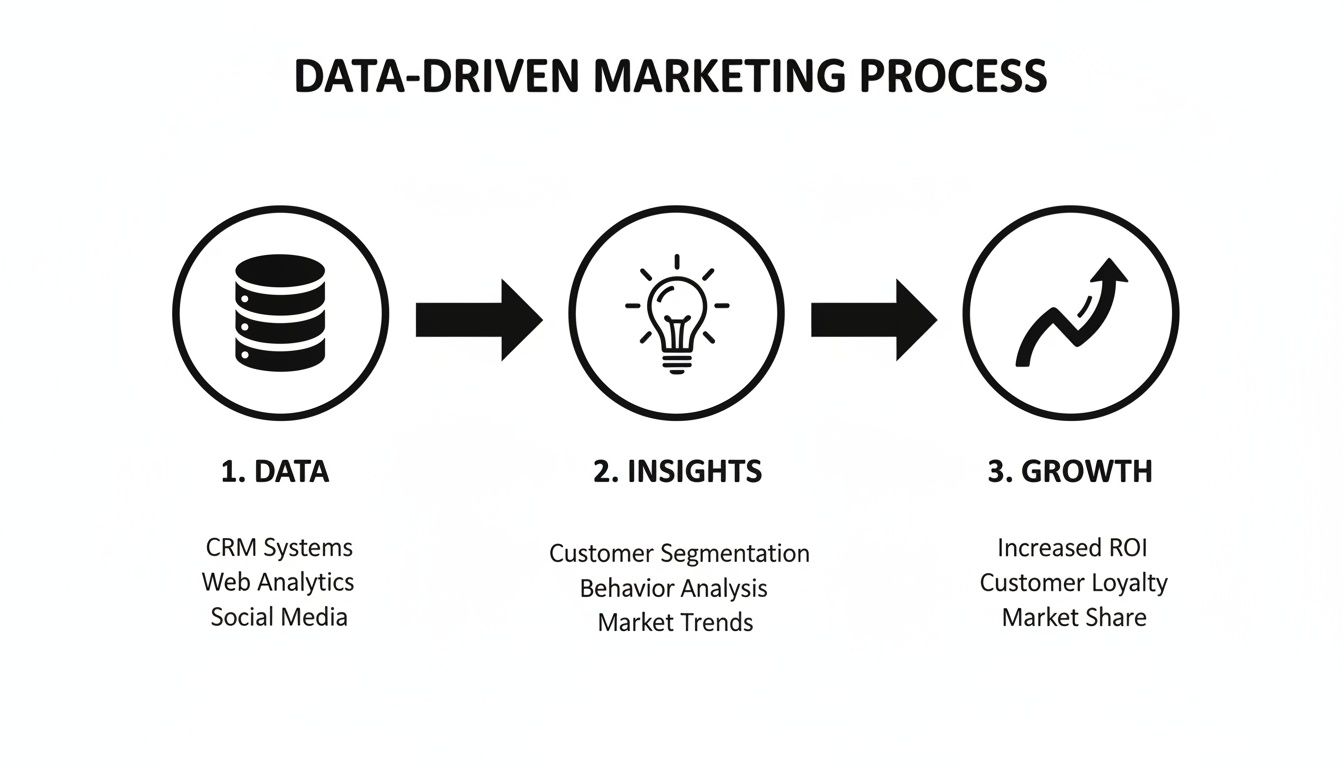
As you can see, it all starts with a solid data foundation. From there, it's about building strategic insights that directly fuel business expansion.
Stage 1: Data Collection And Unification
First things first, you have to gather the raw materials. A skilled agency will pull data from all your disconnected sources—your website analytics, CRM, social media accounts, ad platforms—and bring it all under one roof. Think of it like a chef prepping their ingredients before they start cooking. Without this step, you’re trying to create a meal with half the pantry missing.
Getting this unified view is critical. It’s the only way to see the complete customer journey, from the first ad someone clicked to the final product they purchased. If you don't connect these dots, you’re left with data silos that tell conflicting or incomplete stories, making it impossible to know what’s actually working.
Stage 2: Insight Generation
With all the data in one place, the real detective work begins. Analysts and strategists dive into the numbers, hunting for patterns, trends, and hidden opportunities. They're not just looking at metrics; they're asking tough questions to turn raw data points into actionable intelligence.
- What do our most valuable customers have in common?
- Which marketing channels are actually influencing conversions?
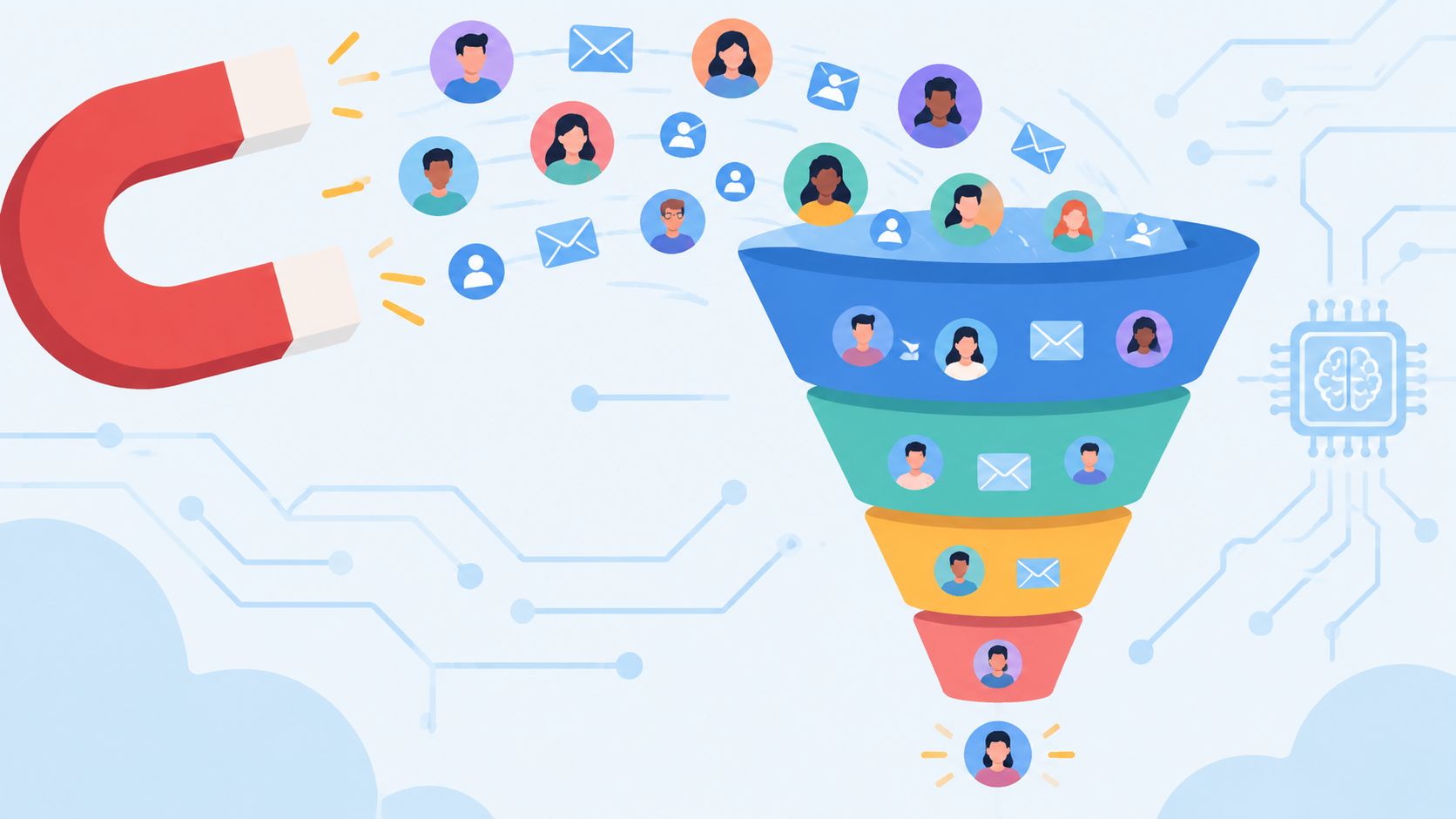
- Where are people dropping off most in our sales funnel?
Answering questions like these provides the "why" behind the "what." It's the difference between knowing sales dipped last month and understanding that they dropped because a competitor's promotion siphoned off a specific customer segment. These are the kinds of insights that become the bedrock of your entire marketing strategy.
Stage 3: Strategy And Activation
This is where insights get put to work. The intelligence gathered in stage two directly shapes the marketing campaigns you create and launch. If the data shows that a certain customer segment responds best to video ads on Instagram, then that’s exactly where the agency will focus its budget and creative energy.
This strategic activation involves a few key moves:
- Audience Segmentation: Going beyond broad demographics to group users by their actual behavior—like purchase history or content they’ve engaged with.
- Personalized Messaging: Crafting ad copy, emails, and landing pages that speak directly to the specific needs and pain points of each segment.
- Channel Optimization: Putting your money where it counts by allocating budget to the platforms that are proven to deliver the highest return for specific audiences.
To truly make this work, agencies build powerful data-driven marketing strategies designed to deliver a measurable return. It’s about ensuring every piece of creative and every dollar spent is aligned with what the data says will work.
Stage 4: Testing And Optimization
Finally, the process comes full circle. A true data-driven agency never assumes its first attempt is the best one. Instead, they’re constantly experimenting, tweaking variables to squeeze out better performance over time.
A core belief in data-driven marketing is that there is always room for improvement. The goal isn't to be perfect on day one, but to make relentless progress backed by evidence.
This means running A/B tests on everything from headlines and call-to-action buttons to ad visuals and audience targets. By carefully measuring the results, the agency learns what resonates most and refines its approach. This cycle of testing, learning, and optimizing is what ensures campaigns become more effective and efficient over time, maximizing your ROI and building a sustainable engine for growth.
Key Metrics That Actually Measure Business Growth
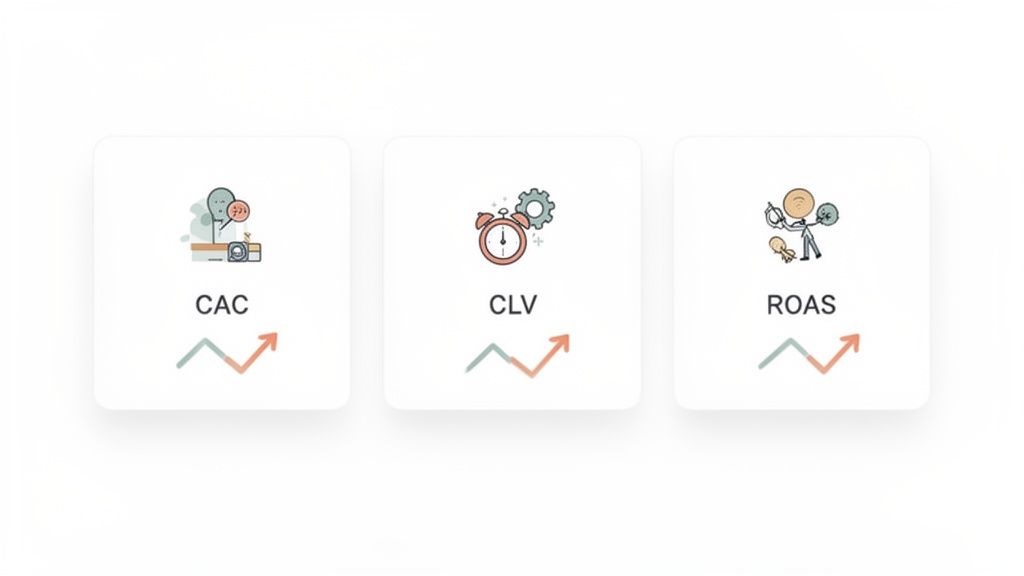
To really grasp the value a data-driven agency brings, we need to look past the flashy, surface-level numbers. Sure, a mountain of impressions or a viral social media post feels great, but those "vanity metrics" don't pay the bills. The real story of success is told through Key Performance Indicators (KPIs) that are directly tied to your bottom line.
These are the numbers that show the true health of your marketing engine and its impact on real, sustainable growth. A top-tier agency doesn't just report these figures; they build their entire strategy around moving them up and to the right. This is how marketing stops being a cost center and becomes a predictable revenue machine.
Moving Beyond Vanity Metrics
Vanity metrics are the candy of the marketing world—they look good and are easy to count, but they offer little substance. They can easily create a false sense of security, making it seem like a campaign is a home run when it’s actually failing to generate any real value. A good data-driven partner helps you see the difference between what looks good and what is good for business.
Think about it this way:
- Vanity Metric: A blog post gets 10,000 views. That's nice, but who are those viewers? Are they potential customers or just random internet browsers?
- Actionable KPI: The same blog post generates 50 qualified leads who download a resource, and 5 of them eventually become paying customers.
That second scenario gives you a clear, measurable business outcome. This is the level of thinking a data-driven agency operates on, ensuring every ad, email, and piece of content has a purpose tied to growth.
Distinguishing between these two types of metrics is crucial. It's the difference between guessing and knowing.
Vanity Metrics vs Actionable KPIs
| Metric Category | Vanity Metric (Often Misleading) | Actionable KPI (Business Impact) |
|---|---|---|
| Website Traffic | Total Pageviews | Conversion Rate, Leads Generated, Cost Per Acquisition |
| Social Media | Follower Count, Likes | Engagement Rate, Click-Through Rate, Social-Driven Leads |
| Email Marketing | Total Subscribers | Open Rate, Click-Through Rate, Conversion Rate From Email |
| Content Marketing | Article Shares, Time on Page | Leads From Content, Assisted Conversions, MQLs Generated |
This table isn't just about picking the "right" numbers; it's about adopting a mindset focused on outcomes, not just activity.
Customer Acquisition Cost (CAC)
One of the most critical KPIs is Customer Acquisition Cost (CAC). Put simply, this is how much you spend on sales and marketing to land one new customer. Getting a handle on this number is the first step toward building a profitable, scalable marketing machine.
A low CAC sounds great, but the number is meaningless on its own. For instance, a $500 CAC might be a disaster for a business selling a $50 monthly subscription. But for a company selling $10,000 enterprise software, it's a fantastic deal. The real goal isn't just to lower CAC, but to optimize it based on the value each customer brings in.
Customer Lifetime Value (CLV)
And that brings us to the other side of the profitability coin: Customer Lifetime Value (CLV). This metric is a prediction of the total profit your company can expect to make from a single customer over the entire course of your relationship.
Understanding CLV is a game-changer. It unlocks the ability to make much smarter, more aggressive investments in acquiring new customers.
If you know the average customer will spend $5,000 with you over three years, you can confidently spend more to acquire them than a competitor who only looks at the first sale. This long-term view is what allows a business to strategically outspend and outgrow its competition.
A deep understanding of CLV can justify a higher initial CAC for certain high-value customer segments, ultimately leading to much greater profitability down the road.
Return On Ad Spend (ROAS)
While CAC and CLV give you that big-picture view of profitability, Return on Ad Spend (ROAS) zooms in on the effectiveness of your paid ad campaigns. This metric shows you the gross revenue you generate for every dollar you put into advertising. A ROAS of 4:1, for example, means you're making $4 for every $1 spent.
A skilled data-driven agency lives and breathes ROAS. They use it to constantly fine-tune campaigns, shifting budget from what’s not working to what is. They can pinpoint the exact platforms, audiences, and ad creative delivering the best returns. If you want to get more familiar with this metric, there are great guides on how to calculate ROAS that can walk you through it.
Ultimately, all these numbers feed into the most important KPI of all: Marketing ROI. If you're ready for a deeper look, check out our guide on how to calculate marketing ROI to see how all these pieces fit together.
How to Choose the Right Agency Partner
Picking a data-driven digital marketing agency is a huge decision, one that can genuinely shape your company's growth trajectory. Get it right, and you’ve found an extension of your own team—a partner who turns business goals into real, measurable marketing wins. Get it wrong, and you're looking at a mountain of wasted budget, missed chances, and a whole lot of frustration.
This process shouldn't feel like you're just crossing your fingers and hoping for the best. It’s all about asking the tough questions and looking past the slick sales pitch. You need to get under the hood and really understand their process, their tech, and most importantly, their history of delivering for businesses like yours.
Assess Their Data and Analytics Capabilities
A truly data-driven agency isn't just throwing a buzzword around; it's the core of their entire operation. Their ability to pull in data, make sense of it, and then act on it is what separates the pros from the pretenders who just report on vanity metrics. So, your first job is to dig into their tech stack and see how they approach analytics.
Don’t be shy about getting into the weeds with your questions:
- What analytics platforms are you experts in? You’re looking for more than just Google Analytics. Do they have hands-on experience with advanced tools for heat mapping, customer data platforms (CDPs), or business intelligence (BI) software like Tableau?
- How do you handle data integration? Ask them how they connect the dots between your CRM, your ad platforms, and your website data to build a single, unified picture of your customer's journey.
- Can you show me a sample of your reporting dashboards? A great partner gives you a clear, easy-to-read dashboard that zeroes in on the KPIs that actually matter to your bottom line, not just fluff.
Their answers will quickly tell you if they truly speak the language of data or if they’re just faking it. They should be able to clearly explain how their tools and know-how turn a spreadsheet of raw numbers into a strategic game plan.
Evaluate Their Strategic Thinking
Running ads, posting to social media, and writing blog posts—that’s just execution. A true growth partner brings high-level business strategy to the table. They don’t just take your orders; they challenge your assumptions and build strategies based on solid data.
The best way to gauge this is to look at their past work. Ask them to walk you through a case study from your industry. Listen carefully to how they identified the client’s core problem, what data they used to form a hypothesis, and how they proved their solution worked.
The real differentiator is the "why" behind their work. A tactical agency tells you what they did. A strategic agency explains why they did it, backing up every single decision with data.
This is the whole ballgame. You’re not just hiring someone to check off tasks on a list; you're investing in a team of thinkers who can help you solve complex problems and find new ways to grow.
A Checklist for Choosing Your Agency
As you start talking to potential agencies, use this checklist to make sure you’re covering all your bases. If you’re getting a confident "yes" on these points, you’re likely on the right path. For a deeper dive, check out our complete guide on how to choose a marketing agency.
- Industry Experience: Have they actually gotten results for other businesses in your niche? They need to get the unique challenges and customer behaviors of your market.
- Data-Informed Case Studies: Can they show you a portfolio packed with clear examples of how data analysis directly led to a specific strategy and measurable outcomes?
- Transparent Reporting: Are you going to get direct access to real-time dashboards showing exactly how you’re performing against your most important KPIs?
- Collaborative Communication Style: Does it feel like they want to work with you as a partner, or just for you as a vendor?
- Focus on Business Outcomes: Is the conversation about ROI, Customer Acquisition Cost (CAC), and Customer Lifetime Value (CLV), or are they stuck talking about impressions and clicks?
Ultimately, the argument for hiring a top-tier data-driven agency is all about boosting ROI and working smarter, not harder. Industry analysis shows that agencies providing these integrated digital services are seeing 15–20% year-over-year growth. By constantly fine-tuning ad bids, creative, and audience targeting, these agencies help companies slash wasted ad spend while dramatically improving conversion rates. They’re not just another expense; they’re true revenue partners.
The Power of a Specialist Collective
Let's be honest: the old-school agency model is showing its age. A team of generalists trying to be experts at everything just doesn't cut it anymore. While a jack-of-all-trades might cover the bases, they rarely hit a home run in any single area of digital marketing. The best data-driven agencies today know that true expertise is deep, not wide.
This is where the specialist collective model comes in, and it's a game-changer.
Think about building a Formula 1 car. You wouldn't ask one mechanic to design the engine, perfect the aerodynamics, tune the suspension, and handle the complex electronics. You’d bring in the best engine builder in the world, an aerodynamics genius, a suspension guru, and a master electrician. Each person is a master of their craft, and together, they create a machine that’s built to win.
That’s exactly how a specialist collective approaches your marketing.

This structure doesn't rely on in-house generalists. Instead, it assembles a hand-picked team of top-tier, independent experts for your specific needs. You get a dedicated pro for SEO, another for paid media, and another for content—all working in perfect sync.
Integrating Deep Expertise Under One Strategy
The real magic isn't just about having A-list talent on your team; it's about how they work together. A central, data-driven strategy acts as the glue, making sure every specialist's efforts are perfectly aligned with your business goals.
The data scientist isn't just crunching numbers in a silo. They're feeding real-time insights to the paid media specialist to fine-tune bidding strategies, while also informing the content creator about what topics will actually connect with your audience.
This integrated approach shatters the departmental barriers that slow down traditional agencies. The result is a marketing strategy where every single piece makes the others stronger.
- Technical SEO Expert: They're not just checking boxes. They're implementing advanced schema and site speed optimizations based on the very latest algorithm shifts.
- Paid Media Specialist: They use predictive analytics to get the absolute most out of every dollar, maximizing your Return on Ad Spend (ROAS).
- Creative Content Strategist: They build content and creative assets that are proven to resonate with your most valuable customers.
- Data Scientist: They stitch together data from all channels to map the entire customer journey and pinpoint hidden growth opportunities.
This synergy turns your marketing from a list of disconnected tactics into a powerful, interconnected growth engine. It’s a structure built for results, not job titles.
Beyond Campaigns to Comprehensive Business Solutions
Because a collective brings such high-level, diverse talent to the table, its impact goes far beyond running a few marketing campaigns. It can help solve bigger business challenges by using deep market insights to not only drive revenue but also make operations more efficient.
For instance, a standard agency might run a lead generation campaign for you. A specialist collective can do that, plus analyze your entire sales funnel, identify where prospects are dropping off, and work directly with your team to improve your lead-to-close ratio.
The goal shifts from simply delivering marketing services to delivering business outcomes. This model positions the agency as a true strategic partner, invested in your overall growth, not just campaign metrics.
This structure is also incredibly flexible. As your business evolves, the collective can bring in different specialists without the cost and hassle of a full-time hire. You always have the exact expertise you need, right when you need it. Figuring out how to assemble an agile team like this is a massive advantage, which is why understanding the ideal digital marketing team structure is so important for any business looking to scale.
Ultimately, partnering with a specialist collective means you stop making compromises. You get the focused power of world-class experts in every critical area, all guided by a single, data-powered strategy. It's the modern way to ensure your marketing investment delivers innovative, effective, and cohesive solutions that drive real, measurable growth.
Still Have Questions About Data-Driven Agencies?
Even after seeing the process and the metrics, it's completely normal for business owners to wonder how a data-driven agency really fits into their world. It's a big shift from the old way of doing marketing, so of course, you want to get all the details straight before you jump in.
Let’s walk through some of the most common questions we hear from companies thinking about making this move. Getting these answers can help you connect the dots and feel confident about taking the next step toward growth you can actually measure.
How Is a Data-Driven Agency Different From a Traditional One?
The real difference comes down to two things: accountability and process.
A traditional agency often starts with a big creative idea. They focus on things like brand awareness and getting people talking, measuring success with broad metrics like website traffic or social media followers. A lot of times, the campaign is judged on how clever it is or how much buzz it creates.
A data-driven agency, on the other hand, builds everything on a foundation of analytics. They start by digging into customer behavior data, use that information to slice their audience into very specific groups, and then test every single part of a campaign to squeeze out the best possible performance.
The core distinction is that every decision is backed by data, and success is defined by real business results. The conversation changes from, "Did people like the ad?" to "Did the ad bring in profitable customers?"
This means their reports are all about the numbers that actually affect your bottom line, like:
- Return on Investment (ROI): The clearest sign of profitability.
- Customer Acquisition Cost (CAC): Exactly what it costs you to land a new customer.
- Customer Lifetime Value (CLV): The total amount of money a customer is expected to spend with you over time.
At the end of the day, a data-driven partner is a growth partner who is held accountable, not just a creative shop you hire.
What Kind of Data Does a Data-Driven Agency Use?
These agencies pull from all sorts of data to get a 360-degree view of your market and customers. Think of it like building a puzzle—they bring together pieces from different places to see the full picture, which then informs every strategic decision.
The data usually fits into three buckets:
- First-Party Data: This is your gold mine—the information you own. It includes website analytics from tools like Google Analytics, customer details from your CRM, and your past sales history. It gives you a direct line of sight into how your actual customers behave.
- Second-Party Data: This is simply another company's first-party data that you get straight from them through a partnership. For example, you might team up with a non-competing business to share audience information for a joint marketing effort.
- Third-Party Data: This is data collected from many different sources and then packaged up for sale. It helps you see the bigger picture with broad demographic, firmographic, and behavioral information.
The magic happens when an agency can weave all these data sources together. By connecting the dots between who’s visiting your website and who’s actually buying from you in your CRM, they can map out the entire customer journey. This lets them figure out which marketing touchpoints work best and create personalized messages that really click with different groups of people.
Are These Agencies Only for Large Companies?
Not at all. This is probably one of the biggest myths out there. While big corporations definitely get a ton of value from a data-driven approach, small and medium-sized businesses (SMBs) often see an even bigger bang for their buck.
For an SMB, every single marketing dollar has to pull its weight. A data-driven approach is the best way to make sure you're not just throwing money at a wall and hoping something sticks. It helps you compete with the big guys by being smarter, not just louder.
For a smaller business, this translates to:
- Less Wasted Ad Spend: Your budget goes directly to campaigns that are proven to work.
- More Efficient Teams: Your people can stop guessing and focus on the high-impact activities data has pointed to.
- A Level Playing Field: Smart targeting means you can get in front of your ideal customers without needing a Super Bowl-sized budget.
It’s all about making your resources work harder, which is a massive advantage for any business that wants to grow sustainably.
What Should I Prepare Before Contacting an Agency?
A little bit of prep work can make your first conversation with an agency incredibly productive. When you come to the table with the right information, they can skip the generic sales pitch and get right to thinking about a real strategy for your business.
First, get crystal clear on your business goals. Don't just say, "We need more website traffic." Instead, define what you want that traffic to do. A much better goal is, "We need to generate 50 qualified sales leads per month through our website."
Next, have a handle on your basic business numbers. You should know your average customer value, what it currently costs you to get a new customer (if you know it), and what a new lead is worth to your company.
Having clear goals and key numbers ready turns that first call from a pitch into a strategy session. It allows the agency to do some initial digging and come back with a plan based on your reality, not just a bunch of assumptions.
Finally, be prepared to grant temporary, view-only access to your analytics platforms, like your Google Analytics or ad accounts. This lets the agency peek under the hood to see what's actually going on, so they can give you a proposal that's grounded in real data.
At ReachLabs.ai, we believe in bringing together a collective of specialists who live and breathe data. We build a world-class team just for you, making sure every strategy is laser-focused on delivering measurable growth for your business. Let us show you how we can turn your marketing from a cost center into a predictable revenue engine. Explore our services and see how we can help you grow.