
Social media reputation management is all about actively keeping an eye on, guiding, and ultimately protecting how people see your brand on social networks. It’s a mix of listening to what people are saying, jumping into conversations with your audience, and carefully telling your brand’s story. This isn't just about damage control; it's a critical business function that directly builds trust and drives sales.
Why Your Social Media Reputation Matters More Than Ever
Picture your brand standing in the middle of a massive, bustling digital town square. Every social media platform, from Facebook to LinkedIn, is a different corner where people gather to chat, rave, and sometimes, complain. In this world, your reputation isn't some static monument you build and then walk away from. It's a living, breathing conversation that’s happening 24/7.
Social media reputation management is the art of joining that conversation with intent and genuine care.
This goes way beyond old-school public relations. It's a core piece of your business strategy because what people think of you online has a very real, very measurable impact on your bottom line. A single complaint that goes viral can shatter consumer trust in a matter of hours, while a steady stream of positive, real interactions can build an army of loyal fans.
The Real-World Impact of Digital Conversations
In today's market, the line between online chatter and real-world consequences has completely disappeared. Every comment, review, and share feeds into a collective story about your brand that directly influences business results.
- Customer Trust and Loyalty: When you consistently and positively engage with your community, it shows you actually care. That builds powerful relationships and turns customers into lifelong fans.
- Sales and Revenue: Think about this: over 75% of consumers check out online reviews before they even think about buying something. This creates a direct line from your social reputation to your sales figures. You can find more data on this in HiFiveStar's latest report.
- Investor and Partner Confidence: A strong, positive online presence is a major green flag for potential investors and partners. It tells them you have a healthy, customer-focused brand that’s worth getting behind.
A proactive strategy is no longer a "nice-to-have." What happens on social media rarely stays there. It shapes your brand’s story, influences what people see in search results, and ultimately defines how the world views your business. Ignoring the conversation isn't really an option—it’s just letting everyone else define your brand for you.
To build a solid foundation, every social media reputation strategy needs to be built on four key pillars. Each one addresses a different, but equally important, part of managing your brand's public perception.
The Four Pillars of Social Media Reputation Management
| Pillar | Core Goal | Key Actions |
|---|---|---|
| Monitoring & Listening | To understand the conversation | – Track brand mentions, keywords, and sentiment. – Identify trends and potential issues early. |
| Engagement & Interaction | To build community and trust | – Respond to comments and DMs promptly. – Actively participate in relevant conversations. |
| Content & Storytelling | To shape your brand narrative | – Create and share valuable, authentic content. – Highlight positive customer stories and reviews. |
| Crisis Management | To protect your reputation | – Develop a plan for handling negative feedback. – Address issues transparently and effectively. |
By consistently working on these four areas, you create a comprehensive system that not only protects your brand from harm but also actively builds a positive and resilient reputation.
From Reactive Defense to Proactive Storytelling
Too many businesses only think about their reputation when a crisis is already blowing up. They’re left scrambling to put out fires, usually long after the damage is done. A truly modern approach flips that script and focuses on proactively building a positive narrative from day one. It’s all about creating a deep reservoir of goodwill through consistent, valuable content and genuine human engagement.
This means you’re not just sitting back and waiting to react to negative comments. You're actively encouraging and amplifying the good stuff. By showcasing user-generated content, sharing glowing testimonials, and transparently addressing concerns as they arise, you build a reputation that can weather a storm. This foundation makes your brand far less vulnerable to the occasional negative comment and more capable of turning a potential crisis into a chance to show just how much you care about your customers.
The goal is simple: own your story before someone else tries to write it for you.
Building Your Reputation Management Framework
A strong social media online reputation management strategy doesn't just happen. It's built, piece by piece, on a framework of three core pillars that have to work together: Proactive Monitoring, Strategic Engagement, and Positive Narrative Building.
Think of it like building a house. You need a solid foundation, sturdy walls, and a protective roof to stand strong against any storm. This approach shifts your mindset from simply putting out fires to actively cultivating a brand that people trust and want to talk about.
This isn't about waiting for a crisis. It's about listening to the conversation, participating in a meaningful way, and steering the narrative in a positive direction. Each pillar has its own job, but they all support each other to create a resilient and balanced online presence.
The infographic below really drives home the impact a well-managed reputation can have on the things that matter most—from building trust to making your brand the preferred choice.
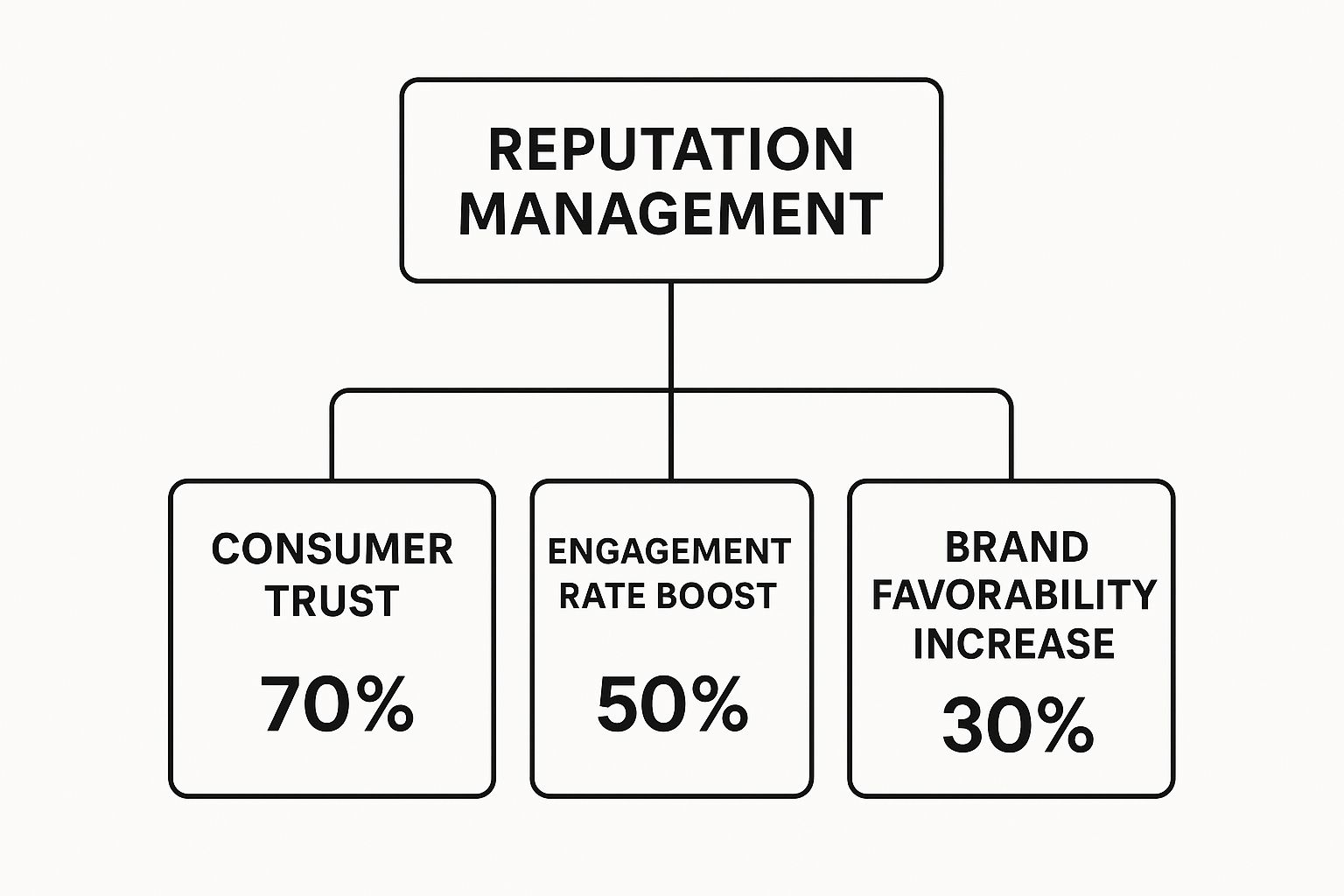
As you can see, the data speaks for itself. The biggest gain is in consumer trust, which is the fuel for long-term loyalty and, ultimately, sales.
Proactive Monitoring: The Foundation
The first and most important pillar is Proactive Monitoring. You simply can't manage conversations you don't even know are happening. This is all about using social listening tools to keep a finger on the pulse of what people are saying about your brand, your industry, and your competitors across every social platform.
And it's about so much more than just catching negative comments before they blow up (though that's definitely a big part of it). It's about gathering critical intelligence.
- Track Brand Mentions: Set up real-time alerts for your company name, products, and even key leaders. This helps you catch every mention, whether you're tagged or not.
- Monitor Competitor Activity: Keep an eye on what your rivals are doing right—and where they're stumbling. A customer complaint about a competitor can be a golden opportunity for you.
- Analyze Industry Sentiment: Get a feel for the overall mood in your market. Are people excited? Frustrated? This bigger picture context helps you make smarter decisions.
By listening first, you gain the awareness you need to act strategically instead of just reacting.
Strategic Engagement: The Supportive Walls
Once you have a handle on the conversation, it's time for Strategic Engagement. This is where you jump in and turn a one-way broadcast into a two-way dialogue. Every single response, whether to glowing praise or harsh criticism, is a chance to show what your brand really stands for. Your guiding principles should be speed, empathy, and professionalism.
A quick, helpful response can do wonders. It can turn an angry customer into your biggest fan. On the flip side, research shows that 94% of customers have steered clear of a business because of negative online reviews, proving just how much every interaction matters.
Your engagement plan should give your team clear rules of the road:
- Acknowledge and Empathize: Always start by validating the customer's feelings. Show them you hear them, whether they're happy or not.
- Respond Promptly: Don't leave people hanging. Aim to respond to comments and questions within a few hours. A fast reply shows you're paying attention.
- Take Conversations Offline: For tricky or sensitive issues, offer to move the chat to a private channel like a DM or email. This allows you to resolve the problem one-on-one.
- Celebrate the Positive: Don't get bogged down in negativity. Share user-generated content, amplify positive feedback, and thank people for their support.
Engaging consistently like this builds a strong, loyal community around your brand.
Positive Narrative Building: The Protective Roof
The final pillar is Positive Narrative Building. This is where you get on the front foot and actively shape your brand's story. While the first two pillars are often about reacting to what's already out there, this one is about creating the content that defines you. It’s the roof that protects everything you've built.
This goes way beyond just posting ads. It's about weaving a story through content that showcases your values, your expertise, and your customers' successes. For example, publishing truly helpful, high-quality articles establishes you as an authority and builds deep trust with your audience.
By consistently creating content that tells your story—from customer testimonials to behind-the-scenes glimpses of your company culture—you build up a massive reserve of goodwill. This positive content doesn't just engage your followers; it also boosts your search engine rankings, pushing your best stories to the top and creating a powerful buffer against any negativity that might come your way.
Proactive Strategies to Build a Positive Brand Image
The best defense is a good offense. Instead of just playing damage control, a smart social media online reputation management strategy is all about getting ahead of the conversation. You want to actively shape the narrative around your brand, not just react to what others are saying about you.
Think of it like building up a massive reservoir of goodwill. By consistently creating positive experiences and being open with your community, you build a brand image that's strong enough to weather the occasional negative comment. It’s about making your brand's own story so compelling that it drowns out the noise.
These aren't complicated tactics, but they do require a real commitment to your audience. The payoff? A loyal community that doesn't just buy from you but actively cheers you on.
Encourage and Amplify Positive Reviews
A glowing customer review is pure gold. It's one of the most powerful forms of social proof you can get. Yet, so many businesses just sit back and hope for them to roll in. The proactive approach is to gently and ethically nudge your happy customers to share their great experiences.
Here are a few simple ways to start collecting that valuable feedback:
- Automated Email Follow-ups: After a customer makes a purchase or has a great service interaction, send a polite, automated email asking them to leave a review on a key platform like Google or Facebook.
- Direct Social Media Outreach: See a great comment or post from a fan? Thank them publicly, then send a quick private message asking if they’d be willing to turn that praise into a formal review.
- Make it Effortless: Don't make people hunt for the "leave a review" button. Add direct links to your review pages in your email signature, on your website, and in your social media bios. The easier you make it, the more likely they are to do it.
Once you get these great reviews, don't just let them sit there. Turn them into marketing assets! Share screenshots on your social feeds (and always tag and thank the customer). This not only showcases your credibility but also subtly encourages others to leave their own feedback.
Harness the Power of User-Generated Content
User-generated content (UGC) is anything your audience creates about you—photos, videos, testimonials, you name it. It's powerful because it's authentic. It’s a genuine endorsement from a real person, not a polished ad.
To get the ball rolling, create a unique branded hashtag and encourage customers to use it when they post about your products. You could even run a contest to incentivize people to share. Just remember to always ask for permission before you repost someone's content, and always give them full credit. That small act of recognition makes your customers feel seen and deepens their connection to your brand.
By turning your audience into a team of content creators, you build an entire library of authentic social proof. This stuff often outperforms a brand's own posts because it comes from a place of genuine excitement, and that's something potential customers can really connect with.
Maintain a Consistent and Trustworthy Brand Voice
Think of your brand's voice as its personality. Are you fun and witty? Helpful and professional? Whatever it is, you have to be consistent everywhere. A brand that sounds buttoned-up on LinkedIn but like a meme-obsessed teenager on Instagram is going to confuse people and feel inauthentic.
That consistency needs to flow through everything, from your ad copy to your DMs. A great way to nail this is by creating a simple set of brand voice guidelines for your whole team. When everyone is speaking from the same playbook, your brand becomes more recognizable and reliable. Keeping a regular posting schedule is a big part of this; our guide on creating a social media content calendar can help you get that organized.
Communicate with Transparency
Being proactive means being transparent, especially when things are changing. If you have a service update or a big company shift coming, don't let your audience find out through the grapevine. Get out in front of it.
If a service is going down for maintenance, tell people ahead of time. Be open and honest. It’s a fact that social media posts influence 78% of purchase decisions, and that kind of trust is built on clear communication. Plus, when brands have positive interactions online, 71% of consumers say they're likely to recommend them to friends and family.
By being upfront, you prevent rumors and show customers you respect them. That reinforces your positive reputation, even when things aren't running perfectly.
Choosing the Right Tools for Your Strategy
Let's be realistic: you can't manage your social media reputation by manually scrolling through Twitter all day, hoping to catch every mention. To do this right, you absolutely need technology. The right tools are your digital eyes and ears, working 24/7 to paint a clear picture of what people are actually saying about you online.
Think of these tools as specialized members of your team. You have the expert listener, the super-organized coordinator, and the sharp analyst. Each one plays a critical role in helping you monitor, understand, and shape your online reputation with a level of speed and precision that’s just not humanly possible.
The market for these tools is crowded, which can feel overwhelming. But it helps to know that most of them fall into three main categories. Once you understand what each type does, you can build a tech stack that truly helps you instead of just being another monthly subscription.
H3 Social Listening Platforms
Social listening platforms are your frontline intelligence. These tools are far more powerful than just setting up a few alerts; they systematically scan millions of sources—social media posts, blogs, news sites, forums, you name it—for mentions of your brand, your competitors, or important industry keywords.
Their main job is to make sure nothing slips through the cracks. This is so important because a staggering 94% of customers admit they’ve avoided a company because of something negative they read online. A solid listening tool helps you spot these issues early on, long before they snowball into a full-blown crisis.
These platforms give you that crucial bird's-eye view of your brand’s footprint. To get a better feel for the options out there, check out our detailed breakdown of the best social media analytics tools.
H3 Review Management Software
While social listening casts a wide net, review management software zooms in with a magnifying glass. It’s built specifically to handle customer feedback on sites like Google, Yelp, and Trustpilot. These platforms are designed to streamline the entire process, from collecting new reviews to responding to existing ones.
They pull all your reviews from different sites into a single dashboard. This alone is a huge time-saver, letting you see what customers are saying and respond quickly. Many also have features to help you proactively ask happy customers for reviews, which is one of the most effective ways to build up a positive reputation.
This screenshot from HiFiveStar's blog gives a great visual of how a centralized dashboard can show you review trends across different platforms.
Having everything in one place isn't just about convenience. It allows you to spot patterns in feedback and fix recurring problems before they affect more customers.
H3 Sentiment Analysis Engines
Sentiment analysis engines are the brains of the operation. You’ll often find this technology baked into social listening or review management platforms. It uses AI to analyze the emotional tone behind the text, automatically flagging mentions as positive, negative, or neutral.
This is an absolute game-changer. Instead of a team member having to read every single comment to get a feel for the public mood, sentiment analysis delivers an instant, data-driven overview of how people feel about your brand.
This is the technology that lets you shift from being reactive to proactive. When you see a sudden spike in negative sentiment, you know there’s a potential crisis brewing and can jump on it immediately—long before it makes headlines.
A Comparison of Reputation Management Tool Categories
Navigating the different types of reputation management software can be confusing. To help you choose the right technology for your specific needs, this table breaks down the main functions and ideal use cases for each category.
| Tool Category | Primary Function | Best For |
|---|---|---|
| Social Listening | Tracking brand mentions and keywords across the web to monitor conversations. | Businesses of all sizes that want to understand brand awareness and industry trends. |
| Review Management | Consolidating and responding to customer reviews from multiple platforms. | Local businesses and B2C companies where reviews heavily influence sales. |
| Sentiment Analysis | Using AI to interpret the emotional tone of online mentions (positive, negative, neutral). | Larger brands or any business wanting to quickly identify and manage PR risks. |
At the end of the day, picking the right technology isn't about buying the most expensive software on the market. It’s about building a toolkit that perfectly aligns with your goals. A local coffee shop will probably get the most bang for its buck from a solid review management tool. A global B2B firm, on the other hand, will lean heavily on social listening and sentiment analysis. By understanding these categories, you can make a smart decision and give your team the tools they need to effectively protect and grow your brand's reputation.
How to Navigate a Social Media Crisis
Even the most buttoned-up brand can find itself in hot water online. In the world of social media, news—and outrage—spreads like wildfire. One poorly-worded post or a single customer complaint can explode into a full-blown crisis in a matter of minutes.
When the pressure is on, panic is your worst enemy. It leads to rushed statements, defensive comments, and decisions that can make a bad situation catastrophic. A clear, well-rehearsed plan is your best defense. It turns chaos into a manageable, step-by-step process, allowing your team to act with confidence and protect the reputation you've spent years building. The goal isn't just to put out the fire; it's to emerge with customer trust still intact.
This process breaks down into five distinct stages, guiding you from preparation all the way through to post-crisis review.
Stage 1: Prepare for Turbulence Before It Hits
The middle of a crisis is the absolute worst time to figure out your crisis plan. You have to do the groundwork before the storm arrives. Think of it as your team’s emergency playbook, outlining exactly who does what, when, and how.
Your prep work should include:
- Assembling a Crisis Team: Get your key players in a room and assign roles. You'll need people from social media, PR, legal, and customer support who know exactly what their job is when things go sideways.
- Creating Response Templates: You can't predict every scenario, but you can draft pre-approved messages for common situations. Having these templates ready saves precious time and prevents off-the-cuff remarks.
- Establishing an Approval Chain: Decide now who has the final say on public statements. This simple step avoids confusion and mixed messages when every second counts.
With this foundation in place, you can focus on solving the problem, not scrambling to figure out who’s in charge.
Stage 2: Identify the Difference Between a Spark and a Wildfire
Not every negative comment is a five-alarm fire. The second stage, Identify, is all about learning to tell the difference between an isolated complaint and a true, escalating crisis. A real crisis usually involves a sudden, massive spike in negative mentions that jumps from one platform to another and starts catching the eye of the media.
Keep your social listening tools running and watch for anything out of the ordinary. Is the volume of negative chatter climbing fast? Is a specific negative hashtag starting to trend? This is how you know it's time to sound the alarm and activate your crisis team.
A critical part of this is understanding velocity and volume. One angry post is a customer service issue. Hundreds of angry posts in an hour is a reputational threat. Knowing the difference keeps you from overreacting to small stuff while ensuring you act fast when it really matters.
Stage 3: Assess the Scope and Impact
Once you’ve identified a crisis, you need to immediately Assess how big the problem is. This stage is all about gathering intel. Who’s being affected? Where is the conversation happening? What’s the core accusation or complaint people are rallying around?
A solid assessment will shape your entire response. It helps you get a feel for public sentiment so you can craft a message that actually addresses people's concerns. If you rush this step, you risk putting out a generic, tone-deaf statement that will only add fuel to the fire.
Stage 4: Respond with Empathy and Transparency
This is where the rubber meets the road. Your Response is the most public part of the process, and it will define how your brand is perceived. The keys here are speed, empathy, and honesty. The first thing you need to do is acknowledge the issue—silence is often seen as guilt.
Follow these best practices for your public response:
- Issue a Timely Acknowledgment: Get a statement out quickly, even if it’s just to say, “We see what’s happening and we’re looking into it. We’ll share an update as soon as we can.”
- Take Responsibility: If you messed up, own it. A sincere apology works far better than a list of excuses. People respect honesty.
- Communicate the Solution: Tell people exactly what you’re doing to fix the problem. This shows you’re being proactive and are genuinely committed to making things right.
For a deeper dive into crafting the right message, check out our complete guide to social media crisis management.
Stage 5: Learn From the Experience
Once the dust has settled, your work isn't over. The final stage is to Learn. Get the crisis team together for a post-mortem. What did we do well? Where did we drop the ball? Use these insights to make your crisis plan even better for next time.
Look at everything from how long it took you to spot the problem to how the public reacted to your statements. Every crisis, no matter how painful, is a learning opportunity. By taking those lessons to heart, you make your brand more resilient and better prepared for whatever comes next.
It’s one thing to be busy managing your brand’s reputation on social media, but how do you actually prove your hard work is paying off? A bigger follower count is nice, but it’s just a vanity metric. To show real value, you need to dig into the numbers that tell the true story of your brand's health.
Think of it like a doctor checking a patient's vital signs. You can't just guess if someone's healthy; you need to look at their heart rate and blood pressure. The same goes for your brand's reputation. Monitoring specific data points shows you what’s working, what isn’t, and where to focus your energy next. This turns reputation management from a vague concept into a tangible business driver with a clear return on investment (ROI).
Key Metrics That Actually Matter
To get the full picture, you have to look past the surface. The most meaningful metrics show you how people genuinely feel about your brand and how you’re doing compared to everyone else in your space. These are the numbers that justify your budget and help you fine-tune your strategy.
-
Sentiment Score: This is your reputation's pulse. AI-powered tools can scan mentions of your brand and classify them as positive, negative, or neutral. Seeing your positive sentiment score climb is solid proof that your efforts are creating a brand image people feel good about.
-
Share of Voice (SoV): How much of the conversation in your industry do you own? SoV stacks up your brand mentions against your direct competitors. A growing SoV shows you're not just participating in the discussion—you're starting to lead it.
-
Average Review Ratings: Keep a sharp eye on your star ratings on crucial sites like Google and Facebook. A steady climb in your average rating is concrete evidence that your customer service and engagement are hitting the mark, building trust one review at a time.
When you track these metrics, you can draw a straight line from your actions to the results. For example, if you run a campaign asking happy customers for reviews, you should see a direct lift in your average star rating over the next few months. That’s how you connect the dots and prove your impact.
Tracking Engagement and How Quickly You Respond
Beyond sentiment and stars, the way you interact with your audience matters immensely. Speed, in particular, is a huge factor. In fact, 76% of consumers say that getting a quick response from a brand is important to them. By tracking metrics like your engagement rate and average response time, you can demonstrate that your team is building a community that feels heard and valued.
You can find more helpful stats and insights about the impact of social media responses at cleartailmarketing.com.
A Few Common Questions About Reputation Management
Even with the best plan in place, some questions always pop up when you're in the trenches of managing your brand's reputation on social media. Let's tackle a few of the most common ones I hear from clients.
How Quickly Should I Really Respond to Comments?
In social media, speed matters. A lot. You should aim to get back to every mention—good or bad—within a few hours. 24 hours should be your absolute maximum. Responding quickly shows you're actually listening and that you care, which can instantly cool down a heated situation or make a happy customer even happier.
For anything truly sensitive or urgent, the faster you can jump on it, the better. Sometimes, all it takes is a quick, "Thanks for flagging this. We're on it and will get back to you shortly." That simple acknowledgment can be the difference between a minor hiccup and a full-blown crisis. Silence is never the right answer.
Is It Ever Okay to Just Delete Negative Comments?
I get this question all the time, and my answer is almost always a hard no. Deleting negative feedback is one of the fastest ways to make your brand look guilty, defensive, or like you're trying to hide something. It almost guarantees you'll make the original poster even angrier, and they'll likely come back louder, often with friends.
The only time you should hit delete is for comments that are clear spam, contain hate speech, or are personal attacks on you or your community. Protecting your space from abuse is one thing; censoring legitimate criticism is another. Always face the feedback head-on.
How Often Should I Be Checking My Social Media Accounts?
Think of it as constant, but smart, monitoring. You don't need to be staring at your screen 24/7, but you definitely need a solid system for daily checks. This is where social listening tools are a lifesaver—set up real-time alerts so you know the moment a conversation starts bubbling up.
If you're doing it manually, at a bare minimum, block out time in the morning, around midday, and before you sign off for the evening. A quick scan of your mentions, DMs, and key hashtags will keep you ahead of the curve and ensure a small issue doesn't have time to snowball overnight.
Ready to build a brand story that’s both powerful and resilient? At ReachLabs.ai, we blend expert strategy with creative execution to manage and grow your online reputation. Discover how our team can protect and elevate your brand today.