Let's be clear: social media crisis management isn't just about deleting a few nasty comments. It's the game plan you have in place for when a single negative spark threatens to burn down your brand's reputation online. Think of it as your digital fire department, ready to act before a small flame becomes an uncontrollable wildfire.
Understanding the Digital Firestorm
Picture this: a customer posts a single, angry tweet about a bad experience. Maybe a misleading video about your product goes viral. Before you've even finished your morning coffee, that one piece of content has been shared thousands of times, picked up by influencers, and seen by millions. That’s a modern social media crisis. It’s fast, public, and operates on a timeline of minutes, not days.
Old-school PR tactics just can't keep up. The days of carefully drafting a press release for tomorrow's news cycle are over. The court of public opinion now convenes on Twitter, and it delivers its verdict instantly. By the time your legal team approves a formal statement, the story has already been written for you, and you’re stuck playing defense.
The New Rules of Brand Protection
This is why effective social media crisis management has to be about more than just reactive damage control. It’s about building a brand that's resilient enough to weather the storm. This isn't just about saying "we're sorry"—it's about proving you mean it through transparency and real action.
Success in this high-stakes environment boils down to a few core principles:
- Speed and Empathy: Your first move should always be to acknowledge the issue quickly and with genuine empathy. It shows you're listening and immediately starts to de-escalate the situation.
- Centralized Truth: In the chaos of a crisis, your brand must become the single, most reliable source of information. Keep your messaging consistent across all your channels.
- Action-Oriented Solutions: Words are cheap. To rebuild trust, you have to show people the concrete steps you're taking to fix the problem.
A strong online presence is foundational. When your brand consistently provides value and fosters a positive community, that reservoir of goodwill becomes a critical buffer during a crisis. Understanding how to boost social media engagement is not just a growth tactic; it's a core part of building this resilience.
To really get a handle on the dynamics of a digital firestorm, it's helpful to understand the wider world of social media reputation management. That broader discipline is what sets the stage for handling crises well, because you’re already maintaining a positive brand image day-to-day. Ultimately, the goal is to earn back trust in a very public arena where every move is under a microscope. This guide will give you the frameworks to do exactly that.
Why You Need a Crisis Plan Before You Need It
Trying to figure out your social media crisis strategy during a crisis is a recipe for disaster. It’s like waiting for your house to catch fire before you start shopping for a smoke detector. By the time you realize what's happening, panic has set in, your team is scrambling, and the damage is spreading fast.
The real cost of being caught flat-footed isn't just a few negative comments. We're talking about a real-time hit to your sales, a nosedive in customer trust, and long-term damage to your brand's reputation that can take years to repair.
This is why the best defense is a good offense. When you shift to a proactive mindset, you're essentially running a "digital fire drill." You map out potential scenarios, assign clear roles to your team, and get communication templates locked and loaded. Suddenly, you're not reacting out of fear—you're executing a plan with confidence.
This kind of preparation is no longer a "nice-to-have." The market for social media crisis management services is booming, projected to grow at roughly 21% a year between 2024 and 2032. That massive growth, detailed in market research on gminsights.com, tells you everything you need to know: businesses are realizing that proactive defense is critical in today's unpredictable digital world.
Your Early Warning System
A cornerstone of any solid plan is social listening. Think of it as your brand's smoke detector online. Modern listening tools constantly scan for red flags—a sudden spike in negative comments, an unusual surge in mentions, or the viral spread of a specific keyword tied to your brand. They can alert you to a problem while it’s still a spark.
This early warning gives you the breathing room to assess the threat before it explodes. Is this just one unhappy customer, or the start of a massive backlash? Without that insight, you’re flying blind until the crisis is all anyone is talking about.
"A proactive social media crisis plan transforms your organization from a potential victim into a prepared responder. Having clear protocols, pre-approved messages, and a designated team ready to act means you control the narrative from the very first minute, rather than letting the narrative control you."
By catching these issues early, you can often extinguish them with a quick, thoughtful response. This isn't just about damage control; it's about strategic prevention that protects the reputation you've worked so hard to build.
The Power of Pre-Approved Protocols
One of the biggest time-wasters during a crisis is the internal approval chain. While your team endlessly debates the perfect sentence, the public conversation is moving on—and defining the story for you. A well-built social media crisis management plan sidesteps this bottleneck by having protocols and message templates ready to go.
Here's what that looks like in practice:
- A Designated Crisis Team: Know exactly who is on point when things go south. This should include everyone from your social media manager and PR lead to your legal counsel and a key decision-maker from leadership. Everyone needs a clearly defined role.
- Scenario-Based Templates: You can't predict every crisis, but you can anticipate the types. Draft holding statements and core messages for common scenarios like a product recall, a service outage, or a controversial post from an employee. This ensures your first response is fast, empathetic, and on-brand.
- A Clear Communication Channel: Set up a private, dedicated channel (like a specific Slack channel) for the crisis team. This is your command center for coordinating in real time, away from the prying eyes of the public.
Having these pieces in place means your response is consistent and true to your company's values, even under pressure. This is where your core brand identity becomes your north star. To make sure your crisis communication is always authentic, take a look at our guide on how to create brand guidelines.
Ultimately, a crisis plan isn't an expense. It's one of the smartest investments you can make to protect your business.
How to Respond When a Crisis Hits
When a social media crisis hits, it feels like all hell is breaking loose. The online noise is deafening, your team is scrambling, and every second feels like an eternity. In those moments, you don't need a 50-page binder; you need a simple, powerful framework that you can remember and act on instantly.
That's where the A.C.T. Framework comes in. Think of it as your emergency playbook, broken down into three commonsense steps: Acknowledge, Communicate, and Take Action. This approach helps you manage both the emotional and practical sides of a crisis, letting you regain control of the narrative.
Acknowledge The Situation Immediately
The absolute first thing you must do is acknowledge the problem. Do it fast. Do it with empathy.
Silence is your worst enemy here. When your brand goes quiet, people don't give you the benefit of the doubt. They assume the worst: you’re incompetent, you don’t care, or you’re trying to hide something. In fact, research shows a staggering 72% of consumers will forgive a brand after a crisis if it just responds quickly and sincerely.
Your first statement doesn't need to have all the answers—you won't have them yet. The point is to show you're listening and taking the issue seriously.
An effective acknowledgment should include:
- Empathy: Start by showing you understand the frustration or concern.
- Ownership: Acknowledge that something has gone wrong. No excuses.
- Assurance: Let everyone know you're on it and investigating to get the facts straight.
A simple "holding statement" is incredibly powerful. Something like, "We're aware of the issue regarding [briefly name the problem] and understand your concerns. Our team is looking into this with full urgency and we'll share more information as soon as we have it." This buys you critical time and immediately lowers the temperature.
This single move stops the rumor mill from spinning out of control and frames your brand as responsive and responsible from the get-go.
Communicate Transparently and Consistently
Once you've put out the initial fire with an acknowledgment, it's time to communicate. Your goal is to become the single source of truth for this crisis. If you don't provide updates, someone else will—and their version of the story will be the one that sticks.
Set a rhythm for your updates. Tell people when to expect the next one, even if the update is just, "We're still investigating and will have more information by 4 PM." This consistency builds trust and shows you haven't forgotten about them. Be honest about what you know, what you don't know yet, and what you're doing to find the answers.
This infographic lays out the ongoing process of preparing your response plan and, just as importantly, learning from it.
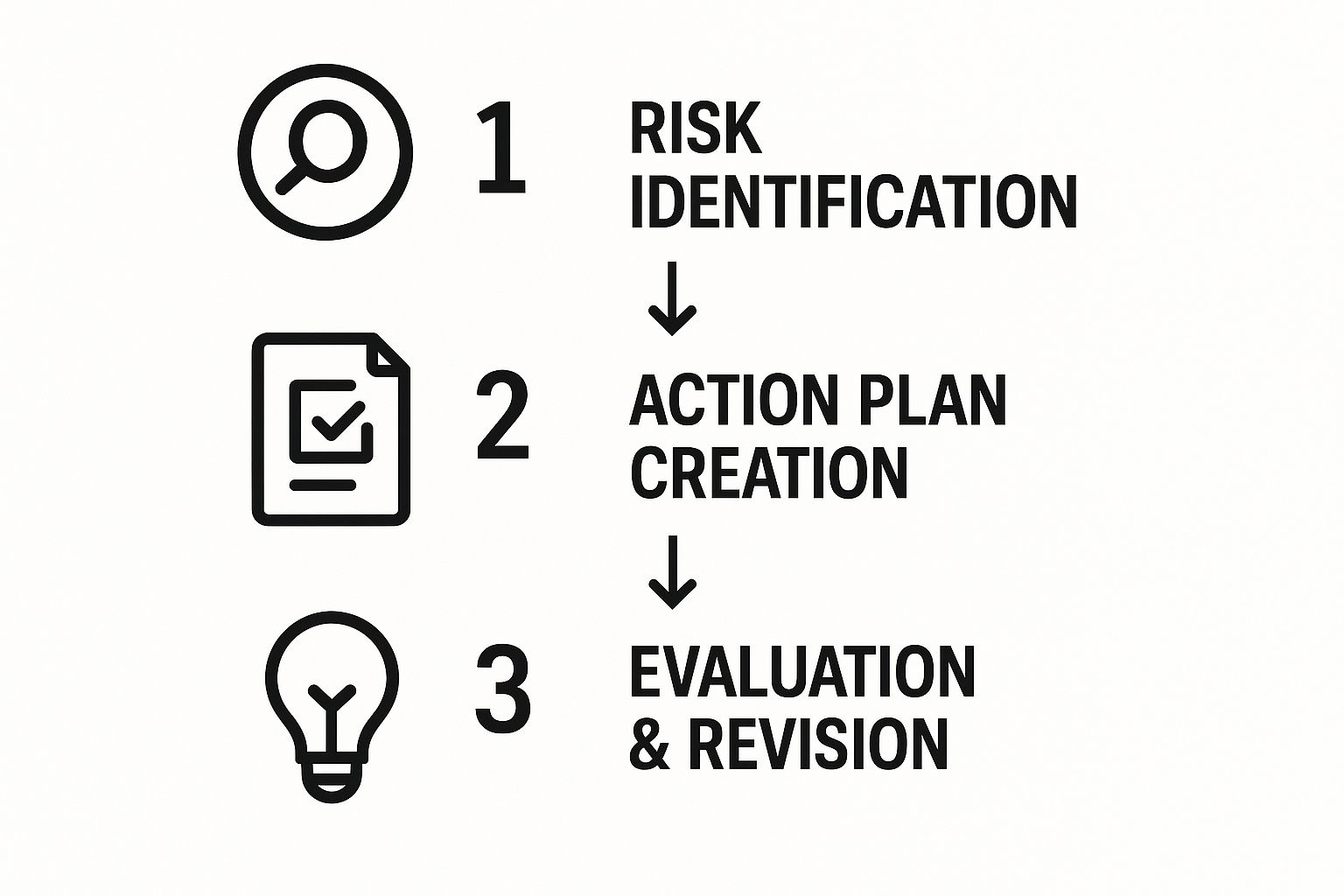
As you can see, a solid crisis plan isn't a one-and-done document. It’s a continuous cycle of identifying risks, creating a plan, and then revising it based on what you learn.
Take Decisive and Visible Action
Words only go so far. Eventually, you have to do something. This is the most important step—it's where you move from saying you'll fix it to actually fixing it. Your audience needs to see you taking real, tangible steps to address the root of the problem.
Get specific about what you’re doing. Are you recalling a product? Updating a policy? Retraining your team? Tell them exactly what's happening. Vague promises like "we will do better" are empty and will only make things worse.
To help you stay on track, here is a quick guide on what to do—and what to avoid—at each stage.
The A.C.T. Framework Do's and Don'ts
| Stage | Do | Don't |
|---|---|---|
| Acknowledge | Respond quickly and with genuine empathy. | Stay silent, get defensive, or delete negative comments. |
| Communicate | Provide regular, honest updates and be the source of truth. | Make promises you can't keep or speculate. |
| Take Action | Detail the specific steps you're taking to fix the problem. | Use vague corporate jargon or say "we're sorry you feel that way." |
Remember, communicating your actions is just as important as the actions themselves. Share progress updates along the way, and once it's over, report back on the outcome. Following through is how you show genuine accountability, and it's the only way to start rebuilding the trust you may have lost. Monitoring the fallout is also key; to get a handle on how sentiment is recovering, you might want to look into some of the best social media analytics tools available.
Building Your Crisis Management Playbook

If a response framework is your compass pointing you in the right direction, a playbook is the detailed, step-by-step map that gets you there safely. This shouldn't be a dusty binder on a shelf; it's a living document designed to give your team clear, actionable instructions when chaos erupts. A great playbook takes the guesswork out of a high-stress situation, empowering everyone to act decisively.
Think of it as your digital fire drill script. When the alarm sounds, everyone knows exactly where to go and what to do. This immediate clarity prevents panic and minimizes damage. A solid foundation for this script comes from understanding the core principles of Standard Operating Procedures, which help you structure all those crucial actions and responsibilities.
Defining Your Crisis Thresholds
Let’s be clear: not every negative comment is a full-blown crisis. The first, and maybe most important, step in building your playbook is deciding what actually qualifies as a crisis versus a minor issue that your customer service team can handle. Getting this right prevents overreactions and saves your team’s energy for the real threats.
Your crisis thresholds need to be specific and, ideally, data-driven. For instance, you might decide a "crisis" is triggered when you see:
- A 300% spike in negative brand mentions within a single hour.
- A negative post from an account with over 100,000 followers that starts gaining serious traction.
- Major media outlets or influential journalists picking up on a negative customer story.
By setting these clear triggers, you create a simple "if-then" system. If a situation hits one of these marks, the playbook is activated instantly. This ensures a fast, coordinated response is central to your social media crisis management strategy.
Assembling Your Crisis Command Team
When you’re in the middle of a fire, you don't have time to figure out who's holding the hose. Your playbook must spell out a crystal-clear chain of command and assign specific roles to a pre-selected crisis team. This is a team sport, involving much more than just your social media manager.
Your command team absolutely needs experts from across the company:
- Team Lead: This is your decision-maker, the person with the final say on strategy. Usually, this is someone from marketing or communications leadership.
- Social Media Manager: Your frontline operator. They are monitoring the channels, posting updates, and engaging directly with your community.
- PR/Communications: The expert responsible for drafting official statements, handling media inquiries, and keeping the message consistent everywhere.
- Legal Counsel: The advisor who vets every single public-facing message to make sure you aren't creating new legal headaches.
- Customer Support Lead: The voice of your customer. They bring crucial insights into public sentiment and help manage the flood of individual support cases that often follow a crisis.
"A well-defined chain of command is the backbone of any crisis response. It ensures that information flows efficiently, decisions are made swiftly, and actions are executed without confusion, turning a chaotic situation into a managed process."
Keeping Your Playbook Sharp and Relevant
Here's the thing about a crisis playbook: it’s never truly "done." Social media platforms evolve, new types of threats pop up, and your team members change. To keep your plan from becoming obsolete, you have to treat it as a living document that needs regular care and feeding.
Social media best practices are always in flux. A plan you wrote last year might be completely useless against a crisis on a newer platform like Threads or Bluesky. This is why top agencies recommend auditing and updating your crisis plans at least quarterly to stay ahead of the curve. Integrating your entire response into a unified command center can also massively improve your speed and consistency.
You also need to practice. Schedule regular drills—at least twice a year—to run through a simulated crisis. These practice runs are invaluable for finding weak spots in your plan, identifying communication bottlenecks, and building your team's confidence. After every drill, get everyone together to talk about what went right, what went wrong, and update the playbook with those lessons. This cycle of continuous improvement is what turns a prepared team into a battle-tested one.
Choosing the Right Tools for Your Tech Stack
A great crisis plan on paper is one thing, but executing it under pressure is another beast entirely. When a crisis hits social media, trying to track everything manually is like trying to catch rain in a thimble—you’ll be overwhelmed in minutes. The right technology is your command center, giving you the clarity and speed you need to get a handle on the situation.
To respond effectively, you need to see, understand, and act on conversations as they happen. Your built-in social media apps just won't cut it. A dedicated tech stack for social media crisis management is what separates a controlled response from a chaotic one.
Social Listening: Your Digital Early Warning System
Your first line of defense is always social listening. These tools are your eyes and ears online, constantly scanning millions of conversations for mentions of your brand, key terms, or sudden shifts in tone. Think of them as a smoke detector for your brand—they're designed to alert you to a potential fire before it burns the whole house down.
Tools like Brandwatch or Talkwalker do more than just count mentions. Their real value is in their analytical muscle. They can spot a sudden nosedive in negative sentiment, track how fast an angry hashtag is spreading, and show you exactly which influencers or news outlets are fanning the flames. This is the intel you need to make smart calls when the pressure is on.
When you're evaluating a listening tool, make sure it has:
- Real-Time Alerts: You need notifications that ping you the second a keyword spikes or sentiment drops. That head start is priceless.
- AI-Powered Sentiment Analysis: The tech needs to grasp context—distinguishing real criticism from sarcasm or spam.
- Visual Dashboards: You won’t have time to decipher a spreadsheet. You need clear, simple reports to quickly show your leadership team what’s going on.
Management Hubs: Your Central Command Post
While listening tools spot the problem, social media management hubs help you organize the solution. Platforms like Sprout Social or Hootsuite are your central command post, letting the team coordinate every move from one place. This is crucial for avoiding the fragmented, mixed messages that only make a crisis worse.
During a crisis, you can use these hubs to immediately pause all scheduled posts (so you don't post a cheerful marketing message in the middle of a disaster), get the right people to approve draft responses, and manage the flood of inbound comments and DMs without losing track.
A crisis can jump from Twitter to Instagram to Facebook in an instant. Having one dashboard to manage a coordinated, multi-platform response is absolutely essential.
Having the right tools is non-negotiable because crises escalate with explosive speed. With 68% of American adults getting news from social media, these platforms are primary information sources, underscoring the need for rapid, precise responses. You can explore more data about social media's role in crisis communication on konnectinsights.com.
In the end, building your tech stack is an investment in your brand's resilience. By pairing a powerful listening platform with a solid management hub, you give your team the ability to shift from a panicked, reactive posture to a proactive, controlled one. This technology is the foundation that makes a swift and effective social media crisis management strategy possible when you need it most.
Lessons from Real-World Brand Crises
https://www.youtube.com/embed/y3IY-EDAQDI
All the theory and frameworks in the world are great, but the real lessons in social media crisis management are learned in the trenches. The best way to understand what works—and what spectacularly doesn’t—is to see how real brands handled the heat when things went sideways.
Let's break down two completely different situations. One company turned a potential disaster into a masterclass in listening, while another stumbled and created a self-inflicted wound that took years to heal.
A Masterclass in Listening and Responding
One of the best examples of turning a negative into a huge positive comes from an unlikely source: barbecue sauce. When Chick-fil-A decided to replace its original BBQ sauce, they had no idea they were about to poke a hornet's nest of fiercely loyal customers.
The backlash was swift and loud. The hashtag #BringBackTheBBQ exploded, and online sentiment took a nosedive, with 73% of mentions turning negative. Instead of digging in their heels or issuing a stuffy corporate apology, the brand did something genius: they listened. Really listened.
Using social listening tools, the team didn't just watch the complaints roll in; they built custom dashboards to engage with people one-on-one across every platform. It wasn’t about damage control. It was about having a genuine conversation.
The result was a powerful lesson in brand loyalty. They brought back the original sauce with a campaign that made heroes out of the very fans who had been complaining.
- The Result: After the relaunch, sentiment flipped to 92% positive.
- The Engagement: The brand saw a massive 188x spike in mentions on the day the sauce returned.
- The Community: They racked up over 5,000 interactions in the first 72 hours.
This whole episode shows that if you listen to your community and act on what they're telling you, you can do more than just fix a problem—you can actually make people love your brand even more. It was a perfect, real-world example of the A.C.T. framework in motion.
The Danger of Ignoring the Conversation
Now, let's look at the flip side. Jaguar found itself battling a storm of misinformation about its advertising. A completely false story took root, sparking hashtags like #BoycottJaguar that were amplified by fake accounts and influencers.
The brand’s first move was a critical mistake. Instead of getting out in front of the specific claims with transparency and a human touch, Jaguar fell back on generic, automated replies. This impersonal approach didn't just fail to calm things down—it made everything so much worse.
The public saw the canned responses as dismissive, which only confirmed their anger. One influencer's tweet criticizing how the brand was handling it all blew up, getting 3.4 million views and pouring gasoline on the fire.
The lesson here is crystal clear: in a social media crisis management situation, silence or robotic responses create a void. And that void will always be filled by misinformation and anger. Jaguar lost control of the story because they failed to show up and engage like real people when it mattered most.
These two stories, Chick-fil-A and Jaguar, highlight the same truth from opposite ends of the spectrum. When a crisis breaks, people aren't waiting for a perfectly polished, lawyer-approved press release. They're looking for a human response. They want you to acknowledge their concerns, be transparent, and show that you're committed to making things right. Your actions—or your inaction—will decide whether you come out of it with stronger trust or a reputation in tatters.
Frequently Asked Questions
When you're in the thick of a social media firestorm, a million questions can race through your mind. When the pressure is on, you need clear, straightforward answers. Let’s tackle some of the most common questions that pop up when it's time to put a crisis plan into action.
Crisis Versus Complaint: What’s the Difference?
So, how do you tell if you’re dealing with a genuine crisis or just a standard customer complaint? The line between the two often comes down to two things: scale and speed.
A complaint is usually a one-off customer service issue. It’s a problem, sure, but it’s a manageable one. A crisis, on the other hand, is a different beast entirely. We're talking about a flood of negative comments, spreading like wildfire across multiple platforms. It's the kind of thing that influencers or the media might latch onto, putting your entire brand reputation at risk.
The smartest move is to set clear, data-driven triggers in your crisis playbook. For instance, you could decide that a 300% jump in negative mentions in an hour, or a negative post shared by an account with over 100,000 followers, automatically kicks your crisis plan into gear. This takes the guesswork out of a high-stress situation.
Should We Delete Negative Comments?
The urge to hit "delete" on a wave of negative comments is strong. It feels like a quick, clean solution. But should you do it? The answer is almost always a hard no.
Scrubbing your page of criticism looks like a cover-up, and it’s one of the fastest ways to destroy the trust you've built with your audience. More often than not, it backfires spectacularly, leading to the "Streisand Effect"—where your attempt to hide something only makes it a bigger story. A transparent, public response is always the better route.
The only real exceptions are for comments that are genuinely harmful and violate your community guidelines—think hate speech, spam, or direct threats. In those cases, removing the content is justified. Even then, it’s a good idea to internally document what was removed and why.
What Is the Very First Step to Take?
Okay, the alarms are ringing. You think a crisis is brewing. What's the absolute first thing you need to do? Activate your crisis plan.
This isn't one single action but a few critical moves that need to happen almost at once:
- Get the Team Together: Assemble your pre-assigned crisis response team. No delays.
- Hit Pause on Posts: Immediately halt all scheduled social media content. Nothing makes a brand look more out of touch than a cheerful, pre-planned post dropping in the middle of a disaster.
- Figure Out What’s Happening: Jump into your social listening tools to get a handle on the situation. How big is this? What's the sentiment? How fast is it spreading?
Your immediate goal is to release a brief, empathetic holding statement. This isn't the full apology or explanation; it's a quick message that says, "We see this, we're taking it seriously, and we're looking into it." This simple act shows you're on top of it and buys you invaluable time to figure out your next move.
A solid strategy is built on expertise and clear execution. The team at ReachLabs.ai brings together specialists to deliver marketing solutions that protect and elevate your brand. Discover how our collective approach can build resilience for your business.