
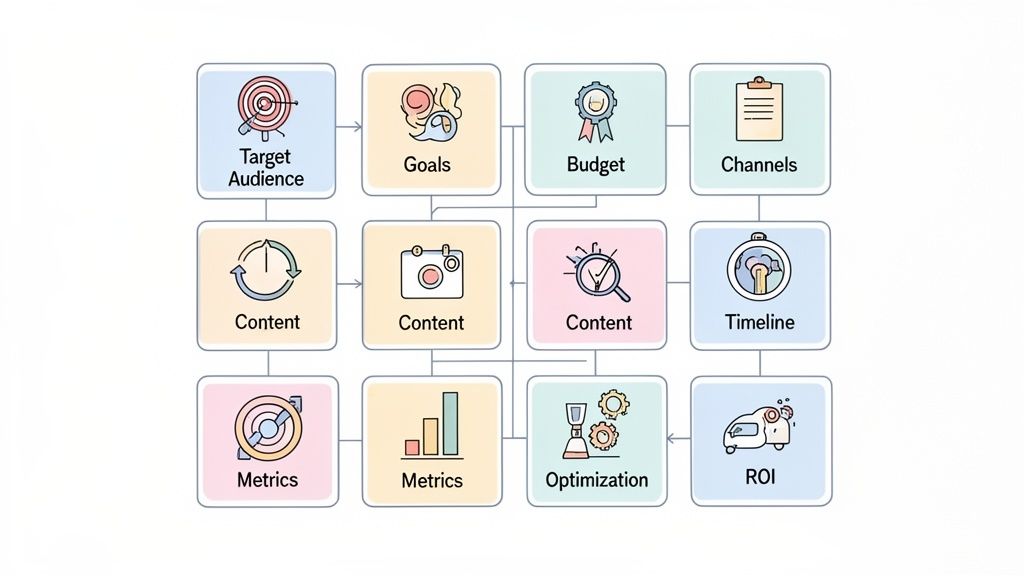
In today's competitive market, a generic marketing strategy is a recipe for failure. An effective plan is a dynamic, living document built from distinct, interconnected components. Each part serves a unique purpose, from defining your audience with surgical precision to proving your return on investment with hard data.
Neglecting even one of these core marketing plan parts is like trying to navigate without a compass. You might be moving, but you won't reach your destination efficiently or predictably. This guide breaks down the nine essential components that form a robust, data-driven marketing strategy. We will move beyond theory and provide a clear blueprint for building a plan that not only looks good on paper but delivers measurable, impactful results.
Here’s what you'll gain from this comprehensive breakdown:
- A clear understanding of what each component entails and why it's critical for success.
- Actionable steps on how to implement each part effectively.
- Practical insights for crafting tailored, multi-channel strategies that drive growth.
For agencies like ReachLabs.ai, mastering these elements is the key to creating sophisticated campaigns that help clients dominate their markets. We'll explore the specific purpose of each section, what to include, key performance indicators (KPIs) to track, and actionable tips for implementation. Think of this as your definitive roadmap to building a marketing engine that generates consistent, scalable growth and leaves the competition behind. Let's dive into the essential marketing plan parts that will transform your strategy from a static document into a powerful business driver.
1. Part 1: The Executive Summary — Your 60-Second Elevator Pitch
Think of the Executive Summary as the blueprint's cover page and index combined. It’s a high-level, concise overview of the entire marketing plan, designed to give stakeholders a complete picture in minutes. Its primary goal is to secure buy-in and budget approval by quickly communicating the strategy’s objectives, key tactics, and expected outcomes.
This section synthesizes the most critical marketing plan parts into a single, compelling narrative. For agencies like ReachLabs.ai presenting to clients, this is where you showcase strategic alignment and promise tangible ROI before diving into the details. While it appears first, it should always be written last, after all other components are finalized.
What to Include
A powerful executive summary is brief yet comprehensive. It should distill the essence of your plan into a few key points:
- Business Goals: Briefly state the core business objective the marketing plan supports (e.g., "Increase market share by 15% in the enterprise SaaS sector").
- Marketing Objectives: Outline the specific, measurable marketing goals that will achieve the business objective (e.g., "Generate 500 marketing-qualified leads per quarter").
- Key Strategies: Summarize the main tactical approaches you will use, such as content marketing, paid search, or account-based marketing.
- High-Level Budget: State the total required investment for the plan's execution.
- Expected ROI: Provide a concise forecast of the anticipated return on investment or key performance outcomes.
Actionable Implementation Tips
To ensure your summary grabs attention and earns approval, follow these best practices:
- Lead with the "Why": Start by connecting your marketing goals directly to the company's overall business objectives. This immediately establishes relevance and importance.
- Focus on Outcomes, Not Activities: Instead of saying "We will launch a blog," say "We will drive a 40% increase in organic traffic through targeted content creation."
- Keep it to One Page (Max): Brevity is crucial. Use bullet points and bold text to highlight the most important data points. This is the cornerstone of all effective marketing plan parts; make it count.
2. Market and Audience Analysis — Knowing Who You're Talking To
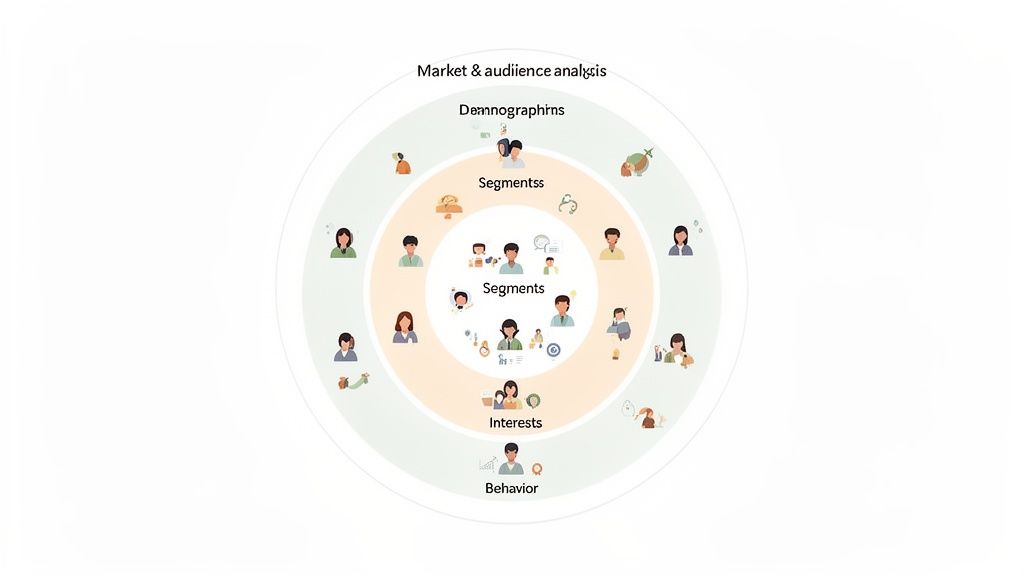
If the Executive Summary is the blueprint's cover, the Market and Audience Analysis is its foundation. This crucial section details exactly who you are trying to reach, why they matter, and how they behave. It involves deep research into your target market, segmenting audiences, and creating detailed customer personas. The goal is to ensure every marketing dollar is spent reaching the right people with the right message.
This analysis is one of the most fundamental marketing plan parts because it prevents wasted effort. For an agency like ReachLabs.ai, a robust analysis demonstrates a deep understanding of the client’s customer base, justifying strategic decisions on channels and messaging. A plan without this component is like shooting arrows in the dark; you might hit something, but it will be by luck, not by design.
What to Include
A thorough analysis moves beyond basic demographics to paint a complete picture of your ideal customer:
- Market Segmentation: Break down the broader market into smaller, manageable groups based on demographics (age, location), psychographics (lifestyle, values), and behavioral data (purchase history, online activity).
- Target Audience Profile: Define the specific segment(s) you will focus on, justifying why they are the most valuable for your business goals.
- Buyer Personas: Create 3-5 detailed, semi-fictional representations of your ideal customers, complete with names, goals, pain points, and motivations. For instance, Nike segments by athletic aspiration, while LinkedIn targets B2B decision-makers by role and industry.
- Competitive Landscape: Briefly analyze how competitors are targeting similar audiences and identify any gaps or opportunities.
Actionable Implementation Tips
To ensure your analysis is practical and drives results, follow these best practices:
- Use a Mix of Data Sources: Combine primary research like customer surveys and interviews with secondary data from tools like Semrush, social listening platforms, and Google Analytics for a 360-degree view.
- Map the Customer Journey: Trace the path your audience takes from initial awareness to becoming a loyal advocate. This reveals critical touchpoints for engagement.
- Keep it Dynamic: Markets and behaviors shift. Review and update your personas and market analysis quarterly or bi-annually to stay relevant. This is a living document, not a one-time task. Explore different strategies for how to identify your target audience to keep your approach fresh.
3. Competitive Analysis — Identifying Your Strategic Edge
Think of the Competitive Analysis as your strategic battlefield map. It’s a thorough examination of your direct and indirect competitors, designed to reveal their strengths, weaknesses, market positioning, and marketing strategies. Its primary goal is to identify "white space" opportunities, mitigate threats, and define how your brand can differentiate itself to win market share.
This section is one of the most crucial marketing plan parts because it prevents you from operating in a vacuum. For an agency like ReachLabs.ai, this analysis demonstrates deep market understanding and forms the foundation for a strategy that positions a client to uniquely dominate their niche, like how Dollar Shave Club used a convenience and price-based model to challenge the incumbent Gillette.
What to Include
A robust competitive analysis goes beyond just listing rivals. It systematically deconstructs their go-to-market approach to inform your own:
- Competitor Profiles: Identify 3-5 key competitors, including direct (offering a similar solution), indirect (solving the same problem with a different solution), and emerging threats.
- SWOT Analysis: For each competitor, outline their Strengths (e.g., strong brand recognition), Weaknesses (e.g., poor customer service), Opportunities (e.g., untapped markets), and Threats (e.g., new regulations).
- Marketing Strategy Breakdown: Analyze their messaging, content themes, channels used (social, SEO, PPC), and pricing models.
- Market Positioning: Map out where each competitor sits in the market based on key attributes like price, quality, and target audience to find your unique spot.
Actionable Implementation Tips
To turn analysis into a competitive advantage, follow these best practices:
- Leverage Intelligence Tools: Use platforms like SEMrush for SEO and keyword insights, Ahrefs for backlink analysis, and Brandwatch for social listening to gather objective data on competitor performance.
- Go Beyond Digital: Don't just analyze their website. Interview customers (yours and theirs) to understand why they chose one brand over another. This provides invaluable qualitative insights.
- Conduct a Social Deep Dive: Systematically review competitors' social media presence. For a deeper dive into understanding your rivals' online presence and strategies, particularly on social platforms, check out this a comprehensive social media competitive analysis guide.
4. Part 4: Marketing Goals and Objectives — Defining Your Destination
If the executive summary is your cover page, your goals and objectives are the destination plotted on your map. This section translates broad business ambitions into specific, measurable, and time-bound marketing targets. Its primary goal is to provide a clear definition of success and align all subsequent strategies and tactics toward a unified purpose. Without well-defined goals, your marketing efforts lack direction and are impossible to measure effectively.
This component is one of the most foundational marketing plan parts, as it ensures marketing activities directly contribute to the bottom line. For an agency like ReachLabs.ai, setting clear goals is non-negotiable; it’s how you demonstrate value and prove ROI to clients. These objectives must be directly linked to the high-level business goals mentioned in the executive summary, creating a clear strategic cascade.
What to Include
Goals should be defined using the SMART (Specific, Measurable, Achievable, Relevant, Time-bound) framework to ensure clarity and accountability.
- Business Objective Alignment: Clearly state which overarching business goal each marketing objective supports (e.g., "To support the business goal of 20% revenue growth…").
- Specific Marketing Goals: Define the primary outcomes. For example, HubSpot aims for 30% year-over-year growth in qualified leads, while Shopify focuses on conversion rate optimization and customer lifetime value.
- Key Performance Indicators (KPIs): List the specific metrics you will use to track progress toward each goal (e.g., Lead Conversion Rate, Customer Acquisition Cost, Website Traffic, Engagement Rate).
- Targets and Timelines: Assign a numerical target and a specific timeframe for each KPI (e.g., "Increase organic MQLs by 25% by the end of Q3").
Actionable Implementation Tips
To set goals that drive performance and provide clarity, follow these best practices:
- Cascade from the Top Down: Ensure every marketing goal can be traced back to a larger company objective. If you can't connect a marketing goal to a business goal, reconsider its relevance.
- Use Benchmarks for Realism: Set achievable targets by analyzing historical performance data and industry benchmarks. This prevents setting goals that are either too conservative or wildly unrealistic.
- Combine Leading and Lagging Indicators: Track lagging indicators like revenue (outcomes) but also monitor leading indicators like email open rates or social engagement (activities that predict future outcomes). This allows for real-time optimization.
5. Marketing Channels, Tactics, and Paid Advertising Strategy — Your Roadmap to the Customer
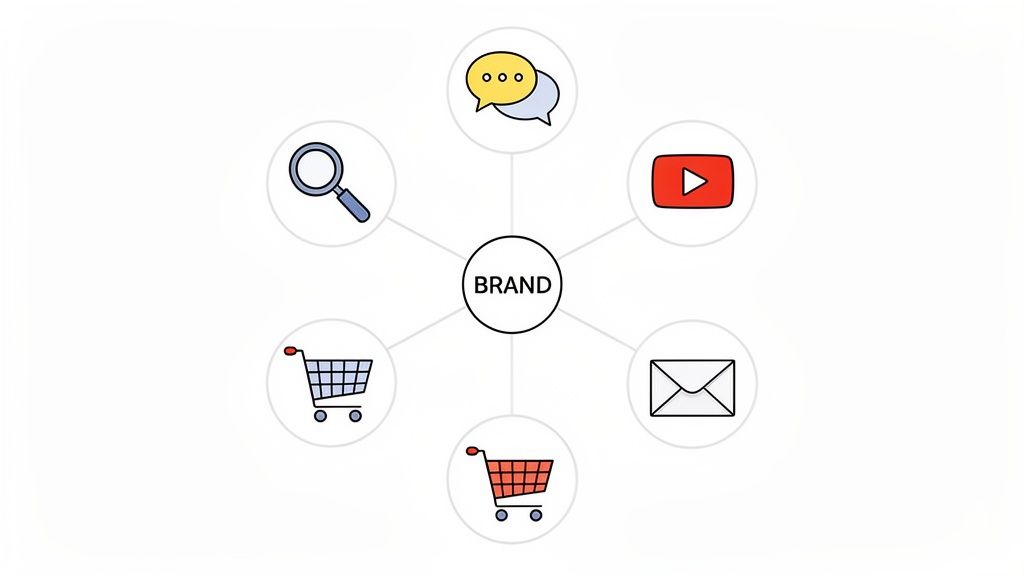
This section is the operational core of your marketing plan, detailing exactly where and how you will engage your target audience. It translates your high-level strategy into a concrete action plan, selecting the most effective channels, defining specific tactics, and outlining a paid advertising approach. This is where you allocate resources to connect with customers at every stage of their journey.
For agencies like ReachLabs.ai, this is where tactical expertise shines. You demonstrate a deep understanding of the digital landscape by choosing channels not just based on popularity, but on where the client's specific audience lives and breathes. It’s one of the most critical marketing plan parts for turning strategy into measurable action and demonstrating tangible progress.
What to Include
A robust channel and tactics plan provides a clear playbook for your marketing team. It should include:
- Channel Selection: Identify primary and secondary marketing channels (e.g., Google Ads, LinkedIn, Instagram, content marketing, email). Justify each choice based on audience data and campaign goals. For instance, Slack used highly targeted LinkedIn ads to reach B2B decision-makers.
- Tactical Breakdown: For each channel, outline the specific tactics. For content marketing, this could be "Publish two in-depth blog posts per week"; for social media, "Run three weekly Instagram Stories campaigns."
- Paid Media Plan: Detail your paid advertising strategy, including platforms (Google, Meta, etc.), target audiences, ad formats, and bidding strategies. For example, Shopify uses retargeting ads to drive repeat purchases from past website visitors.
- Budget Allocation: Assign a specific budget to each channel and major tactic, ensuring resources are aligned with priorities and expected ROI.
- Content and Creative Direction: Briefly describe the type of content and creative assets required for each channel to ensure consistency and platform optimization.
Actionable Implementation Tips
To build a channel strategy that delivers results, follow these proven best practices:
- Prioritize, Don't Dilute: Start with 3-5 core channels where your audience is most active. It is better to dominate a few channels than to have a weak presence across many.
- Start with High-Intent Channels: Allocate initial budget to channels like Google Search Ads that capture existing demand. This secures early wins while you build broader awareness campaigns.
- Allocate an "Experiment" Budget: Set aside 10-20% of your paid media budget for testing new channels, ad formats, or audiences. This keeps your strategy agile and allows for discovering new growth opportunities.
6. Content Marketing and Creative Strategy — Building Your Brand's Voice
Content is the fuel for your marketing engine. This section outlines your plan to create and distribute valuable, relevant, and consistent content to attract and retain a clearly defined audience. It’s not just about what you say, but how and where you say it, transforming your brand from a seller into a trusted resource and thought leader.
A well-defined content and creative strategy ensures every piece of content, from a blog post to a social media update, serves a strategic purpose. For agencies like ReachLabs.ai, this is where you demonstrate how creative execution will drive measurable business outcomes like lead generation and brand loyalty. To craft impactful messages and ensure your 'what' resonates, it's essential to understand how to build a winning content marketing strategy.
What to Include
Your content strategy should be a comprehensive roadmap that guides your creative efforts. Key components include:
- Core Content Themes: Identify 3-5 primary topics that align with your audience's pain points and your brand's expertise.
- Content Formats: Detail the types of content you will create, such as blog posts, videos, case studies, infographics, and podcasts.
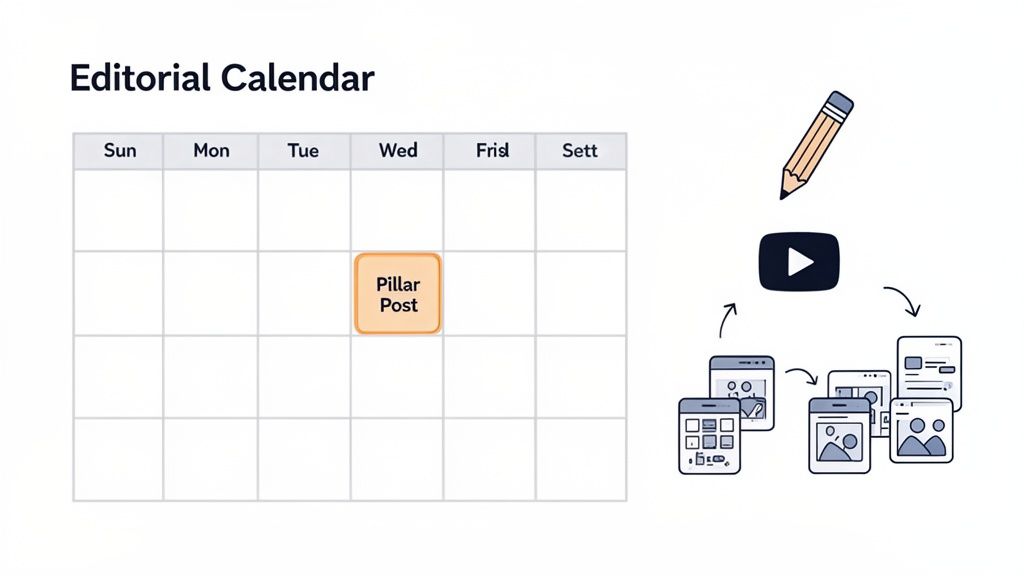
- Editorial Calendar: Map out your content production and publication schedule, including topics, formats, authors, and deadlines.
- Distribution Channels: Specify where you will promote your content, such as social media platforms, email newsletters, SEO, and paid channels.
- SEO Strategy: Outline your approach to keyword research, on-page optimization, and backlink building to improve organic visibility. You can learn more about how a creative strategy ties directly into content performance.
Actionable Implementation Tips
To develop a content plan that delivers consistent results, follow these proven best practices:
- Start with Pillar Content: Commit to creating 2-4 comprehensive, high-value "pillar" pieces each month. These form the foundation for smaller "cluster" content like social posts and short videos.
- Repurpose Everything: Maximize your efforts by repurposing each core piece of content across 5-7 different formats and channels. A single webinar can become a blog post, an infographic, a series of tweets, and a YouTube video.
- Optimize for Search Intent: Focus on answering the questions your audience is asking. Create content that satisfies their intent, not just content that targets a keyword.
- Track and Analyze: Monitor content performance by topic, format, and distribution channel to understand what resonates and double down on what works. These are essential marketing plan parts for continuous improvement.
7. Influencer Marketing and Partnership Strategy — Leveraging Authentic Voices
In an era of ad fatigue, consumers trust recommendations from people they admire far more than traditional advertisements. This section of your marketing plan outlines how you will identify, engage, and collaborate with influencers and strategic partners to build brand credibility, reach new audiences, and drive authentic conversations.
This strategy moves beyond simple product placements to build genuine relationships that amplify your message. It’s a critical component of modern marketing plan parts, especially for B2C brands seeking to cultivate community and trust. For an agency like ReachLabs.ai, this involves creating data-driven frameworks to vet influencers not just for reach but for true audience alignment and engagement quality, ensuring every partnership delivers measurable impact.
What to Include
A robust influencer and partnership strategy is built on clear objectives and systematic execution. It should detail the entire lifecycle of your collaborations:
- Influencer/Partner Personas: Define the ideal characteristics of your partners, including niche, audience demographics, engagement rates, and content style (e.g., "Tech micro-influencers with 10k-50k followers specializing in productivity software for SMBs").
- Partnership Tiers & Types: Outline different levels of collaboration, from one-off sponsored posts and affiliate programs (like Gymshark's athlete network) to long-term brand ambassadorships and co-branded product launches.
- Outreach and Vetting Process: Document your methodology for identifying potential partners, the outreach templates you will use, and the criteria for vetting authenticity and brand safety.
- Campaign Brief and Deliverables: Specify the campaign goals, key messaging, content requirements, usage rights, and disclosure guidelines (e.g., FTC compliance).
- Compensation and Management: Detail your compensation models (flat fee, commission, free product) and the tools or processes for managing communication, content approvals, and payments.
Actionable Implementation Tips
To transform influencer outreach from a gamble into a strategic asset, integrate these practices into your plan:
- Prioritize Authenticity Over Follower Count: Focus on micro-influencers (10k-100k followers) whose audiences are highly engaged and genuinely trust their recommendations. Their conversion rates are often significantly higher than those of mega-influencers.
- Build Long-Term Relationships: Instead of one-off campaigns, cultivate lasting partnerships with a core group of 3-5 influencers. This builds brand consistency and turns them into true advocates who understand your product deeply.
- Grant Creative Freedom within Brand Guidelines: Provide a clear brief with key messages and do's/don'ts, but allow influencers the creative space to speak to their audience in their own voice. This is the key to authentic, non-disruptive content.
- Track Beyond Vanity Metrics: Measure success with metrics that tie directly to business goals, such as referral traffic, conversion rates (using unique promo codes), cost per acquisition (CPA), and audience sentiment. This is a vital step for all successful marketing plan parts.
8. Customer Relationship Management (CRM) and Retention Strategy
Acquiring a new customer is valuable, but retaining an existing one is far more profitable. This section of your plan details how you will nurture customer relationships post-acquisition to maximize their lifetime value. A strong CRM and retention strategy transforms one-time buyers into loyal advocates, creating a sustainable and predictable revenue stream.
This is one of the most critical marketing plan parts for long-term growth. It focuses on systematic engagement, personalization, and value delivery to reduce churn and increase repeat purchases. For an agency like ReachLabs.ai, demonstrating a robust retention plan shows clients you are focused not just on lead generation, but on building a resilient business foundation.
What to Include
An effective retention strategy is data-driven and customer-centric. Your plan should clearly outline the systems and tactics for managing these relationships:
- CRM System: Specify the platform (e.g., HubSpot, Salesforce) you will use to centralize customer data, track interactions, and segment your audience.
- Onboarding Process: Detail the initial experience for new customers, including welcome email sequences, product tutorials, and initial check-ins.
- Engagement Tactics: List the specific methods for ongoing communication, such as personalized email marketing, content newsletters, and community engagement. Examples include Spotify’s personalized playlists or Sephora's tiered loyalty program.
- Loyalty and Advocacy Programs: Describe any formal programs designed to reward repeat business and encourage referrals, like Amazon Prime's subscription benefits.
- Upsell/Cross-sell Pathways: Map out the strategies to introduce existing customers to additional products or premium services at the right time.
Actionable Implementation Tips
To build a retention engine that drives growth, focus on creating genuine value and seamless experiences:
- Segment Your Audience: Use your CRM data to group customers based on behavior, purchase history, or engagement level. Tailor your communication to each segment’s specific needs and interests.
- Calculate and Track CLV: Determine your Customer Lifetime Value (CLV). This metric proves the financial impact of your retention efforts and helps justify further investment in loyalty initiatives.
- Implement Feedback Loops: Actively solicit customer feedback through surveys, reviews, and direct outreach. More importantly, show customers you are listening by acting on their input and communicating changes. This is a foundational element of successful marketing plan parts focused on loyalty.
9. Part 9: The Measurement, Analytics, and Reporting Framework — Proving Your Value
If your strategy is the plan, then the measurement framework is the scorecard. This section details how you will track, analyze, and report on performance, turning raw data into actionable insights. It’s the mechanism that proves ROI, justifies budget, and guides future decisions, ensuring the marketing engine is continuously optimized for better results.
This framework is one of the most critical marketing plan parts because it establishes accountability and demonstrates tangible business impact. For an agency like ReachLabs.ai, a robust reporting system is non-negotiable; it’s how you showcase success and build client trust by linking activities directly to outcomes. This section answers the all-important question: "Is our marketing working?"
What to Include
A strong measurement framework is built on clarity and relevance. It should connect every marketing action to a business result:
- Key Performance Indicators (KPIs): Define the 5-8 primary metrics that directly reflect your marketing objectives (e.g., Customer Acquisition Cost, Conversion Rate, Marketing-Influenced Revenue).
- Data Sources and Tools: List the platforms you will use for data collection, such as Google Analytics for web traffic, HubSpot for lead generation, or Sprout Social for social media engagement.
- Attribution Model: Specify how you will assign credit for conversions across various touchpoints (e.g., first-touch, last-touch, or multi-touch attribution).
- Reporting Cadence and Dashboards: Outline the frequency (weekly, monthly, quarterly) and format of reports. Describe what the primary performance dashboard will display.
- Optimization Process: Explain how insights from reports will be used to make strategic adjustments to campaigns and tactics.
Actionable Implementation Tips
To create a framework that drives improvement, not just reports data, follow these best practices:
- Align KPIs to the Funnel: Assign specific metrics to each stage of the buyer's journey (awareness, consideration, decision) to identify and address bottlenecks effectively.
- Automate Your Dashboards: Use tools to create live, automated dashboards that provide a real-time view of performance, saving time and enabling quicker responses to trends.
- Balance Leading and Lagging Indicators: Track leading indicators like engagement rates and click-through rates to forecast future success, alongside lagging indicators like revenue and ROI to measure past performance. For a deeper dive into which metrics to choose, explore these marketing performance metrics examples.
9-Part Marketing Plan Comparison
| Component | Complexity & Process 🔄 | Resources & Speed ⚡ | Expected Outcomes 📊 | Key Advantages ⭐ | Ideal Use Cases & Tips 💡 |
|---|---|---|---|---|---|
| Executive Summary | 🔄 Low — synthesis task requiring cross‑team inputs | ⚡ Low effort; fast to produce once inputs exist | 📊 Quick stakeholder alignment, budget approval, clear KPIs | ⭐ High for executive buy‑in and direction | 💡 Use for investor/stakeholder presentations; keep 1–2 pages |
| Market and Audience Analysis | 🔄 Medium–High — research and segmentation workflow | ⚡ High resource and time demand; iterative updates needed | 📊 Precise targeting, reduced ad waste, identified opportunities | ⭐ High for targeting accuracy and personalization | 💡 Combine primary + secondary research; update regularly |
| Competitive Analysis | 🔄 Medium — ongoing monitoring and benchmarking | ⚡ Moderate resources; continuous monitoring recommended | 📊 Differentiation insights, positioning gaps, threat detection | ⭐ High for strategic positioning and pricing decisions | 💡 Monitor quarterly; use tools (SEMrush/Ahrefs) and interviews |
| Marketing Goals and Objectives | 🔄 Low–Medium — framework (SMART/OKR) setup | ⚡ Low resources to set; moderate effort to align org | 📊 Clear accountability, measurable ROI, prioritized initiatives | ⭐ High for measurement and team alignment | 💡 Set multi‑level goals; review quarterly and use baselines |
| Channels, Tactics & Paid Strategy | 🔄 High — multi‑channel coordination and optimization | ⚡ Variable — can scale quickly but needs specialist ops | 📊 Reach, conversion lift, scalable paid performance | ⭐ High for growth acceleration when executed well | 💡 Prioritize 3–5 channels; allocate 10–20% to testing |
| Content & Creative Strategy | 🔄 Medium — editorial planning and creative production | ⚡ Moderate ongoing resources; results take months | 📊 Organic traffic, thought leadership, long‑term lead gen | ⭐ High for brand authority and sustainable traffic | 💡 Focus on 3–5 themes; repurpose content across formats |
| Influencer & Partnership Strategy | 🔄 Medium — vetting, contracting, and relationship mgmt | ⚡ Moderate resources; rapid amplification possible (⚡) | 📊 Improved engagement and authentic reach; variable conversions | ⭐ High for credibility and social proof | 💡 Prioritize authenticity over follower count; build long‑term ties |
| CRM & Retention Strategy | 🔄 Medium — platform implementation and lifecycle design | ⚡ Moderate to high investment; ongoing automation speeds ops | 📊 Increased CLV, reduced churn, predictable recurring revenue | ⭐ High for long‑term profitability and customer loyalty | 💡 Implement CRM, segment emails, calculate CLV to guide spend |
| Measurement, Analytics & Reporting | 🔄 High — data infrastructure, attribution, dashboards | ⚡ High upfront effort; enables faster decisions over time | 📊 Demonstrable ROI, channel optimization, early warning signals | ⭐ Critical for accountability and optimization | 💡 Define 5–8 core KPIs; automate dashboards and alerts |
From Blueprint to Reality: Activating Your Marketing Plan
We've journeyed through the nine essential marketing plan parts, from the high-level Executive Summary to the granular details of your Measurement and Reporting Framework. It’s clear that a comprehensive marketing plan is far more than a static document to be filed away; it is the living, breathing blueprint for your brand's growth and a powerful tool for strategic alignment across your entire organization.
Each component we’ve dissected serves a critical, interconnected purpose. Your Market and Audience Analysis provides the foundational "who" and "where," ensuring your efforts are not just loud, but resonant. The Competitive Analysis then gives you the strategic "how" by revealing opportunities for differentiation. Without these, your goals would be based on assumptions rather than data.
Similarly, your strategies for Content, Influencers, and Customer Retention are not isolated tactics. They are the direct outputs of your defined Marketing Goals and Objectives. This integrated structure ensures every blog post, every social media campaign, and every customer email works in concert to achieve specific, measurable outcomes that you can track with your meticulously designed reporting framework.
From Static Document to Dynamic Strategy
The single most important takeaway is this: your marketing plan is not meant to be perfect; it's meant to be active. The true power of a well-crafted plan lies in its ability to adapt. Market trends shift, new competitors emerge, and customer behaviors evolve. A plan built on a solid foundation of data and clear objectives gives you the agility to pivot intelligently, not reactively.
Think of it as the difference between a map and a GPS. A static map shows you one way to get there. A dynamic GPS, informed by real-time data, reroutes you around traffic jams and unforeseen obstacles, ensuring you still reach your destination efficiently. Your reporting and analytics framework is your GPS.
Key Insight: The value of a marketing plan isn't in its initial creation but in its consistent application and iterative improvement. Use your KPIs not just to judge past performance but to inform future decisions.
Your Actionable Next Steps
To transform this knowledge into tangible results, focus on the following immediate actions:
- Conduct a Plan Audit: Use the nine sections covered in this article as a checklist. Where are the gaps in your current strategy? Is your audience persona outdated? Are your KPIs vague? Identify the weakest link and start there.
- Schedule a Quarterly Review: Book a recurring meeting with your key stakeholders now. The purpose is to formally review your plan against your performance data. This institutionalizes the process of analysis and adaptation, making it a core part of your marketing operations.
- Activate One New Insight: You don't need to overhaul everything at once. Choose one powerful insight you've gained, whether it's refining your customer retention strategy or experimenting with a new content format, and commit to implementing it within the next 30 days.
Mastering these individual marketing plan parts and understanding how they synergize is what separates good marketers from great ones. It’s the framework that enables you to justify budgets, prove ROI, and build a brand that not only captures attention but also fosters lasting loyalty. By treating your marketing plan as a dynamic guide for strategic action, you equip your business to navigate the complexities of the modern marketplace and achieve sustainable, predictable growth.
Ready to transform your blueprint into a high-performance growth engine? The team at ReachLabs.ai specializes in building and executing data-driven marketing plans that cover every component discussed here. Visit ReachLabs.ai to see how our full-service expertise can help you craft and implement a winning strategy that delivers measurable results.