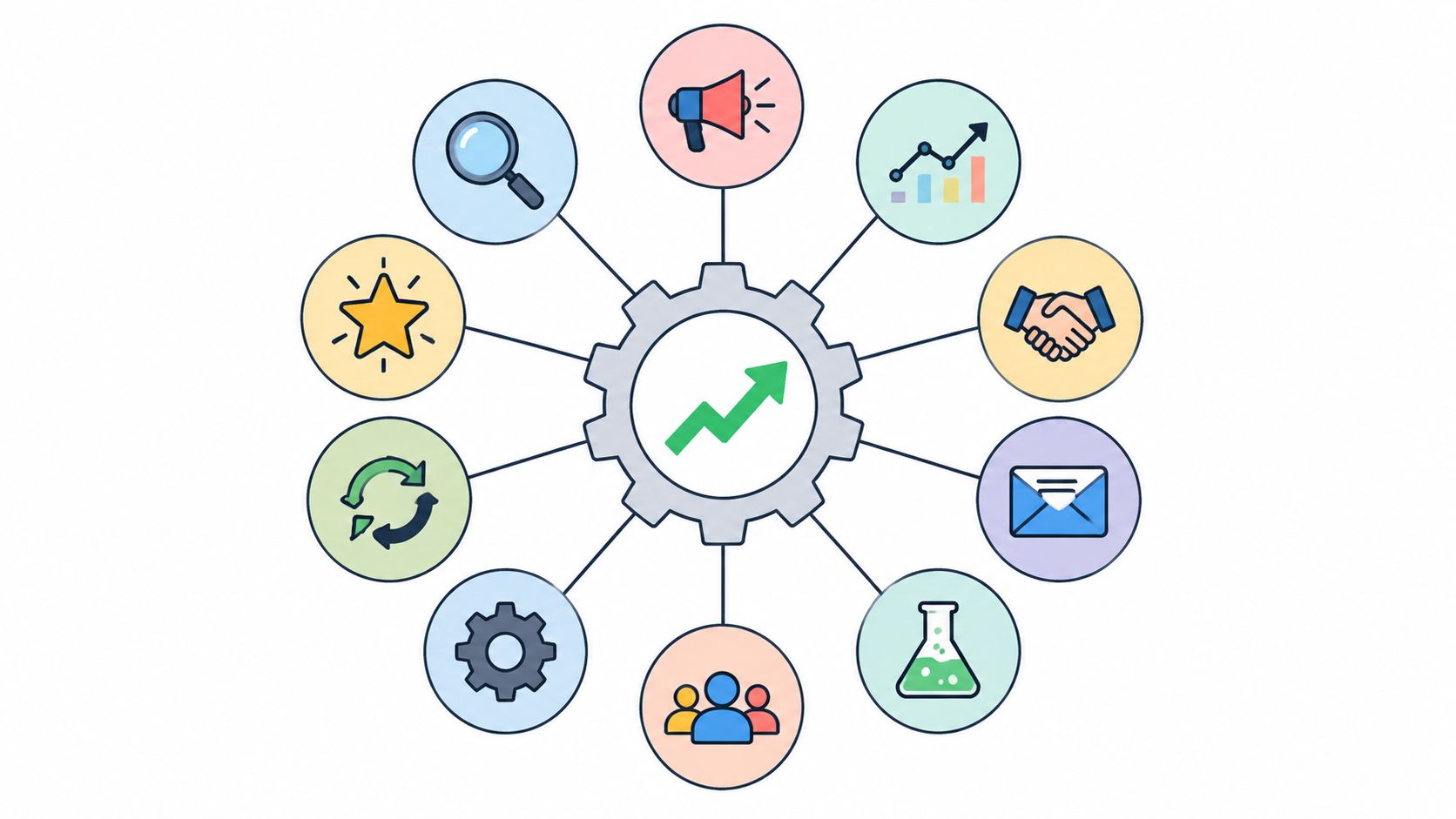

At its heart, a creative strategy is the game plan that connects your business ambitions to your creative output. It’s the intentional "why" that guides every ad, social media post, and email campaign. This ensures everything you create isn't just nice to look at, but is actually working hard to achieve a specific goal.
Defining Creative Strategy Without The Jargon
Let's use an analogy. Imagine building a custom home. You wouldn't just show up with a pile of lumber and start nailing boards together, right? Of course not. You'd start with a detailed architectural blueprint.
That blueprint is your creative strategy. It lays the foundation and dictates the purpose of every single creative decision, turning what could be random acts of marketing into a cohesive, powerful campaign that actually moves the needle. Without that blueprint, your creative work is just guesswork—art for art's sake, not a commercial tool built to solve a business problem.
The Bridge Between Business and Creativity
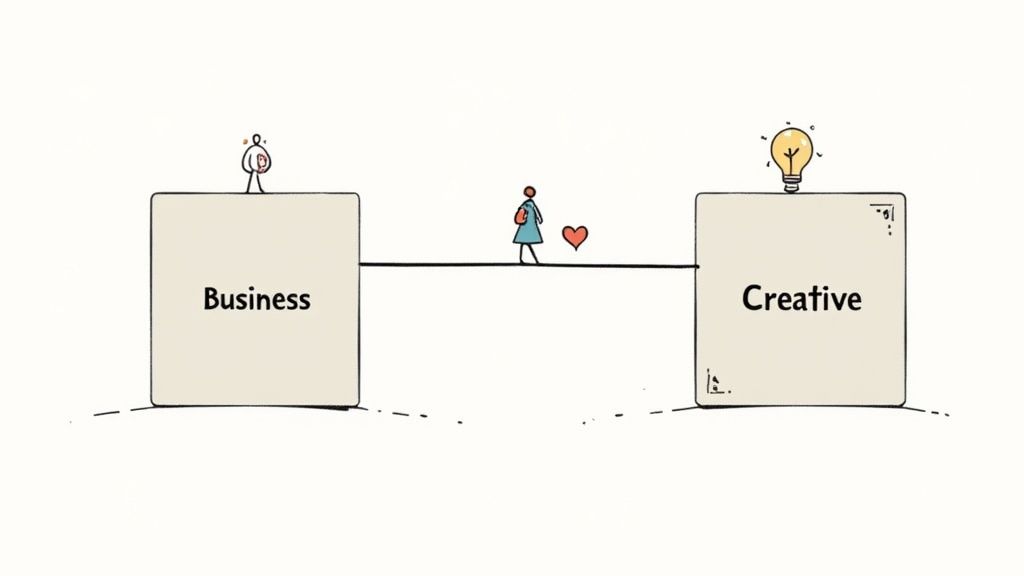
A solid creative strategy isn't about sitting in a room and dreaming up flashy taglines. It’s the crucial link between what a business needs to accomplish and what the creative team makes. It provides clear, actionable guardrails by answering some tough questions before anyone opens a design file or writes a single line of copy.
This framework forces you to get specific on a few key things:
- Target Audience: Who are we really talking to? What do they care about?
- Core Message: What is the one, single-minded thing we need to say?
- Unique Value: Why should they choose us and not the competition?
- Desired Action: What do we want them to do, think, or feel after they see our work?
To make this distinction clearer, it's helpful to separate the strategy from the execution. The strategy is the thinking, and the execution is the doing.
Creative Strategy vs Creative Execution
| Aspect | Creative Strategy (The Blueprint) | Creative Execution (The Building) |
|---|---|---|
| What it is | The "Why" and "What." It's the plan, the insight, and the core message. | The "How." It's the tangible output—the ads, the videos, the website. |
| Focus | Long-term vision, audience insights, problem-solving, and message clarity. | Visual design, copywriting, production quality, and channel-specific details. |
| Example | "Position our brand as the simplest solution for busy professionals." | A series of 15-second social media ads showing a professional saving time. |
Simply put, you can't have great execution without a smart strategy guiding it.
Why It Matters More Than Ever
Today, everyone is fighting for attention. Just being loud or "creative" isn't a winning formula anymore. In fact, a staggering 80.5% of marketers agree that creative effectiveness is what truly drives a campaign's success.
A strong strategy is what gives your creativity purpose. It’s how you cut through the overwhelming noise to make a real connection with your audience and, ultimately, deliver results you can measure. You can learn more about the power of creative thinking in marketing to see just how critical this has become.
The Four Pillars of a Winning Creative Strategy
A powerful creative strategy isn't some mysterious art form. It's actually a structured framework built on four essential pillars. Think of them like the legs of a table—if one is wobbly or missing, the whole thing comes crashing down. Getting these components right gives you a reliable checklist to make sure your creative work is always built on solid ground.
This framework is what separates random creative acts from strategic, goal-driven campaigns. When you deliberately work through each pillar, you create a clear roadmap for your team that ensures every single creative decision has a purpose. It’s how you turn abstract business goals into tangible, creative direction.
1. Who Are We Talking To?
Before you write a single word or design an image, you have to know exactly who you're trying to reach. This goes way beyond basic demographics like age and location. A truly effective creative strategy dives deep into the psychographics—the beliefs, frustrations, desires, and values of your target audience.
What keeps them up at night? What do they secretly hope for? What kind of language do they use when talking to their friends? Take Dollar Shave Club, for example. They didn't just see "males aged 18-35." They brilliantly identified a group of guys who were fed up with the over-engineered, overpriced razor market and just wanted something simple that worked.
A brand is no longer what we tell the consumer it is—it is what consumers tell each other it is. Defining your audience first ensures they tell the right story.
2. What Is Our Core Message?
Once you have a crystal-clear picture of your audience, it's time to nail down your core message. This is the single most important idea you need to communicate. We live in a world overflowing with information, and if you try to say everything at once, you’ll end up saying nothing at all.
Your core message needs to be simple, memorable, and speak directly to a key pain point or desire of your audience. It becomes the central theme that every ad, social media post, and video reinforces. It's not the tagline itself, but the big idea behind the tagline. Dollar Shave Club’s message wasn't just "our blades are great." It was "stop wasting your money on ridiculous, gimmicky razors."
3. Why Should They Choose Us?
This pillar is all about your Unique Selling Proposition (USP). It’s the definitive answer to the question: "With all the other options out there, why should I pick you?" Your USP has to be a compelling benefit that your competitors either can't or don't offer.
- Is it price? (Like Dollar Shave Club)
- Is it convenience? (Like Amazon Prime's next-day delivery)
- Is it a unique feature? (Like Jaguar's game-changing disc brakes back in the 1950s)
Identifying a strong USP is critical for building a complete brand strategy framework and gives your creative team a powerful, undeniable truth to build their stories around.
4. How Do We Sound?
Finally, how do you actually deliver that message? Your tone of voice is the personality of your brand. Are you witty and a bit rebellious, or are you authoritative and trustworthy? Are you warm and empathetic, or sleek and professional? The tone has to feel right for both your audience and your core message.
Dollar Shave Club’s hilarious, no-BS tone was a perfect match for their audience and their disruptive message. Imagine if they had used a serious, corporate voice—it would have completely fallen flat and undermined their entire strategy. Staying consistent with your tone is what builds brand recognition and, more importantly, trust over time.
How to Build Your Creative Strategy From The Ground Up
A powerful creative strategy isn't born from a single flash of genius. It's built. Think of it as a methodical process of investigation and decision-making that takes your core business goals and translates them into a crystal-clear roadmap for your creative team.
Following a proven framework like this demystifies how truly great creative work happens. It gives any team, regardless of size, a reliable way to cut through the ambiguity and land on a single-minded direction that guides every design, copy, and campaign decision that follows.
Step 1: Research and Discovery
Every standout creative strategy starts with listening—a lot of it. Before you can even think about what you want to say, you have to understand the conversation that's already happening. This initial phase is all about deep immersion into the world of your brand, your customers, and your competition.
The whole point here is to unearth the insights that will become the bedrock of your plan. You’re on the hunt for the human truths, the gaps in the market, and the unique brand strengths that will make your message stick.
- Brand Deep Dive: What do we fundamentally stand for? What's our story, our personality?
- Audience Analysis: Who are we really talking to? Ditch the surface-level demographics and dig into their actual motivations, frustrations, and aspirations.
- Market Research: What's everyone else saying? More importantly, where is the white space? Find an opportunity to say something different and far more compelling.
This is all about connecting the dots between who you're talking to, what you need to say, and why they should care.
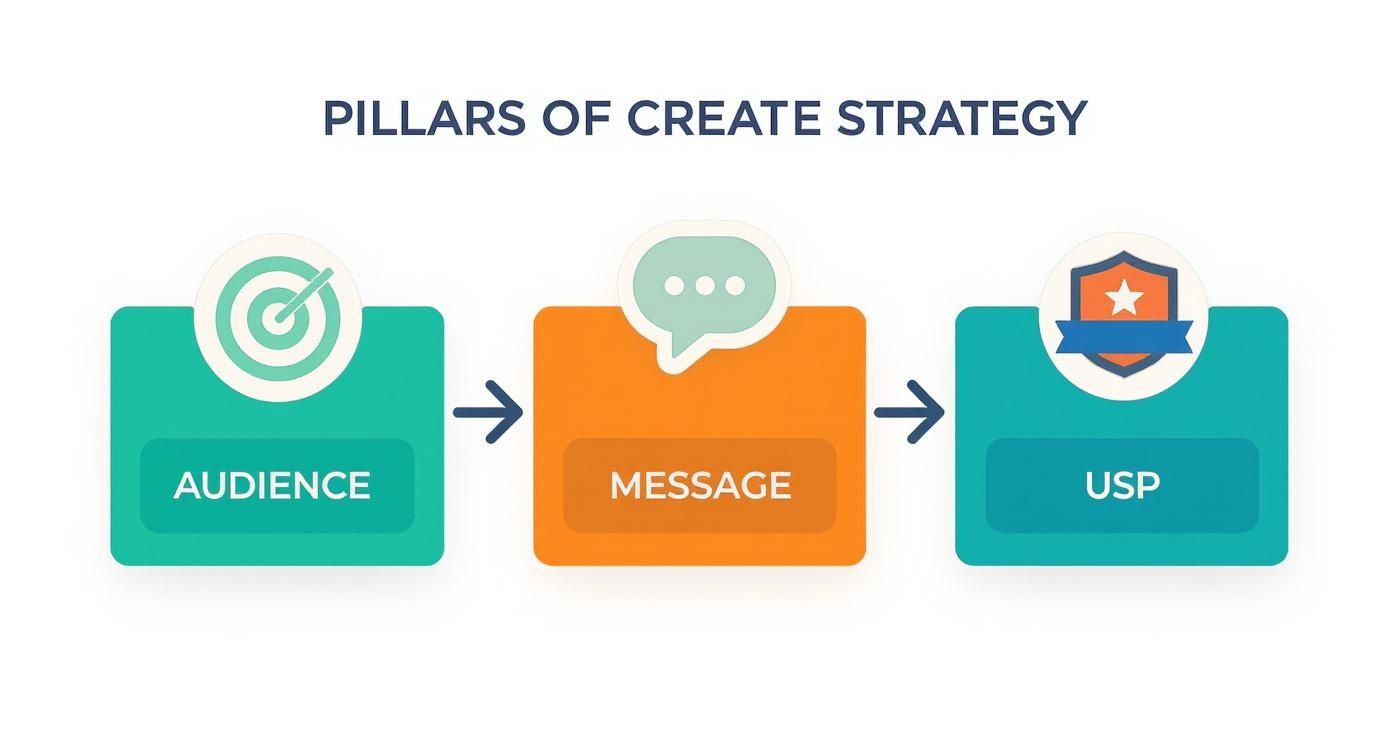
As you can see, a deep understanding of your audience is what directly shapes a message that will actually resonate and helps you zero in on the unique selling proposition that matters most to them.
Step 2: The Creative Brief
The creative brief is, without a doubt, the most important document in this entire process. It’s a tight, often single-page summary of all your research and key decisions, distilled into a direct and inspiring challenge for the creative team. A great brief is the difference between focused, brilliant work and chaotic, off-the-mark attempts.
This document isn’t just a formality; it’s the single source of truth that keeps everyone—from stakeholders to designers—rowing in the same direction. To get this part right, check out our detailed guide on https://www.reachlabs.ai/how-to-write-a-creative-brief/ that really sets your team up to win.
A great brief is a problem well-stated. It doesn’t hand creatives the solution, but it perfectly frames the problem that the creative work needs to solve.
Step 3: Ideation and Concepting
With a sharp, insightful brief in hand, the real fun begins. This is the brainstorming phase where the big ideas—the core creative concepts that bring the strategy to life—are born. The brief serves as your north star, ensuring every idea is strategically sound and directly addresses the problem you defined.
The goal here is to explore a few different creative territories. Don't just settle on the first idea. These concepts might come to life as taglines, rough visual mockups, or even simple storyboards that show different ways to communicate the core message. Once you have your core concept, you can apply it to specific channels using a social media content strategy playbook or other tactical guides.
Step 4: Refinement and Testing
Let's be honest: not all ideas are winners. This final step is all about picking the strongest concept (or two) and polishing it. Crucially, this often involves testing the top contenders with a small sample of your target audience to see what actually connects before you go all-in on a full campaign launch.
This feedback loop is priceless. It pulls subjective "I like it" opinions out of the equation and gives you real-world data on which concept is most likely to hit your goals. It ensures your creative investment is backed by evidence, not just a gut feeling.
Creative Strategy In Action: Real-World Examples

It’s one thing to talk about frameworks and theories, but it’s another to see a creative strategy come alive and change the game. The real magic happens when you see how these ideas translate into campaigns that don't just sell products but become part of our culture.
Let's break down three fantastic examples. These aren't just clever ads; they're the result of sharp insights, a crystal-clear message, and a unique creative angle that led to something truly memorable.
Spotify Wrapped: The Power of Personalization
Every year, Spotify’s "Wrapped" campaign completely takes over social media. It’s a brilliant piece of strategy because instead of broadcasting a generic message about their service, Spotify holds up a mirror and shows users a story about themselves.
The whole thing is built on a very simple, very human truth: we love our music, and we feel like it says something about who we are. Wrapped taps directly into that feeling.
- The Audience Insight: People see their listening habits as a badge of honor, a key part of their identity they're eager to share.
- The Core Message: "We get you. Here's the soundtrack to your year."
- The Execution: Bold, vibrant, and perfectly snackable infographics and playlists that feel custom-made for an Instagram story.
This strategy cleverly turns personal data into a worldwide cultural moment. It generates a tidal wave of free publicity and makes users feel seen, locking in their loyalty for another year. It’s personalization at its best. After all, a staggering 96% of marketers have found that creating personalized experiences directly boosts sales. You can discover more insights about the state of marketing to see just how central this idea has become.
Dove Real Beauty: Challenging The Narrative
Think back to beauty ads from twenty years ago. They were all about selling an impossible ideal with flawless models. Then came Dove's "Real Beauty" campaign, which flipped the entire script. It was a risky strategy built on sparking an emotional connection by tearing down outdated beauty standards.
Dove’s research uncovered a painful insight: very few women saw themselves as beautiful because they felt completely misrepresented by the media. Dove didn't just see a marketing gap; they saw an opportunity to lead a more honest and empowering conversation.
The "Real Beauty" campaign wasn't just about selling soap; it was about shifting an entire industry's perspective. It proved that a brand could stand for something meaningful and win hearts in the process.
Overnight, Dove went from just another soap on the shelf to a brand that stood for something bigger. It created a level of brand loyalty that competitors simply couldn't touch with a conventional ad campaign.
Airbnb Belong Anywhere: From Lodging to Living
When Airbnb first started, many people just saw it as a couch-surfing service or a cheap alternative to a hotel. To shake that image, the company created its "Belong Anywhere" strategy. The entire point was to change the conversation from a simple transaction (renting a space) to a deeply human one (living like a local).
The strategy tapped into our universal desire for connection and authenticity when we travel. Airbnb wasn't just selling you a roof over your head; it was offering the chance to feel truly at home, anywhere on the planet. This single idea completely transformed the brand, elevating it into a global community and carving out a premium spot in the travel market.
Measuring The Success Of Your Creative Strategy
A brilliant creative strategy is only as good as the results it brings in. To really prove its worth, you have to look past vanity metrics like "likes" and start measuring the actual impact of your work. The secret? Connect every single creative choice back to a clear business goal.
Without solid measurement, you're just guessing. You can't prove the return on investment (ROI), and you certainly can't make smart, data-driven decisions for your next campaign. It’s the difference between hoping something works and knowing it does. By tying your creative efforts to hard numbers, you can defend your budget and show everyone how great creative actually grows the business.
Matching Goals To The Right Metrics
Different goals need different ways of measuring success. Using one metric for every campaign is like trying to build a house with only a hammer—it just doesn't work. You need the right tool for the right job.
Let’s explore how to match your goals to the metrics that really count.
A good way to visualize this is to map your primary objective directly to the KPIs that will tell you if you're on the right track. This table makes it easy to see which numbers to watch based on what you're trying to achieve.
Matching Campaign Goals to Key Performance Indicators
| Campaign Goal | Primary KPIs to Track | Example Metric |
|---|---|---|
| Brand Awareness | Reach, Impressions, Share of Voice (SOV) | The percentage of industry-related conversations your brand is part of. |
| Audience Engagement | Likes, Comments, Shares, Time on Page | The average number of comments per post on your latest social campaign. |
| Lead Generation | Form Submissions, Download Counts, CTR | The total number of e-book downloads from a specific landing page. |
| Sales Conversion | Sales Revenue, Conversion Rate, Cart Value | The dollar amount of sales directly attributed to an ad campaign. |
Having a clear connection between your goal and your KPIs means you're not just collecting data; you're gathering intelligence that helps you make better decisions for the future.
Awareness vs. Engagement vs. Conversion
Let's dig a little deeper into these goals.
-
Goal: Brand Awareness
When you just want to get your brand’s name out there, the focus is all on visibility. How many people are seeing you? A key piece of this is understanding Share of Voice in advertising to see how you measure up against the competition. Your main KPIs here would be Share of Voice (SOV), social media mentions, and overall impression volume. -
Goal: Audience Engagement
If your goal is to build a community and spark a conversation, you need to track interactions. This proves your message is actually resonating, not just being passively scrolled past. Look at metrics like interaction rates (likes, comments, shares), how long people spend with your content, and video completion rates. -
Goal: Driving Conversion
When it's all about making sales or getting leads, your metrics have to be directly tied to those money-making actions. This is where your creative strategy shows it can turn eyeballs into revenue. The most important KPIs are lead generation forms completed, click-through rates (CTR) on your calls-to-action, and, of course, sales revenue.
A creative strategy without a measurement plan is just an idea. A creative strategy with a measurement plan is a business asset.
Building A Simple Measurement Framework
You don’t need a fancy, complicated dashboard to get started. Just begin by defining the main goal for each campaign before you launch it.
Is it awareness, engagement, or conversion?
Once you know the goal, just pick two or three key KPIs from the lists above to keep an eye on. This straightforward approach helps you tell a clear story with your data, showing stakeholders exactly how your creative is performing and giving you the insights to make the next campaign even better.
Modern Trends Shaping The Future Of Creative Strategy
Creative teams are in a constant state of reinvention as fresh tools and data reshape how brands tell their stories. Getting clear on what creative strategy really entails lets you adapt to new workflows without losing your unique voice.
AI-powered systems now handle parts of ideation and A/B testing, speeding up iterations while keeping human judgment front and center.
- Adaptive Personalization through machine learning algorithms
- Workflow Automation that frees creatives to focus on big ideas
- Data-Driven Concept Testing before full-scale production
These shifts carve out space for more original thinking. Yet no algorithm can replace true emotional resonance.
AI And Human Insight
Artificial intelligence excels at crunching millions of data points to uncover patterns. Still, it takes human intuition to shape those insights into stories that move people.
Imagine a travel brand using AI to segment audiences by behavior. Then a creative team adds local color and heartfelt narratives to spark real engagement.
Authentic Lo-Fi Content
People are tired of overproduced ads. They want honesty and raw energy.
Recent data shows 42% of top-spending campaigns use lo-fi, user-generated styles. At the same time, short-form video makes up 29.18% of all creative ads, proving authenticity cuts through the noise.
Brands are responding with behind-the-scenes snippets, customer tales straight from the source, and simple how-to clips.
Check out our guide on creative operations management to align your team around these modern practices.
“Blending new technologies with genuine human emotion is the secret to standout creative work.”
Striking the right balance between data-driven speed and unpolished authenticity is where the magic happens. Marketers who master both will lead the pack.
Blending Technology With Authenticity
Pair smart tools with a human touch to craft messages that resonate.
Best Practices To Follow:
- Automate repetitive editing tasks, then layer in personal creative flourishes.
- Source real customer stories to keep the content heartfelt and genuine.
This method ensures tech amplifies your message instead of overshadowing it.
Embrace these insights and innovate.
Got Questions About Creative Strategy? We’ve Got Answers.
Even after laying out the roadmap, it's natural to have a few questions when the rubber meets the road. Let's tackle some of the most common ones that pop up when people start building their own creative strategies.
Creative Strategy vs. Brand Strategy: What's the Difference?
It’s easy to get these two mixed up, but they play very different roles.
Think of your brand strategy as your company's North Star. It’s the big, enduring idea of who you are, what you stand for, and where you fit in the market. It’s the foundational stuff—the "why" behind everything you do.
A creative strategy, on the other hand, is the specific plan for how you bring that brand to life in a particular campaign. It’s the "how we show them who we are right now" to hit a specific, timely goal. It translates your brand’s soul into something people can see, hear, and feel.
How Often Should I Update My Creative Strategy?
Your brand identity should be rock-solid, but your creative strategy needs to be flexible. It’s definitely not a "set it and forget it" kind of thing.
A good rule of thumb is to create a new creative strategy for each major campaign or for a set period, like a quarter or a year. The key is to constantly check how it’s performing against your goals and be ready to adapt based on new data, audience feedback, or a shift in what your business needs.
Is This Just for Big Companies with Huge Budgets?
Not at all. A creative strategy is all about working smarter, not spending more. In fact, for a small business, a sharp strategy is even more important because it makes sure every single penny you spend is working as hard as it possibly can.
It’s what helps smaller brands punch above their weight. A focused strategy allows you to build a consistent, memorable voice that really connects with your specific audience, letting you stand out from bigger competitors by being more clever and relevant, not just louder.
Ready to build a strategy that gets results? ReachLabs.ai integrates world-class talent with data-driven insights to elevate your brand’s voice. Discover our creative solutions today.