
Boosting your marketing efficiency isn't about working harder; it's about getting more results from the same resources. It’s a systematic process of auditing what you’re doing, zeroing in on high-impact channels, automating the grunt work, and letting data guide your decisions to maximize every dollar spent.
Establishing Your Marketing Efficiency Baseline
You can't improve what you don't measure. Before you can make any meaningful changes, you need an honest, detailed picture of where you stand right now. This means getting past vanity metrics like likes or impressions and digging into the numbers that tie your marketing spend directly to business outcomes.
A thorough baseline audit is your true starting point. It’s where you roll up your sleeves and analyze performance data across every single channel to uncover hidden waste and pinpoint your strongest performers. Think of it less like staring at spreadsheets and more like interpreting the story your numbers are trying to tell you.
This simple three-step process is the best way to visualize how to kick off your audit.
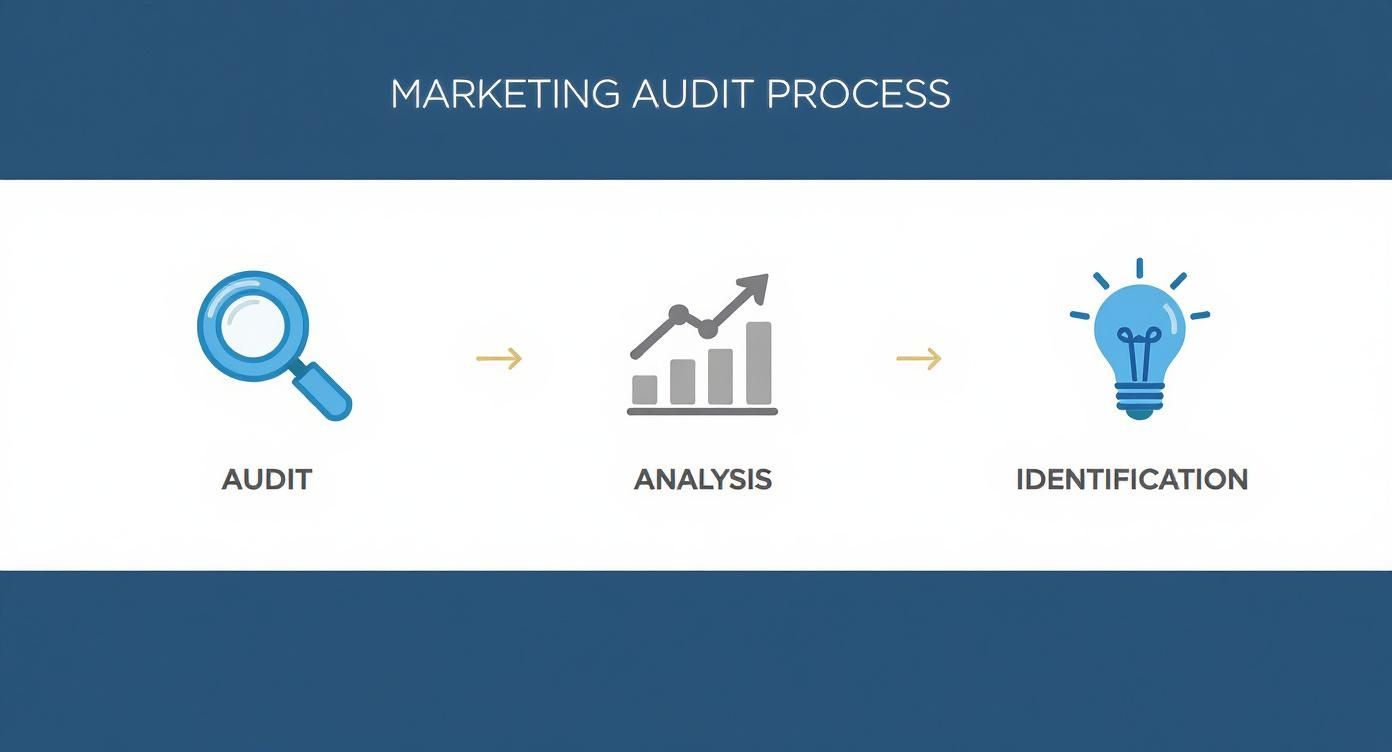
This flow—Audit, Analyze, and Identify—is the bedrock of a data-driven strategy. It’s how you turn raw data into genuinely actionable insights for improvement.
Key Metrics That Truly Define Efficiency
To start, you need to focus on a handful of Key Performance Indicators (KPIs) that actually define efficiency. Forget about drowning in dozens of data points. Instead, concentrate on the metrics that create a direct line between your efforts, revenue, and customer value.
Here's a quick-reference table defining the essential metrics for measuring marketing efficiency and why they're so important.
Key Marketing Efficiency KPIs to Track
| KPI (Key Performance Indicator) | What It Measures | Why It's Critical for Efficiency |
|---|---|---|
| Customer Acquisition Cost (CAC) | The total marketing and sales cost to acquire one new customer. | It reveals which channels are the most cost-effective for growth. A low CAC is a sign of high efficiency. |
| Customer Lifetime Value (LTV) | The total revenue you can expect from a single customer over their entire relationship with your business. | It shows you the long-term value of the customers you're acquiring, helping you justify marketing spend. |
| LTV to CAC Ratio | Compares the lifetime value of a customer to the cost of acquiring them. | This is the ultimate efficiency metric. A healthy ratio (ideally 3:1 or higher) proves your marketing is profitable. |
These core numbers give you a clear, objective benchmark to measure against. For a deeper dive, our guide on essential marketing performance metrics examples has you covered.
Conducting a Comprehensive Channel Audit
With your core KPIs defined, it's time to apply them to every one of your marketing channels. A channel audit means evaluating the performance of each platform—from social media and email to paid search and SEO—to see how it contributes to your bottom line.
Don’t just look at which channels bring in the most leads. That's a rookie mistake. Instead, analyze which ones bring in the best leads—the ones with the highest LTV and the lowest CAC. You might discover that a channel generating fewer leads is actually producing your most profitable, long-term customers, making it a far more efficient place to invest your budget.
The goal of an audit isn't to find blame; it's to find opportunities. It's an objective look at what's working, what's not, and where your budget can be reallocated for maximum impact.
This data-first approach is no longer optional; it's standard practice. In fact, research from Salesforce shows that 88% of marketers now rely on analytics to guide their decisions. By establishing this clear, data-supported baseline, you're arming yourself with the insights needed to make smart, strategic changes that will drive real efficiency gains.
Get Your Workflows in Order to Free Up Your Team
Marketing efficiency isn’t just about the numbers on a final campaign report. It’s born from the people and the processes that power everything you do. The biggest resource drains are often invisible—hidden in clunky workflows and disconnected teams that quietly slow you down.
The first step is to drag these problems into the light.
Start by mapping out how you actually get work done. I mean really tracing the journey of a marketing project from the first spark of an idea to the final launch. Who touches it at each stage? Where are the handoffs? How long does each step really take, not how long you think it should?
This simple exercise is incredibly revealing. You'll immediately spot the bottlenecks, the redundant approval loops, and all the little steps that create friction without adding any real value. You’ll see exactly where a simple sign-off takes three days or where two people are doing the same work without realizing it.

This visual from Atlassian shows how agile marketing creates a continuous loop of improvement. By breaking massive projects into smaller, focused cycles, teams can adapt on the fly and keep the momentum going. It's a powerful way to get more done.
Borrowing Agile Principles for Marketing
The world of software development figured something out a long time ago: rigid, long-term plans often fall apart. Agile marketing takes that lesson and applies it to our world. The core idea is to choose rapid iteration and responsiveness over locking yourself into a six-month plan. This doesn't mean you ditch your strategy; it just means you execute it in a smarter, more flexible way.
Two of the most valuable agile practices you can adopt right now are sprints and daily check-ins.
- Sprints: These are short, focused bursts of work, usually lasting one or two weeks, where your team is dedicated to a specific set of tasks. Instead of a vague "website revamp" project that drags on for a quarter, you could run a two-week sprint focused only on redesigning the homepage.
- Daily Check-ins: I'm talking about quick, 15-minute stand-up meetings. Each person shares what they did yesterday, what's on their plate today, and—most importantly—any roadblocks. This simple habit brings incredible transparency, gets problems solved faster, and keeps everyone on the same page.
A team that flags roadblocks daily can solve them in hours. A team that waits for a weekly meeting lets those same issues stall progress for days, which absolutely kills efficiency and morale.
Adopting these concepts helps your team pivot based on what the data is telling you now, not what you assumed three months ago. If you want to dive deeper, learning about marketing workflow management can give you a more structured way to build these systems.
Tearing Down the Wall Between Marketing and Sales
One of the most classic—and most damaging—inefficiencies in any business is the friction between marketing and sales. When they operate in their own worlds with different goals and metrics, you end up with wasted ad spend, frustrated salespeople, and a confusing journey for your customers.
Real alignment begins with shared goals. It sounds simple, but it’s critical. Both teams need to agree on a single definition of a "qualified lead" and be working toward the same revenue targets. The best way to formalize this is with a Service Level Agreement (SLA). This is just a simple document that outlines what each team promises to deliver to the other.
An SLA might look something like this:
- Marketing commits to delivering 100 marketing-qualified leads (MQLs) per month that fit our ideal customer profile (e.g., specific industry, company size, and job title).
- Sales commits to contacting 90% of those MQLs within 24 hours.
Suddenly, you have mutual accountability. Marketing is on the hook for lead quality, not just quantity, and sales has a clear obligation to follow up promptly. This simple agreement ends the blame game and builds a seamless pipeline from that first click to the final sale, making your entire organization more efficient.
Use Automation to Scale Smarter
Technology should be the engine of your marketing, not an anchor weighing it down. I’ve seen so many teams get bogged down by a messy tech stack—paying for redundant tools, or worse, only using 10% of a powerful platform's capabilities. The real goal isn't just to have tech; it's to build a smart ecosystem that handles the grunt work so your team can focus on what humans do best: strategy and creativity.
Start by taking a hard look at your current tools. Where’s the overlap? Are you paying for two different social schedulers or email platforms that do basically the same thing? Also, dig into the features you're not using. You might be surprised to find that a tool you already pay for has automation features that could save your team hours every week.

This isn't about hoarding software. It's about making your existing investments work harder and smarter for you.
Pinpoint Your Best Automation Opportunities
Once you’ve tidied up your tech stack, it's time to find the quick wins. Don't try to automate your entire department overnight. That’s a recipe for disaster. Instead, go after the most repetitive, time-sucking tasks that are critical to your daily operations.
What are some low-hanging fruit? From my experience, these are often the best places to start:
- Email Nurturing: Set up automated email sequences that trigger when someone subscribes or downloads a resource. This keeps the conversation going without you having to lift a finger, moving leads along based on their behavior.
- Social Media Scheduling: Use a tool to plan and schedule your posts ahead of time. The best ones will even help you post at the optimal times for your audience or automatically re-share popular evergreen content to keep your feed active.
- Dynamic Website Content: Tap into your CRM data to personalize the experience for website visitors. Imagine showing a different offer or featured product to a returning customer versus a first-time visitor. That’s how you make your site feel relevant and drive conversions.
Automating the right tasks isn't just a time-saver. It's about creating a consistent, personalized customer journey at a scale that's flat-out impossible for a human team to manage manually.
If you want to get into the nitty-gritty of building these systems, this guide on marketing automation workflows is a great resource for mapping out the practical steps.
To visualize just how much of a difference this can make, let's look at some common tasks and how automation transforms them.
High-Impact Automation Opportunities for Marketers
| Manual Marketing Task | Automated Solution | Primary Benefit |
|---|---|---|
| Manually posting on social media daily | Using tools like Buffer or Sprout Social to schedule posts in advance | Time Savings & Consistency: Frees up daily time and ensures a consistent posting schedule. |
| Sending one-off welcome emails to new leads | Setting up a multi-step welcome sequence in a platform like Mailchimp | Lead Nurturing: Engages new leads immediately and consistently guides them through the funnel. |
| Replying to every social media comment by hand | Implementing a tool that auto-responds to common questions or keywords | Improved Engagement: Ensures timely responses and frees up social media managers for high-value interactions. |
| Manually segmenting email lists based on behavior | Using rules in your CRM or ESP to automatically add contacts to segments | Better Personalization: Delivers more relevant content to your audience, boosting open and click-through rates. |
As you can see, the shift isn't just about doing the same things faster—it's about enabling a more strategic and effective way of working.
AI Is Changing the Game
If automation is the engine, artificial intelligence is the supercharger. AI is moving marketing beyond simple "if this, then that" rules and into the realm of predictive analytics and smart content creation. These tools can sift through massive datasets to tell you which customers are likely to churn, what blog topic will resonate most, or even draft initial ad copy.
The numbers speak for themselves. According to 2024 research, 88% of marketers are already using AI in their workflows. The results? 83% report better operational efficiency and 84% are delivering content faster. And it's not slowing down; 75% of social marketers are planning to use generative AI to improve customer experiences, expecting a productivity bump of up to 15%.
It's also worth digging into things like the hidden ROI of comment automation to see how these seemingly small efficiencies add up to a major impact on your bottom line.
How to Adopt New Tools Without the Headache
Chasing every new shiny tool is a great way to blow your budget. To make sure any new tech actually delivers value, you need a smart, structured approach.
- Start with the Problem: First, clearly define the inefficiency you need to fix. Is your lead follow-up too slow? Is your content creation process a bottleneck? Get specific.
- Define What Success Looks Like: Before you even sign up for a trial, decide how you'll measure success. Is it a 10% reduction in time spent on a task? A 15% lift in lead response rate? Set a clear KPI.
- Run a Small Test (A Pilot Program): Don't roll out a new tool to the entire department at once. Test it with a small team on a specific project. This lets you iron out any issues and prove its value before making a bigger commitment.
- Measure and Decide: Once the pilot is over, look at the data. Did you hit your KPI? If the tool is delivering a clear, positive ROI, then it's time to roll it out more widely.
Following this simple process keeps you from getting distracted by hype and ensures every tool in your stack is actively working to make your marketing more efficient and effective.
4. Fine-Tuning Your Campaigns with Smart Testing and Attribution
Launching a campaign isn’t the finish line; it’s the starting gun. The real wins in marketing efficiency don't come from the initial launch but from creating a culture of constant improvement. Think of every ad, email, and landing page not as a final product, but as a living experiment.
We have to move past the old "set it and forget it" mentality. The goal is to build a feedback loop: test, learn, iterate, repeat.
This turns your marketing engine into a system that gets smarter over time. You stop relying on gut feelings and start making confident, data-backed decisions that genuinely boost performance and make your budget work harder.
Getting Started with A/B and Multivariate Testing
The cornerstone of any solid optimization strategy is testing. While the terms might sound a bit jargony, the concepts behind A/B and multivariate testing are simple and incredibly effective.
-
A/B Testing (Split Testing): This is your bread and butter. You take one asset—say, an email subject line or a landing page CTA—and create two versions that differ by a single element. Maybe you test a red "Get Started" button (Version A) against a green one (Version B). You show each to a different slice of your audience and see which one drives more clicks. Simple.
-
Multivariate Testing: This is the next level. Instead of changing just one thing, you test several variables at once to find the winning combination. For example, on a single landing page, you could simultaneously test two headlines, two hero images, and two button colors. It requires more traffic to get a clear winner, but the insights can be profound, showing you how different elements play off each other.
My advice? Start small. Don't try to overhaul your entire homepage in one go. Pick one high-impact element and run a clean A/B test. Nailing this discipline builds the muscle you'll need for more complex experiments later.
How to Structure a Test That Actually Teaches You Something
A test is only as good as the question you're asking. Randomly tweaking colors and fonts is a fast track to nowhere. For testing to improve your efficiency, it needs a purpose. It needs a strong hypothesis.
A solid hypothesis isn't just a guess; it's a structured statement: "If I change [X], then [Y] will happen, because of [Z]."
For instance, a weak hypothesis is: "Let's test a new headline." A much stronger one is: "If we change the headline to highlight our 'free shipping' offer, then the add-to-cart rate will increase, because our recent customer survey flagged shipping costs as a top concern."
A well-formed hypothesis forces you to articulate why you believe a change will work. This simple step separates strategic testing from just throwing things at the wall to see what sticks.
Once you have a few good hypotheses, you have to prioritize. Not all tests are created equal. Focus your energy on the pages and assets that get the most traffic and have the biggest impact on your bottom line. A 5% lift on your main checkout page is worth far more than a 50% lift on a forgotten blog post from three years ago.
Moving Beyond Last-Click Attribution
As you get better at optimizing individual campaigns, you need to understand how all your channels work together. This is where most marketers get tripped up by last-click attribution.
This model gives 100% of the credit for a sale to the very last touchpoint a customer had before converting. It's a dangerously simple way of looking at the world. It almost always over-credits channels like branded search and email while completely ignoring the top-of-funnel activities that introduced the customer to you in the first place.
To get a more accurate view, you have to explore better attribution models:
- Linear: Spreads credit out evenly across every touchpoint in the journey.
- Time Decay: Gives more credit to the touchpoints closest to the final conversion.
- Position-Based (U-Shaped): A great starting point. It gives 40% of the credit to the first touch, 40% to the last touch, and splits the remaining 20% across all the interactions in the middle.
Just switching from last-click to a position-based model can radically change your perspective on what's working. You might realize your social media ads, which rarely get the final click, are actually your most valuable tool for bringing in new customers who convert later. This is the kind of insight that lets you reallocate your budget with real confidence.
You can get really granular here, too, by applying this thinking to specific platforms and using strategies like A/B testing for YouTube Shorts. This shift in measurement philosophy is absolutely fundamental to unlocking the next level of marketing efficiency.
Getting Smart with Your Budget and Channel Mix
Let’s be honest: effective marketing comes down to putting your money where it counts. This is where a smart, deliberate approach to budget allocation becomes your secret weapon. It’s not just about spending; it’s about strategically investing in the channels that actually move the needle for your business, whether that’s getting your name out there, nurturing quality leads, or closing deals.
The goal here is to stop spreading your budget thin like peanut butter across every platform imaginable. Instead, we’re going to get surgical. We’ll use real data to pinpoint your most profitable channels, double down on what’s working, and carefully trim the fat from the ones that aren’t—all without losing your momentum.
Figuring Out Which Channels Are Your All-Stars
Before you can improve anything, you have to know what “good” actually looks like for your business. Spoiler: it’s rarely about which channel brings in the most clicks. It’s about which one gives you the best return on your investment for your specific goals.
A great first step is to group your channels by the job they do in your customer’s journey.
- Awareness Channels: This is your top-of-funnel stuff, like organic social media posts or PR hits. The goal isn't an immediate sale; it's about reach and getting people talking. You might measure success here with metrics like brand mentions or share of voice.
- Consideration Channels: Think of your blog, SEO efforts, and email newsletters. Here, you're building a relationship and nurturing interest. Look at metrics like time on page, click-through rates on your guides, and how many people download your lead magnets.
- Conversion Channels: This is the bottom of the funnel, where paid search, retargeting ads, and direct sales promotions do the heavy lifting. The metrics that matter most here are almost always Return on Ad Spend (ROAS) or Customer Acquisition Cost (CAC).
When you look at each channel through the lens of its specific job, you get a much clearer, more honest picture of its performance. You might realize your blog (a consideration channel) doesn't directly convert many people, but it’s the primary source of the high-intent leads that your paid search campaigns (a conversion channel) eventually close.
The Art of Shifting Funds for Maximum Impact
Once you’ve separated the winners from the laggards, it’s time to start reallocating your budget. But hold on—this isn’t about just yanking all the money from your worst channel and dumping it into your best one. That’s a recipe for unintended consequences.
For example, say your data shows that Paid Social Channel A has a way higher CAC than Paid Social Channel B. The knee-jerk reaction is to kill the spend on A and pour it all into B. But what if Channel A is your only way of reaching a super-specific, high-value customer segment that Channel B can't even touch?
A much smarter move is to make a gradual shift. Try reducing the budget for the underperforming campaigns within Channel A by 20% and use that cash to scale up the top-performing campaigns in Channel B. Then, watch the numbers closely for a few weeks. This kind of controlled experiment lets you optimize without accidentally torpedoing your overall lead volume.
This methodical process turns your budget from a static, set-it-and-forget-it plan into a living, breathing tool that constantly adapts to what the data is telling you. That’s the core of real marketing efficiency.
Playing to Modern Platform Strengths
The channels we use are always evolving, and that creates new opportunities to be more efficient. The massive shift toward mobile and social media is a perfect example. Global social media ad spending is on track to blow past $276 billion, with an incredible 80% of that coming directly from mobile devices.
Platforms like TikTok have completely changed the game, showing an average ROAS that's 2.4 times the median for old-school display ads. Why? Because their algorithms are incredibly good at targeting, and the ad formats are naturally engaging. You can dig into more of these trends in the global digital marketing statistics from Loop Media.
The lesson here is simple but powerful: efficiency is often found by aligning your spending with platforms that have incredible targeting capabilities. A channel that lets you reach your perfect customer with laser precision will almost always deliver a better return than one that uses a broad, shotgun approach. It ensures every dollar you spend is working as hard as it possibly can to grow your business.
Frequently Asked Questions About Marketing Efficiency
When you start digging into marketing efficiency, the big-picture strategy is one thing, but the day-to-day execution is where the real questions pop up. It's easy to get stuck on the details—how to budget, which tools to use, or how to get your team to actually use them.
Let's tackle some of the most common hurdles I see marketers face. These are the practical, in-the-weeds questions that can make or break your efficiency efforts.
How Much of My Budget Should I Risk on New Channels?
This is the classic tug-of-war: stick with what you know works, or take a chance on something new? There's no magic number that works for every business, but a framework I’ve used successfully for years is the 90/10 rule. It's simple and effective.
- 90% of your budget stays with your proven, high-performing channels. These are your bread-and-butter workhorses—the campaigns and platforms that consistently deliver a solid return.
- 10% of your budget becomes your R&D fund. This is your license to experiment. Test that new social platform, try a different ad format, or dip your toes into an emerging channel without putting your core results at risk.
This approach gives you a structured way to innovate while keeping your risk managed. If one of your experiments starts showing real promise after a couple of months, you can confidently begin shifting more budget its way, all based on actual performance data.
What’s the Best Way to Get My Team to Adopt New Tools?
Getting people to change their habits is tough, and just dropping a new piece of software on your team is a recipe for failure. The secret is to stop talking about the technology and start talking about the problems it solves for them.
Don't sell the tool; sell the solution. A new project management platform isn't just software—it's the end of hunting through email chains for that one attachment. An automation tool isn't just tech—it's getting three hours of tedious work back every single week.
To make the transition as smooth as possible:
- First, run a small pilot program with a few of your most enthusiastic team members. Let them work out the kinks and become your internal champions.
- Next, provide hands-on training and create simple one-pagers or short video tutorials they can reference later. Don't just rely on the tool's help docs.
- Finally, celebrate the early wins from your pilot group. Show the rest of the team tangible proof of how the tool is making life easier and driving better results.
How Often Should I Review My Marketing Efficiency Metrics?
The right review cadence isn't one-size-fits-all; it depends entirely on the metric you're looking at. If you try to review everything all the time, you'll drown in data. The key is to separate your tactical check-ins from your strategic deep dives.
I like to think about it in tiers:
- Weekly: This is for your in-the-weeds tactical metrics. You should be looking at things like Click-Through Rate (CTR) and Cost Per Click (CPC) for active campaigns. These quick checks let you make fast adjustments to optimize performance on the fly.
- Monthly: Zoom out a bit and look at your channel-level performance. How is your SEO traffic trending? Is paid social hitting its lead goals for the month? This is about course-correction.
- Quarterly: Now it's time for the big picture. This is when you dig into your most important efficiency KPIs like Customer Acquisition Cost (CAC) and the LTV to CAC ratio. Your quarterly review is where you make major strategic calls, like reallocating your budget for the next three months.
This tiered rhythm ensures you're making smart, data-backed decisions at every level without getting bogged down in analysis paralysis. It's the core of running an efficient marketing operation.
Ready to stop guessing and start executing with a team of specialists? At ReachLabs.ai, we blend data-driven insights with world-class talent to build marketing strategies that deliver real results. Let us help you elevate your brand and maximize your efficiency. Discover how we can help you grow.