
SEO is one of the few marketing channels that can keep lowering acquisition costs after the initial work is done. That upside is why small business owners keep shopping for agencies. It is also why choosing the wrong one gets expensive fast.
A weak fit usually does not fail because the agency is doing nothing. It fails because the service model does not match how the business makes money. A local service company needs stronger visibility in maps, cleaner location signals, and pages that convert nearby demand. An e-commerce brand needs site structure, product and category optimization, and technical work that supports scale. A B2B company usually needs content tied to longer sales cycles, lead qualification, and reporting that connects rankings to pipeline.
That is the decision framework that matters before you compare provider names. Start with business type, average customer value, sales cycle length, and whether SEO needs to produce calls, online sales, or qualified leads. Then review agencies based on execution depth, reporting quality, pricing logic, and how clearly they connect search work to revenue outcomes.
I also look for channel overlap early. If video influences discovery or trust in your sales process, an agency should understand video SEO best practices, not just blog content and title tags. If you want a broader view of how SEO fits into paid media, content, and conversion work, this overview of internet marketing and SEO services for growth-focused businesses is a useful reference.
The agencies in this guide are easier to judge once that framework is clear. Brand recognition matters less than fit, operating style, and whether the engagement matches the kind of search demand your business needs to win.
Choose the right SEO service for your business type
Small businesses waste money on SEO when the service model does not match how customers buy. The fastest way to avoid that mistake is to sort agencies by business type before you compare brand names, retainers, or case studies.
Start with the revenue path. A local service company needs stronger map visibility and location-page performance. An e-commerce brand needs technical execution that protects category and product rankings at scale. A B2B firm needs search work tied to qualified leads, not vanity traffic. If you want a more detailed agency selection process, this guide on how to choose a digital marketing agency is a useful companion.
Local businesses need local intent coverage first
For local companies, the best SEO partner usually is not the one publishing the most blog posts. It is the one that can improve Google Business Profile management, service-area relevance, review flow, location pages, and call-driving conversion paths.
That trade-off matters. I have seen small businesses spend months on content while weak GBP categories, duplicate listings, and thin service pages held back the calls they needed.
Use a simple screening question. Ask the agency how it measures success for a business that depends on nearby demand. Good answers mention map visibility, phone calls, booked appointments, and leads by location. Weak answers jump straight to traffic charts.
E-commerce businesses need technical control and margin awareness
E-commerce SEO gets expensive fast when an agency treats a store like a brochure site. Product templates, collection pages, internal linking, crawl waste, duplicate content, schema, and out-of-stock handling affect revenue directly.
This is also where specialization matters. A local SEO shop may do fine work for a dentist or HVAC company and still struggle with faceted navigation, product cannibalization, or category-page intent. Store owners should ask how the agency prioritizes fixes that improve both rankings and conversion value, not just sessions.
If video supports product discovery or trust, ask whether the team understands video SEO best practices alongside on-page and technical work. That is not a side issue for many stores. It affects how products get found and evaluated.
B2B businesses need pipeline logic
B2B SEO has a different math problem. Search volume can be low, sales cycles are longer, and a single qualified lead may be worth far more than a large spike in top-of-funnel traffic.
A good B2B SEO service should show discipline in three areas:
- Keyword selection: Terms tied to active evaluation, not just broad awareness.
- Content structure: Service pages and supporting assets that answer buying questions clearly.
- Reporting: Visibility into lead quality, sales conversations, and contribution to pipeline.
Small-business owners should push hard on attribution. If an agency cannot explain how it connects organic search work to demos, consultations, or sales-qualified leads, the engagement may produce activity without much business value.
Budget should shape the scope of work
Pricing in small-business SEO varies because the work itself varies. A lighter local engagement may focus on GBP optimization, citations, page updates, and reporting. A higher-fee engagement may include technical audits, content production, CRO input, analytics setup, and multi-location support. Thryv’s overview of small-business SEO pricing shows just how wide that range can be, from lower-cost monthly options to larger annual investments depending on scope and provider type (Thryv guide to SEO services for small business).
The practical takeaway is simple. Do not buy on price alone. Buy based on fit between your business model and the work required to produce a return. A local lead-gen company, a growing Shopify brand, and a niche B2B firm can all justify SEO spend, but they should not buy the same service package.
1. Digital Strategies

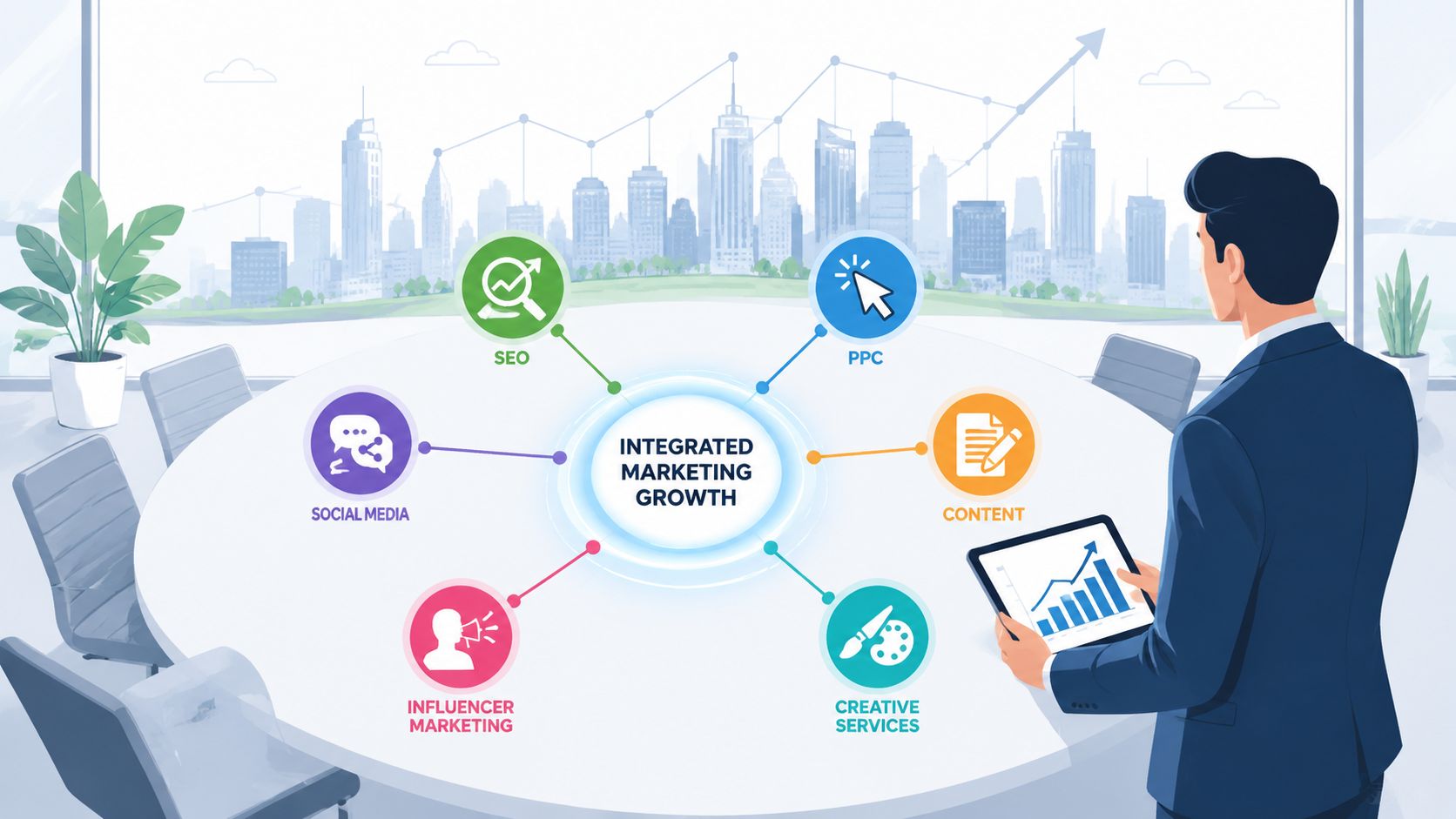
Digital Strategies by ReachLabs.ai is a strong option for small businesses that need SEO to work as part of a larger growth system. Instead of treating organic search as a stand-alone service, it combines SEO with SEM, PPC, creative support, influencer campaigns, and outbound programs. That matters for owners who cannot afford a six-month wait for traction while rankings build.
I usually recommend this model for companies that already know a single-channel engagement will not solve the core problem. If leads are inconsistent, landing pages underperform, and paid acquisition lacks a clear content strategy, an integrated partner can fix more of the bottlenecks at once.
That does not make it the right fit for everyone.
Where Digital Strategies fits in a small-business decision framework
For a local service business, this approach makes sense when the goal goes beyond map pack visibility and basic page updates. A law firm, med spa, home services company, or clinic may need local SEO, paid search coverage for high-intent terms, and better conversion paths on service pages. In that situation, one team managing the full funnel often produces cleaner execution.
For an e-commerce brand, the case is a little different. SEO alone can build category and product visibility over time, but shopping ads, landing page testing, and creative assets usually drive faster revenue feedback. A partner that handles both can make budget decisions based on margin, conversion rate, and search demand instead of channel politics.
For B2B companies, the value is usually in coordination. Organic search can bring in evaluation-stage traffic, but outbound, LinkedIn programs, and paid campaigns often help create demand around narrower services or longer sales cycles. If that sounds familiar, this digital marketing strategy for small business growth gives useful context for how the channels should support each other.
What stands out
The main strength here is coordination. Messaging stays aligned across ads, organic pages, and follow-up campaigns. Landing pages improve faster because the same team can see what converts in paid search and apply those lessons to SEO pages. Budget allocation also gets more practical. If a keyword set is too competitive to wait on, paid search can cover the gap while the organic program matures.
That operating model is missing from a lot of lists of SEO services for small businesses. Many firms are good at one slice of search. Fewer can connect traffic growth to conversion rate, campaign strategy, and near-term pipeline.
For service details, their internet marketing and SEO services page gives a clearer sense of how the search program fits into broader demand generation.
Pros, cons, and buying advice
Digital Strategies makes the most sense for owners who want one accountable partner across acquisition channels, not a collection of specialists who need constant direction.
Here is the practical trade-off:
- Integrated execution: SEO, PPC, creative, and outreach can be planned together instead of managed in separate silos.
- Revenue orientation: The offer is built around leads, sales opportunities, and conversion performance.
- Useful for lean teams: Smaller companies that do not have an in-house strategist can get structure and execution from one source.
- Broader channel support: Services like LinkedIn outreach, influencer support, and investor materials matter for some growth-stage companies.
There are downsides. If you only need low-cost local SEO maintenance, this scope may be broader than necessary. A specialized local SEO shop may be cheaper and easier to justify. If you run a large enterprise with heavy internal approval processes, a bigger agency may have more depth in enterprise governance, analytics, or technical implementation.
The buying question is simple. Do you need an SEO vendor, or do you need a partner that can improve traffic, conversion paths, and demand capture at the same time? If the second option is closer to your situation, Digital Strategies deserves a serious look.
One more point. Video and content distribution now affect how search programs perform, especially when brand trust and topical coverage matter. An integrated agency is usually in a better position to connect those assets to search goals, which is why guidance such as these video SEO best practices tends to be more useful when the team handling SEO also understands content production and promotion.
2. WebFX

WebFX is the agency to look at if you want process, reporting, and a full-service operation with enough bench strength to cover strategy, content, technical SEO, and local execution without piecing together freelancers.
Its biggest appeal for small businesses is operational maturity. Many owners don’t want to manage writers, developers, link builders, and analysts across separate vendors. WebFX is built for that do-it-for-me model.
Where WebFX makes sense
WebFX is a strong fit for companies that want clear deliverables and revenue attribution, not just ranking updates. Its proprietary reporting environment and broader service depth make it attractive for businesses that already know SEO needs to connect to leads and sales.
This also makes WebFX a reasonable option for owners comparing agencies and trying to separate polished sales talk from real execution. If you’re doing that comparison work, this guide on how to choose a digital marketing agency is worth reviewing alongside vendor calls, because it sharpens the questions you should ask about scope, accountability, and measurement.
Pros, cons, and buying advice
What I like about WebFX is that it usually appeals to the right kind of buyer: someone who values structure. If your business wants a partner with repeatable systems and broad channel support, that’s a good sign.
What to weigh before signing:
- Published small-business orientation: Easier to understand than agencies that hide behind “custom solutions.”
- End-to-end fulfillment: Helpful if you don’t have internal marketing operators.
- Revenue-minded reporting: Better than rank-only dashboards.
There are trade-offs. The entry point is higher than many budget providers, and standardized packages can leave edge-case businesses needing add-ons or custom work. That doesn’t make it a bad option. It just means it’s better for companies ready to invest in a more complete engagement.
Buying lens: Choose WebFX if you want operational scale and formal reporting. Skip it if you need a lightweight, highly flexible engagement at the low end of the market.
3. Straight North

Straight North has long appealed to small businesses that care more about lead generation than broad brand visibility. That distinction matters. Plenty of SEO agencies still report on rankings as if rankings were the goal. Straight North positions itself closer to the actual commercial outcome.
If your company sells by phone, consultation, or inbound form fill, that orientation is useful. It pushes the conversation toward conversion tracking and source visibility instead of generic traffic growth.
Lead-centric SEO is its real selling point
Straight North is a practical fit for service businesses, B2B firms, and regional companies that want SEO tied to measurable inquiry generation. Its support across local, national, and e-commerce campaigns also helps if you’re not sure whether your business needs one specific SEO lane.
This is also where strategic clarity matters. Before you sign with any lead-gen-focused agency, make sure your own priorities are clear. ReachLabs.ai has a useful piece on digital marketing strategy for small business that helps owners define channel roles before they outsource execution.
What to like and what to watch
Straight North’s value is less about flashy positioning and more about budgeting realism. It tends to attract buyers who want to know what kind of spend is required to compete.
That’s a plus, but it comes with a few limitations:
- Lead visibility focus: Better than SEO programs that stop at rankings.
- Custom scope: Useful if your market competition or site size creates complexity.
- Support across multiple business models: Helpful for mixed local and broader campaigns.
The downside is that consultation is usually required to land on final scope. That’s normal for serious SEO, but it can frustrate buyers who want a fixed menu. Retainer-heavy models can also feel like too much if you only want a project or a short-term sprint.
For the right buyer, though, Straight North is one of the more grounded choices on this list. It’s built for owners who ask, “How many qualified leads did search produce?” That’s the right question.
4. Blue Corona
Blue Corona makes the most sense for a specific buyer: a small business in home services that needs SEO tied closely to calls, booked jobs, and service-area visibility. If you run HVAC, plumbing, roofing, electrical, or a similar local service business, specialization can improve execution because the agency already understands the pages, tracking, and local search signals that drive revenue in those categories.
That business-type fit matters more than a broad service menu.
For trade companies, SEO usually is not a standalone rankings project. It is a lead-generation system built from local landing pages, Google Business Profile work, review acquisition, citation consistency, call tracking, and clear conversion paths on the site. Blue Corona stands out because that operating model matches how many contractors win business.
Why Blue Corona fits local service businesses
Blue Corona is strongest when search intent is local and urgent. A homeowner with a broken AC unit or a leaking pipe is not doing extended research. They are looking for a provider they can trust, in their area, right now. In those cases, traffic quality matters more than raw traffic volume, and phone attribution matters more than a generic ranking report.
That makes Blue Corona a practical choice for owners who want tighter visibility into where leads come from and which service lines are worth pushing harder.
Its trade focus also helps on the operational side. Local schema, location pages, service-area targeting, and review signals are not advanced ideas on their own, but they do require disciplined execution. As noted earlier in the article, those details can materially affect local performance when the market is crowded.
What to like and what to question
Blue Corona has a clear upside for the right company:
- Strong fit for home services: Better match for contractors than a broad SMB agency that splits attention across very different industries.
- Local lead focus: Useful if your main KPI is booked calls or form leads by service area.
- Asset ownership awareness: A smart consideration for owners who do not want dependency issues with their website or tracking setup.
The trade-off is just as important. Specialization narrows the fit. If you run an e-commerce brand or a B2B company with a long sales cycle, Blue Corona's strengths may not line up with your buying journey or content needs. Even within home services, metro competition can push scope and budget up quickly, especially if several established players are investing in local SEO and paid search at the same time.
I would treat Blue Corona as a decision-framework pick, not a universal recommendation. For local service businesses, a specialist can outperform a generalist because the playbook is tighter and the reporting is closer to revenue. For companies outside that model, a broader agency or a category-specific specialist is usually the better buy.
5. Thrive Internet Marketing Agency

Thrive Internet Marketing Agency is a practical middle-ground option for small businesses that want flexibility, broader channel support, and a month-to-month structure without sacrificing access to full-service execution.
A lot of SMB owners want SEO, but they also know SEO alone won’t cover the full demand gap in the early months. Thrive is appealing because it can pair SEO with PPC, local search work, and supporting services under one roof.
Best fit for businesses that want flexibility
Thrive makes the most sense for companies that need an agency relationship without locking into a rigid long-term contract. That doesn’t guarantee better results, but it does lower the perceived risk for owners who’ve had a bad agency experience before.
Its AI-oriented content positioning is also relevant in a search environment where Google’s results increasingly favor pages that are clear, useful, and well-structured for evolving search behaviors. I’d still evaluate the actual content process, not just the AI language in the pitch, but the broader orientation is sensible.
Where it helps and where it doesn’t
Thrive is a solid option when speed and coordination matter. If your pipeline needs near-term support, combining SEO with paid media is often smarter than asking organic search to do all the work on its own.
Reasons owners choose Thrive:
- Month-to-month terms: Easier commitment for cautious buyers.
- Multi-channel support: Helpful when SEO and PPC need to reinforce each other.
- Local SEO capability: Relevant for location-based businesses.
The main drawback is budget fit. Micro-budgets usually won’t get much traction here, and pricing tends to require a proposal instead of a fully transparent public rate card. For some buyers that’s fine. For very small firms, it can slow decision-making.
Good SEO agencies tell you where SEO should end and where paid search or CRO should start. That’s usually a sign they care about business results more than channel loyalty.
6. SmartSites

SmartSites fits small businesses that are past the "just get me ranking" stage and need a partner that can connect search traffic to actual revenue. That matters for owners deciding between a specialist and a broader agency. If your site needs technical fixes, stronger landing pages, paid search alignment, and conversion improvements at the same time, a wider service model can produce faster business impact than hiring separate vendors.
That does not make SmartSites the automatic pick for every company.
For a local service business, the value is usually coordination. One team can work on local visibility, service pages, calls-to-action, and lead tracking without handing work back and forth between multiple shops. For e-commerce brands, the fit depends more on whether the agency can handle category structure, collection page optimization, and conversion friction, not just blog content and backlinks. For B2B firms, I would look closely at how SmartSites supports long sales cycles, high-intent pages, and CRM-connected lead quality, because rankings alone rarely settle the ROI question.
Where SmartSites tends to fit best
SmartSites makes the most sense for owners who want one agency to manage several connected growth functions. That can reduce delays, conflicting recommendations, and the common problem where SEO drives traffic to pages that were never built to convert.
Its broader setup is useful in a search market where visibility depends on more than keyword placement. Brand credibility, page quality, user experience, and channel alignment all affect performance. As noted earlier in the article, agencies that combine SEO with adjacent capabilities often have an easier time turning traffic gains into measurable pipeline or sales outcomes.
What to evaluate before you sign
The main question is not whether SmartSites offers a wide service mix. It does. The better question is whether your business will use that breadth enough to justify custom pricing.
A good fit usually looks like this:
- You need cross-channel coordination: SEO, paid media, and landing page work influence the same revenue goal.
- Your website still needs improvement: Technical fixes and conversion updates are part of the growth plan.
- You want one accountable partner: Fewer vendors usually means fewer execution gaps.
- You operate in a repeatable service category: Agencies with pattern recognition can often launch faster.
The trade-off is cost clarity. SmartSites does not publish a simple rate card, so smaller businesses have to go through discovery before they know whether the scope matches the budget. That is normal for full-service agencies, but it can slow decisions for owners comparing several providers at once.
If you already have a strong developer, a good PPC manager, and clear conversion tracking, a specialized SEO agency may be the cleaner buy. If those pieces are still fragmented, SmartSites is easier to justify because the value comes from integration, not just rankings.
7. Boostability

Boostability is the entry-level managed SEO option on this list. It tends to fit very small businesses that need help with local search basics, don’t have large budgets, and want a stepping stone into professional SEO before committing to a larger agency relationship.
That’s a legitimate market need. Not every business is ready for a multi-channel growth partner or a heavy monthly retainer. Sometimes the right first move is getting the local fundamentals under control.
Where Boostability fits best
Boostability is most useful for businesses that need Google Business Profile optimization, citation work, basic on-page support, and educational guidance about SEO timelines and budgeting. It’s also relevant for agencies looking for white-label fulfillment.
Affordable SEO demand is growing. One verified dataset says adoption of affordable SEO packages in the $1K to $10K per month range surged year over year in a 2025 SEMrush Agency Network data point, and many SMBs are choosing agency partners for white-label technical SEO and local support (Knapsack Creative overview of SEO companies for small businesses).
Strengths and limitations
Boostability’s biggest strength is accessibility. It’s built for smaller businesses, and that shows in the service framing.
A few practical considerations:
- Budget-friendly orientation: Better entry point for very small firms.
- Local SEO focus: Good for businesses where map visibility matters more than national reach.
- Useful stepping stone: Can help a company build baseline performance before moving upstream.
The trade-off is customization. Smaller-budget SEO programs can become standardized quickly, and you’ll want to vet link-building quality and strategic depth if your market is competitive. If your business operates in a crowded city or a highly contested category, you may outgrow this model faster than expected.
Top 7 Small-Business SEO Services Comparison
| Service | 🔄 Implementation complexity | ⚡ Resource requirements & timing | ⭐ Expected outcomes | 💡 Ideal use cases | 📊 Key advantages |
|---|---|---|---|---|---|
| Digital Strategies, SEO, SEM, PPC and more | High, coordinated SEO + SEM + cross‑channel services | Medium; ongoing SEO (months) + PPC for immediate demand; SMB‑friendly pricing | ⭐⭐⭐⭐, sustainable organic growth + immediate demand capture | SMBs needing combined long‑term growth and short‑term demand | Integrated full‑funnel, conversion‑focused, SEO Optimization Toolkit, multi‑channel execution |
| WebFX | Moderate, structured workflows with large teams & proprietary tools | High; starts ≈ $3,000/month, agency resources available | ⭐⭐⭐⭐⭐, measurable ROI with revenue attribution | SMBs wanting a do‑it‑for‑me program with clear reporting | Clear pricing/scope, RevenueCloudFX attribution, end‑to‑end execution |
| Straight North | Moderate, lead‑generation process with unified reporting | Medium; starts ≈ $1,500/month, typical $4k–$8k | ⭐⭐⭐⭐, lead‑centric, measurable conversions | Owners focused on lead volume and conversion visibility | GoNorth! reporting, real‑world budget guidance, custom scopes |
| Blue Corona | Moderate, industry‑specific local SEO workflows (home/trades) | Medium; month‑to‑month model; audit fee ≈ $2.5k–$3.5k | ⭐⭐⭐⭐, strong local lead tracking for trade services | Home & trade service SMBs, multi‑location businesses | Lead tracking & call analytics, no long‑term contracts, asset ownership |
| Thrive Internet Marketing Agency | Moderate, multi‑channel with AI‑assisted content optimization | Medium; lead selector starts ≈ $2,500/month; month‑to‑month | ⭐⭐⭐⭐, flexible multi‑channel pipeline acceleration | SMBs wanting flexible terms and AI content support | Month‑to‑month terms, combine SEO+PPC, AI‑oriented content optimization |
| SmartSites | Moderate, proposal‑driven with vertical playbooks | Variable; custom quotes, may deprioritize very small budgets | ⭐⭐⭐⭐, integrated SEO + paid + CRO improvements | Local/service businesses seeking integrated growth strategies | In‑house link building, vertical playbooks, ability to pair SEO with paid & CRO |
| Boostability | Low, template/white‑label focused local SEO programs | Low; SMB‑oriented budgets, entry‑level managed SEO | ⭐⭐⭐, steady local visibility over 6–9 months | Very small businesses or agencies needing white‑label/local fulfillment | GBP optimization, citation management, educational resources, partner options |
Your Next Step to Measurable SEO Success
Organic search often becomes one of the few marketing channels that can keep producing leads after the work is done. That upside is real, but only if you choose an agency that fits how your business grows.
The decision gets clearer once you stop comparing firms by brand recognition alone and start judging fit. A local service company needs local visibility, call tracking, and fast response workflows. An e-commerce business usually needs technical fixes, category page strategy, and stronger product discovery. A B2B company with a long sales cycle needs content tied to buying stages, qualified lead reporting, and alignment with sales follow-up. Those are different operating models, so they should not be buying the same SEO engagement.
Results also depend on what your team can support internally. Some agencies expect you to write content, approve pages quickly, and handle implementation through your developer. Others own more of the process. I usually advise small business owners to choose based on execution capacity first, then price. A lower monthly retainer can become expensive if work stalls for three months because no one on your side can move it forward.
Full-service partner or specialist agency
A specialist agency makes sense when the problem is narrow and well defined. A plumber trying to improve map pack visibility in two counties has a very different need from a SaaS firm trying to build non-branded search demand. In a focused engagement, a specialist can often work faster, use tighter playbooks, and avoid wasting budget on services you will not use.
A full-service partner makes more sense when SEO is only one part of the growth problem. If weak landing pages, unclear messaging, poor conversion tracking, or disconnected paid search campaigns are dragging down performance, rankings alone will not solve it. In that situation, one team owning strategy across channels usually creates better accountability and fewer handoff problems.
That is the practical case for considering ReachLabs.ai. The value is not isolated SEO output. The value is coordinated execution across SEO, paid search, creative, outreach, and business growth support when those functions need to work together.
A practical decision framework
Use these questions in your final agency calls:
- Business type: Is your growth model local, e-commerce, or B2B?
- Primary outcome: Do you need phone calls, form fills, booked appointments, online purchases, or stronger pipeline quality?
- Time horizon: Can you give SEO time to build, or do you need paid media support while organic traction develops?
- Internal capacity: Who will approve content, handle site changes, and respond to leads once traffic increases?
- Scope fit: Do you need a specialist for one problem, or a broader partner that can improve the whole funnel?
One more point matters here. Small business owners often spend too much time comparing line-item pricing and too little time testing the agency's thinking. Ask what they would do in the first 90 days. Ask what they need from your team. Ask how they measure lead quality, not just rankings and traffic. A credible agency will give direct answers, explain trade-offs, and set expectations that sound grounded rather than dramatic.
The right next step is simple. Cut your shortlist to the firms that match your business type and operating reality. Then choose the partner with the clearest plan to turn search visibility into revenue, not just reports.