
To generate leads online, you first have to build a strategic foundation that’s laser-focused on your ideal customer and an offer they can’t refuse. This isn't about jumping straight into tactics; it's about defining your audience, creating a compelling value proposition, and setting clear goals to track what's working.
Building Your Lead Generation Foundation
Trying to generate leads with social media ads or content before you have a solid plan is like building a house without a blueprint. You might get something up, but it won't be stable or effective. A strong foundation ensures every ounce of marketing effort is purposeful, efficient, and aimed squarely at the right people.
Frankly, this foundational work is the most critical part of creating a system that consistently brings in high-quality leads. It all starts with an almost obsessive understanding of who you're trying to reach.
Define Your Ideal Customer Profile
Forget generic demographics. To really connect with potential customers, you need to build an Ideal Customer Profile (ICP) that feels like a real person. This means digging deeper than just age and location to uncover their true motivations, their biggest challenges, and where they hang out online. What keeps them up at night? What frustrations are they desperately trying to solve in their job?
Think about it this way:
- Pain Points and Challenges: Pinpoint the exact problems your product or service solves. A company selling project management software isn't just selling a tool; they're selling relief from missed deadlines and chaotic workflows.
- Online Habits: Where do they actually spend their time online? Are they heavy LinkedIn users, scrolling through Instagram, or active in niche Reddit communities? Knowing this tells you exactly where to show up.
- Motivations and Goals: What does success look like for them? When you understand their aspirations, you can frame your offer not just as a solution, but as a direct path to achieving their goals.
A well-defined ICP is your north star for everything that follows. If you need a hand with this, you can learn more about how to identify your target audience in our comprehensive guide.
Craft a Compelling Value Proposition
Once you know who you’re talking to, you have to give them a powerful reason to listen. Your value proposition is a clear, concise promise of the value you deliver. It has to instantly answer their unspoken question: "What's in it for me?"
A weak offer gets ignored. A strong one, on the other hand, can make a prospect feel truly understood and eager to learn more. For instance, instead of a bland statement like "We sell accounting software," a much stronger proposition is, "Our software saves small business owners 10 hours a month on bookkeeping so they can focus on growth." It's specific, benefit-driven, and hits a major pain point.
Your value proposition should be the very first thing a visitor understands when they land on your website. If they have to hunt for it, you've probably already lost them.
Set Clear and Measurable Goals
Finally, you have to define what success actually looks like in concrete terms. Without clear goals, you’re just flying blind, unable to measure progress or make smart adjustments. Good lead generation goals are specific, measurable, and tied directly to business outcomes.
This infographic breaks down this entire foundational process into three core steps.
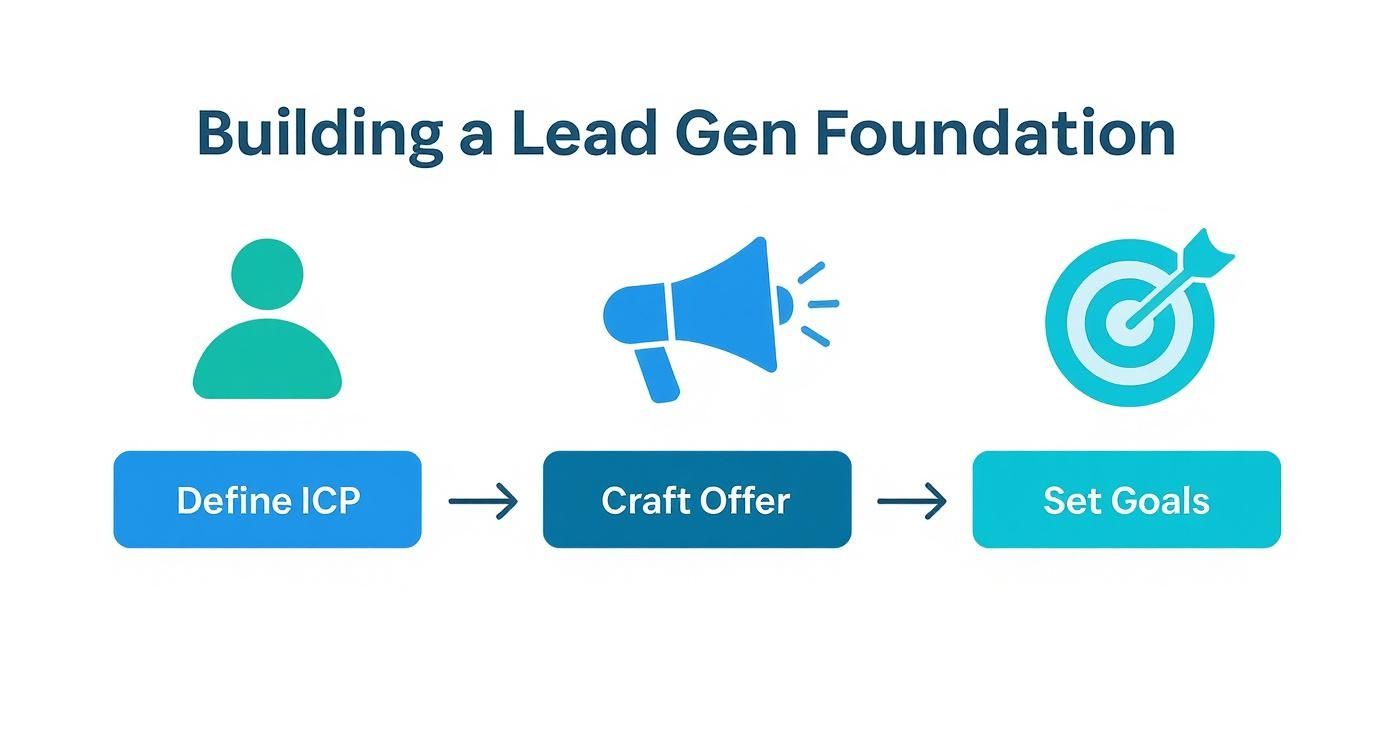
As the visual shows, defining your ICP, crafting an offer, and setting goals are sequential steps that build on each other to create a successful strategy.
Knowing your numbers is crucial here. In 2025, the average cost per lead is projected to be around $198.44, though this can vary wildly by industry. Many mid-sized companies generate fewer than 500 qualified leads per month, with a lead-to-customer conversion rate hovering around 2.9%. Understanding these benchmarks helps you set realistic targets, like a specific cost per lead (CPL) or a target number of marketing-qualified leads (MQLs) per quarter.
Key Lead Generation Channels at a Glance
Once your foundation is solid, you can start exploring different channels to attract leads. Each one serves a different purpose and requires a unique approach.
Here's a quick look at some of the most effective channels and how to think about them.
| Channel | Primary Use Case | Key KPI |
|---|---|---|
| Content Marketing/SEO | Attracting organic traffic by answering user questions and solving problems. | Organic Traffic, Keyword Rankings, Conversion Rate |
| Paid Social (e.g., Meta, LinkedIn) | Targeting specific demographics and interests with compelling ad creative. | Cost Per Lead (CPL), Click-Through Rate (CTR) |
| Pay-Per-Click (PPC) | Capturing high-intent search traffic for specific keywords. | Cost Per Acquisition (CPA), Quality Score |
| Email Marketing | Nurturing existing subscribers and moving them down the sales funnel. | Open Rate, Click-Through Rate, Unsubscribe Rate |
| Referral Programs | Encouraging existing customers to advocate for your brand. | Referral Rate, Customer Lifetime Value (CLV) |
This table isn't exhaustive, but it provides a solid starting point for deciding where to invest your time and budget. The best strategies often blend several of these channels to create a comprehensive lead generation engine.
Using Content Marketing to Attract Quality Leads

If you’ve built a great website, content marketing is the engine that actually brings people to it. Instead of shouting at potential customers with disruptive ads, you’re creating valuable, relevant content that pulls them in naturally. You're earning their attention, not buying it.
And it works. Really well.
The data consistently shows that content marketing generates about three times more leads than old-school outbound methods, all while costing 62% less. It’s no wonder that 72% of companies say content marketing directly boosts their lead count. This isn't just about throwing articles on a blog; it's a deliberate, cyclical process of planning, creating, and sharing assets that attract your ideal customers.
Build Your Authority with a Topic Cluster Strategy
One-off blog posts won't cut it if you want to generate a steady stream of leads. You need a structured approach that shows both search engines and human readers that you're an expert in your field. This is where the topic cluster model comes in.
It's all about organizing your content around core "pillar" topics that your audience cares deeply about.
Here’s how I’ve seen it work wonders for clients:
- Start with a Pillar Page: This is your cornerstone piece of content—a massive, in-depth guide on a broad topic you want to own. Think "The Ultimate Guide to E-commerce Logistics."
- Create Cluster Content: Next, you write a series of shorter, more focused blog posts that dive into specific subtopics. For our logistics pillar, these could be articles like "Choosing the Right Shipping Carrier" or "How to Reduce Cart Abandonment with Better Shipping Options."
- Interlink Everything: The magic happens when you link all your cluster posts back to the main pillar page. The pillar page should also link out to each of the cluster posts. This internal linking structure signals to Google that you have a deep well of knowledge on the entire subject.
This strategy helps your whole content hub rank for competitive terms, bringing in a consistent flow of organic traffic from people who are actively looking for the solutions you offer. To really make an impact, it pays to learn how to find trending topics that will get your audience excited.
Create High-Value Lead Magnets People Actually Want
A lead magnet is simply a resource you offer in exchange for someone's contact information—usually their email. The key word here is value. A generic "sign up for our newsletter" CTA just doesn't have the pulling power it once did.
You need to offer something so compelling that trading an email address for it feels like a bargain.
Think about what specific problem you can solve for your ideal customer. Here are a few ideas:
- E-books and Whitepapers: Perfect for deep dives. A cybersecurity firm could offer a whitepaper on "The Top 5 Data Breach Threats for Small Businesses in 2024," packed with stats and actionable advice.
- Webinars and Workshops: These add a personal touch. I’ve seen a financial advisor get incredible results by hosting a webinar on "Navigating Your First Home Purchase," addressing a major pain point head-on.
- Checklists and Templates: People love practical tools they can use immediately. A project management software company could offer a "Project Kickoff Checklist" that saves managers time and headaches.
A great lead magnet doesn't just collect an email; it provides an immediate win for the prospect, building trust and positioning your brand as a helpful authority from the very first interaction.
Craft Calls-to-Action That Convert
Okay, so your amazing content is drawing visitors in. Now what? Without a clear next step, they'll read, nod, and leave. A Call-to-Action (CTA) is the bridge that guides a visitor from being a passive reader to an active lead.
The best CTAs are direct, highlight a clear benefit, and feel like a natural next step. For example, in a blog post about improving website speed, a CTA like "Get Your Free Website Performance Checklist" is infinitely more powerful than "Contact Us."
Let's break it down:
| CTA Type | Example | Why It Works (or Doesn't) |
|---|---|---|
| Generic | "Learn More" | Vague and uninspiring. Learn more about what? |
| Direct | "Download the E-book" | Better, but it's all about you ("our e-book"). |
| Benefit-Driven | "Start Optimizing Your SEO Today" | Excellent. It's about them and the value they'll get. |
By sprinkling these benefit-driven CTAs throughout your content and linking them to focused landing pages, you create a smooth, frictionless path for readers to become genuine leads. For a deeper dive into building out this entire system, check out our guide on using content marketing for business growth.
Turning Social Media into a Lead Generation Machine
Too many marketers get stuck thinking of social media as just a top-of-funnel play—great for visibility, but not so much for tangible conversions. That’s a huge missed opportunity. If you approach social platforms with a clear lead generation strategy, they can become some of your most reliable sources for qualified prospects.
The trick is to stop chasing likes and start capturing leads. It’s a mental shift. Every piece of content, every campaign, should be designed to entice a follower to take that next step out of the app and into your world—whether that’s signing up for a newsletter, joining a webinar, or filling out a contact form.
Mastering B2B Lead Generation on LinkedIn
For anyone in the B2B space, LinkedIn isn't just another social network; it’s the digital equivalent of the industry’s biggest conference. This is where decision-makers are actively looking for solutions, consuming professional content, and networking. Not being there is like showing up to the wrong trade show.
Your company page is your digital booth. It needs to be more than just a list of your services. It should immediately communicate your value, feature social proof like client testimonials, and consistently share content that actually helps your ideal customer solve a problem. Think less about company news and more about industry analysis, practical guides, and expert takes.
The real game-changer here is LinkedIn Lead Gen Forms. These things are brilliant. They pre-fill a user's contact details from their profile, which slashes the friction of signing up. Instead of bouncing them to a clunky landing page on another site (where they’ll probably get distracted), you can capture their info with one or two taps, right inside the app.
This simple change makes a massive difference. We already know that for B2B marketers, LinkedIn is a powerhouse, with 40% calling it their best source for high-quality leads. Its native Lead Gen Forms boast an average conversion rate of 13%—that’s more than five times higher than what most landing pages achieve. If you want to dig into the numbers, the latest LinkedIn lead generation statistics paint a very clear picture.
Driving B2C Leads on Facebook and Instagram
When you're trying to reach consumers directly, platforms like Facebook and Instagram are hard to beat. Their targeting options are incredibly granular, letting you find people based on just about any interest, behavior, or demographic you can imagine. The key is to stop their scroll with something that feels fun and valuable, not just another ad.
Interactive content is your best friend here.
- Quizzes and Polls: A skincare brand could run a quiz like, "Find Your Skin's True Type." To get their personalized results and product recommendations, users simply pop in their email.
- Contests and Giveaways: Who doesn't love free stuff? Offer a prize your audience genuinely wants in exchange for their contact info. It’s a classic for a reason—the incentive is clear and immediate.
- Lead-Focused Ad Objectives: When you're in Meta's ad manager, don't just boost a post. Choose the "Leads" objective. This unlocks instant forms that work just like LinkedIn's, letting people sign up without ever leaving the app.
A lot of people just throw money at boosting posts and cross their fingers. To actually generate leads, you have to be intentional. Use ad objectives and creative that are built from the ground up to drive conversions, not just rack up likes.
Creating Content That Actually Captures Leads
No matter which platform you’re on, your content has to fit the vibe. A data-heavy analysis that crushes it on LinkedIn will probably be dead on arrival on Instagram. The goal is to create content that feels native to the platform while still steering people toward your lead magnet.
For example, that B2B software company could create a polished, data-rich carousel for LinkedIn that breaks down a complex industry trend. Meanwhile, a B2C fashion brand could post a fast-paced Instagram Reel showing five different ways to style a jacket, with a clear call-to-action in the caption to "Download our complete Fall Style Guide."
In both cases, the content grabs attention, and the CTA gives them a clear path to becoming a lead. When you line up your social strategy with real lead capture mechanics, you start turning passive scrollers into genuine prospects.
Optimizing Your Website for Higher Conversions
Getting people to your website is a great start, but it's only half the job. If that hard-earned traffic shows up, gets confused, and clicks away, all that effort goes down the drain. The real trick to generating leads online is turning your website into a machine that consistently converts visitors into actual prospects. This is what we call Conversion Rate Optimization (CRO).
CRO isn't about random redesigns or just following your gut. It's a methodical way to make your website perform better. It all comes down to understanding how people really use your site—where they click, what they read, and what stops them from taking that next step. By making smart, data-backed tweaks, you can capture way more leads from the traffic you're already getting.
Anatomy of a High-Converting Landing Page
Think of your landing pages as your digital sales reps. Whether someone lands there from a Google search or a Facebook ad, that page has one mission: get them to do something specific. A great landing page is incredibly focused, simple, and makes the decision to act a no-brainer.
Here are the core components I've seen work time and time again:
- A Headline That Hooks: Your headline has to instantly grab their attention and scream the main benefit. It needs to answer their unspoken question: "What's in this for me?"
- A Crystal-Clear Value Prop: In just a couple of sentences, spell out what you're offering and why it matters. Ditch the corporate jargon and focus on the results they'll get.
- Signs of Trust: People are naturally cautious about handing over their info. You can build their confidence with social proof like a powerful customer quote, a quick case study result, or logos of companies you've worked with.
- A Lean, Mean Form: Only ask for what you absolutely need right now. Every single field you add creates more work for the user and lowers your chances of getting a submission. Often, a name and email are all you need to get the conversation started.
The Power of A/B Testing Your Way to More Leads
You can't improve what you're not measuring. A/B testing, also known as split testing, is simply comparing two versions of a page to see which one gets better results. It's how you make decisions based on real user behavior instead of just guessing what might work.
Imagine a software company trying to get more free trial downloads. They could test two different landing pages.
| Element to Test | Version A (The Original) | Version B (The Challenger) |
|---|---|---|
| Headline | "Powerful Project Management Software" | "Finish Your Projects 30% Faster" |
| Button Copy | "Submit" | "Get My Free Trial" |
| Image | A screenshot of the software dashboard | A photo of a happy, relaxed team |
They would then split their traffic, sending 50% to Version A and 50% to Version B. By tracking the sign-ups from each, they'll know for sure which headline, button text, and image actually convinced more people to act. This is how you fine-tune your pages over time for the best possible performance.
A/B testing is great because it takes ego out of the equation. The data shows you what your audience truly wants, not just what your team thinks they want.
Don't Overlook the Technical Essentials
All the brilliant copy and stunning design in the world won't save you if your website is painfully slow or looks broken on a phone. The technical stuff isn't just for IT—it's a critical piece of the conversion puzzle.
First up, your site absolutely must work perfectly on mobile. Mobile responsiveness isn't optional anymore. A huge chunk of your visitors will be on smartphones. If they have to pinch and zoom just to read your text or fill out a form, they're gone. It's that simple. The experience has to be smooth on every single device.
Next is page speed. This is a huge one. Study after study shows that even a one-second delay in load time can tank your conversion rates. People are impatient online. A slow website feels unprofessional and frustrating, scaring away potential leads before they've even had a chance to see what you offer. Use a tool like Google PageSpeed Insights to find out what's holding your site back and get it fixed.
Turn Initial Interest Into Real Opportunity with Lead Nurturing
Getting a new lead is a great first step, but let's be honest—it’s just the beginning. The person who just downloaded your e-book or signed up for a webinar is rarely ready to pull out their credit card on the spot. This is where the real work, and the real magic, happens.
Lead nurturing is how you bridge that gap. It's the process of building a relationship and staying top-of-mind by consistently delivering value. You’re guiding them, not pushing them. When you use marketing automation, you can do this at scale, creating personalized journeys that make every prospect feel like you're talking directly to them.
Set Up Automated Email Sequences
The workhorse of any solid nurturing strategy is the automated email sequence, sometimes called a drip campaign. Think of it as a pre-planned conversation that kicks off automatically when a lead takes a specific action, like grabbing a resource from your site. The goal is to build trust, not to just spam them with sales pitches.
Let's walk through a real-world example. Say someone downloads your guide on "Beginner SEO Tips." Your automated follow-up could look something like this:
- Email 1 (Immediately): Deliver the guide instantly. No fuss, just give them what they asked for.
- Email 2 (Day 3): A quick, friendly check-in. "Hope the guide was helpful! Here's a 'Keyword Research Checklist' that complements it."
- Email 3 (Day 7): Share a short case study. Show them how a business just like theirs saw a jump in traffic using the strategies you teach.
- Email 4 (Day 14): Time for a soft pitch. Introduce a relevant service with a low-pressure call-to-action, like booking a no-obligation chat.
This cadence respects their time while gently keeping the conversation going. For a deeper dive into crafting these workflows, we put together a complete guide on lead nurturing automation.
Match Your Content to Their Journey
The key to effective nurturing is sending the right message at the right time. Someone just discovering they have a problem needs very different information than someone actively comparing solutions. Mapping your content to the sales funnel ensures you're always providing relevant value.
Here's a quick look at how you can tailor your content to guide leads smoothly from one stage to the next.
Lead Nurturing Content by Funnel Stage
| Funnel Stage | Content Goal | Content Examples |
|---|---|---|
| Top of Funnel (Awareness) | Educate and build trust. Address their pain points. | Blog posts, e-books, infographics, checklists, educational webinars. |
| Middle of Funnel (Consideration) | Position your brand as the best solution. Showcase expertise. | Case studies, comparison guides, white papers, product-focused webinars. |
| Bottom of Funnel (Decision) | Remove final barriers to purchase. Make it easy to buy. | Free trials, demos, customer testimonials, pricing pages, consultations. |
By aligning your content this way, you create a natural, helpful progression that makes the decision to buy from you feel like the obvious next step.
Spot Your Hottest Leads with Lead Scoring
Your sales team's time is their most valuable asset. The last thing you want is for them to waste it chasing leads who aren't ready. Lead scoring is the system that separates the curious browsers from the serious buyers.
It's pretty straightforward: you assign points to leads based on who they are and what they do. The more actions they take that signal buying intent, the higher their score climbs.
Lead scoring takes the guesswork out of prioritization. It’s a data-driven way to ensure your sales team is always talking to the people who are most likely to convert, dramatically improving efficiency and morale.
Here’s what a simple scoring model might look like:
- Job Title (Director or higher): +15 points
- Company Size (100+ employees): +10 points
- Visited Pricing Page: +20 points
- Downloaded a Case Study: +10 points
- Opened 5+ Emails: +5 points
- Requested a Demo: +50 points
Once a lead hits a set threshold—for instance, 50 points—the system can automatically flag them as a Sales Qualified Lead (SQL) and pass them directly to a sales rep for immediate follow-up.
Lean on Marketing Automation Platforms
Trying to manage all of this manually is a recipe for disaster. That’s why marketing automation platforms are a game-changer. These tools are the engine behind modern lead generation, handling the repetitive tasks, tracking every interaction, and giving you the data needed to make smarter decisions.
To get the most out of your setup, it’s crucial to connect your different systems. By integrating CMS and CRM platforms, you create a seamless flow of information from the first website visit to the final sale. This creates a scalable machine that turns lukewarm interest into qualified opportunities, ensuring no valuable lead ever falls through the cracks.
Answering Your Questions About Online Lead Generation
Diving into online lead generation is exciting, but let's be honest—it also brings up a ton of questions once you start putting theory into practice. Getting clear on the fundamentals is the first step toward building a predictable pipeline of new business.
Let’s dig into some of the most common questions I hear from marketers who are serious about getting results online.
Getting these definitions straight ensures your entire team is speaking the same language and working toward the same goal.
What’s the Difference Between a Lead and a Qualified Lead?
This is easily one of the most critical distinctions in the entire marketing and sales world. Getting this wrong can grind your growth to a halt.
A lead is simply anyone who hands over their contact info. Maybe they downloaded a simple checklist or signed up for your newsletter. They've raised their hand, but that’s about it.
A qualified lead, however, is the real deal. This is someone who has been vetted and actually looks like your ideal customer, making them a genuine sales opportunity. We usually break this down even further:
- Marketing Qualified Leads (MQLs): These are folks who are clearly engaged with your marketing. They've attended a webinar or downloaded a detailed guide, signaling they're ready for more nurturing.
- Sales Qualified Leads (SQLs): These are the MQLs who take a definitive step toward buying. They've requested a demo or asked for a quote—they're ready for a sales conversation right now.
Drawing this line in the sand is crucial. It stops your sales team from wasting their valuable time on tire-kickers and lets them focus all their energy on closing deals.
How Much Should I Spend to Generate a Lead Online?
I wish there was a magic number, but the truth is, the cost per lead (CPL) is all over the map. It completely depends on your industry, who you're targeting, and the channels you’re using.
You might see an industry average CPL floating around $198, but using that as your north star can be a huge mistake. A lead for a complex enterprise software will always cost more than one for a simple consumer app.
A much better way to think about it is to work backward from your customer lifetime value (CLV).
The right cost per lead is any amount that allows you to acquire new customers profitably. If your average customer is worth $5,000 to your business, a $200 CPL is a fantastic investment.
My advice? Start with small, highly-controlled test budgets on a couple of different channels. Track everything like a hawk to see where you're getting the best bang for your buck. Once a channel proves itself, that's when you confidently start scaling up your investment.
Which Online Lead Generation Channel Is Best for Beginners?
If you're just getting started or are working with a tight budget, you can't go wrong with content marketing and SEO. It’s a powerful, long-term strategy where expertise and effort can outperform a huge ad budget.
When you create genuinely helpful content that solves your audience's real-world problems, you're building an asset that works for you 24/7. I've seen a single, well-written blog post generate organic traffic and high-quality leads for years after it was published.
This approach builds a rock-solid foundation of trust and authority. Once you have that great content, you can start sharing it on the social media platforms where your ideal customers hang out. It’s a brilliant way to build a following and showcase your expertise before you spend a single dollar on ads.
Ready to stop guessing and start growing? The experts at ReachLabs.ai build data-driven marketing strategies that turn traffic into revenue. Let's talk about how we can generate high-quality leads for your business.