
Content marketing isn't just another item on your to-do list; it’s the engine that powers sustainable business growth. The whole idea is to pull your ideal customers in with genuinely useful information, build real trust, and guide them toward a purchase without ever feeling like you're selling.
Why Content Is Your Ultimate Growth Lever
Let’s get straight to it and talk results. When done right, content marketing becomes the backbone of your growth strategy because you're building digital assets that work for you around the clock. Think about it: a paid ad campaign disappears the second you stop funding it. A top-ranking blog post, on the other hand, can keep bringing in qualified leads for years.
The proof is in the numbers. The global content marketing market exploded from $36.8 billion in 2018 to a staggering $413.3 billion by 2022. This isn't just a trend; it's a fundamental shift in how businesses connect with people, proving that content is a primary channel for real growth. You can see more on this market expansion over at Reboot Online.
Fostering Authority and Trust
When you consistently put out high-quality, insightful content, you naturally become the go-to expert in your field. So, when a potential customer has a problem, who do they think of first? The company that's already given them reliable answers.
A powerful case study, for example, does more than just show off your product. It’s tangible proof of your expertise and builds a deep sense of loyalty with your audience. That trust has a direct line to your bottom line because an informed customer who views you as a credible resource is infinitely more likely to buy than someone who just clicked an ad.
The real goal of content isn't just to rank on Google or get a few social shares. It's to become the undeniable, go-to resource in your niche. That's how you create an unshakable bond between your brand and your customers.
To make this crystal clear, let's look at how specific content efforts move the needle on key business metrics.
How Content Directly Impacts Growth Metrics
This table gives a quick summary of how specific content marketing efforts directly impact crucial business growth indicators.
| Growth Metric | How Content Marketing Contributes | Example Tactic |
|---|---|---|
| Lead Generation | Attracts prospects with valuable information, encouraging them to exchange their contact details. | Gated e-books or whitepapers on industry trends. |
| Customer Acquisition Cost (CAC) | Reduces reliance on paid advertising by organically attracting and nurturing leads over time. | A high-ranking blog post that consistently brings in organic traffic. |
| Brand Authority | Establishes your company as a thought leader by consistently providing expert insights and solutions. | Publishing original research or hosting an industry-expert webinar. |
| Customer Lifetime Value (CLV) | Increases loyalty and retention by providing ongoing value and support post-purchase. | A customer-only newsletter with advanced tips and exclusive content. |
| Sales Conversion Rate | Educates and nurtures leads, moving them from awareness to decision with targeted, helpful content. | In-depth case studies that showcase real-world results and ROI. |
As you can see, every piece of content can be tied back to a tangible business outcome, making it one of the most effective growth strategies available.
Building a Nurtured Lead Pipeline
One of the biggest strengths of content marketing is its ability to build a pipeline of leads that are already warmed up. It grabs the attention of potential customers early on—often before they even know they need a solution—and guides them with helpful advice. You're building a relationship long before they're ever ready to make a purchase.
Here's what that looks like in the real world:
- Top of Funnel (Awareness): Someone is struggling with a problem and finds your educational blog post through a Google search. Problem solved, first touchpoint made.
- Mid-Funnel (Consideration): They liked what they read and subscribe to your newsletter for more tips. Now you can share deeper insights, maybe invite them to a webinar.
- Bottom of Funnel (Decision): After weeks of receiving genuine value from you, they're finally ready to look for a solution. Who do you think is top of mind?
This methodical process slashes your customer acquisition costs. You’re investing in building real relationships, not just renting attention for a day. The different advantages of content marketing all point to a more efficient and reliable path to growth.
Building Your Strategic Content Foundation
Great content doesn't just happen. It’s built, piece by piece, on a solid strategic foundation. To see real business growth, every article, video, and social media post needs to tie directly back to a core business objective. This means you have to get more specific than just "get more traffic."
A truly powerful goal is laser-focused. For example: "Increase qualified leads from organic search by 25% within six months." See the difference? This target is specific, measurable, achievable, relevant, and time-bound (SMART). It gives your entire content effort a North Star, making sure every piece of content you create has a real job to do.
Know Who You Are Talking To
With your goals locked in, it’s time to get crystal clear on who you're actually talking to. Generic content pulls in a generic audience, and generic audiences don't convert. This is why building out detailed buyer personas is a non-negotiable part of the process.
And I mean really detailed, going way beyond basic demographics. A great persona should feel like a real person, complete with specific challenges, goals, and questions keeping them up at night.
To get there, you need to do the homework:
- Dig into your customer data: What common threads do you see in job titles, industries, or company size?
- Talk to people: Interview your best customers. Chat with your sales team. Ask about the pain points that led them to you and the "aha!" moments they had.
- Be a fly on the wall: What questions are people in your target market asking on LinkedIn, Reddit, or industry forums?
This research transforms your approach from "marketing to businesses" into "solving a problem for Sarah, the overworked Operations Manager who just needs to boost her team's efficiency." That subtle shift changes everything.
Find What Your Audience Is Searching For
Once you know Sarah, you can figure out what she's typing into Google. This is where keyword research becomes your secret weapon. The aim isn't just to find popular terms; it's to uncover the exact questions and problems your content can answer for her.
You have to think about search intent. Is someone just gathering information ("what is project management software"), or are they close to making a purchase ("best project management tool for small teams")? Your content strategy needs to meet them at every stage. For a great breakdown of this, check out this modern content marketing strategy guide which really nails how to match topics with what users are trying to do.
The infographic below shows how all these foundational pieces work together to create actual business results.
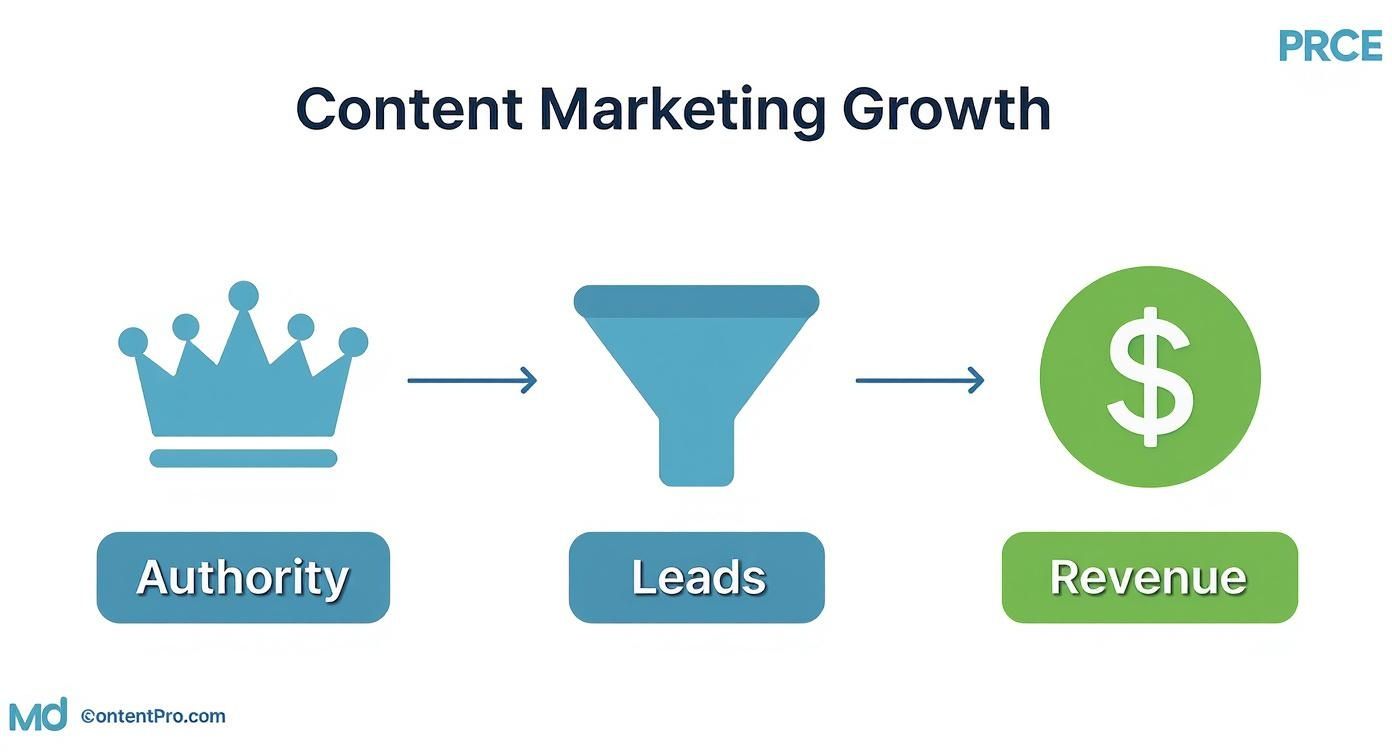
As you can see, building authority with the right content is what ultimately generates leads and drives revenue. To keep all this organized, a good framework can be a lifesaver. You can grab a free content marketing strategy template here to start mapping out your goals, personas, and topic ideas.
By combining clear goals, a deep understanding of your audience, and smart topic selection, you’re not just creating content—you’re building a predictable growth engine. This strategic alignment is what separates content that gets seen from content that gets results.
Creating High-Impact Content That Actually Converts
Okay, you’ve got your strategy mapped out. Now for the fun part: actually creating the content. This is where the rubber meets the road. Remember, the goal isn't just to get eyeballs; it's to create content that gently guides people from being casual readers to loyal customers. Every single piece you publish, whether it’s a detailed blog post or a punchy 30-second video, needs to have a job to do.
Think of your content formats like different tools in a workshop. You wouldn't use a sledgehammer for a finishing nail, right? The same logic applies here. A comprehensive, long-form guide is your go-to for breaking down complex ideas and climbing the search rankings. But if you want to make complex data easy to understand and share, an infographic is a much better fit. Choosing the right format for the right goal is half the battle.

Matching Content Formats to Business Goals
To make sure your efforts are actually moving the needle, you need to be intentional. Tie every content format directly to a specific business objective. This way, nothing gets wasted and every piece contributes to your overall growth.
Here’s a simple way I like to think about it:
- Want to build authority and dominate SEO? Your best bets are long-form blog posts and data-heavy reports. They give you the space to prove your expertise and rank for those valuable, high-intent keywords.
- Need to generate more leads? This is where gated content shines. Think e-books, exclusive webinars, or handy toolkits. You’re offering something genuinely valuable in exchange for an email address.
- Looking to boost brand awareness and engagement? Short-form video, fun quizzes, and eye-catching infographics are made for social media. They're quick, shareable, and perfect for capturing attention in a crowded feed.
The data backs this up. Businesses that consistently publish blog posts get, on average, 55% more visitors than companies that don't. And it's not just about blogs; a staggering 95% of marketers see video as a non-negotiable part of their strategy. It’s clear that a mix of formats is essential to connect with a modern audience.
Crafting Content That Connects and Converts
Once you’ve picked your format, it's all about the execution. It really starts with a headline that someone has to click. Instead of something bland like, "New Product Features," try framing it from the user's perspective: "5 Ways Our New Feature Will Save You an Hour Every Day." See the difference? The second one solves a problem.
The structure of your content is just as critical. Nobody wants to be greeted by a massive wall of text. Break things up with short paragraphs, clear subheadings, and bullet points. You want people to be able to scan your content and pull out the key takeaways in seconds.
Finally, every single piece of content needs a clear call-to-action (CTA). This doesn’t mean you have to be pushy. It can be as simple as asking a question to spark a conversation in the comments, inviting them to join your newsletter for more tips, or pointing them toward another relevant article on your site. A great CTA feels like a natural next step, not an abrupt sales pitch. To get this right, it's worth exploring effective strategies for creating high-impact, concise content that truly connects.
A single piece of original research can be a goldmine. Don't just publish it and move on. Repurpose that data into an infographic, a webinar, a series of social media posts, and even a short video summary. This approach maximizes your investment and lets you reach different parts of your audience on the platforms they love most.
Getting Your Content in Front of the Right Eyeballs
You’ve done the hard work and created a fantastic piece of content. That’s a huge win, but hitting "publish" is just crossing the starting line. Without a smart distribution strategy, even the best article on the planet will just sit there, gathering digital dust. If you want content marketing to actually grow your business, you have to be deliberate about getting it in front of the right people, over and over again.
This means ditching the "post and pray" method. We've all been guilty of it—sharing something on social media and just hoping for the best. A real amplification strategy is proactive. It’s what turns your content investment into tangible results, transforming a single blog post into a reliable engine for traffic and new leads.

Building Your Multi-Channel Promotion Engine
A truly effective amplification plan isn't about blasting a link everywhere. It’s about creating a surround-sound effect by using multiple channels that work in concert. The key is to show up where your audience already hangs out, but in a way that feels natural and adds value to their experience on that specific platform.
Your starting point should always be your email list. These aren't just random prospects; they are your most loyal followers who have explicitly asked to hear from you. Always send your new content to them first. Frame it as an exclusive sneak peek. This simple act strengthens that relationship and kickstarts a dependable first wave of traffic.
Don’t just fire off an email with a bare link. Take a minute to tell your subscribers why this piece of content matters to them. A quick, personal note about what they'll learn can be the difference between a click and a delete.
Beyond your own channels, think about building real relationships with key people in your industry. I'm not talking about paying for a generic shout-out. I mean finding those respected voices whose audience is a perfect match for yours and finding a way to collaborate authentically. One share from a trusted expert can do more for your reach than a dozen of your own posts. There are countless content distribution strategies you can explore to round out your plan.
A Practical Promotion Checklist
To make sure nothing slips through the cracks, it’s a game-changer to have a repeatable checklist for every major piece of content you create. This takes the guesswork out of promotion and ensures every asset gets a consistent push right out of the gate.
Here’s what that might look like in practice:
- Social Media Blitz: Write custom captions for LinkedIn, X, and Facebook. Don’t just copy-paste; tailor the message to fit the audience and tone of each network.
- Visual Teasers: Pull a killer quote or a key stat and turn it into a sharp-looking graphic for Instagram or Pinterest.
- Email Broadcast: Send a dedicated email to your main subscriber list announcing the new resource.
- Internal Amplification: This one’s easy but often overlooked. Ask your team to share the content with their own professional networks.
- Community Drop-in: Find relevant Slack channels, subreddits, or Facebook groups where your content would be genuinely helpful. Just make sure you read the community rules first!
This kind of structured approach gives your content the best possible chance to succeed from day one. And it doesn't have to stop there. By slicing up your core ideas into different formats—maybe turning that blog post into a quick video script or an infographic—you give it a whole new life, creating a continuous cycle of engagement that drives real, sustainable growth.
Weaving AI into Your Content Workflow
Artificial intelligence has moved from a futuristic buzzword to a genuinely practical tool in our content marketing toolkits. When you use it smartly, AI becomes a powerful assistant, taking over the repetitive, time-sucking tasks so your team can focus on the high-level creative and strategic work that actually moves the needle.
Think of it as a way to buy back your team’s most valuable resource: time. Instead of losing half a day to brainstorming blog topics, an AI tool can spit out dozens of solid ideas in minutes, all based on your core keywords and audience pain points. That frees up your people to think bigger—about compelling campaign themes, original research, and the unique stories only your brand can tell.
This isn't just a niche trend, either. The adoption of these tools is happening fast. A recent study found that 67% of small businesses and marketers are already using AI for content marketing or SEO, with copywriting being the most common task. You can dig into more of these findings on AI's role in modern marketing from Digital Silk. This tells us that getting AI into your workflow isn’t just a nice-to-have; it’s quickly becoming table stakes for staying competitive.
Putting AI to Work in Your Content Creation
So how do you actually make this work without turning your content into generic, robotic mush? The key is to blend AI's raw efficiency with the essential oversight and creative spark that only your team can provide.
A fantastic place to start is using AI to generate first drafts. Give it a detailed brief—a solid outline, key data points, and a description of your target persona—and let it build the foundation. This simple step kills the "blank page" paralysis and can easily cut your writing time in half. Your writer's role then shifts from creating from scratch to refining, fact-checking, and weaving in your brand’s unique voice. That's a much more strategic use of their talent.
Here are a few other high-impact ways to get started:
- Better Headlines, Faster: Let AI generate a dozen different headlines for an article. You can then A/B test them to see what actually gets clicks from your audience.
- Smarter Content Repurposing: Take a deep-dive blog post, feed it to an AI tool, and ask for a set of social media captions, a summary for your email newsletter, or even a script for a short video.
- Quick Data Insights: Instead of getting lost in spreadsheets, use AI to analyze your content's performance data. It can spot patterns and highlight the topics that are driving the most engagement or conversions.
Remember, AI is your partner in crime, not your replacement. The best teams use it to knock out 80% of the routine work. This frees up their human creativity to nail the final 20%—the part that makes content truly connect and resonate with an audience.
Finding the Right Tools and Building a Process
The sheer number of AI tools out there can be overwhelming. Don't try to boil the ocean. The best approach is to start small and focus on solving one specific bottleneck in your current process. Is your team buried in SEO research? Look for an AI-powered keyword tool. Struggling to create visuals? Experiment with an AI image generator.
Once you’ve picked a tool, build a clear, repeatable process around it. For instance, your workflow for a new blog post might look something like this:
- Human Strategist: Defines the topic, the goal, and the target keyword.
- AI Tool: Generates a detailed outline and a rough first draft based on the strategist's brief.
- Human Writer: Takes the draft and refines it, adding personal anecdotes, expert insights, and ensuring it sounds like your brand.
- Human Editor: Does a final review for quality, accuracy, and flow before it goes live.
This hybrid approach gives you the speed and efficiency of AI without sacrificing the quality and authenticity that builds real trust. By offloading the grunt work, you empower your team to focus on what truly matters: creating content that drives business growth.
Got Questions? We've Got Answers
Even with a great plan in hand, you're bound to have questions as you start putting your content marketing strategy into action. Let's walk through a few of the most common ones I hear from businesses just starting out.
How Long Until I Actually See Results?
This is probably the number one question, and the honest-to-goodness answer is: it takes time. Content marketing is a marathon, not a sprint.
You might see some early wins—a post gets a flurry of shares on social media, or you notice a small traffic bump. That's great! But the real, business-changing results like a consistent stream of organic leads and top search engine rankings? You should realistically expect those to start showing up in about 6 to 12 months.
Think of it less like flipping a switch and more like building a snowball. Every single piece of high-quality, genuinely helpful content you create adds another layer, building momentum that eventually becomes unstoppable. Consistency is everything.
Content Marketing vs. Traditional Advertising: What's the Difference?
It’s easy to get these two mixed up, but their core philosophies are worlds apart.
Here’s the simplest way I can break it down:
- Traditional Advertising is about interruption. It’s the TV commercial that breaks up your favorite show or that banner ad that gets in the way of an article. It forces a promotional message in front of people.
- Content Marketing is about attraction. It draws people in by offering them something they actually want—answers, solutions, entertainment. You build trust and credibility first, earning the right to talk about your product later.
Ultimately, you're aiming to become a trusted resource, not just another company trying to sell something.
The real difference is intent. Advertising shouts, "Buy now!" Content marketing says, "Let me help you," building a long-term relationship that naturally leads to profitable customer loyalty.
How Do I Measure the ROI of My Content?
Knowing if your content is actually paying off is essential, and it's about a lot more than just counting page views. To really understand your return on investment, you have to connect your content to actual business goals.
Start by focusing on the metrics that matter most to your bottom line. I always recommend tracking:
- Organic Traffic Growth: Is your search traffic trending up and to the right month over month?
- Conversion Rates: Of the people who read your blog posts, how many are taking the next step? This could be anything from signing up for your email list to requesting a product demo.
- Lead Quality: This is a big one. Check in with your sales team. Are the leads coming from your content actually a good fit for your business?
- Customer Acquisition Cost (CAC): How does the cost of landing a new customer through content marketing compare to your other channels, like paid ads?
When you connect these dots, you can start putting a real dollar value on your content and prove its worth.
Can a Small Business Really Succeed with Content Marketing?
Yes, one hundred percent. In fact, content marketing can be a small business's secret weapon.
You don’t need the budget of a Fortune 500 company. What you need is to be smarter, more focused, and more in tune with your audience than your bigger, slower competitors.
For a small business, success comes down to owning a niche. Don't try to be everything to everyone. Instead, pick a specific area where you can become the go-to expert. Get to know your ideal customer's problems better than anyone else and create the absolute best content on the internet that solves those problems.
By dominating a small pond, you can build an incredibly loyal following that drives real growth without breaking the bank on advertising.
Ready to build a content strategy that delivers real business growth? The team of specialists at ReachLabs.ai uses data-driven insights and world-class creative talent to elevate your brand. Learn how we can move the needle for you.