

A great pitch isn't a standalone performance; it's the victory lap of a long, deliberate preparation process. If you want to master how to pitch to investors, you first have to do the unglamorous but essential work of researching your targets, finding a way in, and knowing exactly what you’re asking for. This is what shows you’re a founder who’s serious about the details.
Laying the Groundwork Before You Pitch
Long before you ever open PowerPoint or Google Slides, the real work begins. This prep phase is what separates a pitch that gets a polite "no" from one that gets a term sheet. It's not just about doing your homework—it's about gathering strategic intelligence that sets you up for success from the very first email.
Too many founders fall into the trap of creating a generic deck and firing it off to every VC they can find. That shotgun approach almost never works. You have to be surgical, treating every potential investor conversation as a unique opportunity that demands a tailored strategy.
Research Your Target Investors Thoroughly
Your first job is to become an expert on the investors you want on your cap table. Don't just learn the firm's name. You need to get inside their investment thesis—the fundamental beliefs that guide where they put their money. Are they laser-focused on seed-stage SaaS? Do they only write checks for fintech in emerging markets?
Dive into their portfolio. Seriously, look at every company they've backed.
- Find the Pattern: Can you spot common threads in the problems these companies solve or the industries they operate in? This tells you what gets them excited.
- Check for Conflicts: Make sure they haven't already funded one of your direct competitors. Pitching a firm that has already backed your biggest rival is a massive waste of time for everyone.
- Know Their Stage: Are they writing checks in your size range? A firm that specializes in $20M Series B rounds isn’t going to lead your $500k pre-seed round.
This kind of deep-dive research lets you shape your pitch to their specific interests, showing them precisely how your startup fits into their worldview and existing portfolio.
This level of preparation is more critical than ever. The venture capital world is incredibly competitive, with a massive amount of cash chasing a relatively small number of deals. In 2025, global VC funding hit an eye-watering $120.7 billion in Q3 alone, and a huge chunk of that was funneled into giant rounds for AI companies. If you aren't in a red-hot sector, you have to work twice as hard to prove you align with the big investment themes of the day. You can read more about these global VC investment trends on KPMG.
Secure a Warm Introduction
Once you have your shortlist of dream investors, fight the urge to send a cold email. While it’s not impossible for it to work, your odds of getting a real look skyrocket with a warm introduction. This is a referral from someone the investor already knows and trusts.
A warm intro is like a pre-endorsement. It signals to the investor that someone in their trusted circle vouches for you, making them far more likely to take the meeting.
Start by mining your own professional network. Use LinkedIn to find mutual connections with partners at your target firms. Talk to your mentors, advisors, or other founders you know who might have a relationship with the VCs on your list.
Define Your Funding Needs with Precision
Finally, you need to get razor-sharp on your "ask." This isn't just about plucking a number out of thin air; it’s about creating a budget that’s tied directly to specific milestones. You have to be able to explain exactly how much money you’re raising and precisely how you’ll use it to hit measurable goals.
This infographic shows how these foundational steps fit together.
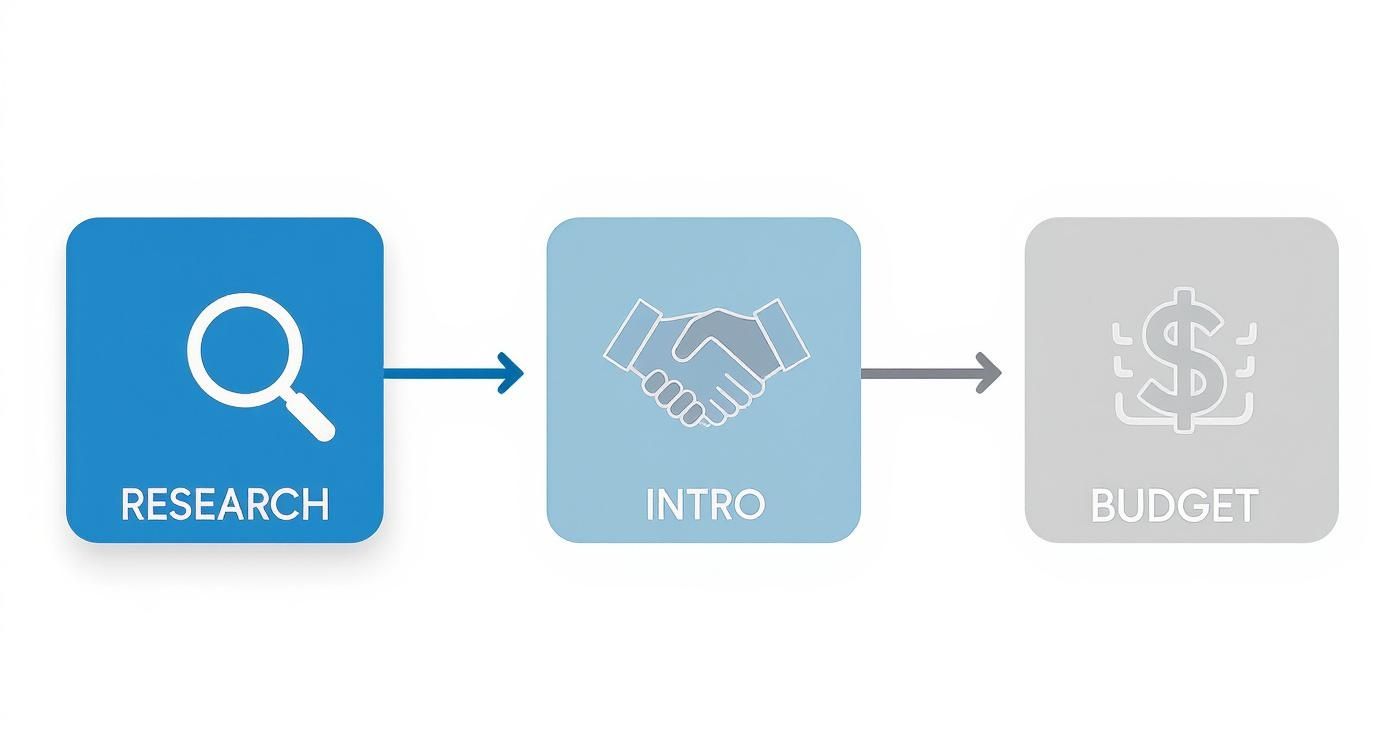
Following this flow—from deep research to a concrete budget—proves to investors you’re a strategic operator, not just a dreamer with an idea.
For instance, don't just say, "We need $1 million for marketing and sales." Break it down into a detailed plan they can believe in:
- $300,000 to hire two senior account executives to go after enterprise clients, aiming to close 20 new logos in the next 12 months.
- $450,000 for performance marketing campaigns across specific channels, with a projection of generating 5,000 qualified leads.
- $250,000 to build out a content marketing function to support sales and drive our organic traffic.
This level of granularity shows you’ve thought deeply about what it takes to grow and gives investors confidence that their capital will be put to good use. A well-defined budget is a non-negotiable part of any startup marketing strategy that investors will take seriously. Nail this groundwork, and you’ll transform your pitch from a simple request for cash into a credible investment opportunity.
Weaving a Narrative That Lands the Investment
Let's get one thing straight: investors don't just fund business plans. They back compelling stories. After all the grinding research, the real work begins: translating your data, vision, and raw passion into a narrative that sticks. A powerful story makes your venture feel inevitable, inspiring the kind of confidence that gets checks signed.
This isn't about spinning a fairytale. It’s about framing the truth in a way that connects on both a logical and an emotional level. Your pitch narrative is the thread that ties every slide and every talking point together, turning a pile of facts into a powerful argument for why your company must exist.
Start With a Problem They Can Feel
Every memorable story kicks off with a problem the audience understands instinctively. Before you even whisper the name of your product, you have to paint a vivid picture of the pain point you’re solving. Make it relatable. Make it urgent. Make it feel big.
Remember, investors sit through dozens of pitches. A vague statement like "we help businesses improve efficiency" is an instant tune-out. You have to get specific. Tell a story about a real person or a type of company struggling with this exact issue.
For instance, don't just say you optimize logistics. Describe the gut-wrenching cost of a single delayed shipment for a small business owner—the lost revenue, the furious customer, the cascade of operational chaos. That’s how you humanize the problem and make the need for a solution feel immediate.
The goal is to get every head in the room nodding. You want them thinking, "I've seen that problem," or even better, "I've had that problem." That creates an instant connection and makes them lean in, waiting for your answer.
Introduce Your Solution as the Hero
Once you've established the "villain" of your story—the problem—it's time to bring in the hero: your solution. This is where you explain what your company does, but you frame it as the elegant and obvious answer to the pain you just laid out.
Avoid a dry list of features. Instead, present your solution as a clear and powerful "why."
- Why is your approach different? This is your moat. Is it a piece of proprietary tech, a clever business model, or a strategic partnership no one else has?
- Why is it ten times better than the alternative? This shows you've done your homework. Articulate exactly where the current options fall short and how you leapfrog them.
- Why is this the only team that can pull this off? Connect your team's specific background and expertise directly to the problem you're solving.
This storytelling structure is a fantastic way to organize your thinking and present a cohesive vision. To get better at this, it's worth exploring what makes a great brand storytelling framework and applying those same principles to your pitch.
Back Up the Story With Proof
A great story is captivating, but investors need proof that it's more than just a good tale. This is where your data comes in. Traction is the hard evidence that your narrative is already working in the real world. It transforms your claims from a hypothesis into a reality that's gaining momentum.
Show them your progress with cold, hard metrics:
- User Growth: Are active users or sign-ups climbing month-over-month? Show the chart.
- Revenue: Do you have early sales or paying customers? Even a growing waitlist is powerful proof.
- Key Partnerships: Have you landed any strategic partners that validate your business model?
Beyond what you've already done, you have to quantify the prize. Investors need to see that your story can play out on a massive stage. Use credible market data to define your Total Addressable Market (TAM). Show them you're chasing a market big enough to generate the venture-scale returns they need.
When you combine a massive market opportunity with early signs of real traction, your story becomes more than just believable—it becomes irresistible.
Building Your Ultimate Investor Pitch Deck
If your pitch narrative is the script, the pitch deck is the movie. It’s the visual scaffolding that holds your story together, making it tangible and memorable for investors. Too many founders treat it like a business plan and cram it full of text. That’s a huge mistake.
Think of it as a visual essay. Each slide should deliver one powerful point, guiding the room through your argument with an undeniable sense of momentum. The goal is to create a clean, persuasive presentation that supports what you’re saying, not competes with it.
The Core Slides Every Pitch Deck Needs
While there’s no one-size-fits-all formula, a winning deck almost always follows a familiar narrative arc over about 10 to 12 slides. This isn't about being rigid; it's a proven framework for telling a complete and compelling story. Before you dive in, it’s worth taking a moment to understand what a pitch deck is at its core.
The table below breaks down the must-have slides that form the backbone of a successful pitch deck. Think of this as your checklist to make sure you’re hitting all the key points an investor expects to see.
| Essential Slides for Your Investor Pitch Deck |
| :— | :— | :— |
| Slide Title | Core Purpose | Key Content to Include |
| The Problem | Hook the audience by defining a significant, relatable pain point. | A compelling narrative or statistic showing the problem's scale and urgency. |
| The Solution | Introduce your product or service as the clear and elegant answer. | A concise statement of your value proposition. Focus on benefits, not features. |
| Market Opportunity | Prove this is a big, venture-scale idea worth pursuing. | TAM, SAM, and SOM figures. Show the size of the prize. |
| Your Product | Make it real. Show investors what you've built. | Screenshots, a link to a short demo video, or a simple workflow diagram. |
| Traction & Milestones | Provide concrete proof that you’re on the right track. | Key metrics: user growth, revenue, key partnerships, positive feedback. |
| Business Model | Explain exactly how your company makes money. | Your pricing strategy, customer acquisition cost (CAC), and lifetime value (LTV). |
| The Team | Show why your team is the one to make this happen. | Brief bios of key founders, highlighting relevant experience and expertise. |
| Financial Projections | Demonstrate a credible path to significant revenue. | A 3-5 year forecast of key metrics like revenue, expenses, and profitability. |
| The Ask & Use of Funds | Clearly state what you need and what you'll do with it. | The specific amount you're raising and the key milestones it will fund. |
Covering these slides ensures you’ve built a logical case, leading the investor from a problem they understand to a solution they can believe in, all backed by real-world proof.
Designing For Impact, Not Information Overload
Great pitch deck design is an exercise in subtraction. The single most common mistake I see is slides that are just walls of text. Remember, you are the presenter. The deck is just your visual aid.
An investor should be able to glance at any slide and grasp its core message in three seconds. If they have to read paragraphs, they’ve already stopped listening to you.
Stick to one big idea per slide. Use large fonts, powerful images, and clean charts to make your points hit home instantly. Instead of a dense table of monthly user numbers, show a simple, upward-trending line graph. It tells the story of growth in a fraction of a second.
This can be intimidating, which is why working from a solid foundation helps. Using a well-structured startup pitch deck template can keep you on track, ensuring you cover all the bases with a professional and clean design.
Grounding Your Financial Projections in Reality
The financials slide is where many founders trip up. Investors know your five-year projections are educated guesses. What they're really testing is your thinking. They want to see numbers that are ambitious but, more importantly, believable.
Your model needs to be built from the bottom up, not the top down. Don't just say, "We'll capture 1% of a $50 billion market." Instead, build your forecast from tangible drivers you can actually influence.
- State Your Assumptions: Be transparent. Clearly list the core assumptions that drive your model, like customer acquisition cost (CAC), conversion rates, and churn.
- Show Your Math: Base your revenue on those assumptions. For example, "With a $500 CAC and a marketing budget of $50k, we project acquiring 100 new customers per month."
- Highlight Key Metrics: Don't drown them in data. Showcase the most critical financial KPIs—Monthly Recurring Revenue (MRR), Gross Margin, and Burn Rate. This proves you understand the levers of your business.
Finally, your "ask" needs to be laser-focused. State exactly how much you're raising and connect it directly to concrete milestones. For example: "We are raising $1.5 million to hire five engineers, launch our V2 platform, and acquire our first 10,000 customers over the next 18 months." This transforms your ask from a request for money into a strategic plan for growth.
Delivering a Pitch That Commands the Room

You can have a brilliant story and a pixel-perfect deck, but without a compelling delivery, it all falls flat. This is the final, make-or-break piece of the puzzle. Your job is to transform those static slides into a dynamic, engaging conversation that builds real trust and excitement.
Remember, you're not there just to recite information. You're there to command the room with confidence, passion, and authority. Investors aren't just backing an idea; they're backing you. Your delivery is their first real glimpse into your leadership and communication skills.
Nailing the First 30 Seconds
I've seen it happen a hundred times: an investor mentally checks out within the first minute. You can't afford a slow start or a rambling intro. You need a hook that grabs them immediately and makes them put their phones away.
Kick things off with your sharpest elevator pitch. In 30 seconds or less, they need to know who you are, the massive problem you're tackling, and your unique solution. No jargon, no long backstory. Just a crisp, high-impact statement that sets the tone for everything else.
For instance, skip the vague opener and hit them with something concrete. "Small e-commerce brands lose a staggering $10 billion every year from abandoned carts. Our AI tool recovers 30% of that lost revenue, turning their biggest headache into pure profit." See the difference? It's specific, quantifiable, and instantly establishes the stakes.
Beyond Memorization: Practicing for Authenticity
The goal of practice isn't to sound rehearsed; it's to practice so much you no longer sound rehearsed. You need to know your material so cold that it flows like a natural conversation, not a memorized script. Nothing kills a pitch faster than someone reading from their slides.
Your practice sessions should be more than just running through the words.
- Record Yourself: It’s cringey, but use your phone to record your pitch. Watching it back is the quickest way to catch awkward phrases, filler words like "um" and "like," and any nervous tics.
- Pitch to Anyone: Seriously, anyone who will listen. Friends, mentors, even family members who aren't in your industry. Their "dumb" questions are often the most insightful because they expose gaps in your logic you're too close to see.
- Time Every Section: Know exactly how long each part of your story takes. This lets you manage your time like a pro and, most importantly, leave plenty of room for questions—which is often where the real magic happens.
The point of all this practice is to build muscle memory. When the nerves inevitably hit, your well-honed flow takes over, letting your genuine passion and expertise shine through.
Preparing for the Inevitable Questions
A great pitch doesn't end with your last slide; it transitions into a dialogue. The Q&A session is where investors will poke and prod, stress-testing your assumptions and digging into the nitty-gritty. Being unprepared here is simply not an option.
Start by brainstorming the most brutal questions you can think of.
- Who is your biggest competitive threat, really?
- How defensible is your business model once a big player notices you?
- What are the shakiest assumptions in your financial projections?
- If this is such a good idea, why hasn't someone else already done it?
Come up with clear, data-backed answers for every single one. But here's the pro move: create an appendix of backup slides. These are slides you don't plan to show but have ready.
When an investor asks for a deeper dive on your customer acquisition costs or a detailed competitive matrix, you can instantly pull up a slide with the exact data they need. It shows you’re incredibly prepared and have a deep command of your business. This simple trick can turn a tough, grilling moment into a huge opportunity to impress.
Mastering the Post-Pitch Follow-Up and Due Diligence
https://www.youtube.com/embed/i9FW-nmFdlI
So, you've delivered your final slide and the handshakes are done. You might feel a sense of relief, but your pitch is far from over. In many ways, the real work is just beginning.
This period right after the meeting is a critical window. It's where you can either build on the momentum you created or watch it fizzle out completely. A smart, professional follow-up strategy is often what separates a pitch that gets funded from one that gets forgotten.
Every interaction from this point on is part of the evaluation. Your actions show investors what you're actually like to work with. Are you organized? Proactive? Do you communicate clearly and respect their time? You’re no longer just a founder with a great idea; you're proving you're a reliable partner they can trust with their capital.
The Art of the Follow-Up Email
Your first move is a simple but powerful one: the thank-you email. Get this out the door within 24 hours of your meeting. The goal here isn't just about being polite—it's a strategic touchpoint to reinforce your key message and keep the ball rolling.
Keep it short and to the point. Here’s a quick recipe for what to include:
- A Genuine Thank You: Start by genuinely thanking them for their time and the insightful questions they asked. Mention something specific if you can.
- Recap Your Core Message: In a sentence or two, remind them of the single most important takeaway from your pitch. What's the one thing you absolutely need them to remember?
- Address Any Open Questions: If they asked for a specific piece of data or you promised to send over more information, this is where you deliver. It shows you were listening and you're on top of things.
- State the Next Steps: Clearly and politely outline what comes next. For example, "As discussed, I've attached the financial model you requested. We'd be happy to schedule a follow-up call next week to walk through it."
This approach keeps you on their radar without being pushy. It's a professional nudge that keeps the conversation moving forward.
Get Your Data Room Ready Ahead of Time
Imagine this: an investor expresses serious interest and asks for your documentation. Within minutes, you reply with a link to a perfectly organized digital data room. That kind of preparation sends an incredibly strong signal.
Don't wait to be asked—build your data room before you even start pitching.
This secure, online folder holds all the critical documents an investor needs to conduct their due diligence. Having it ready to go demonstrates foresight and professionalism, making their job a whole lot easier. Once the pitch is done, you should expect a deep dive. Having a solid venture capital due diligence checklist can help you anticipate their requests and streamline this phase.
Setting up your data room in advance is one of the single best ways to build trust and accelerate the due diligence process. It shows you're organized, transparent, and respectful of an investor's time.
Make sure your data room is clean, logically structured, and easy to navigate. Think of it as a well-organized library of your company's most important information, ready for inspection at a moment's notice.
Navigating Due Diligence and Term Sheet Negotiations
If an investor is serious, they’ll kick off a formal due diligence process. This is a deep dive into every corner of your business—your team, tech, financials, legal structure, and market. Be prepared for a thorough investigation. The key is to respond to their requests promptly and with full transparency to keep the momentum going.
The investment landscape has gotten more selective. Over the past year, we've seen seed and Series A valuations climb, but the total number of deals hasn't kept pace. What does this tell us? Investors are placing bigger bets on fewer, higher-conviction companies. They want to see more than a compelling idea; they demand hard evidence of customer adoption and a team that can execute.
If everything checks out, you’ll receive a term sheet. This non-binding document outlines the proposed terms of the investment. It’s absolutely a moment to celebrate, but it's also where the real negotiation begins.
It's tempting to focus only on the valuation, but don't. Pay close attention to key terms like liquidation preferences, board seats, and anti-dilution provisions. These details can have a massive impact on your control and future outcomes down the road. Maintaining a positive, collaborative tone during these talks is essential for building a strong, long-term partnership with your new investors.
Answering Your Lingering Questions About Pitching Investors
Even after you’ve built the perfect deck and rehearsed your story until you can recite it in your sleep, questions will pop up. The whole process of figuring out how to pitch investors is full of little details that can trip you up.
Let's clear up some of the most common things founders get stuck on.
How Do I Handle Pitch Day Nerves?
First off, feeling nervous is a good sign—it means you actually care about what you're doing. The goal isn't to get rid of the butterflies, but to get them flying in formation. The best way to do that? Over-prepare.
Practice your pitch until it feels like second nature. I don't mean just memorizing words on a slide; I mean truly understanding the core message of each part. When you know your stuff inside and out, you can have a real conversation about it, even if your heart is racing. Right before you go on, take a few deep breaths and stand tall. It’s a simple physical trick, but it can make a world of difference for your mindset.
What Is a Realistic Valuation for My Early-Stage Startup?
Putting a number on your company before you have a ton of revenue feels more like art than science, and that’s because it is. There’s no magic formula. Instead, investors are going to look at a handful of key factors to figure out what they think is fair.
Here’s what they’re usually weighing for a pre-money valuation:
- The Team: Have you done this before? Do you have deep, hard-won expertise in this industry? A team with a proven track record can ask for more.
- Market Size: A massive Total Addressable Market (TAM) signals the potential for massive returns, which helps justify a higher valuation from day one.
- Traction: This is your proof. It could be early revenue, a growing waitlist of paying customers, or impressive user engagement. Any real-world progress makes your case stronger.
- Comparables: Investors live and breathe this stuff. They know what similar companies in your space and at your stage have raised and at what valuation.
You need to walk into that room with a valuation you can confidently defend with data and a clear-headed vision. It shows you've done your homework and aren't just guessing.
How Long Should My Pitch Actually Be?
Keep it tight. You should be able to get through your core presentation in 15-20 minutes, max. That’s the sweet spot—enough time to tell a compelling story without seeing people start to glance at their phones.
A shorter, punchier pitch almost always lands better. It forces you to cut out the fluff and, more importantly, it leaves plenty of time for Q&A. The real meeting often starts after the last slide is down, and that back-and-forth dialogue is where deals are actually made.
Think of it this way: if you can't get your point across in under 20 minutes, your story is probably too complicated. Go back and sharpen your message until it’s impossible to ignore. An investor will always value a founder who can distill a complex idea into something clear and powerful.
What if an Investor Says No?
Rejection is just part of the game. I promise you, every founder you admire has a long list of VCs who passed on their idea. The only thing that matters is how you react. Always, always be professional and gracious.
Thank them for their time. If the vibe feels right, it's perfectly fine to ask for feedback on why they passed. Some investors will give you incredibly valuable insights that will help you nail the next meeting.
Treat every "no" as a data point. It's just a learning opportunity that gets you one step closer to a "yes."
Crafting a pitch that truly connects with investors is one of the most vital skills a founder can develop. At ReachLabs.ai, we work with founders to build investor pitch decks that tell a powerful story and get results. Learn how we can help you turn your vision into a venture-backed reality.