
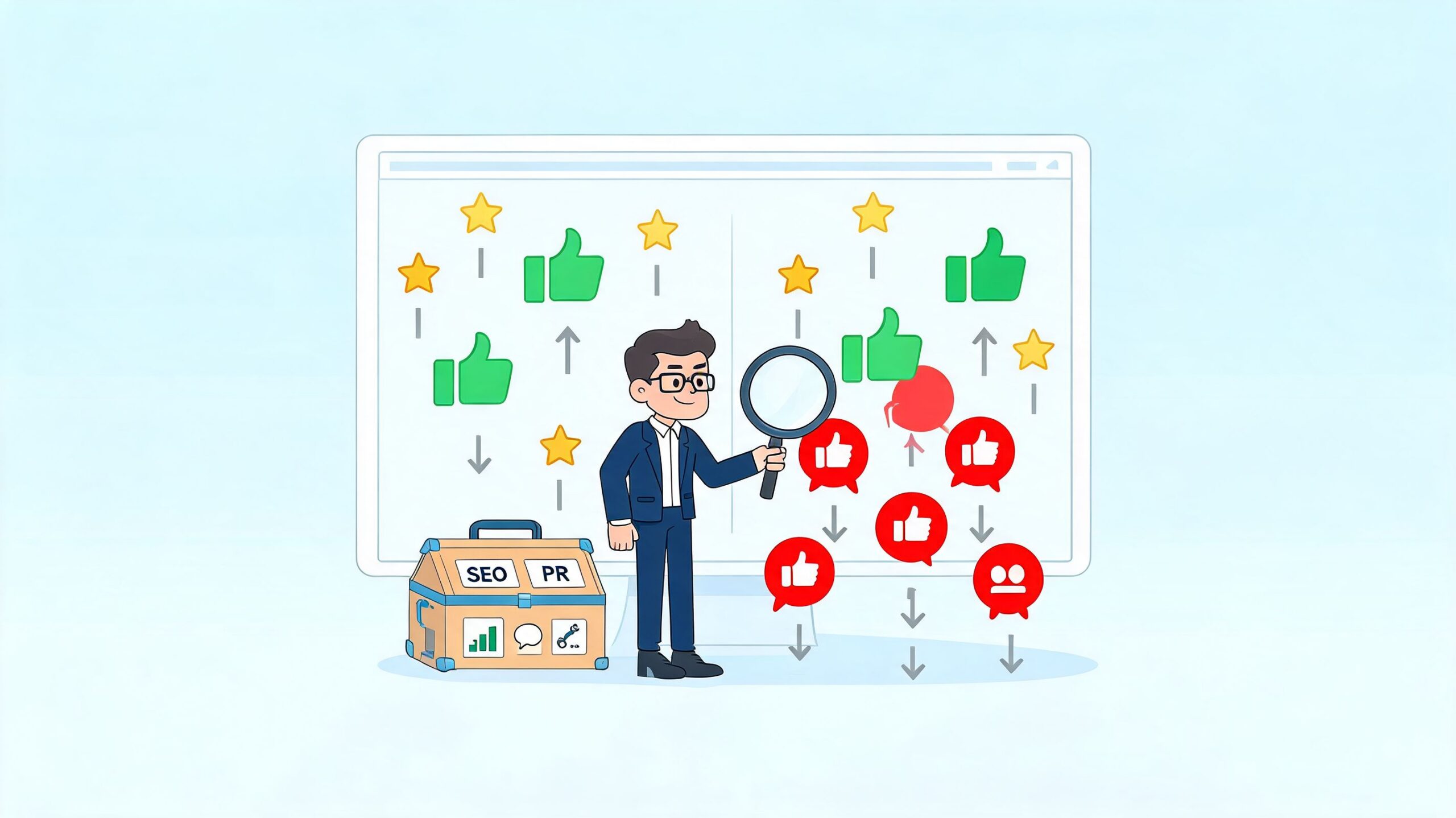
You search your brand name and see it immediately. A bad review thread. A critical article. A Reddit post that doesn't tell the full story. It's sitting on page one, where prospects, partners, recruits, and investors can all find it before they ever talk to you.
That moment feels personal, even when it's business. Most owners and marketing leaders go through the same sequence. First comes disbelief. Then the urge to respond everywhere at once. Then the realization that random activity won't fix online reputation problems if the underlying search, review, and response systems stay broken.
The right move is to get structured fast.
A negative result on page one isn't cosmetic. 94% of consumers have avoided a business entirely due to negative online information, and a single negative article on the first page of Google can cost a business up to 22% of potential customers, according to New Media reputation management statistics. That's why experienced teams don't treat reputation repair like a PR side task. They treat it like revenue protection.
The playbook that works is phased. Triage. Suppress. Proliferate. Monitor. Each phase has a different purpose, different benchmarks, and different failure modes. If you skip triage, you react to symptoms instead of causes. If you skip suppression, damaging results keep ranking. If you skip proliferation, you stay vulnerable. If you skip monitoring, the same issue comes back.
The Moment Your Online Reputation Becomes a Problem
Most reputation problems don't begin as full-scale crises. They begin with one visible asset that ranks too well. A news story from an old dispute. A review that gets marked “most relevant.” A forum post from someone with partial information. One result becomes the frame through which strangers evaluate everything else about your business.
That's why the first few hours matter. Not because you need a dramatic public response, but because you need control over the facts, the search results, and the timing of your next moves.
What page one is really costing you
When a harmful result reaches page one for a branded search, it starts affecting buyers before your sales team has any chance to explain context. Search is often the first reputation filter. If the first impression is negative, every later touchpoint gets harder.
Here's the practical issue. Reputation damage rarely stays confined to search. A bad article influences reviews. Reviews influence click behavior. Social chatter starts referencing the same negative narrative. Then internal teams feel pressure to “do something,” and rushed responses create more material for people to quote.
Practical rule: Don't start by trying to win the argument in public. Start by documenting the problem, securing your owned assets, and building a response path.
A disciplined team begins with monitoring. If you don't already have a system in place, a tool like the Sight AI digital radar tool helps you understand where your brand is being mentioned and how quickly sentiment is shifting.
The four-phase response that works
To fix online reputation issues without making them worse, I use a simple operating model:
- Triage first: Identify what's ranking, what's false, what's legitimate, and what's unresolved customer frustration.
- Suppress strategically: Push damaging but non-removable results down with stronger, better-optimized assets.
- Proliferate owned assets: Build a wider footprint of positive pages you control, so one bad result can't dominate your narrative.
- Monitor continuously: Track rankings, reviews, sentiment, and new mentions so small issues don't turn into recurring brand damage.
That sequence matters. Reputation repair gets expensive and slow when teams confuse activity with progress.
Conduct a Full Reputation Audit
Before you publish anything, respond anywhere, or call a lawyer, audit the current situation. A serious reputation audit is intelligence work. You're not just checking whether someone said something negative. You're mapping what a prospect sees, what Google understands, and what you can realistically influence.

Search like a skeptical buyer
Run your audit in an incognito browser and document everything. Search branded terms, product terms, founder and executive names, and combinations with negative modifiers. Don't just search the company name. Search the phrases your critics, prospects, and recruiters would use.
Use a spreadsheet or Airtable board with these columns:
- Query used: Branded term, executive name, product name, or complaint phrase.
- Ranking position: What appears on page one matters most, but note positions beyond that too.
- Asset type: Review, article, press release, social profile, forum post, YouTube video, PDF, or directory listing.
- Control status: Owned, influenced, or outside your control.
- Risk level: Immediate, medium, or low.
- Action path: Respond, suppress, report, request removal, or monitor.
Audit beyond Google web results
A lot of teams miss the channels that shape trust. Search is the headline, but reputation lives in multiple surfaces at once.
Check these areas manually:
- Review platforms: Google Business Profile, Yelp, Trustpilot, G2, industry directories, and marketplace profiles if you sell through platforms.
- Social channels: LinkedIn, X, Instagram, Facebook, TikTok, YouTube comments, and creator mentions.
- Forums and communities: Reddit, Quora, niche forums, and community threads where buyers compare vendors.
- Visual search surfaces: YouTube results, image search, slide decks, PDFs, and old webinar recordings.
- Executive footprint: Founder LinkedIn profiles, bios, podcast appearances, author pages, and old conference pages.
If you only audit your homepage and Google Business Profile, you're not auditing your reputation. You're auditing your comfort zone.
Prioritize what can actually hurt you
Not every negative mention needs action. Some rank poorly. Some have no credibility. Some are legitimate criticism that should be answered, not buried. The key is separating emotional discomfort from business risk.
I rank findings in this order:
- Page-one branded results
- High-visibility review clusters
- Executive-name search results
- High-authority articles or forum threads that could rise
- Low-visibility complaints that matter operationally but not reputationally
If you need a deeper framework for search-side diagnosis, search engine reputation management is the discipline that connects this audit work to ranking strategy.
Classify before you act
Every damaging asset usually falls into one of four buckets:
| Content type | Best first response |
|---|---|
| Legitimate complaint | Respond, resolve, and document the outcome |
| Misleading but not illegal content | Publish stronger contextual assets and suppress |
| False or defamatory claim | Preserve evidence and assess legal removal options |
| Policy-violating review or copied content | Report through platform or takedown channel |
That classification step saves time. It also prevents one of the most common mistakes in reputation repair: using the same tactic on every problem.
Suppress Negative Content with SEO and Content Velocity
Suppression is the heavy-lifting phase. Most DIY efforts stall here because people assume one blog post, one apology page, and a few social updates will move entrenched negative results. They won't.
When a harmful result ranks because it lives on a strong domain or has years of engagement, you need a volume-and-quality strategy. That means building better assets, publishing them in clusters, and supporting them with real authority signals.

What suppression actually means
Suppression does not mean deleting criticism you don't like. It means making sure your brand's most visible search results are accurate, current, and representative.
A rigorous SERM methodology involves publishing 20 to 50 high-authority assets and building over 100 dofollow links from DR 50+ sites quarterly to achieve a 70% displacement of negative results to page two or beyond within 6 to 8 months, based on RBS Reputation Management's SERM methodology. That's the benchmark serious campaigns are built around.
Build the right asset mix
The best suppression campaigns don't rely on one domain. They create a portfolio.
Use a mix like this:
- Owned assets: Company blog articles, newsroom updates, leadership bios, case studies, resource pages, and FAQ pages.
- Profile assets: LinkedIn company page, executive LinkedIn pages, YouTube channel pages, Medium, Crunchbase, industry directories, and podcast guest pages.
- Earned or contributed assets: Guest posts, interviews, association pages, contributor columns, local media mentions, and partner spotlights.
- Supporting media assets: Slide decks, videos, PDF resources, webinar pages, and image-rich content.
Each asset should target a clear branded query variation. Don't publish generic thought leadership and hope it ranks for your name. Optimize titles, headings, metadata, internal links, and anchor text around the exact branded search phrases you need to improve.
Content velocity beats sporadic effort
Teams lose momentum because they publish reactively. One post goes live after a bad review. Another goes live weeks later after an executive gets nervous. Search engines respond better to coordinated bursts than scattered activity.
A workable suppression sprint usually includes:
- A concentrated publishing window: Release branded and semi-branded assets close enough together to create momentum.
- Unified on-page optimization: Use consistent entity signals, author pages, and internal linking across all properties.
- Authority support: Promote high-value assets through outreach, syndication, and placements on trusted sites.
- Review of ranking shifts: Track what moves, what stalls, and which assets need more support.
One practical path is to pair content creation with a dedicated plan to remove negative search results where policy or legal avenues are available, while simultaneously pushing stronger assets upward.
What usually fails
Most underperforming campaigns have the same flaws:
- Thin content: Short pages with no expertise, no authorship, and no reason to rank.
- Overreliance on social profiles: Useful for coverage, but rarely enough on their own.
- No backlink strategy: Strong domains outrank weak pages unless you build support.
- Poor query targeting: Publishing “brand values” content when the problem is an executive-name result.
- Inconsistent execution: Waiting between uploads long enough for momentum to disappear.
Publish with intent. Every asset should have a target query, a ranking role, and a promotion plan.
This walkthrough adds useful visual context for how suppression fits into a broader cleanup effort:
How to know suppression is working
You don't judge progress by “feeling better” about search results. You judge it by displacement and replacement.
Good signs include:
| Signal | What it means |
|---|---|
| Owned assets entering page one | Google is accepting your brand-controlled narrative |
| Negative results moving downward | Suppression is starting to work |
| Richer result diversity | Your footprint is broadening across profiles, articles, and media |
| Executive and product queries improving | The campaign isn't limited to one branded term |
Suppression is rarely instant. But when done properly, it changes what buyers see at the exact moment they're deciding whether to trust you.
Build a Digital Fortress of Positive Content
Suppression fixes exposure. It doesn't create resilience. If you stop after cleanup, the next bad article, review cluster, or viral complaint can reopen the same weakness.
The stronger move is to build what I call a digital fortress. That means a durable set of branded assets, expert content, third-party validations, and executive profiles that collectively define your company before critics do.

Why this matters beyond cleanup
A company's reputation accounts for 63% of its market value, and businesses that actively manage their online presence see a 93% boost in customer satisfaction and generate 6.9 times more leads, according to Erase online reputation statistics. That's why positive content shouldn't be treated as a defensive afterthought. It's part of commercial performance.
When the positive ecosystem is strong, one negative mention has less room to dominate. Search results become more balanced. Review responses carry more credibility. Journalists and prospects find context faster. Recruiters see a fuller picture of the business.
The assets worth owning
A fortress starts with properties you control directly. Those assets should be strong enough to rank, credible enough to persuade, and fresh enough to stay visible.
Prioritize these:
- A robust about page: Not fluff. Real leadership context, company history, proof points, and expertise.
- Executive bio pages: Especially for founders and senior operators whose names get searched independently.
- Case studies and client stories: Useful for both branded search and trust-building during evaluation.
- A newsroom or updates hub: This gives you a consistent place to publish official statements, milestones, partnerships, and clarifications.
- Expert articles under real authors: E-E-A-T signals improve when knowledgeable people visibly stand behind the content.
The assets worth earning
Owned media matters, but earned credibility carries more weight when a buyer is skeptical.
That's where you invest in:
- Podcast interviews
- Industry publication contributions
- Association memberships and speaker bios
- Partner spotlights
- Positive local or trade press
- Third-party profiles with complete information
A weak reputation campaign tries to hide the negative. A strong one makes positive evidence impossible to miss.
How to keep the fortress growing
This isn't about publishing generic “thought leadership” forever. It's about building a content system that strengthens branded search and trust simultaneously.
A strong cadence usually includes a blend of:
- Evergreen authority content that explains what you do and how you think
- Proof content such as testimonials, case studies, and customer outcomes
- Timely updates tied to launches, hires, partnerships, and community activity
- Executive content that gives the brand a credible human face
The trade-off is simple. Defensive cleanup often feels urgent, so teams put every resource there. But the businesses that recover best are the ones that keep producing visible evidence of quality, consistency, and expertise after the immediate fire is under control.
Master Review Management and Social Listening
Search results shape first impressions. Reviews and social conversations shape trust at the point of decision. If your suppression work improves visibility but your review profiles still look neglected, buyers will notice the mismatch.
Many brands miss the revenue connection. Review management isn't only customer service. It's commercial infrastructure.
Respond like a brand people can trust
A good review response does three things at once. It acknowledges the experience, shows that a real person is paying attention, and lowers the temperature for everyone else reading.
For negative reviews, use a sequence like this:
- Acknowledge the complaint without arguing
- State that the experience isn't acceptable
- Move the specifics offline
- Return with a visible update if resolution happens
Keep the tone calm and specific. Never copy-paste legalistic replies. Prospects can spot defensive wording instantly.
For positive reviews, don't waste the moment. Thank the reviewer, reference something specific they mentioned, and reinforce what your business wants to be known for.
Track reputation velocity, not vanity
A lot of teams fixate on review count because it's easy to see. That's not enough. What matters is the relationship between sentiment and business performance.
Instead of focusing on vanity metrics, track Reputation Velocity, which ties sentiment shifts to sales. A one-star increase in average rating has been shown to boost revenue by 5 to 9%, based on Podium's reputation repair guidance. That makes review operations a direct growth lever, not a cleanup chore.
Use a practical scorecard:
- Average rating trend: Rising, flat, or falling
- Response coverage: Are all meaningful reviews getting a reply
- Resolution outcomes: Which complaints were fixed, refunded, clarified, or reopened
- Theme tracking: Delivery, product quality, billing confusion, support delays, or staff behavior
- Lead or conversion correlation: Are trust signals improving in the same periods as inquiry quality
If YouTube is a meaningful channel for your brand, operational workflows matter there too. Teams managing creators, podcasts, or high-volume comment streams can borrow ideas from this guide to handling YouTube feedback at scale.
Social listening catches what reviews miss
Reviews are structured feedback. Social listening picks up the messier, earlier signals.
Watch for:
- Repeated complaint phrases
- Mentions of executives or products without tags
- Threads where buyers ask whether your company is trustworthy
- Creator commentary that could influence niche audiences
- Customer screenshots or story posts that spread faster than formal reviews
Don't wait for a review bomb to learn that sentiment has shifted. The warnings usually show up earlier in comments, forums, and side conversations.
If review operations are still ad hoc, a dedicated process for review management services can help centralize response standards, escalation rules, and monitoring.
When to Engage an Agency or Legal Counsel
Some reputation issues are manageable in-house. Some aren't. The expensive mistake is picking the wrong escalation path.
An agency helps when the problem is scale, speed, or search complexity. Legal counsel helps when the issue involves falsehood, infringement, impersonation, or defamation. Those are different problems, and they require different muscle.
The triggers for agency support
Bring in a reputation agency when the work has outgrown your team's capacity or skill set. That usually happens when damaging results span multiple domains, multiple branded queries, or multiple platforms at once.
Clear agency triggers include:
- Negative page-one results across several branded searches
- Executive-name search problems
- No internal content team to produce suppression assets
- Stalled progress after months of scattered effort
- Review volume too high for manual response discipline
- A need to coordinate SEO, PR, content, and monitoring together
This is especially true when the business stakes are high. Search issues tied to fundraising, recruiting, partnerships, or enterprise sales usually need experienced operators, not occasional cleanup.
The triggers for legal counsel
Legal escalation is appropriate when content is not merely unflattering, but actionable. That includes defamation, false impersonation, stolen copyrighted material, and some policy-violating review patterns.
While most advice focuses on burying negative content, direct removal is possible in some cases. Hiring a lawyer for a defamation suit can yield a 40% higher removal rate than SEO alone, and DMCA takedowns are successful in approximately 70% of copyright infringement cases, according to Reputation Return's analysis of online reputation repair.
That doesn't mean every harsh review deserves a lawyer. It means legal tools work best when the facts support them and when evidence has been preserved correctly.
If your issue is platform-specific, specialized counsel matters. Marketplace sellers, for example, often need legal help with account standing and brand damage at the same time. In that scenario, resources on how to reinstate your Amazon account can be more relevant than a generic reputation agency.
Decision Framework DIY vs. Agency vs. Legal
| Scenario | Recommended Action |
|---|---|
| A few legitimate negative reviews with clear service issues | DIY, respond, resolve, and improve operations |
| One negative article ranking for your brand | Start suppression and content support. Escalate to agency if movement stalls |
| Multiple negative page-one results across brand and executive terms | Agency |
| Fake reviews or copied content that violates platform rules | Report through platform, then involve counsel if unresolved |
| Defamatory statements, impersonation, or infringement | Legal counsel |
| Ongoing brand chatter across search, reviews, and social with no internal owner | Agency |
| Old but damaging content with uncertain legal standing | Run parallel tracks. Agency for suppression, counsel for review of removability |
The practical trade-off
DIY works when the issue is contained and your team can stay consistent. Agency support works when execution depth matters more than intention. Legal action works when removal, not ranking suppression, is the right outcome.
The wrong escalation wastes time twice. First in the failed tactic, then in the recovery effort after that tactic stalls.
If you're deciding under pressure, use a simple test. Ask whether the core problem is visibility, capacity, or legality. Visibility points to search and content work. Capacity points to agency support. Legality points to counsel.
If your team needs a disciplined partner to fix online reputation issues without guesswork, ReachLabs.ai can help build the strategy, content, and monitoring system behind a real recovery plan. The strongest engagements start with a clear audit, honest prioritization, and a roadmap tied to business outcomes, not vanity metrics.