
Think of a digital strategy framework as the master plan for everything your brand does online. It's the connective tissue that links every single digital touchpoint—from a single tweet to a massive SEO overhaul—directly back to your most important business goals. Without it, you're just guessing.
What Is a Digital Strategy Framework Anyway?
Let's be honest, trying to grow a business online without a plan is like trying to build a house without a blueprint. You might get a few walls up, but you'll probably end up with a crooked foundation and a leaky roof. A digital strategy framework is that blueprint. It keeps your marketing from becoming a jumbled mess of tactics that don't add up to anything meaningful.
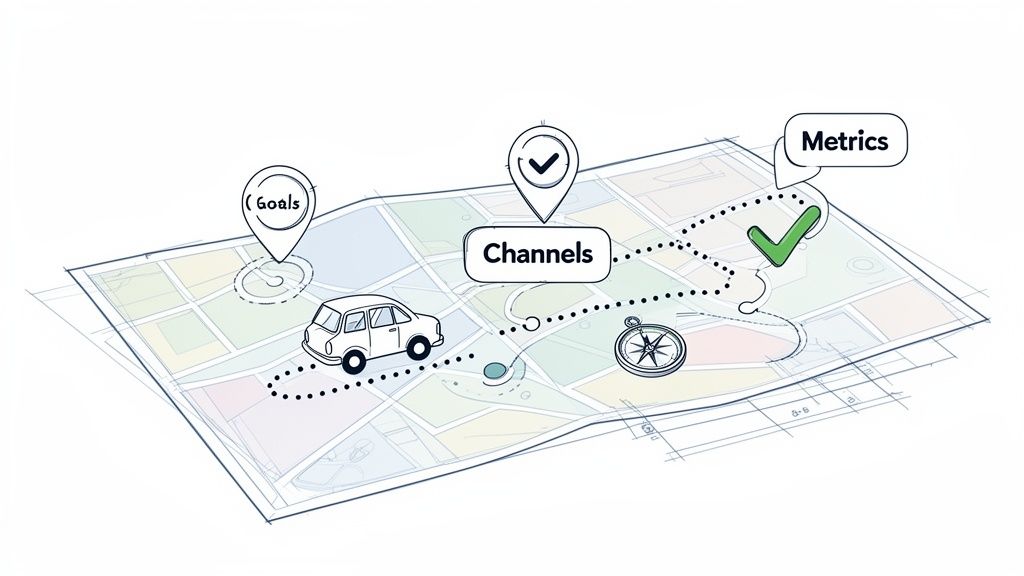
This isn't about creating a simple to-do list with items like "post more on LinkedIn" or "run a Facebook ad." It’s a complete system designed to give your marketing efforts a clear purpose and direction. A great way to think about it is like a road trip map: it shows you where you're going (your business goals), the best roads to take (your channels), and the mile markers you'll pass along the way (your KPIs).
Moving Beyond Random Acts of Marketing
So many teams get stuck in a cycle of "random acts of marketing." They hear about a new social media platform and jump on it, chase the latest shiny trend, and pour money into campaigns without a clear reason why. It’s a reactive, chaotic, and frankly, exhausting way to operate.
A solid digital strategy framework flips the script, moving your team from reactive to proactive. It makes you pause and answer the tough questions before you even think about spending time or money:
- Why are we really doing this? Every action must tie back to a concrete business objective.
- Who are we actually trying to talk to? Getting crystal clear on your ideal customer is non-negotiable.
- How will we know if we’re winning? You need to define what success looks like from day one.
This disciplined approach is what separates teams that are just "busy" from those that are driving real, measurable growth. For a deeper dive, especially for new businesses, understanding the fundamentals of digital marketing for startups shows just how critical a framework is from the very beginning.
The Real-World Impact of a Framework
The true magic of a framework is the alignment and focus it creates. When your entire team is working from the same playbook, they can make smarter decisions on their own. The content writer knows precisely which blog topics will hit home with your audience. The paid ads specialist knows which platforms will deliver the best conversions.
A framework transforms marketing from a cost center into a predictable engine for revenue. It provides the structure needed to consistently test, learn, and optimize your activities for maximum impact.
Ultimately, this blueprint does more than just guide your day-to-day work. It's how you justify your budget, prove your value to the C-suite, and build a marketing machine that can scale with the business. It’s easily the most critical tool for any company serious about winning online.
The Five Pillars of a Winning Framework
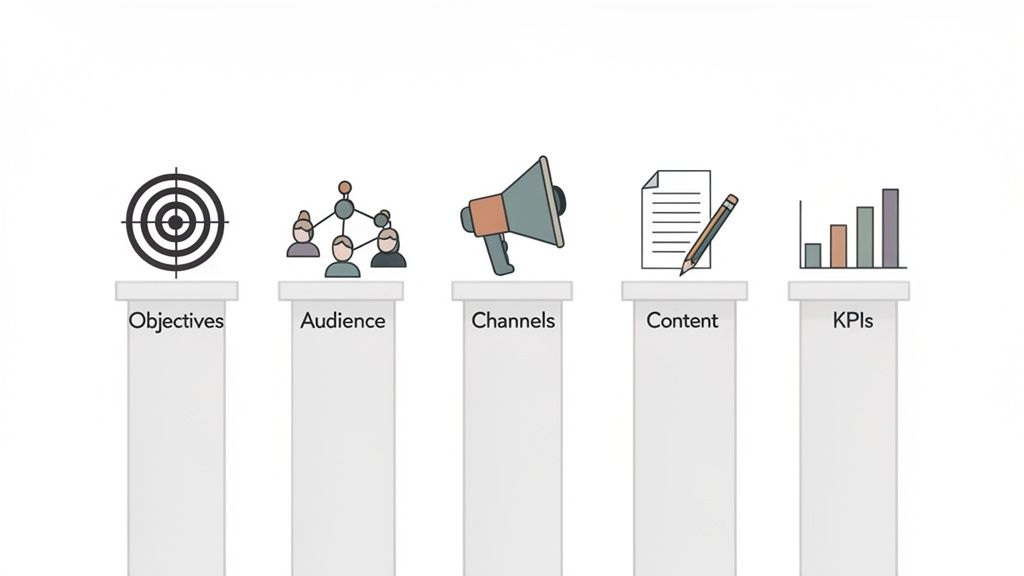
Think of a great digital strategy like a sturdy, five-legged stool. If you take away even one leg, the whole thing wobbles and eventually crashes. These five "legs," or pillars, are the absolute essentials that hold your plan together, turning big-picture business goals into a real, actionable marketing plan.
Each pillar answers a fundamental question—the "who, what, where, why, and how" of your digital efforts. When you thoughtfully address each one, you create a connected strategy where every blog post, every ad, and every email has a clear purpose.
Here’s a quick overview of what these pillars represent and the core question each one helps you answer.
The 5 Core Pillars of a Digital Strategy Framework
| Pillar | Core Question It Answers |
|---|---|
| 1. Objectives | What are we actually trying to achieve here? |
| 2. Audience | Who are we talking to, and what do they care about? |
| 3. Channels | Where will we find them and deliver our message? |
| 4. Content | What will we say that truly matters to them? |
| 5. Measurement | How will we know if any of this is actually working? |
By building your strategy around these five components, you ensure every part of your plan is grounded in reality and aimed at delivering tangible results.
Pillar 1: Defining Clear Objectives
Let's start at the beginning. Before you do anything else, you have to define what winning looks like for your business. This pillar answers the simple but critical question: "What are we trying to achieve?"
Fuzzy goals like "get more brand awareness" just won't cut it. A solid digital strategy framework demands specific, measurable targets that connect directly to the bottom line. For instance, if the company's big-picture goal is to grow market share by 10%, a sharp digital objective might be to generate 25% more marketing-qualified leads (MQLs) this quarter.
Your objectives are the North Star for your entire strategy. Without them, your team is simply sailing without a destination, wasting time, energy, and resources.
This kind of clarity is a game-changer. It makes every other decision—which channels to use, what content to create—infinitely easier because you're always working toward a clear end goal.
Pillar 2: Identifying Your Audience
Okay, you have your destination. Now, who are you trying to bring along for the ride? This pillar is all about answering, "Who are we really talking to?" The better you know your audience, the more your message will hit home.
This goes way beyond simple demographics. We're talking about creating detailed buyer personas that feel like real people. You need to understand their biggest headaches, what gets them excited, and even the slang they use.
- What keeps them up at night? Your product or service should be the answer to that problem.
- Where do they hang out online? This tells you exactly where to spend your time and money.
- What kind of content do they actually trust and share? This is your roadmap for content creation.
For a B2B software company, a persona might be "Marketing Manager Mary." She’s drowning in spreadsheets and desperately needs a tool that gives her clear, simple insights. Knowing Mary’s daily struggles helps you craft marketing that speaks directly to her, making her feel seen and understood.
Pillar 3: Selecting Optimal Channels
Once your objectives are set and you know your audience inside and out, the next step is figuring out where to meet them. This pillar tackles the question, "Where will we find our audience and deliver our message?"
One of the biggest mistakes small businesses make is trying to be everywhere at once. It's a recipe for burnout and wasted cash. A focused approach is always better. Let your buyer personas guide you to the platforms where they’re most active.
Channel Selection in Action:
- Target Audience: Early-stage startup founders.
- Smart Channels: LinkedIn for professional content, niche business podcasts for deep dives, and specific Subreddits where they ask for advice.
- Poor Channels: TikTok or Pinterest. It’s just not where they’re looking for business solutions.
Choosing the right channels means your message actually gets seen by the right people, giving you the biggest bang for your buck.
Pillar 4: Crafting Compelling Content
You know your goals, your audience, and where to find them. Great! But what are you going to say? This is where content comes in, answering the all-important question: "What will we say that matters?"
Your content needs to be the perfect blend of your expertise and your audience's needs. Every single piece—from a blog post to a video—must have a job to do.
Think about our persona, "Marketing Manager Mary." Your content should be designed to help her.
| Content Type | Purpose | Example for "Marketing Manager Mary" |
|---|---|---|
| Blog Post | Solve her immediate problem | "5 Simple Ways to Clean Up Your Marketing Analytics" |
| Case Study | Build her confidence in you | "How Company X Boosted ROI by 40% With Our Tool" |
| Webinar | Show her how it works and capture her info | "Live Demo: Go From Messy Data to Clear Insights in 30 Min" |
This isn't about just making noise. It's about strategically creating content that builds trust and gently guides people toward becoming customers.
Pillar 5: Establishing Measurement and KPIs
Finally, we close the loop. This last pillar answers the question every CEO will ask: "How do we know this is working?" Without measurement, you're just guessing.
This is where Key Performance Indicators (KPIs) come into play. You need to pick the metrics that truly reflect your objectives. If your goal is to generate leads, don't just track website traffic. Focus on the numbers that matter, like conversion rates, cost per lead, and the number of qualified MQLs you're producing.
This data is your feedback mechanism. It tells you what's a home run, what's a total flop, and where you need to adjust your approach to get the best possible results.
Comparing Popular Digital Strategy Models
You don't have to invent a digital strategy framework from scratch. Plenty of smart people have already created battle-tested models that work. Think of them as different recipes for achieving the same goal: growing your business.
While the core ingredients we’ve already covered—Objectives, Audience, Channels, Content, and Measurement—are always part of the mix, these frameworks arrange them in unique ways. Each one gives you a different lens through which to view the customer journey, making some better suited for certain businesses or goals than others.
Let's break down three of the most effective models out there.
The RACE Framework
Developed by Smart Insights, the RACE framework is all about action. It’s built to help you manage and improve results across the entire customer lifecycle, which is why it's so popular—it lines up perfectly with the classic marketing funnel.
RACE stands for:
- Reach: Building awareness and getting your brand in front of your target audience on the right channels. This is the top of the funnel, where you're attracting new eyeballs.
- Act: Encouraging people to actually do something on your website or app. This is all about getting them to take that next step, like exploring a product or reading a blog post.
- Convert: Turning interested prospects into paying customers. This is the moment of truth—the sale, the sign-up, the subscription.
- Engage: Building long-term relationships with customers to create loyalty and bring them back for more. This post-purchase stage turns one-time buyers into repeat customers and, eventually, brand advocates.
This model is a fantastic choice for e-commerce brands or any business with a straightforward sales funnel. It gives you clear KPIs for each stage, so you can easily spot what's working and what's not. A retailer, for instance, could track everything from initial ad impressions (Reach) to shopping cart abandonment rates (Convert) and repeat purchase frequency (Engage).
The See-Think-Do-Care Model
This one comes from Google's own Avinash Kaushik. The See-Think-Do-Care model is completely customer-centric. Instead of starting with what the business wants, it organizes everything around the customer's mindset and intent at different points in their journey.
Here’s how it works:
- See: This is your largest possible qualified audience. These folks aren't looking to buy right now, but they fit your target demographic. The goal is simple: be seen.
- Think: This is the slice of your "See" audience that is now considering a purchase. They have a problem to solve and are actively looking for solutions.
- Do: This group is ready to pull the trigger. They have high commercial intent, and your marketing needs to make it incredibly easy for them to buy.
- Care: This stage is reserved for existing customers who’ve bought from you at least twice. The focus shifts to nurturing these high-value relationships to keep them loyal.
The See-Think-Do-Care model is a powerhouse for content marketing, especially for B2B companies or anyone with a longer, more considered sales cycle. It forces you to create content that serves a real need at each stage, which is the best way to build trust over time.
For example, a software company might use helpful blog posts for the "See" stage, detailed comparison guides for "Think," and free trial offers for "Do." A top-notch customer success program would then own the "Care" stage. This model’s focus on the entire journey aligns well with developing a comprehensive brand strategy framework that builds equity at every touchpoint.
The 5S Model
Created by PR Smith, the 5S model is a simple, goal-oriented framework. It's less concerned with the customer journey and more focused on defining exactly what the business should get out of its digital efforts.
The 5S goals are:
- Sell: Grow sales directly through online channels.
- Serve: Add value by giving customers extra benefits online.
- Speak: Get closer to customers through conversations and community.
- Save: Cut costs by using digital for greater efficiency.
- Sizzle: Extend the brand's presence and personality online.
This model is perfect for businesses that need to justify their marketing investment in clear, bottom-line terms. For a brick-and-mortar shop just getting started online, the 5S model can provide a very clear set of initial objectives. For example, "Save" could mean building an FAQ page to reduce customer service calls, while "Sizzle" could be launching a fun social media campaign to create local buzz.
At the end of the day, the best digital strategy framework is the one that actually fits your business, your customers, and your goals. By understanding these proven models, you can pick a structure that gives you a clear road map to follow instead of just guessing your way forward.
How to Build Your Framework Step by Step
Alright, let's move from theory to action. This is where the rubber meets the road—where we actually build your digital strategy framework, piece by piece. Forget abstract concepts; this is a practical, step-by-step guide you can put to work right away.
The whole point is to create a living, breathing document, not some dusty binder that sits on a shelf. A great starting point is to get familiar with proven strategic planning process steps, as they provide a solid foundation. This process makes sure every move you make is intentional and every dollar is accountable.
Step 1: Conduct a Digital Audit
Before you can figure out where you're going, you need to know exactly where you are. A digital audit is just that: an honest, comprehensive look at your current marketing efforts, what's working, what's not, and where you stand in the market. Think of it as a SWOT analysis for your digital presence.
This isn't about being critical; it's about gaining clarity. You need to dive into your analytics and get a real sense of your performance.
- Owned Media: How's your website doing? Is your blog actually bringing in traffic?
- Earned Media: What's the word on the street? Are people talking about you, and who's linking to your site?
- Paid Media: Which ad campaigns are actually delivering a positive ROI?
- Competitors: What are they doing well? What can you learn from their successes and failures?
This initial deep dive provides the baseline you absolutely need to set realistic goals and make smart decisions.
Step 2: Set SMART Goals
With your audit done, you can now set goals that actually mean something. Vague wishes like "increase brand awareness" just won't cut it. Your framework needs precision, which is why we rely on the SMART goal-setting methodology.
This classic approach ensures every single objective is:
- Specific: Nail down exactly what you want to achieve.
- Measurable: Figure out how you'll track your progress.
- Achievable: Be honest about what you can do with the resources you have.
- Relevant: Make sure the goal ties back to the bigger business picture.
- Time-bound: Give yourself a deadline.
A weak goal sounds like, "Get more leads." A SMART goal is, "Increase marketing-qualified leads (MQLs) from organic search by 15% within the next quarter." See the difference? The second one is a clear target you can actually aim for.
Step 3: Build Detailed Audience Personas
You can't connect with people if you don't know who they are. Building detailed audience personas involves creating fictional profiles of your ideal customers, but these profiles are based on real data and solid market research.
Don't just stop at basic demographics. Dig deeper. What are their biggest pain points? What gets them excited? Where do they hang out online? The more real you can make these personas feel, the easier it will be to create a strategy that truly speaks to them.
Step 4: Map the Customer Journey
Now, let's visualize the path someone takes from a complete stranger to a loyal fan. A customer journey map outlines every interaction—every touchpoint—a person has with your brand. This exercise is incredibly valuable for spotting friction points and identifying opportunities to deliver the right message at the perfect time.
For instance, someone might first find you through a blog post (awareness), then sign up for a webinar (consideration), and finally book a demo (decision). Mapping this out ensures you have the right content and call to action ready at each stage.
This flow is at the heart of popular models like RACE, 5S, and STDC, as you can see below.
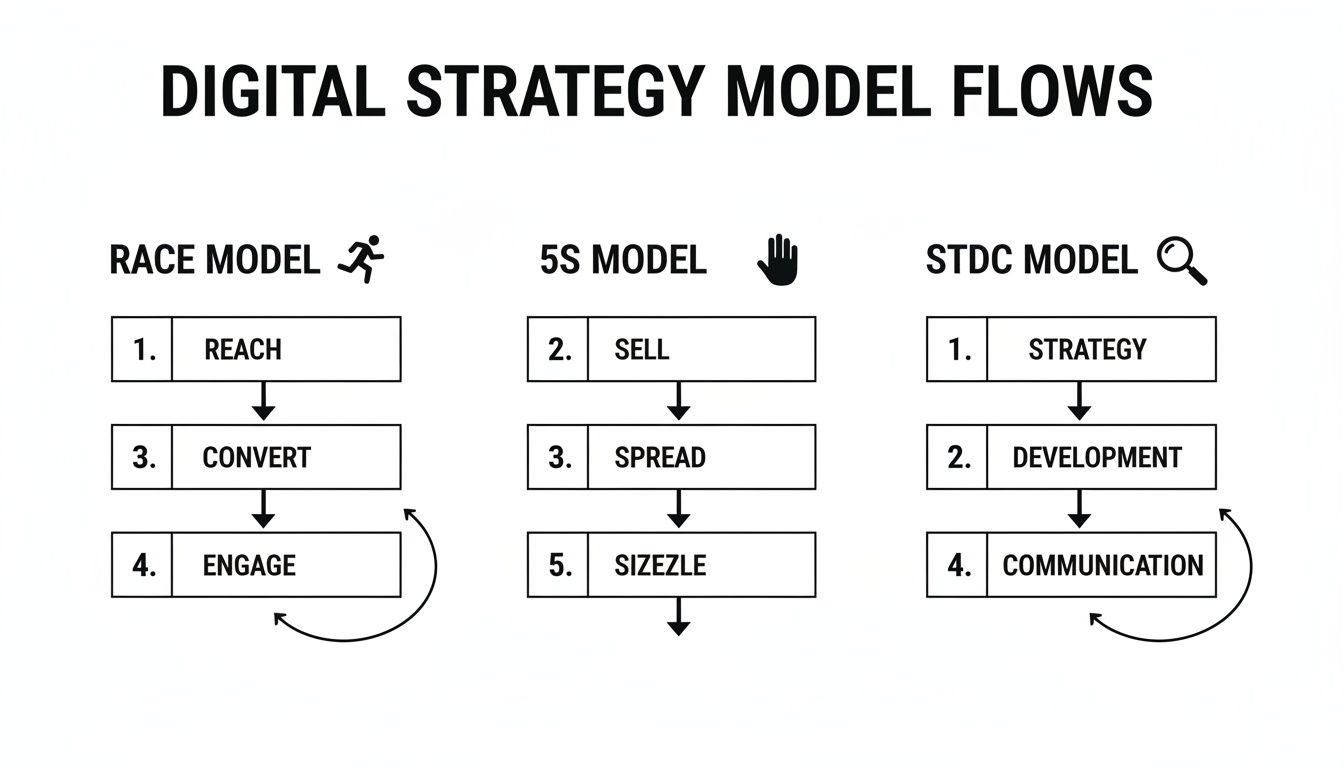
While each model takes a slightly different angle, they all share a common goal: guiding a customer through distinct phases with targeted, intentional actions.
Step 5: Allocate Your Budget
Let's talk about money. Your resources aren't infinite, so your framework has to be realistic. Based on your goals and the channels you've identified, you need to allocate your budget with purpose. This is all about making strategic choices.
Maybe you find that 70% of your best leads come from LinkedIn ads. It makes a lot more sense to double down there instead of spreading your budget thinly across five different platforms hoping something sticks. This step is about investing in what actually moves the needle.
Step 6: Develop a Content and Channel Plan
This is where you bring your message to your audience. Your content and channel plan outlines what you're going to create and where you're going to share it to hit your goals. This plan should flow directly from your personas and their journey map.
- Top-of-Funnel (Awareness): Think helpful blog posts, shareable infographics, and engaging social media content.
- Middle-of-Funnel (Consideration): This is the place for in-depth webinars, compelling case studies, and valuable email courses.
- Bottom-of-Funnel (Decision): Here, you can offer free trials, product demos, and one-on-one consultations.
If you want to explore this further, our guide on how to create a digital marketing strategy offers more context and practical tips.
Step 7: Define KPIs and Set Up Analytics
Last but not least, you have to define what success looks like. Your Key Performance Indicators (KPIs) need to tie directly back to the SMART goals you set. If your goal is to increase MQLs, then your KPIs might be conversion rate, cost per lead, and website-to-lead ratio.
Get your analytics tools, like Google Analytics, configured to track these KPIs from day one. This creates a powerful feedback loop, giving you the data you need to tweak your strategy, prove its value, and make even smarter decisions down the road.
Connecting Your Framework to Business Growth
Let's be honest. A digital strategy framework is more than just a marketing plan—it's the critical link between your team's day-to-day work and the company's bottom line.
Without that connection, marketing often gets unfairly labeled as a cost center, just another line item on a budget with fuzzy returns. A well-designed framework flips that script, turning marketing into an undeniable engine for growth.
The whole point is to translate big-picture business goals into specific, measurable digital KPIs. This creates a direct line of sight from what you spend to the revenue you bring in, a language every C-suite executive understands perfectly.
From Business Goals to Digital KPIs
Imagine your CEO announces a company-wide goal to grow market share by 15% this year. A marketing team without a solid framework might react with vague ideas like "we need to boost brand awareness." That's a classic response, but it’s impossible to measure and fails to show any real impact on the business.
Now, let's look at how a team using a digital strategy framework would tackle the same challenge. They'd break that huge objective down into concrete digital targets.
- The Business Goal: Increase market share by 15%.
- Our Digital Objective: Generate 2,000 new Marketing Qualified Leads (MQLs) from our target expansion region in Q3.
- How We’ll Measure Success (KPIs):
- Hit a 4% conversion rate on our regional landing pages.
- Keep our cost per MQL under $75.
- Grow organic search traffic from that specific region by 30%.
See the difference? This approach turns a lofty corporate mission into a clear-cut action plan for the marketing team. Every single KPI acts as a checkpoint, proving you're on track to hit the larger business goal.
Proving ROI and Getting Everyone on Board
When you can draw a straight line from a specific campaign all the way to a closed deal, your budget meetings feel completely different. You’re no longer just asking for money; you're presenting an investment opportunity with a predictable return. This is where attribution really becomes your best friend.
A framework gives you the structure to track every single touchpoint a customer has with your brand, from the first blog post they read to the final purchase. This data is the hard proof you need to show the value of your work.
For instance, you can walk into a meeting and say that for every $1 we spent promoting content on LinkedIn, we generated $5 in new customer revenue. That kind of data-backed storytelling is how you get executives on your side and shift the perception of your department for good. If you want to dive deeper into this, understanding what is revenue attribution is a great next step.
At the end of the day, a strong framework doesn't just organize your marketing—it validates it. It provides the undeniable proof that your digital efforts are fundamental to the financial health and growth of the entire company.
Scaling Your Strategy for Long-Term Success
Your business won't stay the same forever, so why should your digital strategy? A framework that’s perfect for a five-person startup is going to creak and groan under the weight of a fifty-person team. Scaling your digital strategy framework is all about creating a plan that works now and has the flexibility to grow with you.
Think of it like this: your first framework is a speedboat. It's fast, agile, and gets you where you need to go in the early days. But as your company expands, you need to trade that speedboat for a cargo ship—something built to handle a bigger crew, longer journeys, and much stormier seas.
This isn’t about scrapping your plan every year. It’s about building a system that’s designed to adapt from the very beginning.
Adopting a Test and Learn Mindset
If there's one thing that separates strategies that scale from those that crumble, it's a "test and learn" culture. Customer habits change on a dime, and what killed it for you last quarter might be a total dud today. The companies that get left behind are the ones stuck on "this is how we've always done it."
Instead of carving your annual plan into stone, build your framework around a cycle of constant, small experiments. Treat your marketing campaigns less like a massive product launch and more like a series of calculated bets.
- Hypothesize: Start with a clear idea. "We think using video on LinkedIn will bring our Cost Per Lead down."
- Test: Run a small, controlled campaign for a few weeks with a limited budget.
- Measure: Dive into the data. Did the CPL actually drop? By how much?
- Iterate: If it worked, fantastic—double down and invest more. If it bombed, figure out why and pivot to the next idea.
This cycle pulls you out of the guessing game and puts hard data in the driver's seat.
Optimizing Your Channel Mix and Leveraging Automation
As you grow, your go-to channels will need a refresh. The one or two platforms that delivered amazing results at the start might get too crowded or expensive over time. A scalable framework has a built-in process for auditing your channels and shifting resources.
The goal is to consistently move your budget and effort to the channels giving you the best ROI, not just the ones you're comfortable with.
On top of that, the manual tasks you could easily handle with a small team will become serious roadblocks to growth. Scaling means getting smart with automation. This could be anything from using a marketing automation platform like HubSpot for email campaigns, a tool like Buffer to schedule social media, or AI analytics to spot trends faster.
Automation gives your team their time back. It frees them from the repetitive grunt work so they can focus on what really matters: thinking, analyzing, and planning the next big move. When you combine this agile mindset with the right tech, you build a strategy that doesn't just survive growth—it fuels it.
Common Questions About Digital Strategy
Even with a great blueprint, questions always come up once you start building. Crafting a digital strategy framework is exactly the same. Let's walk through some of the most common questions that trip up marketing teams and business owners when they try to put their plans into practice.
Getting these answers right is what turns your framework from a document that gathers dust into a guide you actually use every day. It's all about creating a living strategy that gets real results.
How Often Should I Review My Digital Strategy Framework?
Your framework isn't carved in stone; think of it more like a living map. Markets change, new channels pop up, and your own business goals will inevitably shift. A "set it and forget it" mindset just doesn't fly.
A good rule of thumb is to use a two-part review schedule:
- A Big Annual Review: Once a year, set aside time for a deep dive. This is where you re-sync the entire framework with the company's main business goals for the year ahead. It’s your opportunity to make foundational changes.
- Quarterly or Monthly Check-ins: You need to look at your key performance indicators (KPIs) and tactical results far more often. These regular check-ins let you stay nimble—doubling down on what's working and cutting what isn't—without having to tear the whole strategy apart.
This rhythm keeps your strategy sharp and responsive to what's happening right now.
What Is the Biggest Mistake to Avoid?
The single most common trap is building your digital strategy in a bubble, completely disconnected from what the business actually needs to achieve. It’s easy to get caught up chasing "vanity metrics" like website clicks or social media likes. They feel good and look productive, but they often have zero impact on the bottom line.
A framework is doomed from the start if it can't draw a straight line from a marketing campaign to revenue, customer acquisition cost, or lifetime value. It will never get buy-in from leadership and will be the first thing on the chopping block when budgets get tight.
Always, always start with the question, "What does the business need to accomplish?" Then, work backward to build your digital goals from that answer. That direct connection is the foundation for any successful strategy.
Can a Small Business Use a Digital Strategy Framework?
Not only can they, but they absolutely should. In many ways, a framework is even more critical for a small business. When you have a tight budget and a small team, you can't afford to waste a single dollar or a single hour. Guesswork is a luxury you just don't have.
A solid digital strategy framework forces a small business to be ruthless with its choices. Instead of trying to be everywhere at once—spreading a small budget thinly across five different social platforms—it helps you pinpoint the one or two channels where your ideal customers actually spend their time.
This focus means every bit of marketing effort is concentrated where it will have the biggest impact, turning your limited resources into a genuine competitive edge.
Ready to build a strategy that drives real growth? The team at ReachLabs.ai specializes in creating data-driven marketing frameworks that connect every action to your business goals. Learn more about how we can help.