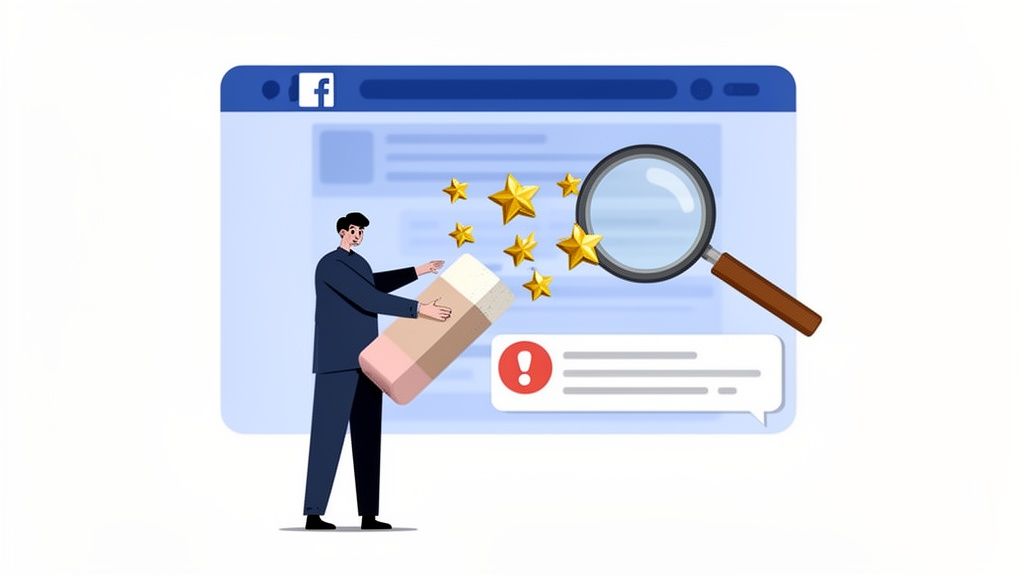
Let’s get one thing straight right away: you cannot just delete a single bad review from your Facebook Page because you don't like what it says. It’s simply not an option.
Instead, your power lies in knowing the two main paths you can take: reporting a review that genuinely breaks Meta's rules or, as a last resort, turning off the entire Recommendations feature. Doing the latter will hide all your reviews, the good along with the bad. This guide is all about managing your reputation strategically, not wishing for a delete button that doesn’t exist.
The Reality of Managing Facebook Reviews
When a negative review pops up, every business owner feels that gut-punch reaction and immediately starts hunting for a way to make it disappear. But Facebook built its system around transparency, which means you can’t just erase legitimate customer feedback.
Accepting this is the first real step toward managing your Page’s reputation effectively. Once you stop searching for a magic "delete" button, you can pivot your focus to what really matters: assessing the review and deciding on the smartest way to respond. This shift in mindset moves you from a place of frustration to one of strategic control.
What You Can and Cannot Control
The real skill here is learning to tell the difference between a valid, albeit negative, customer opinion and content that’s actually violating Facebook's Community Standards. A customer who is unhappy with your service has every right to say so, even if you see things differently. That review is probably staying.
However, a "review" that’s really just hate speech, spam, or a personal attack on an employee is a different story. Those are the ones you can—and should—report. For a deep dive into how this plays out in specific fields, a resource like A Contractor's Guide to Facebook Remove Reviews offers some fantastic, industry-specific insights.
Knowing the difference sets realistic expectations. You can't silence every critic, but you absolutely can defend your business against malicious or fake attacks. This is a core part of a much larger strategy, which we explore further in our guide to reputation management and social media.
Your best move isn't trying to scrub away every bad review. It's building a system that encourages so much positive, authentic feedback that the occasional negative comment becomes background noise. Your energy is far better spent on proactive reputation building.
Your Options for Handling Facebook Reviews
To make it crystal clear, let's break down the common situations you’ll run into and the realistic actions you can take. Think of this table as your quick-reference cheat sheet for deciding what to do next.
| Review Type | Can You Delete It Directly? | Recommended Action |
|---|---|---|
| Legitimate Negative Opinion | No | Respond publicly and professionally to show you're listening. Then, offer to take the conversation offline to solve their problem directly. |
| Spam or Irrelevant Content | No, but you can report it. | Report the review to Meta as "Spam." Give a clear reason, like "This is an ad for another service and not a real review." |
| Harassment or Hate Speech | No, but you can report it. | Immediately report the review. Choose the most fitting reason, like "Hate Speech" or "Harassment." These are taken very seriously. |
| Fake Review (e.g., from a competitor) | No, but you can report it. | Report it as "Spam" or even "Fraud." Gather any proof you can—like a brand-new, empty profile—to strengthen your case with Meta. |
Ultimately, mastering Facebook reviews isn't about deletion. It’s about smart moderation, quick and professional responses, and knowing which battles you can actually win.
How to Turn Off Recommendations on Your Facebook Page
Sometimes, you’ve done everything right—reported the fake review, waited for Meta to act—and still, nothing happens. Or worse, you're hit with a coordinated attack of negative feedback. When you're in that tough spot, you might need to consider the "nuclear option": turning off the Recommendations feature entirely.
Going this route is a big decision. It's a swift, effective way to get rid of all reviews, but it's a blunt instrument. It takes down everything—the good, the bad, and the ugly. Your star rating vanishes from your Page and disappears from Facebook search results.
For some businesses, especially those that rely on social proof to build trust, this is too high a price to pay. But if your business is under a malicious attack or if Facebook isn't a primary customer acquisition channel for you, it can bring immediate relief.
Finding the Off Switch on Desktop
First things first, you'll need to have admin or editor access to your Page. The controls are tucked away in your Page's professional dashboard.
Here’s how to find them:
- Head over to your Facebook Business Page.
- Look for Settings in the menu on the left side of your screen.
- Once you click that, a new menu will pop up. Select Templates and Tabs.
This "Templates and Tabs" area is your control panel for how your Page is laid out. You can rearrange sections like "About," "Photos," and "Events," but more importantly, it's where you can turn off Recommendations.
In the list of tabs, find the one labeled "Reviews" or "Recommendations." You’ll see a simple toggle switch next to it. Just click that switch to the "Off" position.
The change is instant. The tab will disappear from your public Page, taking every single review and your overall rating with it.
The Real-World Trade-Offs
Flipping that switch solves one problem but creates another. While those damaging negative reviews are gone, so are all the glowing testimonials from your happy customers.
Before you hide your reviews, ask yourself this: Is the damage I'm taking from these negative comments greater than the value I get from my positive ones? If the answer is a clear "yes," then disabling the tab might be the best short-term move to protect your brand.
The good news is that this isn't permanent. You can always turn the Recommendations feature back on later. When you do, all your old reviews—and your star rating—will pop right back up as if they never left. This makes it a really useful tool for managing a temporary crisis.
This process highlights the limited options available to business owners. As the flowchart below shows, your direct actions boil down to two paths: reporting an individual review or hiding the entire feature. There is no in-between.

Disabling Reviews from Your Phone
What if you're not at your desk when a crisis hits? No problem. You can manage this from your phone, too. The process is just as simple on the Facebook mobile app.
- Open the Facebook app and navigate to your Business Page.
- Tap the "More" button (it usually looks like three horizontal lines).
- Scroll until you see "Edit Page" and give it a tap.
- From there, select "Tabs" and then "Reorder Tabs."
- Find the "Reviews" or "Recommendations" tab and toggle it off.
Whether you're on a computer or your phone, turning off reviews is a powerful but drastic step. It immediately stops the bleeding from negative feedback, but it comes at the cost of hiding the positive social proof you've worked so hard to build.
Reporting Fake and Malicious Reviews to Meta
If you’re dealing with a flood of bad feedback, hiding your Recommendations tab is the nuclear option. But before you go that far, your first line of defense should always be reporting illegitimate reviews directly to Meta. This is your go-to move for getting policy-violating content removed.
Success, however, isn’t about just clicking the "report" button and hoping for the best. You need to build a solid, evidence-based case that makes it easy for a Meta moderator to rule in your favor.
Here’s where many business owners get it wrong: they think a review has to be factually incorrect to be removed. In reality, Meta’s moderators couldn’t care less if you disagree with a customer’s opinion. Their only job is to see if the review breaks their Community Standards. A legitimate, negative review from an actual customer will almost never be taken down. Your focus has to be on spotting and documenting clear violations.

What Actually Violates Facebook's Policies
Before you can report anything effectively, you need to know the rulebook. Forget your personal feelings about the review; it’s all about whether it fits into one of Meta’s violation categories. For business reviews, these are the most common ones:
- Spam: This is a broad category. It includes obvious copy-paste reviews, content promoting other businesses, or repeated posts from the same person or group trying to tank your rating.
- Hate Speech: Any content attacking people based on protected characteristics like race, religion, ethnicity, sexual orientation, and so on. This is a serious violation and usually gets a quick response.
- Harassment and Bullying: This is for personal attacks on you or your team. A review saying, "The coffee was cold," is just feedback. A review saying, "The barista is a total moron and should be fired," crosses the line into harassment. It also includes revealing private info or trying to shame someone.
- Fraud or Deception: This is your best bet for reviews that are clearly fake. Think reviewers who are known competitors, disgruntled ex-employees, or profiles that show zero evidence of ever being a customer.
Knowing which box to tick is half the battle. Reporting a review for the wrong reason is a fast track to an automated rejection, and that can make it even harder to get a second look.
Building Your Case Before You Report
A winning report is built on good evidence. When a shady review pops up, don’t just react—investigate. Put on your detective hat for five minutes and gather some proof to back up your claim.
Start by clicking on the reviewer’s profile. Does it look real? A brand-new account with no friends, a generic profile picture, and zero other activity is a massive red flag. Grab a screenshot.
Next, look at what they wrote. Is the language vague and generic, or does it mention specific details only a real customer would know? Does it contain threats, slurs, or personal insults? Document everything. This groundwork is what separates a successful takedown from a frustrating dead end, especially when you're facing what looks like a coordinated attack.
A key thing to remember: the moderator handling your report is likely reviewing hundreds of cases a day. They need to make a decision in seconds. The easier you make it for them to spot the violation, the better your chances. A clean, documented case beats an emotional rant every single time.
The sheer scale of Meta's operation is staggering. In the third quarter of 2025 alone, Facebook took action on 1.2 million pieces of hate speech content. While their data suggests around 90% of removal decisions are accurate, mistakes absolutely happen. This is exactly why a well-documented report is so important—it helps your case stand out and gives the moderator clear evidence to act on.
Crafting a Compelling Report
When you’re ready to submit, specificity is your friend. Don’t just hit "Spam" and move on. Always choose the "Something Else" option if it’s available, so you can add your own context.
Here’s a simple framework you can adapt for your report:
Example Report for a Suspected Fake Review:
"This review violates Community Standards on Fraud and Deception. The reviewer's profile was created today, has zero friends, and no public activity, which strongly suggests it's a fake account made to damage our business. We have no record of a customer named 'John Smith' in our system, and the vague complaints don't match any real customer interaction. We believe this is a malicious and fake review."
This short paragraph accomplishes two critical things:
- It names the specific policy being violated (Fraud and Deception).
- It presents the evidence you gathered (new profile, not in your database).
This simple shift turns your report from a weak complaint into a concise, evidence-backed request for moderation.
For businesses looking to do a wider audit of their online reputation, exploring strategies for a 'review clean-up' can offer a more structured plan. By being methodical and persistent, you dramatically increase your odds of getting those unfair reviews off your Page for good.
A Proactive Strategy to Bury Negative Feedback
Trying to get every negative comment removed is an exhausting, and often losing, battle. A much smarter play is to go on the offense. Instead of obsessing over takedowns, your goal should be to build such a powerful, consistent stream of positive feedback that any single negative review just gets lost in the noise.
Think of it this way: the best defense against a bad review is a wall of authentic, positive ones. This isn't about hiding from criticism. It’s about putting that criticism in its proper context—as a rare exception, not the rule. When a potential customer sees one grumpy comment buried among dozens of glowing recommendations, its power completely evaporates.

Make It Effortless for Happy Customers
Here’s a secret: the biggest thing standing between a happy customer and a great review is almost always friction. People are busy. Your job is to make leaving a review so ridiculously easy that it takes them less than a minute.
You can start putting this into practice today with a few simple tactics:
- Set Up a Review QR Code: Generate a free QR code that links directly to your Facebook Page's Recommendations tab. Put it everywhere—on receipts, invoices, business cards, or a small sign near your checkout. A happy customer can scan it with their phone and be on the review page in seconds.
- Add a Link to Your Email Signature: Every email your team sends is a missed opportunity. Add a simple, friendly line to your email signature like, "Love our service? Leave us a review on Facebook!". It’s a set-it-and-forget-it tactic.
- Train Your Team to Ask: This is huge. Empower your staff to spot happy customers and just ask for feedback. It doesn’t have to be a cringey, high-pressure pitch. A simple, "We're so glad you had a great experience! If you have a moment, we'd be incredibly grateful for a recommendation on our Facebook Page," works wonders.
This proactive approach turns customer satisfaction into a real, tangible asset. Over time, you build a "review funnel" that continuously strengthens your social proof and protects your reputation.
How to Handle the Inevitable Negative Review
Even with the best strategy, negative reviews are going to happen. How you respond is just as important as the review itself. Remember, your reply isn't just for the unhappy customer—it's for every single future customer who reads it.
A professional, empathetic response can actually turn a negative into a positive. It shows you care, you listen, and you're committed to making things right. Honestly, that builds far more trust than a pristine-but-empty review section ever could.
The golden rule for responding is simple: Acknowledge, Apologize, Act. Acknowledge their frustration, apologize that their experience wasn't up to par, and then offer a clear action to solve the problem offline.
Here’s a practical template you can adapt for your own use.
Negative Review Response Template:
"Hi [Customer Name], thank you for taking the time to share this with us. I'm truly sorry to hear your experience didn't meet your expectations, and I appreciate you bringing this to our attention.
We're committed to getting things right, and it’s clear we fell short here. I'd really like to learn more about what happened and find a way to resolve this. Could you please send us a direct message or email us at [support@yourbusiness.com] so we can connect with you personally?"
This response accomplishes three critical things:
- It de-escalates the situation by validating the customer's feelings without getting into a public back-and-forth.
- It moves the conversation offline, taking the argument out of the public square and into a private, more productive channel.
- It showcases professionalism to everyone else reading, proving you take customer service seriously.
This kind of proactive reputation management builds a much more resilient brand. While individual testimonials are powerful, you can also explore how to use a series of authentic endorsements by learning about the impact of video customer testimonials. By consistently encouraging and showcasing positive feedback, you create a powerful buffer against the inevitable bad day, making your online reputation stronger and more reflective of your true business quality.
When and How to Escalate a Removal Request
So, you did everything by the book. You found a review that flagrantly violates Facebook’s policies, meticulously gathered your evidence, and fired off a report. And then… you get that soul-crushing automated reply: "This review doesn't go against our Community Standards." It’s a moment every business owner dreads, leaving you feeling like you’ve hit a brick wall.
But when that first report gets rejected, it’s not the end of the line. If you’re dealing with a review that is genuinely harmful, demonstrably false, or part of a coordinated attack, it’s time to escalate. This isn’t for every negative review; this is for the serious stuff—blatant defamation, reviews from fake profiles that the algorithm missed, or clear conflicts of interest.
The clock is always ticking. The damage from a malicious review happens almost instantly. In fact, research from Northeastern University found that moderated content on Facebook often reaches about 75% of its total audience long before it's ever removed. That’s why moving quickly is so critical; the real harm is done in the first 48 hours, often before anyone has even looked at your initial report. You can see more on these sobering findings about content moderation delays at Techxplore.com.
Using the Meta Business Support Portal
Your first move after a rejection should be the Meta Business Support portal. This isn't the same as the public "report" button on the review itself. This is a support channel for advertisers and page managers, and it’s your best bet for getting your case in front of an actual human being.
You'll need a Meta Business Account to access it. Once you’re logged in, navigate to the "Help" section and open a new case for your Page.
When you write your ticket, don't just rehash your first report. You need to build a stronger case.
- Reference the First Attempt: Start by mentioning that you already reported the review and were rejected. This shows you've followed the standard process.
- Present Your Evidence Again: Don't assume the new support agent will have access to your original report. Re-attach all your screenshots and documentation.
- Connect the Dots: This is the most important part. Clearly and calmly explain why the initial decision was wrong. Point to the specific Community Standard the review violates and explain how the evidence proves it. You're essentially appealing the first decision and asking for a manual override.
The Threshold for Legal Action
In truly extreme situations, especially those involving clear defamation, you might need to consider legal action. Let’s be clear: this is a major step and not one to take lightly. The legal bar for defamation is incredibly high. You have to prove that a statement is factually false, was presented as a fact (not an opinion), caused tangible harm to your business, and was published without legal privilege.
Before you even think about calling a lawyer, ask yourself this: Can I prove this review is factually untrue, and can I show it directly caused financial loss? A bad opinion like "the service was slow" is not defamation. A false factual claim like "the owner used my credit card for fraudulent purchases" could be.
Hiring a lawyer to send a cease and desist letter or a formal takedown notice to Meta’s legal team can work, but it’s an expensive and slow-moving process. This path is really reserved for cases where a false review is causing severe, measurable damage, like a provable drop in revenue directly linked to the post. Escalation is a critical skill, and for a broader perspective on handling these high-stakes scenarios, our guide to social media crisis management offers a more comprehensive framework.
A Case Study in Successful Escalation
Let me walk you through a real-world example. A local bakery was targeted by a recently fired employee who left a scathing one-star review claiming the kitchen used expired ingredients.
The owner first reported the review for "Fraud," noting the reviewer was a disgruntled ex-employee. As expected, the report was automatically rejected.
Instead of giving up, the owner escalated through the Meta Business Support portal. She opened a new case, attached a screenshot of the review, and provided a calm, factual summary of the reviewer’s employment history. This established a clear conflict of interest. She wasn't emotional; she just presented the facts.
The result? Within 72 hours, a support agent manually reviewed the case, agreed it was a conflict of interest, and removed the review.
The success here came down to persistence and providing the crucial context that the automated system couldn't possibly understand. It’s proof that when you’re in the right, escalating with professionalism and solid evidence can absolutely turn the tide.
A Few Lingering Questions About Facebook Reviews
Even with a solid game plan, you're bound to run into some specific, tricky situations. When it comes to managing your Page's reputation, the details really matter. Let’s clear up a few of the most common questions that I see business owners wrestling with all the time.
Getting a straight answer on these points can save you a lot of time and frustration.
How Long Does Meta Take to Respond to a Report?
This is the big one, and unfortunately, there's no single answer. The timeline really depends on what you're reporting. For obvious, clear-cut violations like hate speech or blatant spam, Meta's automated systems are surprisingly quick. You could see a review disappear in just 24 to 48 hours.
However, the more nuanced your situation is, the longer it will take. If you're dealing with a suspected fake review from a competitor or a review bomb campaign, it requires a human to investigate. This process can stretch from a few days to several weeks, especially if your initial report is denied and you have to escalate it. If a genuinely harmful review is still up after a week, don't just sit and wait—politely follow up through the Business Support portal.
What About Those Third-Party "Review Removal" Services?
You've probably seen the ads promising to scrub your Page clean of negative reviews for a fee. My advice? Be very, very careful. Most of these services are just taking your money to do exactly what you can do yourself: report the review.
There is no secret back door or special contact at Meta that these companies have access to. They cannot magically delete legitimate negative feedback. If a review doesn't violate Facebook's Community Standards, it's not coming down, no matter who you pay.
Save your cash. Following the official reporting channels and escalating your case when necessary gives you the exact same odds of success without the hefty price tag.
Will My Old Reviews Come Back If I Turn the Tab On Again?
Yes, absolutely. When you hide the Recommendations tab, you're not deleting anything. Think of it more like flicking a switch—all your reviews and your star rating are simply hidden from public view.
The moment you decide to turn the tab back on, everything will reappear just as you left it. Your entire review history, good and bad, will be restored, along with your overall score. This makes it a fantastic temporary fix if you're hit with a coordinated attack. You can go dark until the situation blows over, then flip the switch and get your hard-earned reputation back online.
How Should I Handle a Review from an Ex-Employee?
This is a tough one, but it's a clear conflict of interest and a violation of Meta's policies. The key is to communicate that conflict of interest clearly to the moderation team.
Here's how to approach it:
- First, report the review using a reason like "Harassment" or "Spam."
- In the text box where you can add more detail, be direct. Write something like, "This review is from a disgruntled former employee and represents a conflict of interest. It is not based on a genuine customer experience."
- If that initial report gets rejected, escalate it through Facebook Business Support. This is where you can provide more context to prove the relationship, like the person's name and their dates of employment.
Framing your report around the conflict of interest, rather than just arguing about the content of the review, gives you the best shot at getting it removed.
Navigating the complexities of digital marketing and reputation management can be demanding. At ReachLabs.ai, we provide expert guidance and integrated strategies to protect and elevate your brand. Discover how our collective approach can make a difference for you at https://www.reachlabs.ai.