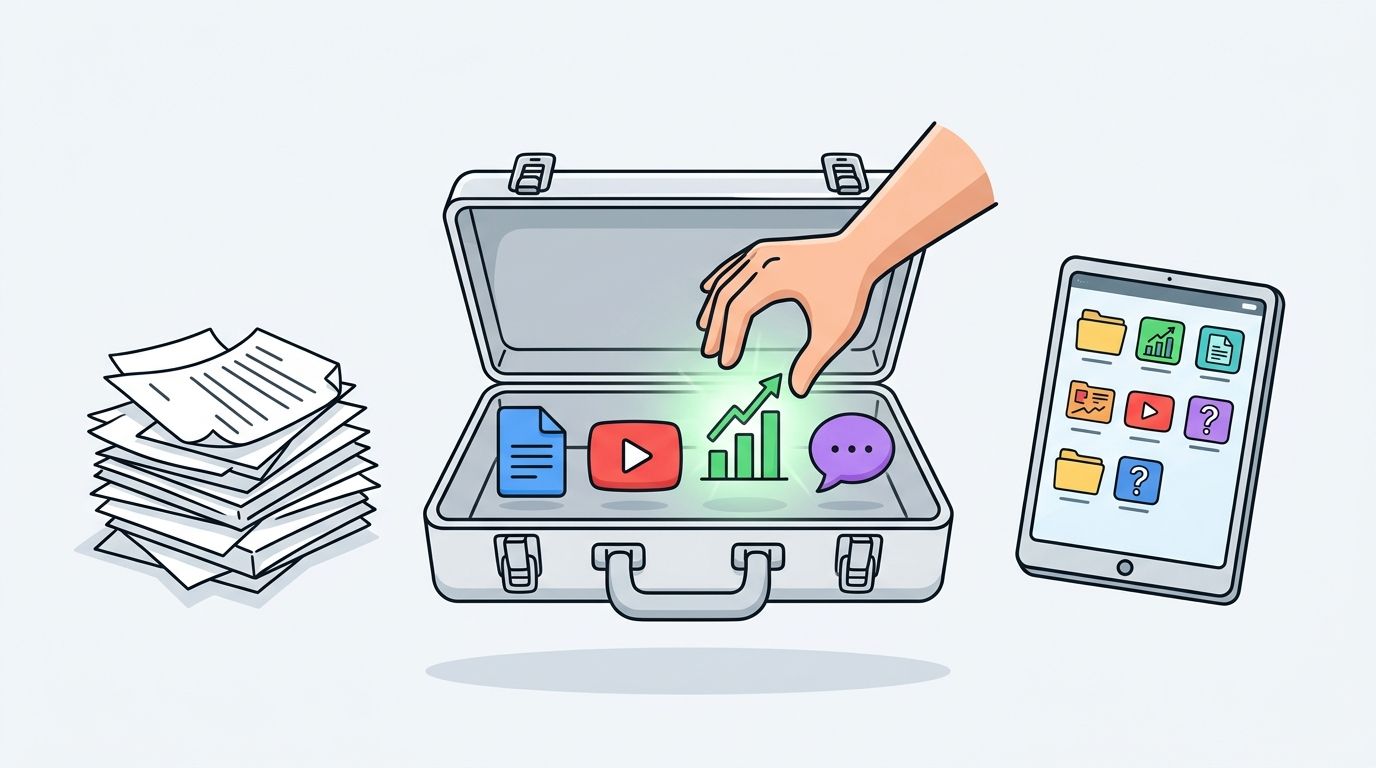

A solid digital marketing strategy is built on a cycle: you plan, you execute, you measure what happened, and then you optimize based on real data to keep growing. It's about creating a predictable engine for your business, not just throwing random campaigns at the wall and hoping something sticks.
Building Your Foundation for a Winning Strategy

Before you jump on the latest trend or pour a bunch of money into ads, you have to build a solid foundation. This is where you stop guessing and start knowing. It all begins with a no-nonsense audit of your digital footprint to see what’s actually working and what's just wasting your time and budget.
Think of this first step as a diagnostic. Take a hard look at your owned media (your website, blog, social media profiles) and your earned media (backlinks, reviews, online mentions). Where does your best traffic come from? Which pieces of content get people to actually engage? The answers you find here set your baseline.
Setting Goals That Actually Drive Business Growth
Let's get one thing straight: vague goals like "get more sales" or "increase brand awareness" won't cut it. Your strategy needs sharp, measurable objectives tied directly to what the business actually cares about. This is where the SMART goal framework becomes your best friend, turning fluffy wishes into concrete targets.
The framework ensures your goals are truly effective. A goal that's specific, measurable, and time-bound is a goal you can actually hit.
SMART Goal Setting Framework
This table breaks down the SMART criteria with real-world marketing examples to help you create effective and measurable goals.
| Criteria | Description | Example Goal Component |
|---|---|---|
| Specific | Clearly define exactly what you want to achieve. No ambiguity. | "Increase organic marketing qualified leads (MQLs) from our blog…" |
| Measurable | Use hard numbers and metrics to track your progress and define success. | "…by 20%…" |
| Achievable | Set a realistic target based on your current resources and baseline data. | (Is a 20% lift possible based on past performance and available resources?) |
| Relevant | Make sure the goal directly supports broader business objectives, like revenue. | (MQLs are a key metric that directly contributes to the sales pipeline.) |
| Time-bound | Assign a specific deadline to create urgency and a clear finish line. | "…within the next quarter." |
Using this framework, a vague idea like "improve our SEO" transforms into a powerful, actionable goal: "Increase organic marketing qualified leads (MQLs) from our blog by 20% within the next quarter." Now that's a target you can build a plan around. It turns marketing from a cost center into a predictable growth driver.
A goal without a plan is just a wish. The foundational stage of your digital marketing strategy is about creating an accountable roadmap where every dollar and every minute spent has a clear purpose tied to a measurable outcome.
This structured approach is non-negotiable for success. With the global digital marketing market projected to hit $786 billion by 2026 and digital ad spend now accounting for over 72% of total ad budgets, the stakes are high. Having a clear strategy ensures your investment actually pays off. You can get more context on these initial steps in our detailed guide on the https://www.reachlabs.ai/strategic-marketing-planning-process/.
Analyzing the Competitive Landscape
Once you know what you’re aiming for, it's time to size up the competition. A good competitive analysis isn't about copying what everyone else is doing; it’s about finding the gaps in their strategy that you can exploit.
Start by picking 3-5 of your top direct and indirect competitors. Then, dig into their playbook:
- SEO Footprint: What keywords are they ranking for? Where are they getting their backlinks? Tools like Semrush or Ahrefs are invaluable here.
- Content Strategy: What topics do they own? Are they all-in on blog posts, videos, or podcasts? Where are they weak?
- Social Media Presence: Which platforms do they dominate? More importantly, what’s their engagement really like?
- Paid Advertising: Are they running ads? What messaging and offers are they pushing?
This intel is gold. Maybe you discover your competitors are all producing generic blog posts. That's your cue to create in-depth video tutorials and own that space. Or perhaps they're completely ignoring a social channel where you know your audience spends their time. These are the opportunities that winning strategies are built on.
Of course, to make any of this work, you need a solid framework for using data effectively. Learning how to build a powerful data and analytics strategy will help you make smarter, data-driven decisions from day one.
Get Clear on Who You're Actually Talking To
Here’s a hard truth: if your marketing tries to speak to everyone, it will resonate with no one. The next vital piece of your strategy is to get laser-focused on the people who matter most to your business. This means moving way beyond generic demographics and building living, breathing buyer personas.
A buyer persona is essentially a character sketch of your ideal customer, built from real data and a bit of educated guesswork. Think of it as your North Star for every single marketing decision. This isn't just a fun creative exercise; it's a critical tool that prevents you from wasting time and money guessing what your audience might want.
Digging for Data in Your Own Backyard
Chances are, you're already sitting on a goldmine of audience information. You just need to know where to look. The best place to start is with the tools you already use every day.
Your analytics platforms are ground zero for this kind of data gathering. A quick look at Google Analytics, for example, can offer up a wealth of demographic and interest data that immediately starts to paint a picture of who’s visiting your site.
For instance, you might see an overview like this in your dashboard, showing you the dominant age groups and gender of your visitors. These are the foundational blocks for building out your personas.
Beyond your website, it's time to do some digging in other places:
- Social Media Insights: Platforms like Instagram, Facebook, and LinkedIn have powerful analytics tools. They’ll tell you who your followers are, where they live, and when they’re most likely to be scrolling.
- CRM Data: Your customer relationship management software is a treasure trove. Look at purchase histories, job titles, and company sizes of your current happy customers.
- Customer Surveys: Sometimes, the best way to get answers is just to ask. A simple survey using a tool like SurveyMonkey can uncover the motivations, challenges, and goals that raw numbers can’t.
If you want to go even deeper on this discovery process, our guide on how to identify your target audience walks through more advanced techniques.
From Data Points to Real People
Once you have all this raw information, it's time to bring it to life. The goal is to create characters that feel so real your entire team can talk about them by name.
Look for patterns in your research. Do you see a trend? Maybe a big chunk of your customers are project managers in the tech industry, hovering between the ages of 30 and 40. Boom. That's the seed of a powerful persona.
Let's build one out as an example:
Persona Profile: "Strategic Sarah"
- Role: Senior Marketing Manager at a mid-sized SaaS company.
- Demographics: 34 years old, lives in a major city, holds an MBA.
- Goals: Increase her team's lead generation by 25% this year and prove the ROI of her marketing spend to leadership.
- Challenges: She’s wrestling with a small team and a tight budget. She feels overwhelmed by the sheer number of marketing tools out there and needs to justify every new expense.
- Watering Holes: Spends her time on LinkedIn and listens to marketing podcasts on her commute. She’s always reading industry blogs to stay ahead of the curve.
A well-crafted buyer persona completely changes the conversation. Instead of asking, "What should we post on social media?" your team starts asking, "What would Strategic Sarah find genuinely useful on LinkedIn today?" It’s a fundamental shift from being company-focused to being customer-obsessed.
When you have detailed personas like Sarah, every piece of content, every ad, and every email can be fine-tuned to connect on a human level. You’re no longer just selling a product; you're solving a specific person's real-world problems. That’s how you build the trust that turns strangers into lifelong customers.
Choosing Your Channels and Crafting Your Content
Alright, you know who you’re talking to. That’s a huge piece of the puzzle. Now, where do you actually find them, and what are you going to say when you do?
The single biggest mistake I see marketers make is trying to be everywhere at once. It's a recipe for burnout and mediocre results. A winning strategy is about focus—picking the digital channels where you can truly connect and make an impact.
Think of it this way: your buyer personas are your treasure map. They tell you exactly where your audience hangs out online. If "Strategic Sarah" practically lives on LinkedIn, then that's your primary battleground. If your other persona is deep in niche Facebook groups or follows specific creators on TikTok, you need to meet them there.
Don't just jump on a channel because it's the hot new thing. Choose it because your ideal customer is already there, waiting for you to start the right conversation.
How to Align Your Channels with Your Business Goals
Every platform has its own strengths. Your job is to build a channel mix that directly supports the SMART goals you set earlier. Not every channel is built for direct sales, and that's perfectly fine. A smart strategy uses different channels for different jobs, all working together.
Here’s how I typically break it down for my clients:
- Goal: Build Brand Awareness? To get your name out there, channels like programmatic display ads, organic social media, and top-of-funnel SEO content (think helpful blog posts) are your workhorses.
- Goal: Generate More Leads? When it's time to capture contact info, you need to zero in. Think gated content (e-books, webinars), search ads targeting high-intent keywords, and laser-focused LinkedIn campaigns.
- Goal: Nurture and Convert? To guide prospects toward a purchase, nothing beats the power of email marketing automation, retargeting ads, and detailed case studies or product demos.
I like to think of it like a sports team. Your SEO is the steady defender, building authority over the long haul. Your paid ads are the star strikers, built for scoring quick wins. And your email marketing? That's your midfield, controlling the game's flow and setting up those crucial scoring opportunities.
To help you visualize this, I've put together a decision matrix. It's a quick reference guide for picking the right channels based on what you want to achieve and who you're trying to reach.
Digital Channel Mix Decision Matrix
| Channel | Best For (Goal) | Primary Audience | Key Content Formats |
|---|---|---|---|
| SEO | Long-term authority, organic traffic, lead gen | Information seekers, problem-aware prospects | Blog posts, guides, landing pages, tools |
| PPC (Search Ads) | Immediate traffic, bottom-funnel conversions | High-intent buyers actively searching for solutions | Text ads, shopping ads, landing pages |
| Social Media (Organic) | Brand building, community engagement, top-of-funnel | Varies by platform (e.g., B2B on LinkedIn, B2C on Instagram) | Short-form video, images, stories, text updates |
| Social Media (Paid) | Targeted awareness, lead gen, retargeting | Highly specific demographic/interest-based segments | Video ads, carousel ads, lead forms, image ads |
| Email Marketing | Nurturing, retention, direct sales | Existing leads and customers | Newsletters, automated sequences, promotional offers |
| Content Marketing | All stages of the funnel, building trust | Anyone seeking information or solutions in your niche | E-books, webinars, case studies, whitepapers |
This isn't an exhaustive list, but it gives you a solid framework for making strategic choices instead of just guessing where to spend your time and money.
Building a Content Plan for the Entire Customer Journey
Once you've picked your channels, you have to feed them. This is where your content plan comes in. Your goal should be to create a cohesive experience that guides a potential customer from the first time they hear about you to the moment they become a loyal advocate.
We can break this journey into three core stages:
- Top of the Funnel (Awareness): People at this stage have a problem, but they might not even have a name for it yet. They're looking for answers, not a sales pitch. Your content here needs to be purely educational and helpful. Think blog posts that solve a common pain point, simple how-to videos, or shareable infographics.
- Middle of the Funnel (Consideration): Okay, they know who you are and are starting to evaluate their options. This is your chance to build trust and prove you're the expert. In-depth case studies, comparison guides, and educational webinars are golden here.
- Bottom of the Funnel (Decision): They're ready to pull the trigger. The content now needs to be direct, remove any final doubts, and make it easy to say "yes." This is the time for free trials, personalized product demos, clear pricing pages, and glowing customer testimonials.
The real magic happens when you create a content ecosystem where every piece has a job. A blog post might attract a new visitor through search, a case study convinces them you’re the real deal, and a personalized demo seals the deal. Each asset hands the baton to the next, creating a smooth and persuasive path to purchase.
Don't Ignore Social Proof: Social Media and Influencers
A modern digital strategy that skips social media and influencer collaborations is simply leaving money on the table. It's where your customers are living, sharing, and—crucially—making buying decisions.
The numbers are staggering. A recent study found that 76% of users say social content influences their buying choices, a figure that skyrockets to 90% among Gen Z. In fact, 41% of Gen Z now turns to social media first for information, beating out even traditional search engines. It's no wonder that 59% of marketers are planning to increase their influencer partnerships. You can dive into more of these digital marketing statistics if you're curious.
But here’s the secret: it has to be authentic. Forget chasing influencers with massive, generic follower counts. The real power is in finding micro-influencers who have a genuine, engaged community that actually aligns with your brand's values.
When it works, a partnership feels like a natural recommendation from a trusted friend, not a clunky, forced advertisement. This is how you build real credibility and connect with people on a human level, turning vanity metrics into real business results. It’s about joining the conversation, not just shouting into it.
Building Your Actionable Marketing Roadmap
A great strategy is just a document until you put it into action. This is where the rubber meets the road—moving from the what and why of your marketing plan to the how and when. We're going to build a concrete roadmap that connects your big goals to the daily tasks needed to hit them.
It all starts with getting real about your budget. You don't need some overly complex financial model. For most businesses, a simple, direct approach works best. The goal is to figure out how to allocate your resources so your plan has the fuel it needs to get off the ground.
Choosing the Right Budgeting Model
There are a handful of solid ways to think about your marketing budget. The trick is to pick the one that makes sense for your company’s financial situation and how fast you’re trying to grow.
- Percentage of Revenue: This is probably the most common method because it's so straightforward. You simply dedicate a set percentage of your total revenue (or projected revenue) to marketing. For instance, a B2B company might set aside 8% of its annual revenue for all marketing activities.
- Objective-Based Budgeting: This approach is much more strategic. You start with your specific goals (like "increase qualified sales demos by 20% next quarter") and then calculate exactly what it will cost to execute the tactics needed to reach that number.
- Competitor Matching: This involves looking at what your main competitors are likely spending and deciding to match or even outspend them. It’s a decent way to get a benchmark, but it makes a big assumption: that their budget is actually effective and that your goals are identical.
No matter which model you land on, you need a clear, defensible number that the whole team can get behind. Your budget isn't just a limit; it's a focusing tool. It forces you to make smart choices about where you're going to put your effort. For many, this includes mastering outbound lead generation to proactively find new customers, which absolutely needs to be baked into your financial planning.
Creating Your 30-60-90 Day Action Plan
Once you have a budget, it's time to map out the work. I’ve found that a 30-60-90 day plan is the perfect tool for this. It takes those big, intimidating annual goals and breaks them into smaller, manageable sprints. This builds momentum and keeps everyone accountable.
This isn't about planning every single task for the next 12 months. It’s about creating total clarity for the next quarter. It's a timeframe short enough to let you stay agile but long enough to see real progress.
A 30-60-90 day plan is all about creating focus. It answers the critical question, "What's the most important thing for us to do right now to get closer to our goals?"
Mapping your actions to the customer journey is a great way to structure this plan. You need different tactics for people who are just discovering you versus those who are ready to buy.
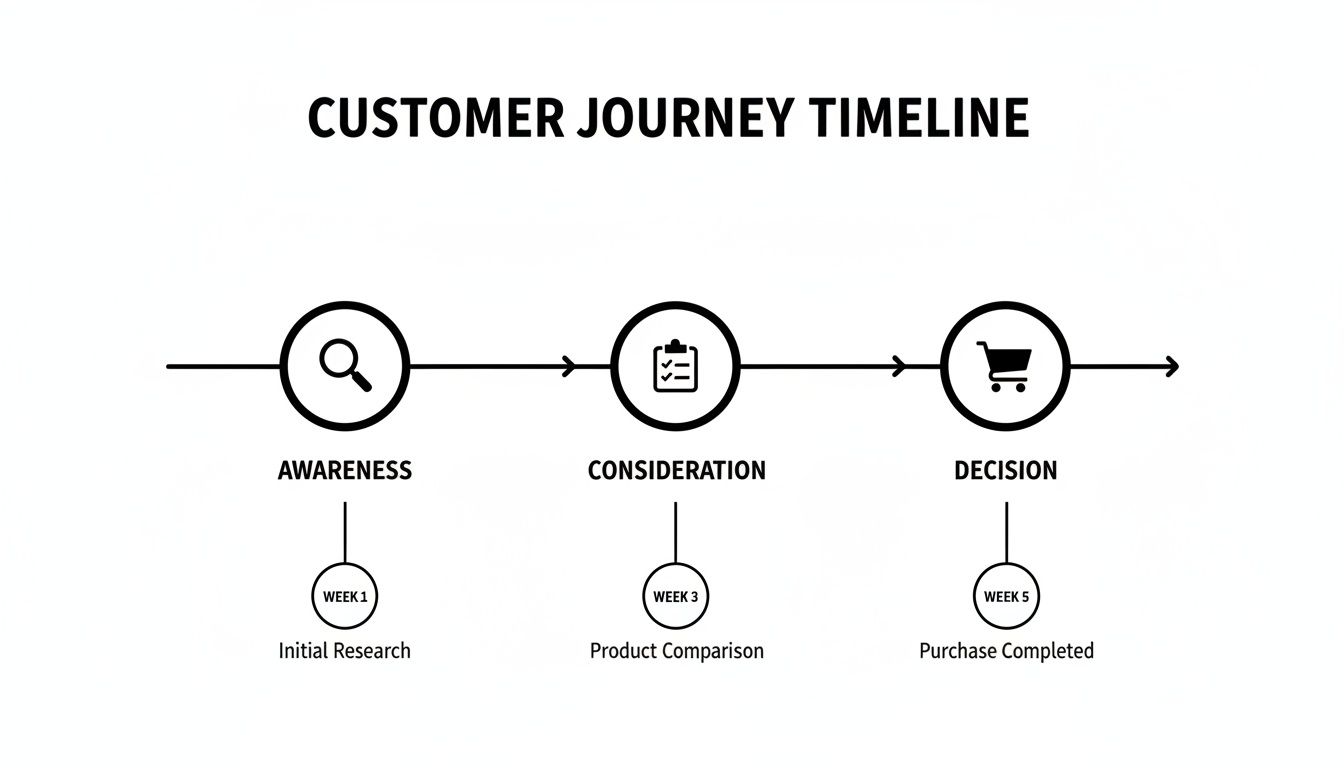
As you can see, the early weeks are focused on generating awareness, which then shifts to providing resources that help potential customers evaluate their options, and finally, pushing for a decision.
Breaking Down the Plan Into Weekly Tasks
The last step is to get granular. A 90-day goal can still feel a bit abstract, so breaking it down into weekly tasks with clear owners is non-negotiable. This is where accountability lives.
Let’s imagine a B2B SaaS company wants to make a serious dent with its SEO.
First 30 Days Focus: Foundational SEO and Content
- Week 1: Finalize the primary keyword list for Q3. Owner: SEO Manager.
- Week 2: Create detailed outlines for the first two pillar content pages. Owner: Content Lead.
- Week 3: Conduct a technical SEO audit of the main website. Owner: SEO Manager.
- Week 4: Write and edit the first pillar page. Owner: Content Team.
When you map out your strategy like this, there’s no confusion. Everyone knows exactly what they’re responsible for and, more importantly, how their work fits into the bigger picture. This is how a well-meaning strategy becomes a machine for generating consistent, measurable results.
Measuring What Matters and Optimizing for Growth
A marketing strategy without measurement is just a collection of hopeful guesses. This is where we make sure the plan doesn't just sit on a shelf gathering dust—we turn it into a living, breathing thing that adapts to what's actually happening in the real world. It all boils down to tracking the numbers that truly matter to the business.
Let’s get one thing straight: vanity metrics like likes, shares, or follower counts won’t pay the bills. While they can be a faint signal of engagement, your focus needs to be locked on the Key Performance Indicators (KPIs) that connect directly to your bottom line.
Choosing KPIs That Drive Business Decisions
To build a plan that actually works, you have to measure what matters. This means picking a handful of KPIs that give you a brutally honest picture of your performance. These are the numbers that will guide every single adjustment and optimization you make down the road.
Here are a few essential KPIs that should be on every marketer’s radar:
- Customer Acquisition Cost (CAC): How much does it cost, in total, to win a single new customer? If your CAC is climbing, it's a huge red flag that something in your strategy is losing steam.
- Conversion Rate: What percentage of people are actually taking the action you want them to take? This could be signing up, booking a demo, or making a purchase. It's a direct measure of how persuasive your marketing really is.
- Return on Investment (ROI): This is the ultimate proof. For every dollar you spend on marketing, how many are you getting back? A positive ROI is the clearest sign that your strategy is adding real, tangible value.
- Customer Lifetime Value (CLV): How much revenue can you expect from a customer over their entire relationship with your brand? Knowing this number is critical because it tells you exactly how much you can afford to spend to acquire them in the first place.
These are just the starting point. For a deeper look, check out our complete guide to essential marketing performance metrics and examples. The trick is to choose just a few that align directly with the SMART goals you set earlier.
Building Your Performance Dashboard
Data is completely useless if it’s buried in a spreadsheet no one ever looks at. The next step is to pull your most important KPIs into a simple, visual dashboard. This gives you a real-time pulse on your marketing health, and you don’t need a fancy, expensive tool to get it done.
Platforms like Google Analytics 4 (GA4) and Google Looker Studio are fantastic for this, and they're free. You can pull data from your website, ad campaigns, and even your CRM to create a single source of truth for your entire team.
Your dashboard needs to be clean and scannable. At a glance, anyone should be able to answer one simple question: "Are we winning or losing?" This isn’t about tracking every possible metric; it’s about making your most critical numbers impossible to ignore.
A great marketing dashboard doesn’t just report the news; it tells a story. It should clearly show the connection between your marketing activities and the business outcomes they’re driving, making it easy to spot trends and identify opportunities.
Creating Your Optimization Feedback Loop
Okay, this is the most important part of the entire process. A marketing strategy isn't something you launch and forget. The secret to long-term, sustained growth is building a consistent feedback loop where you analyze data, learn from it, and make smart, iterative improvements.
This turns your marketing from a series of one-off campaigns into an agile, data-driven engine. It’s a simple, repeatable cycle:
- Review the Data: Block out time every month or quarter to really dig into your dashboard. Don't just look at the numbers—ask "why" they look that way. Why did one channel knock it out of the park? Why did that new campaign fall flat?
- Identify Wins and Losses: Be honest about what’s working and what isn’t. Double down on the channels and tactics that are delivering a solid ROI. And don't be afraid to cut or completely rethink the ones that are draining your budget with little to show for it.
- Form a Hypothesis: Based on what you've learned, make an educated guess. For example, "We believe that changing our ad creative to focus on customer testimonials will increase our conversion rate by 10%."
- Test and Implement: Put that hypothesis to the test. Run an A/B test on your ad creative, tweak your landing page copy, or shift your budget from a poor performer to a strong one.
- Measure and Repeat: Go back to your dashboard and see if your changes moved the needle. Whether you were right or wrong, you’ve learned something valuable that will make your next decision even smarter.
This agile approach is what separates a strategy that works from one that withers. And personalization is becoming a massive factor here. It’s no longer a buzzword but a serious revenue driver, with personalized content making consumers far more likely to buy. In fact, 56% of marketing leaders are actively investing in GenAI tools to power this kind of real-time personalization. You can discover more insights about these emerging AI trends on Nielsen.com.
Still Have Questions About Building Your Marketing Strategy?
Even with the best framework, putting a marketing strategy together can feel a bit overwhelming. That's completely normal. Let's tackle some of the most common questions I hear from marketers who are right where you are now.
Think of this as your go-to cheat sheet for when you hit those inevitable roadblocks.
How Often Should I Actually Update My Digital Marketing Strategy?
Your marketing strategy needs to be a living, breathing document—not a "set it and forget it" PDF that gathers dust. As a general rule, you should plan for a major, deep-dive review and update once a year. This is where you zoom out and re-evaluate the big stuff: your core goals, your audience personas, and the overall channel mix based on a full 12 months of data.
But waiting a whole year to touch anything is a surefire way to get left behind. The digital space just moves too fast. That's why you should be checking in on your key performance metrics monthly and making smaller, tactical pivots every quarter. Competitors will launch new campaigns, algorithms will change, and your customers' habits will shift.
Think of your annual plan as the cross-country road trip map. The quarterly reviews are those moments you pull over to check for traffic, construction, or a better route to get to your destination faster.
This approach keeps you nimble. For instance, a quarterly check-in might show your cost-per-click on Google Ads is suddenly skyrocketing. That's your signal to shift some of that budget toward a channel that's crushing it, like organic content, for the next 90 days.
What’s the Single Biggest Mistake to Avoid When Creating a Strategy?
Hands down, the most common and costly mistake is jumping straight into tactics without laying any groundwork. So many businesses get dazzled by the idea of a viral TikTok video or a flashy new podcast before they've even figured out who they're trying to reach or why that audience should give a damn.
It’s a classic "ready, fire, aim" scenario. It almost always ends with wasted money, campaigns that get zero traction, and a frustrated team wondering what went wrong. It's like trying to decorate a house before you've even poured the foundation.
A truly effective strategy is always built on two pillars:
- Deep Customer Insight: Genuinely understanding your audience’s pain points, what drives them, and where they actually hang out online.
- A Clear Market Position: Knowing who you're up against and what makes your product or service the obvious choice for your ideal customer.
Always, always start with the "who" and the "why." The "what" and the "how" will naturally fall into place after that.
How Can I Create a Strategy With a Tiny Budget?
A small budget isn't a death sentence; it's a powerful filter that forces you to be focused and creative. The trick is to kill the temptation to do a little bit of everything. Your mission is to make a few smart, concentrated bets and go all-in on them.
Forget trying to be everywhere. Pinpoint the one or two social media platforms where your ideal customers are most active and engaged, and aim to become a valuable voice in that specific community.
From there, put your energy into high-ROI organic tactics that reward effort and consistency over a big ad spend.
- Content & SEO: Creating genuinely useful content that solves real problems is the best long-term investment you can make. It's more about sweat equity than cash, and a single great article can bring in organic traffic for years to come.
- Email Marketing: Get obsessive about building your email list from day one. It's your direct, owned channel to your most interested fans and prospects—and it's insanely cost-effective for nurturing the leads you work so hard to get.
A tight budget makes you disciplined. It forces you to be smarter and more resourceful than your bigger competitors, which can be the best advantage of all.
At ReachLabs.ai, we turn these strategic principles into real-world action. Our team lives and breathes this stuff, building and executing data-driven marketing plans that get tangible results. If you're ready to build a strategy that actually moves your business forward, learn more about how we can help.