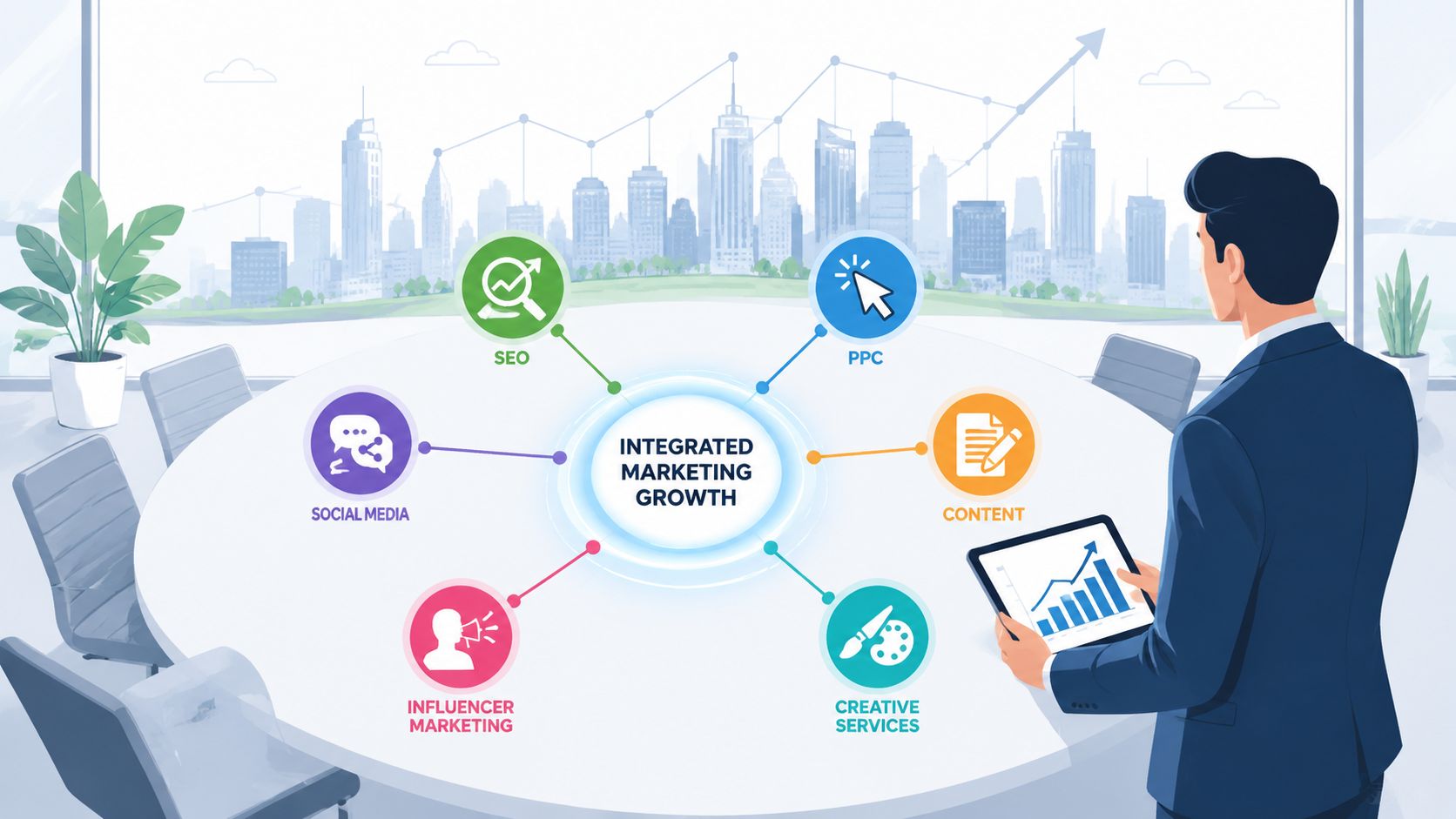

A solid digital marketing strategy isn't just a list of things to do online. It’s a roadmap that explains how you'll use specific digital channels to hit your business goals. The key isn't to be everywhere at once; it's about making smart choices—picking the right channels, knowing your audience inside and out, and actually measuring what's moving the needle. This turns marketing from a guessing game into a reliable growth engine.
Building Your Foundation for Digital Marketing Success
Before you even think about running an ad or writing a blog post, you have to lay the groundwork. Pouring money into marketing without a solid foundation is like building a house on sand. It’s a recipe for disaster. A winning digital marketing strategy for any small business starts with an almost obsessive understanding of two things: your customers and your unique spot in the market.
The good news? This foundational work doesn't need a huge budget. In fact, some of the most powerful insights come from simple, high-impact research you can do yourself.
Uncover What Your Customers Really Want
It's time to put on your detective hat. Your mission is to get inside your audience's head and understand their biggest pain points, their desires, and even the exact words they use to talk about them. You can skip the expensive market research firms—your best data is often hiding in plain sight.
Here are a few practical ways to gather that intel:
- Dig Through Competitor Reviews: Head over to the Google, Yelp, or Amazon reviews of your closest competitors. You're looking for patterns. What do people rave about ("fast shipping," "amazing service")? What do they complain about ("confusing to set up," "terrible customer support")? These are gold mines, showing you exactly where the gaps in the market are.
- Run Quick Social Media Polls: Use Instagram Stories or LinkedIn polls to ask your audience direct questions. A simple poll like, "What's your biggest challenge with [your area of expertise]?" can give you incredible feedback and a dozen new content ideas.
- Just Talk to Your Customers: If you already have customers, you're sitting on a treasure trove of information. Send out a quick survey or, better yet, pick up the phone. Ask them point-blank why they chose you and what specific problem you solved for them.
This process is all about building from the ground up: start with research, use that to build your personas, and then nail down what makes you unique.
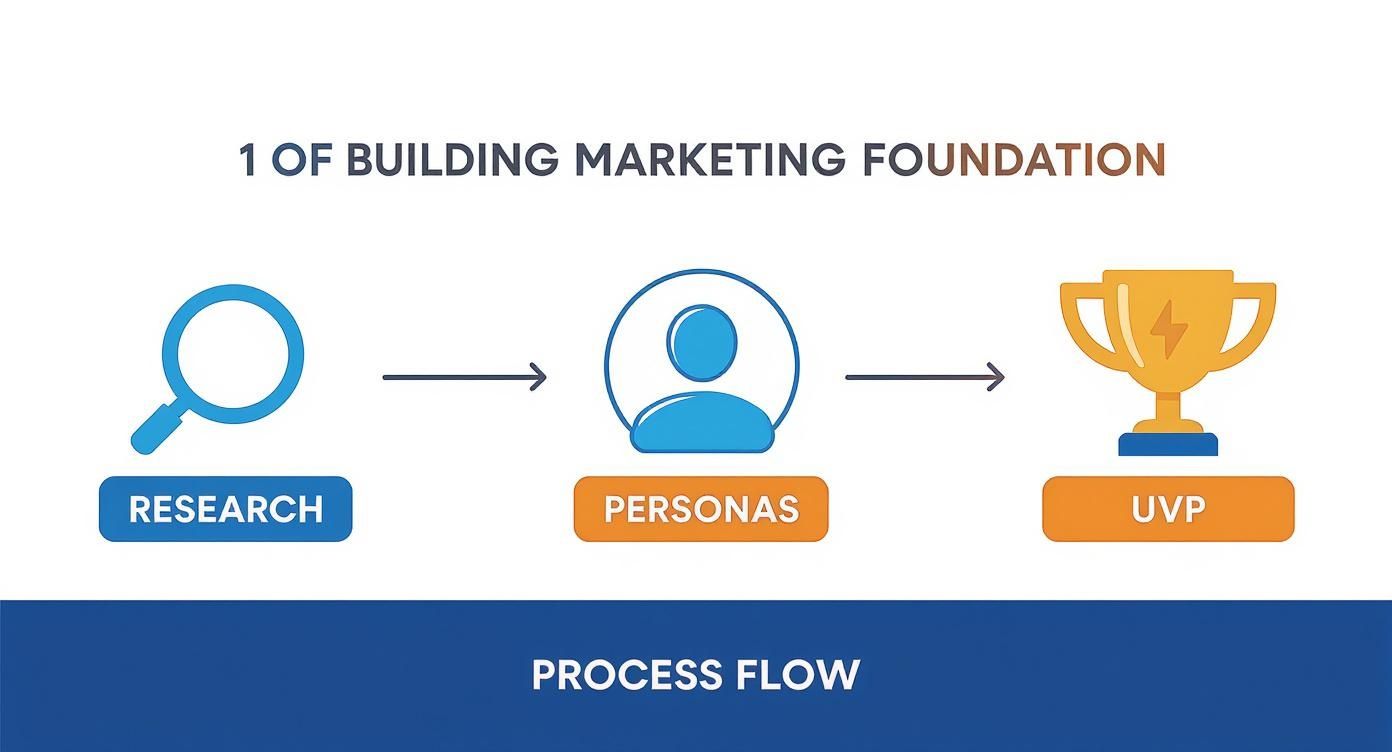
This visual shows how each step builds on the last, making sure your marketing efforts are connected and strategic right from the start.
Create Buyer Personas That Feel Real
Once you’ve collected all this research, it's time to bring that data to life with buyer personas. Think of these as semi-fictional profiles of your ideal customers. The goal is to create a character so vivid you feel like you actually know them.
A great persona goes way beyond basic demographics like age and city. It gets into their goals, frustrations, motivations, and even which social media platforms they scroll through during their lunch break. So instead of a generic "Females, 30-45," you create "Organized Olivia," a 38-year-old project manager who values efficiency above all else, reads industry blogs to stay ahead, and constantly struggles with not having enough hours in the day. See the difference? That level of detail makes every marketing decision that follows so much easier.
Key Takeaway: When you start creating content for "Organized Olivia" instead of a vague demographic, your messaging instantly becomes sharper, more relevant, and a whole lot more effective.
Define Your Unique Value Proposition
Alright, now for the most important question in business: "Why should I choose you over everyone else?" Your answer to that is your Unique Value Proposition (UVP). A strong UVP is clear, short, and shines a spotlight on a real benefit that your competitors can't easily copy. It’s the heart of your brand's promise.
Your UVP is more than just a snappy slogan. It's the guiding star for your entire digital marketing strategy. It should be front and center on your website, woven into your social media posts, and at the core of your ad copy. To really get traction online, you'll want to pair a clear UVP with solid fundamentals. This simple guide to SEO for small business provides a practical look at another core piece of the puzzle. When you combine a powerful UVP with smart SEO, you create a one-two punch that attracts and converts. To get a better sense of how all these foundational elements work together, it's worth learning more about https://www.reachlabs.ai/what-is-a-digital-strategy/.
Choosing the Right Digital Marketing Channels
Now that you know exactly who you’re talking to and what makes your business special, the big question is: where do you find them? It's easy to feel like you need to be on every platform, but that’s a fast track to burnout and a diluted message. A winning strategy for a small business isn’t about being everywhere—it’s about showing up in the right places, over and over again.
Let your customer personas be your compass. If your ideal client, "Organized Olivia," is scrolling through LinkedIn for industry insights during her lunch break, that's where you need to be. It’s a much smarter use of your energy than trying to create a viral dance on TikTok. The whole point is to invest your precious time and budget where you'll get the biggest bang for your buck.
Balancing Long-Term Growth with Short-Term Wins
Think about your marketing efforts in two different buckets: things that build lasting value and things that get you results right now. A solid strategy has a healthy mix of both.
- Long-Term (Building Assets): This is your foundation. I’m talking about Search Engine Optimization (SEO) and content marketing (like a company blog). These don’t deliver a flood of leads overnight, but they steadily build your authority and create a stream of free traffic that pays you back for years. Every blog post you write is like a tiny digital salesperson working for you 24/7.
- Short-Term (Immediate Impact): This is where paid advertising comes in. With platforms like Google Ads or Facebook Ads, you can turn on a campaign and see traffic almost instantly. The catch? The moment you stop paying, the traffic disappears.
I always tell clients to think of it like owning vs. renting. SEO and content are like buying a house; it’s a lot of work upfront, but you’re building equity. Paid ads are like renting a great apartment in the heart of the city—you get to enjoy the benefits right away, but you walk away with nothing once you stop paying rent.
Choosing Your Core Marketing Channels
For most small businesses, it’s far better to master two or three channels than to be mediocre at ten. Let’s break down the heavy hitters and see where your business fits.
Search Engine Optimization (SEO)
SEO is all about getting your website to show up higher on Google when people search for what you offer. It’s the ultimate long-game.
- Who it's for: Any business whose customers are actively searching online for solutions. Think "emergency plumber near me" or "best accounting software for freelancers."
- Real-world example: A local bakery wants to be the go-to for "custom birthday cakes in Brooklyn." They spend six months writing blog posts about cake decorating techniques and getting their Google Business Profile in top shape. Soon enough, they’re the first result, driving a consistent flow of highly-qualified—and free—traffic to their site.
Paid Advertising (PPC)
Pay-per-click (PPC) ads on Google or social media let you jump to the front of the line and reach a specific audience, fast. You just pay every time someone clicks your ad.
- Who it's for: Businesses needing to generate leads or sales quickly, test a new product, or target a very niche demographic.
- Real-world example: A new e-commerce store selling handmade leather wallets uses Facebook Ads to target men aged 25-40 who follow high-end fashion brands. They can immediately see which ad photos and messages are driving sales and double down on what works.
Key Insight: Don't just follow the crowd. Your channel choices should be a direct reflection of your business goals and where your ideal customers hang out online. A B2B consultant is going to find far more success on LinkedIn than they ever will on Pinterest.
To help you decide, let's look at the main channels side-by-side. This table breaks down what you can expect from each in terms of cost, effort, and what they do best.
Comparing Key Digital Marketing Channels for Small Businesses
| Channel | Primary Goal | Typical Cost | Time to See Results | Best For |
|---|---|---|---|---|
| SEO | Organic Traffic & Authority | Low to Medium (Time/Tools) | 6-12 Months | Building long-term, sustainable growth; local businesses. |
| Content Marketing | Brand Building & Trust | Low to Medium (Creation) | 3-6 Months | Educating customers and establishing expertise. |
| Paid Ads (PPC) | Immediate Leads & Sales | Medium to High (Ad Spend) | Immediate | Quick results, product launches, highly targeted campaigns. |
| Social Media | Community & Engagement | Low to Medium (Time/Ads) | 1-3 Months | Building a brand personality and direct customer interaction. |
| Email Marketing | Lead Nurturing & Retention | Low (Platform Cost) | Immediate | Driving repeat business and communicating with owned audience. |
Ultimately, this comparison shows there's no single "best" channel—only the best channel for your specific goals, budget, and audience right now.
The Power of Owned and Emerging Channels
Don't overlook the channels you have complete control over. Email marketing still delivers one of the highest ROIs in the game for one simple reason: you own the list. No algorithm change can take your audience away from you. It's the perfect tool for turning interested leads into loyal customers.
And you can't ignore the massive shift toward short-form video. The adoption of digital strategies is crucial for small business growth, with around 58% of them now active on digital channels. Inside that trend, video is exploding; things like Instagram Reels and TikToks can boost sales by up to 80%. You can discover how small businesses are adapting to these new realities. This doesn't mean you need a Hollywood production studio—just your smartphone and a willingness to share your knowledge in a quick, engaging format.
Dominating Your Local Market with Targeted SEO
If you run a small business with a physical location or a set service area, winning at local search isn't just a good idea—it's everything. When someone pulls out their phone to search for "coffee shop near me" or "emergency plumber in Austin," you absolutely have to be the first name they see. This is where a sharp local SEO strategy stops your website from being a digital brochure and turns it into a customer-generating machine.
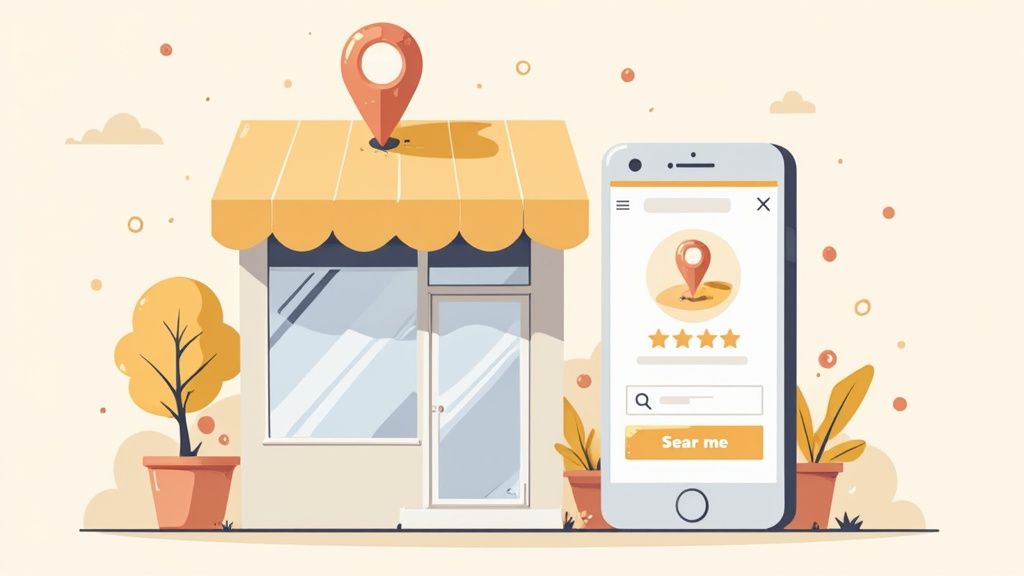
It all begins with your digital storefront: your Google Business Profile (GBP). Just claiming it and walking away is a huge mistake. You need to treat it like the most important landing page you have, because for a lot of your local customers, it is. Think of it as your modern-day Yellow Pages ad, business card, and front door all rolled into one.
Turn Your Google Business Profile into a Customer Magnet
An optimized GBP is a living, breathing profile. It’s packed with fresh, relevant information that tells both Google and potential customers that you're active, engaged, and ready for their business. Your goal is to make your profile so complete and compelling that a searcher has zero reason to even look at a competitor.
Here’s how you can put your profile to work:
- Nail Your NAP: Make sure your business Name, Address, and Phone number are perfectly consistent everywhere online. A tiny difference like "St." versus "Street" can confuse search engines and hurt your ranking.
- Post Often: Use Google Posts to share company news, special offers, or upcoming events. A local restaurant could post its weekly specials; a mechanic could run a limited-time deal on oil changes.
- Show, Don't Just Tell: Load your profile with high-quality photos. Show off your storefront, your products, your team in action, and even happy customers (with their permission, of course!). Visuals tell your story instantly.
- Enable Messaging: Switch on the direct messaging feature. It lets people ask you a quick question right from your profile, giving you an immediate connection.
The numbers here don't lie. A staggering 46% of all Google searches are for local information. For small businesses, that's a goldmine. Visuals have a massive impact, too—profiles with over 100 images can get 1065% more clicks than those without. These local marketing insights prove that a rich, visually engaging profile isn't a "nice-to-have," it's a core part of your local strategy.
Build Local Authority Beyond Google
While Google is king, you can strengthen your position by building your presence across the rest of the local web. This is all about getting local citations—mentions of your business's NAP on other trusted sites. Think directories like Yelp, Angie's List, and any niche sites relevant to your industry. Consistency is the name of the game.
Another fantastic tactic is to create location-specific content on your own website.
Pro Tip: Build out dedicated service pages for each town or neighborhood you cover. If you’re a plumber who works across several suburbs, you should have separate pages like "Plumbing Services in Oak Park" and "Emergency Plumbing in Evanston." This is how you start ranking for those super specific, high-intent "near me" searches.
Your Website Has to Work on a Phone
Put yourself in your customer’s shoes for a second. They’re searching locally, which means they are almost certainly on their phone, probably on the go, and they need an answer now. If they click over to your site and it's clunky, slow, or impossible to read on a small screen, they're gone. You've lost them.
A mobile-friendly website is non-negotiable. It has to be:
- Fast: Aim for a load time of under three seconds.
- Responsive: The layout needs to automatically adjust to any screen size.
- Simple to Use: Your phone number, address, and hours must be front and center—and clickable.
Data shows that 61% of mobile users are more likely to contact a local business if it has a mobile-optimized site. Your website is the final destination in their local search journey. Make sure it’s ready to convert that hard-won click into a phone call, a visit, or a brand-new customer.
Creating a Content Plan That Actually Converts
Content is the fuel for your digital marketing engine, but just churning it out for the sake of it is a fast track to burnout. An effective content plan isn't about volume; it's about creating genuinely valuable assets that pull the right people in and guide them toward becoming customers.
The best ideas aren't dreamed up in a boardroom. They come directly from the people you’re trying to reach. Your job is to listen to the questions they're already asking online.
Uncovering Your Customers’ Burning Questions
Before you type a single word, you have to get inside your audience's head. Think of yourself as a problem-solver first, marketer second. When you answer their most urgent questions, you build trust and position yourself as an authority without even trying.
Here are a few goldmines for content ideas:
- Online Forums: Places like Reddit or Quora are incredible. Search for your industry or service and just read. A thread titled, "How do I choose the right accountant for my startup?" is a blog post practically writing itself.
- Google’s "People Also Ask": Type a question related to your business into Google. That "People Also Ask" box is a direct window into the minds of your potential customers. Every single question in there is a potential piece of content.
- Your Own Inbox: What questions do you get over and over from prospects? If one person took the time to ask, you can bet dozens more are wondering the same thing.
This approach guarantees that every piece of content you create already has a built-in audience eager to find it.
Structuring Your Content Calendar
Consistency trumps intensity every time. A simple, manageable content calendar is your best friend—it stops the last-minute panic and keeps things moving. You don’t need a fancy, complicated system; a basic spreadsheet works perfectly.
A great way to start is by planning your content around a few core "themes" or "pillars."
For example, a local landscaping company might build its plan on three pillars:
- Lawn Care Tips: Blog posts like "5 Common Weeds in Our Area and How to Beat Them."
- Design Inspiration: Short-form videos for Instagram showing "Before & After Patio Makeovers."
- Seasonal Maintenance: Quick social media updates like "Your Fall Cleanup Checklist."
This structure keeps your content focused and relevant. For a more detailed walkthrough, check out our guide on how to create a content calendar that gets you organized without the overwhelm.
Key Takeaway: Think of your content plan not as a rigid rulebook, but as a flexible framework. It provides direction, ensures you're hitting the topics that matter most to your audience, and helps you stay consistent across all your channels.
Using AI and Repurposing to Work Smarter
For most small businesses, the challenge isn't a shortage of ideas—it's a shortage of time. This is where smart workflows and modern tools change the game.
Artificial intelligence (AI) has become an incredible ally, especially for busting through writer's block and getting those first drafts done quickly. In fact, an estimated 67% of small businesses are already using AI for content and SEO. With 89% of all marketers now using generative AI, it's pretty clear this is no longer just an option if you want to keep up.
Just as crucial is the art of repurposing. One fantastic piece of content can be sliced, diced, and remixed into multiple assets to maximize its reach.
- A long-form blog post can be spun into a 10-tweet thread.
- The key stats from that post can become a shareable infographic for Pinterest.
- The main talking points can serve as the script for a short TikTok video.
This "create once, distribute many times" mindset is the secret to a sustainable content strategy. It lets you maintain a strong presence on multiple platforms without having to reinvent the wheel every single day.
Measuring Success and Optimizing Your Strategy
Getting your digital marketing strategy off the ground is a fantastic start, but it's really just the beginning of the journey. The real growth happens when you start digging into the data, seeing what works, and using those insights to make better, smarter decisions.
You can't improve what you don't measure. It’s a classic saying for a reason, and it’s where a lot of small businesses stumble.
Focusing on the Metrics That Matter
It’s incredibly easy to get overwhelmed by all the data available. You can drown in numbers like social media likes or total website visitors, which might look impressive but don't actually tell you if you're making money. These are often called "vanity metrics."
Instead, you need to laser-focus on the numbers directly tied to your business goals. These are your Key Performance Indicators, or KPIs.
Think of KPIs as the true health-check for your marketing. Here are a few that genuinely move the needle:
- Conversion Rate: This is the big one. It's the percentage of people who take the action you want them to, whether that's buying a product, filling out a form, or signing up for your email list. It’s the ultimate test of how effective your marketing really is.
- Cost Per Acquisition (CPA): How much does it cost you, on average, to get one new customer? If your CPA is well below what that customer is worth to you, your marketing is profitable. Simple as that.
- Customer Lifetime Value (CLV): This number predicts the total profit you'll make from any given customer over their entire relationship with your business. Knowing your CLV helps you justify spending more to acquire the right kind of customer.
- Return on Ad Spend (ROAS): For every dollar you put into ads, how many dollars do you get back? A high ROAS is a clear sign your paid campaigns are hitting the mark.
Tracking these numbers gives you an honest, unfiltered look at what’s working and what isn't. You move from thinking your marketing is effective to knowing it is.
Key Takeaway: Don't chase vanity metrics. A successful digital marketing strategy is built on tracking KPIs that directly translate to revenue and growth. Your goal is to understand what drives real business results.
Building Your Simple Analytics Dashboard
So, how do you track all this? For most small businesses, the best place to start is Google Analytics 4 (GA4). It's free, powerful, and the industry standard.
Getting GA4 installed on your website is your first practical step. Once it's up and running, it will start collecting crucial data on your site traffic, how people behave on your pages, and—most importantly—your conversions.
Your goal isn't to create some ridiculously complex report. All you need is a simple dashboard that shows your most important numbers at a glance. You can build this right inside GA4 or use a tool like Google Looker Studio to create a clean, visual summary.
A good dashboard should help you quickly answer questions like:
- Where are my best customers coming from—Google, Facebook, or my email list?
- Is that new blog post I spent hours on actually getting people to sign up for my newsletter?
- Why are so many people leaving my site on the checkout page?
To truly measure the effectiveness of your digital marketing, it’s vital to master key concepts like tracking your digital marketing performance metrics. This understanding is what turns raw data into profitable action.
Essential KPIs for Small Business Marketing Channels
To make this even more practical, let's break down which metrics matter most for each channel. You don't need to track everything; you just need to track the right things.
| Channel | Primary KPI | Secondary Metrics |
|---|---|---|
| SEO | Organic Conversions | Keyword Rankings, Organic Traffic, Click-Through Rate (CTR) |
| Content Marketing | Leads Generated (e.g., downloads) | Time on Page, Bounce Rate, Social Shares |
| Social Media | Engagement Rate | Reach, Clicks, Follower Growth |
| Paid Ads (PPC) | Return on Ad Spend (ROAS) | Cost Per Click (CPC), Cost Per Acquisition (CPA), Conversion Rate |
| Email Marketing | Email-Driven Revenue | Open Rate, Click-Through Rate (CTR), Unsubscribe Rate |
This table gives you a clear starting point. By focusing on these primary and secondary metrics, you can quickly assess the health of each marketing channel without getting lost in the noise.
The Cycle of Test, Measure, and Optimize
Here’s the thing about data: it’s completely useless unless you act on it. Your KPIs and dashboard exist to empower you to make informed decisions and kickstart a cycle of continuous improvement.
This is what optimization actually looks like in the real world.
Let's say you see your Facebook ads are delivering a fantastic CPA, but your Google Ads are falling flat. What do you do? You shift more of your budget to Facebook. That's a data-driven decision.
Or maybe you notice a huge number of people are abandoning their carts on your checkout page. You could test a simpler form or add a new payment option to see if it improves the conversion rate.
This isn't about massive, sweeping changes. It's about making small, consistent tweaks based on what the numbers are telling you. Over time, these little adjustments add up to big results. Understanding how to calculate marketing ROI is the final piece of the puzzle, allowing you to prove the direct financial impact of these strategic adjustments.
Your Top Digital Marketing Questions, Answered
Jumping into digital marketing can feel like you're trying to read a map in a foreign language. It's totally normal to have a ton of questions. Let's tackle some of the most common ones I hear from small business owners.
How Much Should We Really Spend on Digital Marketing?
This is always the first question, isn't it? While you'll see benchmarks thrown around, like 7-12% of your total revenue, that's just a starting point. It doesn't really work if you're a brand-new business without any revenue to calculate from.
If you're just starting out, flip the question. Instead of asking what to spend, figure out what a new customer is actually worth to you. Once you know that, you can work backward to see what you can afford to spend to get one.
The absolute best way to go about it is to start small, test everything, and then scale what works. Don't just dump thousands into a channel because you read it was a good idea. Run a small, targeted Facebook ad campaign. Put a few hundred dollars behind a local SEO push. Then, watch your results like a hawk.
My Two Cents: Think of your first marketing budget as a series of small experiments. The goal isn't to hit a home run right away. It's to collect data. Once you find a channel that’s actually bringing in money, that's when you double down and confidently pour more into it.
I Have Almost No Budget. Where Do I Start?
When cash is tight, you have to trade money for effort. It's all about focusing on activities that build long-term value for your business. Forget the big, expensive ad campaigns for now and get your hands dirty with these foundational tasks.
Here's your 90-day sprint plan:
- Master Your Google Business Profile: This is your single most powerful free marketing tool for attracting local customers. Max it out. Add great photos, write detailed descriptions of what you do, and regularly use the Posts feature to share updates.
- Create "Answer" Content: Think about the top three questions you get from customers all the time. Now, write a detailed blog post answering each one. Things like "How much does [your service] cost?" or "What's the best way to [solve a problem]?" This kind of content is search engine gold.
- Start Your Email List: Get a simple email signup form on your website today. Offer something small in return—a 10% discount, a free checklist, anything of value. This list is an asset you own, and you can market to these people for free, forever.
These things cost you time and brainpower, not a truckload of cash.
How Long Until I Actually See Results?
This is where expectations need to be managed, because the answer really depends on where you're putting your effort. Not all marketing channels work at the same speed.
It helps to think about it in two lanes:
- The Sprint (Paid Ads): Things like Google Ads or boosted social media posts can bring in traffic and leads almost instantly. You can literally start a campaign in the morning and have leads by lunch. The catch? As soon as you turn off the money, the leads dry up.
- The Marathon (Organic Marketing): This is your SEO and content marketing. Building authority and ranking on Google is a long game. Realistically, it can take 6-12 months to see significant, steady traffic. But the payoff is huge—the results are far more stable and tend to grow on their own over time.
A smart strategy uses a bit of both. Use paid ads to get some quick wins while your long-term organic engine is warming up.
Should I Do This Myself or Hire Someone?
This boils down to a classic trade-off: your time versus your money. There’s no right or wrong answer, just what’s right for your specific situation.
Here's a simple way to look at it.
Go the DIY route if:
- You can genuinely commit 5-10 hours every week to learning and doing the work.
- You're a tech-savvy person who enjoys figuring out new software.
- Your budget is next to nothing, making your time your main investment.
Look into hiring a pro (freelancer or agency) if:
- Your time is more valuable when spent actually running your business.
- You're dealing with complex stuff like technical SEO or conversion rate optimization.
- You have a dedicated budget and want to get results faster by leveraging someone else's expertise.
A lot of businesses start with a hybrid model. Maybe you handle the day-to-day social media posts yourself but hire a freelancer to manage your Google Ads.
Making these decisions is part of crafting a strategy that works for you. At ReachLabs.ai, we work with businesses to bring clarity to these questions and turn them into a profitable action plan. Let us help you build a strategy that truly moves the needle. https://www.reachlabs.ai