
As a small business owner, you know that every dollar and every minute has to pull its weight. A smart content marketing strategy for small business isn't about churning out content for the sake of it. Think of it as your practical playbook for turning what you already know—your expertise—into your most powerful engine for growth. It’s how you go toe-to-toe with the big guys, building real trust and attracting quality leads without a giant advertising budget.
Why Content Is Your Best Investment
Let's be honest, old-school outbound tactics can feel like shouting into a hurricane. Content marketing is the complete opposite. At its heart, it’s about creating genuinely helpful, relevant assets—blog posts, videos, how-to guides—that put in the work for you around the clock.
Unlike a paid ad that vanishes the second you stop funding it, a single great article can bring in your ideal customers for years. Your website stops being just a digital brochure and becomes a magnet, pulling in people who are actively looking for the solutions you offer.
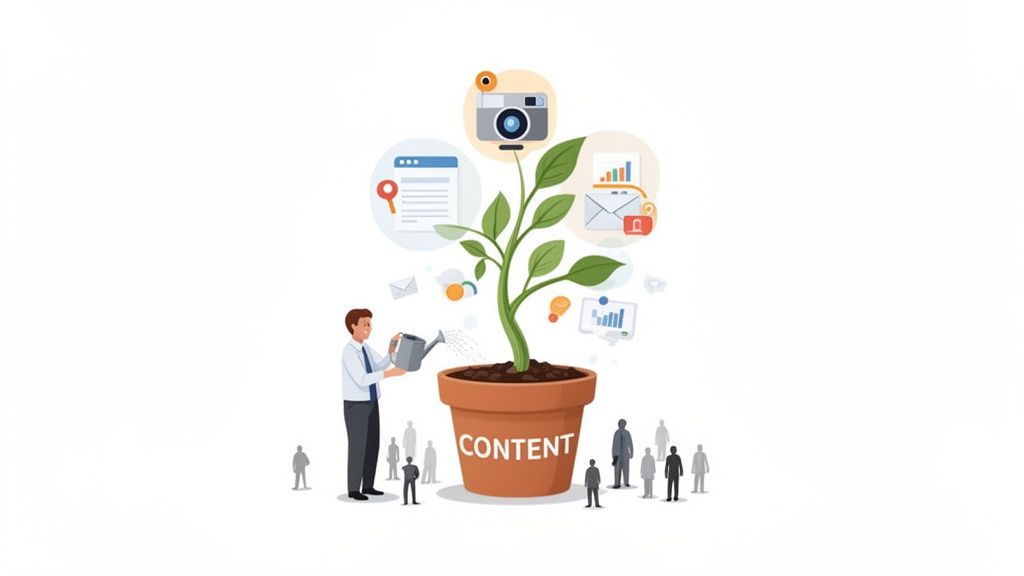
This guide isn't filled with vague theories. It’s a nuts-and-bolts framework built for the reality of running a small business, where time is tight but your drive isn't.
The Power of Owning Your Audience
One of the biggest wins with content marketing is building an audience on channels you actually own—namely, your website and your email list. We've all seen social media algorithms change on a whim, tanking reach overnight. The connection you forge through your own content? That's a stable, long-term asset you control.
Every article you publish, every video you create, is another brick in the foundation of your authority. You slowly but surely become the go-to resource in your field.
A great content marketing strategy for a small business does more than just sell; it solves problems. When you consistently provide answers and insights, you build a loyal community that trusts you long before they ever need to make a purchase.
From Content Creation to Business Growth
The real magic happens when your content plan is tied directly to real-world business results. The goal isn't just more traffic; it's getting the right traffic and then gently guiding those people toward becoming happy customers. You do this by making sure every piece of content you create serves a specific business purpose.
Here’s what that looks like in practice:
- Increased Visibility: Top-notch content that's built with search engines in mind helps you climb the ranks on Google. You show up right when potential customers are searching for you.
- Lead Generation: Offering valuable resources—think checklists, ebooks, or webinars—in exchange for an email address is a classic way to fill your sales pipeline with interested prospects.
- Building Trust and Credibility: When you share your expertise without asking for anything in return, you naturally position yourself as an authority. That trust is what ultimately convinces people to buy from you.
- Cost-Effectiveness: Content marketing definitely takes an upfront investment of your time. But over the long haul, it’s far more sustainable and often cheaper than traditional advertising, delivering a much better return.
First Things First: Who Are You Talking To and What Do You Want?
Jumping into content creation without a clear audience or objective is like setting sail without a map. You might be busy, but you're not going anywhere. Any effective content marketing strategy for small business is built on two things: knowing exactly who you're talking to and what you're trying to accomplish.
This isn't just about scratching out a generic customer profile with vague demographics. It’s about getting a real, practical understanding of the people you want to help. What keeps them up at night? What are they trying to achieve? And where do they go for answers?
Stop Guessing and Start Building Personas
A persona is basically a character sketch of your ideal customer, pieced together from real data and research. It brings your audience to life, making it infinitely easier to create content that actually connects with them. Before you write a single word, it's absolutely critical to learn how to identify your target audience.
So, where does this info come from? It's probably closer than you think.
- Talk to your best customers. Seriously, just pick up the phone. Ask them what problem they were trying to solve when they found you. What other options did they look at? Their answers are pure gold.
- Survey your email list. Use a simple tool like Google Forms or SurveyMonkey. Ask them about their biggest professional challenges or what they're most interested in learning. You'll be surprised what you find out.
- Look at your analytics. Tools like Google Analytics show you who is visiting your site, what pages they're spending time on, and how they found you in the first place.
- Become a social listener. What questions are people asking in industry Facebook groups or on LinkedIn? What's trending under relevant hashtags? This is a live feed of your audience's pain points.
When you pull these sources together, you’re no longer operating on a hunch. If you want a more detailed walkthrough, our guide on https://www.reachlabs.ai/how-to-create-buyer-personas/ will give you a structured process.
Set Goals That Actually Matter to Your Business
Okay, so you know who you're creating content for. Now, you need to define why. Every piece of content needs a job. Vague goals like "get more traffic" or "increase engagement" sound nice, but they don't help you make decisions. Good goals are specific, measurable, and tied directly to your business's health.
I’m a big fan of the SMART goal framework because it forces clarity:
Specific: What exactly do you want to achieve?
Measurable: How will you know if you've achieved it?
Achievable: Is this realistic for you right now?
Relevant: Does this actually help your business grow?
Time-bound: When do you want to achieve this by?
Let's look at how this turns a fuzzy idea into a real plan.
| Vague Idea | SMART Goal |
|---|---|
| Get more leads. | Increase qualified leads from our blog by 20% this quarter by creating four new lead-magnet downloads. |
| Be more active on social. | Grow our LinkedIn follower count by 15% in 6 months by posting three high-value tips each week. |
| Improve website traffic. | Increase organic traffic to our main service pages by 10% in the next 90 days by publishing targeted blog content. |
Setting clear goals isn't just for measurement—it's for focus. A solid goal acts as a filter, helping you instantly decide which content ideas are worth your time and which are just distractions.
By connecting every article, video, or social post back to a specific business objective, you ensure your efforts aren't just creating noise. You're building an engine that purposefully drives growth, turning what you know into a reliable source of leads, sales, and lasting customer loyalty.
Choosing Your Content and Distribution Channels
The pull to be on every platform, all at once, is real. But for a small business, it's also a recipe for burnout. A smart content strategy isn't about shouting from every rooftop; it's about starting great conversations in the places where your ideal customers already hang out. This means making strategic, focused choices about what you create and where you share it.
Forget the pressure to have a profile on every social media app. The real work is figuring out where your audience actually spends their time and meeting them there with content that genuinely helps them. Quality over quantity should be your mantra.
Matching Content Types to Your Business Goals
Different content formats do different jobs. A snappy, short video is perfect for grabbing attention and building brand awareness on social media. On the other hand, a detailed case study is built to earn trust and nudge a potential customer toward making a decision. The goal is to create a mix of content that supports your audience at every stage of their journey with you.
Think of it like a toolkit—you wouldn't use a hammer to tighten a screw. In the same way, you shouldn't rely solely on blog posts if your main goal is to show off a highly visual product.
This is where you connect the dots between the goals you set earlier and the specific formats you'll use. Here’s a quick look at how different content types line up with common business objectives.
Matching Content Types to Your Business Goals
Here's a breakdown of common content formats and the marketing objectives they are best suited to achieve, helping you select the right mix for your strategy.
| Content Type | Primary Goal | Best For… | Example Use Case |
|---|---|---|---|
| Blog Posts & Articles | Awareness & Consideration | SEO, building authority, educating your audience, and generating organic traffic. | A local bakery writes a post on "5 Common Mistakes When Baking Sourdough at Home" to attract home bakers searching for tips. |
| Short-Form Video | Awareness & Engagement | Grabbing attention quickly, showcasing personality, and demonstrating products in a fun, digestible format. | A small software company creates a 30-second Instagram Reel showing a "day in the life" of a developer to humanize their brand. |
| Case Studies | Decision | Building trust and credibility by providing real-world proof that your product or service delivers results. | A freelance graphic designer publishes a case study detailing how their rebrand for a client led to a 25% increase in website inquiries. |
| Email Newsletters | Nurturing & Retention | Building a direct relationship with your audience, sharing exclusive content, and driving repeat business. | An e-commerce store sends a weekly newsletter with a mix of new product announcements and helpful style tips. |
By aligning your content formats with your goals, you ensure every piece you create has a clear and measurable purpose.
Finding Your Core Distribution Channels
Once you have a better idea of what you'll create, you need to decide where to publish it. Again, less is more. It is far more effective to master one or two channels than to spread yourself thin across five. Your audience persona research is your roadmap here—it tells you exactly where your customers are.
If you’re a B2B service provider, LinkedIn and a high-quality blog might be your power combo. But if you run a home decor shop, Instagram and Pinterest are probably your sweet spots.
The data backs up this focused, mixed-media approach. For example, 92% of B2B marketers use short articles and posts, but that’s complemented by the 76% who use videos and 75% who use case studies. This proves that a blend of quick hits and deeper storytelling really works.
Your distribution plan isn't set in stone. Start small with the channels you know your audience uses most. Once you've built momentum there, you can consider expanding. The goal is sustainable growth, not immediate, widespread coverage.
Picking the right channels isn't just about reach; it's about context. Your message will land differently on LinkedIn than it will on TikTok. For a deeper dive, our guide on effective content distribution strategies can help you map out a more detailed plan.
By thoughtfully picking your content formats and the channels to share them on, you shift from a scattergun approach to a laser-focused one. This is how you make sure every piece of content has a purpose and the best possible chance of reaching the people who matter most.
Building a Sustainable Content Creation System
A brilliant strategy is nothing more than a document on your hard drive without a system to bring it to life. For a small business, chaos is the enemy of consistent growth. This is where we shift from planning to doing—building a simple, repeatable process for creating high-quality content that won't burn you out.
The cornerstone of this whole operation is an editorial calendar. This doesn't need to be some fancy, expensive software. A simple Google Sheet or a Trello board will do the trick just fine. Your calendar becomes the single source of truth, mapping out what you're publishing, when it's going live, and who's on the hook for getting it done.
Brainstorming Topics That Actually Solve Problems
Your best content ideas will never come from a vacuum. They come from listening—really listening—to the audience you’ve already worked so hard to define. The goal here is to build a backlog of topics that directly tackle their biggest pain points, answer their burning questions, and line up perfectly with your SEO goals.
Here are a few tried-and-true methods for generating a steady stream of relevant ideas:
- Mine Your "Sent" Folder: Seriously, go look through your sent emails and customer support tickets. What questions are you answering over and over again? Each one of those is a potential blog post just waiting to be written.
- Use Free SEO Tools: Tools like AnswerThePublic or even just looking at Google's "People Also Ask" section can show you the exact questions people are typing into search engines about your industry.
- Be a Fly on the Wall on Social Media: Join Facebook groups where your customers hang out or follow industry hashtags on LinkedIn. Pay close attention to the discussions and frustrations—they are absolute content goldmines.
Following this process ensures every single piece of content you create has a built-in audience and a clear purpose right from the get-go.
Deciding Who Creates the Content
Okay, now for the nitty-gritty: who's actually going to do the work? As a small business, you've got a few options, and each one comes with its own trade-offs. There’s no universally "right" answer; it all comes down to your budget, timeline, and the skills you already have in-house.
Let's break down the most common approaches.
| Resource Option | Pros | Cons | Best For… |
|---|---|---|---|
| In-House Team | Deep product knowledge, consistent brand voice, agile and quick to adapt. | Can be expensive, may lack specialized skills (e.g., video editing). | Businesses with a dedicated marketing person or a team member passionate about content. |
| Freelancers | Access to specialized skills, flexible and scalable, often more affordable than a full-time hire. | Finding the right fit takes time, requires clear briefs and management. | Businesses needing specific expertise (like writing or design) on a project basis. |
| AI-Powered Tools | Extremely fast for first drafts, great for brainstorming and overcoming writer's block. | Lacks human nuance and expertise, requires significant editing and fact-checking. | Teams looking to increase efficiency and speed up the initial drafting process. |
To really build a sustainable system, exploring the best AI content creation tools can be a huge help, especially for scaling up everything from blog posts to video scripts. Think of these tools as a powerful assistant, helping you produce more without necessarily needing to hire more people.
The Power of Repurposing Your Content
Here's the secret to scaling your content production without doubling your workload: stop creating everything from scratch. Adopting a "create once, distribute many" mindset is an absolute game-changer for any content marketing strategy for small business. One solid piece of content can be the seed for a dozen smaller assets.
This flow chart shows exactly how a core piece of content, like a blog post or video, can be sliced and diced to fuel your entire strategy.
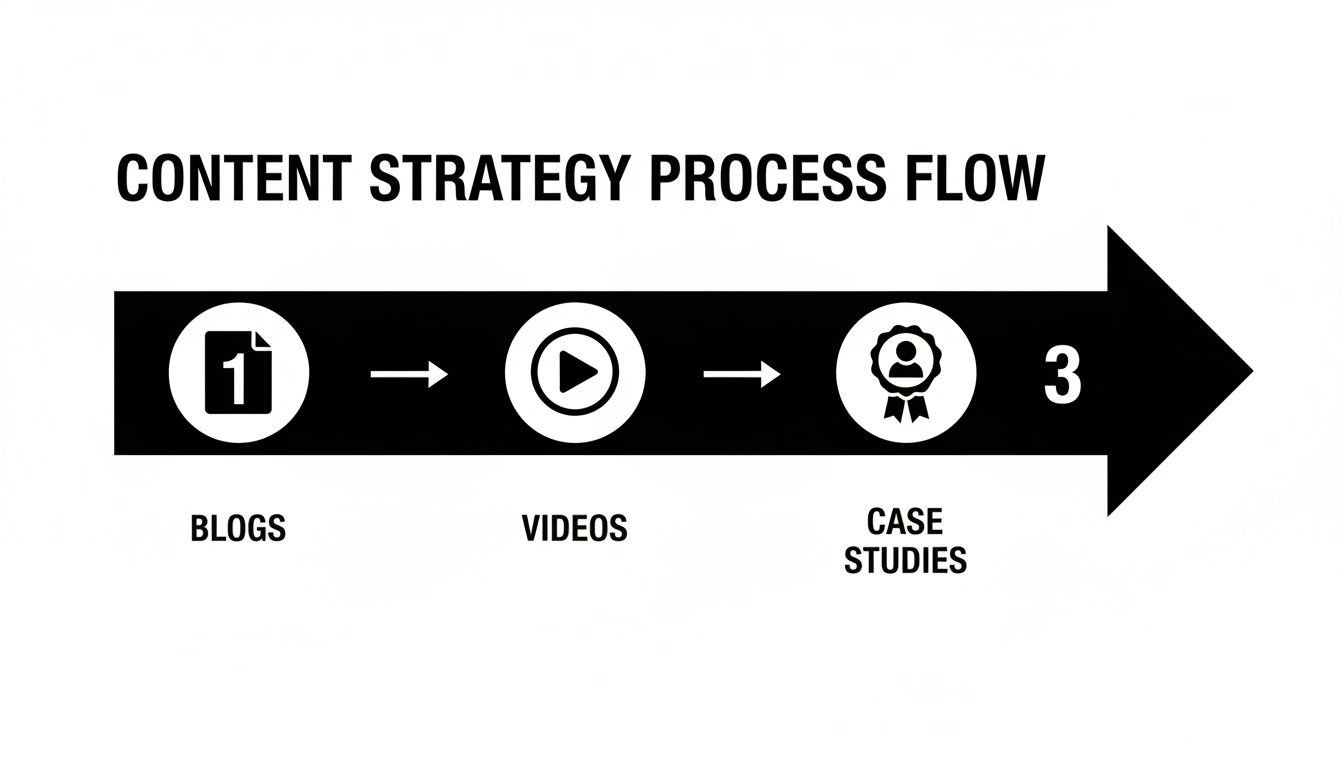
The big idea here is that your "pillar" content—that big, comprehensive piece—acts as a wellspring for smaller, more digestible content perfect for different channels.
By repurposing, you're not just saving time. You're reinforcing your message across multiple platforms and reaching different segments of your audience where they actually spend their time.
Let's walk through what this looks like in the real world:
- The Pillar Piece: You write an in-depth, 2,000-word blog post, "The Ultimate Guide to Local SEO for Small Businesses."
- The Video Script: You pull the main sections from that post and turn them into a script for a 10-minute YouTube video.
- The Social Snippets: You grab five key stats or quick tips from the article and create individual quote graphics for LinkedIn and Instagram.
- The Email Newsletter: You write a short summary of the blog post's main points for your email list, with a clear link back to the full article.
- The Infographic: You visualize the guide's step-by-step process into a clean, shareable infographic for Pinterest.
See what just happened? With one focused effort, you've generated a week's worth of content across five different channels. That's the core of a sustainable system—working smarter, not just harder, to squeeze every last drop of value out of everything you create.
How to Measure Your Content Marketing ROI
You've put in the work, you've created some fantastic content, but now for the million-dollar question: Is it actually working?
If you can't answer that, you're just throwing things at the wall and hoping something sticks. You need to know what's driving results so you can do more of it. This is where many small businesses hit a roadblock, but figuring out your return on investment (ROI) doesn't require a data science degree.
It's really all about connecting the dots between your content and actual business results. A solid measurement plan is what turns content from a "nice-to-have" expense into a predictable engine for growth. You'll go from thinking your blog is working to knowing it is, with the data to back it up.
Focusing on the KPIs That Truly Matter
It’s incredibly easy to get distracted by "vanity metrics." A spike in social media likes or a jump in website visitors feels great, but those numbers don't necessarily translate to revenue. You need to zero in on the key performance indicators (KPIs) that tell you how your content is impacting the bottom line.
A helpful way to think about this is through the classic marketing funnel. You'll need different metrics to see how you're performing at each stage.
Top of the Funnel (Awareness): Are we reaching the right people?
- Organic Traffic: How many people are finding you through search engines? A steady climb here is a great sign your SEO and content strategy are aligned.
- Keyword Rankings: For the phrases you want to be known for, are you on the first page of Google? This is a direct measure of your content's visibility.
- Backlinks: This is a big one. Are other credible sites linking back to your content? Every backlink is like a vote of confidence that boosts your authority.
Middle of the Funnel (Engagement): Is our content resonating?
- Time on Page: Are people sticking around to actually read your articles or watch your videos? Low time-on-page might mean your content isn't hitting the mark.
- Email Subscribers: This is a powerful signal. If someone reads a blog post and then trusts you with their email address, you've definitely provided value.
Bottom of the Funnel (Conversion): Is our content driving business?
- Lead Conversion Rate: Of all the people who view your content, what percentage takes the next step—filling out a form, downloading a guide, or requesting a demo?
- Content-Assisted Conversions: How many blog posts did a new customer read before they decided to buy? Tools like Google Analytics can help you map out this journey.
Don't get fixated on a single month's data. Look for trends. The real story isn't in a snapshot; it's in the growth you see over a quarter or even six months. That's what reveals the true impact of your strategy.
Using Free Tools to Connect Content to Revenue
You don’t need to shell out for expensive software to get started. Google Analytics is a beast of a tool, and it's completely free. The trick is to set up "Goals" that track the actions you care about.
A "Goal" can be anything you want to measure: a "Contact Us" form submission, a case study download, or someone clicking the "Request a Quote" button.
Once you have Goals configured, the magic happens. You can finally see which blog posts, videos, or pages are actually driving those actions.
Imagine you own a landscaping company. You might log into Google Analytics and discover your article on "How to Choose the Right Landscaping Stones" is responsible for 40% of all your new quote requests. That's not just a nice stat; it's a huge business insight. It tells you to write more content on similar topics. It proves that this article is a valuable asset, not just words on a page.
This is exactly how you start proving real content marketing return on investment.
This data-first approach creates a powerful feedback loop: create, measure, analyze, and refine. By keeping a close eye on your KPIs, you can confidently double down on what’s working and stop wasting time on what isn’t, ensuring every bit of effort you put into content pushes your business forward.
Answering Your Top Small Business Content Marketing Questions
Diving into content marketing can bring up a lot of questions. It's totally normal. Let's cut through the confusion and get you some straight answers to the most common hurdles small business owners face.
How Often Should a Small Business Publish New Content?
This is a classic one, but the answer isn't a magic number. The golden rule is simple: consistency always trumps frequency.
It’s a thousand times better to publish one incredible, deeply researched article per month that people actually want to read than it is to churn out four mediocre posts that nobody cares about. Trying to do too much, too soon is a surefire recipe for burnout and low-quality work.
So, instead of chasing an arbitrary number, find a rhythm you can actually stick with.
- On your blog: If you have the team, one high-quality post a week is a great goal. But honestly? Two genuinely helpful posts a month is a fantastic and sustainable place to start.
- On social media: For your main channel, shooting for 3-5 posts a week is a solid baseline. It keeps you visible without turning your entire week into a content creation scramble.
The real secret is locking in a schedule with an editorial calendar and treating it like any other business commitment. This builds trust with your audience and makes your content process predictable and calm.
What Are Some Budget-Friendly Content Marketing Tools?
You don't need to break the bank on fancy software to run a powerful content marketing strategy for small business. Seriously. Some of the most effective tools out there have free plans that are more than enough to get you off the ground and driving results.
Don't ever let a small budget be an excuse for not starting. The free and freemium tools available today are so good that a one-person shop can genuinely punch above its weight class.
Here are a few must-haves that won't cost you a penny to start with:
- For SEO and Topic Research: Google Keyword Planner is the classic starting point. Pair it with the free versions of AnswerThePublic or Ubersuggest to find the exact questions and phrases your customers are typing into search engines.
- For Creating Visuals: The free plan for Canva is a non-negotiable. It lets you create professional-looking social graphics, blog headers, and simple charts without any design background. It’s a game-changer.
- For Writing and Editing: Install the free Grammarly browser extension. Think of it as your personal proofreader, catching typos and awkward phrasing so your writing always looks polished and professional.
How Long Does Content Marketing Take to Show Results?
Let’s be real: content marketing is a long game. It's a marathon, not a sprint. While a paid ad can get you traffic today (and that traffic disappears the second you stop paying), content is an asset that builds momentum and value over time. Patience is everything.
You’ll likely start seeing some early signs of life—like a bump in traffic or more social media engagement—within the first 3 months. But for the real, bottom-line results like a steady stream of leads from your website? You should plan for that to take 6 to 12 months of consistent, focused effort.
Think of it like planting a tree. You have to water it for a while before the roots take hold and it really starts to grow. It’s the same with content; it takes time for search engines to recognize your expertise and for an audience to truly trust you.
Should I Create New Content or Update Old Posts?
The smartest answer is a mix of both, but your focus will shift over time.
When you're just starting out, your job is 100% creating new, foundational content. You need to build that core library of "pillar" articles that cover the most important topics in your niche. I usually recommend getting a solid 15-20 articles published before you even think about updating old stuff.
Once you have that base, you can get more strategic. Every six months or so, do a quick content audit. Find those older posts that are getting a little bit of traffic but have the potential to do much better.
Go back into those posts and give them a refresh—add new statistics, update the examples, embed a new video, and optimize the keywords. This tactic, sometimes called "historical optimization," can give you a much faster boost in rankings than writing a brand-new article from scratch. It's one of the most efficient ways to get more out of the work you've already done.
Ready to build a content marketing strategy that drives real business growth? At ReachLabs.ai, we blend expert talent with data-driven insights to create plans that work. Learn how our full-service agency can elevate your brand.