
At its core, content marketing return on investment (ROI) is a simple concept: it tells you if the money you're spending on content is actually making you more money in return. It’s the metric that answers the all-important question, "Was it worth it?"
Specifically, it measures the total revenue generated from your content efforts against the total investment you put in. The result shows you just how much value your blog posts, videos, and social media campaigns are really creating for your business.
What Is Content Marketing ROI, Really?

But defining content marketing ROI goes deeper than a basic profit-and-loss calculation. It’s not always a straight line from A to B.
Think of it like planting an orchard. You spend money on seeds, soil, and water upfront. You don't get a basket of fruit the next day, but that initial investment is crucial. Over time, those seeds grow into trees that produce fruit season after season.
Your content works the same way. A blog post published today might not lead to a sale tomorrow. Instead, it starts building brand authority, earning customer trust, and attracting steady organic traffic. These are the roots that support sustainable, long-term growth.
The True Value of Your Content Investment
To really understand your content marketing return on investment, you have to look beyond immediate sales. It's a measure of total value, which includes both the hard financial gains and the powerful, long-term benefits that are a bit harder to quantify.
This is where the magic of compounding comes in. A high-quality article can continue generating leads and sales for years, long after you’ve paid for its creation. It becomes a lasting asset.
This long-game approach is why a massive 97% of marketers see content marketing as a core part of their strategy. While its value is widely accepted, the results can vary. For example, 14% of marketers say content marketing delivers the highest ROI of all their efforts. If you want to dive deeper, you can explore more content marketing trends and statistics.
The goal is to view content not as an expense, but as a business asset that appreciates in value. Each piece you create contributes to your brand's reputation, search engine visibility, and customer loyalty—all of which drive revenue.
Breaking Down Costs and Returns
To get a clear picture for your calculation, it’s best to separate the "ins" from the "outs." Let's break down what you should be tracking for both your investments (costs) and your outcomes (returns). This gives you a solid framework to start with before you even touch a calculator.
There are countless advantages of content marketing, and this table helps you start putting real numbers to them.
Breaking Down the Components of Content Marketing ROI
Here's a high-level summary of the inputs (costs) and outputs (returns) involved in your content marketing ROI calculation.
| Component | What It Includes | Real-World Examples |
|---|---|---|
| Investment (Costs) | All expenses related to creating and promoting content. | Writer salaries, design software subscriptions, freelance fees, paid ad spend. |
| Return (Outcomes) | The total value generated from your content efforts. | Direct revenue from sales, value of new leads, increased organic traffic. |
Thinking about your ROI in these two distinct buckets—what you spend versus what you gain—is the first and most critical step to proving the value of your work.
Calculating Your Content Marketing ROI Step by Step
This is where the rubber meets the road. Turning the abstract value of your content—all that trust, authority, and brand awareness—into a hard number is a common sticking point for marketers. But don't worry, you don't need an advanced degree in mathematics to figure it out.
At its core, the formula is refreshingly simple.
[(Return − Investment) / Investment] × 100 = ROI %
That's it. This little equation gives you a percentage that tells you how efficiently your money is working. A positive number means you’re making more than you’re spending. Negative? You're in the red. The real trick, of course, is nailing down what "Return" and "Investment" actually mean for your business.
This infographic does a great job of visualizing the journey. It shows how the money you put in at the start builds a foundation of brand authority, which eventually pulls in traffic, builds loyalty, and drives real business results.
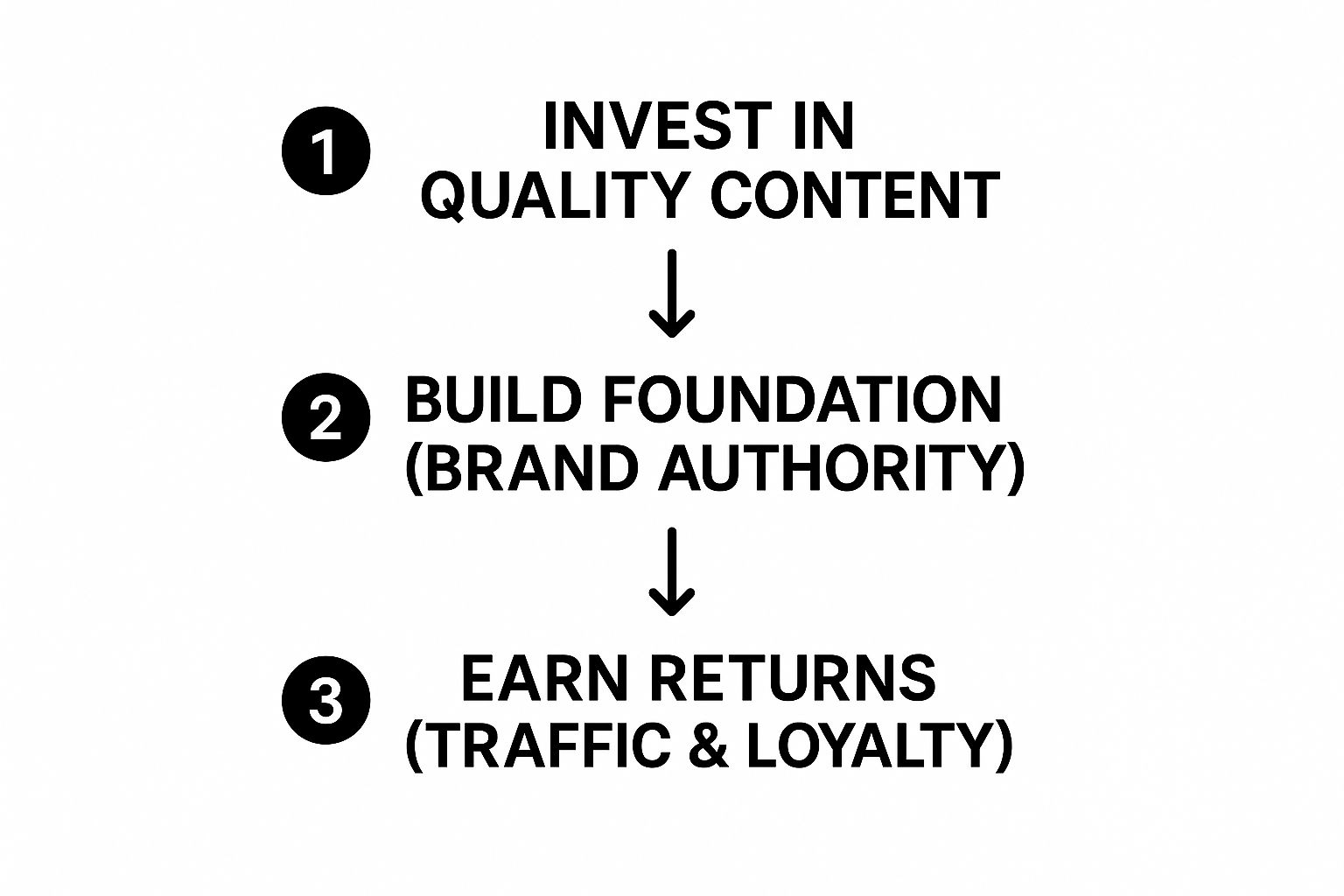
As you can see, ROI isn't an overnight miracle. It's the payoff from a deliberate, multi-stage process where those initial costs are designed to fuel long-term gains.
Step 1: Tallying Your Total Investment
First things first: you can't measure a return until you know exactly what you’ve spent. And this goes way beyond just the invoice from your freelance writer. To get an accurate ROI, you need a complete picture of every dollar that went into your content efforts.
Think of it like building a custom piece of furniture. You wouldn't just count the cost of the wood. You'd include the screws, the paint, the designer's time, and even the electricity for the power tools. Your content investment is the sum of all its parts.
Be sure to add up these key costs:
- Content Creation Costs: This bucket includes salaries for your in-house team, fees for freelancers and agencies, and any expenses related to video production or graphic design.
- Tools and Software: Don't forget your tech stack. We're talking about subscriptions for SEO tools, analytics platforms, project management software, and your Content Management System (CMS).
- Promotion and Distribution: Content doesn't promote itself. This is your budget for paid social ads, search engine marketing (SEM), influencer outreach, or any sponsored placements.
Add it all up, and you'll have a clear, honest number representing your total investment for a specific campaign or period.
Step 2: Quantifying Your Financial Return
Now for the tougher part of the equation: putting a dollar value on the results. Your 'Return' is the total revenue that your content marketing directly or indirectly brought in.
The key is to draw a clear line from a piece of content to a tangible business outcome. If a blog post leads someone to request a demo, and that demo turns into a new customer, you need a system to trace that path and credit the revenue back to the blog post that started it all.
Here are a few ways to calculate that value:
- Direct Sales Attribution: This is the low-hanging fruit. A customer clicks a "buy now" button on a product page you built content around, and you can directly attribute that sale. Easy.
- Lead Value Calculation: Most content, especially in B2B, doesn't lead to an immediate purchase. Here, you need to calculate the value of a lead. Start with your average Customer Lifetime Value (CLV) and your lead-to-customer conversion rate. For instance, if your average CLV is $5,000 and 1 in 10 leads converts, then each lead is effectively worth $500.
- Assisted Conversions: Content often plays a supporting role. Someone might read a blog post today, click a retargeting ad next week, and finally convert through an email campaign. Analytics tools can show you these "assisted conversions," allowing you to assign partial credit to the content that warmed them up.
Getting your tracking right is crucial. For a deeper dive, check out these powerful examples of marketing performance metrics to help you connect your content to cold, hard cash.
A Practical B2B Tech Company Example
Let's walk through a quick scenario with a hypothetical B2B tech company to see how it all comes together.
-
Total Investment: The company spends $15,000 in one quarter on a major campaign. This includes a deep-dive whitepaper, a supporting blog post series, and a LinkedIn ad budget to promote it.
-
Results: The campaign was a hit, generating 50 qualified leads who downloaded the whitepaper. The sales team worked their magic and converted 5 of those leads into paying customers.
-
Calculating Return: This company knows its numbers. Their average customer lifetime value (CLV) is a solid $10,000. With 5 new customers, that's a total return of $50,000 (5 customers × $10,000 CLV).
Now, we just plug those figures into our trusty ROI formula:
ROI = [($50,000 − $15,000) / $15,000] × 100
ROI = [$35,000 / $15,000] × 100
ROI = 2.33 × 100
ROI = 233%
Boom. The B2B tech company achieved a 233% content marketing ROI. Put another way, for every single dollar they spent, they got $2.33 back. Now that's a clear, defensible number you can confidently take to any stakeholder meeting.
Tracking the Metrics That Actually Matter

Calculating your final content marketing ROI gives you a powerful headline number, but that single percentage doesn't tell the whole story. To really understand what’s working—and what’s falling flat—you have to lift the hood and look at the specific key performance indicators (KPIs) driving that result. These metrics are the vital signs of your content strategy.
Think of it like a car's dashboard. Your ROI is the speedometer, telling you how fast you're going. But you also need the fuel gauge, engine temperature, and oil pressure light to understand the car's overall health. In content marketing, these gauges are your leading and lagging indicators.
Leading indicators are the early signals that hint your strategy is on the right track. Lagging indicators are the final results that prove it.
Leading Indicators: The Early Warnings
Leading indicators are forward-looking metrics that give you a real-time pulse on how your content is doing. They're the first signs of life, providing the data you need to adjust your campaigns on the fly before you’ve sunk too much time and money into them.
When these numbers start moving in the right direction, you know your content is gaining traction and finding its audience.
- Organic Traffic Growth: An uptick in visitors from search engines is a classic sign that your SEO efforts are bearing fruit and your content is getting discovered.
- Keyword Ranking Improvements: Climbing the search engine results pages (SERPs) for your target keywords is a direct predictor of future organic traffic.
- Social Media Engagement: This is all about the likes, shares, comments, and follower growth that show your content is connecting with your community.
- Backlinks Acquired: When other credible sites link to your work, it’s a massive vote of confidence that boosts your authority and search rankings.
To get the full picture, you have to measure SEO success beyond rankings. It's about connecting these early wins to actual business goals.
Lagging Indicators: The Proof of Value
While leading indicators predict future success, lagging indicators measure it. These are the bottom-line results that definitively prove the value of your content marketing. They’re called "lagging" because they take time to show up, often weeks or months after a campaign goes live.
These are the numbers that feed directly into your final ROI calculation and show a real business impact.
Attribution modeling is the bridge that connects your leading and lagging indicators. It’s the process of identifying which touchpoints a customer interacts with on their journey to conversion, allowing you to accurately assign credit to the content that influenced their decision.
A huge part of this is social proof. For instance, user-generated content (UGC) now influences an astounding 90% of shoppers’ buying decisions—making it more impactful than even search engines. With 87% of consumers saying UGC affects their choices, it’s clear that weaving authentic customer voices into your strategy is a proven way to boost your lagging indicators.
Key lagging indicators to keep an eye on include:
- Conversion Rate: The percentage of visitors who take a desired action, like signing up for a newsletter, downloading an ebook, or requesting a demo.
- Customer Acquisition Cost (CAC): The total cost to bring in a new customer through your content efforts. A core goal is always to drive this number down.
- Customer Lifetime Value (CLV): The total revenue you can expect from a single customer over their entire relationship with you. Great content builds loyalty and increases CLV.
- Direct Sales Revenue: The most straightforward metric of all. This tracks sales that can be tied directly back to a specific piece of content.
By monitoring both sets of metrics, you get a complete, dynamic view of your performance. A solid system for marketing campaign tracking is what ties all your efforts to tangible business outcomes. It allows you to prove your value and make smarter, data-driven decisions to keep improving your content marketing ROI.
Setting Realistic ROI Benchmarks for Your Industry
So, you’ve calculated your content marketing ROI. The next logical question is always, "Is this number any good?" A 200% ROI might feel like a massive win, but what if your competitors are hitting 400%? On the flip side, a 50% ROI from a brand-new, long-term strategy could actually be an amazing start.
It all comes down to context.
Your ROI goals can't exist in a vacuum. A B2B SaaS company with a nine-month sales cycle has a completely different set of benchmarks than a DTC ecommerce brand that lives and dies by flash sales. Trying to compare them is like judging a world-class weightlifter on their marathon time—they’re playing entirely different sports.
Understanding this from the get-go helps you set achievable goals, manage what your boss or client expects, and avoid the classic mistake of chasing flashy case studies that have nothing to do with your business.
Channel Performance Sets the Stage
Not all content channels are created equal, especially when it comes to how quickly you see a return. Some give you quick wins, while others are a slow burn, building value that compounds over the long haul. Knowing the difference is key to spending your budget wisely and reporting on progress accurately.
Email marketing, for example, is famous for delivering some of the highest and fastest returns out there. You’re talking directly to a warm audience that asked to hear from you, which makes getting conversions a whole lot easier.
SEO, on the other hand, demands patience. You invest upfront in creating fantastic, authoritative content that slowly, painstakingly climbs the search rankings. Your initial ROI might be low or even negative for a while. But give it time, and a single, well-ranked article can turn into a lead-generation machine that works for you 24/7, for years to come.
Common ROI Benchmarks Across Channels
To give you a better sense of where to set your targets, it helps to know what’s typical for major marketing channels. Your mileage will absolutely vary, but these numbers offer a great starting point for measuring your own content marketing return on investment.
In 2025, global benchmarks show businesses are pulling in an average of $42 in revenue for every $1 spent on email marketing. That’s a massive return that leaves most other channels in the dust. For comparison, paid search ads bring in about $2 for every $1 spent, while a solid SEO strategy can deliver around $22.24 per dollar spent over the long term. If you want to dive deeper into the numbers, you can explore the full marketing ROI statistics on Firework.com.
To help you set realistic benchmarks for your own strategy, here's a quick comparison of typical returns for major content marketing channels.
Average ROI Across Popular Marketing Channels
A comparison of typical returns for major content marketing channels to help you set realistic performance benchmarks.
| Marketing Channel | Average Return Per $1 Spent | Typical Timeframe for Returns |
|---|---|---|
| Email Marketing | $42.00 | Immediate to Short-Term |
| SEO Content | $22.24 | Medium to Long-Term |
| Paid Search (PPC) | $2.00 | Immediate |
| Social Media | Varies widely by platform | Short to Medium-Term |
The table really drives home a key point: channels like PPC give you instant results but often have a lower ceiling on returns. Meanwhile, long-term plays like SEO can produce incredible value once they finally hit their stride.
Tailoring Benchmarks to Your Business Model
Beyond just the channel, your industry and business model are the biggest factors shaping what a "good" ROI really looks like for you.
-
B2C Ecommerce: Here, it's all about immediate sales. A solid goal might be a 5:1 ratio ($5 earned for every $1 spent), with a heavy focus on channels that drive quick purchases, like social media ads and email promos.
-
B2B SaaS: The sales cycle is much, much longer. Content is about generating leads and nurturing them over months. A successful ROI calculation has to include Customer Lifetime Value (CLV), and hitting a 10:1 ratio over a 12-18 month period would be fantastic.
-
High-Consideration Services (e.g., Financial, Legal): In these fields, trust is everything. Content is used to build authority over a long period. ROI is tied to generating a few very high-value leads, and success is often measured in years, not weeks.
At the end of the day, the most important benchmark is your own past performance. The real goal should be continuous improvement—making every dollar you spend work a little harder than the last one. Use these industry averages as a guidepost, but stay focused on moving your own needle forward.
Proven Strategies to Maximize Your Content ROI

Knowing your content marketing ROI is like getting a diagnosis from a doctor. Now it’s time for the treatment plan. Once you have a clear picture of what’s working and what isn’t, you can start making targeted changes to get better results.
The secret isn’t working harder—it’s about working smarter. You need to focus your efforts where they’ll make the biggest difference.
When you boil it down, boosting your ROI comes from pulling three main levers: generating more value from your content, getting that content in front of more people, and spending less to create it. Let's dive into some practical ways to pull each of these levers.
Sharpen Your Conversion Pathways
The fastest way to improve your content marketing ROI is to squeeze more value out of the traffic you already have. Even tiny improvements in your conversion rates can lead to a big jump in revenue, all without spending another dollar on ads.
Think of your content as a set of signposts guiding a traveler on a journey. If the signs are confusing, poorly placed, or lead to dead ends, the traveler gets frustrated and leaves. Your job is to make the path from casual reader to happy customer as smooth and obvious as possible.
Here are a few high-impact areas to focus on first:
- Refine Your Calls-to-Action (CTAs): Ditch the generic "Learn More" buttons. Your CTAs need to be specific, compelling, and directly related to the content on the page. For a blog post on email marketing, a CTA to download an "Email Subject Line Template" is far more effective than a simple link to your homepage.
- Create Irresistible Lead Magnets: Give people something genuinely useful in exchange for their email. A well-designed checklist, a report packed with exclusive data, or a helpful video tutorial can make your lead capture forms work overtime.
- Optimize Your Landing Pages: Make sure the landing page experience is seamless. The headline has to match the ad or CTA that brought them there, the form should be short and simple, and the page must load in a flash. Every little bit of friction you can remove makes a conversion more likely.
Amplify Your Content Distribution
You put a ton of effort into creating a fantastic piece of content. Letting it just sit on your blog after an initial social media push is like building a supercar and only driving it to the end of the driveway. To get a real return, you need to amplify its reach.
This doesn’t mean spamming the same link all over the internet. It’s about smartly repackaging a core idea for different platforms and audiences, which multiplies its impact without you having to start from scratch every time.
A single pillar piece of content, like an in-depth webinar, can be the foundation for an entire month's worth of marketing. This approach maximizes your initial investment, ensuring your best ideas reach the widest possible audience.
Let's say you just finished hosting a one-hour webinar. Instead of immediately moving on to the next big project, you can:
- Publish the recording on your website, but put it behind a simple lead-capture form.
- Get it transcribed and turn the text into a series of detailed blog posts.
- Pull out the key stats and surprising quotes to create a shareable infographic.
- Chop up the video into 10-15 short, punchy clips perfect for social media.
- Design eye-catching quote graphics for Instagram and LinkedIn featuring the best soundbites.
From that one initial effort, you've just created more than a dozen unique assets, each perfectly suited for a different channel. Effective post-campaign optimization for better ROI ensures you get every last drop of value out of your work.
Reduce Your Investment Costs Smartly
The last lever is the most direct: just spend less. The lower your costs are for the same (or better) results, the higher your content marketing return on investment will be. This isn't about cutting corners on quality, but about finding smart efficiencies in how you work.
The most successful companies get this. Research shows that 79% of companies rated as ‘very successful’ put more than 10% of their total marketing budget toward content, and 80% of them have a documented strategy. They're committed, but they're also smart about how they spend—which is crucial when only 36% of marketers feel they can accurately measure their ROI in the first place.
Here’s how you can lower your costs without compromising on quality:
- Embrace User-Generated Content (UGC): Actively encourage your customers to share their stories, reviews, photos, and videos. Not only is UGC free, but it's also authentic and highly persuasive.
- Use AI Tools for Efficiency: Let AI handle some of the grunt work. It can be great for brainstorming ideas, conducting initial research, or even writing a rough first draft. This frees up your team to focus on the high-level strategy, editing, and adding that crucial human touch.
- Update and Refresh Old Content: Dig into your analytics and find older posts that are still getting a bit of traffic. Updating them with new stats, fresh examples, and better visuals is way cheaper than creating something new and can give you a nice SEO bump.
Got Questions About Content Marketing ROI? You’re Not Alone.
Even after you’ve memorized the formulas and crunched the numbers, things can get fuzzy when you try to apply them in the real world. Let's be honest, figuring out the true value of your content marketing is tricky, but it's essential for getting buy-in and making smarter decisions.
So, let's get into some of the most common questions and sticking points that pop up once you move from theory to practice.
How Long Until I Actually See a Return?
Ah, the million-dollar question. The most honest answer? It depends. Content marketing isn't a light switch you can flip for instant results like a PPC ad. It’s a long game.
Think of it like planting a tree. You don't get a shady spot to relax under the day after you put a sapling in the ground. It needs time to grow roots, build strength, and mature. Your content operates on a similar timeline, steadily building your authority and organic footprint.
- For SEO-focused content: You might see some early signs of life—like your keywords starting to climb the ranks—in about 3-6 months. But the really meaningful, traffic-driving results? That often takes 6-12 months, sometimes even longer.
- For email marketing: This is where you can get some quick wins. A solid campaign sent to a warm list can bring in revenue within hours or days.
- For social media campaigns: This can be a mixed bag. A video could go viral overnight, creating a huge spike. On the other hand, a community-building strategy shows its worth over many months of consistent, authentic engagement.
Patience isn't just a virtue here; it's a prerequisite. You're creating assets that will hopefully pay dividends long after you hit "publish."
Which Content Formats Give the Best ROI?
There’s no magic bullet. The "best" format is whichever one your specific audience needs to solve their problem. A B2B tech firm might get fantastic results from a deep-dive whitepaper, while a fashion brand will probably find more success with a snappy TikTok video.
That said, we do see some clear trends. Video, especially short-form, is an engagement powerhouse and often delivers great returns. And you can never go wrong with in-depth, authoritative blog posts that earn top search rankings—those can become lead-generating machines that work for you 24/7. The real key is to test, measure what happens, and then pour your resources into what your audience actually responds to.
The most profitable content format is the one that solves a specific problem for your target customer at a crucial point in their buying journey. Align the format with the funnel stage for maximum impact.
How Do I Justify the Cost When There Aren't Immediate Sales?
This is a classic struggle, especially when you're reporting to people focused on this quarter's revenue. The trick is to reframe the conversation. Instead of talking only about closed deals, you need to highlight the leading indicators—the early signs that sales are on the way.
Sure, that blog post might not have directly led to a purchase today. But you can show exactly how it's building a pipeline for tomorrow.
Show them the value by tracking and reporting on metrics like:
- Organic Traffic Growth: Show how your content is making your brand more visible online.
- New Email Subscribers: These aren't just names on a list; they're future customers you're now nurturing.
- Improved Keyword Rankings: Point out how you're systematically capturing more search territory from competitors.
- Engagement Metrics: Use shares, comments, and time on page to prove your message is hitting home.
Connecting these early wins to the bigger picture helps you tell a complete story. It's not just about the final sale; it's about all the crucial steps that lead up to it. And proving this has never been more critical. While 83% of marketing leaders call ROI a top priority, many are still wrestling with attribution. This pressure is exactly why 64% of companies now tie future marketing budgets to past performance, a shift you can explore further in these current marketing ROI statistics. By showcasing those leading indicators, you're not just justifying your budget—you're building a rock-solid case for continued investment.
At ReachLabs.ai, we specialize in creating data-driven content strategies that deliver measurable results. Our team of experts develops and executes campaigns designed to move the needle, turning your content investment into a powerful engine for growth. Discover how we can help you prove your content’s value at https://www.reachlabs.ai.