

A powerful marketing plan is more than a document; it's the strategic blueprint guiding every decision, dollar, and action your team takes. Without a clear and comprehensive plan, marketing efforts can become disjointed, reactive, and impossible to measure, leading to wasted resources and missed opportunities. Many businesses struggle with this, treating marketing as a series of disconnected tactics rather than a cohesive strategy designed for intentional growth. The solution lies in deconstructing the process into its foundational, manageable parts.
This guide provides a comprehensive breakdown of the 10 core elements every successful marketing plan must include. We move beyond theory to deliver actionable insights, practical examples, and clear guidance for implementation. You will learn not just what each component is, but how to build it effectively and integrate it into a unified strategy.
By mastering each component of a marketing plan detailed here, you will transform your approach from guesswork into a predictable engine for growth. This ensures every initiative is purposeful, measurable, and directly aligned with your ultimate business goals. This is not just another checklist; it is the architectural framework for building a resilient, effective, and results-driven marketing operation. Let's assemble your blueprint for success. We will cover everything from high-level objectives in the executive summary to the granular details of analytics and reporting, providing you with a complete roadmap to navigate the market and outperform your competition.
1. Executive Summary & Objectives
The Executive Summary & Objectives is the foundational component of a marketing plan, serving as a high-level overview of the entire document. Think of it as the "elevator pitch" for your strategy; it’s the first thing stakeholders read and often the only section they review to grasp the plan's core purpose. This section distills your detailed research and tactics into a concise summary, ensuring everyone from the C-suite to the marketing team understands the mission, the goals, and how success will be measured.
It opens with a brief synopsis of your company’s mission and current market position. More importantly, it clearly outlines the specific, measurable marketing objectives that directly support broader business goals. This is where you connect marketing activities to revenue and growth.
Why It's an Essential Component
Without this section, a marketing plan is just a collection of tactics without a unifying purpose. It provides strategic context, ensuring that every subsequent action, from a social media post to a major product launch, is aligned with a clearly defined objective. It forces you to crystallize your thinking and prioritize what truly matters, preventing wasted effort on misaligned initiatives.
Practical Implementation & Examples
To be effective, this section must be clear and data-driven. It's not a place for vague aspirations.
- HubSpot famously sets 3-5 primary, overarching goals each quarter. This sharp focus prevents their teams from getting spread too thin and ensures all efforts are directed toward a few high-impact outcomes.
- Salesforce often builds its marketing objectives around specific lead generation and sales pipeline targets. An objective might be: "Increase marketing qualified leads (MQLs) from the enterprise sector by 20% in Q3."
- Buffer takes a transparent approach, often sharing its strategic goals publicly. This practice holds them accountable and builds trust, demonstrating a clear connection between their marketing efforts and company values.
Key Insight: The Executive Summary should be written last, even though it appears first. Only after you’ve detailed your entire strategy can you accurately summarize its key points and objectives.
Actionable Tips for Success
- Use the SMART Framework: Ensure every objective is Specific, Measurable, Achievable, Relevant, and Time-bound. For example, instead of "increase brand awareness," use "Increase organic brand name searches by 15% within six months."
- Align with Revenue: Directly link marketing objectives to business revenue targets. For instance, tie a goal of increasing website conversion rates to a specific revenue contribution.
- Define Success Metrics Early: State your Key Performance Indicators (KPIs) upfront. This includes metrics like Customer Acquisition Cost (CAC), Conversion Rate, and Customer Lifetime Value (CLV).
- Schedule Quarterly Reviews: The market changes quickly. A quarterly review process allows you to pivot your objectives based on performance data and emerging trends, keeping your marketing plan agile and effective.
2. Target Audience & Buyer Personas
A critical component of a marketing plan is the detailed analysis of your ideal customers. This section moves beyond broad market definitions to create a vivid picture of the people you want to reach. It involves defining your target audience through demographic, psychographic, and behavioral data, and then distilling that research into actionable buyer personas, which are semi-fictional representations of your ideal customers.

These personas give your marketing efforts a human face, ensuring that every piece of content, every ad campaign, and every product feature is designed with a specific individual in mind. This clarity helps you craft messages that resonate deeply, rather than creating generic marketing that speaks to no one.
Why It's an Essential Component
Without a clear understanding of your audience, your marketing is essentially a shot in the dark. Buyer personas transform abstract data into relatable stories, aligning your entire organization, from sales to product development, around a shared vision of the customer. This alignment ensures message consistency and helps you make strategic decisions about where to invest your marketing budget for the highest impact.
Practical Implementation & Examples
Effective audience definition is rooted in both qualitative and quantitative research. A fundamental step in this process is understanding how to create buyer personas that truly reflect customer needs.
- Mailchimp excels by creating distinct personas for small business owners, e-commerce managers, and nonprofit coordinators, tailoring its features and content to the unique pain points of each group.
- LinkedIn segments its audience with precision using firmographic data like industry, company size, and job title, allowing for hyper-targeted advertising and content strategies.
- HubSpot develops detailed Ideal Customer Profiles (ICPs) for enterprise, mid-market, and SMB segments, ensuring their messaging and sales approach are perfectly suited for each tier.
Key Insight: Your buyer personas should be living documents. As your business grows and the market evolves, revisit and refine them with new customer data to ensure they remain accurate and relevant.
Actionable Tips for Success
- Use Your Own Data: Start by analyzing your website analytics and CRM data to identify common traits among your best customers.
- Conduct Customer Interviews: Talk to 5-10 current customers who fit your ideal profile. Ask about their goals, challenges, and what led them to choose your solution.
- Visualize Your Personas: Create a one-page document for each persona with a name, photo, and key attributes. Share it widely within your team for easy reference. You can explore how to create buyer personas with our detailed guide.
- Update Personas Quarterly: Set a reminder to review your personas every quarter. Incorporate new insights from your sales team, customer support interactions, and market research.
3. Competitive Analysis & Market Positioning
A Competitive Analysis & Market Positioning section is where you systematically identify your competitors and evaluate their strategies to determine their strengths and weaknesses relative to your own brand. It's a critical component of a marketing plan that moves beyond simple awareness of rivals. This analysis informs how you will carve out a unique space in the market, ensuring your brand isn't just another voice in a crowded room but a distinct solution to a customer's problem.
This section dissects everything from competitor pricing and messaging to their customer service reputation and content strategies. By understanding where competitors excel and where they fall short, you can identify strategic opportunities and potential threats, directly influencing your product development, sales tactics, and marketing messages.
Why It's an Essential Component
Without a deep understanding of the competitive landscape, your marketing strategy operates in a vacuum. You risk creating a "me-too" brand, battling on features or price alone, which is often a race to the bottom. This analysis is essential for true differentiation. It provides the evidence needed to build a compelling value proposition and a market position that is both unique and defensible, giving customers a clear reason to choose you over everyone else.
Practical Implementation & Examples
Effective positioning is about owning a specific idea or benefit in the consumer's mind.
- Dollar Shave Club directly disrupted Gillette's market dominance by analyzing a key weakness: high price and inconvenience. Their positioning was built on simplicity, affordability, and a direct-to-consumer model, communicated through witty, relatable marketing.
- Slack positioned itself not against other chat apps, but against the inefficiency of email. Their analysis identified the pain points of fragmented communication and positioned Slack as the central "hub" for team productivity.
- Coca-Cola vs. Pepsi provides a classic example. Coke has consistently positioned itself around emotional connection, happiness, and tradition, while Pepsi has targeted a younger demographic with themes of adventure, youth, and celebrity endorsements.
Key Insight: Your goal isn't just to list competitors, but to uncover the "why" behind their success or failure. Focus on the unmet customer needs that their strategies create or leave behind.
Actionable Tips for Success
- Use Competitive Intelligence Tools: Leverage platforms like SEMrush, Ahrefs, and SimilarWeb to analyze competitor SEO, paid ads, and website traffic data for concrete insights.
- Analyze Customer Reviews: Scour competitors' reviews on sites like G2, Capterra, or Yelp. These are goldmines for identifying common customer pain points and service gaps you can exploit.
- Conduct Quarterly Audits: The market is dynamic. A quarterly competitive audit ensures your positioning remains relevant and that you're aware of new threats or opportunities. Learn more about how to set up a robust system with a competitor analysis framework.
- Talk to Your Sales Team: Your sales team is on the front lines. Regularly ask them about the most common competitor objections they hear from prospects to inform your messaging.
4. Marketing Channels & Tactics Strategy
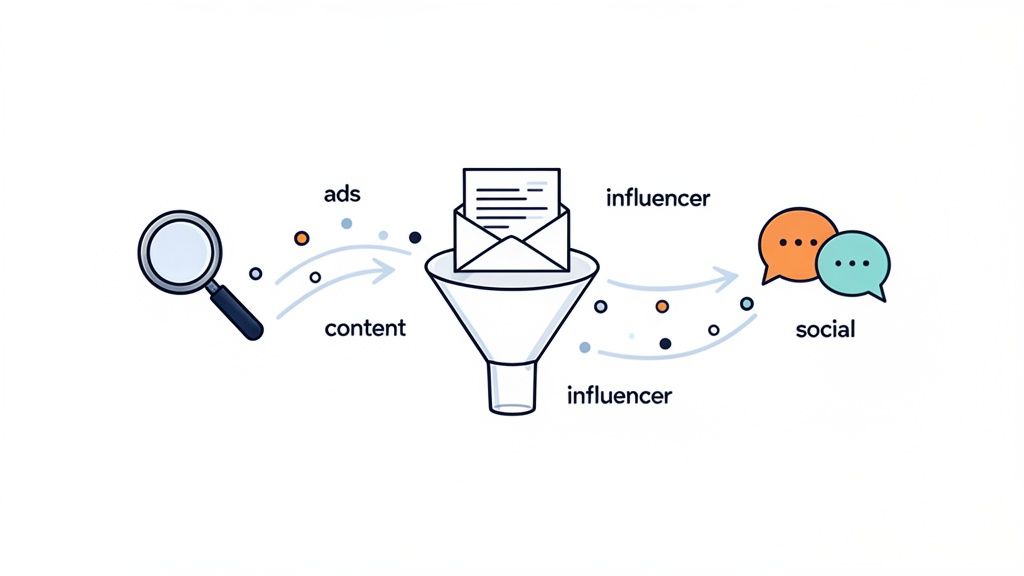
The Marketing Channels & Tactics Strategy is the tactical roadmap of your marketing plan, detailing exactly how you will reach your target audience and achieve your objectives. This component translates high-level goals into concrete actions by selecting the most effective platforms and methods for execution. It outlines the specific mix of digital channels like social media, SEO, and paid advertising, alongside content marketing, influencer partnerships, or traditional media, providing a clear rationale for each choice.
This section moves from the 'why' to the 'how', ensuring that every marketing dollar and hour is spent on activities that have the highest probability of engaging your target customer. It specifies not just which channels to use, but how they will work together to create a cohesive and seamless customer journey.
Why It's an Essential Component
Without a defined channel and tactics strategy, marketing efforts become scattered and reactive. This is a critical component of a marketing plan because it ensures resource allocation is intentional and data-driven, rather than based on assumptions or chasing trends. It forces you to deeply understand where your audience spends their time and how they prefer to consume information, leading to more efficient spending and higher engagement rates.
Practical Implementation & Examples
Effective channel strategies are focused, integrated, and tailored to specific audience behaviors.
- HubSpot exemplifies a multi-channel content strategy. They don't just create blog posts; they integrate them with SEO, promote them through email newsletters, host related webinars, and repurpose key takeaways for social media, creating a powerful content ecosystem.
- Glossier built its empire on an influencer-centric strategy, primarily leveraging Instagram. They focused on micro-influencers and user-generated content to build an authentic community, making their channel selection a perfect match for their target demographic.
- Neil Patel uses a content hub model, with his blog as the central pillar. He then uses YouTube to explain complex topics visually and email marketing to drive repeat traffic, with each channel feeding the others to maximize reach and authority.
Key Insight: The best channel strategies aren't about being everywhere. They are about being in the right places with a message and format that resonates with the audience on that specific platform.
Actionable Tips for Success
- Prioritize Primary Channels: Start by mastering 2-3 channels where your target audience is most active and engaged before expanding.
- Create Channel-Specific Content: Avoid simply cross-posting the same content everywhere. Adapt your message, tone, and format for the unique context of each platform (e.g., professional insights on LinkedIn vs. visual storytelling on Instagram).
- Use UTM Parameters: Systematically use UTM codes for all campaigns to precisely track which channels are driving traffic, leads, and conversions, enabling you to optimize your budget effectively.
- Integrate Your Channels: Plan how channels will work together. For instance, use paid social ads to drive traffic to a high-value blog post, then use a retargeting campaign to capture leads who showed interest.
5. Content Marketing & Creative Strategy
The Content Marketing & Creative Strategy is a vital component of a marketing plan that outlines how you will create and distribute valuable, relevant content to attract and retain a clearly defined audience. This isn't just about what you create; it’s about the story you tell, the voice you use, and the platforms you leverage. It transforms your brand from a seller of products into a source of information, entertainment, and trust.
This section details your content types (blogs, videos, case studies), production schedule via a content calendar, brand voice guidelines, and overall creative direction. It’s the engine that powers your SEO, social media, and email marketing efforts, establishing your authority and building a loyal community around your brand.
Why It's an Essential Component
Without a documented strategy, content creation becomes chaotic and ineffective. A clear plan ensures every piece of content serves a purpose, whether it's building awareness at the top of the funnel or driving conversions at the bottom. It aligns your creative output with your business objectives, guaranteeing that your efforts build long-term brand equity and don't just chase fleeting trends.
Practical Implementation & Examples
A great content strategy is both strategic and systematic, delivering consistent value to its audience.
- HubSpot built its empire on content, offering an extensive blog and resource library that generates millions of visitors. Their strategy focuses on educating their audience at every stage of the buyer's journey.
- Moz's "Beginner's Guide to SEO" is a legendary piece of content that cemented its status as an industry authority, attracting countless qualified leads for over a decade.
- Buffer uses its blog not only for social media guides but also to share transparent reports on its business operations and salaries, building incredible trust and a unique brand identity.
Key Insight: Your content is not about your product; it's about your customer's problems. The best content solves those problems, with your product being a natural part of the solution.
Actionable Tips for Success
- Develop Content Pillars: Build your strategy around 3-5 core topics that represent the intersection of your brand's expertise and your audience's needs.
- Create a 90-Day Calendar: Plan your content at least a quarter in advance to ensure consistency and alignment with marketing campaigns.
- Repurpose Everything: Turn a single blog post into a video, an infographic, a series of social media posts, and a podcast segment to maximize reach and efficiency. Learn more about how a creative strategy can guide this process.
- Audit Competitor Content: Analyze what your competitors are doing well and, more importantly, identify the content gaps you can fill to stand out.
- Track Performance Metrics: Monitor key indicators like organic traffic, time on page, social shares, and content-driven lead generation to measure ROI and refine your strategy.
6. Digital Advertising & Paid Media Strategy
A Digital Advertising & Paid Media Strategy is the component of a marketing plan that details how you will leverage paid channels to achieve specific business goals. While organic marketing builds long-term authority, paid media acts as an accelerator, allowing you to instantly reach highly targeted audiences across search engines, social media platforms, and other websites. This section outlines your campaign objectives, target demographics, budget allocation, creative assets, and performance metrics.
It defines where you will spend your advertising dollars and why. From Google Ads capturing high-intent searchers to Facebook campaigns building brand awareness, a well-defined paid strategy ensures your investment generates a measurable return by placing the right message in front of the right person at the right time.
Why It's an Essential Component
Without a paid media strategy, you are entirely reliant on the slow, often unpredictable growth of organic channels. This component is essential for businesses that need to scale quickly, enter new markets, or amplify key marketing campaigns. It provides a controllable, scalable, and highly measurable way to drive traffic, generate leads, and acquire customers, offering immediate data to refine your overall marketing approach.
Practical Implementation & Examples
Effective paid media is about precision targeting and compelling creative, not just a large budget.
- Dollar Shave Club used humorous, viral video ads on Facebook and YouTube to rapidly build brand awareness and disrupt the men's grooming market, achieving massive scale on a relatively small initial budget.
- Slack leverages targeted LinkedIn advertising to reach key decision-makers within specific industries and company sizes, aligning its ad spend directly with its enterprise sales objectives.
- Warby Parker masters retargeting on Facebook and Instagram, showing specific frames to users who previously viewed them on their website, effectively guiding potential customers back to complete a purchase.
Key Insight: Treat your paid media budget as a strategic investment in data. Every campaign, whether it succeeds or fails, provides valuable insights into your audience's preferences, messaging resonance, and conversion behavior.
Actionable Tips for Success
- Establish Conversion Tracking First: Before spending a dime, ensure your tracking pixels (like the Meta Pixel or Google Ads tag) are correctly installed to measure every conversion accurately.
- Test Audience Segments: Start with small budgets to test multiple audience segments, including lookalike audiences built from your best customer data, to identify who responds best.
- Create Platform-Specific Creative: Avoid a one-size-fits-all approach. Design ads that feel native to each platform, whether it’s a vertical video for Instagram Reels or a text-heavy ad for LinkedIn.
- Monitor Customer Acquisition Cost (CAC): Continuously track your CAC for each campaign and channel. This core metric will tell you if your paid strategy is profitable and sustainable.
7. Social Media & Community Strategy
The Social Media & Community Strategy is a critical component of a marketing plan that outlines how your brand will build, engage, and nurture online communities. It goes beyond simple broadcasting, treating social platforms as two-way communication channels for fostering brand awareness, loyalty, and advocacy. This plan details everything from platform selection and content creation to community management and influencer partnerships.
This section defines your brand's online personality and dictates how you interact with your audience in real-time. It maps out a strategy to transform passive followers into an active, engaged community that feels connected to your brand's mission.
Why It's an Essential Component
Without a dedicated strategy, social media efforts can become chaotic, inconsistent, and ultimately ineffective. A clear plan ensures your content serves a purpose, your engagement is authentic, and your resources are focused on the platforms where your target audience is most active. It’s the framework that turns social media from a time-consuming task into a powerful engine for growth, customer insight, and brand evangelism.
Practical Implementation & Examples
Effective social media strategies are platform-native and community-focused. They understand the unique culture of each channel.
- Wendy's has become legendary for its Twitter strategy, using a witty, humorous, and sometimes sassy brand voice to drive massive real-time engagement and cultural relevance.
- Glossier built its empire on Instagram by prioritizing user-generated content and creating a community-centric feel, making customers feel like they are part of an exclusive club.
- Duolingo leverages a viral TikTok strategy with its quirky mascot, "Duo," to create entertaining, trend-driven content that resonates deeply with a younger demographic.
Key Insight: Social media is not just a distribution channel; it's a conversation and community-building tool. The goal is to facilitate dialogue and connection, not just to broadcast marketing messages.
Actionable Tips for Success
- Focus, Don't Scatter: Choose 2-3 primary platforms where your audience is most active and engaged. Master these channels before expanding.
- Establish an Authentic Voice: Define and document a consistent brand voice and personality. Is it witty, professional, or inspirational? Stick to it across all platforms.
- Prioritize Quality Over Quantity: Consistent posting is important, but posting high-value, platform-native content is what truly drives engagement and growth.
- Leverage User-Generated Content (UGC): Encourage and showcase customer photos, reviews, and testimonials. UGC is a powerful form of social proof that builds trust.
8. Email Marketing & Marketing Automation
Email Marketing & Marketing Automation is the strategic component of a marketing plan focused on nurturing leads and retaining customers through targeted, personalized communication. This involves building and segmenting an email list, then using automation software to deliver the right message to the right person at the right time. By automating workflows, from welcome sequences to re-engagement campaigns, you can scale relationship-building efforts, making it one of the highest-ROI channels available.
This strategy transforms a simple email list from a static database into a dynamic communication engine. It allows you to guide prospects through the buyer's journey and keep existing customers engaged with relevant content, promotions, and updates, all while saving significant time and resources.
Why It's an Essential Component
Without a dedicated email and automation strategy, you lose direct control over your audience relationship. Unlike social media, where algorithms dictate reach, your email list is a wholly-owned asset. This component of a marketing plan is crucial for building long-term loyalty, driving repeat business, and moving leads efficiently through the sales funnel. It provides a reliable, direct line of communication for converting interest into revenue.
Practical Implementation & Examples
Effective automation goes far beyond generic email blasts. It’s about creating personalized experiences at scale.
- HubSpot excels at this by offering educational email sequences triggered by content downloads. If you download an ebook on SEO, you'll receive a series of related tips and resources, nurturing you from a curious reader into a qualified lead.
- Neil Patel uses his newsletter not just to announce new blog posts but to deliver exclusive marketing insights directly to subscribers, consistently driving traffic and reinforcing his authority.
- ConvertKit builds its platform around creator-focused strategies, enabling users to segment subscribers based on purchases or link clicks, ensuring every email is highly relevant to its recipient.
Key Insight: The goal of automation isn't just efficiency; it's to create a more human and personalized experience at a scale that would be impossible to manage manually.
Actionable Tips for Success
- Segment Your Audience: Don't send the same email to everyone. Segment lists based on behavior (e.g., pages visited, past purchases) and demographics to increase relevance and engagement.
- Create a Welcome Sequence: Automate a series of 5-7 emails for new subscribers to introduce your brand, set expectations, and provide immediate value.
- Balance Your Content: Use the 80/20 rule. Send 80% educational or entertaining content and only 20% promotional messages to avoid subscriber fatigue.
- Monitor Key Metrics: Track open rates, click-through rates (CTR), conversion rates, and unsubscribe rates to continuously refine your strategy and improve performance.
9. Influencer Marketing & Partnerships
Influencer Marketing & Partnerships is a strategic component of a marketing plan focused on collaborating with individuals who have built credibility and an engaged audience in a specific niche. This approach leverages their trust and authority to authentically promote your brand, products, or services. It moves beyond traditional advertising by using word-of-mouth at scale, tapping into pre-existing communities that align with your target market.
This section of your plan details the entire process: how you will identify, vet, and engage with influencers, brand ambassadors, and strategic partners. It outlines the structure of these relationships, content collaboration guidelines, and the key performance indicators used to measure success, ensuring partnerships drive genuine engagement and tangible business results.

Why It's an Essential Component
In a market saturated with ads, consumers crave authenticity. An influencer marketing strategy provides a powerful way to cut through the noise by borrowing credibility from trusted voices. When executed correctly, it builds brand affinity, generates high-quality user-generated content, and can drive significant ROI. This component of a marketing plan is crucial for brands looking to connect with audiences in a more human and relatable way.
Practical Implementation & Examples
Effective influencer strategies are built on genuine alignment, not just follower counts. The goal is to find partners whose values and audience mirror your own.
- Glossier built its empire on a micro-influencer strategy, partnering with everyday beauty enthusiasts to create a powerful sense of community and authenticity around its products.
- Audible has a long-standing podcast influencer collaboration strategy, sponsoring creators whose listeners are a perfect demographic match for audiobooks, resulting in high-conversion campaigns.
- Fitbit runs a successful ambassador program with fitness influencers who genuinely use and love the product, turning them into long-term advocates rather than one-off promoters.
Key Insight: The most successful partnerships feel like an organic recommendation from a friend, not a paid advertisement. Prioritize long-term relationships with creators who truly align with your brand ethos.
Actionable Tips for Success
- Prioritize Alignment Over Reach: Focus on an influencer's audience demographics and engagement rate, not just their follower count. Authenticity and relevance trump sheer numbers.
- Use Vetting Tools: Employ platforms like HypeAuditor or AspireIQ to analyze an influencer's audience health, spot fake followers, and verify engagement metrics before you commit.
- Start with Micro-Influencers: Creators with 10k-100k followers often have more niche, dedicated communities and can deliver a higher ROI than mega-influencers.
- Establish Clear Guidelines with Creative Freedom: Provide a clear brief with key messages and FTC disclosure requirements, but allow the creator the flexibility to speak in their own voice.
- Track Beyond Vanity Metrics: Measure success with metrics that matter, such as conversion rates (using unique discount codes or affiliate links), engagement rate, and brand sentiment.
10. Measurement, Analytics & Reporting
The Measurement, Analytics & Reporting component of a marketing plan is the framework that translates actions into insights. It’s the engine of accountability, defining how you will track performance, analyze data, and communicate results to stakeholders. This section moves your strategy from a set of hopeful initiatives to a data-driven operation by defining key performance indicators (KPIs), specifying measurement tools, and establishing a reporting cadence.
It transforms raw data into a narrative about what’s working, what isn’t, and where to pivot. This continuous feedback loop ensures that your marketing efforts are not just busywork but are actively contributing to business growth and delivering a quantifiable return on investment.
Why It's an Essential Component
Without a robust measurement framework, a marketing plan is built on assumptions. This section is essential because it provides objective proof of performance, justifies budget allocation, and enables continuous optimization. It creates a culture of accountability where decisions are based on evidence, not intuition. Ultimately, the success of your marketing plan hinges on your ability to measure its return on investment effectively; for a deeper dive, resources on how to measure marketing ROI can provide detailed methodologies.
Practical Implementation & Examples
Effective measurement goes beyond vanity metrics to focus on data that drives strategic decisions.
- Google Analytics 4 is a prime example, shifting focus from sessions to events and user engagement, allowing marketers to build sophisticated multi-touch attribution models to understand the entire customer journey.
- Salesforce connects marketing efforts directly to revenue through its advanced attribution models. Marketers can see exactly which campaigns and channels are sourcing leads that convert into closed-won deals.
- HubSpot provides an all-in-one platform where marketing activities are tracked from the first touchpoint to the final sale, offering integrated dashboards that report on campaign performance, lead generation, and customer acquisition costs in one place.
Key Insight: Your data is only as good as its structure. Establish a strict data governance policy, including consistent UTM parameter usage and standardized event naming, before launching any campaign.
Actionable Tips for Success
- Define 3-5 Primary KPIs: Focus on core metrics directly tied to your main business objectives, such as Customer Acquisition Cost (CAC), Lifetime Value (LTV), and Marketing-Sourced Revenue.
- Establish Baseline Metrics: Before launching a campaign, benchmark your current performance. This provides a clear "before and after" picture to evaluate your impact accurately.
- Create Automated Dashboards: Use tools like Google Data Studio or Tableau to build real-time dashboards that visualize your primary KPIs. This democratizes data and keeps the team focused.
- Schedule Weekly Performance Reviews: Dedicate time each week to review performance data. This agile approach allows you to quickly identify trends and optimize campaigns before they go off track.
10-Component Marketing Plan Comparison
| Component | Implementation Complexity 🔄 | Resource Requirements ⚡ | Expected Outcomes 📊 | Ideal Use Cases 💡 | Key Advantages ⭐ |
|---|---|---|---|---|---|
| Executive Summary & Objectives | Low — concise synthesis and KPI definition | Low — leadership time, analyst input | Clear strategic direction; stakeholder alignment; measurable KPIs | Align teams; executive briefings; campaign kickoff | Quick alignment; decision enablement; performance clarity ⭐⭐⭐⭐ |
| Target Audience & Buyer Personas | Medium — research, synthesis, persona creation | Medium — analytics, interviews, CRM data | Improved targeting and message relevance; better ROI | New products; segmentation for campaigns; personalization | Increases relevance; reduces wasted spend; guides content ⭐⭐⭐⭐ |
| Competitive Analysis & Market Positioning | Medium–High — ongoing research and SWOT | Medium — intelligence tools, market research | Differentiation opportunities; informed pricing and messaging | Market entry; rebranding; competitive response | Reveals white space; informs positioning and pricing ⭐⭐⭐ |
| Marketing Channels & Tactics Strategy | High — channel mapping, sequencing, integration | High — channel specialists, budget, tooling | Coordinated omnichannel execution; optimized channel ROI | Omnichannel launches; scale lead generation | Clear execution roadmap; budget optimization; measurement-ready ⭐⭐⭐⭐ |
| Content Marketing & Creative Strategy | High — long-term calendar, production workflows | High — writers, designers, SEO, production resources | Organic traffic growth; authority; sustained lead generation | Brand building; thought leadership; inbound growth | Builds authority; cost-effective long term; SEO lift ⭐⭐⭐⭐ |
| Digital Advertising & Paid Media Strategy | Medium–High — campaign setup, targeting, testing | High — ad spend, platform expertise, creative assets | Immediate visibility, traffic, conversions; measurable ROI | Fast acquisition; demand gen; audience testing | Scalable results; precise targeting; rapid optimization ⭐⭐⭐ |
| Social Media & Community Strategy | Medium — consistent content and moderation | Medium — community managers, creators, tools | Brand awareness, engagement, advocacy; UGC | Community-driven brands; engagement-led growth | Direct customer relationships; real-time feedback; community growth ⭐⭐⭐ |
| Email Marketing & Marketing Automation | Medium — flow setup, segmentation, automation | Medium — email platform, content, list-building | High ROI; improved conversions, retention, lifecycle nurture | Lead nurture; retention campaigns; cross-sell/up-sell | Personalization at scale; measurable conversions; automation efficiency ⭐⭐⭐⭐ |
| Influencer Marketing & Partnerships | Medium — vetting, contracts, creative collaboration | Variable — compensation, management, vetting tools | Authentic reach; niche audience engagement; UGC | Awareness campaigns; social proof; niche penetration | Trusted endorsements; content amplification; authentic reach ⭐⭐⭐ |
| Measurement, Analytics & Reporting | High — tracking, attribution, dashboarding | High — analytics tools, engineers, integrations | Clear ROI, optimization insights, data-driven decisions | Cross-channel optimization; executive reporting; budget allocation | Enables accountability; continuous improvement; predictive insights ⭐⭐⭐⭐ |
From Plan to Performance: Activating Your Strategy
You have navigated the intricate landscape of what constitutes a modern, effective marketing plan. From the high-level vision of the Executive Summary and the deep customer understanding forged through Buyer Personas, to the strategic battleground of Competitive Analysis and the tactical precision of your Channel and Content Strategies, each component of a marketing plan is a critical gear in a larger machine. We have explored the nuances of paid media, social engagement, email automation, partnerships, and, crucially, the analytical frameworks that measure it all.
The journey, however, does not end here. A completed marketing plan is not a trophy to be placed on a shelf; it is a living, breathing blueprint for growth. The most common mistake marketers and business owners make is treating their plan as a static document, a one-time task to be checked off a list. True market leaders understand that a plan is a starting line, not a finish line. It is a set of well-researched hypotheses waiting to be tested in the real world.
The Shift from Static Document to Dynamic Framework
Think of your plan as a dynamic framework for decision-making. The real work begins when you activate your strategy and the first pieces of performance data start to roll in. This is where theory meets reality, and agility becomes your most valuable asset.
- Quarterly Reviews are Non-Negotiable: Schedule formal reviews of your marketing plan every quarter. This cadence is frequent enough to adapt to market shifts but long enough to gather meaningful data. During these sessions, systematically revisit each component. Are your target personas still accurate? Has a new competitor emerged? Is a particular marketing channel vastly underperforming or overperforming against your KPIs?
- Embrace the "Test and Refine" Mindset: Treat every tactic as an experiment. Your paid media strategy, for instance, is a series of tests on ad creatives, audiences, and bidding strategies. Your content strategy is a collection of experiments on topics, formats, and distribution channels. The goal is not to be right from the start but to learn and adapt faster than your competition.
- Resource Reallocation is Key: Data from your Measurement and Analytics framework should directly inform your budget allocation. If your social media efforts are generating high engagement but low conversion, while your email marketing campaigns are driving significant revenue, it is time to reallocate resources. A dynamic plan allows you to double down on what works and pull back from what does not, maximizing your return on investment.
Key Insight: The value of a marketing plan is not in its initial perfection but in its ability to evolve. A plan that is 70% correct and is consistently iterated upon will always outperform a "perfect" plan that is never revisited.
Connecting the Components for Sustained Growth
The true power of understanding each component of a marketing plan lies in seeing how they interconnect. Your competitive analysis should inform your content strategy, helping you identify gaps you can fill. Your buyer persona insights should shape the messaging in your paid ad campaigns and the tone of your social media interactions. Your measurement framework is the connective tissue that holds it all together, providing a unified view of performance across all channels.
By mastering and integrating these elements, you transform marketing from a cost center into a predictable engine for revenue and brand growth. You move beyond reactive, "hope-based" marketing and step into a world of strategic, data-informed execution. Your plan becomes your roadmap, your compass, and your playbook for achieving your most ambitious business objectives. The next step is simple but profound: execute, measure, iterate, and win.
Tired of building marketing plans that collect dust? At ReachLabs.ai, we transform your static strategies into dynamic, AI-powered growth engines that adapt in real-time. Let us help you connect every component of your marketing plan to measurable results by visiting us at ReachLabs.ai.