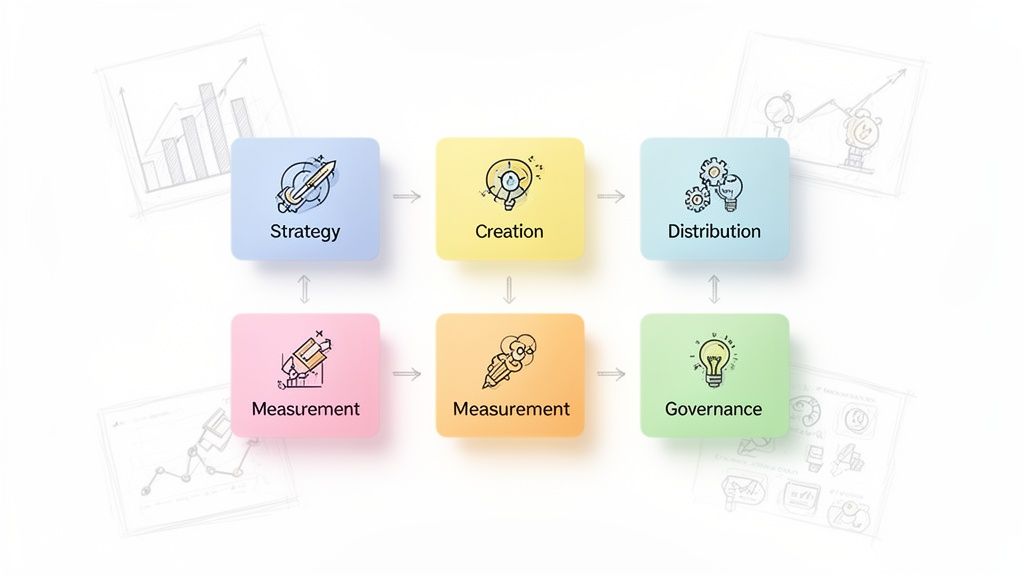
Content marketing remains a cornerstone of digital growth, yet many brands struggle to see a meaningful return on their investment. The gap between simply creating content and creating content that actually converts is widening. It’s no longer enough to just publish blog posts or update social media; success demands a strategic, data-informed, and highly optimized approach. If your efforts feel like a constant uphill battle with minimal results, you're not alone, but there is a clear path forward.
This guide cuts through the noise to deliver the essential best practices for content marketing that will transform your activities from an expense into a powerful revenue-generating asset. We are moving beyond generic advice to provide a concrete framework for building a high-performance content engine. You will learn how to build a documented strategy, create content that genuinely serves your audience, master multi-channel distribution, and prove your ROI with clear, measurable data. For those looking to get a head start, these 10 content marketing best practices for 2025 offer a foundational perspective on what works right now.
Think of this article as your comprehensive playbook. Each point is designed to be actionable, providing you with the exact steps needed to refine your process and achieve tangible business goals. By the end of this roundup, you will have a clear, actionable blueprint to not only compete but to build a sustainable advantage in a crowded market. Let's dive into the core practices that separate the most successful brands from the rest.
1. Develop a Documented Content Strategy Based on Data-Driven Insights
Operating without a documented content strategy is like navigating a new city without a map. You might eventually reach a destination, but the journey will be inefficient, costly, and likely frustrating. A formal strategy document acts as your North Star, aligning all team members on your objectives, target audience, and the path to success. This foundational step is one of the most critical best practices for content marketing, shifting your efforts from reactive and haphazard to proactive and purposeful.
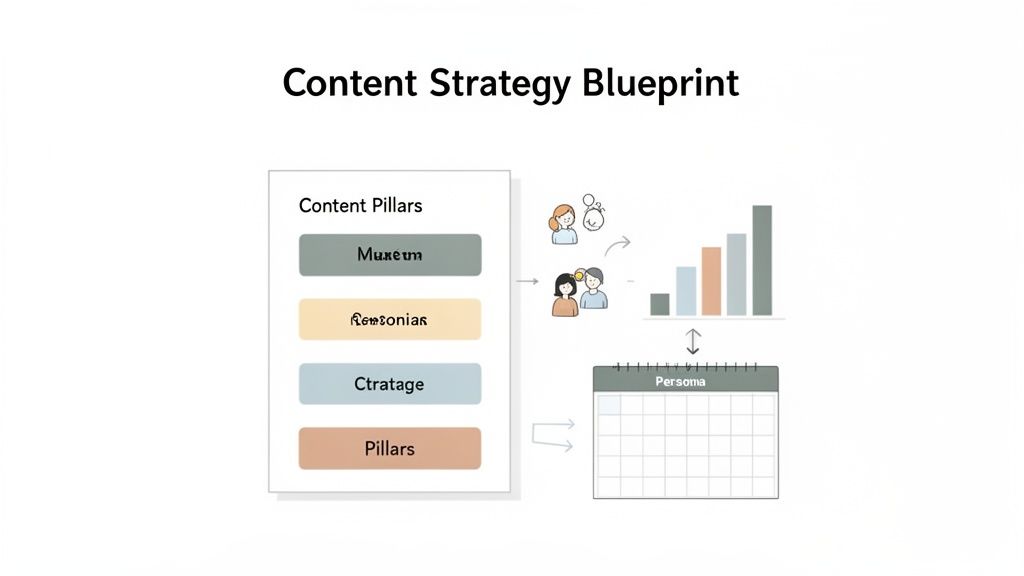
The core principle is grounding your plan in data, not assumptions. By analyzing audience behavior, competitive intelligence, and market trends, you create content that resonates deeply and performs effectively. For instance, HubSpot’s renowned strategy segments content by buyer journey stage (Awareness, Consideration, Decision), ensuring they deliver the right message at the right time. This data-first approach transforms content from a creative exercise into a predictable growth engine.
How to Implement This Practice
- Conduct a Comprehensive Audit: Start by analyzing your existing content. Use analytics tools to identify your highest-performing themes, formats, and channels. What topics generate the most engagement? Which pages have the highest conversion rates?
- Define Data-Backed Personas: Move beyond generic assumptions about your audience. Build detailed buyer personas using actual customer data from your CRM, surveys, and interviews to understand their true pain points and motivations.
- Establish SMART Goals: Set Specific, Measurable, Achievable, Relevant, and Time-bound objectives. A goal like "Increase organic blog traffic by 20% in Q3" is far more effective than a vague aim to "get more visitors." For those specifically focusing on video, a comprehensive guide can help define a winning strategy. You can find more details in A Modern Playbook for Your Video Content Marketing Strategy.
- Document and Share: Codify your strategy in a central document that outlines your goals, personas, content pillars, distribution channels, and KPIs. To streamline this process, you can get started with a comprehensive content marketing strategy template. Ensure all stakeholders review it for buy-in and treat it as a living document, reviewing and updating it quarterly based on performance data.
2. Create High-Quality, Original Content That Provides Genuine Value
In an online world saturated with information, creating generic, surface-level content is a direct path to being ignored. The cornerstone of effective content marketing is producing high-quality, original material that solves a genuine problem or answers a specific question for your audience. This practice involves moving beyond rehashing competitor articles and instead investing in deep research, unique data, and expert perspectives to create assets that build authority, foster trust, and earn top search engine rankings.

The principle here is to become the primary source of information, not an echo. When you provide genuine value, your audience rewards you with their attention, engagement, and loyalty. For instance, Backlinko's definitive SEO case studies, which feature detailed methodologies and original findings, have become go-to resources in the industry. This commitment to originality is one of the most powerful best practices for content marketing because it creates a competitive moat; your unique insights cannot be easily replicated.
How to Implement This Practice
- Conduct Original Research: Run your own surveys, analyze internal data, or conduct experiments to generate proprietary insights. Publishing an industry report with fresh statistics can position your brand as a thought leader.
- Interview Subject Matter Experts: Go beyond your internal team. Incorporate quotes, perspectives, and advice from recognized industry experts to add credibility and depth to your content.
- Invest in Quality Control: Prioritize thorough editing, fact-checking, and proofreading. High-quality content is free of errors and presents information clearly and professionally, which directly reflects on your brand's credibility.
- Document Unique Methodologies: If your company has a unique process or framework for solving a problem, document it in a detailed guide or pillar page. This proprietary content becomes a valuable asset that attracts links and establishes your expertise. To deliver these kinds of tailored and original solutions at scale, many businesses turn to creative content services to ensure every piece is impactful.
3. Implement Multi-Channel Distribution Strategy Tailored to Platform Dynamics
Creating high-quality content is only half the battle; ensuring it reaches the right audience on the right platform is what drives results. A multi-channel distribution strategy means moving beyond a "one-size-fits-all" approach and instead adapting your content to the unique dynamics of each platform. This practice involves tailoring your messaging, format, and timing to align with how users behave on different channels, from LinkedIn to Instagram to your company blog.
The core principle is to respect the platform. A detailed whitepaper might be perfect for a targeted email campaign or a download on your website, but it needs to be atomized into a professional infographic for LinkedIn, a quick-tip carousel for Instagram, and a short, engaging video for TikTok. For example, Hootsuite masterfully creates platform-specific content calendars, ensuring their social media presence feels native and engaging everywhere they post. This tailored approach is one of the most effective best practices for content marketing because it maximizes reach and engagement by meeting the audience where they are, in the format they prefer.
How to Implement This Practice
- Create a Content Adaptation Matrix: Develop a simple chart that outlines how a single core piece of content (like a blog post) will be adapted for each distribution channel. Specify the format (e.g., video, carousel, quote graphic), the caption's tone, and the call-to-action for each platform.
- Embrace Native Formats: Prioritize formats that are native to each platform, as their algorithms often favor them. This means creating Reels for Instagram, using LinkedIn Polls for engagement, and producing long-form video for YouTube rather than just cross-posting the same link everywhere.
- Optimize for Platform-Specific Timing: Use analytics tools to identify the optimal posting times for your audience on each individual platform. A B2B audience might be most active on LinkedIn during business hours, while a B2C audience might engage more on Instagram in the evenings.
- Track Performance with UTM Parameters: Append unique UTM parameters to links shared on different channels. This allows you to precisely track which platforms are driving the most traffic, leads, and conversions, enabling you to double down on what works and refine your strategy based on hard data.
4. Establish Clear, Measurable KPIs and Regular Performance Analytics
If content is king, then data is the power behind the throne. Creating content without a system to measure its performance is like shouting into the void and hoping for an echo. Establishing clear Key Performance Indicators (KPIs) and a regular analytics cadence transforms your content marketing from an art form into a science, allowing you to prove its value, optimize your efforts, and make informed decisions that drive real business growth. This is one of the most crucial best practices for content marketing because it directly connects your creative work to tangible outcomes.

The core principle here is to move beyond vanity metrics like page views or social media likes. Instead, focus on KPIs that directly reflect business objectives, such as lead generation, conversion rates, customer acquisition cost (CAC), and pipeline influence. For instance, a B2B company might track how many MQLs (Marketing Qualified Leads) a specific whitepaper generates, while an e-commerce brand would measure the revenue attributed to a series of product-focused blog posts. This focus on attribution and impact is what separates high-performing teams from the rest.
How to Implement This Practice
- Define KPIs Before Launch: Before any campaign goes live, determine what success looks like. Define your primary and secondary KPIs, ensuring they align with the content's purpose and the overall business goals.
- Implement Robust Tracking: Use tools like Google Analytics 4 for cross-platform tracking and set up conversion goals and events. Consistently apply UTM parameters to all campaign links to accurately trace traffic sources and user behavior.
- Create Performance Dashboards: Build a centralized dashboard (using tools like Google Data Studio, HubSpot, or a BI platform) to monitor your KPIs in real time. This provides a single source of truth for all stakeholders and simplifies reporting. For a detailed overview of which metrics to track, you can explore these examples of marketing performance metrics.
- Establish a Reporting Cadence: Schedule regular (weekly, bi-weekly, or monthly) performance reviews to analyze data, identify trends, and derive actionable insights. Discuss what's working, what isn't, and how to pivot your strategy accordingly. This consistent loop of analysis and optimization is the key to sustained success.
5. Build Long-Term Relationships Through Consistent, Authentic Engagement
Effective content marketing is a dialogue, not a monologue. Shifting from one-way broadcasting to genuine two-way conversations is crucial for building a loyal audience. This practice involves actively engaging with your community by responding to comments, answering questions, and participating in relevant discussions. It’s about being consistently present and helpful, which fosters the trust and loyalty that turns followers into customers and brand advocates.
The core principle here is to humanize your brand and build authentic connections. When you invest time in your audience, they invest their attention and loyalty in you. For example, Pat Flynn built his Smart Passive Income empire by prioritizing authentic community engagement, answering questions, and being genuinely helpful. Similarly, Glossier’s success is built on a community-first social media strategy, where they actively listen to and feature their customers, making them feel like an integral part of the brand’s story.
How to Implement This Practice
- Prioritize Responsiveness: Make it a policy to respond to every comment and message, ideally within 24 hours. This simple act shows your audience that you value their input and are actively listening.
- Use Audience Questions for Content Ideation: Pay close attention to the questions your community asks. These are direct indicators of their needs and pain points, providing a goldmine of proven topics for your future content calendar.
- Share Behind-the-Scenes Content: Humanize your brand by showing the people and processes behind your products or services. This transparency builds a stronger, more personal connection with your audience.
- Nurture Your Email List with Exclusive Value: Treat your email subscribers like VIPs. Go beyond promotional messages and offer them exclusive content, early access, or special insights that aren't available elsewhere.
- Host Live, Interactive Sessions: Use formats like live Q&A sessions, webinars, or "Ask Me Anything" (AMA) events on social media. These real-time interactions create a powerful sense of community and direct engagement.
6. Optimize Content for Search Intent and SEO to Drive Organic Discovery
Creating excellent content is only half the battle; ensuring your target audience can find it is the other. Optimizing for search engines transforms your content from a hidden gem into a beacon that attracts consistent, high-quality organic traffic. This practice involves aligning your content with the specific questions, problems, and needs your audience types into search engines, a process known as matching search intent. By doing so, you build a sustainable source of leads and reduce your reliance on paid advertising channels.
The core principle here is to become the best answer to a user's query. This involves in-depth keyword research, on-page optimization, and creating content that is comprehensive and authoritative. For example, Backlinko’s detailed guides consistently rank for highly competitive SEO terms because they meticulously address every possible facet of a user's search intent, leaving no question unanswered. Adopting these SEO-centric best practices for content marketing ensures your hard work gets discovered by those who need it most, precisely when they are looking for a solution.
How to Implement This Practice
- Conduct In-Depth Keyword and Intent Research: Use tools like Ahrefs or SEMrush to identify the phrases your audience is searching for. Focus on understanding the intent behind the keywords. Is the user looking for information (informational), comparing products (commercial), or ready to buy (transactional)? For a deeper dive, you can explore a detailed guide on how to find the best keywords for your strategy.
- Create Comprehensive, Optimized Content: Build content that is significantly more thorough and valuable than what currently ranks on the first page. Structure your content with clear headings (H2s, H3s), optimize meta titles and descriptions, and naturally incorporate your target keywords.
- Prioritize On-Page and Technical SEO: Ensure your website is technically sound with fast load times, mobile-friendliness, and a logical internal linking structure. Use internal links to guide users and search engines to related, high-value content on your site.
- Build Authority with Backlinks: Earn backlinks from reputable, relevant websites by creating original research, data-driven reports, or exceptional "link-worthy" content. High-quality backlinks act as votes of confidence in the eyes of search engines, boosting your rankings.
- Regularly Update and Refresh Content: SEO is not a "set it and forget it" task. Periodically review your top-performing content to update statistics, add new information, and fix broken links to maintain its relevance and ranking.
7. Develop Content for All Stages of the Customer Journey
Imagine trying to sell a product to someone who doesn't even know they have a problem. Your message would fall flat. This is why mapping content to the customer journey is one of the most fundamental best practices for content marketing. It ensures you deliver relevant information precisely when your audience needs it, guiding them from initial awareness to a final purchasing decision. This targeted approach prevents you from alienating early-stage prospects with a hard sell or losing late-stage leads with overly generic information.
The core principle is to meet your audience where they are. Someone in the Awareness stage is looking for educational content that helps them understand their pain points. In the Consideration stage, they are actively researching solutions. Finally, in the Decision stage, they need proof and validation to choose your offering. Salesforce excels at this by providing a mix of high-level educational blog posts (Awareness), detailed solution comparisons (Consideration), and compelling customer success stories (Decision), creating a seamless and supportive journey for potential buyers.
How to Implement This Practice
- Map Your Customer Journey: Begin by outlining the distinct phases your typical customer goes through. Identify the key questions, challenges, and information needs they have at each stage, from initial problem recognition to final purchase.
- Create a Content Matrix: Develop a grid that maps your buyer personas against each stage of the journey. Use this matrix to brainstorm and plan specific content pieces (e.g., blog posts for Awareness, webinars for Consideration, case studies for Decision) that address the unique needs at each intersection.
- Use Diverse Formats: Align content formats with the buyer's intent. Top-of-funnel awareness content works well as blog posts, infographics, and short videos. Consideration-stage content is often more in-depth, like whitepapers, webinars, or comparison guides. Decision-stage content should build trust through case studies, testimonials, and demos. For instance, ReachLabs.ai uses detailed case studies and investor decks to support B2B decision-making.
- Automate Content Delivery: Implement a marketing automation platform to nurture leads effectively. Create email sequences that deliver the right content based on a user's behavior, ensuring they receive timely and relevant information that moves them to the next stage. Measure the conversion rates between stages to identify content gaps and opportunities for optimization.
8. Leverage Influencer Partnerships and Social Proof to Amplify Reach
In an era of declining trust in traditional advertising, consumers look to peers and trusted experts for recommendations. Leveraging influencer partnerships and social proof is a powerful content marketing best practice that taps into this behavior, allowing you to borrow credibility and amplify your reach through authentic, third-party voices. Instead of just telling your audience you’re great, you let respected figures and satisfied customers do it for you.
This approach involves collaborating with individuals whose audiences align with your target market. These partnerships extend your content's reach into new, highly engaged communities and provide the validation needed to build trust quickly. For example, beauty brand Glossier built its empire by partnering with micro-influencers, turning real customers into brand evangelists. This strategy transforms marketing from a monologue into a community conversation, making your brand more relatable and trustworthy.
How to Implement This Practice
- Prioritize Audience Alignment Over Follower Count: The most effective partnerships are with influencers whose followers match your ideal customer profile, regardless of their size. A micro-influencer (10K-100K followers) with a dedicated niche following often drives higher engagement and conversions than a macro-influencer with a broad, less-targeted audience.
- Create Co-Branded, Value-Driven Content: Focus on collaborations that benefit both parties and provide genuine value to the audience. This could be a co-hosted webinar with an industry expert, a joint research report, or an influencer takeover of your social media channels. The key is to make it a true partnership, not just a paid promotion.
- Systematize Social Proof: Actively encourage and showcase customer testimonials, case studies, and user-generated content across your website and social channels. Feature positive reviews prominently on product pages and create detailed case studies that tell a compelling story of customer success.
- Establish Long-Term Relationships: Move away from one-off campaigns and toward building long-term ambassador programs. Nurturing relationships with key influencers and brand advocates creates more authentic and consistent promotion over time. For instance, B2B tech companies often build lasting partnerships with LinkedIn thought leaders to continuously tap into their professional networks.
9. Create Evergreen Content That Continues to Drive Value Over Time
Balancing timely, trend-based content with foundational evergreen pieces is a hallmark of sophisticated content marketing. While news-jacking and reacting to current events can generate short-term traffic spikes, evergreen content is the asset that builds sustainable, long-term value. These are the guides, tutorials, and resources that remain relevant and useful for years, continuously attracting organic traffic and establishing your brand as a durable authority in your niche. This strategic focus on longevity is one of the most impactful best practices for content marketing.

The core principle is to create definitive resources that solve timeless problems for your audience. Think of Backlinko's comprehensive SEO guides, which consistently rank for high-value keywords and drive traffic years after publication with only minor updates. This approach delivers a significantly higher return on investment over time because a single asset can generate leads and build authority for years, unlike a campaign-based article that quickly becomes obsolete. Evergreen content becomes the stable, traffic-driving backbone of your entire content ecosystem.
How to Implement This Practice
- Identify Core Audience Problems: Use keyword research, customer surveys, and sales team feedback to uncover the fundamental, recurring questions your audience has. Focus on topics that aren't tied to a specific year, tool version, or fleeting trend.
- Create Definitive Pillar Content: Go beyond a simple blog post. Develop comprehensive, in-depth resources (often 3,000+ words) that cover a topic exhaustively. Formats like "The Ultimate Guide to X" or "How to Do Y: A Beginner's Playbook" work exceptionally well.
- Establish a Refresh Cadence: Evergreen content is low-maintenance, not no-maintenance. Schedule quarterly or semi-annual reviews to update statistics, replace outdated links, and add new, relevant information to maintain its top-ranking position and accuracy.
- Repurpose and Atomize: Maximize the value of your core evergreen asset by breaking it down into other formats. A comprehensive guide can be repurposed into a webinar, an infographic, a video series, social media snippets, and an email course. Internally link from new, timely blog posts back to your foundational evergreen content to pass authority.
10. Use Data-Driven Personalization and Segmentation to Improve Relevance
Broadcasting generic content to your entire audience is an outdated practice that yields diminishing returns. Today's consumers expect experiences tailored to their specific needs, interests, and context. Data-driven personalization and segmentation are the solution, transforming mass communication into meaningful one-to-one conversations at scale. This is one of the most impactful best practices for content marketing because it directly increases relevance, which in turn boosts engagement and conversions.
The principle is simple: divide your audience into smaller, distinct groups based on shared characteristics and deliver content specifically designed for them. Instead of a one-size-fits-all approach, you create a one-size-fits-one experience. For example, Spotify’s "Discover Weekly" playlist isn't a random assortment of songs; it’s a hyper-personalized experience curated from a user's listening history. This level of relevance builds loyalty and keeps users deeply engaged with the platform.
How to Implement This Practice
- Start with Basic Segmentation: You don't need complex AI to begin. Start by grouping your audience based on accessible data like job title, industry, company size, or past purchase history. Even simple segmentation can significantly improve your results.
- Leverage Marketing Automation: Implement a marketing automation platform like HubSpot or Marketo. These tools are essential for tracking user behavior, building dynamic segments, and delivering personalized content automatically through email, on-site messages, and more.
- Use Dynamic Content: Create content blocks on your website or in your emails that change based on the viewer’s segment. A B2B tech company could show a case study relevant to a visitor's industry or display a pricing page that reflects their company size.
- Implement Progressive Profiling: Avoid overwhelming new leads with long forms. Use progressive profiling to gather information over time. Ask for a name and email first, then on their next visit, ask for their company name, and later, their job title, gradually building a rich contact profile.
- Create Account-Based Marketing (ABM) Campaigns: For high-value B2B prospects, use an ABM strategy to create bespoke content experiences for specific target accounts. This involves personalizing everything from ad copy to landing pages to address the unique pain points of that single organization.
Top 10 Content Marketing Best Practices Comparison
| Item | Implementation 🔄 (complexity) | Resources & speed ⚡ (requirements) | Expected outcomes 📊 (impact & quality ⭐) | Ideal use cases 💡 |
|---|---|---|---|---|
| Develop a Documented Content Strategy Based on Data-Driven Insights | High 🔄🔄🔄 — comprehensive audits & planning | High resources; slower to launch ⚡ | Clear alignment and higher ROI 📊 ⭐⭐⭐ | Organizations building foundational marketing infrastructure 💡 |
| Create High-Quality, Original Content That Provides Genuine Value | Medium‑high 🔄🔄 — deep research & expert sourcing | High resources; time‑intensive ⚡ | Authority, engagement, improved SEO 📊 ⭐⭐⭐ | Brands needing differentiation and trust building 💡 |
| Implement Multi-Channel Distribution Strategy Tailored to Platform Dynamics | High 🔄🔄🔄 — platform coordination & adaptation | High resources; ongoing management ⚡ | Broader reach and multiple touchpoints 📊 ⭐⭐⭐ | Brands maximizing audience reach across platforms 💡 |
| Establish Clear, Measurable KPIs and Regular Performance Analytics | Medium 🔄🔄 — tracking setup & modeling | Moderate resources; moderate speed ⚡ | Measurable ROI and rapid optimization 📊 ⭐⭐⭐ | Data-driven teams proving and improving performance 💡 |
| Build Long-Term Relationships Through Consistent, Authentic Engagement | Medium 🔄 — continuous community management | Moderate‑high resources; slow results ⚡ | Increased retention, advocacy, CLV 📊 ⭐⭐⭐ | Brands focused on retention and community building 💡 |
| Optimize Content for Search Intent and SEO to Drive Organic Discovery | Medium 🔄🔄 — technical + content optimization | Moderate resources; results over months ⚡ | Sustainable organic traffic and lead capture 📊 ⭐⭐⭐ | Companies aiming for long-term organic growth 💡 |
| Develop Content for All Stages of the Customer Journey | Medium‑high 🔄🔄 — mapping & varied content formats | Moderate resources; requires coordination ⚡ | Higher conversion rates across funnel stages 📊 ⭐⭐⭐ | B2B and complex sales organizations 💡 |
| Leverage Influencer Partnerships and Social Proof to Amplify Reach | Medium 🔄 — partner selection and compliance | Variable resources; can be fast or costly ⚡ | Amplified reach and third‑party credibility 📊 ⭐⭐ | Brands seeking rapid awareness and social proof 💡 |
| Create Evergreen Content That Continues to Drive Value Over Time | Medium 🔄 — deep upfront creation, low maintenance | Moderate resources; long-term payoff ⚡ | Continuous traffic and strong ROI over time 📊 ⭐⭐⭐ | Teams building sustainable content libraries 💡 |
| Use Data-Driven Personalization and Segmentation to Improve Relevance | High 🔄🔄🔄 — segmentation, automation, privacy | High resources; requires tech stack ⚡ | Higher engagement and conversion rates 📊 ⭐⭐⭐ | Businesses scaling personalized experiences and ABM 💡 |
Turning Best Practices into Measurable Results
We've explored a comprehensive roadmap detailing the essential best practices for content marketing, moving from high-level strategy to the granular details of execution and measurement. The journey from a basic content plan to a powerful, results-driven engine is not about checking boxes; it's about fundamentally shifting your approach to be more strategic, audience-centric, and relentlessly data-informed.
The principles we've covered, from developing a documented strategy to creating evergreen assets and personalizing experiences, are not isolated tactics. They are interconnected components of a single, powerful system. A brilliant piece of high-quality content (Practice #2) will fail to deliver if it isn't optimized for search intent (Practice #6) and distributed effectively across multiple channels (Practice #3). Likewise, even the most robust distribution plan is ineffective without clear KPIs and consistent performance analysis (Practice #4) to guide future decisions. This is the core takeaway: success lies in integration, not just implementation.
From Theory to Tangible Growth
Mastering these best practices for content marketing moves your organization beyond simply publishing content. It transforms your marketing function into a predictable driver of business growth. When you align content with every stage of the customer journey (Practice #7), you don't just attract visitors; you build a pipeline of educated, engaged leads who are more likely to convert and become loyal advocates.
The true value emerges when these practices become ingrained in your team's workflow. It's the difference between a one-off viral hit and a sustainable stream of organic traffic. It’s the shift from chasing fleeting trends to building a library of evergreen content (Practice #9) that generates value for months and even years to come. This commitment to a holistic strategy is what separates market leaders from the competition. It builds brand equity, fosters authentic community engagement (Practice #5), and ultimately creates a defensible competitive advantage.
Your Actionable Path Forward
The sheer volume of these best practices can feel overwhelming, but progress begins with a single, deliberate step. Don't attempt to overhaul everything at once. Instead, identify the most significant gap in your current strategy and start there.
- Start with an Audit: Where are you weakest? Is it the lack of a documented strategy? Poor SEO performance? Inconsistent measurement? Use the points in this article as a checklist to conduct an honest self-assessment.
- Prioritize One Core Area: Choose one high-impact area to focus on for the next quarter. If your strategy is undefined, make documenting it your sole priority (Practice #1). If your distribution is weak, focus on mastering one or two key channels (Practice #3).
- Establish Foundational KPIs: Before you begin, define what success looks like. Implement the measurement tools and processes needed to track your progress against those clear, measurable KPIs (Practice #4).
- Iterate and Expand: Once you've made measurable improvements in one area, move to the next. This iterative approach ensures sustainable progress and prevents your team from getting bogged down.
Ultimately, adopting these best practices for content marketing is an investment in your brand's future. It's about building a resilient, scalable system that consistently delivers qualified leads, strengthens customer relationships, and drives meaningful revenue. By moving from random acts of content to a cohesive and data-driven ecosystem, you build more than just a marketing channel; you build an invaluable business asset.
Ready to transform your content strategy from a checklist into a powerful growth engine? The team at ReachLabs.ai specializes in implementing these very best practices, providing the data-driven expertise and execution power needed to elevate your brand. Visit ReachLabs.ai to see how our full-service approach can help you achieve measurable results and a tangible return on your content investment.