
To build a content strategy that actually moves the needle, every single piece you create has to be tied directly to a real business objective. It’s about shifting your mindset away from vanity metrics and focusing squarely on outcomes that drive growth—think generating qualified leads, boosting customer retention, or increasing sales conversions. This is the first and most critical step. It’s what turns random acts of content into a predictable, results-driven machine.
1. Align Your Strategy With Business Goals
Before you even think about writing, you need a plan. A powerful content strategy isn't about just filling a calendar with blog posts. It’s a core business function designed to hit specific, measurable targets.
So many companies fall into the trap of chasing superficial numbers like page views or social media likes. These rarely have a direct line to revenue or customer loyalty. The real goal here is to treat your content as a growth engine, not just another line item on the marketing budget.
This means every blog post, every video, and every case study needs a clear job to do. Are you trying to build brand awareness in a new market? Then your key performance indicators (KPIs) should be things like organic traffic growth and improved search rankings for target keywords. If lead generation is the name of the game, then you need to be laser-focused on conversion rates and the number of marketing-qualified leads (MQLs) your content produces.
Defining What Success Looks Like
To get out of the guessing game, you have to define what success looks like upfront. This means translating those big, high-level business ambitions into concrete content marketing KPIs.
For instance, if the sales team is crying out for better leads, your content goal isn’t just “get more leads.” A much stronger, more actionable goal is: "increase MQLs from our blog by 20% this quarter by publishing three in-depth, bottom-of-the-funnel guides." See the difference? It’s specific, measurable, and has a clear action plan.
This simple flowchart breaks down the process perfectly—it all starts with a goal, which you measure with KPIs, and that ultimately fuels real business growth.
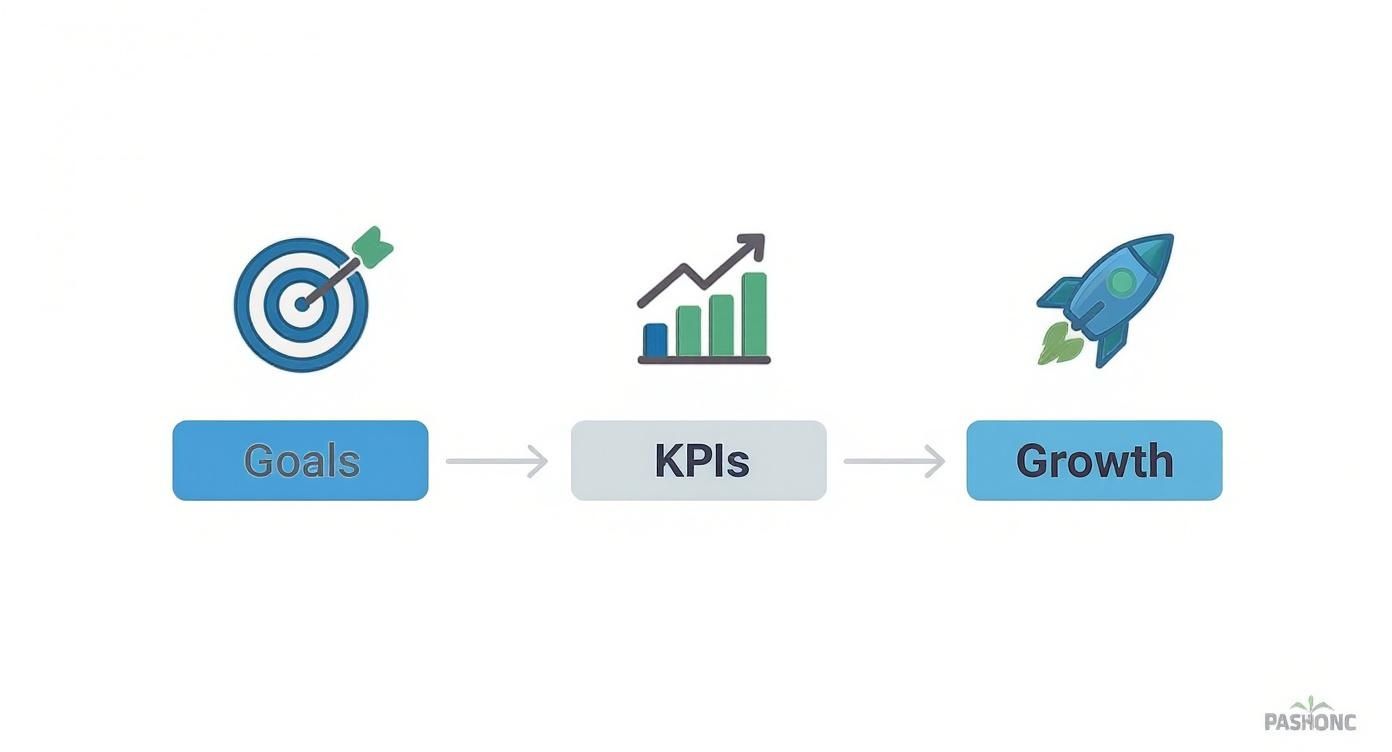
Growth doesn't just happen by accident. It's the direct result of a strategic plan that begins with clear, well-defined objectives.
This structured approach is what separates the high-performers from everyone else. The difference is stark: research shows 80% of the most successful companies have a documented content strategy, while only 52% of unsuccessful ones do. That 28-point gap says it all. A written plan is your roadmap to consistent results.
A content strategy without clear business goals is like a ship without a rudder. You’ll be busy, for sure, but you won’t be making any real progress. Every piece of content has to earn its keep by contributing to a measurable outcome.
To help you make this connection, here’s a quick table that shows how different business objectives can be mapped to specific content KPIs.
Mapping Business Objectives to Content KPIs
This table connects high-level business goals with specific, trackable content marketing metrics.
| Business Objective | Relevant Content KPI | Example Metric |
|---|---|---|
| Increase Brand Awareness | Organic Traffic & Search Rankings | 25% increase in non-branded organic traffic quarter-over-quarter |
| Generate More Leads | Conversion Rate & MQLs | 150 MQLs from gated content downloads per month |
| Improve Customer Retention | Engagement & Product Adoption | 10% decrease in customer support tickets related to a specific feature |
| Enable the Sales Team | Asset Usage & Influence | 50% of late-stage deals engaged with a specific case study |
| Build Thought Leadership | Share of Voice & Mentions | Increase in unlinked brand mentions on social media by 20% |
Using a framework like this helps ensure every ounce of effort is directed toward a meaningful goal.
Getting Stakeholder Buy-In
Setting clear goals does more than just guide your work—it’s also your secret weapon for getting buy-in from leadership.
When you can walk into a meeting and show exactly how your content is contributing to the bottom line, it’s a game-changer. Whether you’re driving leads, helping sales close deals, or keeping customers happy, the conversation shifts. You're no longer just "making content"; you're running a program that's expected to deliver a tangible return on investment.
This foundational step ensures your team gets the budget and support it needs to succeed. As you start this process, a solid guide on digital content strategy can give you a valuable framework to build upon.
Uncovering Your Audience's Real Needs
Great content doesn't just talk at people; it speaks directly to a specific person. If you want your content strategy to actually move the needle, you have to get past surface-level demographics and truly understand what makes your ideal customers tick. What are their biggest headaches? What gets them excited? This is where you build the empathy that powers every single piece of content you create.

The best place to start is by listening. Your current customers are a goldmine, and they can give you the exact language and pain points you need to reflect back in your marketing.
From Vague Ideas to Detailed Personas
A buyer persona isn't just a slide in a marketing deck. It’s a living, breathing profile of your ideal customer, pieced together from real data and actual conversations. The goal is to create a character so clear that your whole team feels like they know them.
To get there, you’ll need a mix of qualitative and quantitative insights.
- Customer Interviews: Seriously, just talk to your best customers. Ask them open-ended questions like, "Walk me through the day you realized you needed a solution like ours," or "What was the biggest challenge you were dealing with before you found us?"
- Sales Team Feedback: Your sales reps are on the front lines every single day. They know the objections, the frequently asked questions, and the real-world frustrations your prospects face. Make it a habit to regularly sync up with them.
- Analytics Deep Dive: Fire up Google Analytics. Look at the demographic data, see how users behave on your site, and identify which content is already getting traction.
Combining direct feedback with hard data is how you build a persona that’s based on reality, not just your team's assumptions. From there, you can dig even deeper by exploring what is audience segmentation to fine-tune your messaging for different groups within your target market.
Tapping Into Online Communities
Your audience is already out there talking about their problems—you just have to find them. Think forums like Reddit, professional LinkedIn or Facebook groups, and even product review sites. These places are treasure troves of candid conversation.
Spend some time just lurking in these digital hangouts. Pay close attention to:
- The exact phrases they use to describe their issues. This is pure keyword research gold.
- The other solutions they’ve tried that fell short. This insight helps you position your own offerings.
- The questions they’re asking each other. These are your next dozen blog post ideas, served up on a silver platter.
For instance, a company selling project management software might discover its audience in a Slack community for operations managers. They're not talking about "optimizing workflows"; they're complaining about "messy handoffs" and "zero visibility." Using their language is incredibly powerful.
A persona built on real-world language and documented frustrations is your most powerful strategic asset. It ensures you’re not just creating content, but creating answers to questions people are actively asking.
Analyzing Your Competitive Landscape
Once you have a solid grasp of your audience, it's time to see how your competitors are trying to reach them. A smart competitive analysis isn't about mimicking what everyone else is doing. It’s about finding the gaps they’ve left wide open for you.
Use an SEO tool to see what their top-performing content is. Look for topics where they rank, but the content itself is a bit thin, outdated, or just doesn't fully answer the question. That’s your opening.
Think of it this way: if your main competitor has a basic "10 Tips for Better Time Management" listicle, you have an opportunity to create the definitive guide. Pack it with downloadable templates, insights from experts, and maybe even a video tutorial. You’re not just entering the conversation—you’re elevating it and positioning your brand as the go-to authority. This is how you focus your content efforts where you can actually win.
Auditing Your Content to Find Hidden Opportunities
Before you jump into creating a single new piece of content, take a hard look at what you already have. Your existing library of blog posts, videos, and guides is often a goldmine of untapped potential. A strategic content audit isn't about tidying up; it's about a deep analysis to see what’s working, what’s not, and where the real opportunities lie.
Think of it as taking inventory of your digital assets. You're about to evaluate everything you've ever published to understand its current value and future potential. This isn't just a trip down memory lane—it's a data-driven exercise that will give you a much smarter path forward.

Starting Your Content Inventory
First things first: you need to get everything in one place. Your starting point is a comprehensive spreadsheet where you'll log every single content URL. Yes, it can be a bit tedious, but this list is the absolute foundation for a successful audit.
In that spreadsheet, you'll want to create columns for the key data points that tell the story of each piece of content. These metrics are what turn guesswork into an objective, strategic plan.
At a minimum, your inventory should track:
- Content URL: The direct link to the piece.
- Content Title: The headline of the post, video, or guide.
- Content Type: Is it a blog post, case study, video, or webinar?
- Publication Date: When it first went live.
- Key Metrics: Pull data like page views, time on page, bounce rate, and any relevant conversions from the last 6-12 months.
Once you have this initial data, you’ll have a bird's-eye view of your entire content world. Now, the real fun begins—digging in to find those hidden gems.
Sorting Your Content for Action
With your inventory complete, it's time for analysis. The goal here is to sort every single piece of content into a specific bucket based on its performance and current relevance. This is more nuanced than just "good" or "bad"; it's about figuring out the right next step for each asset.
A simple and incredibly effective framework is to use four main categories.
- Keep: These are your all-stars. They pull in consistent traffic, keep readers engaged, and align perfectly with your business goals. Leave them be.
- Update/Refresh: This is solid content that just needs a little love. Maybe it's a popular post with outdated stats or a guide that’s missing a few recent industry trends. These are your low-hanging fruit for a quick performance boost.
- Consolidate/Repurpose: Do you have three or four posts that all tackle the same topic from a slightly different angle? Combining them into one massive, definitive guide can be a huge win for SEO and create a much better user experience.
- Remove/Prune: Let's be honest—some content just doesn't work. It might be totally irrelevant now, low-quality, or getting zero traffic. Getting rid of this dead weight can actually help your site’s overall SEO by focusing your authority on your best work.
Don't be afraid to prune underperforming content. A smaller library of high-quality, relevant assets is far more valuable than a sprawling collection of outdated or low-impact pieces. Quality always trumps quantity.
Identifying and Filling the Gaps
An audit isn't just about what you have; it’s also the perfect time to find out what you’re missing. This is where you need to perform a thorough SEO content gap analysis. This process is all about looking at the keywords your competitors rank for that you don't, which instantly shows you topics your audience is searching for that you haven't even touched.
This analysis moves you beyond just reacting to old content and helps you proactively plan for the future. By spotting these gaps, you can build a content roadmap that directly answers your audience's questions and starts capturing valuable search traffic that's currently going to your competitors.
Finding Your Voice: Your Core Message and Content Pillars
Now that you have a solid grasp of your business goals and who you're talking to, we get to the fun part: deciding what you're actually going to talk about. This is where you pivot from research to creation. It’s about carving out your unique point of view in a crowded space.
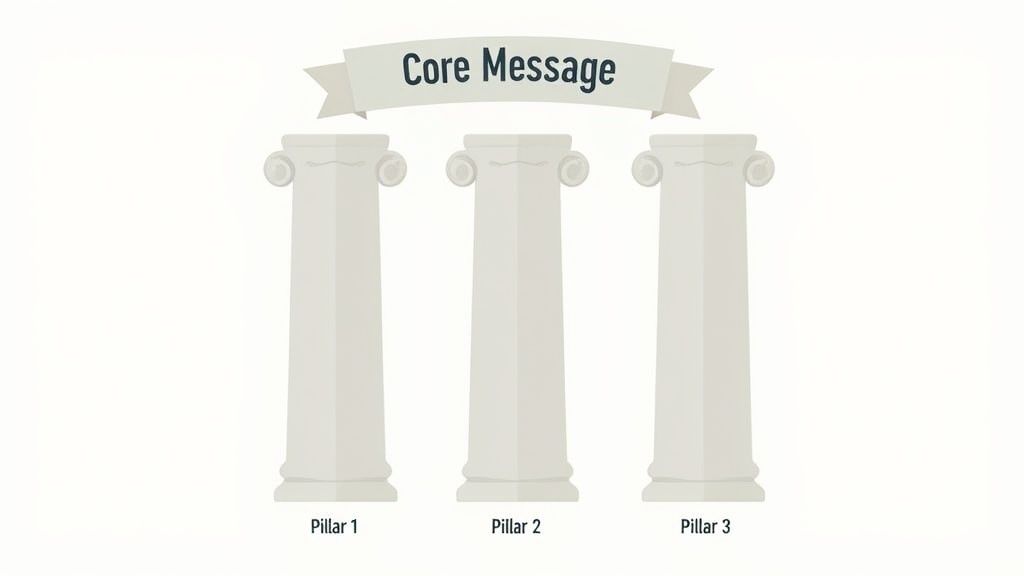
This starts with your core message. It’s not a tagline or a slogan. Think of it as the central promise you make to your audience—the consistent value and perspective they can expect from you, no matter the format.
From that core message, we’ll build out your content pillars. These are the 3-5 major themes your brand will be known for. They act like the main support beams for your entire content strategy, making sure everything you publish is cohesive and reinforces your expertise.
Defining Your Unique Angle
Your core message answers the simple but powerful question: "Why should anyone listen to us?" It’s the blend of your unique expertise, your brand's personality, and how you solve problems in a way no one else does. A great core message feels authentic to you and genuinely useful to your audience.
For instance, a company selling project management software for creative agencies isn't just selling software. Their core message might be: "We help creatives kill the chaos and get back to doing the work they love." See how that's specific? It's focused on the audience and immediately sets the stage for what kind of content they'll create.
Nailing this down is crucial. If you're struggling to articulate what makes you different, working through a complete brand messaging framework can give you a structured path to defining your unique value.
Your core message is your content’s North Star. It ensures that whether you’re creating a blog post, a video, or a social media update, you’re always reinforcing the same central promise to your audience.
Building Your Content Pillars
With your core message locked in, you can build your pillars. These aren't just random topics; they're the strategic subject areas that directly support your core message and intersect with what your audience is actually looking for. A good pillar is broad enough to spawn tons of ideas but specific enough to let you build real authority.
Here’s a practical way I like to approach this:
- Brainstorm Big Ideas: First, just get everything out. What are the major topics in your industry? What are the biggest headaches your customers complain about?
- Connect to Your Solution: Now, filter that list. Which of these topics create a natural bridge to the solution you provide? Discard the rest.
- Check for Demand: Don't guess. Use SEO tools like Ahrefs or Semrush to see if people are actually searching for these topics. A pillar is useless without an audience.
- Group and Refine: Look for themes. Start clustering similar ideas together until you have 3-5 distinct, powerful pillars that feel right for your brand.
Content Pillar Examples in Action
Let’s make this real. Imagine a B2B SaaS company selling workflow automation software specifically for marketing teams. Their core message is all about helping marketers save time and prove their value.
Based on that, their content pillars could look something like this:
| Pillar | Subtopic Examples | Target Audience Need |
|---|---|---|
| Marketing Automation Strategy | – How to Build Your First Workflow – Lead Nurturing Best Practices – Automating Social Media Reporting |
Needs clear, actionable guidance on setting up and optimizing automation. |
| Team Productivity & Efficiency | – The Best Tools for Remote Marketing Teams – How to Run Meetings That Don't Suck – Killing Manual Data Entry for Good |
Is constantly battling wasted time and clunky, inefficient processes. |
| Measuring Marketing ROI | – Building a Marketing Dashboard in Google Sheets – A Simple Guide to Tracking Campaign Performance – Tying Marketing Activities to Revenue |
Faces constant pressure to justify budgets and prove their work drives business growth. |
This structure is what turns a random list of blog ideas into a strategic content engine. Every piece you create—from a high-level guide on strategy to a quick "how-to" video—connects back to your core mission. You’re no longer just creating content; you’re building a library of resources that establishes authority and systematically guides your audience toward becoming a customer.
Choosing the Right Channels and Formats
Creating brilliant, insightful content is only half the battle. If that content doesn’t reach the right people, in the right place, at the right time, you might as well be shouting into the void. This is where you graduate from simply making content to strategically distributing it.
Forget the overwhelming advice to "be everywhere at once." Real success comes from making smart, deliberate choices about where you publish and what you post there. It's about meeting your audience on their terms with formats they already love. This targeted approach gives every piece of content the best possible chance to connect and drive action, instead of just adding to the digital noise.
Go Where Your Audience Lives
The first rule of content distribution is simple: don't make your audience come find you. Figure out where they already spend their time online and show up there. This is where all that persona research you did earlier really pays off.
Is your ideal customer a B2B professional? You’ll likely find them on LinkedIn or in niche industry forums. If you're targeting a younger, visually-driven audience, platforms like TikTok or Instagram are probably your best bet. The goal is to prioritize impact over volume. It’s far better to be a respected voice on two highly relevant channels than a forgotten whisper on ten irrelevant ones.
Your distribution plan can't be based on assumptions. Dig into your analytics, survey your customers, and lurk where the real conversations in your industry are happening. Let data, not the latest trend, dictate where you focus your energy.
Once you’ve nailed down your primary channels, you can start thinking about what kind of content to create for each one.
Matching Formats to the Buyer's Journey
Not all content is created equal. A blog post serves a different purpose than a case study, and a TikTok video won't work the same way as an in-depth webinar. A powerful content strategy delivers the right format at the right stage, gently guiding people from "who are you?" to "take my money."
Think about how different formats align with where a potential customer is on their journey:
-
Awareness Stage (Top of the Funnel): People here have a problem, but they might not have a name for it yet. They're looking for answers and education, not a sales pitch. Your job is to be helpful.
- Formats: Blog posts, infographics, short social videos, checklists.
- Example: A software company could publish a blog post titled, "5 Telltale Signs Your Team's Project Management Is Broken."
-
Consideration Stage (Middle of the Funnel): Now, they're actively researching solutions. They need more substantial content that helps them evaluate their options and shows why you're a credible choice.
- Formats: In-depth guides, case studies, webinars, product comparison sheets.
- Example: The same company could host a webinar on "How to Choose the Right PM Software for Your Agency."
-
Decision Stage (Bottom of the Funnel): They're ready to buy. The content here needs to remove any final doubts and make it incredibly easy for them to choose you.
- Formats: Free trials, demos, detailed pricing pages, customer testimonials.
- Example: Offering a personalized one-on-one demo or a compelling case study from a very similar company.
The Undeniable Power of Video
Let’s be clear: no modern content strategy is complete without video. The data is overwhelming. Video has shifted from a "nice-to-have" to an absolute must-have for engaging, educating, and building a real human connection.
This doesn't mean you need a Hollywood-level production budget. Some of the most effective videos prioritize authenticity over polish. By 2025, it's estimated that 89% of businesses will use video as a marketing tool, with 95% of marketers saying it’s a critical part of their strategy. The top priorities for video creators are social videos (77%), branded stories (61%), and how-to videos (59%). You can dig into more content marketing statistics to see the full picture.
Getting started can be as simple as pulling out your smartphone and recording:
- Quick "how-to" tutorials that answer common customer questions.
- Behind-the-scenes glimpses of your company culture.
- Short, impactful customer testimonials.
By choosing your channels wisely and tailoring your formats to your audience's journey, you build a distribution plan that works smarter, not harder. This strategic approach is what ensures your valuable content actually gets seen, consumed, and drives the results your business needs.
6. Creating a Sustainable Production and Measurement System
A brilliant strategy is just a document until you build the operational engine to bring it to life. This is where ideas on paper become consistent, high-quality published content. It's about creating a sustainable process that turns your content pillars and audience insights into a reliable growth driver, not a chaotic scramble to hit deadlines.
This system really boils down to two things. First, you need a production workflow that keeps your team aligned and efficient. Second, you need a straightforward measurement framework that proves your efforts are actually working and shows you where to double down.
Building Your Content Calendar
The foundation of any good production system is the content calendar. This is so much more than a simple schedule; it's your single source of truth for what’s being created, who's responsible for it, and when it’s going live. A well-structured calendar is your best defense against last-minute panic and ensures a steady, reliable stream of content.
Don't overcomplicate this. A shared spreadsheet or a simple project management board in a tool like Trello or Asana works perfectly. What truly matters is that it tracks the essential details for each piece of content.
At a minimum, your calendar should include:
- Topic/Headline: The working title of the content piece.
- Content Owner: The single person responsible for getting it over the finish line.
- Target Persona: Which of your audience segments is this for?
- Content Pillar: Which strategic theme does it support?
- Format: Is it a blog post, video, case study, or something else?
- Key Dates: Hard deadlines for the draft, final review, and the all-important publication date.
For a deeper dive into organizing your publishing schedule, check out this guide on what is a content calendar. It’s packed with templates and solid practices to get you started.
Establishing a Realistic Production Workflow
With your calendar in place, the next step is to map out the actual production process. This workflow outlines every stage a piece of content moves through, from a rough idea to a published asset. Documenting this clears up any confusion about roles and sets firm expectations for everyone involved.
A typical workflow might look something like this:
- Ideation & Briefing: The content owner creates a detailed brief outlining the goal, target audience, and key talking points.
- Drafting: The writer or creator gets to work on the first version.
- Review & Editing: An editor or a subject matter expert reviews the draft for accuracy, tone, and clarity. This is a critical quality-control step.
- Design & Formatting: The piece is prepped for its final channel, which might mean adding images, creating social graphics, or embedding video elements.
- Final Approval: The content owner gives the final sign-off before scheduling.
- Publishing & Promotion: The content goes live, and the distribution plan kicks into gear.
Defining these stages eliminates the "What's next?" chaos and creates a predictable rhythm for your team.
A documented workflow is the secret to scaling your content production without quality falling off a cliff. It turns a creative process into a repeatable system that anyone on the team can follow.
Measuring What Truly Matters
Finally, your system must connect back to those business goals you set way back at the beginning. A content strategy without measurement is just guesswork. You have to track the right metrics to understand what's connecting with your audience, what's falling flat, and how to intelligently adjust your approach.
Instead of getting lost in a sea of data, focus on a handful of Key Performance Indicators (KPIs) that directly tie back to your initial goals.
- For Brand Awareness: Track organic traffic and keyword rankings. Are more people finding you through search engines month over month?
- For Lead Generation: Monitor conversion rates on your gated content and the number of Marketing Qualified Leads (MQLs) your content generates.
- For Audience Engagement: Look at metrics like time on page, comments, and social shares. Are people actually sticking around and interacting with what you publish?
Create a simple monthly dashboard to track these core KPIs. This doesn't have to be some complex beast; a basic spreadsheet that pulls data from Google Analytics and your other marketing tools is often more than enough. This regular review cycle is what ensures your strategy remains a living document, constantly evolving to drive better and more predictable results.
Common Questions About Content Strategy
Even with the most detailed framework, a few questions always pop up once you start putting a content strategy into action. Let's tackle some of the most common ones I hear from marketing teams.
Content Strategy vs. Content Plan: What’s the Difference?
This one trips people up all the time. Think of it this way: your content strategy is the high-level vision—the "why" behind everything you create. It defines your goals, your audience, and your core message.
Your content plan, on the other hand, is the tactical roadmap. It's the "how, what, and when." This is your editorial calendar, your topic clusters, your production schedule—the day-to-day operations that bring the strategy to life. You can't have an effective plan without a solid strategy guiding it.
How Long Does It Take to See Results?
This is the million-dollar question, isn't it? Everyone wants results yesterday, but great content marketing is a long game, not a quick fix.
While you might see some early engagement, it typically takes a good 6 to 9 months of consistent effort to see significant, measurable ROI from a new content strategy. This is especially true if you're aiming for organic search rankings. Patience and persistence are your greatest assets here.
How Often Should I Update My Strategy?
A content strategy isn't a "set it and forget it" document. The market changes, your audience evolves, and your business goals shift.
I recommend a light review every quarter to see what's working and what isn't. Are certain content pillars outperforming others? Do you need to adjust your channel mix?
Then, plan for a deep-dive, comprehensive overhaul once a year. This is your chance to reassess everything from the ground up to ensure your content is still perfectly aligned with your bigger business objectives.
Building a powerful content strategy is a complex job, but you don't have to figure it all out alone. ReachLabs.ai blends top-tier creative talent with data-driven insights to build digital strategies that deliver real growth. Learn how we can elevate your brand’s voice.