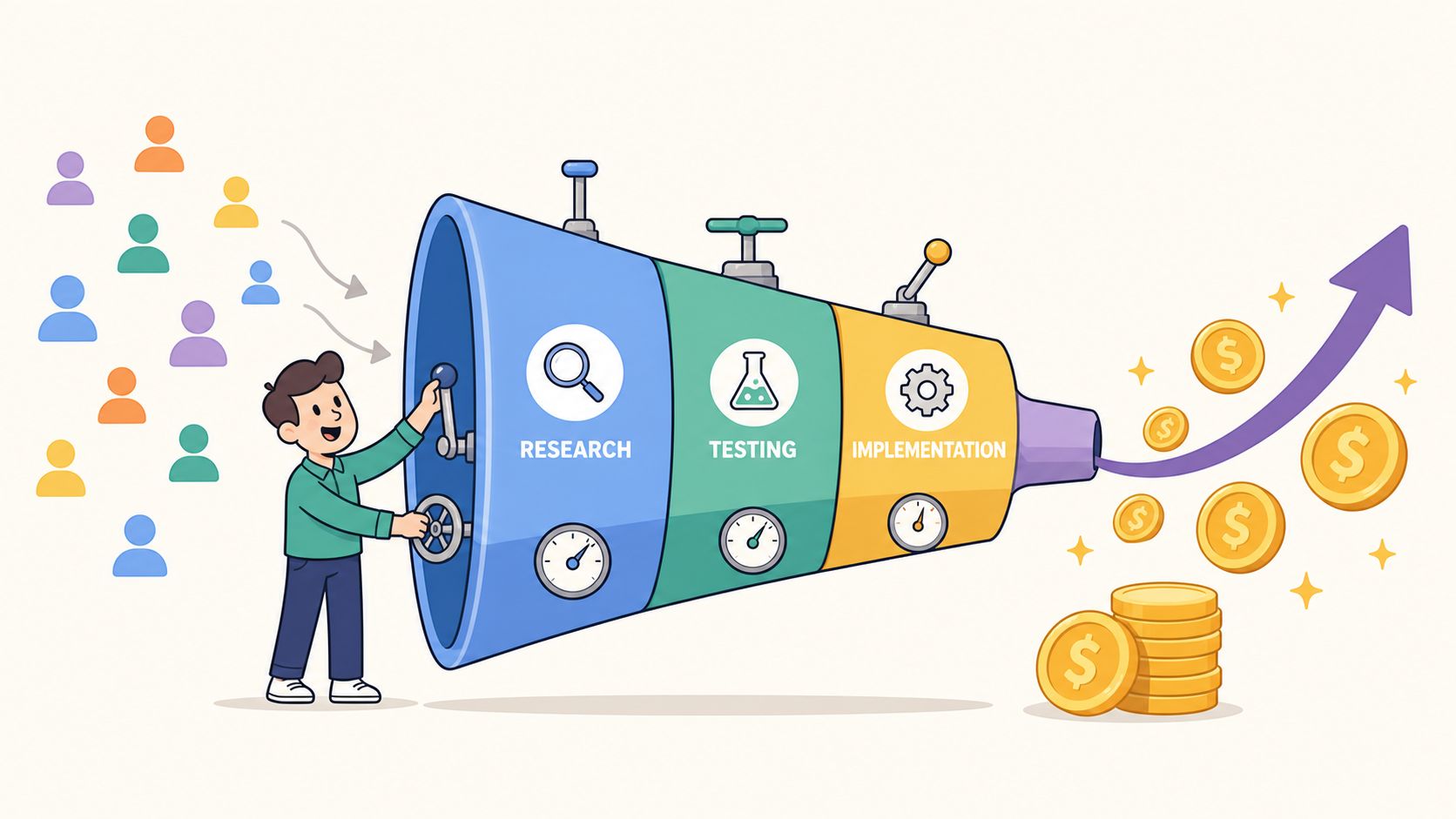
Conversion optimization is the systematic process of increasing the percentage of website visitors who take a desired action, and for most sites that starts from a low baseline of about 2.35% to 2.9%. In plain terms, only 2 to 3 out of every 100 visitors usually convert, which is why improving how your site turns traffic into leads or sales has such a direct effect on growth.
If you're reading this, there's a good chance your traffic problem isn't really a traffic problem. You may already have people arriving from SEO, paid ads, email, or social, but the numbers still feel underwhelming once they hit the site. More sessions don't automatically create more revenue. Better conversion paths do.
A lot of beginner explanations of CRO make it sound like button-color testing and headline tweaks. Those things can matter, but they aren't the foundation. Real conversion optimization starts earlier, with the quality and intent of the traffic you attract, and it continues deeper into the journey by tracking the smaller actions that signal progress before a final purchase or lead submission happens.
That broader view is what makes CRO useful for an actual business. It helps you turn existing demand into measurable outcomes without treating every growth problem as an acquisition problem.
What Is Conversion Optimization Anyway
The question usually comes up when a business has already done the obvious work. Paid campaigns are live, SEO is bringing in visits, email is getting clicks, and the pipeline still feels thinner than it should. At that point, conversion optimization stops being a marketing buzzword and becomes an operating issue.
Conversion optimization, or CRO, is the practice of increasing the percentage of visitors who take a defined action, whether that action is a purchase, demo request, form submission, trial signup, phone call, or email subscription. The calculation is straightforward: (Total Conversions / Total Visitors) × 100, as outlined in Matomo's conversion rate optimisation statistics.
The bigger point is what that percentage represents. A conversion rate is not just a website metric. It reflects how well your acquisition, messaging, page experience, offer, and follow-up process work together. Strong CRO work improves that entire system, because a weak handoff anywhere in the journey can suppress results long before a visitor reaches the final form or checkout.
Average sites convert far below top performers, as noted earlier. That gap usually comes from execution, not luck. Teams that convert better tend to attract the right traffic, set the right expectation before the click, reduce friction during evaluation, and measure smaller intent signals before the primary conversion happens.
CRO starts before the landing page
A practical conversion optimization guide can help explain page-level friction, and that is useful. But page edits alone rarely fix the whole problem.
The visitor arrives with context. A keyword signals intent. An ad makes a promise. An email frames the offer. A retargeting click suggests a different level of awareness than a branded search. If those inputs are misaligned, the page inherits a problem it did not create. That is why I treat CRO as journey design, not just on-page testing.
It also helps to map the full conversion funnel, because final conversions are often too sparse to diagnose in isolation.
The teams that make steady gains track micro-conversions such as pricing-page visits, form starts, demo-page engagement, cart additions, and return sessions from high-intent channels. Those actions do not replace revenue metrics. They help explain how prospects progress toward revenue, where momentum stalls, and whether the traffic being bought or earned is qualified.
Done well, conversion optimization shows where demand is leaking, which traffic sources deserve more budget, and which journey fixes are likely to produce measurable business impact.
Why CRO Is Your Biggest Growth Lever
Most growth teams react to missed targets by pushing harder on acquisition. They increase ad spend, publish more content, or expand channel coverage. Sometimes that's necessary. Often it isn't the first fix.

CRO is usually the better first lever because it improves the value of traffic you already paid to attract. Think of acquisition as increasing water pressure and CRO as widening the pipes. If the system is narrow, leaky, or misrouted, sending more volume through it just wastes more budget.
The pre-conversion friction most teams miss
Often, basic CRO advice falls short because a surprising amount of conversion loss happens before the visitor even lands on the page. EmberTribe notes that 64% of failed conversions stem from misaligned acquisition channels rather than landing page flaws, which is why source-to-page continuity matters so much in practice. The same source also points out that companies often spend only $1 on conversion optimization for every $92 spent on customer acquisition, despite the upside of improving conversion efficiency through a stronger post-click journey and intent alignment in their conversion optimization analysis.
If someone clicks an ad promising pricing clarity and lands on a page full of vague brand language, that isn't a page-design issue alone. It's a message match issue. If a blog post attracts informational traffic but routes those visitors straight into a hard demo ask, that's a journey design issue.
This is also why CRO and customer acquisition cost are tightly connected. Teams trying to reduce customer acquisition costs often focus on media efficiency, but they should also ask whether the post-click experience is wasting qualified visits that were already expensive to win.
Why CRO creates better decisions, not just better pages
A mature CRO program does more than raise conversion rates. It gives your team a clearer read on buyer intent.
You learn which channels bring high-fit visitors, which pages create hesitation, and which objections keep repeating. Those insights improve paid media, SEO targeting, sales enablement, email nurture, and even product positioning. CRO becomes a feedback system for the whole customer journey.
Practical rule: If your traffic source, page promise, and CTA don't align, page-level testing won't rescue performance.
This is why CRO is such a strong growth lever. It doesn't just increase outcomes from existing traffic. It forces the business to remove friction between intent and action.
The CRO Process A Systematic Approach to Growth
A prospect clicks a high-intent search ad, scans your pricing page, opens the form, then disappears. The page may still be part of the problem, but the process starts earlier. Was the traffic qualified? Did the ad promise something the page did not confirm? Did the visitor hit a meaningful micro-conversion that signals interest before the final ask? A good CRO process answers those questions in order, so growth comes from a better journey, not a string of isolated page edits.

Research and discovery
Start by defining the journey you want to improve. That includes the traffic source, the first page experience, the micro-conversions that show intent building, and the final business outcome. If you skip that mapping step, teams often optimize a page for visitors who were never likely to buy in the first place.
Build a baseline from recent data and segment it by source, device, audience, and landing page. Aggregate conversion rate hides too much. Paid social traffic may bounce because the offer is too early. Branded search may convert well because intent is already high. Mobile visitors may engage with product content but abandon long forms. Those are different problems, and they need different fixes.
Use three inputs together:
- Analytics platforms: Google Analytics 4 shows entry points, pathing, assisted conversions, and drop-off points.
- Behavior tools: Heatmaps, scroll maps, and session recordings show where visitors stall, rage click, or miss the next step.
- Qualitative input: Sales notes, support conversations, chat transcripts, and survey responses explain the hesitation behind the behavior.
For larger research sets, teams sometimes use tools built for document analysis for research to review call transcripts, survey exports, and customer feedback faster. The point is not speed alone. It is getting from raw evidence to a clear pattern without relying on opinion.
Hypothesis and experiment design
Once the pattern is clear, turn it into a hypothesis tied to a business outcome.
A useful hypothesis has three parts:
- Observed issue: Visitors from comparison-keyword campaigns reach the pricing page, engage with pricing tabs, but do not start the demo form.
- Proposed change: Tighten message match, answer the likely objection earlier, and reduce the commitment of the first CTA.
- Expected outcome: More qualified visitors take the next step, and sales receives leads that still match pipeline targets.
That last part matters. Higher conversion volume is not enough if lead quality drops. I usually push clients to state the downstream trade-off before a test goes live, especially in B2B funnels where a weak lead can look like a win in marketing reporting and a loss in sales reporting.
A quick distinction helps:
| Test type | Best use | Example |
|---|---|---|
| A/B test | Compare one meaningful change against a control | Current headline vs revised headline |
| Multivariate test | Evaluate combinations of multiple elements | Headline plus CTA copy plus hero image |
| Split URL test | Compare substantially different page versions | Existing landing page vs redesigned page on a separate URL |
Here's a useful walkthrough of that mindset in action:
Analyze, implement, and document
Analysis starts before you declare a winner. Check whether the lift happened in the right audience, whether micro-conversions improved before the macro-conversion moved, and whether the result held across device and channel segments. A variant that increases form fills from low-intent traffic can create more work without creating more revenue.
Document every test with enough detail that another strategist could use it six months later:
- The page or flow tested
- The traffic segment
- The hypothesis
- The primary conversion metric
- Supporting micro-conversions
- The result, including losing variants and side effects
Losing tests still have value. If a shorter form raises starts but lowers completion quality, that changes how you design the next experiment. If a softer CTA improves engagement for cold traffic but weakens demo intent for bottom-funnel visitors, that is not a failed test. It is a signal that the journey needs different experiences for different intent levels.
After rollout, keep watching the downstream numbers. At ReachLabs.ai, this is usually where the real lesson shows up. A lift on-page only counts if it improves pipeline, revenue, or sales efficiency after the handoff.
Core Metrics That Actually Move the Needle
A campaign brings in plenty of clicks, but sales stays flat. In most cases, the problem is not button color or headline length. It is a measurement problem. The team is watching surface activity instead of tracking whether qualified visitors are progressing through the journey in a way that leads to revenue.

Macro conversions and micro conversions
Macro-conversions are the business outcomes that justify the spend. That usually means a purchase, demo request, qualified lead, booked consultation, or signed proposal.
Micro-conversions are the signals that a visitor is moving closer to that outcome. Product page views, pricing interactions, form starts, return visits, video plays, and visits to high-intent pages all fit here.
The distinction matters because conversion optimization starts before the final action. If paid traffic is poorly matched to the offer, the form completion rate will look weak no matter how polished the page is. If high-intent visitors engage with the right steps but drop before submission, the issue is likely friction in the flow. Micro-conversions help separate traffic quality problems from page experience problems, which is what makes them useful.
A content-led business, for example, may never get a direct purchase from a first visit. But if the right audience reaches comparison pages, subscribes, returns, and eventually requests a demo, those earlier actions deserve attention because they explain how growth happens.
What to track in practice
A strong CRO scorecard ties business outcomes to the steps that create them. That means tracking final conversion metrics, but also the pre-conversion signals that show whether acquisition and on-site experience are aligned.
This typically includes:
- Conversion rate: The percentage of visitors who complete the primary action.
- Revenue per visitor: A cleaner measure of business impact than conversion rate alone.
- Lead quality rate: The share of leads that become qualified pipeline, not just raw form fills.
- Form starts and form completions: Useful for spotting friction between interest and action.
- CTA clicks, pricing interactions, and key page progression: Strong indicators of buying intent when mapped to the funnel.
- Channel-to-conversion performance: A way to see whether the right traffic sources are feeding the journey.
- Customer acquisition cost by segment: Helpful for judging whether a lift is profitable, not just visible in analytics.
The trade-off is focus. Tracking everything creates noise. Tracking only final conversions hides the cause of underperformance.
Choose a small set of micro-conversions that reflect real intent, then confirm that those actions correlate with downstream results. A whitepaper download may matter for one funnel and mean almost nothing in another. A pricing-page visit from branded search traffic may be far more predictive than a scroll-depth event from broad social traffic.
If your team is sorting through user interviews, call transcripts, support notes, or qualitative feedback to decide which metrics deserve attention, a tool for document analysis for research can help organize that input into clearer test themes. For teams building that scorecard, these conversion optimization tips for auditing funnel friction can help connect engagement signals to revenue-focused decisions.
Micro-conversions matter when they represent progress in the buying journey, not when they simply make a dashboard look busy.
That is the standard to use. Measure what shows intent, qualifies traffic, and predicts revenue. Everything else is secondary.
Practical CRO Tactics You Can Implement Today
A common CRO scenario looks like this. Paid traffic is arriving, the landing page looks polished, and conversions still lag. In that situation, changing button colors is rarely the answer. The underlying issue is usually a mismatch between the visitor's intent, the promise that brought them in, and the amount of confidence the page builds before asking for action.
The tactics below work because they address friction across that full decision path. They help qualify the click before it lands, clarify the next step on the page, and remove hesitation at the moment of conversion.
Simplify the decision path
Pages convert better when the next step is obvious. If a campaign page asks visitors to compare three offers, explore the navigation, read a long product story, and book a demo, attention gets split. Conversion rates usually fall because the page is forcing the buyer to make too many decisions at once.
Analysts at ElectroIQ found that simpler landing page structures, video content, and customer reviews are all associated with stronger conversion performance in its roundup of conversion rate optimization statistics. The takeaway is practical. Clarity and confidence beat volume.
In practice, that usually means:
- One dominant CTA: Make the primary action visually clear and specific.
- Reduced navigation: Remove off-path exits on pages built for a single campaign goal.
- Tighter copy hierarchy: Start with the value proposition, support it with proof, then ask for the next step.
If you need a working checklist, these conversion optimization tips for auditing high-intent pages are a solid starting point.
Match the page to the traffic source
Many introductory CRO guides stop prematurely in the journey. A landing page cannot fix low-intent traffic on its own.
If someone clicks from a high-comparison search query, they need proof and differentiation fast. If they arrive from branded search or a retargeting ad, they are often ready for pricing, implementation details, or a direct demo ask. Sending both groups to the same experience creates unnecessary friction and muddies your test results.
Start by aligning message, offer, and CTA to the source:
- Cold paid social traffic: Use lower-commitment offers, stronger education, and clearer problem framing.
- High-intent search traffic: Get to use cases, pricing context, trust, and action faster.
- Retargeting traffic: Remove repetition and address the objections that kept them from converting the first time.
This is one of the most impactful fixes because it improves both conversion rate and lead quality. More form fills do not help the business if sales gets a pipeline full of poor-fit leads.
Add explanation where buyers hesitate
Some offers need more explanation before a visitor will act. That is especially true for unfamiliar products, technical services, and higher-ticket B2B decisions.
Use demonstration content where uncertainty is slowing the sale. A short product walkthrough, annotated screenshot sequence, implementation summary, or pricing explainer can do more than another paragraph of polished copy. The format matters less than the job it does. It should answer the question that is blocking the next step.
I usually see this work best in three places:
- Above the fold: Show what the product or service does.
- Near forms or demo CTAs: Explain what happens after submission.
- On pricing or service pages: Reduce fear around cost, setup, or commitment.
Strengthen trust at the moment of action
Trust signals help when they appear where hesitation is highest. A testimonial buried below the fold has less value than proof placed next to a form, price, or checkout step.
Use proof that matches the buying risk. For lead generation, that might be client logos, a short testimonial, or a privacy reassurance near the submit button. For ecommerce, it may be reviews, shipping clarity, return terms, and payment security indicators. For B2B services, case-study snippets and outcome-focused quotes often outperform generic praise.
Good trust elements do one of two things. They reduce perceived risk or confirm that people like the visitor have succeeded with the offer.
Improve mobile and technical experience
Technical friction distorts every CRO test. A strong headline cannot overcome a slow mobile page, a broken form, or a CTA that is hard to tap.
Review speed, layout spacing, form inputs, autofill behavior, and button placement together. Then check the full path, not just the landing page. If ad traffic arrives on mobile but the calendar embed fails on smaller screens, the conversion problem is broader than page copy.
Fix obvious UX blockers first. Then test messaging and layout changes on top of a stable experience. That sequence produces cleaner results and prevents teams from attributing wins or losses to the wrong variable.
Prioritization Frameworks And Common Pitfalls
After grasping the basics of CRO, many teams struggle with prioritization. The two failure modes are predictable. They either run scattered tests that muddy the signal, or they stay stuck in planning because every idea feels important.
Good prioritization fixes both. It helps teams put effort behind changes that can improve revenue, lead quality, or sales efficiency, not just lift a page-level conversion rate that looks good in a report.
Two frameworks that keep teams focused
Use a simple scoring model that balances upside with execution reality.
| Framework | Component 1 | Component 2 | Component 3 | Formula |
|---|---|---|---|---|
| PIE | Potential | Importance | Ease | Prioritize ideas with the strongest mix of upside, page significance, and implementation simplicity |
| ICE | Impact | Confidence | Effort | Prioritize ideas with high expected effect, high confidence, and manageable effort |
PIE is useful when comparing page-level opportunities. ICE is better for ranking hypotheses in a testing backlog, especially when ideas span landing pages, forms, email follow-up, and sales handoff.
That broader view matters. CRO does not begin and end on the page. If paid traffic arrives with weak intent, or if high-intent visitors disappear because no one tracks form starts, pricing-page visits, or demo-scheduler opens, the team can prioritize the wrong fix. Strong programs score ideas across the full journey, from traffic source and message match to micro-conversions and final conversion.
A common example makes the trade-off clear. A homepage messaging test may affect a large audience, but it often needs design, brand, and leadership input, which slows execution and muddies ownership. A shorter lead form on a high-intent page may look less strategic, yet it can be faster to ship, easier to measure, and closer to pipeline impact. In many cases, the second test belongs first.
Teams that need a more structured process often use conversion rate optimization services when internal backlog scoring breaks down across channels or departments.
Common pitfalls that waste time
Some mistakes do more than slow progress. They lead teams toward the wrong conclusions.
- Testing low-traffic pages first: Limited volume means longer test timelines and weaker confidence in the result.
- Calling tests too early: Early movement often reflects noise, not a reliable pattern.
- Ignoring pre-conversion quality: A landing page can underperform because the traffic is poorly matched, not because the headline is weak.
- Skipping micro-conversions: If you only measure the final submit or purchase, you miss where intent builds, stalls, or drops off.
- Copying competitors: Their audience, offer structure, sales cycle, and traffic mix may be completely different.
- Using blended averages: One sitewide conversion rate can hide major differences by source, device, funnel stage, or visitor intent.
The best first test is usually the one tied to a clear bottleneck in a high-value journey, with enough volume to learn quickly and enough business relevance to matter if it wins.
One final filter helps. Ask what happens if the test succeeds. Does it improve qualified leads, sales conversations, average order value, or another business outcome the team cares about? If the answer is vague, the idea probably belongs lower in the queue.
Conclusion Your CRO Next Steps Checklist
Conversion optimization isn't a one-time redesign project. It's a repeatable way to find friction, improve how qualified visitors move through your journey, and increase the return on traffic you already have.
The biggest mindset shift is this: don't define CRO too narrowly. It isn't just about buttons, forms, or isolated landing pages. It starts with traffic quality and message continuity, then gets stronger when you track the micro-conversions that show whether intent is building or stalling.

Your first week of CRO
- Define one macro-conversion. Pick the primary action that matters most right now, such as a purchase, booked call, or qualified form submission.
- Choose three micro-conversions. Track actions that signal movement toward that macro goal, like pricing-page clicks, video plays, or form starts.
- Audit one high-traffic page. Review analytics, page experience, and message match from the traffic source to the landing page.
- Collect customer language. Pull objections and recurring questions from sales calls, support conversations, or on-site feedback.
- Write your first hypothesis. Keep it simple, specific, and tied to a measurable outcome.
- Create a testing cadence. Decide who owns research, who approves changes, and how results will be documented.
If you need outside support to operationalize that process, conversion rate optimization services can provide structured help with behavior analysis, research, experiment design, UX and copy changes, and measurement.
Start small, but start systematically. The companies that improve conversion performance over time aren't the ones with the most ideas. They're the ones that keep learning from real user behavior and keep refining the journey.
If you want help turning traffic, user behavior, and funnel data into a practical CRO program, ReachLabs.ai can support the full process from research and prioritization through testing and implementation.