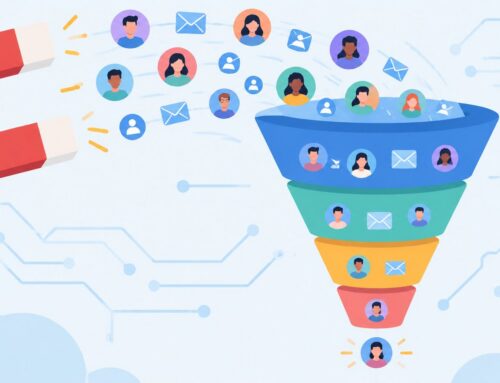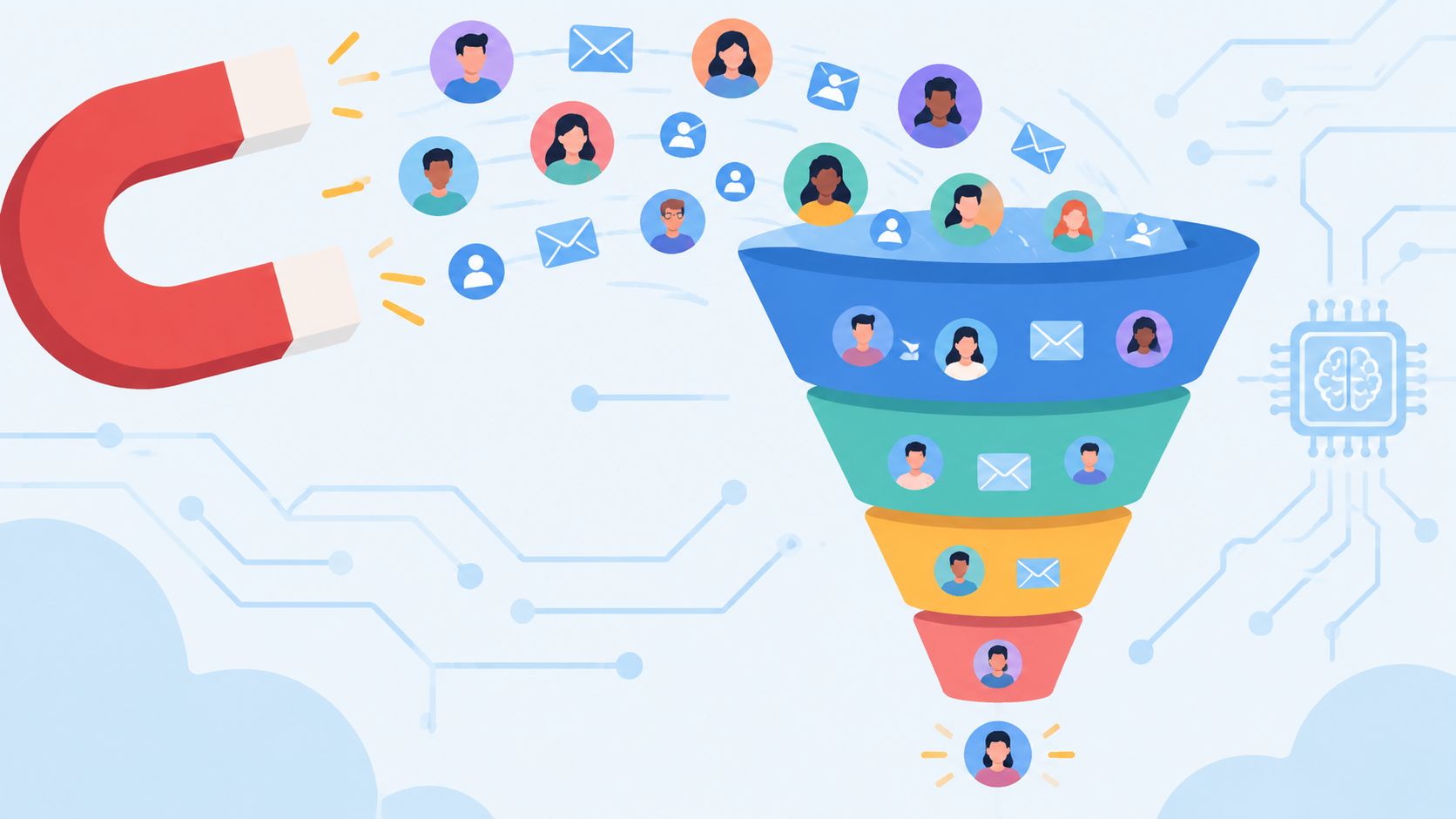
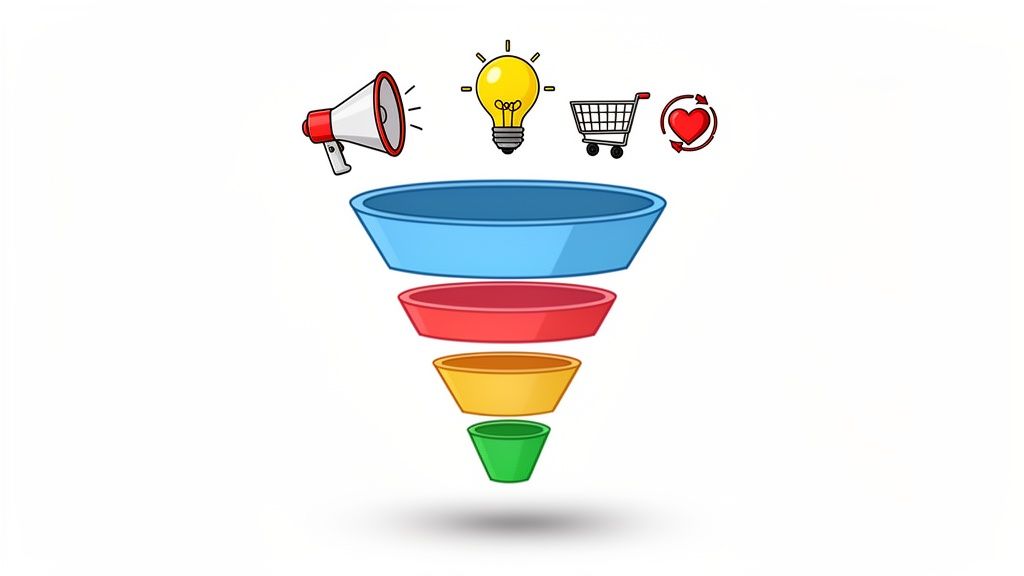
A conversion funnel is really just a way to visualize the journey someone takes from being a total stranger to your brand to becoming a paying customer. Think of it as a roadmap. You’re not just hoping people find you and buy something; you’re intentionally guiding them from that first "hello" all the way to a final, desired action—like making a purchase.
Your Quick Guide to the Conversion Funnel

Ever wonder how a random visitor on your website actually becomes a loyal customer? It's rarely a straight line, and it definitely isn't random. The path they follow is what we call the conversion funnel.
Let's use a real-world analogy. Picture a busy high street. Hundreds of people walk past a new coffee shop (Awareness). A much smaller group decides to peek inside and look at the menu (Consideration). An even smaller bunch will actually order a latte and a pastry (Decision). And if they love it, a happy few will come back every morning (Loyalty).
Your digital marketing works in exactly the same way. The funnel gives you a framework to understand and improve this customer journey. By splitting the process into clear stages, you can pinpoint exactly where you're losing people and apply the right tactics to plug the leaks. To get a solid foundation on this, it’s worth exploring what a conversion funnel is in more detail.
The Four Core Stages
The classic conversion funnel is broken down into four key stages. Each one has its own specific goal and requires different marketing strategies. Getting a handle on these stages is the first real step toward building a system that reliably turns strangers into customers.
The big idea here is simple but incredibly important: most people who find your brand aren't ready to buy on the spot. Your job is to guide them along, giving them the right information at the right time to build trust and help them make a decision.
Let's break down those four core stages. This table offers a quick snapshot of the entire process, and we’ll dive much deeper into each one a bit later on.
The Four Core Stages of a Conversion Funnel
| Funnel Stage | Primary Goal | Example Marketing Tactic |
|---|---|---|
| Awareness | Capture the attention of your target audience. | A compelling social media ad or an SEO-optimized blog post. |
| Consideration | Nurture interest and showcase your value. | An in-depth case study or an educational webinar. |
| Decision | Persuade qualified leads to choose your solution. | A limited-time discount or a free trial offer. |
| Loyalty | Retain existing customers and create brand advocates. | An exclusive customer email newsletter or a rewards program. |
By mapping your marketing activities to these distinct stages, you can create a much more cohesive and effective customer experience from start to finish.
Breaking Down Each Stage of the Funnel
A conversion funnel isn't a one-size-fits-all experience. It’s a series of distinct stages, and your customer is in a completely different headspace at each one. Getting this right is the key to guiding someone from a first-time visitor to a loyal fan.
Think of it like building a relationship—you don't ask for a huge commitment on the first date. You start with an introduction, build trust, and then make your move. We'll walk through a modern four-stage model: Awareness, Consideration, Decision, and Loyalty.
Stage 1: The Awareness Stage
This is the very top of your funnel (TOFU). People here don't even know they need your specific product yet. They've just realized they have a problem or a question, and they're starting to look for answers. Their mindset is pure discovery.
Your only job at this stage is to get on their radar and be genuinely helpful. Forget the hard sell. It’s all about providing value upfront and making a great first impression.
Great strategies for the Awareness stage look like this:
- Search Engine Optimization (SEO): Writing blog posts that directly answer the questions your ideal customers are typing into Google.
- Social Media Marketing: Creating content or running ads that stop the scroll and introduce your brand in a non-salesy way.
- Content Marketing: Producing high-value videos, infographics, or podcast episodes that position you as an expert in your field.
Stage 2: The Consideration Stage
Okay, they know who you are. Now they’ve moved into the Consideration stage, where things get a bit more serious. Their mindset shifts from discovery to evaluation. They're actively comparing you to your competitors and digging deeper to find the best solution.
Your goal here is to build trust and show them why you're the best choice. This is where you provide the details that help them connect the dots between their problem and your solution. To see how this fits into a broader campaign, it’s worth exploring the nuances of the digital marketing funnel stages.
At this point, the customer is asking, "Why should I choose you over anyone else?" Your marketing needs to provide a clear and compelling answer.
To win them over in the Consideration stage, focus on:
- Case Studies and Testimonials: Nothing builds confidence like showing how you’ve already solved this exact problem for someone else.
- Webinars and Product Demos: Give them a behind-the-scenes look. Let them see the value for themselves instead of just telling them about it.
- Detailed Guides and Whitepapers: Offer in-depth resources that prove you truly understand their challenge and have the expertise to solve it.
Stage 3: The Decision Stage
Welcome to the bottom of the funnel (BOFU). The prospect is ready to pull the trigger. They’ve done their homework, weighed the pros and cons, and are just looking for that final nudge to say "yes." Their mindset is all about action.
Your objective is simple: make it incredibly easy and compelling for them to buy. Any friction here—a confusing checkout, a surprise fee, a moment of doubt—can kill the sale instantly.
Winning tactics for the Decision stage include:
- Free Trials or Consultations: Let them experience your solution risk-free. It's one of the most powerful ways to overcome last-minute hesitation.
- Limited-Time Offers or Discounts: A little urgency goes a long way. This can be the push they need to commit right now.
- Clear Pricing and a Seamless Checkout: Be transparent. Make the process so smooth they don't have a chance to second-guess their decision.
Stage 4: The Loyalty Stage
The sale is just the beginning of the real relationship. The Loyalty stage is all about turning that new customer into a repeat buyer and, eventually, a brand evangelist who sings your praises. They want to feel good about their decision and know they made the right choice.
Your job now is to deliver an amazing post-purchase experience. After all, keeping a customer is almost always cheaper and easier than finding a new one.
Here’s how you build lasting loyalty:
- Exceptional Customer Support: When they need help, be there. Being fast, friendly, and effective reinforces their trust in you.
- Email Newsletters with Exclusive Content: Don't just disappear. Keep providing value with tips, insights, and special offers to stay top-of-mind.
- Loyalty Programs and Rewards: Make them feel appreciated. A simple reward system encourages them to come back again and again.
Measuring Funnel Performance with Key Metrics
Mapping out your conversion funnel is a great start, but a funnel without data is just a pretty diagram. To turn that model into a growth engine, you have to measure what’s happening at every step. This is where you move from theory to reality, swapping abstract ideas for hard numbers that show you exactly what’s working and what’s broken.
Think of it like a health checkup for your marketing. Tracking key performance indicators (KPIs) at each stage is how you diagnose problems. These numbers are your vital signs, giving you clues about where prospects are getting stuck, confused, or losing interest. By keeping a close eye on them, you can spot the leaks and make smart, evidence-based decisions instead of just guessing.
Core Metrics for Funnel Analysis
While every business will have its own unique KPIs, a few metrics are universally important for understanding how well your funnel is working. At the very top, you might look at Impressions to see how broad your reach is. Moving down, Click-Through Rate (CTR) tells you if your initial message is compelling enough to grab attention.
But the most telling metric is often the drop-off rate—the percentage of people who leave between one stage and the next. This number points directly to the biggest holes in your funnel. For example, a huge drop-off between seeing a product and adding it to a cart might mean your pricing is confusing or your product descriptions aren't convincing.
The goal isn't just to shove more people into the top of the funnel. It's about guiding more of the right people through to the end. Fixing one major bottleneck is often far more profitable than just doubling your ad spend.
Benchmarking Your Funnel's Success
Okay, so you have your numbers. But are they any good? This is where benchmarking comes in. Context is everything. Comparing your performance against industry averages gives you a realistic baseline to see how you stack up and helps you set achievable goals.
And let's be real—converting leads is tough. Recent B2B data shows that the journey from an initial lead to a Marketing Qualified Lead (MQL) has a conversion rate of only 11-15%. From there, just 16-20% of those MQLs typically become Sales Qualified Leads (SQLs). The final jump from a qualified opportunity to a closed deal? The average win rate is a slim 17-20%. These numbers really drive home why every single stage of your funnel needs constant attention and improvement. You can dig into the full research on sales funnel conversion benchmarks on Gradient.works.
This chart gives you a clear look at some of those key conversion benchmarks in a standard sales process.
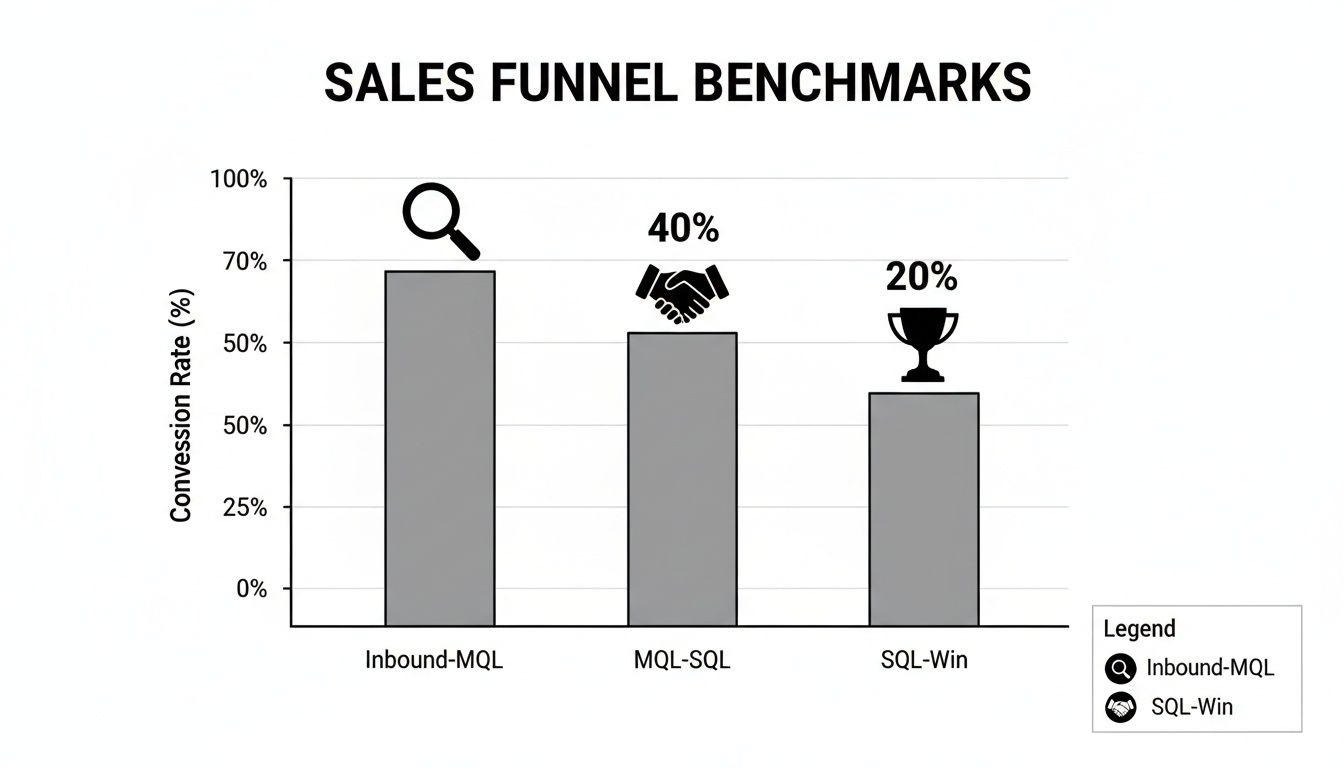
As you can see, the drop-off at each stage is significant, which is exactly why optimizing those transition points is so critical to your success.
Turning Data into Actionable Insights
Once you have your metrics and benchmarks, the real work starts. These numbers are telling you a story about your customers. Your job is to listen to that story and figure out how to write a better ending.
Here’s how to put that data to work:
- Identify the Leaks: Find the single biggest drop-off point in your funnel. That’s where you should focus your energy first.
- Test Your Ideas: Is your checkout page losing people? Maybe the call-to-action is weak. Form a hypothesis, then run an A/B test with a stronger CTA to see if you can plug the leak.
- Forecast More Accurately: When you know your conversion rates inside and out, you can build a predictable revenue model. You'll know exactly how many leads you need at the top to hit your sales goals at the bottom.
Ultimately, tracking performance takes the guesswork out of marketing. To learn more about setting up your tracking, take a look at our guide on how to monitor conversion metrics.
Conversion Funnels in Action Across Industries

Theory is one thing, but seeing the conversion funnel work in the wild is where it all clicks. The real power of this framework is how it molds itself to just about any business you can think of—from a global software giant to the coffee shop on your corner.
By mapping out these customer journeys, you're not just dealing with abstract ideas anymore. You're building a concrete roadmap. Let's walk through three completely different business models to see how they guide people from "just looking" to "take my money."
Example 1: The eCommerce Brand
For any online store, the game is all about speed and visuals. The journey has to be smooth, engaging, and dead simple. The goal? Turn a casual Instagram scroller into a happy customer with as few clicks as possible.
Here's how that might play out for a sustainable activewear brand:
- Awareness: It starts with a dynamic video ad on Instagram. Someone scrolling their feed sees an ad for a new line of leggings, it catches their eye, speaks to their values, and they tap "Shop Now."
- Consideration: They land on a sharp-looking product page with great photos, a detailed description, and a ton of positive reviews. They add the leggings to their cart but get distracted and leave.
- Decision: The next morning, an automated "Did you forget something?" email hits their inbox. It's a friendly reminder that includes a 10% discount code. That little nudge is all it takes for them to go back and finish the checkout.
- Loyalty: A week later, they get another email with tips on caring for their new gear and an invite to the brand's loyalty program. Now they're not just a customer; they're part of the community.
Example 2: The B2B SaaS Company
Selling software to other businesses is a different beast altogether. The sales cycle is longer, more people are involved in the decision, and it’s all about building trust and proving value. The funnel here is less about impulse and more about education.
A typical B2B journey looks something like this:
- Awareness: A marketing manager is scrolling through LinkedIn and finds a genuinely helpful article about team productivity. The article is from a project management software company, positioning them as an expert in the field.
- Consideration: At the end of the article is a call-to-action to download a free, in-depth guide on remote collaboration. To get it, the manager enters their email address. Boom—they're now a lead.
- Decision: After receiving a few more educational emails, the manager gets invited to a live product demo. The sales team shows them exactly how the software solves their team's specific problems, which convinces them to sign up for a paid plan.
- Loyalty: The relationship doesn't end there. A customer success team helps them with onboarding and checks in regularly. This stellar support ensures they get the most out of the tool, making them likely to renew or even upgrade later on.
Example 3: The Local Service Business
What about businesses like plumbers, electricians, or landscapers? Their funnels are often hyper-local and driven by an immediate need. When a pipe bursts, you're not comparison shopping for weeks—you need someone reliable, now. Trust and accessibility are everything.
Even for a local business without an online store, a conversion funnel is essential for turning local searchers into paying clients. The principles remain the same—attract, educate, and convert.
Here’s how a local landscaper could build their funnel:
- Awareness: A homeowner Googles "lawn care services near me." Thanks to solid local SEO, the landscaper's website is one of the first results they see.
- Consideration: The homeowner clicks the link and finds a clean website showcasing a portfolio of beautiful lawns, clear service descriptions, and testimonials from happy neighbors. They're impressed.
- Decision: They fill out a simple "Request a Free Estimate" form. The landscaper calls back within an hour to schedule a visit, and their professional attitude and fair pricing seal the deal. The homeowner signs up for weekly service.
This incredible adaptability is why 48% of marketers made improving their sales funnels a top priority in 2023. While the average eCommerce conversion rate hovers around 2.9%, it can swing wildly from 6.22% for Food & Beverage to a mere 0.94% for Luxury & Jewelry. This just goes to show how critical it is to tailor your funnel to your specific industry. To dig deeper, check out these sales funnel statistics and trends at Growbo.com.
Proven Strategies to Optimize Your Conversion Funnel

Just having a conversion funnel is like having a map without a car. It shows you the destination, but you need a way to actually get people there efficiently. Optimization is that vehicle. The goal is to constantly refine the journey, plugging the leaks at every stage to guide more people smoothly toward a purchase.
The whole process starts with a simple but crucial question: "Where are people dropping off, and why?" Answering this means getting comfortable with testing, listening to your audience, and letting data—not guesswork—drive your decisions. You'd be surprised how even small, informed tweaks can lead to massive gains over time.
A/B Test Everything That Matters
You might think you know what works, but your audience often has other ideas. A/B testing is your secret weapon for finding out what truly resonates. It's a straightforward process: you create two versions of something (a webpage, an email, an ad) and see which one performs better with a live audience. This takes the ego out of marketing and lets real-world behavior be the judge.
While you can test nearly anything, your time is valuable. Focus on the elements that can make the biggest difference first.
- Headlines and Calls-to-Action (CTAs): Try different phrases, button colors, or placements. Does "Get Started" work better than "Sign Up Free"? Only testing will tell you for sure.
- Landing Page Layouts: See how a single-column design stacks up against a two-column one. Move your forms or images around and watch what happens to engagement.
- Email Subject Lines: This is your first impression in a crowded inbox. A great subject line can single-handedly boost your open rates and get more people into the funnel.
For a deeper dive into making your entire site more effective, check out these powerful strategies to increase website conversion rate.
Reduce Friction and Build Trust
Think about every single step a customer has to take. Every confusing form field, every extra click, every moment of uncertainty is an exit ramp from your funnel. Your job is to make the path to conversion as simple and painless as possible.
The easier you make it for someone to say "yes," the more often they will. Remove the obstacles, and you'll see your conversions climb.
A great place to start is the checkout process. Only ask for the information you absolutely need. Another powerful tactic is using social proof. When new visitors see real customer reviews, glowing testimonials, or detailed case studies, it builds instant trust. Seeing that others have already had a great experience with you helps them feel confident in their decision.
Re-Engage and Personalize the Experience
Let's be realistic—most people won't convert on their first visit. That's perfectly normal, and it's why retargeting is so important. By showing targeted ads to people who visited your site but didn't buy, you can gently remind them of what they were interested in and bring them back into the fold.
Personalization is just as critical. Stop sending one-size-fits-all emails and start segmenting your lists to deliver content that’s genuinely relevant to each group. This level of attention pays off. While the average sales funnel conversion rate hovers around a meager 2.35%, businesses with smart, well-optimized funnels report revenue growth that is 18 times greater. It's clear that treating people like individuals works.
By consistently applying these strategies, you can turn your funnel from a passive outline into an active, high-performing engine for your business. For more actionable ideas you can implement right away, explore our detailed guide on conversion optimization tips.
Common Questions About Conversion Funnels
As you dig into the world of conversion funnels, a few questions always seem to pop up. It's totally normal. Getting these cleared up will help everything click, so you can start putting these ideas to work with confidence. Let's walk through some of the most common ones.
What’s the Difference Between a Sales Funnel and a Marketing Funnel?
You'll hear "marketing funnel" and "sales funnel" thrown around, sometimes even to describe the same thing. It's confusing, but there’s a simple way to think about it: they're two sides of the same coin, not totally separate things.
The marketing funnel is all about the top—the beginning of the journey. Its job is to make noise, get people aware of you, and pull in leads. This is where you see things like blog posts, social media, and SEO working to attract a big audience.
Once a lead looks promising, the sales funnel takes over. This part is focused on the pointy end of the process—taking those interested leads, nurturing them with things like demos or consultations, and finally, closing the deal. Marketing casts the wide net; sales brings the right fish into the boat.
How Long Does It Take to Build a Funnel?
Let's be real: building a great conversion funnel doesn't happen overnight. Sure, you can get the technical bits—a landing page, an email sequence—up and running in a few days. But creating a funnel that actually converts consistently? That can take anywhere from a few weeks to several months.
What's the holdup? It usually comes down to a few things:
- Knowing Your Audience: You can't rush this. Truly getting inside your customer's head to understand their problems is what makes your messaging hit home.
- Creating Great Content: Writing compelling blog posts, designing a valuable lead magnet, and crafting emails that people actually want to open takes real effort.
- Testing and Tweaking: A funnel is never really "finished." The secret sauce is in the continuous process of looking at the data, seeing what works, and making small adjustments.
It's crucial to set the right expectations. Don't think of your funnel as a project you finish and walk away from. Treat it like a living system that you're always refining. Patience and paying attention to the data are what will get you there.
Do Funnels Work for Service-Based Businesses?
Yes, absolutely. A funnel is just a framework for guiding a customer's journey, and it works perfectly for businesses that don't have a simple "Add to Cart" button. It doesn't matter if you're a consultant, a freelance designer, or a B2B agency—the principles are exactly the same.
The only thing that changes is the "conversion" at the end. Instead of buying a product, your goal might be to get a potential client to:
- Book a free consultation.
- Request a detailed quote.
- Sign up for a discovery call.
For service businesses, the funnel is all about building trust and proving your expertise step-by-step, until the person on the other end is confident enough to reach out and start a conversation.
Ready to build a conversion funnel that doesn't just attract visitors but turns them into loyal customers? At ReachLabs.ai, our team of specialists combines data-driven strategy with world-class creative to build marketing systems that deliver real results. We move beyond general advice to execute campaigns that move the needle. Learn how our collective approach can elevate your brand's voice and drive strategic growth.