
Ever feel like your brand might be sending mixed signals? Or maybe what you think your brand stands for isn't quite what your customers are hearing. That’s where a brand audit comes in.
Think of it as a complete health check-up for your brand. It’s a deep, honest look at how your brand is performing, both from your team's perspective and, more importantly, through the eyes of your customers. It's the business equivalent of an annual physical—a chance to catch problems, see what's working, and make sure you're on track for healthy growth.
What a Brand Audit Reveals About Your Business

It’s a common mistake to think of a "brand" as just a logo and some cool colors. Those are certainly part of the equation, but your true brand is the gut feeling people have about your company. It’s the sum of every single touchpoint—from your social media posts and website copy to the way your team answers the phone.
A brand audit unpacks all of that. It systematically compares your brand's intended identity with its actual reputation in the marketplace. The whole point is to find the gaps between the story you want to tell and the story your audience is actually experiencing.
An Essential Diagnostic Tool
You wouldn't want a doctor to prescribe treatment based on a guess, right? They run tests to understand the root cause. Running a marketing campaign without a brand audit is pretty much the same thing—you're making big decisions based on assumptions instead of solid evidence.
An audit gets you the objective data you need to answer some really important questions:
- Are we saying the same thing on our website, on social media, and in our sales calls?
- Do customers see us as the experts, the budget-friendly option, or something else entirely?
- Do our internal company values actually show up in how we treat our customers?
- How do we really stack up against our closest competitors?
This process lays the groundwork for smart, effective brand development, ensuring your next moves are based on reality, not wishful thinking.
To give you a clearer picture, here’s a quick breakdown of what a brand audit typically covers and why each piece is so important.
Brand Audit at a Glance
| Component | What It Means | Why It Matters |
|---|---|---|
| Internal Branding | How your team understands and lives the brand values. | Consistent customer experiences start with a team that's on the same page. |
| External Branding | Your visual identity, messaging, and overall market presence. | This is what shapes your customers' first impressions and overall perception. |
| Customer Experience | The complete journey a customer takes with your brand. | Positive experiences build loyalty; negative ones drive customers away. |
This table is just a snapshot, but it highlights how an audit connects your internal culture to your external reputation and ultimately, to your bottom line.
The Strategic Value of Regular Audits
A brand audit isn’t a one-and-done task. It’s a vital strategic tool that should be part of your regular business cycle. In fact, companies that perform regular brand audits—usually every 12 to 18 months—are 25% more likely to hit their annual growth goals than those who skip it.
A brand audit is your early warning system. It shines a light on hidden growth opportunities, flags potential threats before they spiral out of control, and helps you invest your marketing dollars where they’ll actually make a difference.
At the end of the day, it's about keeping your brand strong and relevant in a market that never stops changing.
Why a Brand Audit Is Your Strategic North Star
So, we know what a brand audit is. But the real question is, why should you care? What separates the brands that fizzle out from the ones that thrive is often this very process.
Think of it like this: running marketing campaigns without a brand audit is like sailing a ship in a storm without a compass. You’re definitely moving, but are you heading towards your destination or straight for the rocks? You simply don't know. A brand audit is that compass, giving you the direction you need to navigate with confidence.
It’s the tool that shifts your marketing budget from a hopeful expense into a smart, calculated investment. Suddenly, every dollar spent isn’t just making noise; it’s actively working to strengthen your position in the market. More importantly, it bridges the often-costly gap between how you think your brand is seen and how it’s actually perceived by customers.
Uncovering Hidden Value and Risks
Often, it’s the small, subtle inconsistencies that do the most damage over time, slowly eroding customer trust. Maybe one of your social media channels has a playful, meme-heavy tone, while your website sounds like it was written by a corporate lawyer. These mixed signals don't just confuse people; they make your brand feel disjointed and unreliable.
A thorough audit lights up these discrepancies like a flare gun, allowing you to finally craft a unified and compelling story across every single touchpoint.
But it’s about more than just fixing problems. It’s also about finding treasure. By digging into customer feedback and market trends, you might discover an underserved niche your competitors have completely ignored or a new messaging angle that resonates deeply. After you've found those insights, our guide on developing a brand strategy can help you build them into a powerful action plan.
Measuring What Truly Matters
At the end of the day, a brand audit is about taking your brand's pulse so you can improve its performance. This isn't just about feeling good; it has a direct and measurable impact on your bottom line.
In fact, according to research shared on Aprimo.com, companies that regularly audit their brand have seen a 30% improvement in brand equity scores in as little as 12 months after acting on the results.
A brand audit isn’t an expense; it’s an investment in clarity. It provides the strategic intelligence needed to build stronger customer loyalty, align your internal team, and make smarter business decisions that drive sustainable growth.
Taking this deep, honest look at your brand gives you the power to steer your business with purpose. You'll be guided by hard data, not just guesswork, ensuring your brand is built not just to survive, but to win.
The Anatomy of a Brand Audit: A Four-Part Health Check
Think of a brand audit like a comprehensive physical for your business. You wouldn't just check your blood pressure and call it a day, right? You'd look at everything. The same logic applies here. A proper audit isn't one giant task; it's a deep dive into four distinct, but interconnected, areas of your brand.
Breaking it down this way makes the whole process feel less overwhelming and ensures you don't miss any blind spots. Let's walk through the four core components that make up a thorough brand health check.
1. Internal Branding: Is Your House in Order?
Every great brand is built from the inside out. Before you can convince the world of who you are, your own team has to be on board. This first step is all about looking inward.
Does your team truly understand and live by the company's mission and values? If there's a disconnect internally—if your people don't believe in the brand promise—that cracks will eventually show on the outside, in customer service calls, sales pitches, and marketing campaigns.
- The Big Question: Are our mission and values just words on a poster, or do they actually shape how we make decisions every day?
- What to Look At: Dig into employee feedback, review internal communication on platforms like Slack, and see if your onboarding process truly instills your brand's DNA in new hires.
2. External Branding: What Does the World See?
This is the stuff everyone thinks of when they hear the word "brand": your logo, your website's color scheme, the font you use, and the voice that comes through in your social media posts. This is your brand's public face, and consistency is everything.
This part of the audit is a meticulous review of every single touchpoint. From your email signature to your billboard ads, does it all look and feel like it came from the same company? Inconsistencies, even small ones, can weaken your message and confuse your audience. A big piece of this is checking how you're currently handling your visual assets; for a great deep-dive, check out this guide on managing brand assets effectively.
Your external brand is your handshake with the world. An audit ensures it’s a firm, confident, and consistent one every single time.
3. Digital Footprint: How Do You Show Up Online?
For most businesses today, the first impression happens online. Your digital footprint is your virtual storefront, office, and billboard all rolled into one. This part of the audit means getting your hands dirty with data.
We're talking about a full review of your website, social media channels, and your performance in search engines (SEO). You’ll be looking at web analytics to see how people behave on your site, checking social media metrics to understand what your audience responds to, and seeing where you rank for the keywords that matter. This is also where you size up the competition. Using a solid competitor analysis framework helps you benchmark your performance and spot opportunities they might be missing.
- The Big Question: Can a new visitor land on our website and understand exactly what we do and why it matters within five seconds?
- What to Look At: Website traffic, bounce rate, keyword rankings, social media engagement, and, of course, online reviews.
4. The Customer Experience: Walking in Their Shoes
Finally, we zoom out to look at the entire journey your customers take with you. This is the most holistic piece of the puzzle, mapping out every interaction from the moment they first hear about you to the follow-up they receive after a purchase.
This isn't just about your website's user experience or how quickly you answer the phone. It's about everything. The checkout process. The packaging. The return policy. The tone of your support emails. One frustrating moment can undo all the great branding work you've done. Analyzing the full experience is critical for finding those friction points and turning satisfied customers into true brand fans.
To help organize your audit, here's a quick-glance table breaking down these components and what you should be tracking for each.
Key Brand Audit Components and Metrics to Track
This table acts as a starting point, helping you focus on the right questions and data as you move through each phase of the audit.
| Audit Component | Key Questions to Ask | Example Metrics (KPIs) |
|---|---|---|
| 1. Internal Branding | Does our team understand and embody our brand values? Is our culture aligned with our public image? | Employee Net Promoter Score (eNPS), Employee turnover rate, Results from internal surveys |
| 2. External Branding | Is our visual identity (logo, colors, fonts) used consistently everywhere? Is our brand voice clear and consistent? | Brand recognition survey scores, Social media sentiment analysis, Content engagement rates |
| 3. Digital Footprint | Is our website user-friendly and optimized for conversions? How visible are we on search engines for key terms? | Website conversion rate, Organic search traffic, Social media reach and engagement, Customer Acquisition Cost (CAC) |
| 4. Customer Experience | What are the friction points in our customer journey? Are we delivering on our brand promise at every touchpoint? | Customer Lifetime Value (CLV), Customer satisfaction scores (CSAT), Net Promoter Score (NPS), Churn rate |
Each of these four pillars provides a vital piece of the puzzle. When you put them all together, you get a crystal-clear, actionable picture of your brand's overall health and the exact steps you need to take to make it stronger.
A Step-by-Step Framework for Your First Brand Audit
Knowing you need a brand audit is one thing; actually starting one can feel like a massive undertaking. Where do you even begin? The trick is to break it down into smaller, more manageable pieces. This simple, five-part framework will help you do just that, giving you a clear roadmap from initial planning all the way to a concrete strategy.
Think of this as your project blueprint. Each phase builds directly on the last, making sure you gather the right information, analyze it properly, and come out the other side with a plan that truly strengthens your brand’s place in the market.
Phase 1: Define Your Goals and Scope
Before you get lost in a sea of data, you have to define what success actually looks like. What specific questions are you trying to answer? Maybe you're trying to figure out why a new product is falling flat, or you need to measure brand awareness in a new territory. Or perhaps it's as simple as making sure your messaging is consistent across every single channel.
Setting clear objectives from the get-go keeps the project on track and stops you from chasing down irrelevant data. Your goals will ultimately dictate the scope of the audit and the key performance indicators (KPIs) you’ll need to watch.
Phase 2: Gather Your Data
With your goals locked in, it’s time to start collecting information. This means looking both inside and outside your company. Internally, you’ll want to pull together things like your official brand guidelines, all recent marketing materials, and even sales scripts. At the same time, you’ll gather external data—think customer surveys, online reviews, social media comments, and website analytics from a tool like Google Analytics.
This flowchart breaks down the core areas to investigate.
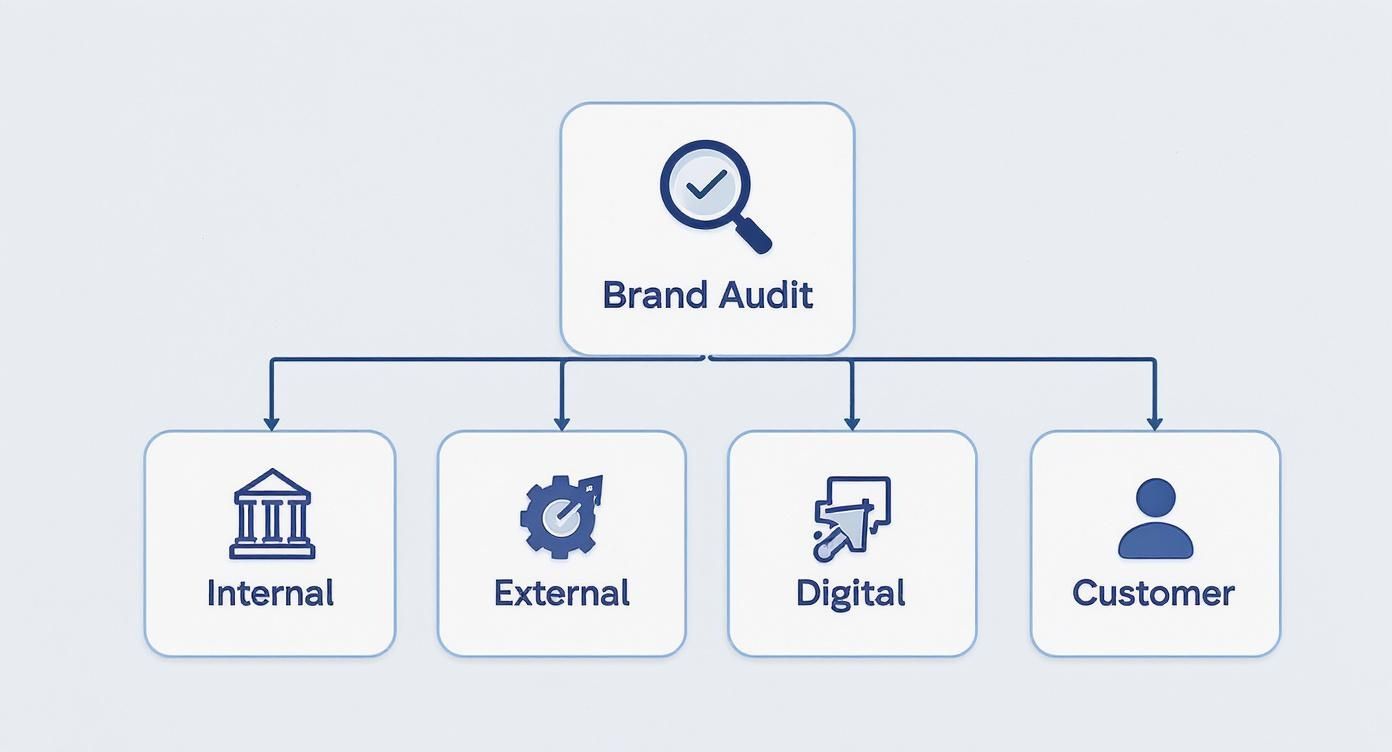
As you can see, a truly comprehensive audit has to balance what you think your brand is with what the outside world—your customers and your digital footprint—is actually reflecting back at you.
Phase 3: Analyze and Evaluate
This is where you start turning all that raw data into genuine insight. Begin organizing your findings and look for patterns, common themes, and any glaring inconsistencies. This is your chance to compare your internal brand perception with the external feedback you’ve collected. How does the brand message you want to send stack up against what customers are actually saying?
This step also involves a deep dive into your competition. Benchmarking your performance against your key rivals is crucial for spotting your own strengths, weaknesses, and potential opportunities you might be missing.
The goal isn't just to collect data, but to connect the dots. A successful brand audit reveals the 'why' behind the 'what,' linking specific findings to broader strategic implications for the business.
Phase 4: Synthesize and Report
Okay, now it’s time to distill your analysis into a report that people will actually read. Summarize the key findings for each area you audited, from the consistency of your brand identity to any friction points in the customer experience. Use visuals like charts and graphs to make complex data easy to digest for everyone involved.
Most importantly, your report needs to clearly spell out the main challenges and opportunities you’ve uncovered. This synthesis is what sets the stage for the final, and most critical, step.
Phase 5: Create Your Action Plan
An audit is pretty much useless if it doesn't lead to action. Based on your report, you need to develop a strategic action plan that outlines specific, measurable, achievable, relevant, and time-bound (SMART) goals. Assign someone to own each initiative and set a clear timeline for getting it all done.
This plan becomes your roadmap for the future, turning those hard-won insights into tangible improvements. And following through has a real financial impact. One recent study found that organizations saw a 20% reduction in customer acquisition costs (CAC) within a year of implementing changes based on their audit findings. For a deeper look, check out this guide on the benefits of a brand audit from Brand24.
Turning Your Audit Findings Into Actionable Strategy
Finishing a brand audit feels great, but the report itself is just a pile of raw data. The real magic happens when you turn those findings into a concrete game plan. This is where insights spark real, measurable impact and you transform all that information into a clear roadmap for your brand.
The first step is to zoom out from the individual data points and start looking for the bigger picture. You’re hunting for patterns and connections. For example, did you notice that your inconsistent social media voice lines up with a 15% higher churn rate for new customers? That’s not a coincidence; it’s a critical insight waiting to be acted on.
Connecting these dots helps you understand the why behind the what, allowing you to build a strategy that fixes the root cause of a problem, not just the symptoms.
Prioritizing Your Next Moves
After digging through the data, you’ll probably have a laundry list of things you could do. Don’t fall into the trap of trying to fix everything at once—that’s a surefire way to get overwhelmed and achieve nothing. You have to be ruthless about prioritizing. A simple and incredibly effective way to do this is with an Impact/Effort Matrix.
This framework forces you to sort every potential action by asking two straightforward questions:
- High Impact vs. Low Impact: How much will this actually help us hit our main business goals?
- High Effort vs. Low Effort: How much time, money, and manpower will this take?
Your first priority should always be the high-impact, low-effort tasks. These are your quick wins. They build momentum, deliver fast results, and get everyone excited. High-impact, high-effort projects are your big strategic bets that need careful planning. Anything with low impact should be pushed to the back of the line or forgotten entirely.
Your audit findings provide the map, but prioritization gives you the turn-by-turn directions. It ensures you invest your limited resources where they will generate the greatest return for your brand.
Building Your Post-Audit Action Plan
With your priorities straight, it's time to create a formal action plan. Think of this as your playbook for the next few months, something that keeps the entire team aligned and accountable.
For every single initiative, your action plan needs to spell out:
- Clear Objective: What exactly are we trying to accomplish? (e.g., "Make our brand voice consistent across all social channels.")
- Designated Owner: Who is the one person responsible for getting this done?
- Key Performance Indicators (KPIs): How will we know if we’ve succeeded? (e.g., "Cut negative sentiment mentions by 20%.")
- Realistic Timeline: By when does this need to be finished?
This structure gets rid of any confusion and turns vague recommendations into specific tasks people can actually own and complete.
Case Study: TechBrand Inc. Pivots for Success
Let’s look at a real-world example. A mid-sized B2B tech company, we’ll call them "TechBrand Inc.," ran an audit and uncovered a huge gap. Internally, they saw their product as innovative and easy to use. But customer surveys and reviews told a different story: people saw them as "complex" and "expensive."
Armed with this knowledge, they built a targeted action plan. First, they tackled a high-impact, low-effort item: rewriting the homepage copy to emphasize ease-of-use and ROI. Then, they kicked off a larger project to create a series of simple video tutorials that solved common customer frustrations.
The results were impressive. In just six months, their website's lead conversion rate jumped by 30%, and mentions of "complexity" in online reviews were cut in half. This is what happens when you turn audit findings into a focused, actionable strategy.
Answering Your Brand Audit Questions
Even with a solid plan, jumping into your first brand audit can feel a bit daunting. A few practical questions always seem to pop up around timing, cost, and the tools you'll need. Let's clear the air and tackle some of the most common queries we hear from marketing teams and business owners.
How Often Should We Do This?
This is probably the number one question people ask. While there isn't a single magic number that fits every business, a good rule of thumb is to perform a full-scale brand audit every 12 to 18 months. This rhythm is frequent enough to spot inconsistencies before they snowball into bigger problems, but it also gives you enough time to actually implement changes and see what works.
That said, some situations should ring the alarm bell for an immediate audit, no matter where you are in your regular cycle.
- You're making a huge business move: Think mergers, acquisitions, or a major pivot in your core business model.
- You're entering a new market: What resonates with customers in one region might fall completely flat in another.
- Your numbers are tanking: If you're seeing a consistent slide in sales, market share, or customer love, an audit is your first step to figuring out why.
- You're planning a rebrand: Before you even think about designing a new logo, an audit is non-negotiable. It’s the foundation for your entire new direction.
What's a Brand Audit Going to Cost?
Ah, the budget question. The truth is, the cost can swing wildly—from a few thousand dollars to tens of thousands, or even more. The final number really boils down to a few key factors.
The biggest variable is scope. An internal-only audit looking at your marketing materials will cost a fraction of a deep-dive analysis that involves extensive customer surveys, focus groups, and competitor intelligence. Naturally, your company's size and the complexity of your industry also weigh in.
You can really think about the cost in two ways:
- The DIY Route: If you’ve got a sharp in-house team, you can get a fantastic audit done by investing your team's time and using a few affordable analytics tools.
- Hiring an Agency or Consultant: Bringing in an outside expert guarantees objectivity and specialized experience, but it comes at a higher price. This is often the right call for bigger companies or for anyone who knows they need an unbiased, expert opinion.
Do I Need a Bunch of Fancy Tools?
Good news: you don't need a massive, expensive software stack to get started. While professional tools can definitely speed things up and offer deeper data, you can uncover a ton of valuable information with resources you probably already have.
The most important "tool" for a successful brand audit isn't a piece of software—it's a commitment to being objective and a willingness to act on what you discover.
For a solid, foundational audit, you can lean on:
- Google Analytics to see what people are doing on your website.
- Native social media insights (from platforms like Meta or LinkedIn) to check audience engagement.
- Customer surveys using straightforward tools like SurveyMonkey or Google Forms.
- A simple manual review of all your marketing assets and internal brand guides.
As you grow, you can always layer in more advanced platforms for things like social listening or competitive analysis. But honestly, these basics are more than enough to find powerful insights you can act on right away.
A brand audit gives you the clarity to make smarter marketing decisions and build real, sustainable growth. At ReachLabs.ai, we specialize in turning those audit insights into powerful, data-driven strategies that amplify your brand's voice and deliver results you can actually measure. Learn how our collective of experts can build and execute a plan that moves the needle for your business.