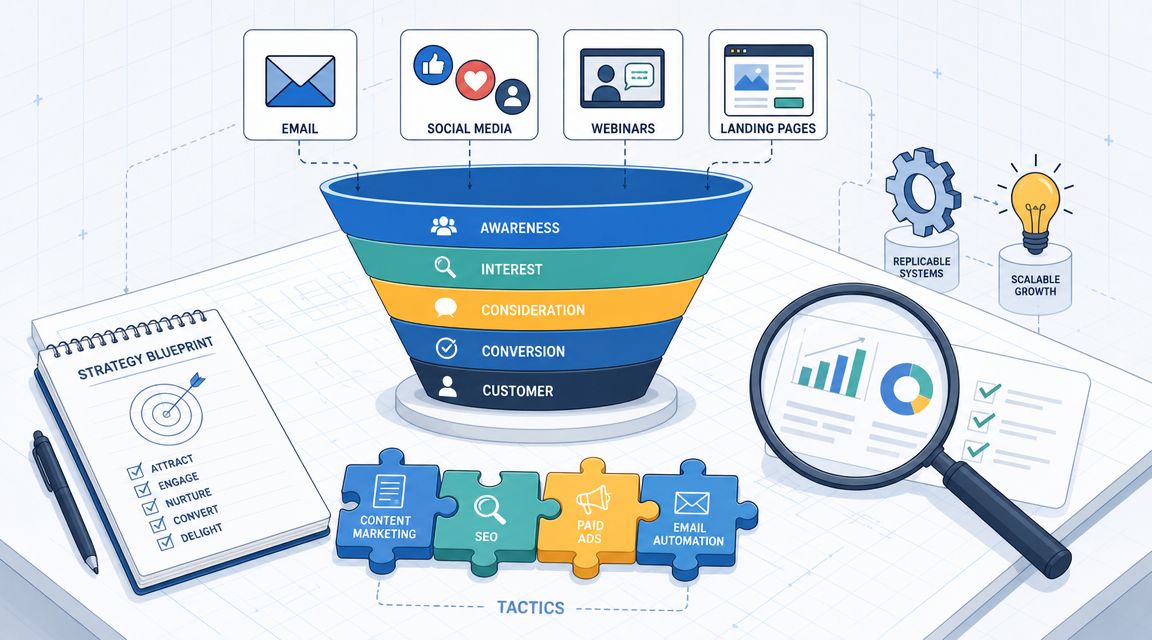
53% of marketers report putting more than half of their budget into lead generation, according to HubSpot's overview of lead generation trends, which helps explain why campaign design matters so much when cost per lead starts climbing (HubSpot lead generation statistics). Lead gen is expensive enough without treating it like a collection of disconnected tactics.
Strong lead generation campaign examples show more than a form, an ad, or a webinar registration page. They show the operating model behind the result: what the campaign was built to do, where it sits in the funnel, how leads are qualified, what happens after conversion, and which numbers determine whether the campaign should scale or stop. That is the difference between generating names and generating pipeline.
This guide breaks down 10 lead generation campaign examples as blueprints you can use. For each one, you will see the objective, funnel stage, key metrics, and a Swipe and Adapt section so you can apply the structure to your own market, offer, and budget without copying someone else's execution.
If you want extra context before building your first campaign, these expert tips for generating leads are a useful companion. Teams building inbound programs should also review this practical guide to SEO lead generation strategies. For content teams exploring audio as part of demand generation, Optimizing B2B content with podcasts offers a useful angle on distribution and audience trust.
1. Content Marketing & SEO-Driven Lead Generation
Organic search drives some of the lowest-cost leads over time because it captures buyers who are already looking for a solution. It also takes longer to ramp than paid media, which is why strong SEO programs are built like systems, not one-off blog calendars.

The campaign structure is simple. Create content around pain-driven searches, route visitors into a focused conversion path, and capture demand with the next logical offer. The real work is in the alignment. Topics need enough search demand to matter, enough buying intent to attract the right audience, and a clear CTA that matches what the visitor is ready to do.
Strategic Blueprint
Objective: Capture high-intent organic traffic and convert it into owned leads.
Funnel stage: Top and middle of funnel.
Key metrics: Non-branded organic traffic, conversion rate by page, CTA click-through rate, lead quality, assisted pipeline.
Best-fit tools: Ahrefs, Semrush, Google Search Console, WordPress.
A content-led lead gen campaign usually works best with three layers:
- Pillar content: Build one strong page around a core buyer problem, then support it with narrower articles that answer related questions.
- Conversion paths: Add in-content CTAs to templates, calculators, webinars, consultations, or product-led next steps.
- Refresh cycles: Update pages that already rank on page one or two before investing in a full rewrite library.
One trade-off matters here. High-volume keywords often bring mixed intent, while lower-volume terms tied to a workflow, pain point, or use case convert better. I usually prefer the second group for lead generation because traffic without fit rarely turns into pipeline.
If you need a working model, this guide to SEO lead generation strategies shows how to connect rankings, content structure, and conversion design.
Practical rule: Leave educational search content ungated. Gate the asset that helps the buyer apply what they learned.
Distribution also matters after the article goes live. Strong teams reuse source material across formats so one expert insight can support search, email, social, and lead magnets. Optimizing B2B content with podcasts is a useful example of how a single conversation can turn into multiple inbound assets.
Swipe & Adapt: Start with one commercially relevant problem. Build one pillar page, one downloadable asset, and one landing page with a single CTA. Then publish three to five supporting articles that link back to the conversion page and answer the exact follow-up questions a qualified buyer would search next.
2. LinkedIn Outreach & Account-Based Marketing
B2B teams rarely need more prospects. They need more replies from the right accounts.
LinkedIn outreach and account-based marketing work well when the target list is tight, the message reflects real account context, and the ask matches buying stage. This channel creates demand in accounts that may not be searching yet, which makes it different from inbound. It also gets expensive fast if the team treats it like volume prospecting.

The pattern behind strong ABM programs is consistent. Targeting, message angle, and follow-up are built around named accounts rather than a loose persona. That sounds obvious, but it changes everything. The outreach references a hiring push, a new market entry, a product launch, a funding event, or a visible operational shift. Buyers respond to relevance, not effort.
Strategic Blueprint
Objective: Start conversations with named accounts and convert qualified interest into sales meetings.
Funnel stage: Middle and bottom of funnel.
Best-fit tools: LinkedIn Sales Navigator, Apollo, Clay, CRM workflows, and sequencing tools such as ReachLabs.ai.
A practical LinkedIn and ABM motion usually has four parts.
- Tight account selection: Start with 50 to 100 accounts that match revenue potential, use case fit, and buying likelihood.
- Role-specific messaging: Write separate angles for founders, department heads, and operators. Each role cares about a different risk, KPI, or bottleneck.
- Credibility before outreach: Clean up the sender profile, recent activity, and mutual context before the first message goes out.
- Sequenced touches: Use profile views, light engagement, a connection request, and one or two concise follow-ups. Keep each touch focused on one idea.
The common failure points are predictable.
- Generic first messages: If the opener could be sent to any company, it will read like automation.
- Early meeting asks: Asking for 30 minutes before you have earned attention suppresses reply rates.
- No account research: Recent hiring, leadership changes, expansion moves, or product updates often provide the best opening angle.
- One-channel execution: ABM works better when LinkedIn outreach, email, and sales follow-up use the same account logic.
There is a real trade-off here. Personalization improves response quality, but it limits scale. That is usually the right compromise for higher-value deals. For lower ACV offers, the math may favor lighter research and broader segmentation. The mistake is mixing an enterprise sales motion with SMB-level efficiency targets.
The strongest LinkedIn outreach feels like a relevant introduction between professionals, not a cold pitch dropped into a feed.
Swipe & Adapt: Build a target list by segment, then assign one trigger to each segment, such as hiring, expansion, or a new product line. Write a short connection request that references that trigger and the business implication behind it. After the connection, send one useful observation or asset tied to the account's likely priority, then ask a narrow question that opens a conversation instead of pushing straight to a call.
3. Webinar & Virtual Event Lead Generation
Webinars earn leads because they capture a stronger intent signal than a basic content download. Someone who registers is raising a hand around a specific problem. Someone who attends, stays, and asks questions is giving your team useful qualification data without filling out a long form.

That is why webinar campaigns still hold up as paid targeting gets less precise and first-party data matters more. LocaliQ's overview of privacy-first lead generation points to webinars, gated content, and newsletters as common ways B2B teams collect consent-based audience data they can use later (privacy-first lead generation ideas and first-party data trends).
Strategic Blueprint
Objective: Attract problem-aware prospects and capture declared interest around one well-defined topic.
Funnel stage: Top and middle of funnel.
Best-fit tools: Zoom Webinars, Livestorm, Demio, GoTo Webinar.
The campaign structure matters more than the platform. A webinar generates results when the topic is narrow, the registration promise is specific, and the follow-up changes based on what each lead did.
Use three working parts:
- A sharp topic: Build the session around one repeated buyer question, one operational bottleneck, or one high-cost mistake your audience wants to fix.
- A conversion path: Set up the registration page, reminder emails, live session CTA, replay page, and post-event handoff before promotion starts.
- A post-event split: Segment registrants into attendees, no-shows, and high-engagement viewers, then send each group a different next step.
This is the trade-off. Broad webinar topics usually lift registration volume, but lead quality drops because intent gets fuzzy. Narrow topics reduce volume, yet they often produce better sales conversations because the audience self-qualifies before the event begins.
A useful webinar does three jobs at once. It teaches. It surfaces objections. It creates a clean handoff into the next asset, whether that is a demo, a diagnostic, or a targeted nurture flow. If you need ideas for that follow-up, these email drip campaign examples for post-webinar nurturing show how to build sequences around behavior instead of sending the same replay email to everyone.
Swipe & Adapt: Pick one question your sales team answers every week. Turn it into a 25 to 35 minute session with one clear promise, one practical framework, and one CTA tied to buyer readiness. Record the event, gate the replay, and keep using that asset in retargeting, nurture, and sales follow-up until the topic stops converting.
4. Email Marketing & Lead Nurturing Sequences
Email remains one of the most dependable ways to turn an existing lead into a qualified conversation. It gives you direct access, clear response data, and strong control over sequencing. It also exposes weak segmentation fast. If the list is messy or the offer is vague, nurture emails usually make that obvious within a few sends.
The strategic advantage is timing. A good sequence responds to what the lead did, what they viewed, and how close they are to a buying decision. A weak sequence follows a calendar and treats every contact the same.
Strategic Blueprint
Objective: Nurture interest, surface intent, and qualify leads through behavior-based follow-up.
Funnel stage: Middle of funnel.
Best-fit tools: Mailchimp, ActiveCampaign, Klaviyo, Customer.io.
The pattern that works is simple. Trigger emails from actions, not dates alone. A pricing-page visit should not get the same follow-up as a newsletter signup. A webinar attendee who watched most of the session should not enter the same path as someone who downloaded a top-of-funnel checklist three weeks ago.
That is the trade-off. Highly personalized nurture paths usually improve reply rates and lead qualification, but they take more planning, cleaner data, and tighter CRM hygiene. Simpler sequences are easier to launch and maintain, yet they often flatten performance because the messaging ignores intent signals.
Watch for this mistake: teams map emails by calendar instead of buyer behavior. That creates polite spam.
A solid sequence usually includes four parts: a welcome or context-setting email, one or two educational emails tied to the lead's original interest, a proof-focused email with a case study or outcome, and a conversion email tied to a demo, consultation, or next-step asset. Keep each message centered on one job. If an email tries to educate, pitch, and reintroduce the brand at the same time, clicks usually drop.
If you want practical models before building your workflow, review these email drip campaign examples. For teams pairing nurture with creator or partner acquisition, these influencer marketing campaign examples are also useful because they show how source of lead should shape follow-up.
Swipe & Adapt: Split leads into three buckets: new inquiries, engaged non-buyers, and dormant contacts. Write a separate sequence for each bucket. Then set one trigger that moves people out of nurture and into sales follow-up, such as repeated visits to high-intent pages, a reply, or a request for pricing.
5. Influencer Marketing & Collaborative Partnerships
Collaborative lead generation works because borrowed trust shortens the path to action. A niche creator, consultant, community host, or complementary brand can get you in front of buyers who would ignore a cold ad or generic outreach. The catch is intent. If the partnership only produces views, comments, or vague brand lift, sales teams get noise instead of pipeline.
The better model is a campaign built around one concrete offer and one clear audience. In practice, that usually means co-creating a webinar, benchmark report, checklist, workshop, or buyer guide tied to a real problem your audience is trying to solve. The partner supplies credibility and distribution. Your team supplies the conversion path, lead capture, and follow-up.
Strategic Blueprint
Objective: Use a trusted third party to bring qualified prospects into your funnel.
Funnel stage: Top and middle of funnel.
Best-fit tools: CreatorIQ, Upfluence, Impact.com, Typeform.
A strong partnership campaign usually comes down to four decisions:
- Partner fit: Choose a partner whose audience matches your buyer, but whose offer does not compete with yours.
- Offer specificity: A narrow topic usually converts better than a broad thought-leadership asset.
- Lead handling: Decide before launch who owns registrations, which fields get collected, and how consent is managed.
- Follow-up by source: Leads from a partner campaign need context-aware nurture. A generic demo sequence usually underperforms.
One trade-off matters here. Bigger influencers can give you reach, but smaller niche partners often produce better lead quality because their audience trusts them on a specific topic. I usually advise teams to start with relevance over audience size, then expand once they know which message and format convert.
If you want creative patterns and execution models before building your own campaign, review these influencer marketing campaign examples for lead generation.
Vague collaboration is where these campaigns fail. If the landing page, event topic, and promotion copy do not answer "who is this for?" and "why should I register now?", people engage at the surface level and disappear after the click.
Swipe & Adapt: Pick one trusted partner in your niche. Build one tightly scoped asset around a problem your shared audience already cares about. Use a dedicated landing page and hidden source tracking, then route follow-up based on the partner, topic, and conversion action.
6. Paid Advertising Campaigns (PPC, Display, Social)
Paid ads can produce leads within days, which is exactly why weak strategy gets exposed so quickly. If the audience is off, the offer is too aggressive, or the handoff is slow, you pay to learn that lesson faster.
The practical value of paid media is speed. It lets teams test message, audience, and offer combinations before rolling them out more broadly. I treat it as a validation channel first and a scaling channel second. That order matters, because paid campaigns amplify whatever is already true about your positioning.
Strategic Blueprint
Objective: Generate leads quickly while testing which audience, offer, and message combination earns efficient conversion.
Funnel stage: Any stage, depending on whether the campaign is built for intent capture, retargeting, or top-of-funnel demand creation.
Best-fit tools: Google Ads, LinkedIn Ads, Meta Ads Manager, Google Analytics.
Channel choice should follow buyer intent. Search works well when prospects already know the problem and are actively looking for a solution. Paid social is stronger when you need to introduce a pain point, distribute a lead magnet, or retarget visitors who were interested but not ready. Display usually performs best as support, not as the core engine, especially for retargeting or account list coverage.
The campaign itself usually breaks on one of three points:
- Offer-to-audience fit: Cold audiences respond better to guides, calculators, webinars, or diagnostic tools than direct demo requests.
- Creative fatigue: Response rates drop when the same ad runs too long, even if targeting is still sound.
- Lead follow-up speed: Paid leads get expensive fast when no one responds for hours or days.
A strong paid campaign is not just an ad set with budget behind it. It is a system: traffic source, message, offer, form, qualification, routing, and follow-up. If one part is weak, the platform does not fix it. It just sends more people into the gap.
Paid campaigns expose weak positioning fast.
A useful way to study paid lead generation is to look at campaign examples through the lens of objective and funnel stage, not just platform choice. That is the difference between copying an ad and building a repeatable playbook.
Swipe & Adapt: Start with one controlled test. Pick either a high-intent search term cluster or one narrow paid social audience. Match it to a low-friction offer, define success before launch, and review performance by lead quality, not clicks alone.
7. Landing Page Optimization & Conversion Rate Optimization
Conversion lifts on landing pages often come from a few plain fixes, not a full redesign. Clearer headlines, tighter form fields, and stronger trust elements usually change lead volume faster than sending more traffic to the same weak page.
This part of lead generation is easy to underestimate because the page sits between campaign performance and pipeline quality. A paid ad can attract the right visitor. An email can create intent. The landing page still decides whether that interest turns into a form fill, a booked meeting, or a bounce.
Strategic Blueprint
Objective: Increase the percentage of visitors who become leads.
Funnel stage: Any stage where traffic is being converted.
Best-fit tools: Instapage, VWO, Hotjar, Optimizely.
I start with the conversion path itself. What promise brought the visitor here, what proof supports it, what friction slows the action, and what happens after the form submit. That sequence matters more than cosmetic changes.
Four areas usually decide the result:
- Headline clarity: A buyer should understand the offer and audience fit within a few seconds.
- Form friction: Ask only for fields your sales or ops team will use.
- Trust signals: Add proof that reduces risk, such as customer logos, testimonials, outcome-focused copy, or a short explanation of the process.
- CTA alignment: The button text and surrounding copy should match the promise that drove the click.
The trade-off is straightforward. Shorter forms usually raise submission rate. They can also reduce lead quality if your team needs qualification data to route follow-up well. Longer forms filter harder, but they often cut volume enough to hurt the campaign. The right answer depends on sales capacity, deal size, and how quickly your team can qualify leads after submission.
A common mistake is running A/B tests on small design details before fixing the message. If the offer is vague, changing the button color or swapping a hero image rarely changes the outcome in a meaningful way. Start with message match, proof, and form logic. Then test layout refinements.
Swipe & Adapt: Build one page for one traffic source and one offer. Match the headline to the ad, email, or CTA that sent the visitor. Remove distractions when focus matters, review session recordings or heatmaps to spot hesitation, and judge tests by qualified leads, not raw conversion rate alone.
8. Investor Pitch Decks & Business Solutions for Lead Generation
This isn't the first format marketers think of, but it matters in consulting, services, partnerships, and founder-led businesses. A pitch deck, one-pager, or business case can function as a lead-generation asset when it helps a buyer, investor, or strategic partner understand your market position quickly.
The actual use case isn't only fundraising. These materials can open distribution partnerships, channel deals, media opportunities, strategic introductions, and enterprise conversations. In that context, the deck becomes a conversion tool for high-value opportunities rather than a presentation artifact.
Strategic Blueprint
Objective: Generate qualified strategic conversations with investors, partners, and enterprise stakeholders.
Funnel stage: Middle and bottom of funnel.
Best-fit tools: Pitch, Canva, Google Slides, DocSend, Notion.
What a strong deck-led campaign needs:
- A clear narrative: Problem, solution, traction, market, and next step.
- Controlled distribution: Use trackable links and customized versions for different audiences.
- Follow-up logic: Don't send a deck without a meeting path or reply trigger.
The trade-off is simple. A polished deck can create authority fast, but outdated or generic materials can damage trust just as quickly.
Swipe & Adapt: Build one short deck for investor conversations and another for commercial partnerships. Keep each version customized to the recipient's decision criteria, and send it through a trackable platform so you know when to follow up.
9. Personal Brand Building & Thought Leadership
Buyers often form an opinion about your company before they ever request a demo or reply to sales. In practice, that opinion is often shaped by a founder, executive, or subject matter expert who keeps showing up with useful ideas.
This campaign works best when the market is crowded and your offer is hard to tell apart at a glance. Personal brand content gives prospects a reason to remember your company, trust your judgment, and start the conversation with context already in place. It also creates second-order lead sources that branded demand gen rarely captures on its own, such as podcast invites, event opportunities, newsletter shares, and warm inbound messages.
Done well, thought leadership is not a vanity play. It is a distribution system for expertise.
Strategic Blueprint
Objective: Build trust early and turn expertise into qualified inbound interest.
Funnel stage: Top and middle of funnel.
Best-fit tools: Substack, Beehiiv, Buffer, Hypefury, Riverside.
The mechanics are straightforward, but the trade-offs matter. A visible executive can shorten trust-building and improve response rates across other channels. The cost is consistency. If the spokesperson disappears for six weeks, posts generic opinions, or writes only about company milestones, the campaign loses momentum and audience trust.
The strongest programs usually include three parts:
- One clear voice: Pick a single spokesperson buyers can associate with a category, problem, or point of view.
- A repeatable thesis: Publish around a few core ideas, not random observations. Client objections, buying mistakes, operational lessons, and market shifts usually work well.
- A capture path: Every post does not need a hard CTA, but the system needs one destination, such as a newsletter, webinar signup, or consultation request.
A useful benchmark for quality is simple. If a buyer can reuse the insight in an internal meeting, the content is doing its job.
Publish material that helps your audience make a decision, defend a budget, or avoid a mistake.
Swipe & Adapt: Choose one executive, one channel, and three recurring content themes for the next 90 days. Turn real sales calls, customer questions, and delivery lessons into short posts, longer essays, or video clips. Then connect that content to one lead capture asset, and track subscriber growth, inbound conversations, speaking requests, and assisted pipeline rather than judging success by impressions alone.
10. Referral & Partnership Programs
Referred leads close differently. Trust enters the deal before your sales team does, which usually means less education, fewer credibility hurdles, and shorter path-to-meeting times.
That upside only shows up when the program is specific. A vague “send people our way” request produces inconsistent lead flow. A defined referral motion, with the right partner type, clear handoff, and visible follow-up, can become a reliable acquisition channel.
Strategic Blueprint
Objective: Turn customer advocacy and partner relationships into a repeatable stream of qualified introductions.
Funnel stage: Middle and bottom of funnel.
Best-fit tools: ReferralCandy, FirstPromoter, Airtable.
The operating model depends on the sale. For lower-priced products, credits, discounts, or affiliate payouts can drive volume. For B2B services and higher-consideration offers, referral performance usually improves when the exchange is tied to outcomes, such as reciprocal introductions, channel commissions, bundled service packages, or co-marketing with a shared audience.
Fit is the constraint. Good referral programs ask for a very specific lead, at a very specific moment. Partners refer more often when they can spot the use case quickly and know exactly how to introduce it. Customers refer more often when the recommendation makes them look smart to a peer.
The strongest programs usually include three parts:
- A narrow referral profile: Define company size, trigger event, buyer role, and problem worth introducing.
- A low-friction handoff: Give referrers a short intro template, a dedicated page, or one contact person to route opportunities.
- A closed feedback loop: Confirm receipt, share status updates, and tell referrers whether the lead was a fit.
One more trade-off matters. Automation helps with tracking and payouts, but it does not create partner motivation. Early on, manual outreach often works better. Identify five to ten customers or complementary partners who already trust your team, test the message, and document which offers and referral prompts produce intros. Then automate the process you know works.
People refer offers they understand quickly and can explain in one sentence.
Swipe & Adapt: Pick one partner segment first, agencies, consultants, software integrations, or existing clients. Write a one-paragraph “ideal referral” description, create a copy-paste intro email, and assign one owner to respond within one business day. Track referral-to-meeting rate, fit rate, and partner repeat activity before adding incentives or software.
10 Lead Generation Campaigns, Quick Comparison
| Strategy | Implementation Complexity 🔄 | Resource Requirements ⚡ | Expected Outcomes 📊⭐ | Ideal Use Cases 💡 | Key Advantages ⭐ |
|---|---|---|---|---|---|
| Content Marketing & SEO-Driven Lead Generation | Medium–High 🔄 (strategy, technical SEO, ongoing) | Content team, SEO tools, time (3–6+ months) ⚡ | Qualified organic traffic; compounding leads and authority 📊⭐ | SMBs/enterprises with content capacity; long-term growth | Cost-efficient over time; builds trust and high-intent leads |
| LinkedIn Outreach & Account-Based Marketing (ABM) | Medium 🔄 (personalization, account research) | Sales/BD reps, Sales Navigator, outreach tools, CRM | High-quality B2B conversations; target account engagement 📊⭐ | B2B services, SaaS, enterprise targeting specific accounts | Direct access to decision-makers; high personalization ROI |
| Webinar & Virtual Event Lead Generation | Medium 🔄 (production, promotion, tech) | Webinar platform, presenters, promotion budget, AV setup | Engaged, high-intent leads; thought leadership assets 📊⭐ | Agencies, SaaS, consultancies demonstrating expertise | Interactive engagement; reusable replay content |
| Email Marketing & Lead Nurturing Sequences | Low–Medium 🔄 (setup, segmentation, automation) | Email platform, clean data, content, automation workflows ⚡ | Predictable conversions; high ROI and measurable metrics 📊⭐ | All businesses with customer databases; SaaS, e‑commerce | Highest ROI; scalable and highly measurable |
| Influencer Marketing & Collaborative Partnerships | Medium 🔄 (vetting, contracts, coordination) | Influencer fees or incentives, creative briefs, tracking tools | Expanded reach; authentic referrals and niche audiences 📊⭐ | Consumer brands, e‑commerce, niche B2B products | Third‑party validation; access to engaged, pre‑qualified audiences |
| Paid Advertising Campaigns (PPC, Display, Social) | Medium–High 🔄 (targeting, optimization, tracking) | Ad spend, creatives, analytics, optimized landing pages ⚡ | Immediate traffic and leads; scalable CPL control 📊⭐ | Rapid lead generation, launches, performance-driven campaigns | Fast results; precise targeting and real-time optimization |
| Landing Page Optimization & CRO | Medium 🔄 (testing, design, analysis) | Design/dev resources, A/B testing tools, analytics | Higher conversion rates; improved campaign ROI 📊⭐ | Any business driving paid/organic traffic | Data-driven uplift across channels; low incremental cost |
| Investor Pitch Decks & Business Solutions for Lead Generation | Medium 🔄 (strategy, storytelling, design) | Designers, financial/data inputs, narrative expertise | Investor interest; strategic partnerships and high-value leads 📊⭐ | Startups, growth-stage companies, agencies seeking partners | Establishes credibility; opens investor and partnership doors |
| Personal Brand Building & Thought Leadership | High 🔄 (consistent, long-term effort) | Time, content creation, PR/speaking opportunities | Long-term authority; media coverage and compound opportunities 📊⭐ | Executives, founders, agency leaders seeking market authority | Authentic trust-building; differentiates leadership and company |
| Referral & Partnership Programs | Low–Medium 🔄 (program design, tracking) | Incentives, referral tracking, partner enablement materials ⚡ | High-quality referrals; lower CAC and higher LTV 📊⭐ | SaaS, service providers, businesses with strong NPS | Generates trusted leads with lower acquisition cost and high retention |
Your Next Campaign Starts Here
B2B buyers rarely convert on first touch. That is why a lead generation campaign should be judged as a system, not as a form-fill report. Lead volume matters, but lead quality, routing speed, nurture logic, and sales acceptance decide whether a campaign produces pipeline or just dashboard activity.
That is the thread running through every example in this article. Each campaign works because the pieces fit together. The objective is clear. The funnel stage matches the offer. The success metric reflects business value, not just channel activity. The Swipe and Adapt lens matters for the same reason. It turns a good example into something you can build, test, and improve.
Start there.
A practical campaign plan needs four decisions up front: the objective, the funnel stage, the conversion action, and the metric that determines whether to scale. Teams that skip this step usually compensate with more spend, more outreach, or more content. The result is familiar. Higher activity, mixed lead quality, and weak confidence in what is effective.
Trade-offs show up quickly. Narrow targeting usually lowers reach, but it often improves reply rates, meeting quality, and close rates. A broad content asset may drive more traffic, while a focused asset tied to one pain point often brings in fewer leads with stronger intent. Neither approach is automatically right. The right choice depends on whether you need volume, precision, speed, or a better handoff to sales.
If you need a simple way to choose, pair one capture channel with one nurture channel. SEO plus email fits teams that can invest time and subject-matter expertise into compounding demand. LinkedIn outreach plus email fits teams selling into a defined account list. Paid search plus a focused landing page fits teams that need faster feedback and can manage budget tightly.
Use the campaign breakdowns above as a working blueprint. Pick one path from first touch to qualified conversation. Track what happens after conversion, not just at conversion. Then fix the first bottleneck you find, whether that is targeting, offer strength, landing page friction, nurture timing, or sales follow-up.
ReachLabs.ai is one option for teams that need execution support across content, outbound, influencer programs, and broader growth operations. If partner-led acquisition is also on the roadmap, this guide to launching profitable SaaS affiliate programs is a useful next read.
Strong campaigns are usually built from plain mechanics: a relevant audience, a credible offer, a focused conversion path, and consistent follow-up. Put those pieces in place, and your next campaign becomes easier to measure, easier to improve, and much more likely to turn into revenue.