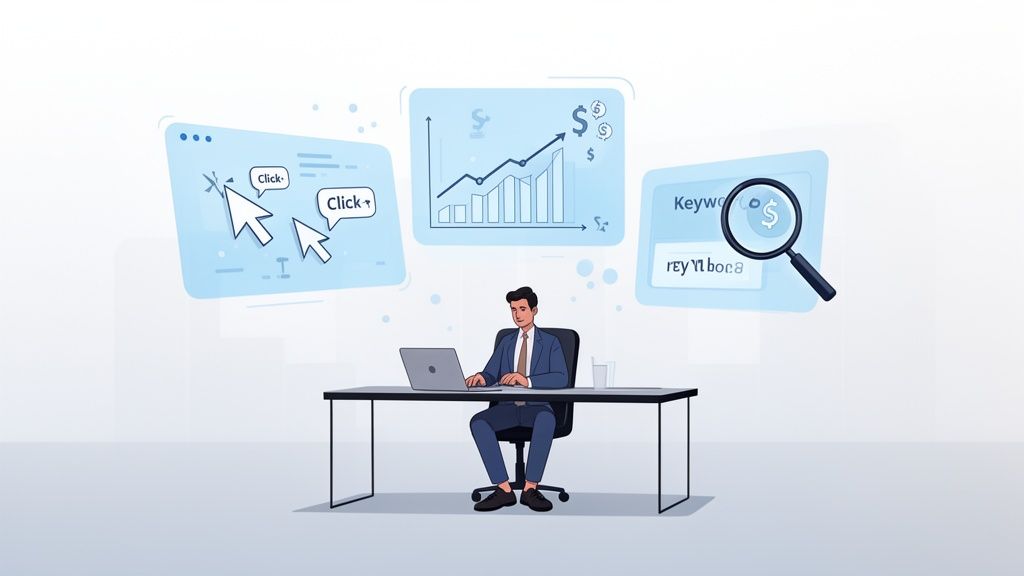
Think of a pay per click expert as the master architect of your advertising budget. Their real job isn't just about spending your money on ads. It's about investing every single dollar with surgical precision to get you the highest possible return—whether that means more leads, sales, or just getting your name out there.
They are the strategic mind behind every successful ad campaign, blending data analysis with creative thinking.
What a Pay Per Click Expert Actually Does

The role of a PPC expert goes way deeper than just hitting "launch" on a Google or Facebook ad. They are the architects of your campaign's profitability, managing the entire lifecycle of your paid advertising strategy from initial idea to final report. It's a craft that combines hard data, market research, and a bit of consumer psychology.
This strategic skillset is exactly why these experts are in such high demand. Global search ad spending is expected to rocket to $351.55 billion in 2025, a huge leap from $190.5 billion in 2024. That growth tells you one thing: businesses are relying on experts to cut through the noise and reach customers who are ready to buy.
The Core Functions of a PPC Expert
A seasoned pro doesn't just "set it and forget it." Their daily work revolves around a few key pillars that are crucial for keeping your campaigns healthy and profitable.
Here’s what they're busy doing behind the scenes:
- Deep Keyword Research: They become detectives, hunting for the exact search terms your ideal customers are using. They're not just looking at what's popular; they're analyzing user intent, competitor activity, and how much each click will cost.
- Compelling Ad Copywriting: They write the headlines and descriptions that make people stop scrolling. The goal is to grab attention, solve a problem, and convince someone to click your ad instead of the one right above or below it.
- Strategic Audience Targeting: They're like sculptors, carefully carving out audience segments based on demographics, online behavior, and interests. This ensures your ads are only shown to the people most likely to convert.
- Continuous Campaign Optimization: The work is never done. Experts are constantly monitoring performance, A/B testing different ad versions, tweaking bids, and shifting your budget to the campaigns that are actually making you money.
Translating Data into Business Growth
At the end of the day, a PPC expert’s main job is to turn clicks into customers. They are fluent in the language of the ad platforms and know all the tools of the trade. For a quick refresher, it helps to understand the fundamentals of paid search advertising and platforms like Google Ads.
A great PPC expert doesn’t just show you a dashboard full of clicks and impressions. They connect those numbers to what really matters—your revenue. They show you exactly how your ad dollars are fueling business growth and helping you hit your goals.
This is the key difference between a real professional and someone just dabbling. They bring clarity and accountability, turning your ad budget from a simple expense into a powerful growth engine for your business.
What Makes a Great PPC Expert Tick?
What’s the real difference between a decent PPC manager and a true pay per click expert who consistently knocks it out of the park? It’s not just about knowing their way around the Google Ads dashboard. The best in the business are a unique mix of data scientist, creative copywriter, and sharp business strategist, all rolled into one.
This trifecta of skills is what allows them to go beyond just "running ads." They become a growth partner, someone who can take your business objectives and turn them into a high-performing, profitable advertising machine. Without that balance, you end up with campaigns that get plenty of clicks but don't actually move the needle on what matters: your bottom line.
They Live and Breathe Data
At its core, PPC is a numbers game. An expert’s real talent lies in their ability to dig into the performance data, find the hidden gems, and stop you from wasting money. They aren't just looking at vanity metrics like clicks or impressions; they're piecing together the entire customer journey to figure out what's really driving results.
A sharp analytical mind means they can:
- Read the Story in the Numbers: They can glance at a complex spreadsheet and instantly spot patterns, red flags, and opportunities. For example, they might see a campaign with a fantastic click-through rate but a terrible conversion rate, immediately flagging a problem with the landing page experience.
- Forecast Performance: Using past data, they can build models to predict how campaigns will perform. This is huge, as it turns your ad budget from a hopeful expense into a predictable investment with clear targets.
- Reverse-Engineer the Competition: They use powerful tools to see exactly what your competitors are up to—which keywords they're winning, what their ads look like, and how their landing pages are structured. This lets them find weaknesses and carve out a space for you.
They Know How to Spark a Connection
Data tells you what happened, but creativity explains why. You can have the most technically perfect campaign in the world, but if the ads themselves are boring, no one is going to click. Elite PPC experts have a gut instinct for what makes people tick.
This creative spark helps them:
- Write Ads That People Actually Want to Click: They craft headlines and descriptions that speak directly to a customer's problems and goals. A great ad doesn't just list product features; it sells a better version of the customer's future.
- Create Thumb-Stopping Visuals: On platforms like YouTube or Meta, you have milliseconds to grab someone's attention. They know how to direct or design images and videos that are impossible to scroll past.
A truly great PPC expert understands that an ad is a conversation starter. The creative has to be compelling enough to earn that first click, giving the landing page a chance to continue the conversation and seal the deal.
They See the Bigger Picture
The final, and perhaps most important, piece is strategic vision. This is the ability to look past the day-to-day campaign metrics and see how PPC fits into your overall business strategy. A technician obsesses over lowering the cost-per-click; a strategist obsesses over increasing your customer lifetime value (LTV).
This high-level thinking means they:
- Tie Everything Back to Business Goals: They aren’t just chasing conversions for the sake of it. They're focused on attracting the right kind of customers—the ones who will be profitable for you in the long run.
- Stay One Step Ahead: They keep a close eye on market trends and platform algorithm updates, making proactive adjustments to your strategy instead of just reacting when things break.
- Translate Jargon into Business Impact: They can clearly explain how the campaign is performing in terms you care about—revenue, profit, and market share—not just a bunch of technical acronyms.
To really understand what sets a top-tier professional apart, let's break down these competencies. A true expert blends these skills seamlessly to create campaigns that don't just run, they evolve and drive tangible growth.
Essential Skills of Top-Tier PPC Experts
| Skill Category | Core Competencies | Impact on Your Business |
|---|---|---|
| Analytical | Data analysis, A/B testing, statistical modeling, competitive intelligence, conversion rate optimization (CRO) | Prevents wasted ad spend, identifies profitable opportunities, and ensures decisions are backed by data, not guesswork. |
| Creative | Compelling copywriting, visual storytelling, understanding of user psychology, landing page design principles | Grabs audience attention, builds brand connection, and persuades potential customers to take action, improving ad effectiveness. |
| Strategic | Budget management, goal alignment, market trend analysis, multi-channel integration, performance forecasting | Ensures your ad spend directly supports business growth, adapts to market changes, and provides a predictable return on investment. |
Ultimately, finding someone who excels in all three of these areas is the key to unlocking the full potential of your PPC advertising. They're not just a service provider; they become an integral part of your growth engine.
To Hire a PPC Expert or Go It Alone? That is the Question.
It’s a classic crossroads for any business starting to see some traction: should you keep managing your own PPC campaigns, or is it time to bring in a pro? In the beginning, a DIY approach makes a lot of sense. Your budget is tight, you’re learning the ropes, and you’re just getting a feel for paid ads.
But there comes a point where what saved you money initially starts costing you growth. Real-deal PPC management isn't a side-of-the-desk job. It’s a full-time commitment to learning, testing, and adapting to the constant shifts in algorithms and what your competitors are doing. If you're not all in, you’ll hit a wall where your ad costs are creeping up, but your results are going nowhere. That’s the moment when hiring a true pay per click expert stops being an expense and becomes a strategic investment.
Tipping Points: When It's Time to Call for Backup
So, how do you know you've hit that wall? It’s not always a sudden crash, but more of a slow burn. Keep an eye out for these tell-tale signs that your DIY days are numbered.
It's probably time to look for a professional if:
- Your results have gone stale. Remember when your campaigns were humming along nicely? If that feels like a distant memory and you’re now stuck in a rut, an expert can spot the hidden problems and inject new life into your strategy.
- You're spending more to get less. If your ad budget keeps increasing just to keep the same number of leads coming in, that’s a major red flag. A specialist lives and breathes budget optimization, squeezing every last drop of value out of your ad spend.
- You just don't have the time. Good PPC requires constant attention. If you can’t carve out several hours a week for deep analysis and tweaking, you’re almost certainly leaving money on the table.
- The platforms are changing too fast. Google and Meta are always updating something. An expert’s entire job is to stay ahead of these changes so you can focus on running your business.
This little flowchart breaks down the decision pretty clearly.

It really boils down to this: if what you're doing isn't working and you don’t have the bandwidth to become a PPC guru yourself, hiring an expert is your most direct route to turning things around.
Making the Financials Make Sense
Let's be honest, the biggest hurdle for most people is the cost. But you have to shift your thinking from "cost" to "investment." A good PPC pro isn't just running your ads; they're maximizing your return. On average, PPC generates a 200% return—that's $2 in revenue for every $1 spent. With 45% of small businesses now relying on paid ads, you need a sharpshooter in your corner.
Hiring a PPC expert isn't just about handing off a task. It's about bringing on a partner whose sole focus is turning your ad budget into a reliable, revenue-generating machine. Their fee is often small compared to the wasted ad spend they save you and the new growth they unlock.
The choice is ultimately yours and depends on your goals and resources. If you're weighing the pros and cons of building your own team versus outsourcing, our guide comparing a marketing agency vs in-house team can offer some valuable perspective. Making the right call now will set the stage for where your business goes next.
How to Interview and Evaluate PPC Candidates

Finding the right pay per click experts isn't about ticking boxes on a resume. It’s about digging into their strategic mind. A great interview process moves beyond the technical jargon to uncover how a candidate truly thinks, solves real-world problems, and handles the inevitable pressure of managing ad spend.
Think of it less like a test and more like a strategic conversation. You're looking for a partner who can see your business goals and translate them into a profitable ad strategy. This approach will help you compare candidates clearly and hire with confidence, whether you're bringing on a freelancer or a full-blown agency.
Going Beyond the Textbook Questions
Anyone can memorize the definition of "Quality Score" or spit out the formula for "ROAS." That's the easy part. True expertise shows up when you push them to apply that knowledge to messy, real-world situations—the kind you’ll actually face.
Standard Q&A sessions just don't cut it. They fail to reveal who can actually jump into a chaotic ad account and drive results.
To get to the heart of their skills, you need to ask questions that demand a story.
- "Walk me through a campaign that failed. What went wrong, what did you learn, and what did you do next?" This question is pure gold. It tests for humility, analytical chops, and the ability to pivot. A great answer is all about accountability and a clear problem-solving process, not blaming the platform or the client.
- "Imagine you have 90 days to turn around our underperforming account. What are the first five things you would investigate?" This reveals their diagnostic process on the spot. Look for answers that prioritize an audit of the fundamentals: account structure, conversion tracking, audience targeting, ad creative, and the landing page experience.
- "How do you stay current with platform changes and industry trends?" The PPC world changes constantly. A strong candidate will be able to name specific publications, podcasts, or experts they follow. More importantly, they’ll explain how they test new features, showing they are proactive, not just reactive.
The best candidates don't just answer your questions; they ask insightful ones back. If they aren't curious about your business goals, target audience, or customer lifetime value, it's a major red flag that they are more of a technician than a strategist.
Critically Reviewing Case Studies and Past Work
Case studies are a candidate's highlight reel, but you need to be the director reviewing the raw footage. Don't just take impressive numbers at face value. Your job is to understand their specific contribution to that success and figure out if their experience actually applies to your business.
When they present a case study, dig in. Ask pointed questions to get the full story. To take it a step further, it helps to master behavioral interview questions, which are designed to reveal how someone thinks and collaborates under pressure.
To help you structure your conversations, here are some key questions to have in your back pocket.
PPC Expert Interview Question Checklist
| Question Category | Sample Question | What a Good Answer Reveals |
|---|---|---|
| Strategic Thinking | "How would you determine the initial budget for our campaigns, and how would you recommend scaling it?" | Their ability to align ad spend with business goals, not just pull a number out of thin air. |
| Technical Proficiency | "Describe a time you had to troubleshoot a complex conversion tracking issue. What was your process?" | Hands-on technical skills and a systematic, logical approach to problem-solving. |
| Problem-Solving | "Our lead costs have increased by 30% in the last month. What's your step-by-step plan to diagnose and fix this?" | A clear diagnostic framework and an understanding of the key levers that impact performance. |
| Client Management | "How do you handle a situation where a campaign isn't meeting a client's expectations?" | Their communication style, transparency, and ability to manage expectations proactively. |
These questions aren't about finding a "right" answer. They're about understanding how a candidate thinks, which is the most important indicator of future success.
Key Red Flags to Watch For During the Process
Just as important as spotting the green flags is knowing how to recognize the red ones. Certain promises and behaviors should immediately put you on high alert.
Be very wary of any candidate or agency that:
- Guarantees #1 Rankings or Specific Results: Nobody can guarantee outcomes in a live auction. A real pro will focus on a sound process and strategy designed to maximize your ROI, not on making promises they can't keep.
- Lacks Transparency About Their Process: If their strategy is a "secret sauce" they can't explain, head for the door. A true partner will be an open book about what they’re doing and why.
- Uses Vague or Confusing Reporting: Reports should tell a clear story connecting ad performance to your bottom line. If they hide behind vanity metrics like impressions and clicks, it means they can't prove their real value.
- Has No Questions for You: This is a huge one. A candidate who isn’t curious about your business doesn’t really care about your business. It signals they plan to use a one-size-fits-all approach, which almost never works.
Understanding PPC Management Pricing Models
When you start looking to hire a PPC pro, one of the first things you'll talk about is money. It’s not just about the cost, though—it’s about understanding how they charge. Getting this right from the start helps you set a realistic budget and builds a transparent partnership.
There’s no one-size-fits-all answer, but most experts and agencies use one of a few common pricing structures. The best fit for you will likely depend on your monthly ad spend, your business goals, and how hands-on you want to be. Each model sets up a slightly different relationship, so let’s break down the pros and cons.
Percentage of Ad Spend
This is probably the most common model you'll run into, especially if you have a decent-sized ad budget. The agency or expert charges a monthly management fee that's a straight percentage of what you spend on ads. Typically, this falls somewhere between 10% and 20%.
So, if your monthly ad spend is $10,000 and the management fee is 15%, you'll pay them $1,500 for that month's work.
- Pros: It’s simple and scales up or down with your advertising. This model motivates the expert to handle bigger budgets well, since their fee grows as you invest more.
- Cons: Here’s the catch—it can create a potential conflict of interest. An expert might be tempted to recommend increasing your ad spend just to boost their fee, even if it's not the most efficient path to your goals.
Flat-Rate Monthly Retainer
With a flat-rate model, things are simple and predictable. You pay a fixed fee every month, no matter how much you spend on ads. This fee is usually based on the amount of work involved, how complex your account is, and the overall scope of your campaigns. These retainers can range from a few hundred dollars a month to several thousand.
This approach is perfect for businesses that need to know exactly what their costs will be each month. It makes budgeting a breeze and focuses the expert on getting results within a set cost. For a deeper dive into how agencies calculate their fees, take a look at our complete guide to digital marketing agency pricing.
A flat-rate retainer aligns the expert's focus with your goals—efficiency and profitability—rather than simply encouraging higher ad spend. It fosters a partnership centered on getting the best possible results for a fixed management cost.
Performance-Based Pricing
This is where the expert puts their money where their mouth is. A performance-based model ties their pay directly to the results they deliver. It's the least common structure because it can get complicated, but when it works, it works beautifully. Payment is triggered by hitting specific KPIs you both agree on ahead of time.
A few ways this can be structured:
- Cost Per Lead (CPL): You pay a set amount for every qualified lead they generate.
- Cost Per Acquisition (CPA): You pay a fee for each new customer or sale that comes from the campaigns.
- Revenue Share: The expert gets a cut of the total revenue generated by their PPC work.
This might sound like a dream scenario with zero risk, but it requires crystal-clear definitions of what counts as a "lead" or "sale" and rock-solid tracking to work. Otherwise, you're just asking for disagreements. This model is best for businesses with a simple sales funnel and a high volume of conversions.
The Key Metrics for Measuring PPC Success

When you start working with a pay per click expert, it's easy to get buried in an avalanche of acronyms and data. But here’s the thing: true PPC success isn't about getting more clicks or impressions. Those are "vanity metrics"—they look nice on a report but don't tell you if you're actually making money.
A real pro cuts through that noise. They focus on the numbers that actually matter to your bottom line: the key performance indicators (KPIs) that track real business growth. Getting a handle on these metrics is crucial for having meaningful conversations with your expert and knowing if your investment is paying off.
The Financial Metrics That Really Matter
While a good expert tracks dozens of data points, everything boils down to three core metrics. These are the numbers that directly connect your ad spend to your revenue.
- Cost Per Acquisition (CPA): This is your all-in cost to land one new customer from your ads. Simply divide your total ad spend by the number of new customers. A low CPA sounds great, but it's only one piece of the puzzle.
- Return on Ad Spend (ROAS): This shows you exactly how much revenue you're generating for every dollar you spend. A 4:1 ROAS means you’re making $4 for every $1 invested. To dig deeper, check out our guide on how to calculate your return on ad spend.
- Customer Lifetime Value (CLV): This is the total profit you can expect from a single customer over their entire relationship with your business. It’s the long-term view of a customer's true worth.
The real magic happens when an expert starts balancing these three metrics. They don't just chase a low CPA; they optimize for a high ROAS by targeting customers with the highest possible CLV.
How Experts Use These Metrics to Make Smart Decisions
Let's put this into a real-world scenario. Say you sell a subscription box for $50 a month, and your average customer sticks around for six months. That means your average CLV is $300.
An inexperienced marketer might see the CPA climb to $70 and immediately hit the panic button. They're only looking at the initial $50 sale and thinking they're losing money.
But a seasoned expert sees the full picture. They understand that paying $70 to acquire a customer who will generate $300 in revenue is a fantastic deal. This is the kind of strategic thinking that separates a novice from a professional—being willing to pay more upfront to acquire a more valuable long-term customer. That’s how you scale a business sustainably.
The data shows this approach works. Experts consistently drive better results, pushing the average Google Ads conversion rate to 7.52%. In fact, in 65% of industries, these pros managed to increase conversion rates year-over-year, proving they can turn data into growth even when ad costs are rising. You can find more of these PPC statistics from Shopify and see the impact expert management has.
This strategic mindset—balancing short-term costs against long-term value—is the signature of a true PPC professional. They don’t just manage clicks; they manage profitability.
Got Questions? We've Got Answers
Even with all this information, you probably still have a few practical questions rattling around. That’s perfectly normal. Bringing on a PPC pro is a big commitment, and it's smart to iron out the details before you sign on the dotted line.
Think of this as the final checklist—addressing the common "what ifs" and "how longs" that business owners run into. We'll get straight to the point, so you can move forward with total confidence.
How Long Until I Actually See Results?
This is the big one, right? While you'll see clicks and impressions roll in almost instantly, the results that matter—leads, sales, and profit—take a little more time. You should realistically expect a three to six-month runway.
The first month is all about laying the foundation: deep-dive research, account setup, and collecting that crucial baseline data. Months two and three are where the real magic happens—it’s all about testing, tweaking, and optimizing. By the end of this phase, a good expert should be delivering consistent returns and starting to pour gas on the campaigns that are working best. It’s an engine you build and tune, not a switch you flip.
What’s a Realistic Budget to Start With?
A solid starting budget really has two parts: the expert's management fee and your actual ad spend. The management fee can be all over the map, from $500 to over $5,000 per month, depending on how much work is involved.
For the money you're putting into the ad platforms themselves, you'll need at least $1,000 to $2,000 per month to get enough data to make smart decisions. Anything less, and you're just guessing. A true pro will help you land on a number that pushes for growth without making you break a sweat over the return.
Be very wary of anyone who "guarantees" the #1 ad spot. That’s a massive red flag. Ad position is decided by a live auction, and no one can promise a specific rank. A real expert's job is to improve your Quality Score and bidding strategy to get you the best possible placement for your money.
What Should I Look for in a PPC Report?
You should demand reports that are clear, honest, and tied directly to your business goals. Forget the vanity metrics. A standard monthly report must include the KPIs that actually matter:
- Cost Per Acquisition (CPA): How much does it cost you to get a new customer?
- Return on Ad Spend (ROAS): For every dollar you put in, how many dollars did you get back?
- Total Conversion Volume: How many leads or sales did the campaigns generate?
But numbers are just half the picture. A great report comes with a story. Your expert should be explaining what the data means, sharing insights they’ve uncovered, and laying out a clear plan for what they’re doing next month. It’s a strategy document, not a data dump. This level of clarity is what separates the pros from the amateurs.
Ready to turn your ad spend into a predictable growth machine? The specialists at ReachLabs.ai blend data-backed strategy with sharp execution to deliver results that make a real difference. Stop guessing and start growing. Schedule a consultation with ReachLabs.ai today.