
Deciding between hiring a marketing agency vs an in-house team is one of those pivotal moments that can truly define your brand's trajectory. There’s no single right answer here.The choice between a marketing agency vs an in-house team is one of those foundational decisions that really sets the course for your brand's future. It's not a one-size-fits-all situation; an agency brings a deep bench of specialized talent to the table right away, while an in-house team lives and breathes your brand every single day. The best path for you comes down to your specific goals, your budget, and where you see your company heading.
Making the Right Marketing Choice for Your Business
Figuring out how to structure your marketing is more than just a line item in the budget—it's a core strategic decision. This isn't just about hiring people or signing a contract; it's about building the very engine that connects your brand to the world. We're going to move past the simple pros and cons to give you a real framework for making this choice. Think of it less as "which is better?" and more as "which is the right fit for me right now?"
To get there, you have to honestly assess things like cost, the specific skills you need, and how much hands-on control you want. The ideal setup depends entirely on where your business is today. A scrappy startup trying to make a big splash needs something very different from an established company focused on protecting its brand voice.
Key Trade-Offs at a Glance
This infographic lays out the fundamental differences you'll see in monthly spending, the range of expertise you get, and the level of day-to-day control when comparing an in-house team to an agency.
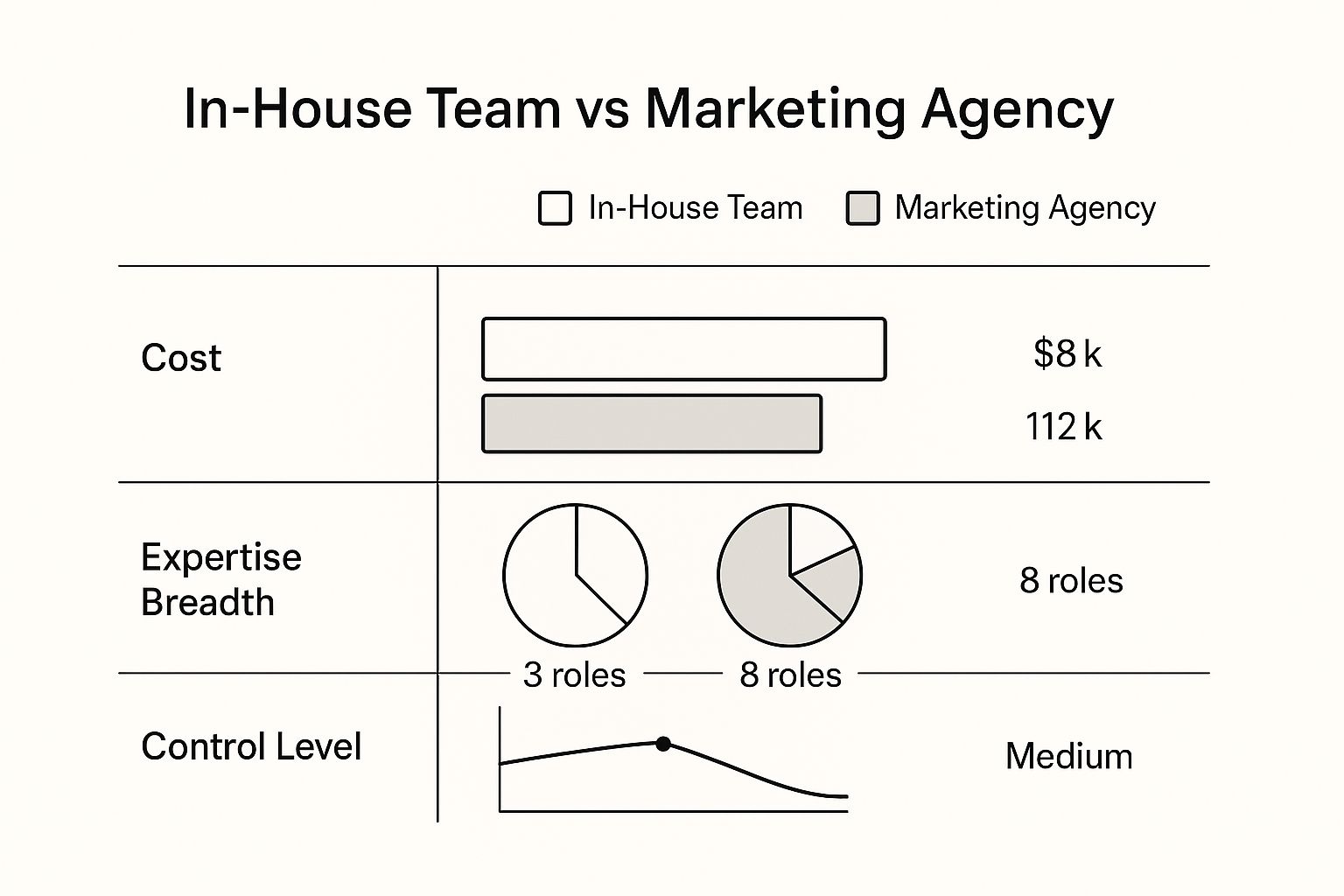
As you can see, an agency might carry a higher monthly price tag, but what you're buying is instant access to a whole team of specialists—something that's tough to replicate with a small internal hire.
To help break this down even further, here's a quick side-by-side comparison. Getting a handle on these core differences is the first critical step in building a solid marketing decision-making process that will actually support your business objectives.
Quick Look: In-House vs. Agency at a Glance
This table provides a high-level summary, highlighting the primary differences between building your own team and hiring an external one across key business factors.
| Factor | In-House Team | Marketing Agency |
|---|---|---|
| Primary Advantage | Deep brand knowledge and a true cultural fit. | Broad expertise and the ability to scale up or down quickly. |
| Control Level | High: You have direct oversight of every task and strategy. | Medium: It's a collaborative partnership defined by your contract and goals. |
| Speed to Impact | Slower, as it involves a full hiring and onboarding process. | Faster, with specialists who are ready to hit the ground running. |
| Cost Structure | Fixed overhead, including salaries, benefits, and tools. | Variable costs, typically structured as retainers or project fees. |
| Perspective | Internal viewpoint, completely aligned with the company's culture. | External perspective that brings in fresh ideas and market-wide insights. |
This at-a-glance view sets the stage for a much deeper dive into what each of these factors really means for your daily operations and long-term growth.
A Deep Dive into Cost Structures and Real ROI
When you’re weighing an agency against an in-house team, the conversation inevitably turns to money. But just comparing a monthly retainer to a salary is a surefire way to make the wrong call. To get the real picture, you have to dig into the total cost of ownership and what the return on that investment actually looks like for each path.
The expenses for an in-house team run much deeper than just salaries. You're also on the hook for payroll taxes, health insurance, retirement contributions, and paid time off. On top of that, there are the costs of recruiting, ongoing training, and the hefty price tag for the software and tools a modern marketing team needs to function.
An agency’s retainer might seem high at first glance, but it often bundles costs that would otherwise be separate, unpredictable expenses for an in-house team, such as specialized software subscriptions and ongoing professional development.
In contrast, an agency's pricing feels more straightforward, but it comes in a few different flavors. Getting to know these models is the key to finding a partnership that fits your budget and your goals.
Unpacking Agency Pricing Models
Agencies don’t have a one-size-fits-all billing sheet. Their pricing is designed to be flexible, matching different client needs and project scopes in a way a fixed-salary employee just can't.
- Monthly Retainer: This is the classic model. You pay a set fee every month for a specific list of services. It makes budgeting predictable and keeps the partnership rolling.
- Project-Based Fees: Perfect for one-off jobs like a website overhaul or a targeted campaign launch. You agree on a flat fee for a project with a clear start and finish line.
- Performance-Based: Here, the agency’s pay is directly linked to hitting specific KPIs, like a certain number of leads or closed sales. It’s a high-stakes, high-reward structure that puts your goals and the agency's goals in perfect alignment.
Each model has its place. A retainer is great for long-term work like SEO and content, while a project fee is just what you need for a time-sensitive product launch.
Calculating the True Cost of an In-House Team
The decision really hinges on a full cost breakdown. Research suggests that building even a modest four-person in-house team can run you between $450,000 to $550,000 a year. That’s after you add up all the direct employee expenses and the hidden costs like training and equipment. An agency might have a significant price tag, but its flexibility lets you scale services up or down as needed, which can offer much better value in the long run.
This broader view shows that an agency retainer of, say, $10,000 per month ($120,000 annually) can be a far more economical move than building a department from the ground up. It's also worth drilling down into specific service expenses, like understanding video editing costs, to see just how quickly specialized, one-off tasks can inflate an in-house budget.
Connecting Cost to Realistic ROI Scenarios
At the end of the day, the right choice isn't about which option is cheaper—it's about which one delivers the highest ROI for your business right now. That means looking past the initial spend to the speed and quality of the returns.
Scenario 1: Agency Delivers Faster ROI
A tech startup needs to generate leads for its new software, and they need them yesterday. Hiring an agency gives them instant access to a team of PPC specialists and data analysts who can launch and tweak campaigns in a matter of weeks. That speed allows the startup to start bringing in revenue much faster than if they'd spent the next six months hiring and onboarding their own people.
Scenario 2: In-House Drives Sustainable Growth
An established B2B company operates in a complex, highly regulated industry. They need marketing that’s built on deep product knowledge and a sharp eye for compliance. An in-house team, fully immersed in the company culture and the nitty-gritty of the products, is perfectly positioned to create authentic, expert-level content. That deep institutional knowledge builds long-term trust and drives sustainable organic growth—an ROI that’s harder to measure but incredibly valuable. This kind of detailed approach is essential for accurate marketing mix modeling to properly attribute value over the long haul.
Comparing Expertise and Skill Development
Your marketing success ultimately comes down to having the right talent. When you’re weighing a marketing agency vs in house team, you’re really choosing between two very different ways to access expertise. One model is built on breadth, the other on depth. Neither is automatically better—the right call hinges entirely on your company's immediate goals and where you want to be in the long run.
Think about it this way: an agency gives you instant access to a whole roster of specialists. Need a deep technical SEO audit, a complex paid media campaign, and a new content strategy—all at once? Building an internal team with that kind of diverse, top-tier talent could easily take a year and a huge budget. An agency brings that ready-made team to the table from day one.
This is precisely why agencies can attract and keep elite talent in niche fields. A full-time data scientist or a dedicated conversion rate optimization (CRO) specialist is often a tough sell for a single company's payroll. But for an agency serving dozens of clients, that expert is a core, invaluable asset.

The Agency Advantage: Specialist Knowledge on Demand
By their very nature, marketing agencies are learning machines. They're constantly in the trenches, working across multiple industries and testing countless strategies, tools, and platforms. This cross-pollination of ideas means they often spot emerging trends or algorithm shifts long before in-house teams, who are naturally focused on just their own world.
This constant exposure is a powerful antidote to strategic stagnation. While an internal team might master what works in their specific vertical, an agency brings fresh eyes and proven tactics from entirely different markets. They might take a strategy that killed it for an e-commerce brand and apply it to a B2B SaaS company, unlocking growth you never would have found otherwise.
Specialization is becoming non-negotiable. Recent data shows that 64% of companies choose to work with marketing agencies primarily for their superior access to specialized skills. In a world where data analytics and AI-driven marketing are critical, many businesses find it impossible (and incredibly expensive) to keep an in-house team at the bleeding edge of every single discipline.
The In-House Edge: Deep Brand and Audience Immersion
On the other hand, the expertise of an in-house team is cultivated, not bought. These marketers live and breathe your brand every single day. They're in the product development meetings, they talk directly with the sales and customer service teams, and they absorb your company culture in a way no external partner ever could.
This deep immersion leads to an almost intuitive understanding of your product's quirks and your audience's real-world pain points. An in-house content marketer doesn't just write about your solution; they understand the why behind it. That lets them craft messaging with an authenticity and authority that's nearly impossible for an outsider to replicate.
An in-house team's greatest strength is its institutional memory. They don't just know what campaigns worked; they know the history, the failed experiments, and the subtle cultural shifts that led to the current strategy.
This built-in knowledge makes your marketing far more agile and aligned. When a new competitor pops up or a product feature gets an update, your in-house team can react immediately. There are no lengthy briefs or kickoff calls needed. Their skill development is perfectly synced with the company’s growth, creating a powerful, self-reinforcing cycle of expertise that allows you to build a clear and effective content marketing team structure that evolves with your business.
Comparing Skill Development Pathways
The way talent grows in each environment is also a major point of difference. Agency pros are thrown into a high volume of diverse challenges, which accelerates their skills in specific channels. In-house marketers tend to develop more T-shaped skill sets, combining deep knowledge of their industry with a broader competence across the marketing function.
Here’s a look at how that breaks down:
| Aspect of Expertise | Marketing Agency | In-House Team |
|---|---|---|
| Skill Breadth | High; immediate access to specialists (SEO, PPC, design). | Lower; often relies on generalists wearing many hats. |
| Skill Depth | Deep expertise in specific channels and tactics. | Unmatched depth in your product, brand, and industry. |
| Knowledge Source | Insights from dozens of industries and client experiences. | Direct collaboration with sales, product, and leadership. |
| Learning Curve | Minimal; specialists are ready to go from day one. | Steep; new hires need extensive brand and product onboarding. |
Ultimately, your choice is a strategic one. Do you need immediate, specialized firepower to seize a market opportunity right now? Or are you playing the long game, investing in the organic growth of a team that is woven into the very fabric of your organization?
Evaluating Control and Cultural Integration
Beyond budgets and skill sets, the marketing agency vs in house debate really gets interesting when we talk about day-to-day operations. How much direct control do you really need? And how important is it that your marketing team feels like a part of your company culture? These aren't soft questions—they directly impact how fast you can move and how consistent your brand feels.
An in-house team is the gold standard for integration. They're in the building (or the company-wide Slack), absorbing your brand's DNA by osmosis. They hear the same all-hands updates, grab coffee with the sales team, and get the inside scoop on product development. This creates an incredibly powerful, unified front.
That seamless connection makes you nimble. A competitor makes a surprise move? A huge PR opportunity just landed in your lap? An in-house team can huddle up and pivot strategy in an afternoon. There are no formal briefs to write or contract addendums to sign. You just get it done.

The Power of Brand Immersion
The real magic of an in-house team is that they don't just learn your brand voice; they help shape it. They live and breathe the brand every single day. This deep, almost intuitive understanding ensures every blog post, every ad, and every campaign feels genuinely authentic.
It’s a level of immersion that's incredibly difficult for any external partner to truly replicate. Your marketing becomes a natural extension of every other part of the business, from product to sales.
Structured Partnership vs. Seamless Collaboration
On the other hand, working with an agency is, by design, more structured. Quick chats by the water cooler are replaced with scheduled calls, detailed project briefs, and formal approval cycles. While this can sometimes feel a bit slower, that structure is also a hidden strength.
It forces you to be crystal clear about your goals, feedback, and expectations. Everything is documented. A great agency partnership is built on this very foundation of intentional, accountable communication.
An agency’s greatest asset might be its outside perspective. They can challenge your team’s long-held assumptions and save you from the dreaded "echo chamber" effect, where a company gets so locked into its own worldview that it completely misses what customers actually want.
An agency isn't burdened by your company's internal politics or the "we've always done it this way" mentality. Their advice is grounded in data, cross-industry experience, and a fresh look at your strategy. That objective viewpoint can be the catalyst you need to break out of a rut and unlock new growth.
To lay it all out, let's look at how these operational dynamics stack up side-by-side.
Operational Dynamics In-House vs Agency
This table breaks down the core operational differences between having your own team and hiring an agency.
| Operational Factor | In-House Team Advantage | Marketing Agency Advantage |
|---|---|---|
| Communication Speed | Instant. Ideas flow freely and can be acted on in real-time. | Structured. Relies on scheduled meetings and formal communication channels. |
| Cultural Fit | Total immersion. The team is woven into the fabric of the company culture. | Objective distance. Unaffected by internal politics or historical biases. |
| Strategic Control | Absolute. You have direct command over every decision and priority. | Collaborative. Control is guided by shared goals and agreed-upon KPIs. |
| Brand Consistency | Instinctive. The brand voice is second nature and executed organically. | Requires meticulous onboarding and clear brand guidelines to get right. |
| Collaboration | Seamless. Natural integration with other departments like sales and product. | A dedicated external resource that needs a clear internal point of contact. |
Ultimately, your choice here boils down to what your business needs to thrive. If your marketing depends on deep, nuanced product knowledge and constant, fluid teamwork with other departments, an in-house team is probably your best bet. But if you're looking for an objective viewpoint to challenge your thinking within a structured, goal-focused partnership, an agency brings a unique strategic edge to the table.
When Does a Marketing Agency Make the Most Sense?
Figuring out whether to go with a marketing agency or build an in-house team often boils down to your company's stage and immediate needs. Bringing on an agency isn't just about handing off a to-do list; it’s a strategic decision to plug in specialized skills and scale up your marketing efforts right when it counts. In a few key situations, an agency is the obvious, most effective path to growth.
Think about an early-stage startup. The pressure is on to get market traction and build a brand fast. They need to get the word out and start bringing in leads immediately, but they almost never have the budget or time to build a full marketing department from scratch. An agency gives them a ready-to-go, experienced team on day one—a massive advantage when speed is everything.
This lets the founders stay focused on the product and running the business while marketing experts handle the complex stuff. You get the brainpower of a senior marketing team without the long-term financial burden of salaries, benefits, and overhead.
You Need a Specialist for a Specific Job
Let's say your current team is fantastic at creating content and managing social media, but you're about to dive into a complex paid advertising campaign on multiple platforms. That requires a very specific skill set—deep knowledge of ad platforms, bidding strategies, and conversion optimization. Trying to build that skill internally could mean months of training or a tough search for the right hire.
This is a textbook case for bringing in an agency. You can hire specialists for that one project, tapping into their expertise to make sure your campaign hits the mark and delivers a solid ROI. It’s a smart way to fill a temporary skill gap without adding permanent headcount. When looking for outside help, for example, understanding the specific benefits of hiring an SEO agency for a highly technical project can make the decision much clearer.
Here are a few common scenarios where an agency's specialized help is a game-changer:
- Technical SEO Audits: Getting into the weeds of site architecture, Core Web Vitals, and schema markup that’s beyond what a marketing generalist can handle.
- Advanced PPC Management: Running sophisticated campaigns on Google Ads or LinkedIn with big budgets and complicated targeting.
- Breaking into New Markets: An agency with experience in international expansion can navigate local customs, languages, and cultural marketing styles.
You Need a Fresh Pair of Eyes
Sometimes, your biggest roadblock is the echo chamber inside your own company. When an in-house team has been focused on the same brand for years, it's easy to develop blind spots. They might be too attached to old strategies or simply miss major shifts happening in the market.
An agency's greatest asset can be its objectivity. They aren't tied to your company’s internal politics or the "that's how we've always done it" mindset. They bring a fresh, data-first perspective on what’s truly working and what's not.
This kind of outside look can be a catalyst for change. An agency will benchmark your performance against competitors and the industry at large, quickly spotting weaknesses and opportunities your team might have overlooked. Because they work with clients across different industries, their recommendations often bring new ideas to the table you wouldn't have thought of on your own. That honest, unbiased feedback is exactly what you need to break through a plateau and keep your marketing sharp.
When to Bring Your Marketing In-House
While plugging into an agency gives you an instant team, the whole in-house vs. agency debate looks different when you're playing the long game. If your goal is to build deep brand equity and knowledge that sticks around, then building your own team is a serious contender. It's a major investment, for sure, but sometimes it's the only way to forge a real, lasting competitive edge.
This path usually makes sense for established companies that have hit a certain level of scale and predictability. There's often a tipping point where your monthly agency retainers start looking a lot like full-time salaries. When that happens, the financial case for bringing talent inside gets pretty compelling. You stop seeing marketing as just another monthly expense and start treating it as an investment in your people and your company's own brainpower.
You're in a Niche or Highly Regulated Field
If your product is super technical or you're navigating a heavily regulated space like finance or healthcare, the learning curve for an outside agency is steep—and risky. An in-house team, on the other hand, lives and breathes this complexity every single day. They don’t just memorize the rules; they understand the why behind them.
This kind of deep, day-in-day-out knowledge is vital for creating marketing that's both accurate and genuinely speaks the language of your customers. Your team can walk down the hall (or hop on a quick Slack call) with product developers, legal counsel, and sales engineers to make sure every campaign is on point and compliant. It’s a level of seamless integration that’s incredibly difficult to replicate with an external partner.
When your brand's authority is built on expertise, you can't afford to outsource your voice. An in-house team becomes the keeper of that authority, ensuring every message is steeped in real, firsthand knowledge.
This direct line to internal experts lets your marketing move faster and with more confidence—a clear advantage when weighing the marketing agency vs in-house decision.
Your Brand's Voice Is Everything
For businesses built on a strong, personality-driven brand, authenticity isn't just a buzzword; it's non-negotiable. An in-house team is immersed in your company culture from their very first day. They get the inside jokes, know the company history, and absorb the subtle cultural DNA that makes your brand one-of-a-kind.
This total immersion means they can create content that feels real because it is real. This is especially true for brands that depend on a passionate community. An agency can study your brand guidelines, but an internal team lives your brand.
This deep connection is a game-changer in a few key scenarios:
- Founder-led brands where the company's identity is fused with a specific person's vision.
- Community-focused businesses that succeed based on authentic engagement and user-generated content.
- Mission-driven organizations where every single marketing message has to be perfectly aligned with core values.
Your Marketing Data Is a Secret Weapon
Finally, think about building an in-house team when your marketing data and processes are a core part of what makes you competitive. By keeping your analytics, customer data, and strategic planning under your own roof, you have total control and security. This lets you build a powerful, data-driven marketing machine that’s perfectly tuned to your business, ensuring your most valuable insights never walk out the door.
Frequently Asked Questions
You’ve got the high-level breakdown, but what about the nitty-gritty? Choosing between building an in-house team and hiring an agency brings up a lot of practical questions. Let's tackle some of the most common ones I hear from business leaders.
Is It Possible to Use a Hybrid Model with Both an In-House Team and an Agency?
Not only is it possible, but for many growing businesses, it's the smartest way to operate. A hybrid approach lets you play to your strengths. You can keep your core brand strategy, day-to-day social media, and content creation in-house where that deep, institutional knowledge really shines.
Then, you can bring in an agency for heavy-lifting or highly specialized projects. Think technical SEO audits, complex pay-per-click campaigns, or a major video production project. This gives you the best of both worlds: the consistent brand voice from your internal team and access to top-tier specialists when you need them most.
What Are the Biggest Red Flags to Watch for When Hiring a Marketing Agency?
When you're vetting agencies, you need to keep your eyes open for a few warning signs. The biggest red flag is anyone promising "guaranteed results" without outlining clear, measurable KPIs. Marketing has variables; a good partner knows this and focuses on strategy, not empty guarantees. Another is a cookie-cutter proposal that feels like it could be for any company.
A reputable agency won't just act like a vendor; they'll become a strategic partner. They should be asking you tough questions about your business, being totally transparent about how they work, and pushing to define what success actually looks like from day one.
Also, be wary of high staff turnover (ask who will be on your account), poor communication right out of the gate, or any hesitation to share detailed case studies and client references. A confident agency has nothing to hide.
How Long Does It Realistically Take to Build a Good In-House Marketing Team?
Let's be clear: building a solid in-house team from scratch is a marathon, not a sprint. Just the hiring process—from writing job descriptions to interviewing, vetting, and onboarding—can easily take 6 to 12 months to get a core group of 3-4 specialists in place. We're talking about a content manager, an SEO specialist, a paid ads manager, for instance.
And that's just getting them in the door. It takes even more time for them to truly gel as a team, learn your company's culture and products inside and out, and hit their stride. It’s a serious investment in building a long-term asset.
In the Long Run, Is It Actually Cheaper to Hire a Marketing Agency?
This one truly depends on your company's scale and specific needs. For most small to medium-sized businesses, an agency is almost always the more cost-effective option. You get a whole team of experts—strategists, copywriters, designers, SEO pros—for less than the fully-loaded cost of a few full-time hires once you factor in salaries, benefits, training, and software.
But as you grow, the math starts to change. For a large enterprise with constant, high-volume marketing needs, there's a tipping point where paying hefty monthly agency retainers becomes more expensive than building your own team. At that scale, bringing the talent in-house is often the more financially prudent long-term play.
At ReachLabs.ai, we act as a seamless extension of your team, providing the specialized expertise and strategic partnership that drives real growth. Discover how our collective approach can elevate your brand.