Generating new leads is the lifeblood of any small business. It’s the process of finding people who are genuinely interested in what you offer and guiding them toward becoming loyal customers. This isn't about just ticking off a list of marketing chores; it's about building a reliable, predictable system that keeps your sales pipeline full and fuels real, sustainable growth.
Why Smart Lead Generation Is Your Growth Engine
Let's be real—finding new customers can feel like a never-ending grind, especially when you're juggling a tight budget and an even tighter schedule. It's easy to think of lead generation as a complicated, expensive game played only by big companies with massive marketing departments. But that's a huge misconception. A smart, focused approach can turn this challenge into your single most powerful engine for growth.
It’s a shift from just "getting your name out there" to creating a deliberate process. This means knowing exactly who you want to reach, what problems they're desperate to solve, and where they hang out online. Instead of shouting into a crowded room, you're starting meaningful conversations with the right people.
From Obstacles to Opportunities
The challenges are real. You're up against limited resources, tough competition, and the pressure to make every single dollar count. In fact, most small businesses are in the same boat; nearly 78% spend between $100 and $1,000 a month on their marketing efforts. You can find more lead generation statistics at seoprofy.com that highlight this reality.
This is precisely why a well-crafted lead generation plan is so critical. It forces you to focus only on what will move the needle.
The goal is to build a system where growth isn't just a happy accident—it's intentional. When you consistently attract the right people and nurture their interest, you create a steady stream of opportunities that keeps your business thriving.
This playbook is designed to give you that exact system. We're going to break down everything you need to build a successful lead generation strategy, piece by piece.
- Pinpointing Your Ideal Customer: We’ll go beyond surface-level demographics to uncover what truly motivates them.
- Choosing the Right Channels: You’ll learn to focus your energy where your audience actually is, not where you think they are.
- Offering Genuine Value: It’s all about creating irresistible reasons for prospects to connect with you.
- Tracking and Optimizing: I’ll show you how to use simple data to do more of what works and ditch what doesn't.
Laying the Groundwork for High-Quality Leads
Jumping into lead generation without a plan is like trying to drive across the country without a map. You'll definitely burn a lot of fuel (and cash), but you probably won't end up where you wanted to go. The most successful campaigns I've ever seen didn't start with flashy ads; they started with solid foundational work.
This prep work ensures that every piece of content, every ad, and every dollar you spend is aimed squarely at the people who are most likely to become your best customers.
It all starts with getting crystal clear on what "success" actually means for your business. A vague goal like "get more leads" is a recipe for frustration because it gives you no finish line. You need specific, measurable targets that guide your strategy and tell you if you're actually winning.
Define Your Goals with the SMART Framework
The best way to turn a fuzzy idea into a concrete plan is by using the SMART framework. It forces you to think through the details and create objectives that are truly actionable.
- Specific: Instead of "more leads," get precise. "Generate 50 qualified leads for our new web design package."
- Measurable: How will you know you're succeeding? "We'll track form submissions from our landing page in our CRM."
- Achievable: Be honest about your resources. Is the goal a stretch but still possible? "Based on past campaigns, 50 leads in a quarter is ambitious but doable."
- Relevant: Does this actually help your business grow? "These leads are crucial for hitting our Q3 revenue target of $15,000."
- Time-bound: Give yourself a deadline to create urgency. "This goal must be achieved by the end of Q3."
With a SMART goal locked in, you suddenly have a North Star for your entire campaign. Every decision becomes easier because you can ask a simple question: "Will this help us get to 50 leads this quarter?"
Create Buyer Personas That Actually Work
Once you know what you're aiming for, you have to figure out who you're talking to. This is a classic stumbling block for small businesses. Too many rely on vague demographics like "women, ages 30-50," which tells you almost nothing about what they actually need or want.
You need a practical buyer persona—a detailed, semi-fictional profile of your ideal customer built from real data and research. Think of it as a character sketch for the person you’re trying to help.
A detailed buyer persona is your marketing compass. It guides your content, your channel selection, and your messaging, ensuring you're speaking directly to the people who need you most.
Let's say you run a small accounting firm. Instead of targeting the generic "small business owner," you could create a persona for "Jasmine, the Freelance Designer."
Jasmine's Profile Might Include:
- Role: Solopreneur, freelance graphic designer.
- Challenges: Hates tracking expenses, dreads tax season, and feels totally overwhelmed by financial paperwork. She's a creative, not a numbers person.
- Goals: Wants to spend more time designing and less on admin. She needs to feel confident and in control of her business finances.
- Online Habits: Hangs out in freelance communities on Facebook, follows design influencers on Instagram, and Googles things like "how to manage freelance finances."
See how much clearer that is? Now you know exactly what blog posts to write, which social media platforms to use, and what pain points to highlight in your ads. For a much deeper dive, you can explore our full guide on how to identify your target audience.
This infographic gives a great overview of how to prioritize your efforts based on the typical constraints small businesses face.
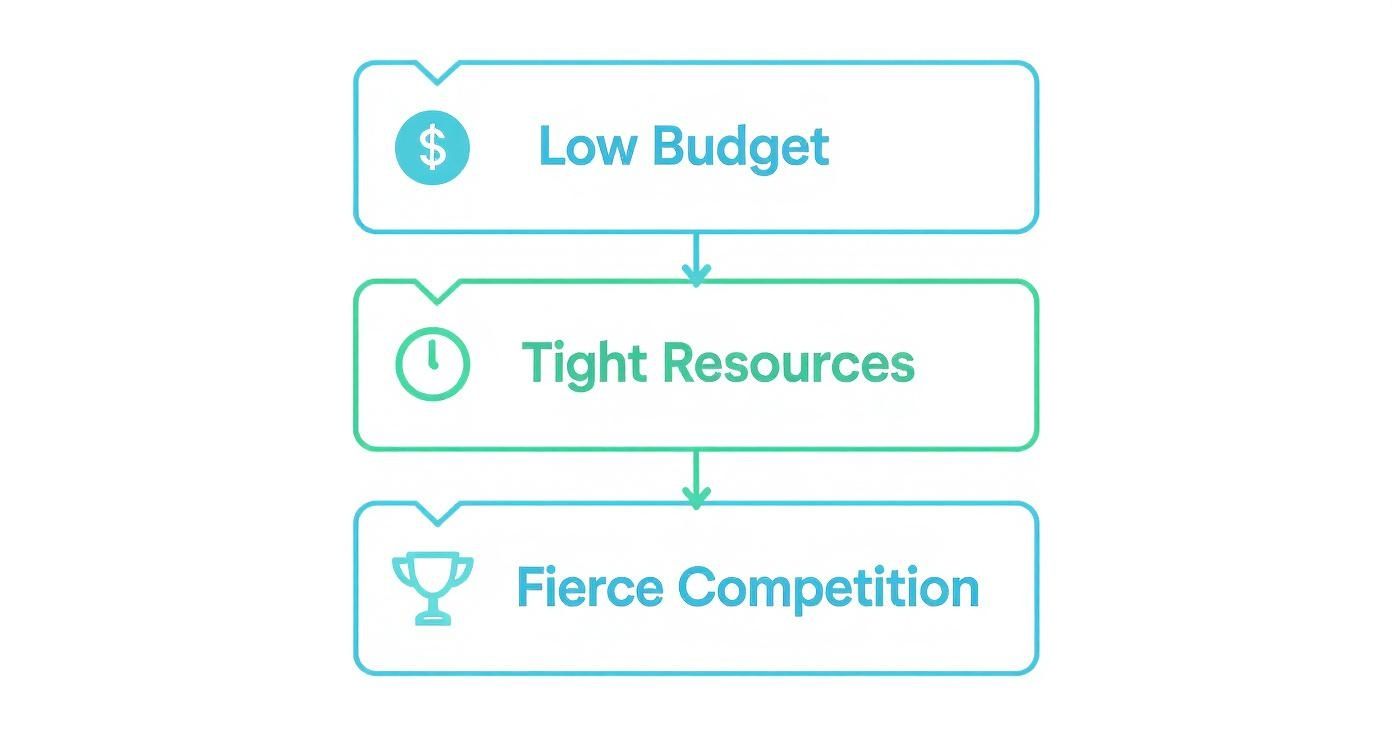
As the visual shows, your specific limitations—whether it's your budget, your time, or the competition—should directly shape the strategies you choose. There's no one-size-fits-all answer.
Winning Leads with Organic Content and Social Media
When every dollar in your budget counts, finding a way to generate leads without a massive ad spend is a total game-changer. This is where organic content and social media come in. Think of it as your powerhouse duo for creating a steady, sustainable flow of interested prospects.
I'll be honest, this approach is a marathon, not a sprint. It’s all about building real trust and establishing yourself as an authority over time.
The core idea is beautifully simple: become the go-to answer for your ideal customer's biggest problems. Instead of paying to interrupt their day with an ad, you're showing up with valuable help right when they need it most. That builds a foundation of trust that paid ads just can't buy.
Become the Expert with SEO and Content
Search Engine Optimization (SEO) is the engine that drives this whole strategy. It’s the craft of getting your website seen by people who are actively searching on Google for the exact solutions you provide. When someone types in a problem, you want your business to be one of the first things they see.
High-quality content is how you make that happen. This isn’t about just churning out blog posts for the sake of it. It’s about creating genuinely helpful resources that your buyer personas are actually looking for.
Here are a few ways to start creating content that pulls people in:
- Definitive "How-To" Guides: If you're a local bakery, a detailed guide like "How to Choose the Perfect Wedding Cake" could attract engaged couples right at the start of their planning.
- Shareable Checklists: A financial advisor could create a "New Parent Financial Checklist." It’s an incredibly useful tool that helps young families navigate a huge life change.
- Local SEO for Brick-and-Mortar: If you have a physical location, local SEO is everything. That means keeping your Google Business Profile updated with current hours, fresh photos, and a clear list of services. And don't forget to encourage those happy customers to leave reviews!
The numbers back this up. A solid 67% of companies are using content marketing to generate leads. Why? Because it brings in three times more leads than old-school outbound marketing and costs 62% less. That’s a massive win for any small business.
The real magic of organic content is that it works for you 24/7. A single, well-written blog post can keep attracting qualified leads for months—or even years—after you hit "publish." It's an incredible return on your initial time investment.
By consistently putting out valuable content, you’re not just climbing the search rankings. You’re cementing your reputation as an expert in your field. To really get this right, take a look at our full guide on https://www.reachlabs.ai/content-marketing-for-small-businesses/.
Drive Engagement on Social Media
Social media is the other critical piece of the organic puzzle. This is where you build a community, have real conversations, and show the human side of your brand. The key is to stop thinking about it as just a place to post ads and start treating it like a place for genuine connection.
You don't need to be on every single platform. Just be active on the one or two channels where your "Jasmine, the Freelance Designer" persona actually hangs out. Once you know where to focus your energy, you can start getting creative.
Turn Followers into Warm Leads
On social media, your goal is to build relationships that make people want to learn more about what you do. That means you have to be a resource first and a salesperson second.
Here are a few practical ways I’ve seen this work wonders:
- Use Interactive Features: Run a poll in your Instagram Stories asking your audience about their biggest challenges. This is basically free market research, and it can give you incredible ideas for your next lead magnet.
- Join Relevant Groups: Get active in Facebook or LinkedIn Groups where your ideal customers gather. Answer questions and share your expertise without a sales pitch. Just be helpful. You'll quickly become a trusted voice.
- Go Behind the Scenes: People connect with people, not logos. Share content that shows the real, human side of your business. That kind of transparency builds a level of trust a polished ad could never achieve.
Authentic engagement is what turns a passive follower into an active lead. By being consistently helpful and present, you warm up your audience over time. For more proven strategies to generate leads on social media that actually convert, check out this resource. It’s a great way to ensure that when you finally do make an offer, your audience is ready to listen because they already know, like, and trust you.
Driving Results with Paid Ads and Direct Outreach
https://www.youtube.com/embed/hLFYOS_lGOE
While organic content is a fantastic long-term asset, sometimes you just need to make the phone ring now. This is where paid advertising and direct outreach shine. Think of them as your accelerators, letting you jump the line and get in front of your ideal customers with precision and speed.
I get it. The idea of spending your hard-earned money on ads or sending cold emails can feel like a huge gamble, especially for a small business. But the key is to stop thinking of it as a gamble and start treating it as a calculated investment. With the right strategy, you can generate high-quality leads surprisingly quickly and see a direct return on every dollar spent.
Mastering Paid Ads on a Small Budget
Paid ad platforms like Google and Facebook give you incredible targeting power. You can get your message directly to the people most likely to buy from you, which makes your budget work that much harder. The goal isn't to outspend your competition; it's to outsmart them with better, more focused targeting.
Where to Spend Your Ad Dollars
Google Ads is all about capturing intent. You're showing up for people who are actively searching for a solution you provide. Imagine you're a local plumber. An ad that pops up when someone frantically searches "emergency plumber near me" is incredibly powerful because it meets an immediate, urgent need right in the moment.
On the flip side, Facebook and Instagram Ads are brilliant for capturing attention. Here, you can target users based on their interests, behaviors, and demographics. This is where you find your "Jasmine, the Freelance Designer" persona by targeting users who follow design publications, belong to freelance communities, or use small business software.
For a deeper dive, a solid guide on PPC marketing for small business can really help you nail the fundamentals.
Here are a couple of my favorite, must-use tactics for small businesses:
- Retargeting: Have you ever visited a website, only to see their ads follow you around the internet? That’s retargeting. It’s a simple but powerful way to show ads only to people who've already visited your site but didn’t take action. It keeps you top-of-mind and gives them a gentle nudge to come back.
- Lookalike Audiences: This feature is an absolute game-changer. You can upload a list of your best customers, and the platform’s algorithm will build a brand new audience of people who share similar traits. It's one of the most effective ways I've seen to find new, high-quality prospects without guessing.
Launching a Human-Centered Email Outreach Campaign
Direct email outreach is another fantastic tool, especially if you're in the B2B space. But let's be clear: the days of blasting generic, robotic emails to a massive, purchased list are over. Success today is all about personalization and offering real value from the very first sentence.
Don't underestimate email. It's consistently ranked as one of the most effective lead generation channels, with 48% of marketers citing it as their top method for generating leads in 2025. With an average cold email open rate for B2B small businesses at 27.7% and a reply rate of 5.1%, even a small, thoughtfully targeted campaign can deliver incredible results without a huge price tag.
A successful outreach campaign is built on research. Before you even think about writing, you have to know who you're talking to and what they actually care about.
Cold outreach fails when it's all about you. It succeeds when you make it all about them. Your first email should feel less like a sales pitch and more like a helpful introduction from one professional to another.
Here’s a simple, human-sounding template you can steal and adapt:
Subject: Quick question about [Their Company Name]
Hi [First Name],
I was just looking at your website and was really impressed with the work you're doing on [mention something specific, like a recent project or blog post].
My company helps businesses like yours with [your one-sentence value proposition]. Given your focus on [their company's goal], I thought you might find it interesting how we helped [a similar client] achieve [a specific, impressive result].
Would you be open to a 15-minute call next week to see if this could be a good fit for you too?
Best,
[Your Name]
Why does this work? It’s personalized, it proves you’ve done your homework, and it focuses entirely on their potential benefit. It’s a low-pressure way to start a real conversation. By combining the speed of paid ads with the personal touch of direct outreach, you create a powerful lead generation system that drives results today while fueling your growth for tomorrow.
Turning Website Visitors into Engaged Leads
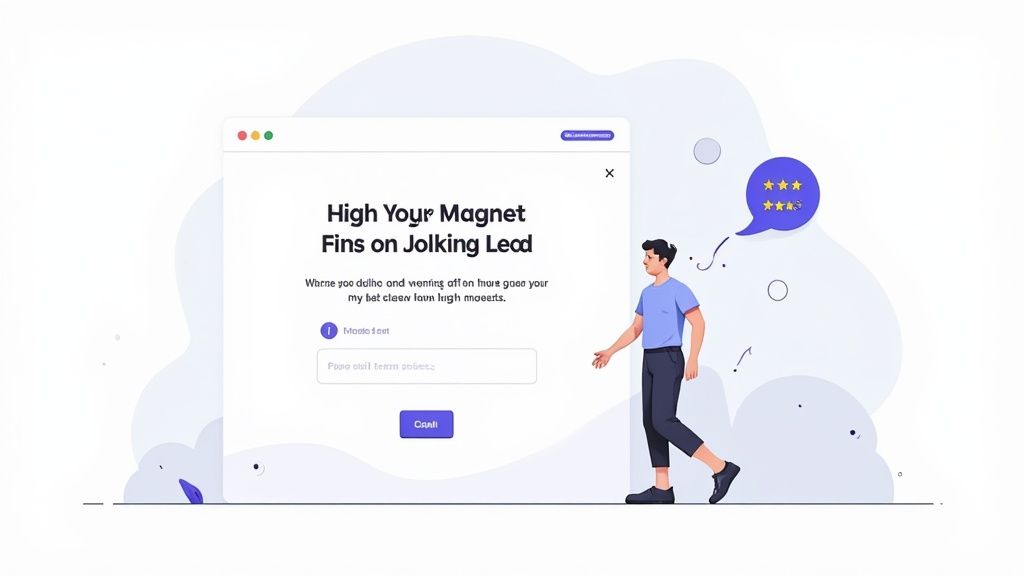
Getting traffic to your website is a huge win, but let’s be honest—it’s only half the battle. A website visit is fleeting, but an email address? That’s an asset. This is where you master the art of conversion, turning those curious clicks into real, engaged leads you can build a relationship with.
The secret to this whole process is a simple exchange of value. You can't just put up a form and expect people to hand over their email. You have to earn it. That's where the lead magnet comes in. Think of it as an irresistible, high-value freebie you offer in exchange for their contact info.
This isn’t about some slick marketing trick. It’s about being so genuinely helpful that your ideal customers want to hear from you again.
Crafting the Perfect Lead Magnet
A great lead magnet solves a specific, nagging problem for your ideal customer. What’s their biggest frustration? The one question they always seem to ask? The answer to that is the seed of your perfect lead magnet. It has to be something they can digest quickly and put to use right away.
Here are a few real-world lead magnet ideas that just plain work:
- For a service business (like an IT consultant): A PDF checklist called "The 5-Minute Weekly Security Audit for Small Businesses." It's specific, actionable, and hits a major pain point for their target market.
- For an ecommerce shop (selling handmade soaps, for example): An exclusive 15% discount code on their first order. This is a classic for a reason—it offers immediate financial value and nudges them toward a purchase.
- For a local pro (like a personal trainer): A free "7-Day At-Home Workout Plan" designed for beginners. This gives them a taste of your expertise and a tangible result, making them far more likely to sign up for your actual services.
The best lead magnets deliver a quick win. They make your new lead feel smart and capable, which is the perfect way to kick off a strong customer relationship.
Building a High-Converting Landing Page
Once you've got your killer lead magnet, you need a dedicated place to offer it up. This is your landing page—a single, focused web page with one mission: to get that visitor to convert. A landing page is not your homepage. It’s a clean, distraction-free environment where your offer is the star of the show.
Your landing page is your 24/7 digital salesperson. It has to grab attention, build trust, and make it unbelievably easy for someone to say "yes."
Every single element on the page—from the headline to the button color—should work toward that one goal. If it doesn't help with the conversion, it gets cut. Simple as that.
Anatomy of an Effective Landing Page
To build a page that actually turns traffic into leads, you need to nail these critical components:
- A Magnetic Headline: This is the first thing people read. It needs to shout the benefit of your lead magnet, loud and clear. Instead of "Download Our Ebook," try something like "Learn to Double Your Instagram Engagement in 30 Days." One is a boring command; the other is a powerful promise.
- A Crystal-Clear Value Proposition: Use a few punchy bullet points to explain what they're getting and why it’s so valuable. Don't talk about features; talk about the transformation. What problem will it solve? What amazing result can they expect?
- Trust-Building Elements: People are rightfully protective of their inbox. You need to build trust in a split second. A short testimonial from a happy client or logos of places you've been featured can work wonders here.
- A Frictionless Form: This is where so many businesses stumble. Please, only ask for the information you absolutely need. For most lead magnets, a first name and email address are more than enough. I guarantee it: the more fields you add, the more your conversion rate will drop.
By pairing a genuinely valuable lead magnet with a sharp, persuasive landing page, you create a powerful system for generating leads. This isn't just about collecting emails. It’s about starting meaningful conversations with people who are actually interested in what you do.
Measuring Your Success and Optimizing for More Leads
You've done the hard work of launching your campaign. That's a huge milestone, but the real magic starts now. The path from a good campaign to a great one is paved with data, and it's all about tracking your efforts to make smarter decisions over time. This is where you stop guessing what works and start knowing.
It really boils down to a handful of core metrics. You don't need a complicated dashboard—just a clear view of the numbers that actually move the needle for a small business.
Key Metrics to Watch
Think of these as your campaign's vital signs:
-
Conversion Rate: This is your most important number. It’s simply the percentage of people who do what you want them to do. If 100 people land on your page and 5 sign up, your conversion rate is 5%. It tells you how effective your offer and page are.
-
Cost Per Lead (CPL): This one is all about efficiency. How much are you paying for each new lead? If you spend $200 on an ad campaign and get 10 leads, your CPL is a crisp $20. This metric is crucial for managing your budget.
Knowing these two numbers lets you compare apples to apples. You can finally see if your Google Ads are more cost-effective than your LinkedIn outreach, which is essential for figuring out where to double down. For a much deeper dive, check out our guide on how to measure marketing campaign success.
The goal isn't just to get leads; it's to get them without breaking the bank. Tracking your CPL and conversion rates is how you make sure every dollar you spend is pulling its weight.
You don't need expensive software to get started. A free tool like Google Analytics is more than enough. You can set up simple conversion goals to see exactly how many people who click a link from your newsletter end up on your "thank you" page.
A Simple Approach to A/B Testing
Once you know your baseline numbers, you can start tinkering to improve them. This is where A/B testing comes in, and it's not as complex as it sounds. You’re just comparing one version of something against another to see which one performs better.
Here’s a classic example: Test two different headlines on your landing page.
- Version A: "Download Our Free Guide"
- Version B: "Get the Ultimate Checklist for…"
You'd send half your traffic to Version A and the other half to Version B. After a week or so, the data will show you which headline convinced more people to sign up. No guesswork needed.
This cycle—act, measure, refine—is the secret sauce. It’s an ongoing process that turns a decent lead generation strategy into a predictable engine for business growth, ensuring your results get better and better over time.
A Few Common Lead Gen Questions We Hear All the Time
Even the best-laid plans run into real-world questions. I've heard these from countless small business owners over the years, so let's tackle the big three sticking points right now.
What’s a Realistic Lead Generation Budget?
There’s no one-size-fits-all answer here, but a good rule of thumb is to set aside 7-10% of your gross profit for all your marketing efforts. If you're just starting out or launching a big new product, you might want to bump that up temporarily to build some early momentum.
For most small businesses, a starting budget often falls somewhere between $100 and $1,000 a month. The smartest thing you can do is avoid spreading that too thin. Instead of trying to be everywhere, pick one or two channels you can really own—like a highly specific Facebook Ads campaign or a solid content strategy—and get good at them first.
How Long Does This Actually Take?
Your timeline really comes down to your strategy. If you need leads now, paid advertising and direct outreach are your fastest paths. You can literally start seeing results within a few hours of launching a campaign. You’re essentially paying for speed.
On the other hand, organic strategies like SEO and creating valuable content are a long game. You're building an asset. It can easily take 3-6 months to see a steady flow of traffic and leads from these channels, but the reward is a system that keeps working for you around the clock, long after you've put in the initial effort.
What if Nothing’s Happening?
First off, take a deep breath. It happens to everyone. The goal isn't to get it perfect on day one, but to figure out why it's not working. Don't throw the whole strategy out—instead, get back to basics.
Ask yourself these three questions:
- Is the right person seeing this? This is the number one reason campaigns fail. An amazing offer shown to the wrong audience will always fall flat.
- Is my offer actually compelling? Does your lead magnet or ad solve a painful, urgent problem for your ideal customer? If it's just a "nice-to-have," it won't get them to act.
- Is my landing page making it easy for them? A confusing layout, a vague headline, or a form that asks for too much information will absolutely tank your conversion rates.
The trick is to isolate one thing at a time. Test a new headline. Tweak your ad copy. Try a completely different lead magnet. The entire process is a cycle: measure what happened, learn from it, and adjust.