
Getting more people to click on your stuff—whether it's an ad, an email, or a search result—really comes down to one thing: being more interesting and relevant than everyone else. This means writing magnetic headlines that people can't ignore, crafting persuasive meta descriptions that promise value, and using structured data to make your search listings pop. These aren't complicated tricks; they're just smart ways to show both people and search engines that you have the best answer.
Why You Can't Afford to Ignore Your Click-Through Rate

Before you start obsessing over the numbers, let's talk about why CTR is such a big deal. It’s not just a percentage on a dashboard; it’s a direct reflection of how well your message is connecting with the people you’re trying to reach. When you have a high CTR, platforms like Google see it as a huge thumbs-up, signaling that your content is a great match for what people are looking for.
This little signal can create a huge ripple effect. For organic search, a consistently strong CTR can actually help boost your rankings over time. In the world of paid advertising, it's a massive part of your Quality Score. A better score almost always means you pay less for your ads and get better placement. It's a win-win.
It's Not Just About Clicks—It's About Quality Clicks
A great headline or ad does more than just get a click. It gets the right click.
When your message is a true reflection of what’s on your landing page, you’re essentially pre-qualifying your traffic. The people who land on your site are the ones who are genuinely interested in what you’re offering. This is the first step toward better on-site engagement and, ultimately, more conversions.
Think about it. A clickbait-y title might get you a spike in traffic, but if those visitors hit the back button a second after they arrive (hello, high bounce rate), search engines take note. They learn that your page wasn't a good answer for that search, and that can tank your rankings down the road.
A high CTR is just a vanity metric if it doesn't lead to conversions. The real goal isn't just any click—it's the right click from a user whose intent lines up perfectly with your offer.
Before we get into the nitty-gritty, here's a quick overview of how the core principles of CTR apply across different channels.
Quick Guide to Improving CTR Across Channels
| Marketing Channel | Primary CTR Lever | Key Tactic |
|---|---|---|
| Organic Search | Titles & Snippets | Write compelling, benefit-driven title tags and meta descriptions. |
| Paid Ads | Ad Copy & Headline | Address the user's pain point directly and include a strong call to action. |
| Email Marketing | Subject Line | Create curiosity and urgency while clearly stating the email's value. |
This table is a great starting point, but now it's time to explore the specific, actionable strategies you can use to really move the needle. We'll be covering how to boost your CTR in these key areas:
- Organic Search: Going beyond basic titles to use structured data for eye-catching results.
- Paid Ads: Crafting ad copy and headlines that are simply irresistible.
- Email Campaigns: Writing subject lines that practically beg to be opened.
Writing Headlines and Ad Copy That People Actually Click

Think of your headline as the digital handshake. In a crowded feed or a packed search results page, it’s your first and often only chance to get someone to stop scrolling and pay attention to what you have to say. If it falls flat, the brilliant content behind it might as well not exist.
Getting this right is about more than just following a formula. It's about tapping into the psychology of what makes people genuinely curious. You can start by getting a handle on title tag best practices, which will help with both rankings and clicks, but the real magic happens when you layer in persuasion.
Signal Clear Value with Numbers and Data
There's a reason you see so many headlines with numbers—they just work. Our brains love them. They cut through the noise of a text-heavy page, they create a sense of order, and they promise a predictable, easy-to-digest piece of information. "7 Ways to Improve Your Garden" feels much more manageable and concrete than the vague "How to Improve Your Garden."
Let's imagine a quick A/B test for a project management tool:
- Version A: "Tips for Better Project Management"
- Version B: "11 Project Management Tips for a More Productive Week"
Version B is going to win almost every time. The number "11" is specific, making it feel more credible and substantial. Adding the benefit "for a More Productive Week" connects the tips directly to a reader's goal. In fact, some studies show headlines with numbers can pull in 40% more clicks. That’s not a small difference.
Spark Curiosity by Asking Questions
When you ask a sharp, relevant question in a headline, you immediately engage the reader's brain. It’s a direct invitation into a conversation. You're framing a problem they likely have and positioning your content as the answer they need. A good question creates an "information gap" that people feel a natural urge to close.
So instead of a flat statement like, "Why Organic Marketing Works," try flipping it into a question: "Is Your SEO Strategy Missing This One Key Element?" See the difference? The second one creates a touch of anxiety and a powerful need to know what that missing element is.
Your headline’s job isn’t to give the answer—it’s to make the user desperately want to find it. Frame a problem, hint at a solution, and let curiosity do the rest.
Lean on Emotional Triggers and Power Words
Words carry weight. Some carry more than others. In copywriting, we call these "power words"—words that are proven to spark an emotional response and drive action. Weaving them into your headlines and ad copy can give your CTR a serious boost.
Here are a few examples of how this works in practice:
- Create Urgency: Now, Instantly, Limited, Hurry
- Hint at Exclusivity: Secret, Unlocked, Members-Only, Insider
- Showcase Value: Free, Proven, Guaranteed, Effortless
The trick is to pick words that resonate with your audience's specific desires. If you're looking for a deeper dive into this, exploring professional resources on copywriting for businesses is a great next step for crafting messages that connect and convert.
At the end of the day, writing copy that gets clicks is really an exercise in empathy. It’s about putting yourself in your reader’s shoes, understanding what keeps them up at night, and then framing your content as the fastest, most valuable solution to their problem. It’s both an art and a science, and when you get it right, it becomes one of the most effective tools you have.
Winning the Click on the Search Results Page
Landing a spot on the first page of Google is a huge win, but it's only half the battle. Ranking well gets you seen, but the real prize is earning the click. This is where we move beyond basic SEO and start thinking about your search engine results page (SERP) listing as a tiny, high-stakes advertisement for your content.
Organic search is an absolute powerhouse, driving about 53% of all website traffic worldwide. And with the SEO industry expected to be worth around $90 billion in 2024, the competition for eyeballs is more intense than ever. This is precisely why just showing up isn’t enough—you have to convince searchers to choose your result over everyone else's.
Craft Meta Descriptions That Act Like Mini-Adverts
Think of your meta description as your sales pitch on the SERP. While it's not a direct ranking factor anymore, it has a massive influence on whether someone actually clicks on your link. Stop stuffing it with keywords and start answering the user's real question: "Why should I click this?"
A truly effective meta description nails three things:
- It hits a nerve. It quickly identifies the pain point or problem the searcher is trying to solve.
- It promises a clear solution. It spells out exactly what the user will get by clicking, often using action-oriented words.
- It includes a gentle nudge. Simple phrases like "Learn how," "Discover the steps," or "Find your solution" can make all the difference.
This process flow shows how all the pieces of an optimized SERP listing fit together.
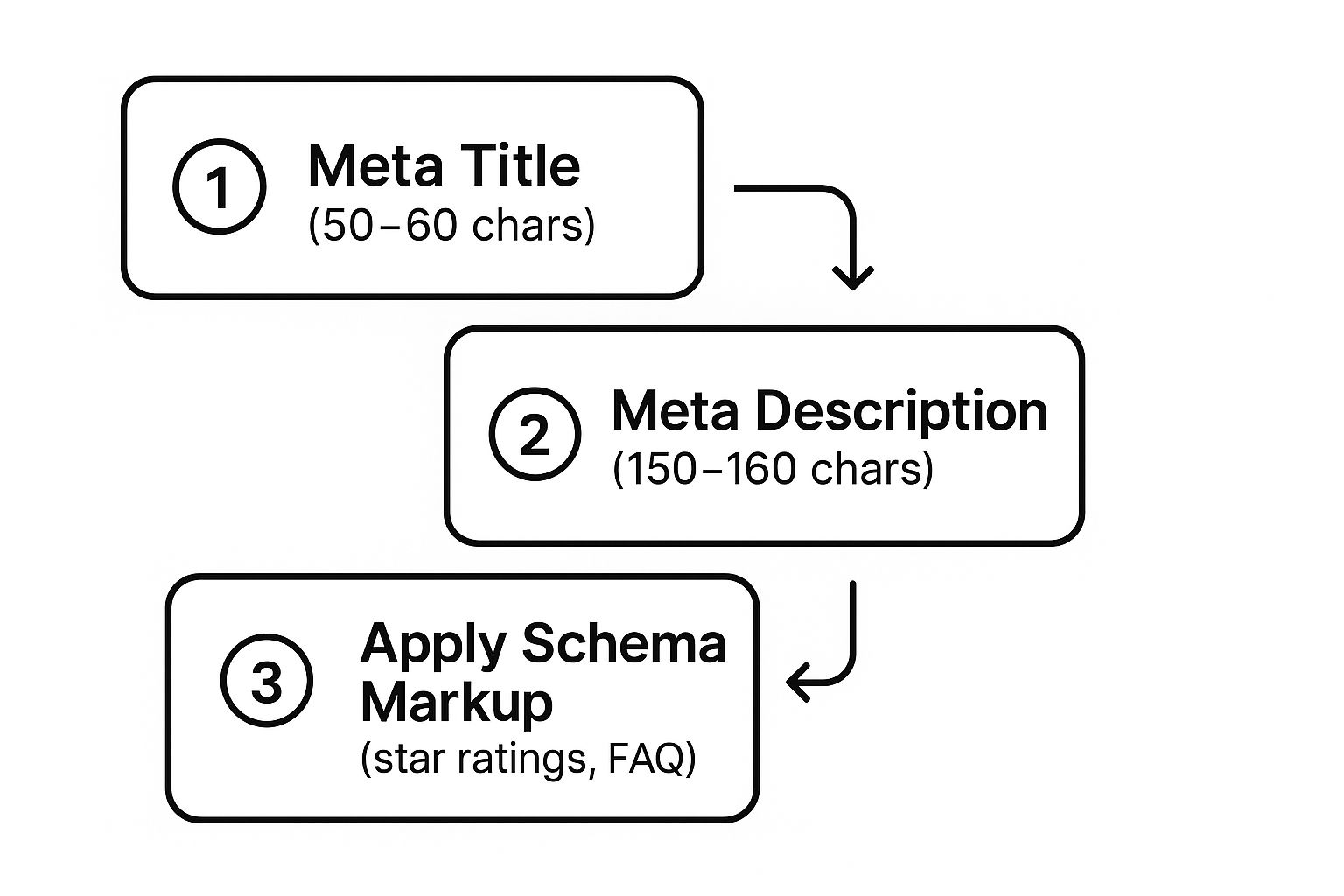
As you can see, a powerful title and description, beefed up with Schema, create the complete, click-worthy package you’re aiming for.
Use Structured Data to Create Rich Snippets
Structured data, often called Schema markup, is a bit of code you add to your site to help search engines make sense of your content. When you do it right, Google might reward you with eye-catching Rich Snippets that make your listing pop right off the page.
Think of Rich Snippets as a visual upgrade for your search listing. They make your result stand out, build immediate trust, and can dramatically improve your organic click-through rate without changing your ranking.
Some of the most effective types of Rich Snippets for boosting CTR include:
- Review Stars: Nothing builds trust faster than social proof. Perfect for products, recipes, or local services.
- FAQ Dropdowns: Answering common questions directly in the SERP takes up more real estate and instantly positions you as an expert.
- Price and Availability: For e-commerce stores, showing this information upfront is a magnet for high-intent buyers ready to make a purchase.
Implementing Schema might sound complicated, but a lot of WordPress plugins and online generators have made it much more accessible. And remember, success on search engines often involves a two-pronged attack—it's just as important to master your Google Ads campaign optimization to capture every possible click.
Optimize Your Title Tags and URLs
Your title tag is prime real estate. Beyond just your main keyword, small tweaks can have a huge impact on your CTR. Adding simple modifiers like [Guide], (Checklist), or the current year helps manage expectations and tells users exactly what they’re getting.
The same goes for your URL. A clean, readable URL like yourdomain.com/improve-ctr-guide feels far more trustworthy than a garbled mess of numbers and symbols. A logical URL structure doesn't just look better; it also helps both users and search engines understand how your site is organized. Of course, this all starts with targeting the right terms, so check out our guide on how to find the best keywords to get your foundation right.
Adapting Your Strategy for an AI-Powered Search World
The search engine results page (SERP) is going through a massive shake-up. With the introduction of AI Overviews, Google is now trying to answer questions directly on the results page, which is leading to a boom in what we call "zero-click searches."
For many of us, this is a scary thought. If users get their answers without visiting our sites, what happens to our traffic? This new reality demands a strategic pivot. The goal isn't to fight the AI, but to work with it—and sometimes, around it. The key is to figure out what AI can't easily summarize and what still makes a user need to click.
The data already paints a pretty stark picture. One recent 12-month analysis found organic CTR plummeted by a staggering 67.8% on SERPs where AI Overviews were present. It's a clear signal that we can't rely on old-school tactics anymore. If you want to dig deeper, you can read more about these search trends to get the full story.
Creating Content That Demands a Click
To keep your traffic flowing, your content has to offer something an AI summary can't. AI is fantastic at scraping together basic facts, definitions, and simple lists. Where it falls short is in delivering genuine insight, nuanced analysis, or a unique perspective. That's your opening.
This is where you can really lean into creating content that has depth and a distinct point of view. Think about focusing on:
- In-depth case studies that tell a real story and showcase tangible results.
- Original research and data analysis that provides insights your competitors simply don't have.
- Expert interviews or roundups that bring multiple authoritative voices into a single, valuable resource.
- Actionable tutorials that use custom graphics, screenshots, or videos to guide users through a process. A simple text summary just can't compete with that.
When a user sees a title that promises a deep-dive analysis or a unique dataset, their curiosity is piqued. They know an AI summary won't give them the full picture, which makes them far more likely to click through.
Diversifying Your Traffic Sources
If this AI shift has taught us anything, it's that putting all your eggs in the organic search basket is a huge gamble. It's always been risky, but AI Overviews have turned up the heat. Now, more than ever, is the time to build traffic channels you actually own and control.
Don't just build a website; build an audience. A loyal email list or a strong social media following gives you a direct line to your community that no search engine can ever take away.
Start by making these channels a priority:
- Build a high-value email list: Offer something genuinely useful in exchange for an email—an exclusive guide, a free tool, or a members-only discount.
- Grow an engaged social media following: Instead of being everywhere, pick one or two platforms where your ideal customer hangs out and go all-in on building a community there.
By cultivating these direct relationships, you create a much more resilient business. You're no longer completely dependent on the whims of search engine algorithms, ensuring you can always reach your audience, no matter what changes come next.
Tailoring Your CTR Strategy for Different Industries and Devices

A good click-through rate isn't a magic number that works for everyone. What’s considered a huge win for an e-commerce store selling sneakers will almost certainly be a total flop for a B2B software company. To get real results, you have to dig into the nuances of your industry and understand how your audience interacts with you on different devices.
The tone, the offer, and the emotional triggers that resonate with one audience can fall completely flat with another. A retail brand, for instance, might crush it with urgent, flashy copy like "Flash Sale Ends Tonight!" But a law firm? They need to build trust with measured, authoritative language that screams expertise.
Mastering The Mobile-First Mindset
Most of your audience is on their phone. This isn't news, but it means optimizing for small screens is no longer optional—it's table stakes. A headline that looks perfectly crafted on your desktop monitor can get butchered on a smartphone, instantly killing its appeal.
Your mobile game plan needs to cover all the bases:
- Write Punchy Headlines: Keep them short and sweet. Put the most important words first so the core message survives even if the title gets cut off.
- Simplify Everything: Mobile users are distracted. They're on the go. You have to get straight to the point in your ad copy, emails, and meta descriptions. No fluff.
- Speed Is Everything: A slow-loading landing page is the ultimate click-killer. Someone taps your ad, waits more than a couple of seconds, and they're gone. A fast, high-converting landing page is non-negotiable if you want to turn those clicks into actual customers.
The mobile experience is the user experience now. Before you push anything live, pull it up on your phone. What you see there is what most of your audience is going to see.
Adapting To Your Niche And Device Benchmarks
CTR benchmarks are all over the map depending on the industry. Just look at some recent data from early 2025—websites ranked #1 on desktop got an average CTR bump of about 1.31 percentage points. Digging deeper, the auto industry saw a 1.92 percentage point increase for that top desktop spot.
On the flip side, the legal and political sector actually saw a 1.92 percentage point drop in mobile CTR for sites ranked in the second position. It just goes to show how much device and industry can swing your numbers. You can find more of these CTR trends on Advanced Web Ranking to see how you stack up.
The key is to look at your own analytics. Where does your most valuable traffic come from? If you find that 80% of your conversions happen on desktop, it’s time to double down on perfecting that experience. But if mobile gets tons of clicks but no sales, you probably have a broken landing page or a clunky checkout process to fix.
This is how you win: stop chasing universal best practices and start tailoring your approach based on what your own data tells you. That's how you get the right people clicking.
Got Questions About CTR? We’ve Got Answers.
When you start digging into click-through rates, questions are bound to pop up. It's a metric with a lot of layers. Getting straight answers is the only way to feel confident you're on the right track. Let’s clear up some of the most common things marketers wonder about when they're trying to boost their CTR.
Think of this as your go-to reference for making sense of the data and turning insights into action.
What Is a Good Click-Through Rate?
Ah, the million-dollar question. The most honest answer I can give you is, it depends. A "good" CTR isn't a single, universal number. It’s completely relative to your industry, the platform you're on, and even the specific keywords you're bidding for.
For instance, the average CTR for a Google search ad hovers around 3-5%. But if you're talking about a display ad, that number plummets to somewhere between 0.5-1%. Meanwhile, snagging that number one spot in organic search can get you a CTR well over 30%.
Don't get caught up chasing some generic industry benchmark. The best way to measure success is against yourself. A good CTR is one that's consistently getting better than it was last month. Aim to beat your own records first.
How Do I A/B Test for a Better CTR?
Successful A/B testing comes down to one thing: being methodical. The cardinal rule is to test only one variable at a time. Seriously. If you tweak the headline, the image, and the CTA button all in one go, you'll have no idea which change actually moved the needle.
Always start with a simple hypothesis. Something like, "I bet using a question in the ad headline will spark more curiosity and drive more clicks than a plain statement."
Here are a few ideas to get you started:
- Ad Copy: Pit a headline with a number against one without.
- Email Subject Lines: Try adding a relevant emoji versus a clean, text-only version. Or test personalization with a first name.
- CTAs: Experiment with button color or wording. Is "Get Started" more compelling than "Try for Free"?
And remember, let the test run long enough to get statistically significant results. Jumping to conclusions based on a small handful of clicks is a classic mistake that can lead you down the wrong path.
Can a High CTR Ever Be a Bad Thing?
You bet it can. A high CTR can quickly become a dangerous vanity metric if those clicks don't translate into actual business results, like leads or sales. This usually happens when your ad or title is pure clickbait—it makes a big, flashy promise that your landing page simply can't back up.
When someone clicks expecting one thing and gets another, they bounce immediately. This mismatch creates a frustrating user experience, wastes your ad spend, and sends all the wrong signals to platforms like Google. A high bounce rate essentially tells the search engine that your result wasn't a good match, which can hurt your rankings over the long haul.
The goal isn't just to get a click; it's to get the right click from someone who's genuinely interested in what you have to offer. Always look at your CTR next to your conversion rates and on-page engagement to see the full story.
At ReachLabs.ai, we focus on building data-driven marketing strategies that do more than just attract clicks—they drive real, sustainable growth. Our team looks past the surface-level metrics to create campaigns that truly connect with your audience and deliver results. To see how our collective approach can elevate your brand's voice and performance, visit us at https://www.reachlabs.ai.