
When you start looking into what a digital marketing agency costs, you'll see numbers all over the place, from a lean $50 to over $6,000 per month. That huge range isn't a typo. It simply reflects the vast differences between a small startup needing a little help and a large company going all-in on a multi-channel strategy.
The price tag really depends on what you need, how big your business is, and the agency's track record.
Decoding Agency Pricing Models
Opening an agency proposal for the first time can feel a little intimidating. The numbers and line items might seem confusing, but at their core, they're just different ways for an agency to package its time and expertise. Getting a handle on these models is the key to comparing quotes and finding a partner that actually fits your budget and your goals.
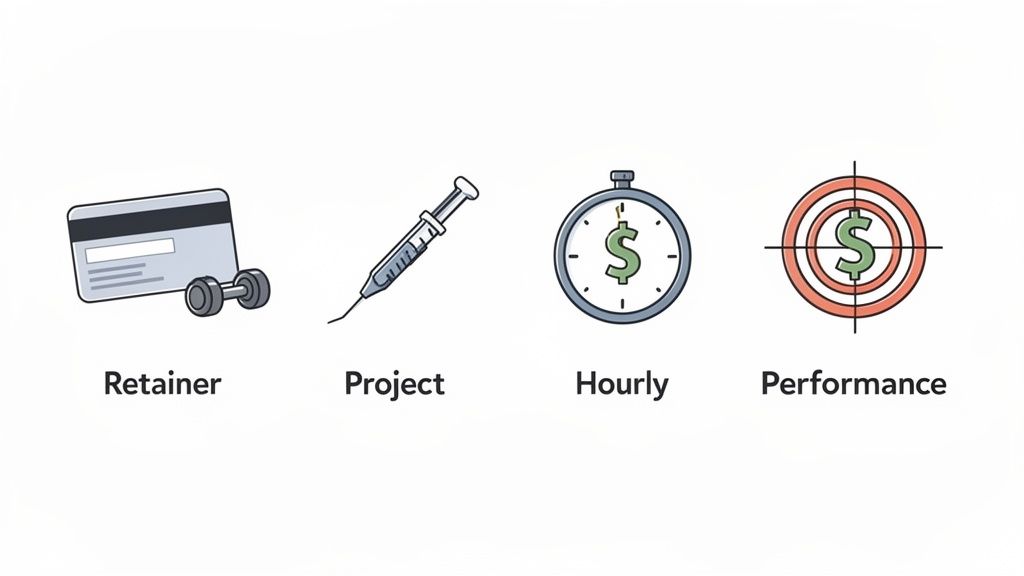
The way an agency structures its pricing tells you a lot about how they work with clients. Some are built for steady, long-term partnerships, while others are geared up for short, focused sprints. That $50 to $6,000+ monthly range is almost entirely shaped by which pricing framework they use.
The Four Core Pricing Structures
Most agencies will base their proposals on one of four main models. Each one has its own pros and cons, making them a better fit for different kinds of projects and business goals. Let's break them down.
-
Monthly Retainer: This is the go-to model for long-term work like SEO, content creation, or social media management. Think of it like a subscription. You pay a set fee every month, and in return, you get consistent work and ongoing access to their team. It’s great for predictable budgeting and building a real strategic relationship.
-
Project-Based Fee: Perfect for one-and-done jobs with a clear finish line—things like building a new website, creating a brand guide, or launching a specific ad campaign. You agree on a single, fixed price for a specific outcome. This gives you total cost control for isolated tasks.
-
Hourly Rate: You'll often see hourly billing for consulting, training sessions, or small, unpredictable fixes. Rates usually fall between $75 and $200+ per hour. It’s flexible, but it can make budgeting tricky and doesn't always incentivize the agency to work efficiently.
-
Performance-Based Pricing: This is the most interesting model. The agency's pay is directly tied to the results they deliver, like the number of leads generated or a percentage of sales. It's fantastic because everyone's goals are perfectly aligned. However, it's less common because it can be really tough to track and agree on what counts as a success. If you're curious, you can explore various pricing structures to see real-world examples.
The big question is this: Are you paying for a list of tasks, or are you investing in a business outcome? A project or hourly rate buys you tasks. A retainer or performance model buys you a partner who is invested in your growth.
Comparing Agency Pricing Models at a Glance
Choosing the right model can feel overwhelming. This table breaks down the four main structures to help you quickly see which one might be the best match for your business needs and marketing goals.
| Pricing Model | Best For | Budget Predictability | Scope Flexibility |
|---|---|---|---|
| Monthly Retainer | Ongoing, long-term strategies (SEO, Content, Social) | High | Moderate |
| Project-Based Fee | One-off projects with clear deliverables (Web design) | High | Low |
| Hourly Rate | Consulting, small tasks, unpredictable needs | Low | High |
| Performance-Based | Campaigns with easily trackable metrics (Lead Gen) | Variable | Moderate |
Ultimately, the best model depends on your comfort with risk, your need for a predictable budget, and the nature of the work itself.
This decision is also closely tied to the bigger question of whether you should hire an agency or build your own team. Each option has its own financial implications, which you can read about in our complete guide comparing a https://www.reachlabs.ai/marketing-agency-vs-in-house/.
Breaking Down the Cost of Marketing Services
Now that we’ve covered how agencies package their pricing, let’s get into the nitty-gritty of what they actually charge for specific services. The price on a proposal isn’t just a number pulled out of thin air; it’s a direct reflection of the time, expertise, software, and strategic brainpower required to move the needle for your business.
Think of it like building a custom home. The final cost hinges on whether you're dreaming of a cozy bungalow or a sprawling mansion, the quality of the materials you choose, and the skill of the builders bringing it to life.
In the same way, a basic marketing plan is worlds apart from a comprehensive, multi-channel growth strategy. A simple $1,000/month SEO retainer might get you foundational work like keyword research and basic on-page tweaks. But a more serious $7,500/month engagement? That’s where you get deep technical audits, a sophisticated link-building campaign, and a full-funnel content strategy designed to attract and convert customers at every step of their journey.
SEO Service Pricing
Search Engine Optimization (SEO) is a long-term play for your brand's digital real estate. The pricing almost always reflects how fierce the competition is in your niche and the sheer amount of work needed to carve out a top spot. It's not about flipping a switch; it's a marathon of continuous, strategic effort.
- Entry-Level SEO ($750 – $2,000/month): This is your foundation. Expect a thorough site audit, solid keyword research, on-page SEO for your most important pages, and getting your local SEO in order (like your Google Business Profile).
- Mid-Tier SEO ($2,000 – $5,000/month): Here, things get more proactive. This budget typically unlocks ongoing content creation, strategic outreach for backlinks, constant technical SEO monitoring, and much more detailed performance reports.
- Advanced SEO ($5,000+/month): For businesses swimming with sharks in highly competitive markets. This investment covers everything in the mid-tier plus the heavy hitters: programmatic SEO, digital PR campaigns for high-authority links, and deep-dive competitor analysis.
PPC and Paid Media Management Costs
Pay-Per-Click (PPC) advertising is fantastic for getting eyeballs on your brand almost instantly, but it demands careful management to be profitable. Agency fees are usually structured in one of two ways: a percentage of your monthly ad spend (typically 10-20%) or a flat management fee.
Crucially, this fee covers the expertise to run your campaigns—it doesn't include the ad spend itself. That's a separate cost you pay directly to platforms like Google or Meta.
A common mistake is to balk at the management fee. But a skilled PPC manager can easily save you more on wasted ad spend than their fee costs, delivering a much higher return on your total investment.
If you want to get a clearer picture of how agencies allocate their time and resources, looking into models like Activity Based Costing for agencies can be incredibly insightful. This approach helps show exactly how much effort is going into specific tasks within your campaign, making it easier to see the value behind the management costs.
Social Media and Content Marketing Investments
Content and social media are all about building a community, earning trust, and establishing your brand as the go-to expert. The investment here covers the whole nine yards: strategy, creation, distribution, and engagement.
The cost for these services can vary widely because the deliverables are so different. For instance, a basic social media management plan might cost $1,000-$5,000 a month for a small business, while a more involved strategy for a medium-sized company could be anywhere from $2,500-$12,000.
What drives that difference?
- Content Marketing ($2,000 – $8,000/month): This budget can cover anything from blog posts and case studies to detailed whitepapers and video scripts. Pricing is driven by the volume, complexity, and research required for each piece.
- Social Media Management ($1,000 – $7,500+/month): On the lower end, you might get content scheduling on one or two platforms. A higher investment gets you a multi-platform strategy, active community management, influencer collaborations, and deep-dive analytics.
A Practical Guide to Service Costs
To bring these numbers to life, here’s a look at what small and medium-sized businesses can realistically expect to invest each month. Think of this table as a starting point for your budget—it will help you understand what's generally included at different investment levels.
Typical Monthly Investment for Digital Marketing Services
| Service | Small Business Range | Medium Business Range | Key Activities Included |
|---|---|---|---|
| SEO | $1,500 – $4,000 | $4,000 – $10,000+ | Keyword research, on-page optimization, local SEO, content creation, link building |
| PPC Management | $1,000 – $3,000 | $3,000 – $7,500+ | Campaign setup, ad copywriting, bid management, A/B testing, landing page optimization |
| Content Marketing | $2,000 – $5,000 | $5,000 – $15,000+ | Blog writing, email newsletters, case studies, topic ideation, content distribution |
| Social Media | $1,000 – $3,500 | $3,500 – $9,000+ | Content calendar, post creation, community engagement, paid social ads, reporting |
Ultimately, the best approach is to find a service package that aligns directly with what you want to achieve. A local plumber will likely prioritize SEO and PPC to get their phone ringing. On the other hand, a national e-commerce brand might pour their budget into content and social media to build a loyal following. The key is to match your investment to your goals.
The Hidden Factors That Influence Agency Costs
Ever get two proposals for the same marketing services, but the price tags are miles apart? It’s a common experience, and it can leave you wondering what you're missing. The truth is, that final number on a proposal is shaped by a lot more than just a checklist of deliverables.
To really get a handle on digital marketing agency pricing, you need to look under the hood. It’s the only way to understand the true value behind the numbers.
Think of it like this: a neighborhood diner and a Michelin-starred restaurant both serve food. But the expertise, the quality of the ingredients, and the entire experience are worlds apart—and so is the bill. Agency pricing works the same way. You're not just buying a list of tasks; you're investing in a specific caliber of team, strategy, and experience.
Agency Size and Structure
The sheer scale of an agency is a huge factor in what they charge. A large, full-service firm with hundreds of employees has massive overhead. We're talking prime office space, expensive software subscriptions, and layers of management. These resources can be a huge advantage, offering deep expertise in dozens of disciplines, but that infrastructure naturally inflates their rates.
On the other hand, a small boutique agency with a tight-knit team has much leaner operating costs. This often lets them be more competitive on price. You might get a more personal, hands-on feel, but their services might be more specialized. Neither is automatically better; it all comes down to whether you need a broad, integrated team or more focused, dedicated attention.
This image gives you a sense of how a typical monthly budget might be split across key marketing channels.
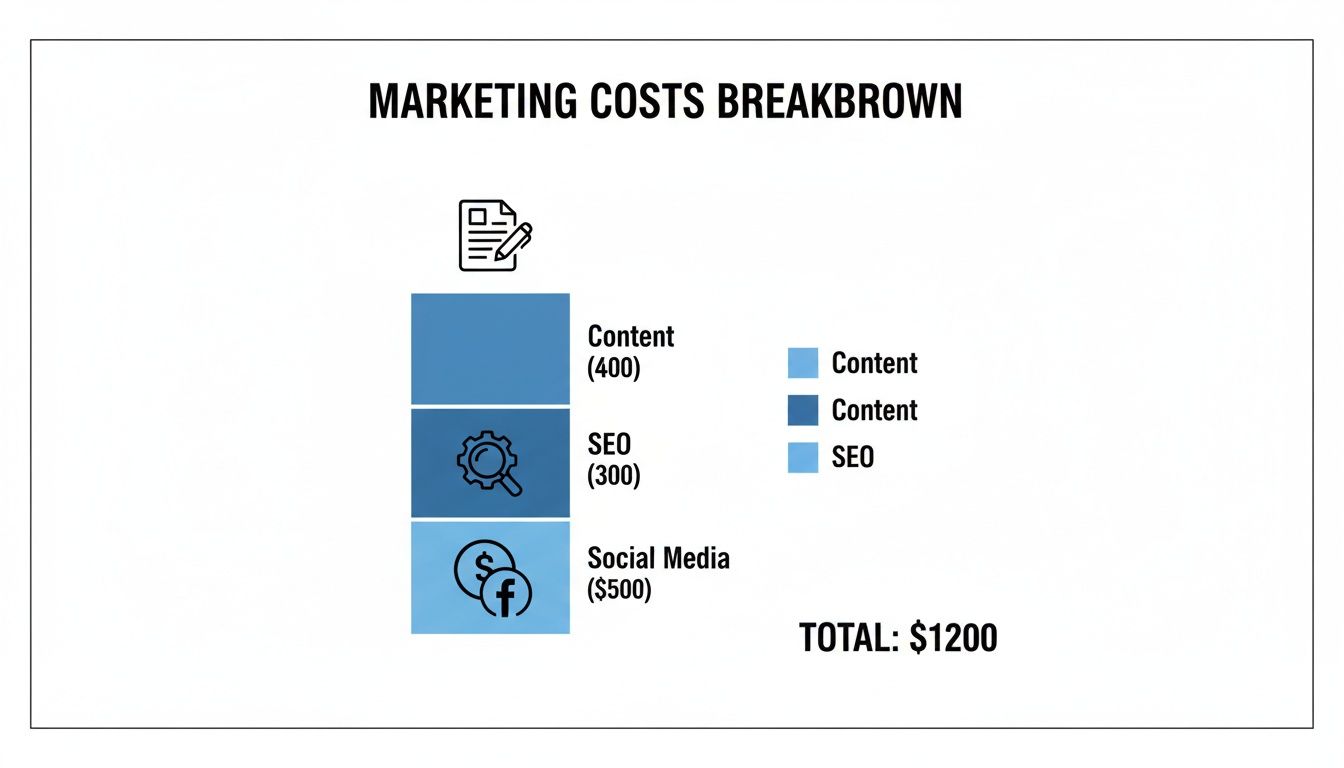
As you can see, a solid growth strategy usually means investing in several channels at once rather than putting all your eggs in one basket.
Location and Geographic Arbitrage
You might be surprised by how much an agency's home base affects its pricing. Just like the cost of living is different from city to city, so are the costs of running a business. An agency with an office in a major hub like New York or San Francisco faces sky-high salaries and rent compared to one in a smaller city or a team that works completely remotely.
These geographical cost differences are a major reason for the price swings you see. For example, small businesses around the world typically budget between $500-$5,000 per month for digital marketing. But an agency in a tier-1 U.S. city might mark up its rates by 10-30% over the national average, while one in a smaller town or with a remote team could offer prices 20-40% lower. You can read more about how location impacts marketing costs to dig deeper into these dynamics.
An agency’s location isn’t just about cost—it’s about the talent pool. A major tech hub offers access to highly specialized experts, which can justify a higher price for businesses that need that specific skill set.
Team Expertise and Specialization
This might be the most important hidden factor of all: who is actually doing the work on your account? Are you getting a senior strategist with a decade of proven wins under their belt, or is your project being handed off to a junior account manager who's still learning the ropes?
An agency that hires and retains seasoned professionals will command higher rates. It's simple, really—expertise leads to better, faster results and helps you sidestep expensive mistakes.
Here's how the team's makeup can influence the price:
- Generalist Agencies: These firms do a little bit of everything. They are often a great, cost-effective choice for businesses that need a wide range of foundational marketing support without going too deep in one area.
- Specialist Agencies: These agencies are hyper-focused on one thing, like B2B SaaS SEO or e-commerce PPC. Their deep knowledge in a specific niche makes them more expensive, but they can be invaluable if you're in a competitive market.
At the end of the day, a higher price often means you're paying for top-tier strategic talent. So when you're comparing proposals, don't just scan the list of services. Ask about the team, their specific experience, and their track record with businesses just like yours. That's how you'll get a true picture of what you're really paying for.
Building a Realistic Marketing Budget
Price lists and cost breakdowns are helpful, but they don't tell the whole story. To really get a handle on digital marketing agency pricing, we need to see how a budget actually comes to life in the real world. Every business is different, and a smart budget is never a one-size-fits-all template.
I like to think of it like planning a road trip. Your total cost is going to depend entirely on where you're going, the kind of car you're driving, and how fast you want to get there. Your marketing budget works the same way—it’s shaped by your business goals, your industry, and how quickly you're trying to grow.
Let's walk through three different business scenarios to see how a strategic budget gets built to deliver real, predictable results. Each one has a totally different goal, which means they need a unique mix of services to win.
Scenario 1: The Local Contractor
First up, let's meet a local plumbing company. Their goal is simple and direct: get the phone to ring with service requests from people in their city and the surrounding suburbs. Success isn't about website traffic; it's about booked appointments.
For a business like this, the marketing strategy has to be laser-focused on local intent. You want to pour your resources into channels that capture customers who are right now searching for a plumber.
Here’s what a sample $4,000 monthly budget could look like:
- Local SEO ($1,500): This is the bedrock of their plan. It means optimizing their Google Business Profile, getting listed in local directories, and making sure their website shows up for searches like "emergency plumber in [City Name]."
- Google Ads (PPC) ($2,000): This breaks down into $1,200 for ad spend and $800 for management. The campaigns would target high-intent keywords, getting them in front of homeowners the second a pipe bursts or a drain clogs.
- Content & Social ($500): A smaller slice of the pie here goes toward creating useful blog posts ("How to Prevent Frozen Pipes") and keeping a professional Facebook page active to build local trust and show off five-star reviews.
Scenario 2: The B2B Software Company
Now, let's shift gears to a B2B SaaS company that’s hungry for rapid growth. Their goal is to attract, educate, and ultimately convert high-value business customers, which often involves a much longer sales cycle. For them, success is measured in marketing qualified leads (MQLs) and booked product demos.
Their strategy needs to build authority and nurture leads over time. That means a much bigger investment in content that proves their expertise and paid ads that can target very specific professional roles. You can dig deeper into marketing budget allocation best practices in our other guide.
A sample $12,000 monthly budget might be allocated this way:
- Content Marketing ($5,000): This is the engine driving their entire strategy. This budget covers in-depth articles, detailed case studies, whitepapers, and webinars—all designed to solve their target audience's biggest problems.
- Technical SEO ($3,000): All that great content is useless if no one can find it. Technical SEO ensures their site is structured properly, helps build authoritative backlinks from industry publications, and ranks for complex B2B search terms.
- LinkedIn Ads & PPC ($4,000): This bucket includes $2,500 in ad spend and a $1,500 management fee. The campaigns would target people on LinkedIn by their job title, company size, and industry, while Google retargeting ads keep them top-of-mind.
These scenarios highlight a critical point: your budget allocation should be a direct reflection of your business goals. A local service company invests in immediate lead capture, while a B2B firm plays the long game by investing in authority.
Scenario 3: The E-commerce Store
Finally, let's look at an online store selling apparel directly to consumers. Their main objective is to scale online sales, boost brand visibility, and encourage repeat purchases. The metrics that matter most are Return on Ad Spend (ROAS) and Customer Lifetime Value (CLV).
Their budget needs to fuel a multi-channel attack that builds a powerful brand presence while converting casual browsers into loyal customers. This naturally means a heavy focus on visual platforms and performance-driven advertising.
A sample $8,500 monthly budget could be broken down like this:
- Paid Social Ads ($4,500): This consists of $3,000 in ad spend and a $1,500 management fee for campaigns on Instagram and Facebook. The goal is to run visually stunning ads that send traffic directly to product pages.
- Content & Influencer Marketing ($2,500): This portion of the budget funds user-generated content campaigns, collaborations with fashion influencers to showcase the apparel, and high-quality lifestyle photography for social proof.
- Email Marketing & SEO ($1,500): This investment keeps the machine running. It supports email automation for things like abandoned cart recovery and special promotions, along with foundational e-commerce SEO to get product pages ranked in Google Search and Shopping.
How to Evaluate Proposals and Measure Real ROI
Okay, so the proposals have started rolling in. This is where the rubber meets the road. It’s your best opportunity to see how an agency really thinks—to move past the sales pitch and see if they’ve built a genuine strategy for your business. A great proposal isn't just a price list; it's a roadmap to your growth.
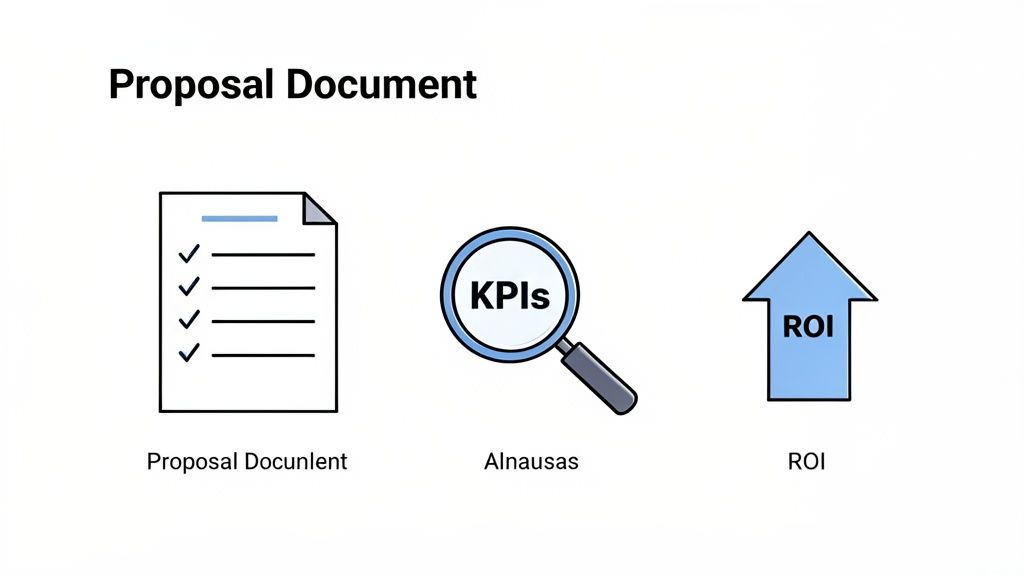
It’s easy to fall into the trap of comparing proposals by the number of deliverables. Agency A offers ten blog posts, but Agency B only offers eight. It’s a common mistake, but it misses the entire point. You’re not trying to buy activities; you're investing in outcomes.
Look for Business Outcomes, Not Just Activities
A strong proposal will always tie its proposed activities directly to your business goals. It won't just promise "social media posting." Instead, it will explain how that posting will boost brand engagement and funnel qualified traffic to your website.
As you review each proposal, keep an eye out for these crucial elements:
- Clearly Defined Deliverables: What are you actually getting? It needs to be specific, like "four 1,200-word blog posts per month" or "full management of a $5,000 monthly Google Ads budget."
- Specific KPIs: How will you know if it's working? Look for concrete metrics like Cost Per Lead (CPL), Return on Ad Spend (ROAS), or a goal like a 20% increase in organic search traffic within six months.
- Reporting Cadence: How often will you hear from them? A solid partner will commit to regular reports (usually monthly) that don’t just show data but explain performance, share insights, and outline next steps.
- Transparent Contract Terms: Is the commitment reasonable? Most good agencies start with a 3-6 month initial term, with clear language about what happens after that.
A proposal focused on business outcomes sounds different. It says, "We will generate 50 qualified leads for your sales team each month," not just, "We will manage your PPC campaign." Always lean toward the partner who speaks your language—the language of results.
Calculating and Measuring True Marketing ROI
Once you're up and running, measuring success becomes the top priority. The most direct way to do this is by calculating your Return on Investment (ROI). The formula is simple, but its purpose is powerful: to show you exactly how much revenue you’re generating for every dollar spent on marketing.
This calculation is the cornerstone of justifying your marketing budget and making smart decisions about where to double down. For a full walkthrough, our guide on how to calculate marketing ROI breaks it down step-by-step.
But remember, true ROI often goes beyond immediate sales. A successful content marketing campaign doesn't just bring in leads today; it builds a digital asset that can attract organic traffic for years to come. That long-term value is incredibly important, even if it's a bit harder to fit neatly into a spreadsheet.
Beyond the Immediate Sale
Think about the wider impact a great marketing partner can have. They're not just running campaigns; they're building assets for your business that grow in value over time.
Consider these long-term gains:
- Brand Authority: Publishing valuable content, month after month, positions you as an expert in your field. This trust makes every future sale just a little bit easier.
- Customer Lifetime Value (CLV): Smart email marketing doesn't just secure one purchase. It nurtures loyalty and encourages repeat business, which dramatically increases the total value of each customer you acquire.
- Owned Audience: Growing your email list or social media following gives you a direct line to your customers. It's a communication channel you own, reducing your long-term dependency on paid advertising.
When you're talking to agencies, ask them how they measure and report on these kinds of long-term assets. A true growth partner gets it. Their job isn’t just to deliver a quick win but to help you build a more resilient and profitable business for the long haul.
A Few Lingering Questions You Might Have
Even after we've walked through pricing models, service costs, and all the variables, you might still have a few questions rolling around in your head. That’s completely normal. Investing in your company's growth is a big decision, and it’s smart to be thorough.
Let's tackle some of the most common questions we hear from business owners and marketing managers when they're trying to nail down their agency budget.
How Much Should a Small Business Actually Spend on Digital Marketing?
A good rule of thumb is to set aside 7-12% of your total revenue for marketing. So, if your business brings in $500,000 a year, you’re looking at a marketing budget between $35,000 and $60,000. Broken down monthly, that’s about $3,000 to $5,000.
But think of that as a starting point, not a hard-and-fast rule. A brand-new company trying to make a splash in a competitive market might need to be more aggressive with its spending right out of the gate. The most important thing is to invest enough to be consistent in one or two key areas, rather than spreading a tiny budget too thin.
Here's some real talk: a monthly agency budget under $1,500 just doesn't have enough gas in the tank. It's tough to gather enough data or build the momentum needed to see real, scalable results. Consistency is everything.
Are Cheaper Digital Marketing Agencies a Good Deal?
It’s always tempting to go for the lowest price, but that initial "deal" often comes with hidden costs that can hamstring your business down the road. Rock-bottom pricing usually means the agency is cutting corners somewhere important.
Here’s where you might feel the pain:
- Inexperienced Staff: Your account could end up in the hands of junior marketers who are learning on your dime, leading to rookie mistakes and missed opportunities.
- Outdated Tactics: Some low-cost providers still rely on old-school tricks, like spammy link building, that can get you penalized by Google.
- One-Size-Fits-All Strategies: Without the time or resources for a deep dive, they’ll likely slap a generic template on your business, completely ignoring what makes you unique.
The goal isn't to find the cheapest option; it's to find the best value. An agency that costs more but delivers a 3x return on your investment is infinitely better than a cheap one that gets you nowhere. Always look for proof of quality—case studies, client testimonials, and a transparent process are non-negotiable.
What Red Flags Should I Look for in an Agency Proposal?
An agency's proposal tells you a lot about how they operate. Learning to spot the warning signs can save you a world of headaches and wasted money. Keep an eye out for these red flags.
First, be skeptical of long-term contracts (over 12 months) that don't have a clear way out. A confident agency is happy to prove its worth on a shorter 3-6 month agreement before locking you into something longer.
Second, run from anyone making absolute promises like "guaranteed #1 Google rankings." Nobody can guarantee that. Search engine algorithms are way too complex and fluid, so making that kind of promise is a huge red flag that signals they're using questionable methods.
Third, a lack of transparency is a major problem. If they're vague about who will be working on your account or how they'll actually measure success, it's a sign of a dysfunctional partnership. A true partner is an open book from day one.
Finally, if the proposal is stuffed with confusing jargon and is light on specific, measurable goals (KPIs), take a step back. A great agency speaks your language and ties every single action back to your business objectives.
At ReachLabs.ai, we don't just sell services; we build partnerships. Our team is a collective of world-class specialists who create data-driven strategies tied directly to your revenue. If you’re ready to see how a smart marketing investment can truly move the needle for your business, see how we do things differently at https://www.reachlabs.ai.